
A complete issue · 26 pages · 1905
Life — May 25, 1905
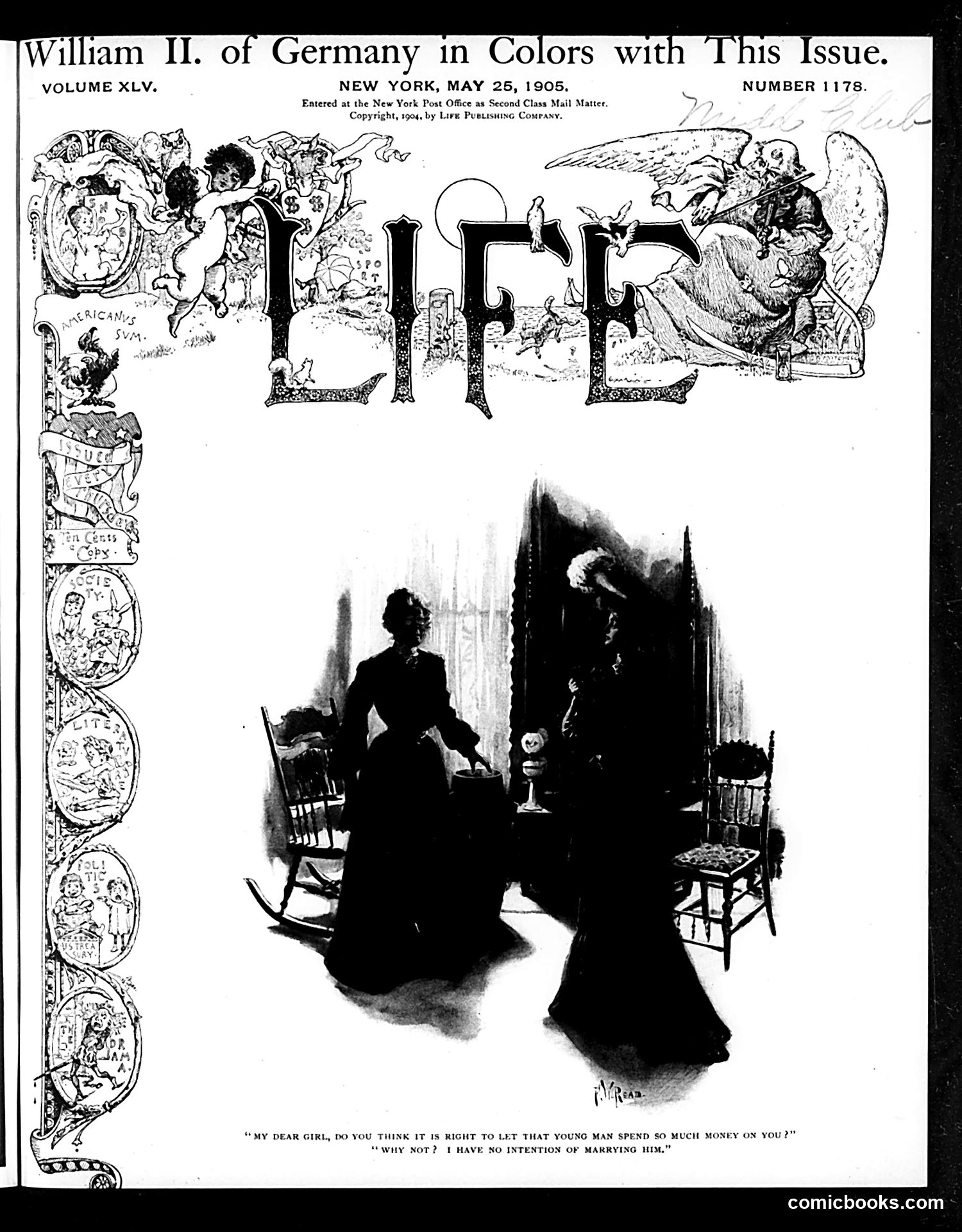
This is the cover of *Life* magazine featuring a domestic scene with satirical dialogue. Two silhouetted figures—a woman and man—sit in a parlor. The woman asks: "My dear girl, do you think it is right to let that young man spend so much money on you?" The response: "Why not? I have no intention of marrying him." The satire targets early-20th-century gender relations and courtship expectations. It mocks women who accept expensive gifts and attention from suitors without commitment, suggesting opportunistic romantic behavior. The headline promises a color feature on **William II of Germany**, the German Kaiser, though that content appears elsewhere in the issue. The ornate left border contains decorative vignettes typical of *Life*'s design.
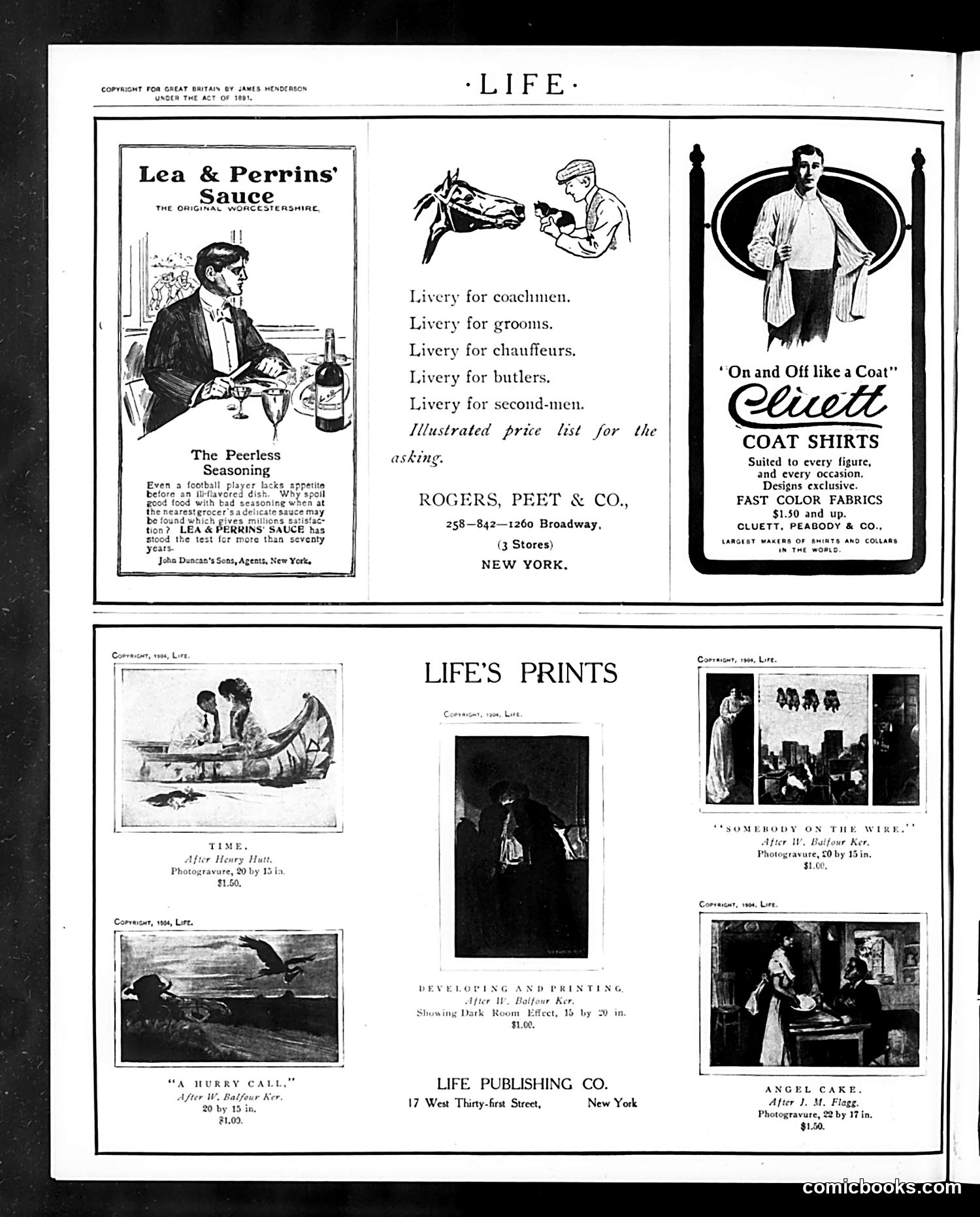
This page is primarily **advertising**, not editorial content or political cartoons. It contains three advertisements: 1. **Lea & Perrins' Sauce** — promoting their Worcestershire sauce with a man at a dining table 2. **Rogers, Peet & Co.** — advertising livery uniforms for various servant positions (coachmen, grooms, butlers, etc.) 3. **Cluett Coat Shirts** — promoting men's dress shirts 4. **Life's Prints** — the magazine's own department selling photogravure prints, including titles like "Time," "A Hurry Call," "Developing and Printing," "Somebody on the Wise," and "Angel Care" The page reflects early 20th-century consumer culture and class distinctions (note the emphasis on servant livery). There are no political cartoons or social satire present—this is a commercial page typical of Life magazine's revenue model.
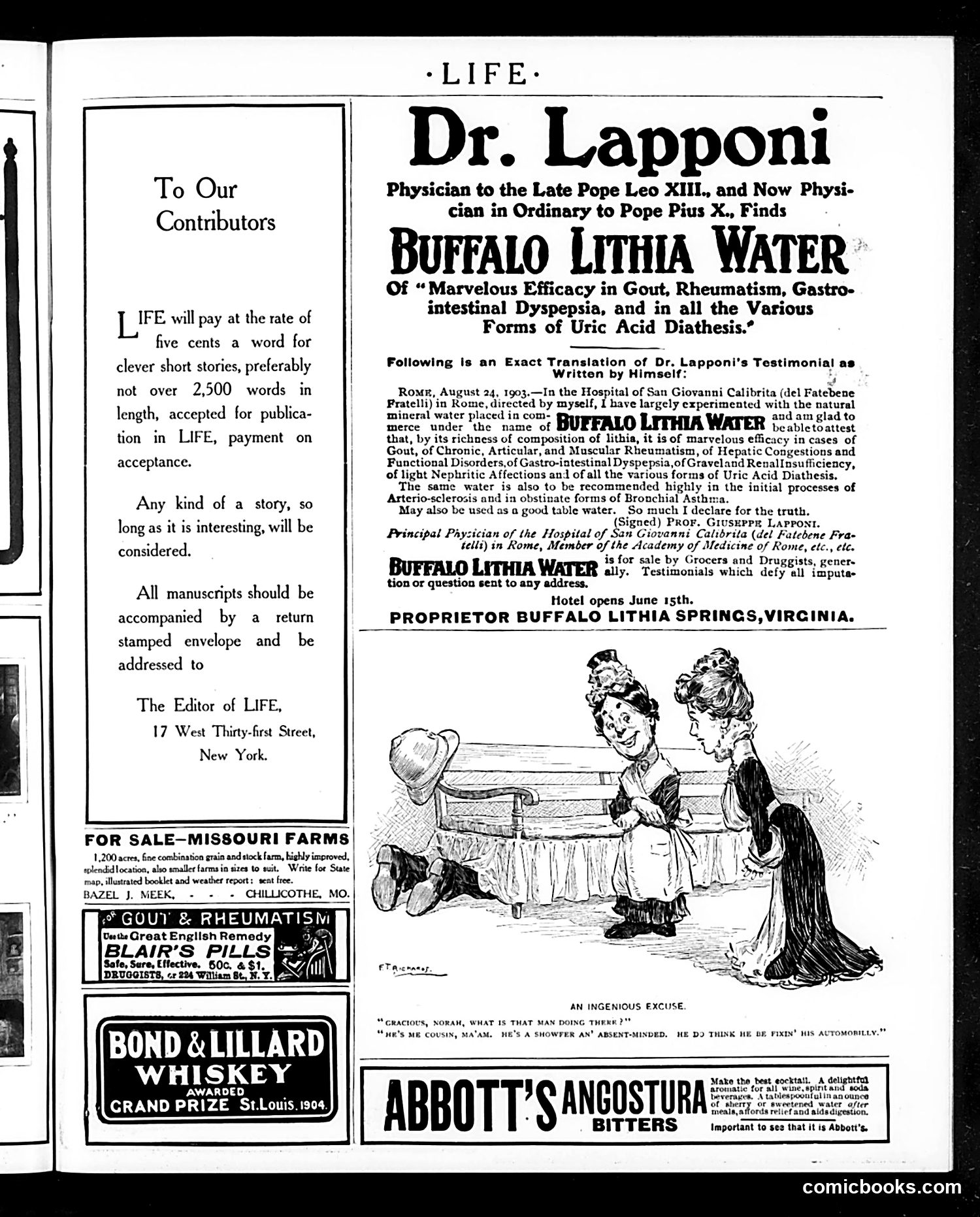
This page is **primarily advertising**, not satire or political commentary. The main content features an endorsement for "Buffalo Lithia Water" attributed to Dr. Lapponi, physician to Popes Leo XIII and Pius X. The advertisement claims the mineral water treats gout, rheumatism, and digestive disorders. It's positioned as a legitimate medical testimonial, though by modern standards such unsubstantiated health claims would be considered fraudulent marketing. The small cartoon at bottom—showing two women with a well and a man in an automobile—appears to be a separate joke about rural versus modern life, with the caption suggesting skepticism about the man's claims. However, without clearer context, its specific satirical point remains unclear. The page also advertises Missouri farms, rheumatism pills, whiskey, and bitters—typical early-1900s product placement.
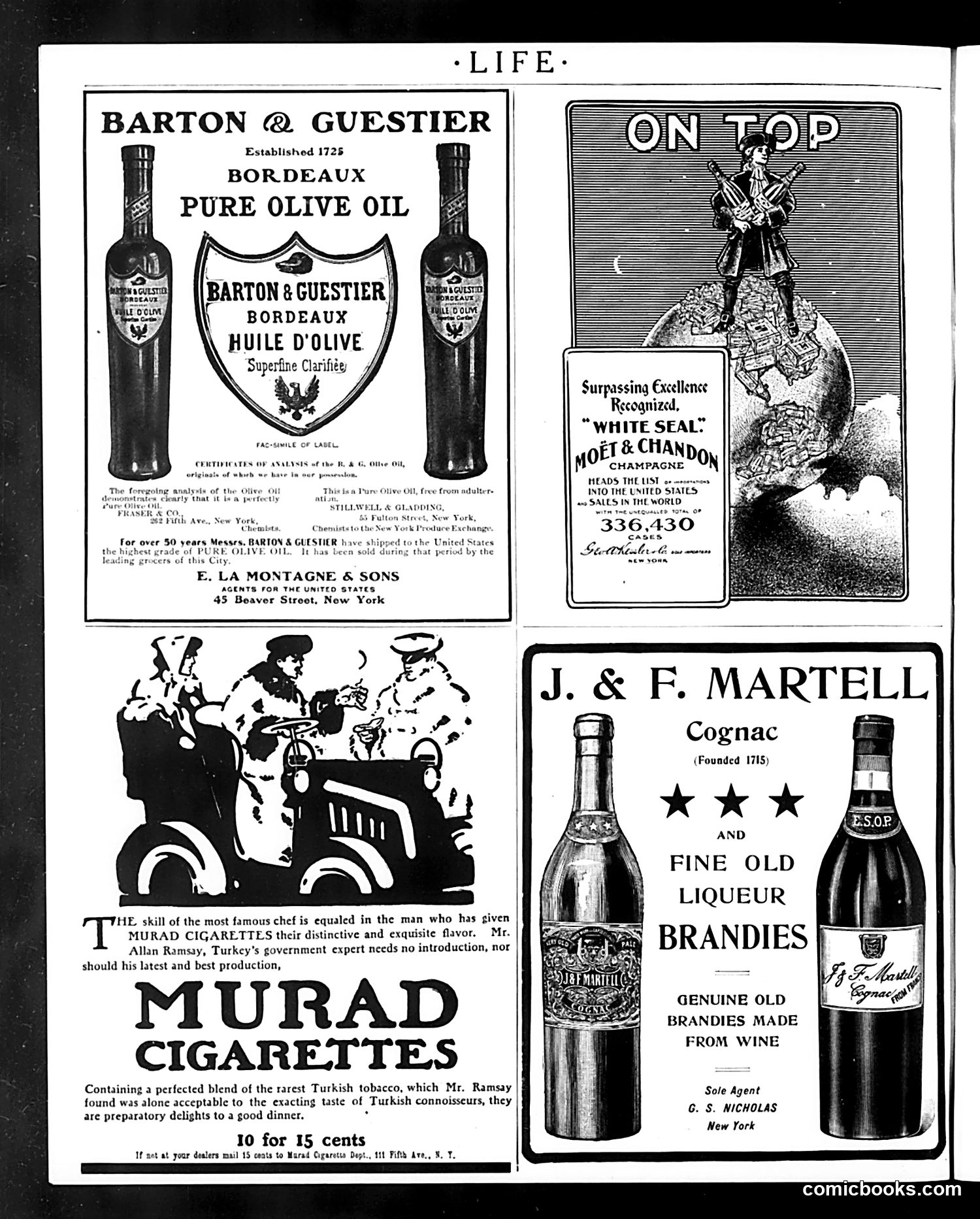
This page is primarily **advertising**, not political satire. It contains four product advertisements from the early 20th century: 1. **Barton & Guestier** (olive oil from Bordeaux) 2. **Moët & Chandon** champagne, featuring an illustration of a figure standing atop a globe 3. **Murad Cigarettes**, which includes a brief comedic text about a Turkish chef and an illustration of men in a car, concluding with the product pitch ("10 for 15 cents") 4. **J. & F. Martell** cognac and fine brandies The Murad advertisement contains the page's only satirical element—a light joke comparing culinary skill to tobacco quality—but the page is fundamentally a collection of luxury product advertisements aimed at affluent readers.
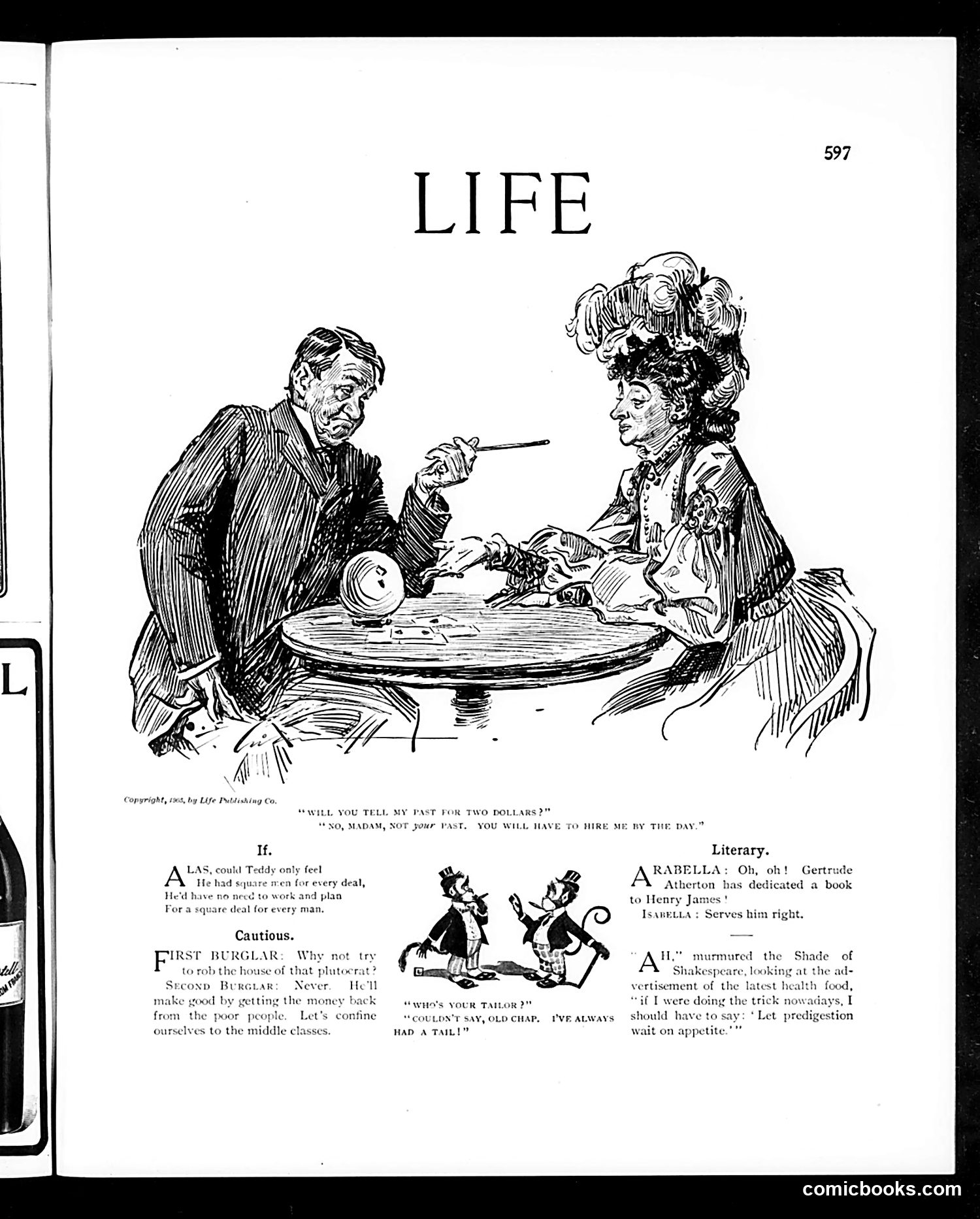
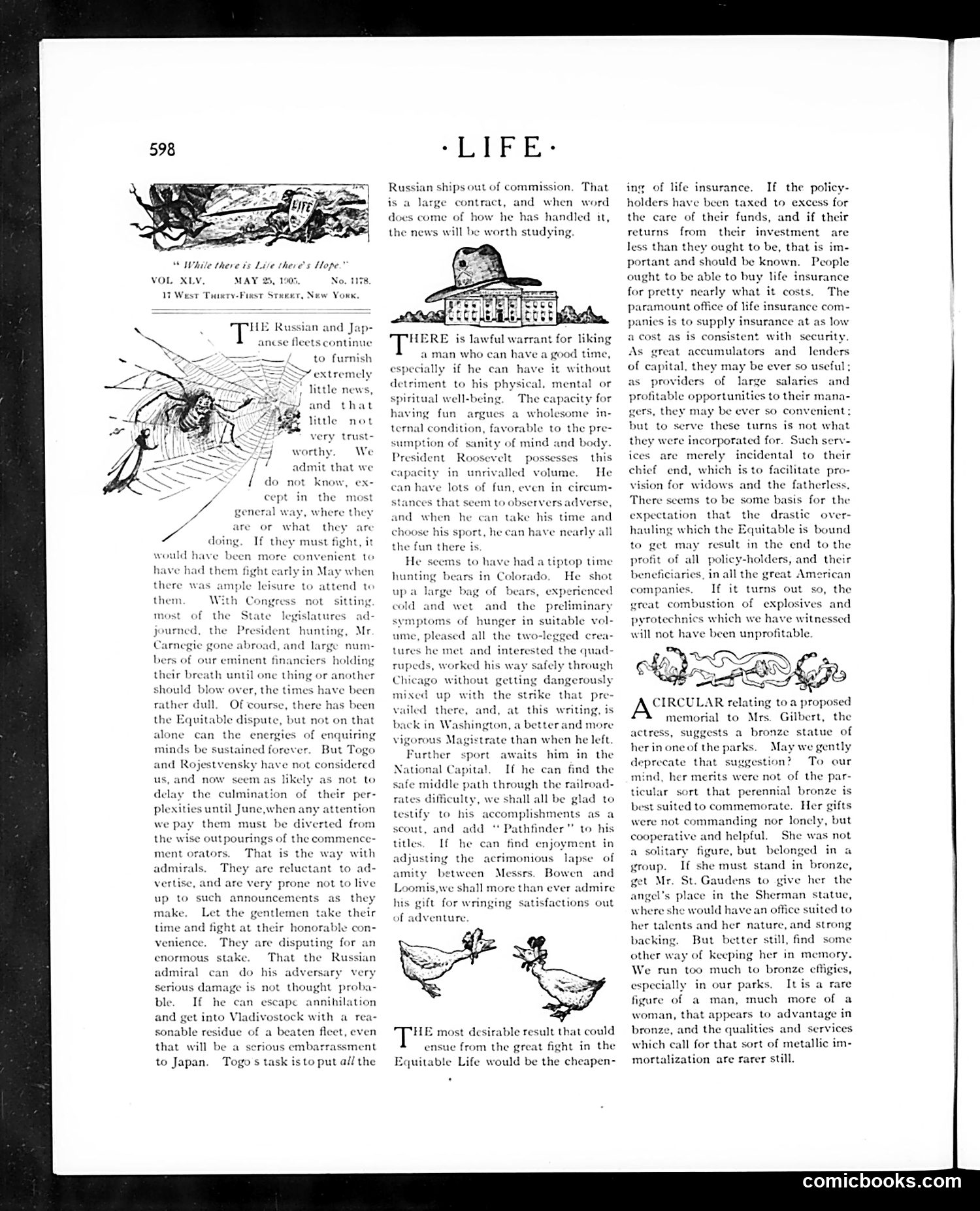
This page from Life magazine (Vol. XLV, May 25, 1905) contains editorial commentary on contemporary events rather than political cartoons. The main text discusses President Theodore Roosevelt's recent bear-hunting trip in Colorado, praising his ability to enjoy leisure and sport. It notes Roosevelt successfully hunted bears and plans further hunting in the National Capital region. The page also addresses the ongoing Russo-Japanese naval conflict, suggesting Japan's fleet poses serious embarrassment to Russian naval power and encouraging diplomatic resolution. A secondary item discusses proposals for a bronze memorial statue to actress Mrs. Gilbert, cautioning against over-reliance on bronze monuments as memorials. The decorative illustrations (birds, ships) are period ornamental elements rather than satirical cartoons.
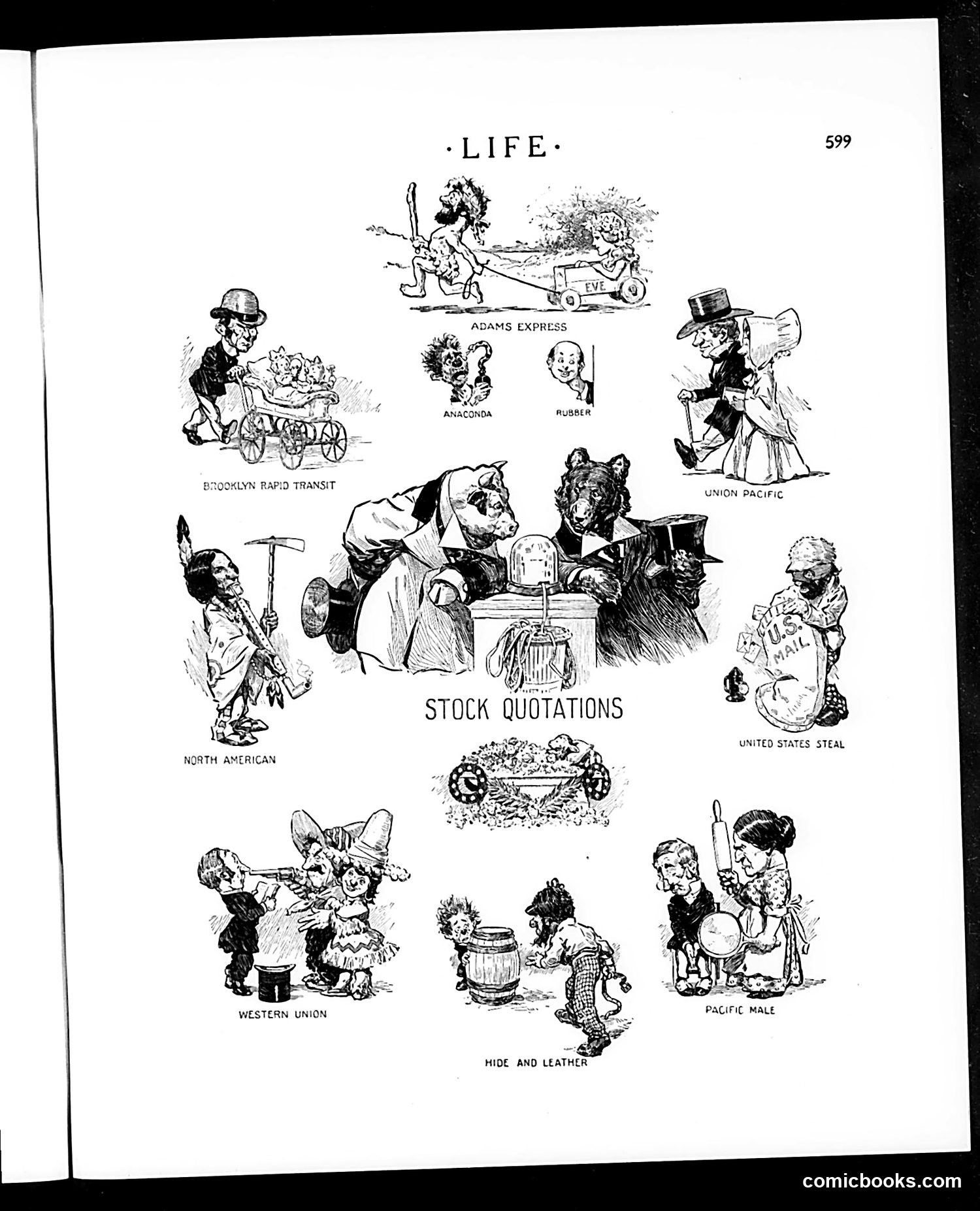
This page uses animal and human caricatures to satirize major American corporations and industries circa early 1900s. Each illustration pairs a company name with a symbolic figure: - **Adams Express, Union Pacific, Brooklyn Rapid Transit, Western Union**: Transportation companies depicted with crude, animalistic characters - **United States Steel**: Shown as a mail carrier, suggesting monopolistic reach - **North American** (likely utility company): Depicted as a Native American - **Stock Quotations** (center): Features bears and wolves in business attire, a common metaphor for aggressive speculators The satire mocks these powerful corporations as predatory animals and uncontrollable forces. The crude depictions suggest criticism of corporate power, monopolies, and their perceived threat to ordinary citizens—reflecting Progressive Era concerns about unchecked capitalism and business consolidation.
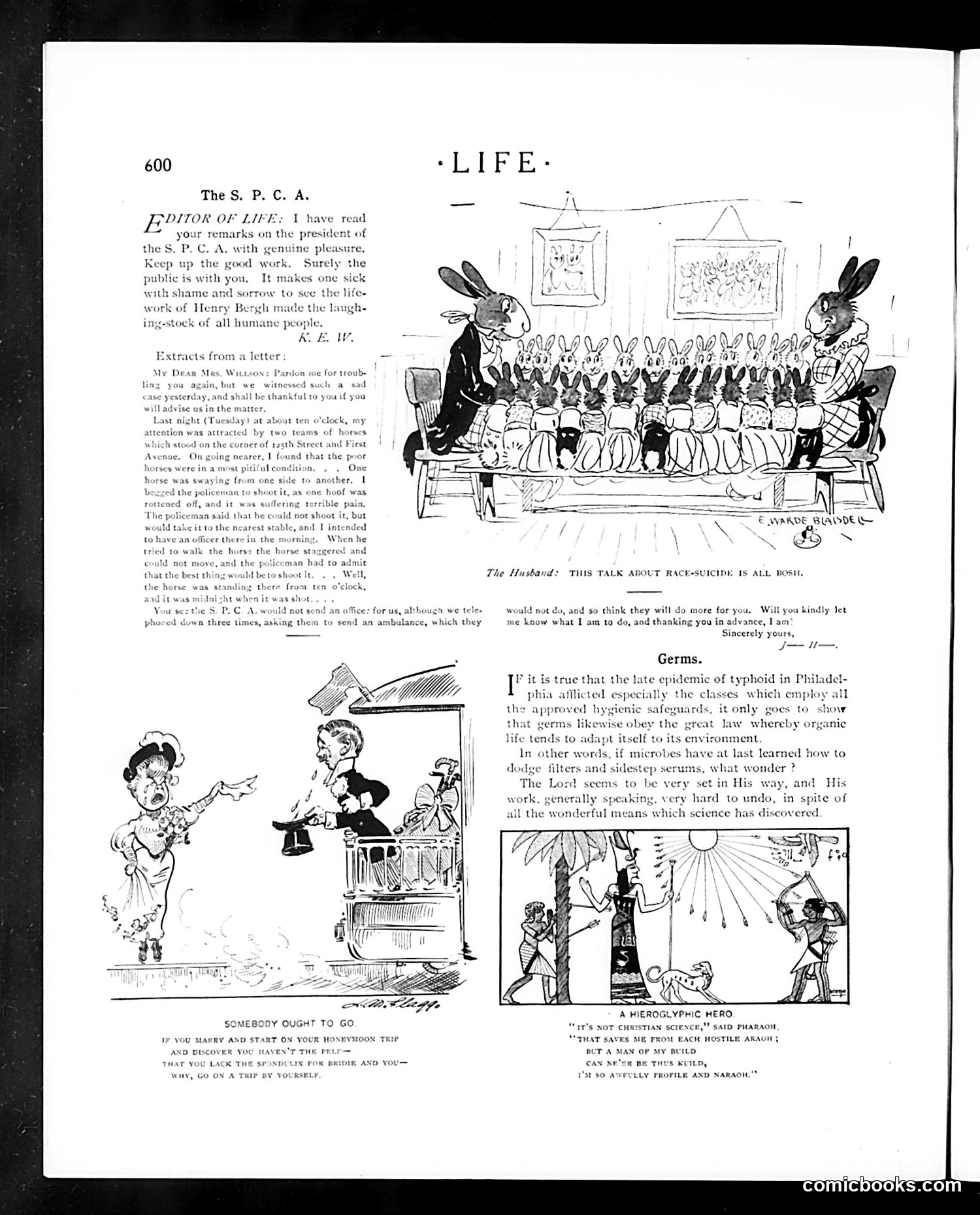
The page contains satirical commentary on the Society for the Prevention of Cruelty to Animals (S.P.C.A.). The main cartoon depicts two large rabbits hosting a dinner party for dozens of smaller rabbits, with the caption referencing "race-suicide" — a contemporary concern about declining birth rates among certain populations. Below, "Somebody Ought to Go" shows a couple with luggage, mocking honeymoon culture and the expectation that newlyweds must travel. The "Germs" section discusses typhoid epidemics in Philadelphia, illustrating how microbes adapt to sanitary conditions. The final cartoon, "A Hieroglyphic Hero," parodies Pharaonic imagery while discussing disease prevention through hygiene rather than religious intervention. Overall, the page reflects early 20th-century anxieties about public health, social behavior, and scientific progress.
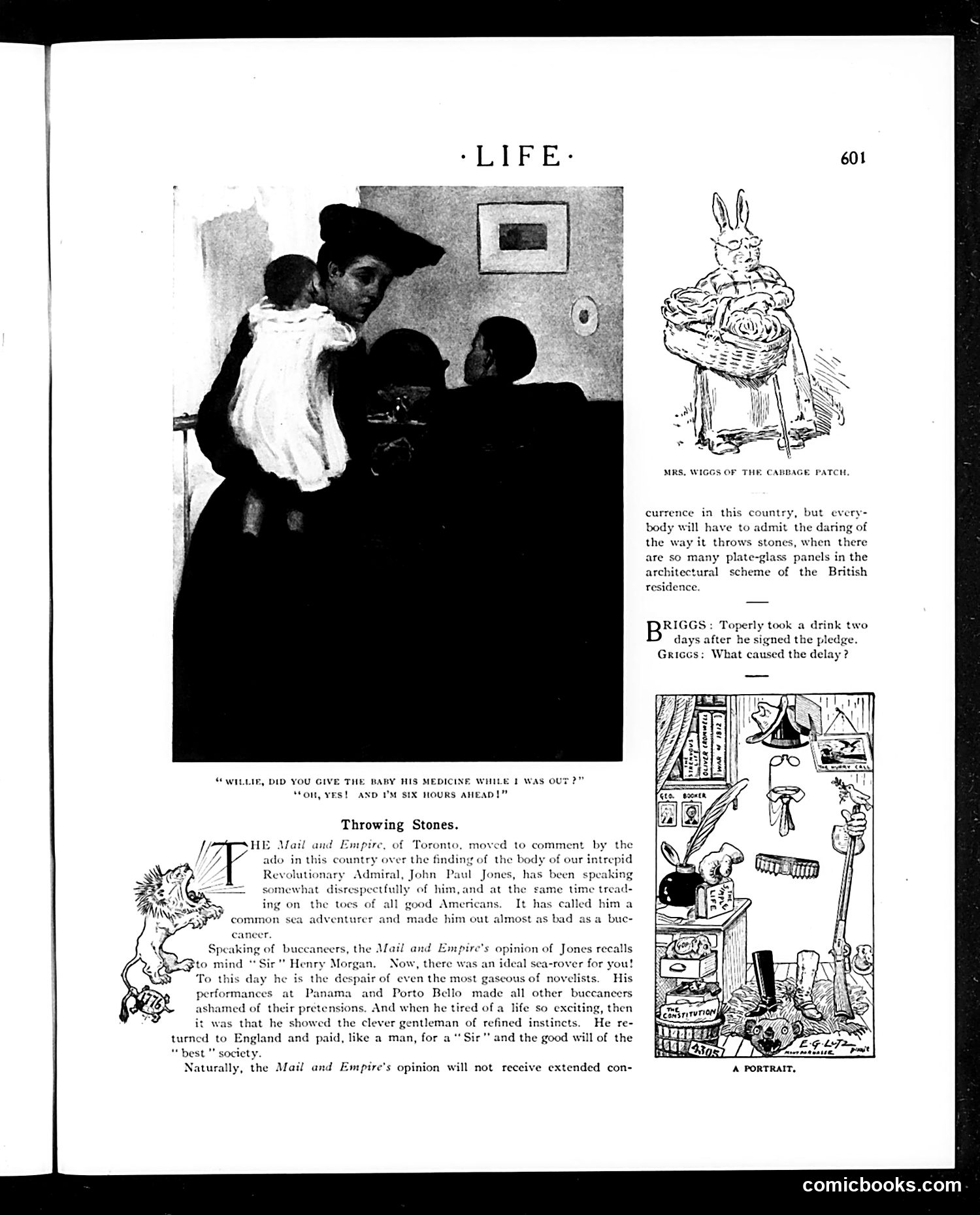
This page satirizes **Admiral John Paul Jones**, the Revolutionary War figure. The *Mail and Empire* (a Toronto newspaper) had praised Jones as a "common sea adventurer" while disparaging **Henry Morgan** (the famous pirate/privateer) as inferior. Life's satire mocks this comparison, noting that Morgan's exploits—attacking Panama and Porto Bello—actually exceeded Jones's achievements. The joke is that Jones is celebrated as a "gentleman of refined instincts" in England while Morgan is condemned, despite Morgan's greater daring. Life criticizes this double standard: why lionize one adventurer while scorning another? The accompanying photograph and cartoon labeled "A Portrait" and "Mrs. Wiggs of the Cabbage Patch" appear unrelated to the main article's argument about historical reputation and bias.
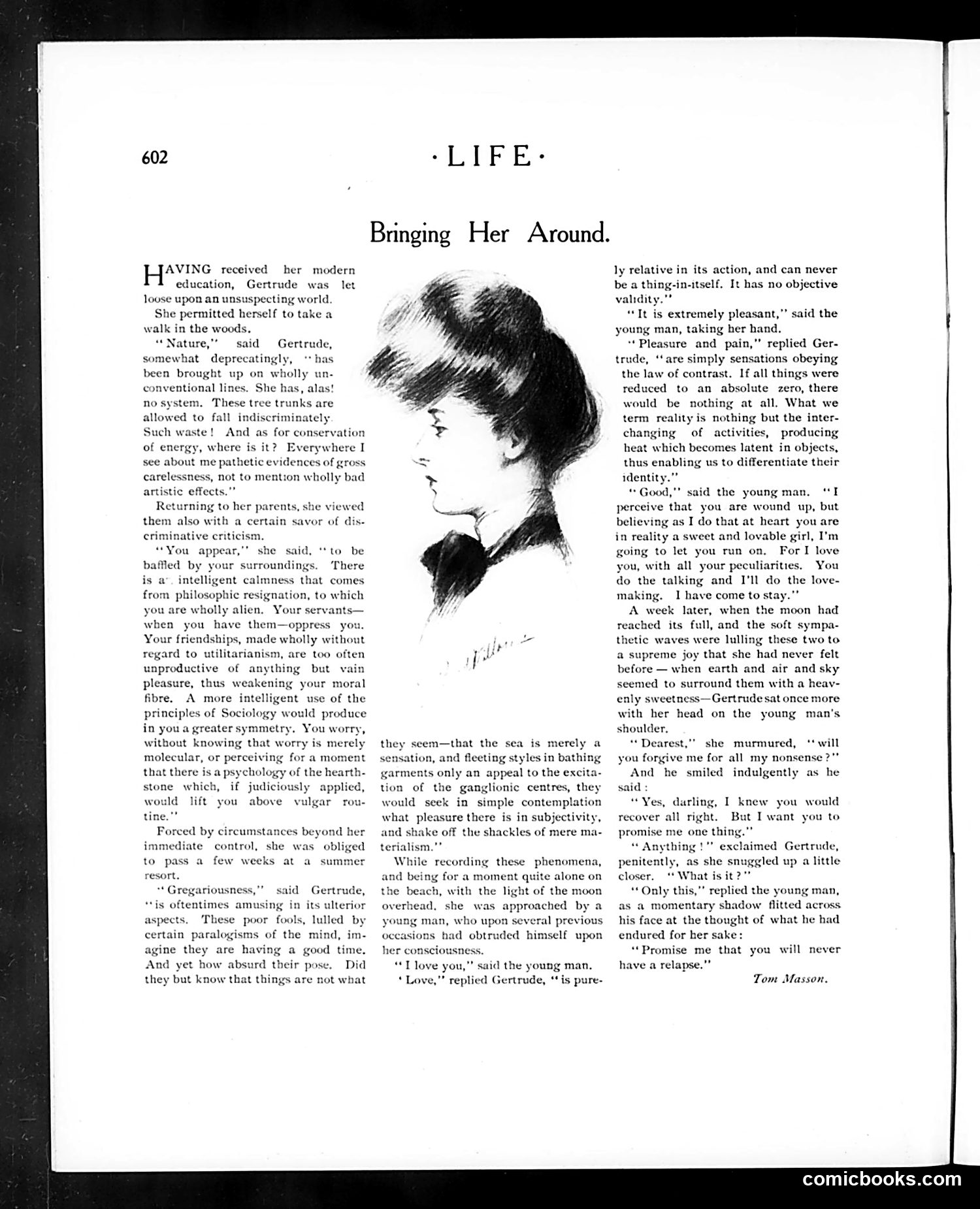
This page from *Life* magazine presents a literary story rather than political satire. The narrative concerns Gertrude, a young woman with a modern education who adopts an unconventional, somewhat dismissive attitude toward her surroundings and conventional life. The illustration shows her profile in a contemplative pose. The text depicts a romantic subplot where a young man attempts to "bring her around" from her philosophical detachment—her belief that pleasure and pain are merely sensations with no objective meaning. The story explores early 20th-century tensions between modern intellectualism and traditional romanticism. Gertrude's sophisticated but cold worldview is gradually softened by emotional connection, illustrating a common *Life* magazine theme: the clash between cerebral modernity and human sentiment. The author is identified as Tom Masson.
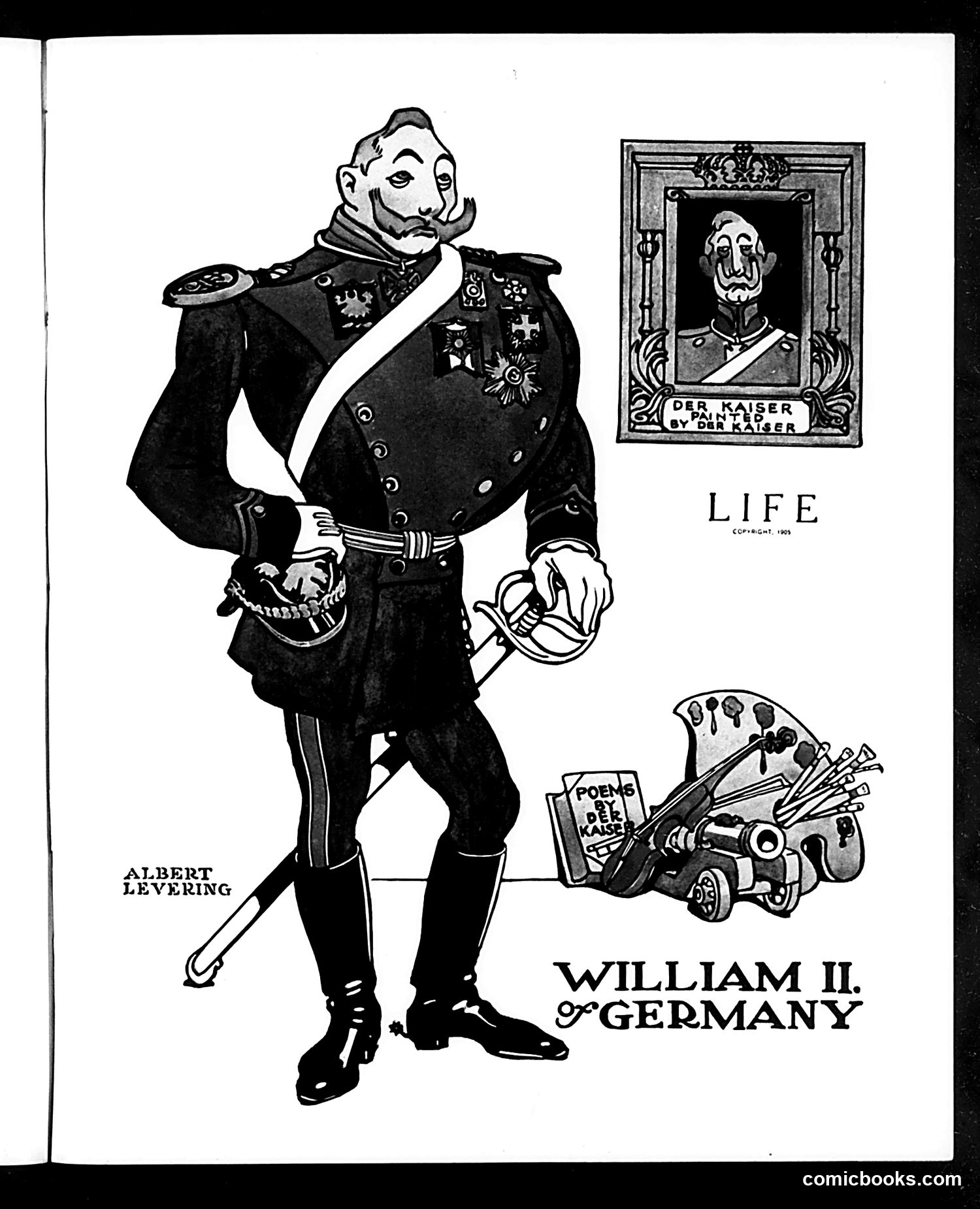
This is a satirical illustration by Albert Levering from *Life* magazine (copyright 1903) depicting German Kaiser Wilhelm II as a militaristic autocrat. The caricature emphasizes his exaggerated facial features and shows him in full military regalia with medals and insignia, holding a sword. The surrounding elements mock German militarism: a framed portrait labeled "Der Kaiser" hangs above, while at his feet lie scattered items including a book labeled "Poems by der Kaiser" and military supplies/weapons, suggesting his pretensions to both artistic and martial greatness. The satire critiques Wilhelm II's aggressive militarism and autocratic rule during Germany's expansionist period in the early 1900s, mocking the Kaiser's self-importance and Germany's military ambitions.

I can see this is a blank or nearly blank page from what appears to be a historical publication, with only "comicbooks.com" visible in the bottom right corner. The page shows a white/blank interior with dark borders typical of a scanned book or magazine page. Without visible cartoon content, text, or illustrations to analyze, I cannot identify any figures, political references, or satirical commentary. The page appears to be either a title page, blank filler page, or the image quality/scanning may have resulted in the content not being captured clearly enough to discern any material worthy of historical analysis. To provide meaningful historical context about the cartoons or content, I would need a page with visible illustrations, captions, or article text.
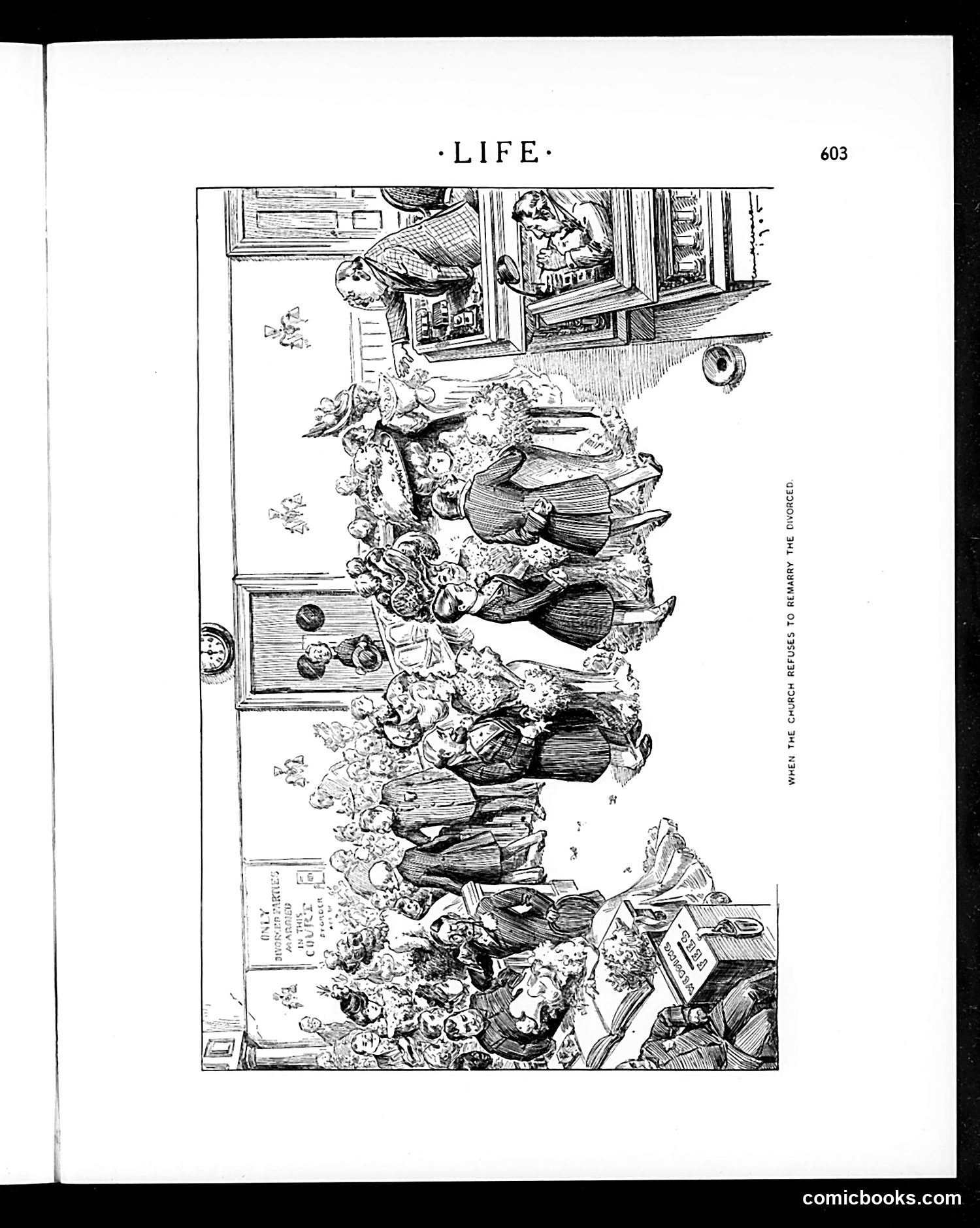
This is a satirical cartoon about divorce and religious institutions. The caption "When the Church Refuses to Remarry the Divorced" indicates the subject: a divorced person seeking remarriage through the church but being denied. The image shows what appears to be a crowded church interior with multiple figures. The visual humor seems to depend on depicting the consequences or awkwardness of this refusal—likely showing the divorced person's frustration or the church's stern rejection. The satire targets the church's strict stance on remarriage of divorced persons, which was (and remains) a significant religious and social issue. The joke criticizes institutional rigidity around divorce, a topic of ongoing social debate in early-to-mid 20th century America. Without clearer visibility of specific caricatured individuals, I cannot identify particular church figures or politicians referenced.
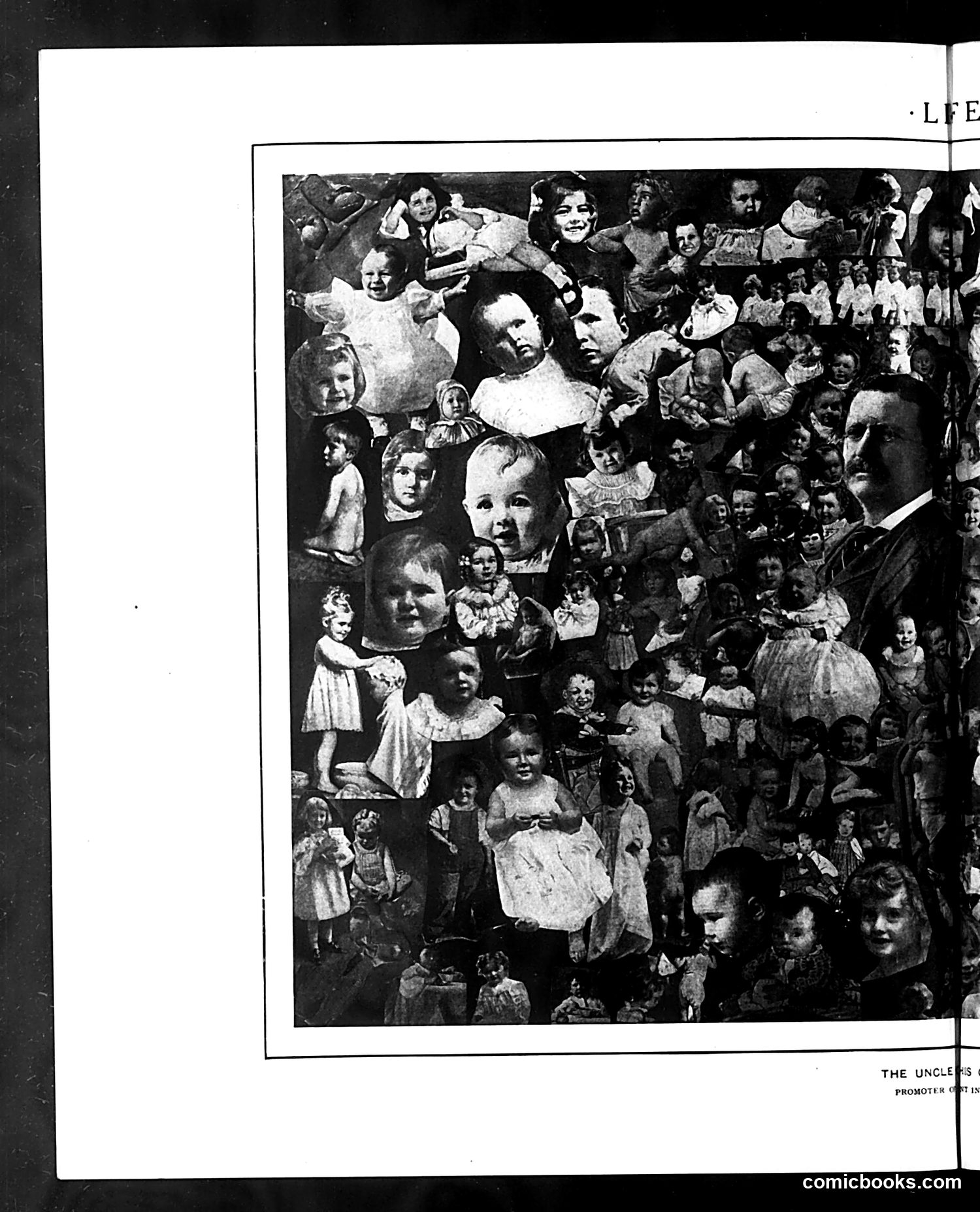
This page from *Life* magazine shows a composite photograph titled "THE UNCLE'S [text cut off] PROMOTED [text cut off]" featuring dozens of children's faces of varying ages arranged together. The image appears to be satirizing someone's family connections or nepotism—the title's reference to an "uncle" being "promoted" suggests the cartoon critiques favoring relatives for advancement through family connections rather than merit. The crowded arrangement of so many young faces may emphasize the absurdity of such preferential treatment or the extent of family influence. Without the complete caption or date visible, the specific target of this satire remains unclear, though it represents *Life's* typical criticism of political or social corruption involving family advancement.
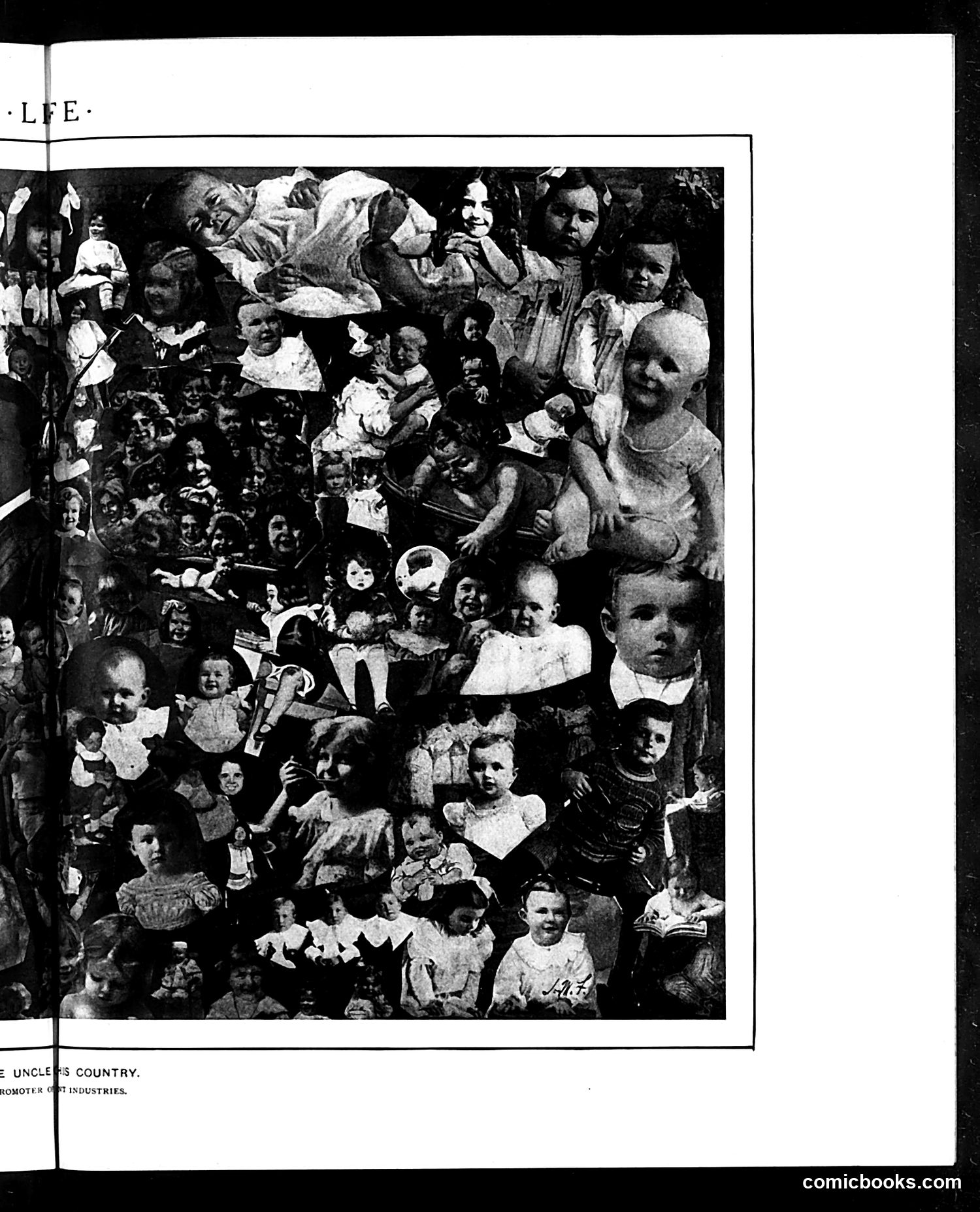
This page from *Life* magazine shows a densely packed composition of numerous children and babies of various ages, dressed in period clothing (appearing to be early 20th century). The OCR text is too fragmentary to read clearly, though it appears to reference "Uncle's country" and "industries." Without complete text visible, the exact satirical point remains unclear. However, the composition's emphasis on sheer quantity of children—crowded together tightly—likely comments on either: population growth, child labor in American industries, immigration and overpopulation, or rapid industrialization's effects on families. The formal presentation suggests social commentary rather than humor, possibly critiquing conditions affecting children in the era. The specific political/social target cannot be determined with confidence from the visible image alone.
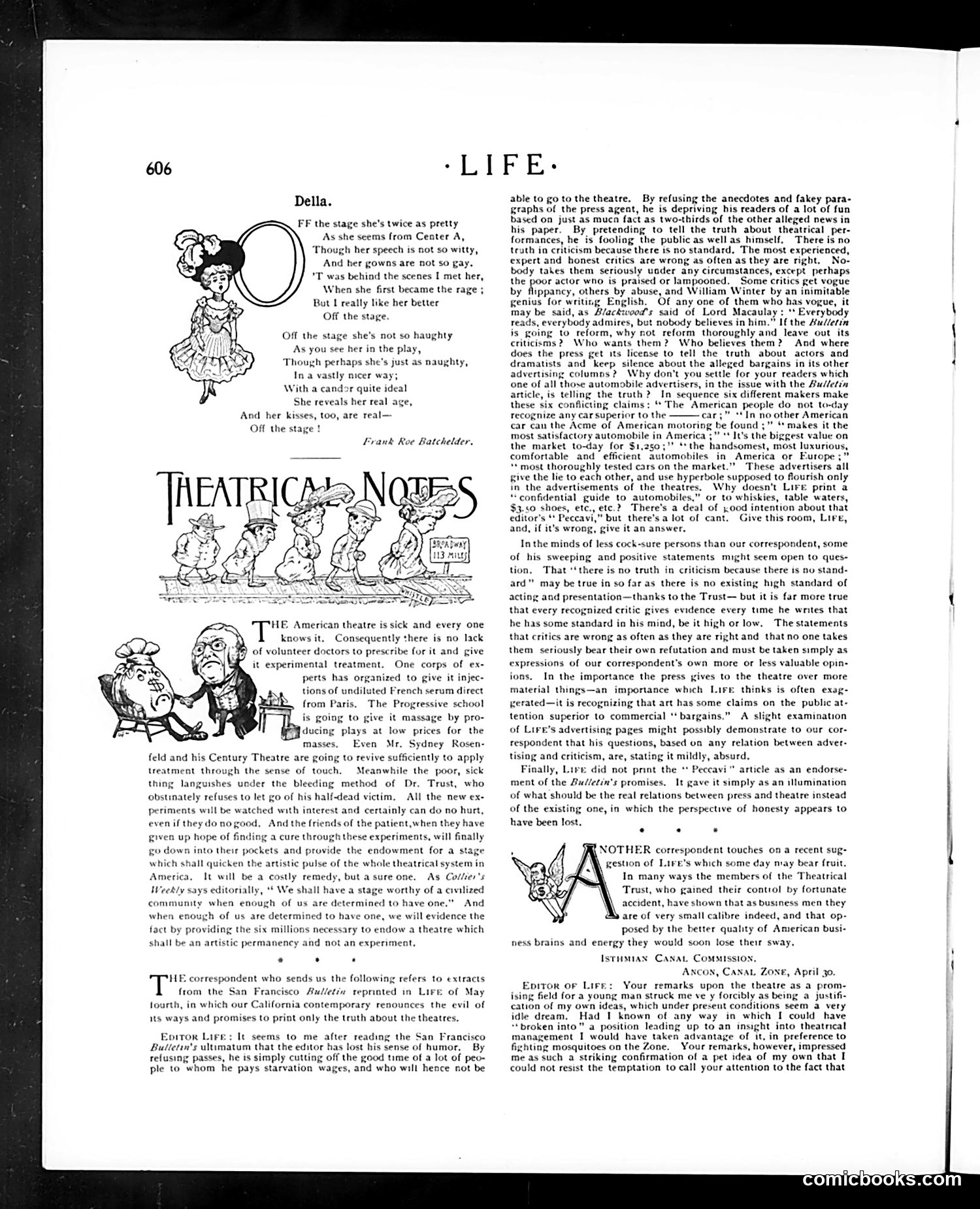
This page contains **literary and editorial commentary on American theater** circa early 1900s, not political cartoons. The poem "Della" by Frank Roe Batchelder contrasts actresses' public versus private personas—they're prettier and more genuine offstage than their theatrical performances suggest. The editorial discusses the theater's financial and artistic decline, proposing various "cures": French theatrical innovations, low-price progressive productions, and ultimately a government-endowed theater requiring $6 million in funding. A San Francisco *Bulletin* editor's pledge to print only truth about theater sparks a critical response: the correspondent argues critics lack authority (no objective standard exists), that theater criticism is merely subjective opinion-mongering, and that the editor's self-righteousness ignores that readers enjoy theatrical press releases and gossip regardless of truthfulness. The satire targets both theatrical pretension and journalistic hypocrisy about truth-telling.
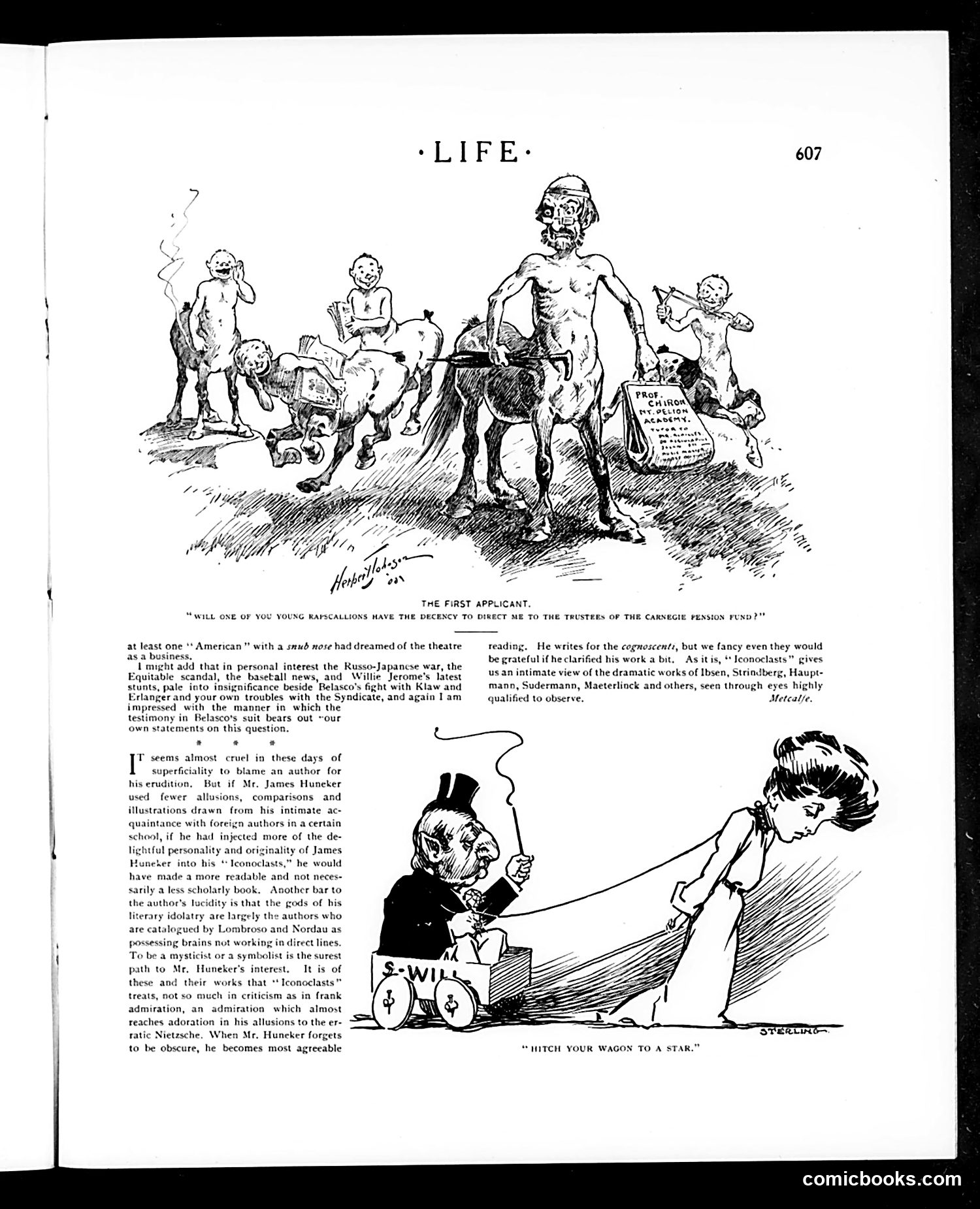
The page contains two cartoons satirizing aspirational ambition and erudite pretension in early 1900s America. **Top cartoon**: Depicts ragged children approaching a wealthy man, asking directions to the "Carnegie Pension Fund." This mocks the gap between Andrew Carnegie's philanthropic reputation and actual access to his wealth—suggesting his charity remains distant and inaccessible to the desperately poor. **Bottom cartoon** ("Hitch Your Wagon to a Star"): Shows a small man in a wagon being pulled by a woman. This appears to satirize artistic or social climbers who rely on others (particularly women) to advance their ambitions through aspirational ideals rather than genuine effort. The accompanying text critiques author James Huneker's book *Iconoclasts* for excessive obscure literary allusions and affected erudition, arguing his pretentious references to European symbolists and Nietzsche obscure rather than clarify his work. The overall theme: authentic achievement requires clarity and genuine effort, not fashionable obscurity or riding on others' coattails.
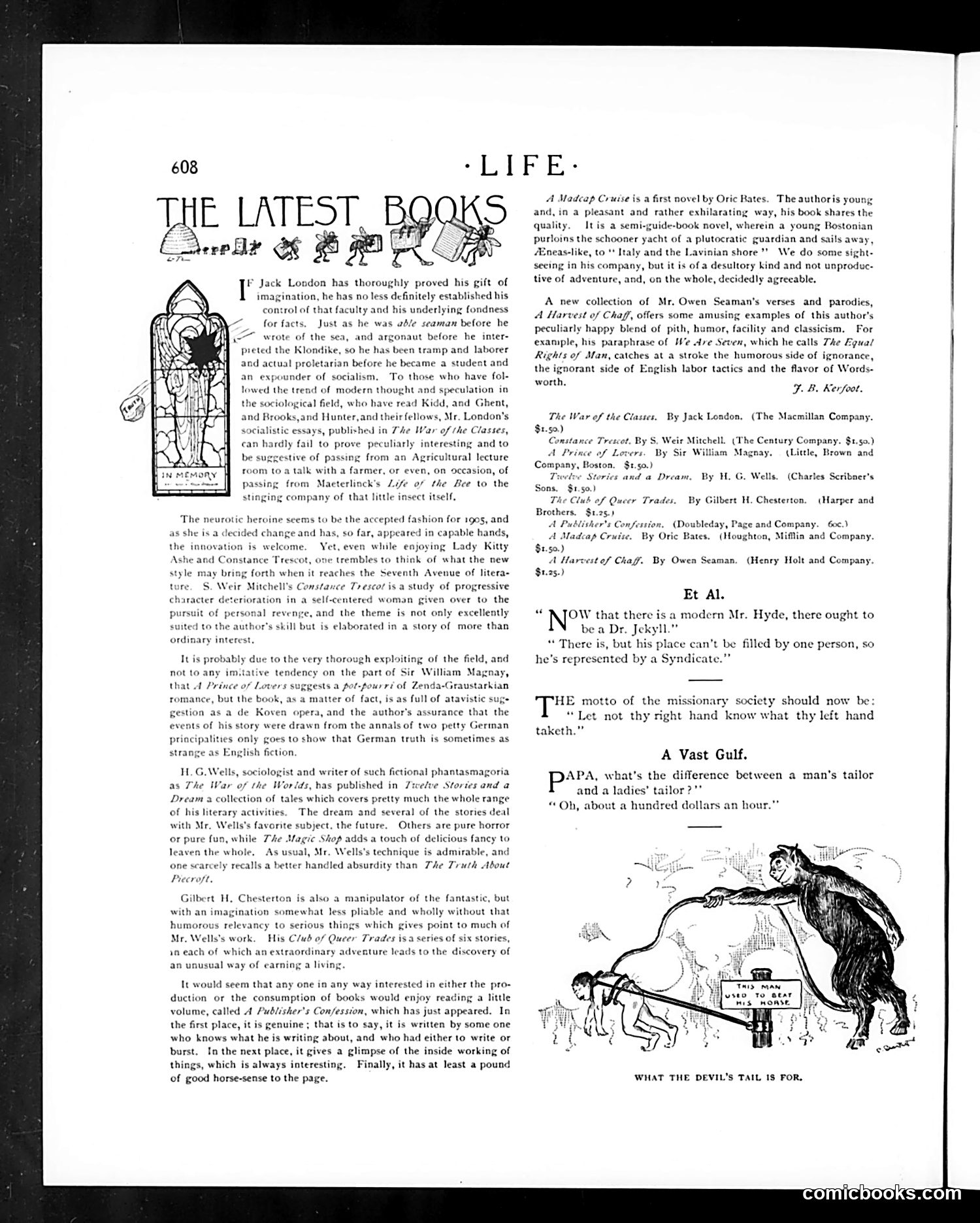
This is a literary review section discussing contemporary novels from around 1905. The page critiques works by Jack London, emphasizing his credibility as a socialist writer because he'd actually lived as a laborer and seaman before writing about such subjects. The reviews also note a trend: the "neurotic heroine" has become fashionable in 1905 literature, exemplified by S. Weir Mitchell's *Constance Trescot*. The critic expresses mild concern this trend could spread to lower-quality writers. **The cartoon** (titled "What the Devil's Tail Is For") depicts a devil using his tail as a whip on a prone figure, likely satirizing publishing or literary criticism itself—perhaps suggesting publishers or critics use harsh tactics. The page reflects early 20th-century intellectual culture: serious engagement with socialism, fascination with H.G. Wells's speculative fiction, and debate over literary fashions and character types.
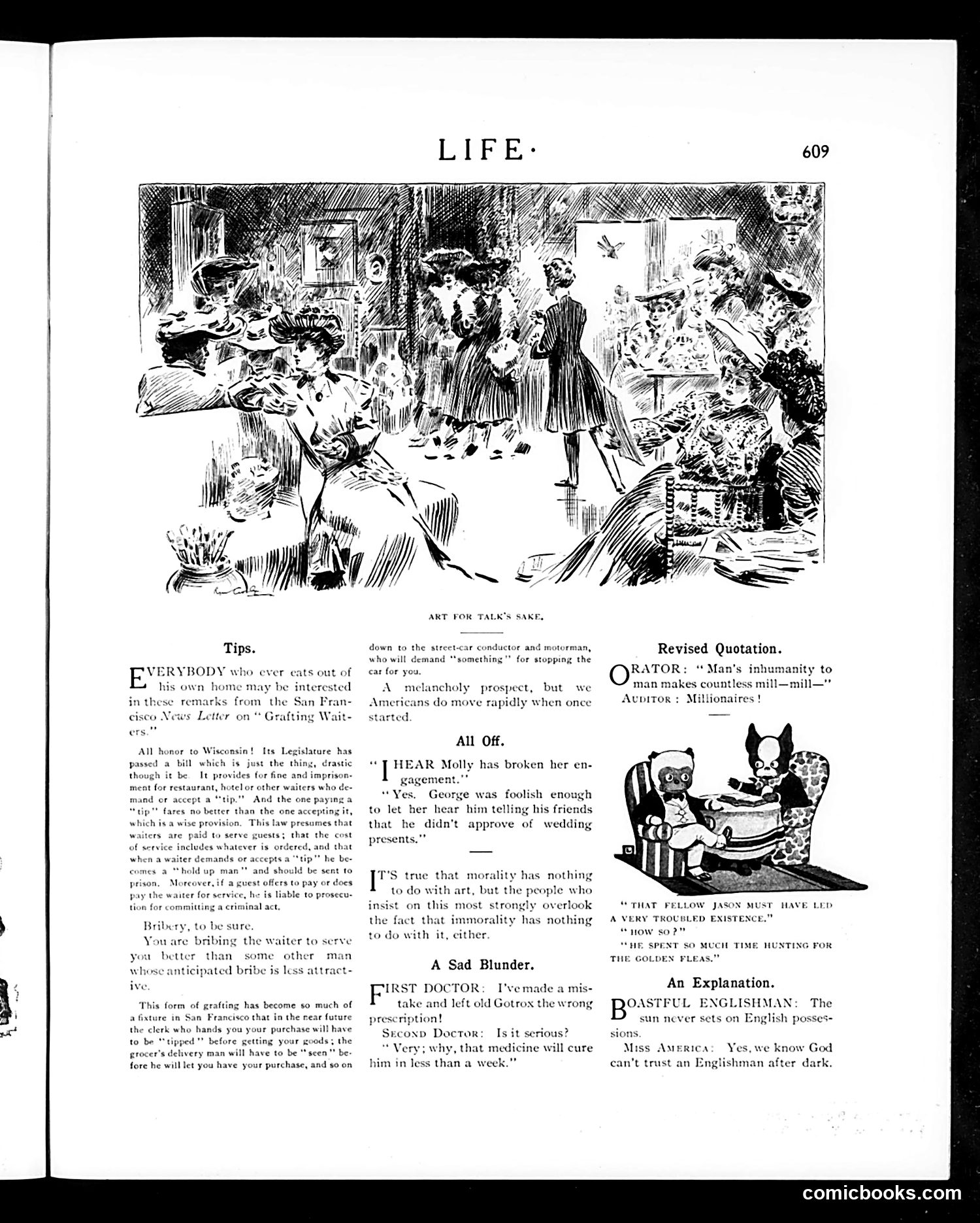
This page contains several brief satirical jokes typical of early 20th-century American humor: **"Tips"** criticizes the San Francisco practice of mandatory tipping at restaurants and service establishments. The satire suggests this has become so normalized that it will eventually extend to all transactions—streetcar conductors, grocery delivery men, etc.—making it indistinguishable from extortion or bribery. **"All Off"** jokes about broken engagements: a man loses his fiancée after she overhears him disapproving of wedding gifts. **"A Sad Blunder"** features doctors discussing a prescription error that paradoxically benefits the patient by actually curing him. **"Revised Quotation"** mocks wealth inequality by modifying the famous Burns poem line about human cruelty to suggest "millionaires" instead of "man." **"An Explanation"** contains a dig at British imperialism: an Englishman boasts the sun never sets on British possessions; Miss America responds that God simply doesn't trust the English after dark.
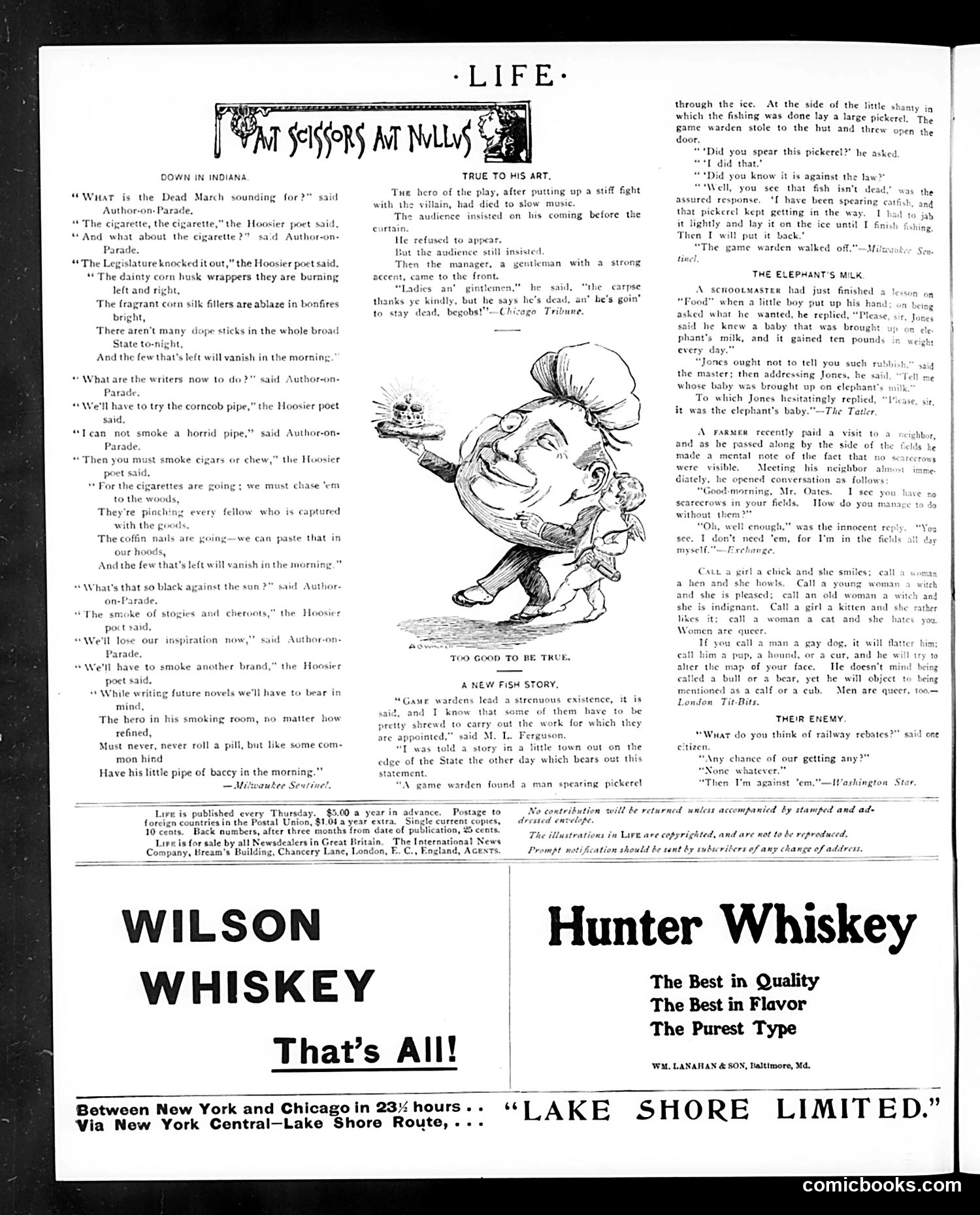
This page satirizes **Indiana's prohibition of cigarettes**, a real 1900s legislative action. The cartoon frames this as absurd censorship affecting writers and artists. **The satire:** - An "Author-on-Parade" and a "Hoosier poet" discuss Indiana's cigarette ban - They joke that writers must now smoke corn husks, corncobs, or cigars instead - The implication: censoring a common vice destroys artistic inspiration and creative life - The cartoon ridicules the legislature's paternalism as naive and unenforceable **Social context:** Early 20th-century America saw various state-level tobacco restrictions (cigarettes were seen as particularly corrupting). *Life* magazine, as a satirical publication, mocked such moral legislation as both ineffective and damaging to personal freedom and culture. The page also includes unrelated humorous anecdotes ("Too Good to Be True," "The Elephant's Milk") typical of *Life*'s format, plus period whiskey advertisements.
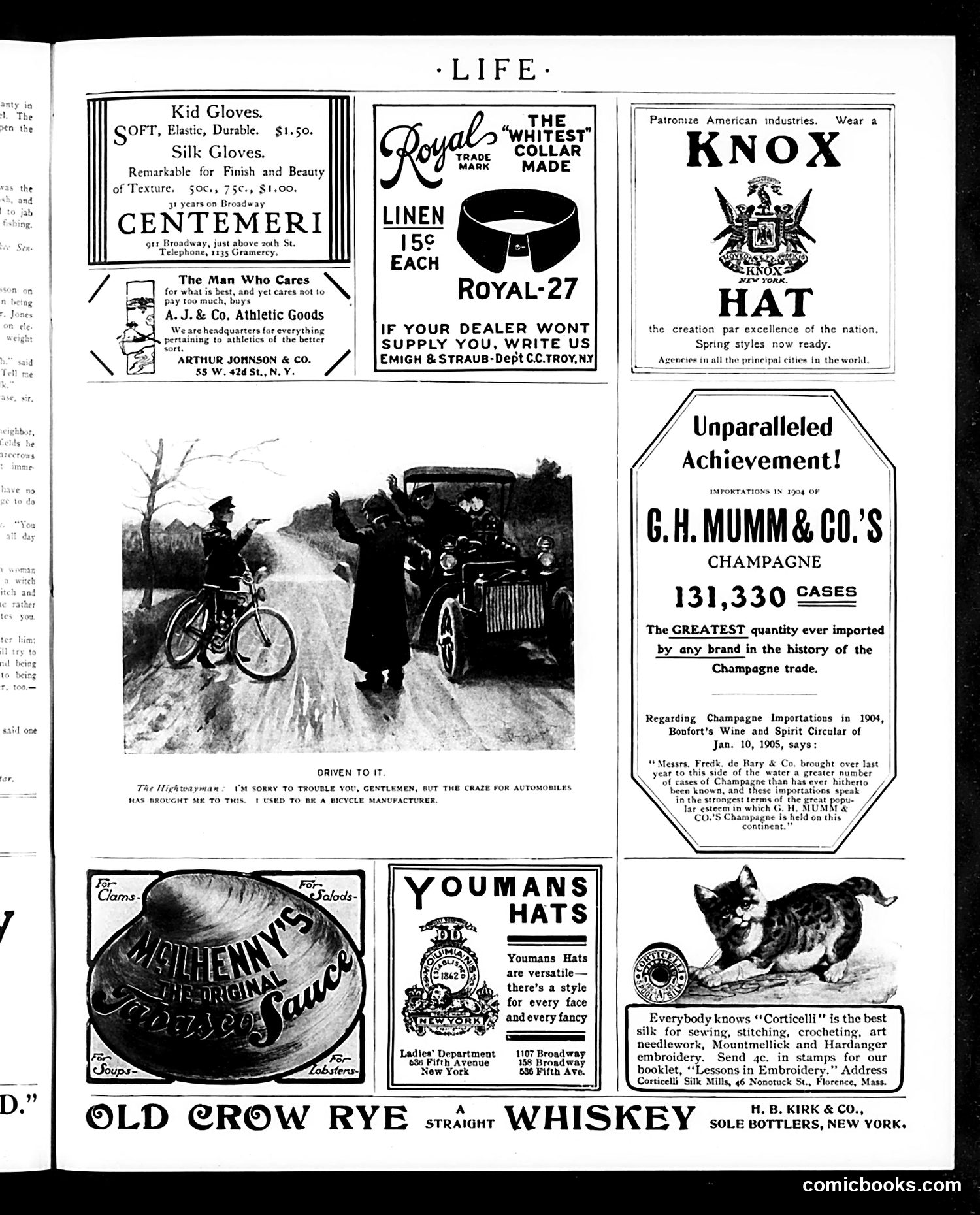
The central cartoon shows a former bicycle manufacturer, now reduced to begging on a roadside, apologizing to motorists for his presence. A car and cyclist pass by; the man explains he "used to be a bicycle manufacturer" but "the craze for automobiles has brought me to this." The satire targets the rapid technological displacement of the 1900s. The bicycle industry, once thriving, was being obliterated by the automobile boom. Life magazine is mocking both the speed of this economic upheaval and the callousness toward workers left behind—the man must apologize for his own obsolescence. This reflects genuine anxiety about industrial change during the Progressive Era, when new technologies routinely destroyed entire trades overnight, leaving skilled workers destitute with no social safety net. The joke's dark edge comes from presenting this catastrophe as almost comedic inevitability. The page is otherwise advertisements for luxury goods—hats, champagne, whiskey—highlighting the ironic juxtaposition: while some industries boom, others collapse completely.
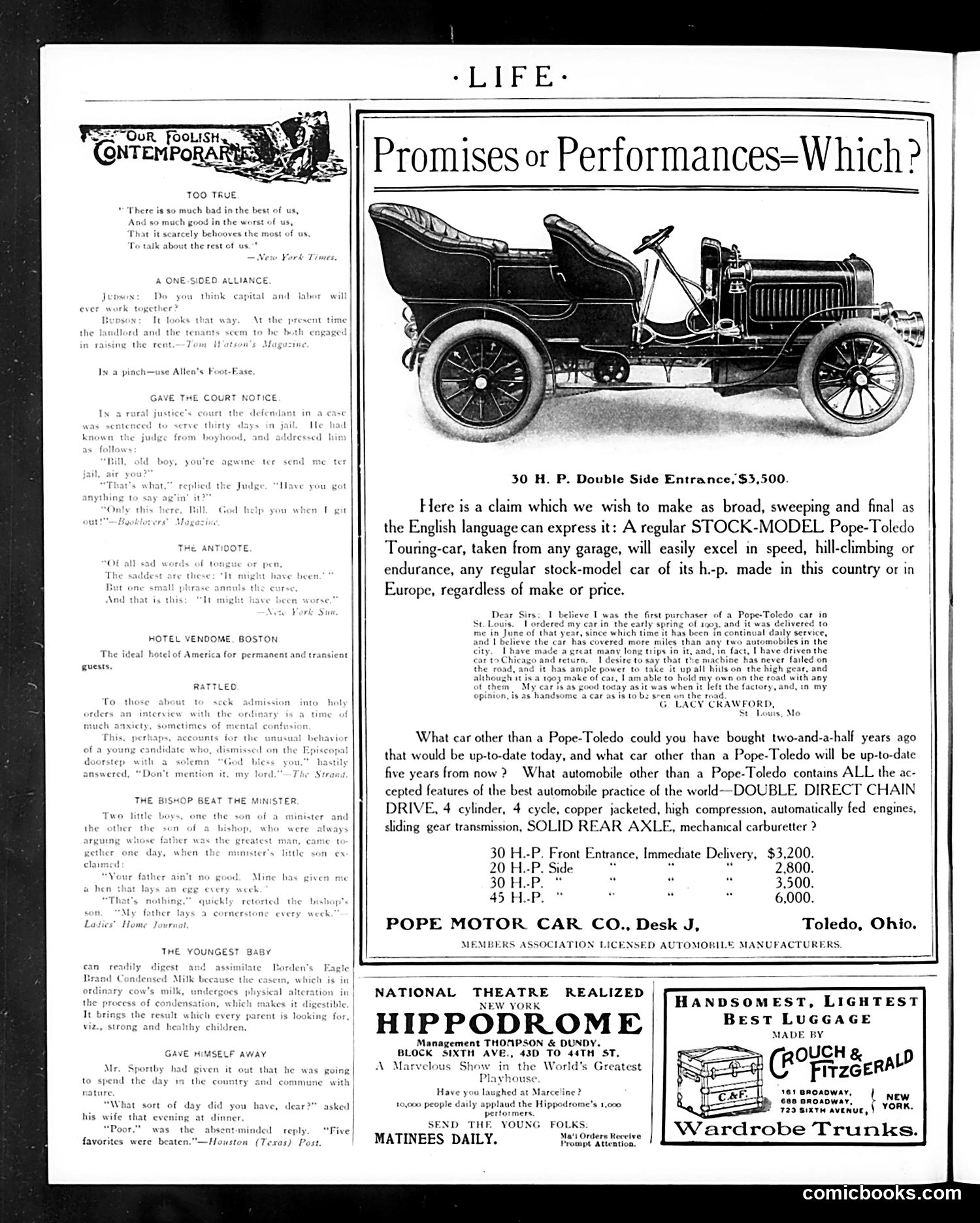
This page is primarily **advertising**, not political satire. The main content is a Pope-Toledo automobile advertisement claiming their cars excel in speed and durability compared to competitors—a boastful marketing claim typical of early 1900s auto industry competition. The left column contains brief humorous anecdotes under the "Our Foolish Contemporaries" rubric—Life's regular feature mocking foolish public statements or behaviors. These appear to be social commentary on everyday absurdities (a judge's ignorant remark, a child's innocent observation about a minister) rather than political satire. The bottom half features advertisements for the Hippodrome theatre, Crouch & Fitzgerald luggage, and wardrobe trunks. **Key context for modern readers**: This reflects the early automobile era's competitive marketing and Life's dual role as both satirical magazine and advertising vehicle. The "foolish contemporaries" feature represents genteel, apolitical humor about human foibles rather than sharp political commentary.
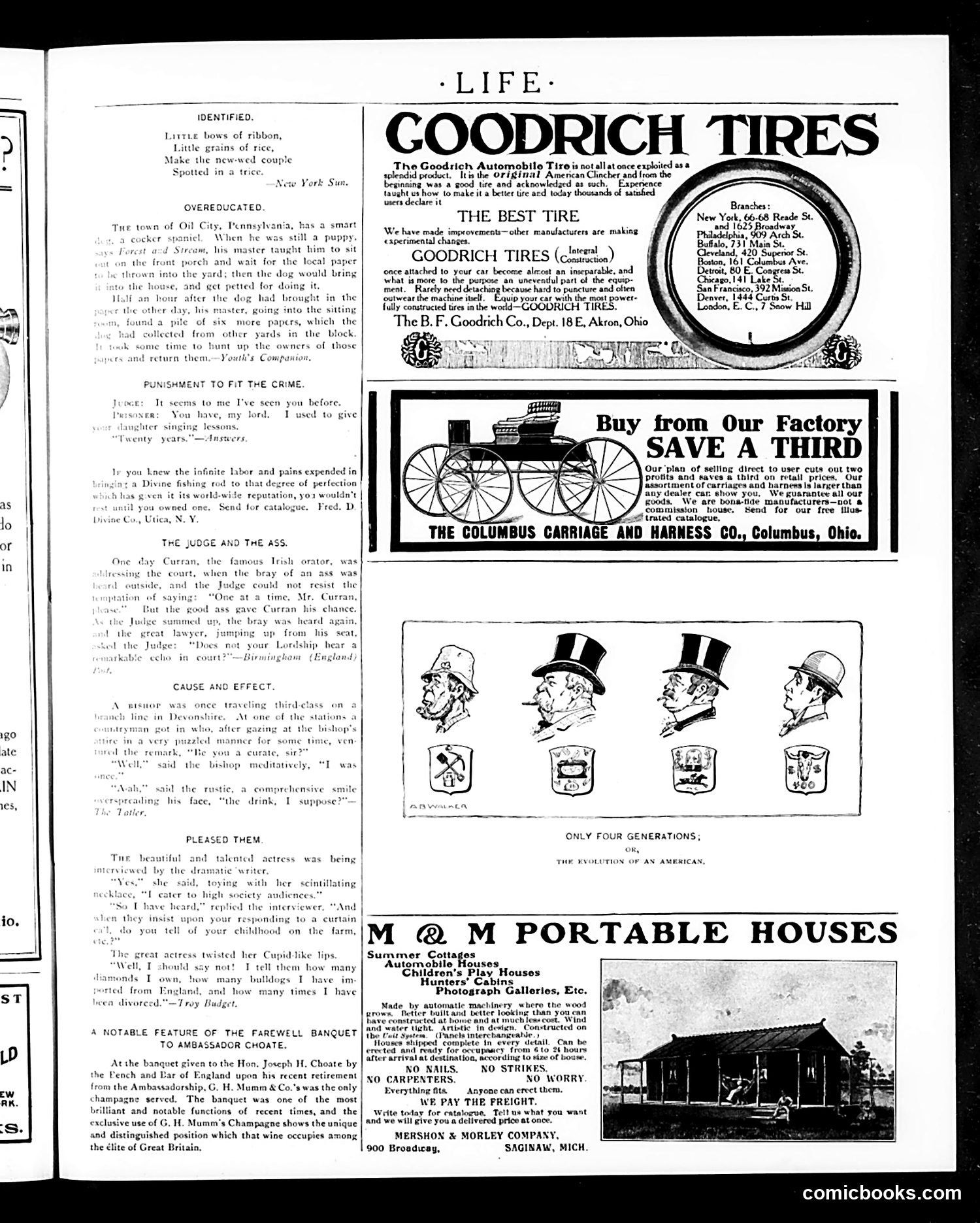
This page is primarily **advertising**, not satirical content. It features: **Main Advertisements:** - **Goodrich Tires**: Emphasizes their product as "the original American Clincher," highlighting durability and puncture resistance—key selling points for early automobiles. - **Columbus Carriage & Harness Co.**: Promotes direct factory sales to consumers, promising to "save a third" by eliminating middlemen. - **M&M Portable Houses**: Markets prefabricated structures (summer cottages, hunting cabins, etc.) using "automatic machinery," emphasizing quick assembly. **Sidebar Content:** The left column contains brief humorous anecdotes ("Identified," "Overeducated," "The Judge and the Ass") typical of Life's satirical humor—social commentary through short jokes about human behavior. **Historical Context:** These ads reflect early 1900s American concerns: automobile reliability was novel, direct manufacturing/sales disrupted traditional retail, and prefabrication represented modern industrial efficiency. The page demonstrates Life's dual function: satirical social commentary alongside contemporary advertising targeting middle/upper-class readers.
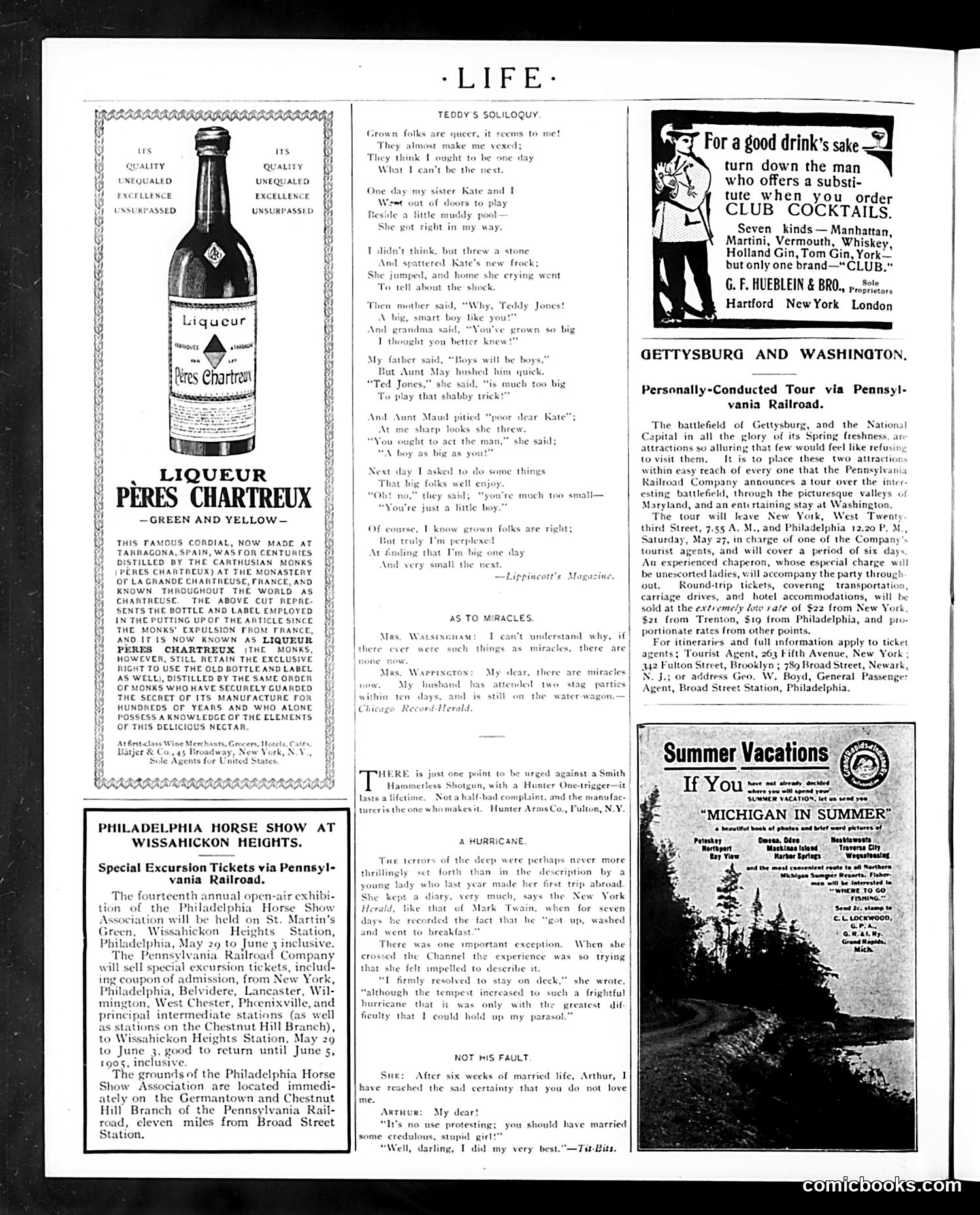
This page from *Life* magazine is primarily **advertising and travel promotion**, not political satire. The dominant content includes: **Liqueur Advertisement**: A large ad for Pères Chartreaux liqueur, emphasizing its French monastic origins and quality. **Travel Promotions**: Multiple Pennsylvania Railroad advertisements promoting excursions to the Philadelphia Horse Show, and a tour to Gettysburg and Washington, D.C. **Humor Pieces**: Small comic sections titled "Teddy's Soliloquy" (a child reflecting on grown-up behavior), "As to Miracles," "A Hurricane," and "Not His Fault"—these appear to be light domestic humor rather than political commentary. **Club Cocktails Advertisement**: A pitch for branded cocktail mixers. The "Teddy" reference appears to be a generic boy's name, not Theodore Roosevelt. The overall page reflects early 1900s American magazine formatting: heavy advertising interspersed with light humor and cultural content rather than serious political cartoons.
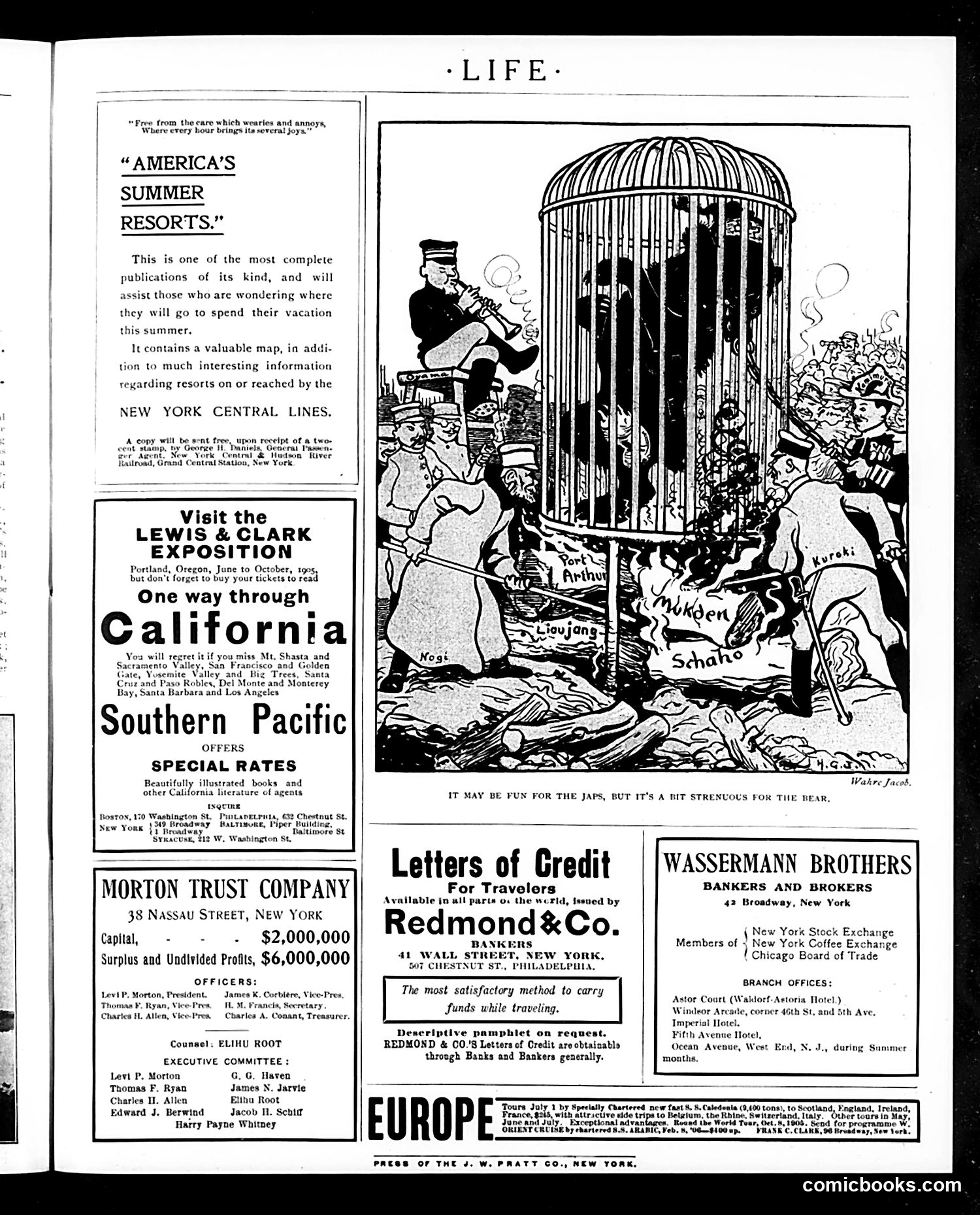
This cartoon satirizes the Russo-Japanese War (1904-1905) through a zoo metaphor. A zookeeper (representing a neutral observer or world powers) displays caged animals labeled with warring nations—"Japs," "Russians," and indigenous peoples like "Ainu," "Koreans," "Liaojians," and "Schalio." The joke's brutality: the conflict is "fun" entertainment for distant observers watching Japan and Russia fight, while indigenous populations trapped between them suffer "strenuous" consequences. The bear (Russia) appears stressed in its cage, suggesting Japan's unexpected military success alarmed Western observers who viewed Russia as the dominant power. The satire mocks both the dehumanizing spectacle of war as public entertainment and Western indifference to colonial/regional peoples caught in imperial conflicts. The page is primarily advertisements for travel and financial services, with this single political cartoon as commentary.
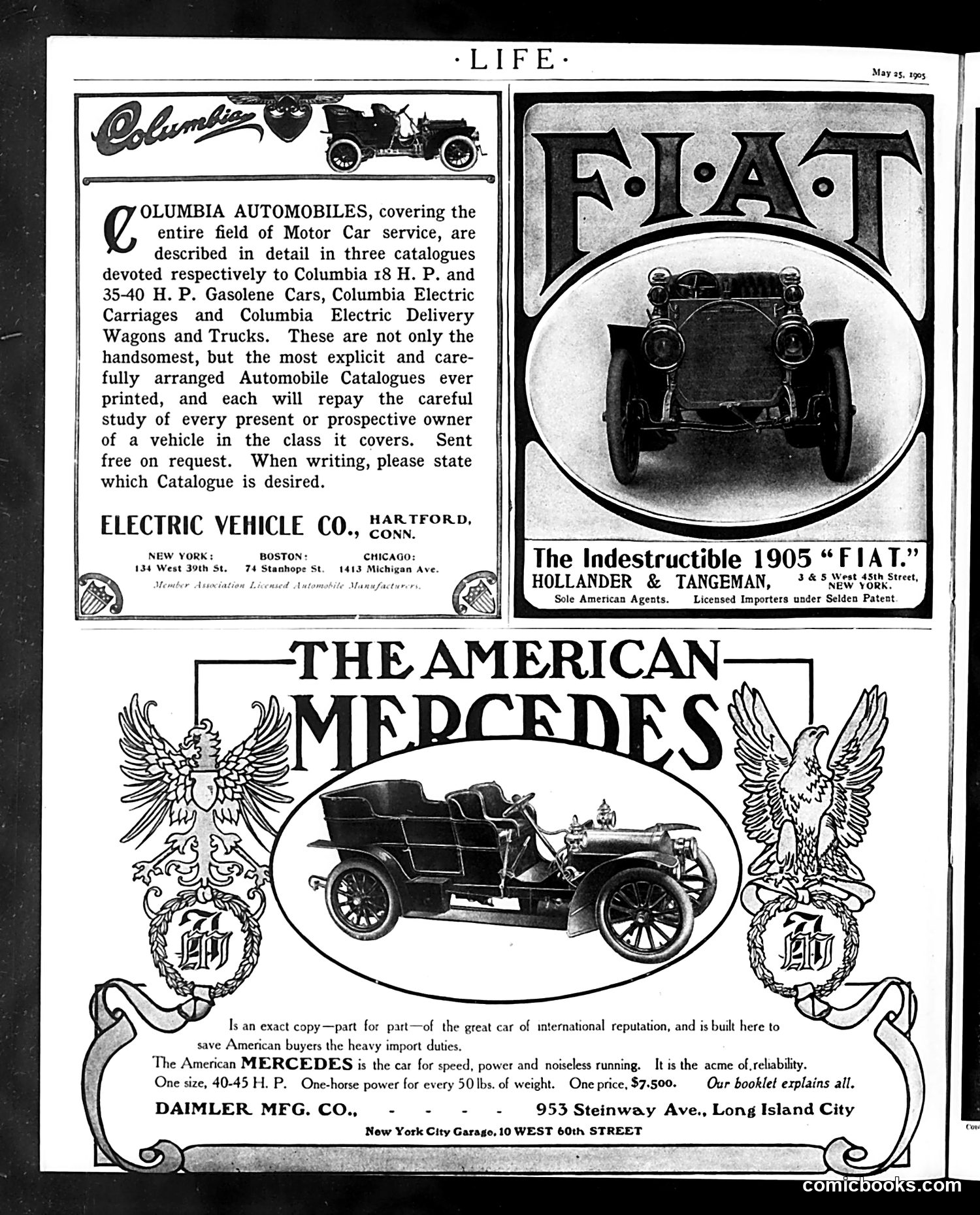
This is primarily an **automobile advertisement page**, not a political cartoon. It contains three separate car ads from the early motorcar era: 1. **Columbia Automobiles** (top left) - promoting gasoline and electric vehicles through detailed catalogs 2. **Fiat** (top right) - advertising the 1905 "Indestructible" model as imported by Hollander & Tangeman 3. **American Mercedes** (bottom, largest) - the main advertisement, explicitly positioning itself as a domestically-built copy of the famous European Mercedes to save American buyers import duties The Mercedes ad's claim that it's an "exact copy—part for part" to avoid tariffs reflects the economic protectionism of the era. The ornate eagle emblems and formal styling reflect the prestige associated with European luxury automobiles. This page reflects early-1900s American automotive competition and the nascent domestic auto industry's struggle against established European manufacturers.