
Life, 1905-05-25 · page 16 of 26
Life — May 25, 1905 — page 16: what you’re looking at
What you’re looking at
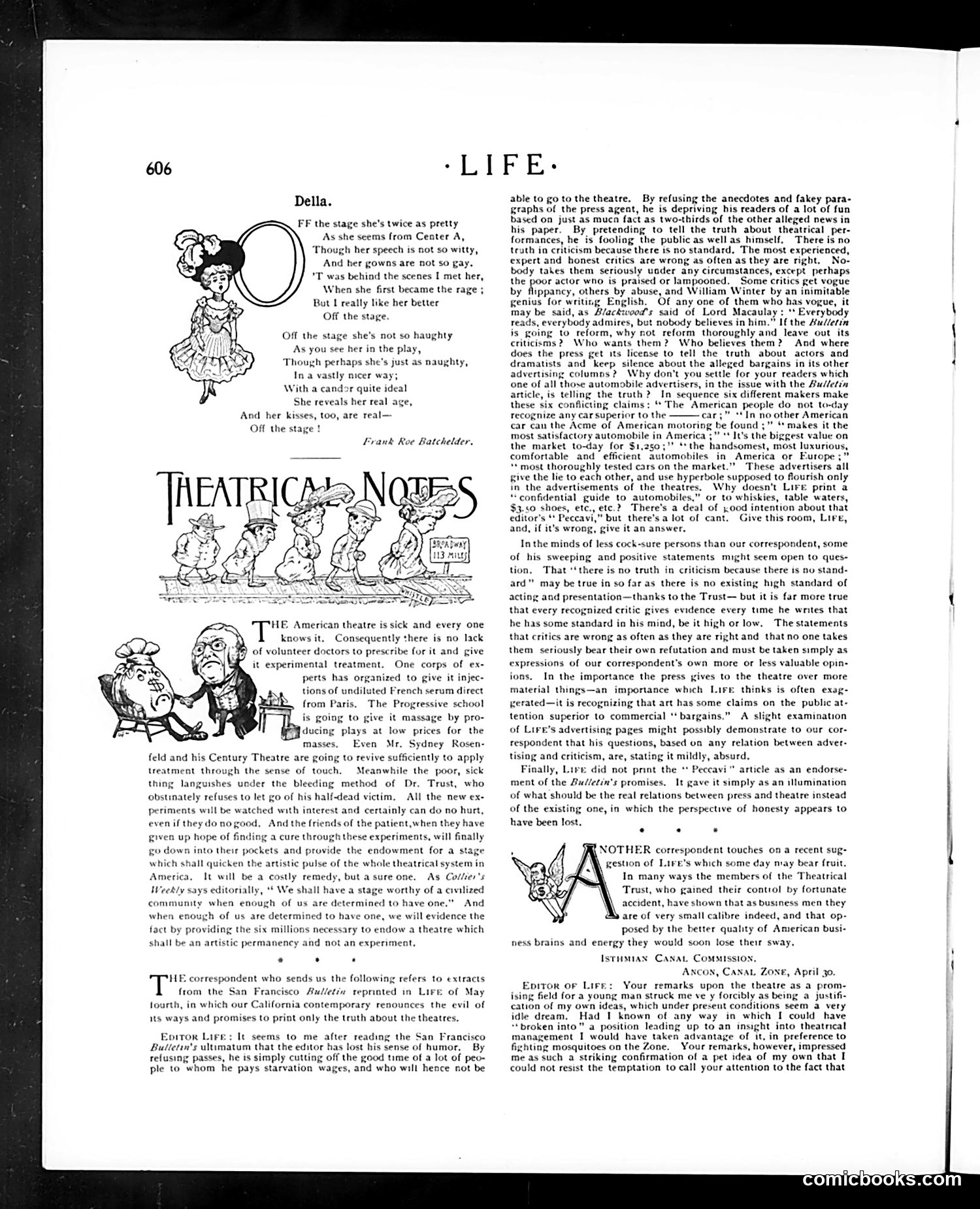
This page contains **literary and editorial commentary on American theater** circa early 1900s, not political cartoons. The poem "Della" by Frank Roe Batchelder contrasts actresses' public versus private personas—they're prettier and more genuine offstage than their theatrical performances suggest. The editorial discusses the theater's financial and artistic decline, proposing various "cures": French theatrical innovations, low-price progressive productions, and ultimately a government-endowed theater requiring $6 million in funding. A San Francisco *Bulletin* editor's pledge to print only truth about theater sparks a critical response: the correspondent argues critics lack authority (no objective standard exists), that theater criticism is merely subjective opinion-mongering, and that the editor's self-righteousness ignores that readers enjoy theatrical press releases and gossip regardless of truthfulness. The satire targets both theatrical pretension and journalistic hypocrisy about truth-telling.
📄 Transcribed text from this page (OCR, searchable)
Machine-transcribed from the original scan — historical spelling and the odd misread are preserved.
Della. FF the stage she’s twice as pretty As she seems from Center A, ‘Though her speech is not so witty, And her gowns are not so gay. 'T was behind the scenes I met her, When she first became the rage ; Bot L really like her better Off the stage. Off the stage she’s not so haughty As you see her in the play, Though perhaps she’s just as naughty, Ina vastly nicer way; With a candor quite ideal She reveals her real age, And her kisses, too, are real— Off the stage ! Frank Roe Batchelder, T American theatre is sick and every one knows it, Consequently there is no lack of volunteer doctors to prescribe for it and give it experimental treatment. One corps of ex- perts has organized to give it injec- ’ tions of undiluted French serum direct Jb from Paris. The Progressive school is going to give it massage by pro- ducing plays at low prices for the ydney Rosen- feld and his Century Theatre are going to revive sufficiently to apply treatment through the sense of touch. Meanwhile the poor, sick thing languishes under the bleeding method of Dr. Trust, who obstinately refuses to let go of his half-dead victim, All the new ex- masses. Even Mr. periments will be watched with interest and certainly can do no hurt, «when they have even if theydo nogood, And the friends of the patien! up hope of finding a cure through these experiments, will finally go dow nto their pockets and provide the endowm: at for a stage which shall quicken the artistic pulse of the whole theatrical system in ie. As Collier's ys editorially, “ We shall have a stage worthy of a civilized America, It will be a costly remedy, but a sure o Weekly community when enough of us are determined to have one.” And when enough of us are determined to have one, we will evidence the fact by providing the six millions necessary to endow a theatre which shall be an artistic permanency and not an experiment. * . . HE correspondent who sends us the following refers to extracts of May fourth, in which our California contemporary renounces the evil of its ways and promises to print only the truth about the theatres, from the San Francisco Aul/etin reprinted in LiFe Epiror Lire: It seems to me after reading the San Francisco Bulletin’s ultumatum that the editor has lost his sense of humor, By refusing passes, he is simply cutting off the good time of a lot of peo- ple to whom he pays starvation wages, and who will hence not be -LIFE:- able to go to the theatre, By refusing the anecdotes and fakey para- graphs of the press agent, he is depriving his readers of a lot of fun Dased on just as mucn fact as two-thirds of the other alleged news in his paper. By pretending to tell the truth about theatrical per- formances, he is fooling the public as well as himself, There is no trath in criticism because there is no standard, The most experienced, expert and honest critics are wrong as often as they are right, No- body takes them seriously uader any circumstances, except perhaps the poor actor who is praised or lampooned. Some critics get vogue by Aippancy, others by. abuse, and William Winter by an inimitable genius for writing English, Of any one of them who has vogue, it may be said, as Blackwood's said of Lord Macaulay: ** Everybody reads, everybody admires, but nobody believes in him.” If the Hulletin is going to reform, why not reform thoroughly and leave out its criticisms? Who wants them? Who believes them? And where does the press get its license to tell the truth about actors and dramatists and keep silence about the alleged bargains in its other advertising columns? Why don’t you settle for your readers which one of all those automobile advertisers, in the issue with the Bulletin article, is telling the truth? In sequence six different makers make these six conflicting claims: * The American people do not to-day recognize any car superior to the car;” ‘In no other American car can the Acme of American motoring be found ;” makes it the most satisfactory automobile in America ;””* It’s the biggest value on the market to-day for $1,250; ‘the handsomest, most luxuriou comfortable and efficient’ automobiles in America or Europe ; *+ most thoroughly tested cars on the market.” These advertisers all give the lie to each other, and use hyperbole supposed to flourish only in the advertisements of the theatres, Why doesn't Lire print a “confidential guide to automobiles,” or to whiskies, table waters, $3.40 shoes, et€., etc.? There's a deal of ,ood intention about that editor's * Peccavi,” but there's a lot of cant. Give this room, Lire, and, if it’s wrong, give it an answer. Inthe minds of le: of his sweeping and positive statements might seem open to ques- tion, That ‘there is no truth in criticism because there is no stand- ard" may be true in so far as there is no existing high standard of acting and presentation—thanks to the Trust— but it is far more true that every recognized critic gives evidence every time he wntes that he has some standard in his mind, be it high or low, The statements that critics are wrong as often as they are right and that no one takes them seriously bear their own refutation and must be taken simply as expressions of our correspondent’s own more or less valuable opin= ions. In the importance the press gives to the theatre over more material things—an importance which Lire thinks is often exag- Kerated—it is recognizing that art has some claims on the public at- tention superior to commercial “bargains.” A slight examination of Lire’s advertising pages might possibly demonstrate to our cor- respondent that his questions, based on any relation between adver tising and criticism, are, stating it mildly, absurd, Finally, Lire did not print the © Peccavi article as an endorse- ment of the Buéletin's promises. It gave it simply as an illumination of what should be the real relations between press and theatre instead of the existing one, in which the perspective of honesty appears to have been lost. cock-sure pet sons than our correspondent, some NOTHER correspondent touches on a recent sug- gestion of Lire’s which some day may bear fruit. In many ways the members of the Theatrical Trust, who gained their control by fortunate accident, have shown that as business men they are of very small calibre indeed, and that op- posed by the better quality of American busi- ness brains and energy they would soon lose their sway. Istitiax Caxat. Comsitssiox, Axcox, CANAL Zone, April 30. Epttor oF Lire: Your remarks upon the theatre as a prom- ising field for a young man struck me ve y forcibly as being a justifi- cation of my own ideas, which under preseut conditions seem a very idle dream. Had I known of any way in which [ could have “broken into” a position leading up to an insight into theatrical management I would have taken advantage of it, in preference to fighting mosquitoes on the Zone. Your remarks, however, impressed me as such a striking confirmation of a pet idea of my own that I could not resist the temptation to call your attention to the fact that \ \