
Life, 1905-05-25 · page 18 of 26
Life — May 25, 1905 — page 18: what you’re looking at
What you’re looking at
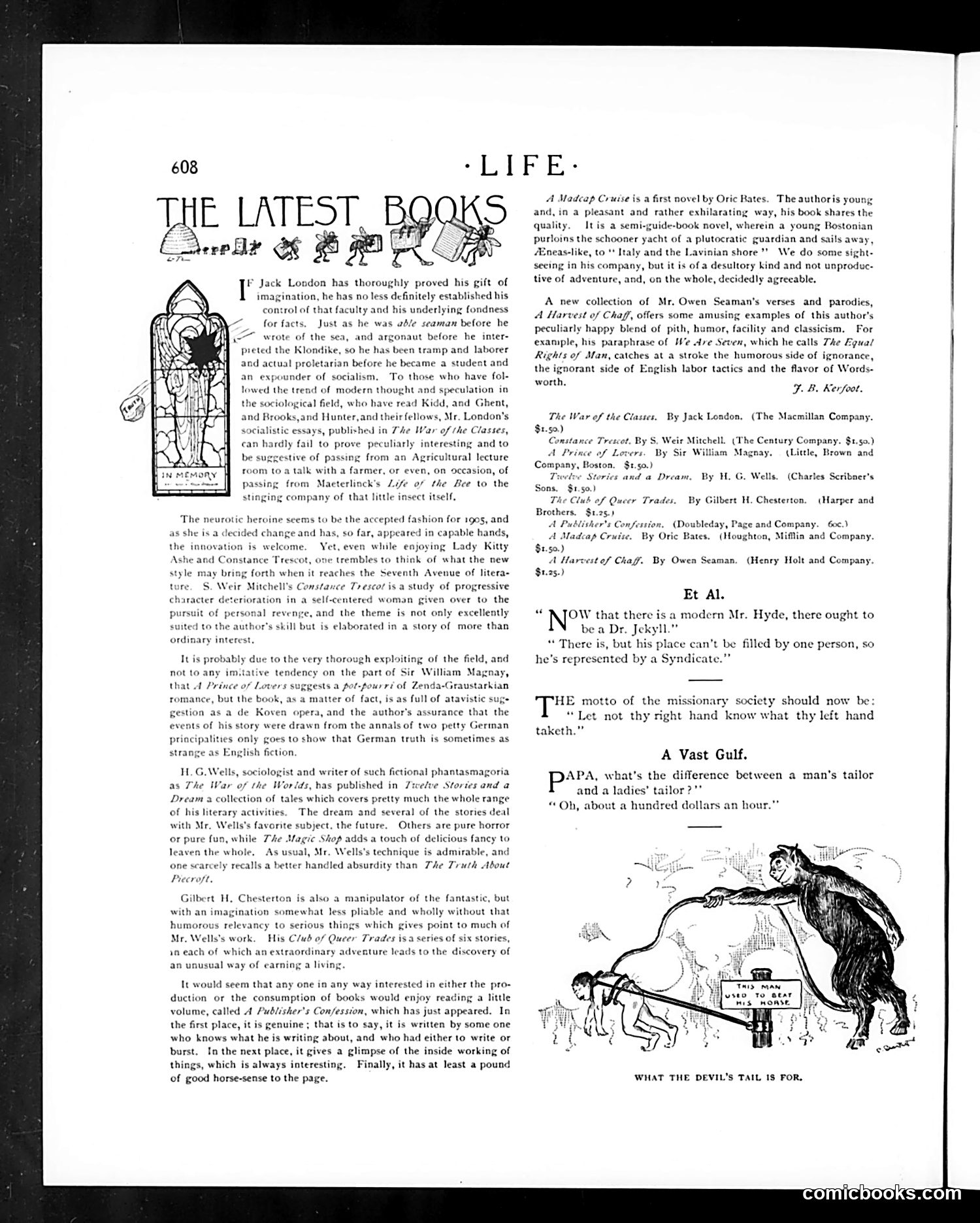
This is a literary review section discussing contemporary novels from around 1905. The page critiques works by Jack London, emphasizing his credibility as a socialist writer because he'd actually lived as a laborer and seaman before writing about such subjects. The reviews also note a trend: the "neurotic heroine" has become fashionable in 1905 literature, exemplified by S. Weir Mitchell's *Constance Trescot*. The critic expresses mild concern this trend could spread to lower-quality writers. **The cartoon** (titled "What the Devil's Tail Is For") depicts a devil using his tail as a whip on a prone figure, likely satirizing publishing or literary criticism itself—perhaps suggesting publishers or critics use harsh tactics. The page reflects early 20th-century intellectual culture: serious engagement with socialism, fascination with H.G. Wells's speculative fiction, and debate over literary fashions and character types.
📄 Transcribed text from this page (OCR, searchable)
Machine-transcribed from the original scan — historical spelling and the odd misread are preserved.
608 THE LATEST, ere lY GR © O F Jack London has thoroughly proved his gift of I imagination, he has no less definitely established his control of that faculty and his underlying fondness for facts, Just as he was ad/e seaman before he wrote of the sea, and argonaut before he inter preted the Klondike, so he has been tramp and laborer and actual proletarian before he became a student and an expounder of socialism, To those who have fol- lowed the trend of modern thought and speculation in the sociological field, who have read Kidd, and Ghent, and Brooks,and Hunter,and their fellows, Mr, London's in The War of the Classes, can hardly fail to prove peculiarly interesting and to be suggestive of passing from an Agricultural lecture room to a talk with a farmer, or even, on occasion, of passing from Maeterlinck’s Life of the Bee to the stinging company of that little insect itself, socialistic essays, publi The neurotic heroine seems to be the accepted fashion for 1905, and as she is a decided change and has, so far, appeared in capable hands, the innovation is welcome. Y ven while enjoying Lady Kitty Ashe and Constance Trescot, one trembles to think of what the new style may bring forth when it reaches the Seventh Avenue of litera- ture, S. Weir Mitchell's Constance Trescot isa study of progressive character deterioration in a self-centered woman given over to the and the theme is not only excellently is elaborated in a story of more than pursuit of persc ordinary interest, It is probably due to the very thorough exploiting of the field, and not to any imitative tendency on the part of Sir William Magnay, that 4 Prince of Lovers suggests a pot-pourri of Zenda-Graustarkian romance, but the book, as a matter of fact, is as full of atavistic suge gestion as a de Koven opera, and the author's assurance that the events of his story were drawn from the annals of two petty German principalities only goes to show that German truth is sometimes as as English fiction. H. G.Wells, sociologist and writer of such fictional phantasmagoria as The War of the Worlds, bas published in Tielve Stories and a Dream a collection of tales which covers pretty much the whole range of his literary activities. The dream and several of the stories deal with Mr, Wells's favorite subject, the future, Others are pure horror or pure fun, while The Magic Shop adds a touch of delicious fancy to leaven the whole. As usual, Mr. Wells's technique is admirable, and one scarcely recalls a better handled absurdity than The Truth About Precroft, Gilbert H, Chesterte with an imagination somewhat less pliable and wholly without that is also a manipulator of the fantastic, but humorous relevancy to serious things which gives point to much of Mr. Wells's work h of which His Club of Queer Trades isa series of six stories, extraordinary adventure leads to the discovery of sual way of earning a living. It would seem that any one in any way interested in either the pro- duction or the consumption of books would enjoy reading a little volume, called A Publisher's Confession, which has just appeared. In the first place, it is genuine ; that isto say, it is written by some one who knows what he is writing about, and who had either to write or burst. In the next place, it gives a glimpse of the inside working of things, which is always interesting. Finally, it has at least a pound of good horse-sense to the page. “LIP B= A Madcap Cruise is a first novel by Oric Bates. The authoris young and, in a pleasant and rather exhilarating way, his book shares the quality. It is a semi-guide-book novel, wherein a young Bostonian purloins the schooner yacht of a plutocratic guardian and sails aw Aneas-like, to" Italy and the Lavinian shore ” We do some sight- seeing in his company, but it is ofa desultory kind and not unproduc- tive of adventure, and, on the whole, decidedly agreeable. A new collection of Mr, Owen Seaman's verses and parod A Harvest of Chaff, offers some amusing examples of this author's peculiarly happy blend of pith, humor, facility and classicism, For example, his paraphrase of We dre Seven, which he calls The Equal Rights of Man, catches at a stroke the humorous side of ignorance the ignorant side of English labor tactics and the flavor of Words- worth. 7. B. Kerfoot. The War of the Classes, By Jack London, (The Macmillan Company. $1.50) Constance Trescot, By $, Weir Mitchell. (The Century Company. $1.0.) A Prince of Lovers. By Sit William Magnay, (Little, Brown and Company, Boston, $1.50.) Twelve Stories and a Dream, By WH. G. Wells. (Charles Scribner's Sons. $1.50.) The Club of Queer Trades. Brothers. $1.25.) A Publisher's Confession, (Doubleday, Page and Company. Goc.) A Madcap Cruise. By Otic Bates. (Houghton, Mifflin and Company. $1.50.) A Harvest of Chaff. By Owen Seaman. (Henry Holt and Company, $1.25.) By Gilbert H. Chesterton, (Harper and Et Al. “ OW that there is a modern Mr. Hyde, there ought to be a Dr. Jekyll.” There is, but his place can’t be filled by one person, so he’s represented by a Syndicate.” T IE motto of the missionary society should now be: “Let not thy right hand know what thy left hand taketh.” A Vast Gulf. pA what's the difference between a man's tailor and a ladies’ tailor?" about a hundred dollars an hour.”” HAT THE DEVIL'S TAIL 18 FOR,