
Life, 1905-05-25 · page 17 of 26
Life — May 25, 1905 — page 17: what you’re looking at
What you’re looking at
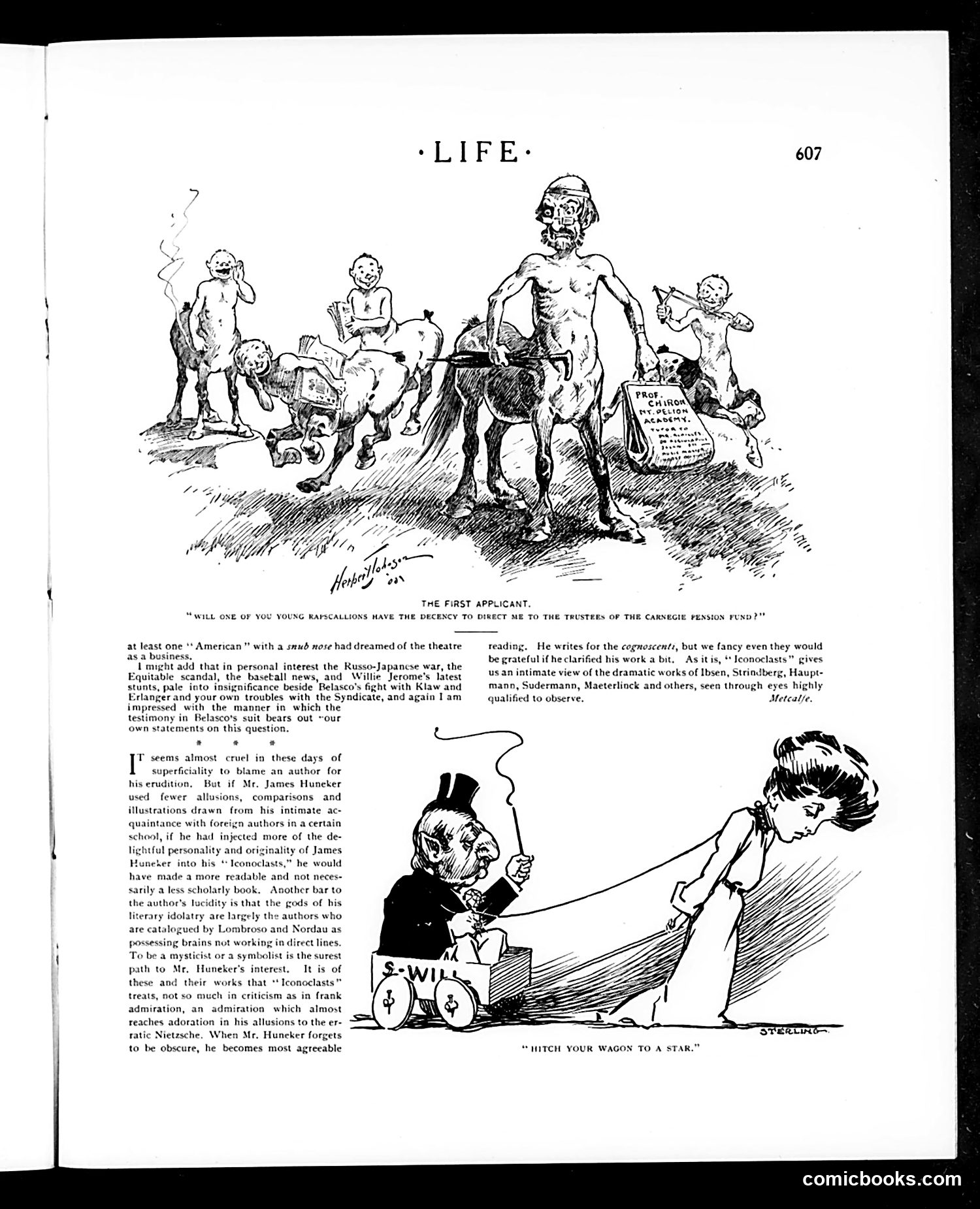
The page contains two cartoons satirizing aspirational ambition and erudite pretension in early 1900s America. **Top cartoon**: Depicts ragged children approaching a wealthy man, asking directions to the "Carnegie Pension Fund." This mocks the gap between Andrew Carnegie's philanthropic reputation and actual access to his wealth—suggesting his charity remains distant and inaccessible to the desperately poor. **Bottom cartoon** ("Hitch Your Wagon to a Star"): Shows a small man in a wagon being pulled by a woman. This appears to satirize artistic or social climbers who rely on others (particularly women) to advance their ambitions through aspirational ideals rather than genuine effort. The accompanying text critiques author James Huneker's book *Iconoclasts* for excessive obscure literary allusions and affected erudition, arguing his pretentious references to European symbolists and Nietzsche obscure rather than clarify his work. The overall theme: authentic achievement requires clarity and genuine effort, not fashionable obscurity or riding on others' coattails.
📄 Transcribed text from this page (OCR, searchable)
Machine-transcribed from the original scan — historical spelling and the odd misread are preserved.
PROF. ‘cHiRoNg BT PELION. THE FIRST APPLICANT. “WILL ONE OF YOU YOUNG RAFSCALLIONS HAVE THE DECENCY TO DIRECT ME TO THE TRUSTERS OF THE CARNEGIE PENSION FUND?" at least one ‘* American” with a snub nose had dreamed of the theatre as.a business. I might add that in personal interest the Russo-Japancse war, the Equitable scandal, the basetall news, and Willie Jerome's latest stunts, pale into insignificance beside 'Relasco’s fight with Klaw and Erlanger and your own troubles with the Syndicate, and again Tam impressed with the manner in which the testimony in Belasco’s suit bears out “our own statements on this question. T seems almost cruel in these days of superficiality to blame an author for his erudition, But if Mr, James Huncker used fewer allusions, comparisons and illustrations drawn from his intimate ac- quaintance with foreign authors in a certain school, if he had injected more of the de- ‘ul personality and originality of James Juneher into his * Iconoclasts,” he would ¢ made a more readable and not neces- sarily a less scholarly book. Another bar to the author's lucidity is that the gods of his literary idolatry are largely the authors who are catalogued by Lombroso and Nordau as possessing brains not working in direct lines. To be a mysticist or a symbolist is the surest path to Mr, Huneker's interest, It is of these and their works that * Iconoclasts" treats, not so much in criticism as in frank admiration, an admiration which almost reaches adoration in his allusions to the er- ratic Nietzsche, When Mr. Huncker forgets to be obscure, he becomes most agreeable reading. He writes (or the cognoscents, but we fancy even they would be grateful if he clarified his work a bit, As itis, ** Iconoclasts” gives us an intimate view of the dramatic works of Ibsen, Strindberg, Haupt- Sudermann, Maeterlinck and others, seen through eyes highly Metcalfe. mann, qualified to observe, “MITCH YOUR WAGON TO A STAR.” comicbooks.com