
A complete issue · 32 pages · 1905
Life — May 18, 1905
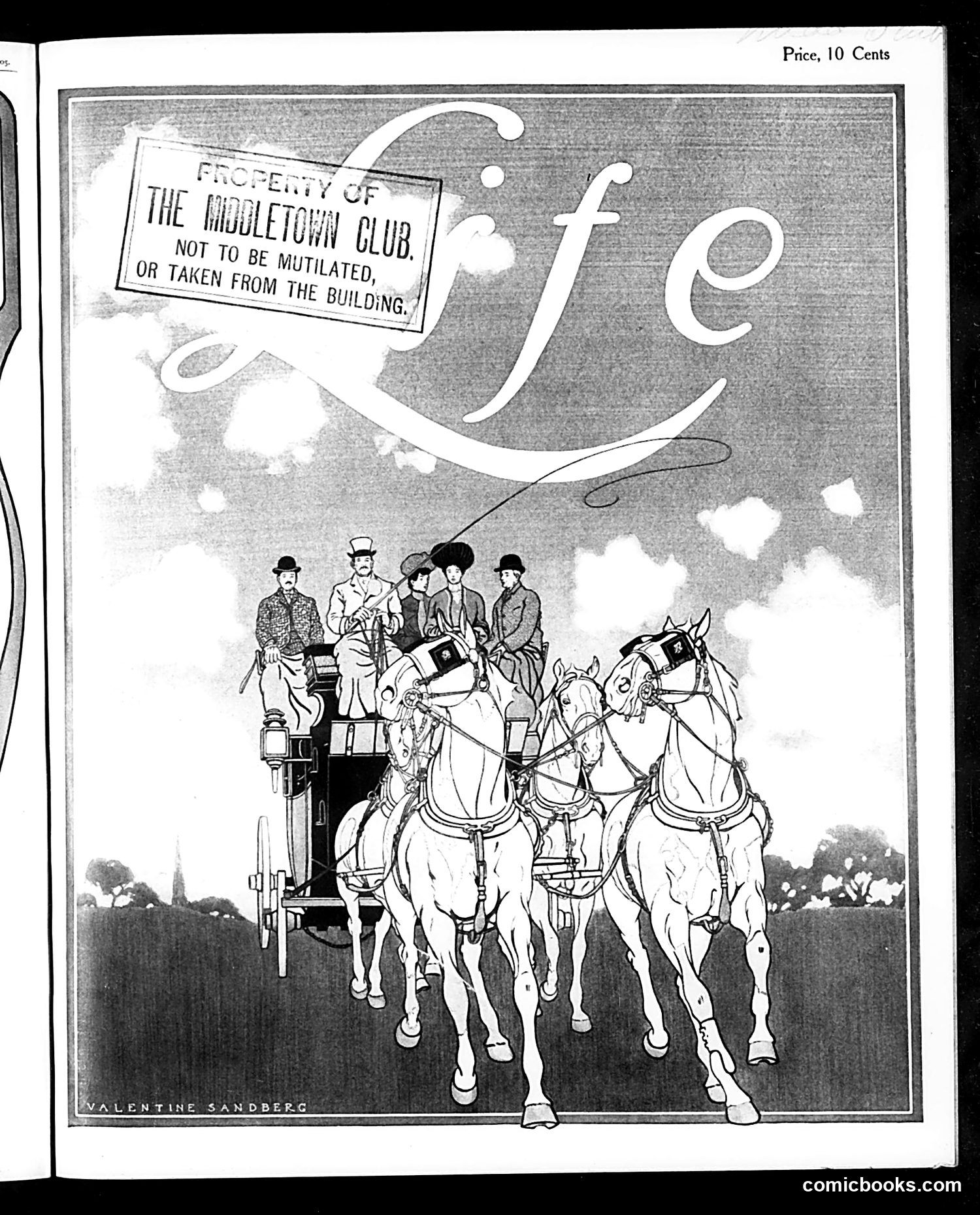
This is a cover illustration by Valentine Sandberg depicting four men in formal attire riding in a horse-drawn carriage pulled by two horses. The large text "Life" dominates the upper portion. The notable element is a property stamp in the upper left reading "PROPERTY OF THE MIDDLETOWN CLUB. NOT TO BE MUTILATED OR TAKEN FROM THE BUILDING." The satire appears to target a social club, likely the Middletown Club, suggesting that this illustration was valuable enough to warrant protective marking—implying either the club's pride in owning the image or commentary on institutional possessiveness. The formal gentlemen and elegant carriage suggest wealth and social status, though without additional context, the specific satirical point about these particular figures remains unclear.
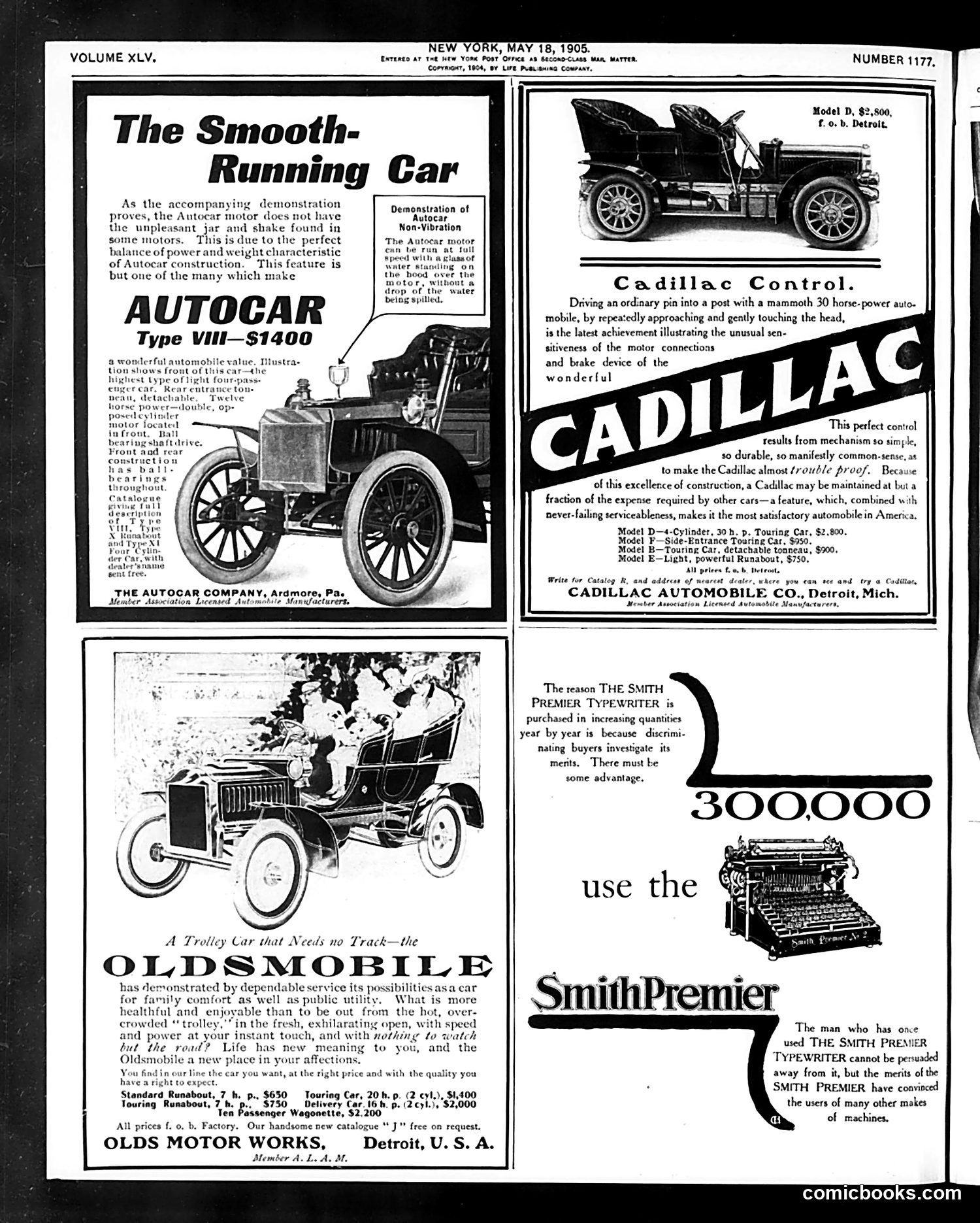
This page from Life magazine (May 18, 1905) contains **advertisements rather than political cartoons or satire**. The ads promote early automobiles: the Autocar (Type VIII, $1400), Cadillac (with emphasis on smooth control), and Oldsmobile (described as a "trolley car that needs no track"). There's also an advertisement for the Smith Premier typewriter, noting 300,000 in use. The content reflects the historical moment—automobiles were new, luxury goods requiring detailed explanation of their features and reliability. The Cadillac ad's emphasis on control and the Oldsmobile's comparison to familiar trolleys suggest manufacturers were addressing public skepticism about this emerging technology. No political message or satire is evident on this page.
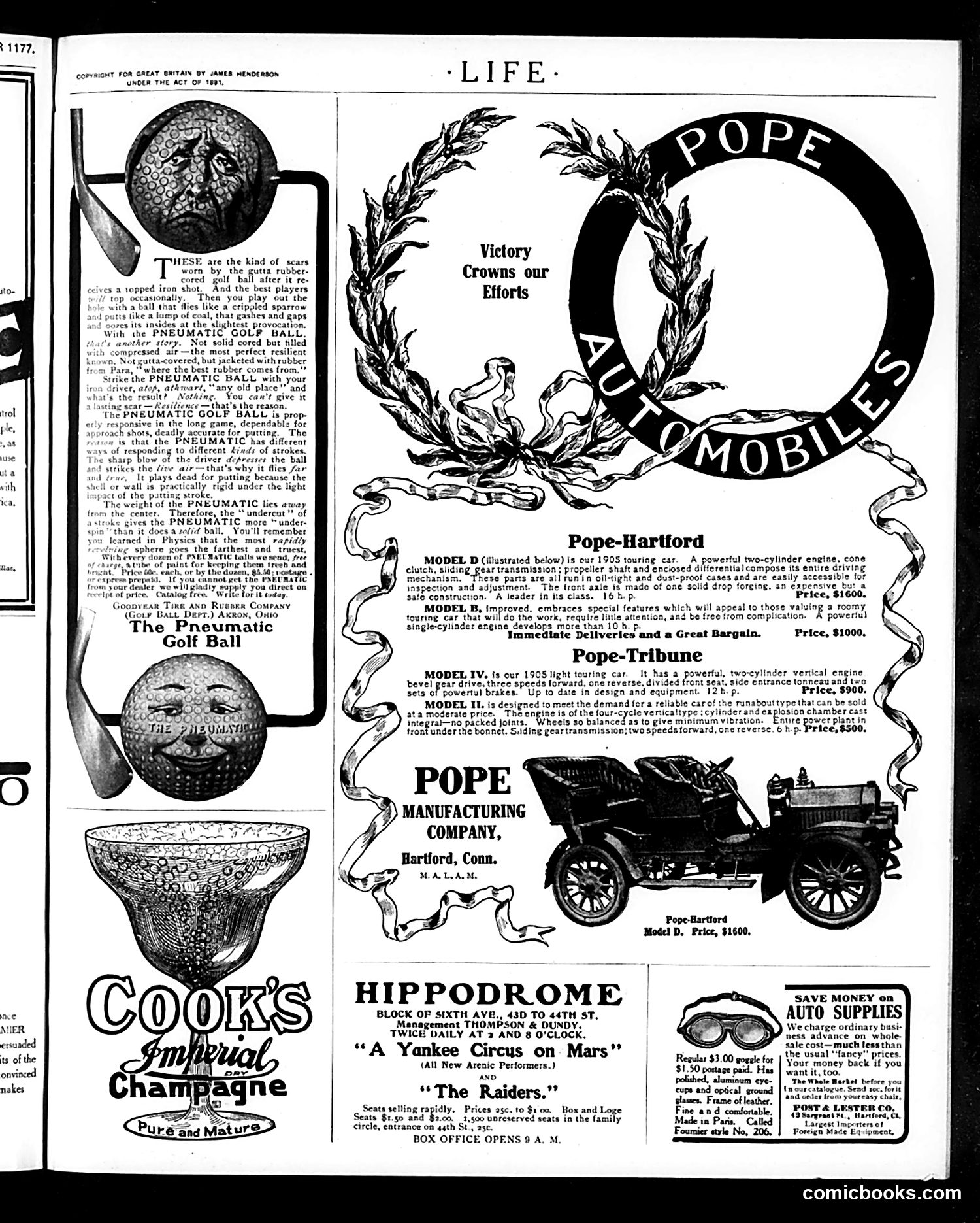
This page is **primarily advertisements** for early 1900s products and entertainment, not political satire. The left column features ads for sporting goods ("The Pneumatic Golf Ball," Cook's Imperial Champagne) with descriptive text about manufacturing quality. The right side advertises **Pope Manufacturing Company automobiles** from Hartford, Connecticut—various models with prices ($1,600-$1,000). The decorative wreath frame reading "Pope Automobiles" surrounds text describing different car models. Below are entertainment advertisements: the Hippodrome theater promoting "A Yankee Circus on Mars" and "The Raiders," and an auto supplies shop offering discounted parts. The only potentially satirical element is the phrase "Victory Crowns our Efforts" paired with the automobile ads, possibly referencing Pope's commercial success in early automotive manufacturing, though this remains unclear without additional historical context.
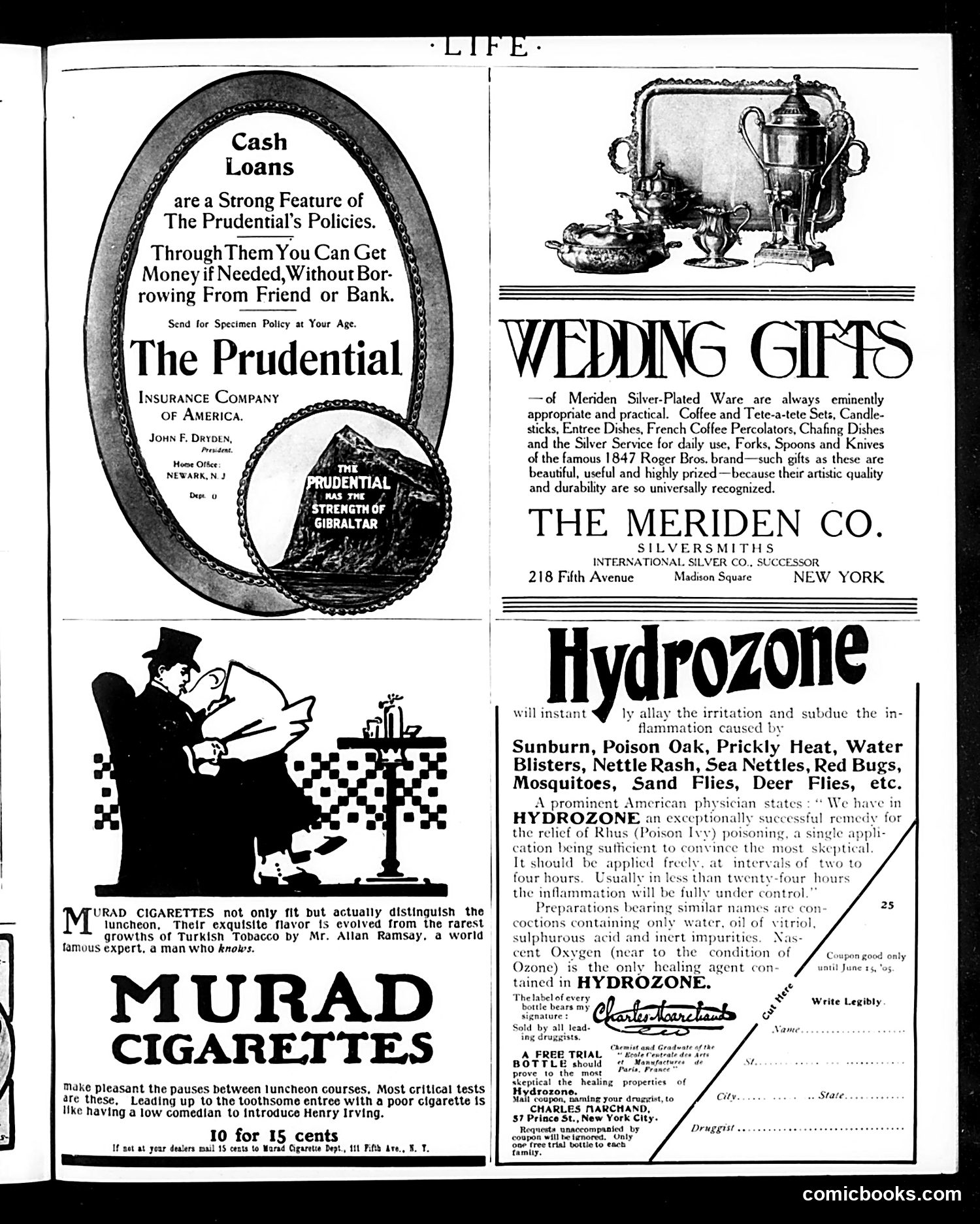
This page is primarily **advertising rather than satirical content**. The Murad Cigarettes ad (lower left) contains the only notable cartoon element: a gentleman in formal dress examining a cigarette at what appears to be a formal luncheon. The satire here is gentle—the ad claims Murad cigarettes are so refined they "distinguish the luncheon" and make "pleasant the nausea between luncheon courses," with a humorous acknowledgment that poor cigarettes can ruin a meal's final course. The remaining content consists of straightforward product advertisements: The Prudential Insurance Company promoting cash loans, The Meriden Co. advertising silver-plated wedding gifts, and Hydrozone promoting a medical remedy for various skin conditions and insect bites. The page reflects early 20th-century advertising practices combining light humor with earnest product promotion.
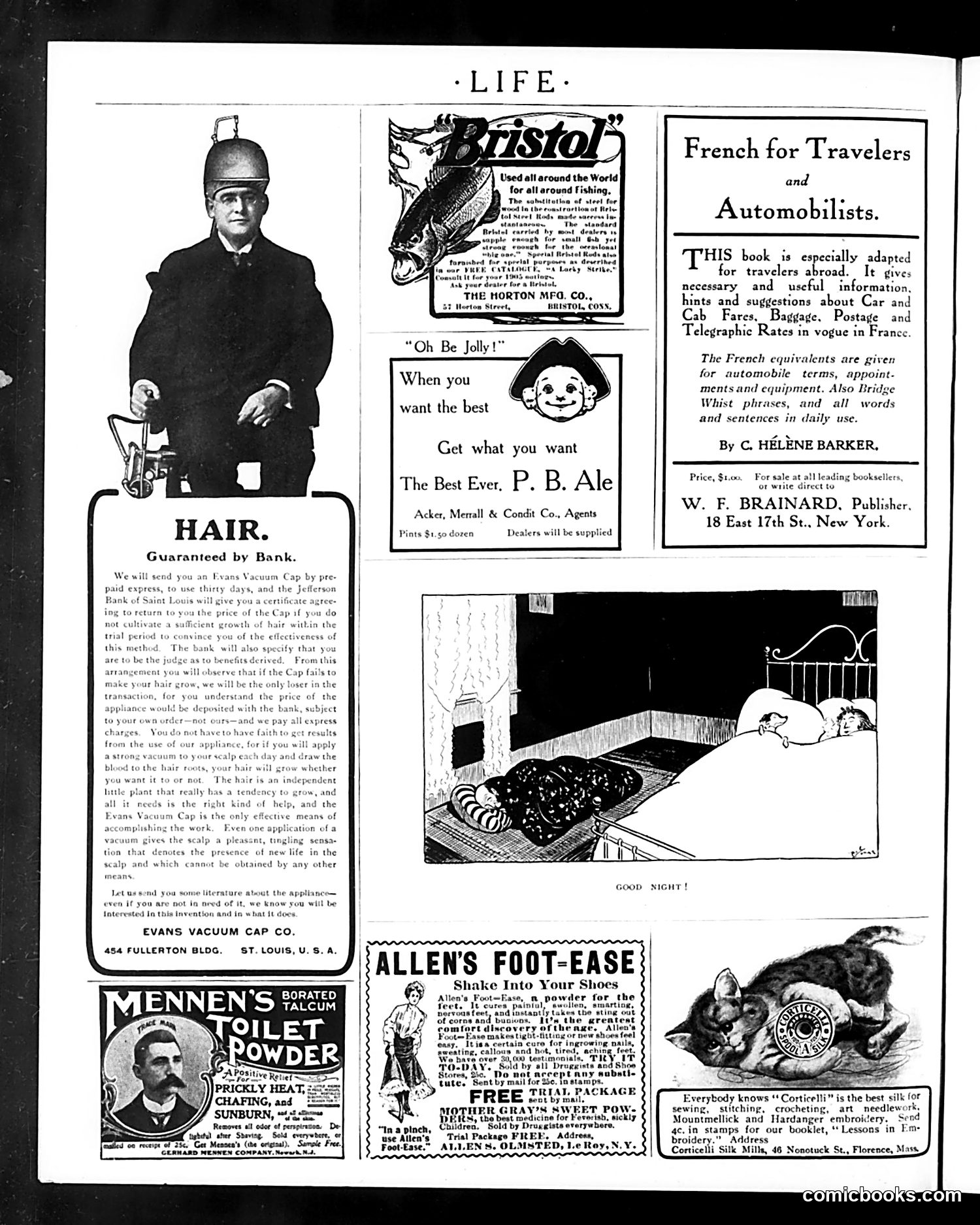
This page is primarily **advertising content** from an early 20th-century Life magazine, not political satire. The ads include: - **Hair growth product** (Evans Vacuum Cap) with bank guarantees - **Bristol** fishing equipment - **P.B. Ale** beer ("Oh Be Jolly!") - **Mennen's Talcum Powder** - **Allen's Foot-Ease** powder - **Corticelli Silk Mills** embroidery thread There is one small cartoon labeled "GOOD NIGHT!" showing a child in bed—a gentle domestic scene without political content. The only notable feature is a French language travel guide advertisement targeting wealthy American tourists and automobilists visiting France. This represents typical magazine revenue through product advertising rather than editorial satire or commentary.
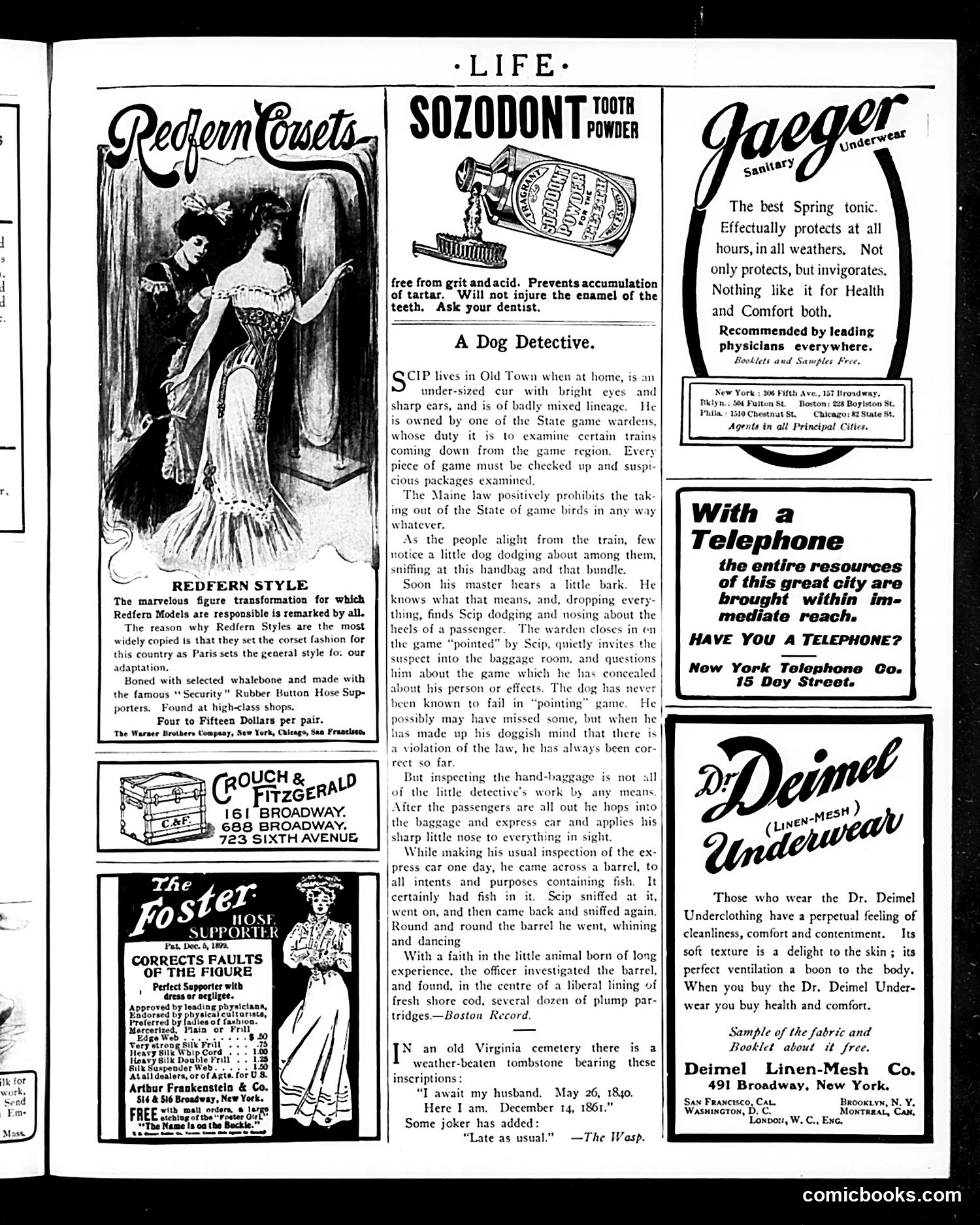
This page is primarily **advertising content**, not political satire. It features period product advertisements from early 20th century America, including: - **Redfern Corsets**: A fashion advertisement emphasizing the "Redfern Style" corset as fashionable Paris-inspired design - **Sozodont Tooth Powder**: A dental product claiming to prevent tartar accumulation - **Jaeger Sanitary Underwear**: Marketed for health and comfort protection - **Dr. Deimel Linen-Mesh Underwear**: Advertised as promoting cleanliness and health The center of the page contains a short story titled "A Dog Detective" about a game warden's dog named Scip who inspects game packages at a train station. The advertisements reflect period concerns about hygiene, fashion, and health products typical of Life magazine's commercial content during this era. There is no significant political cartoon or satire present.
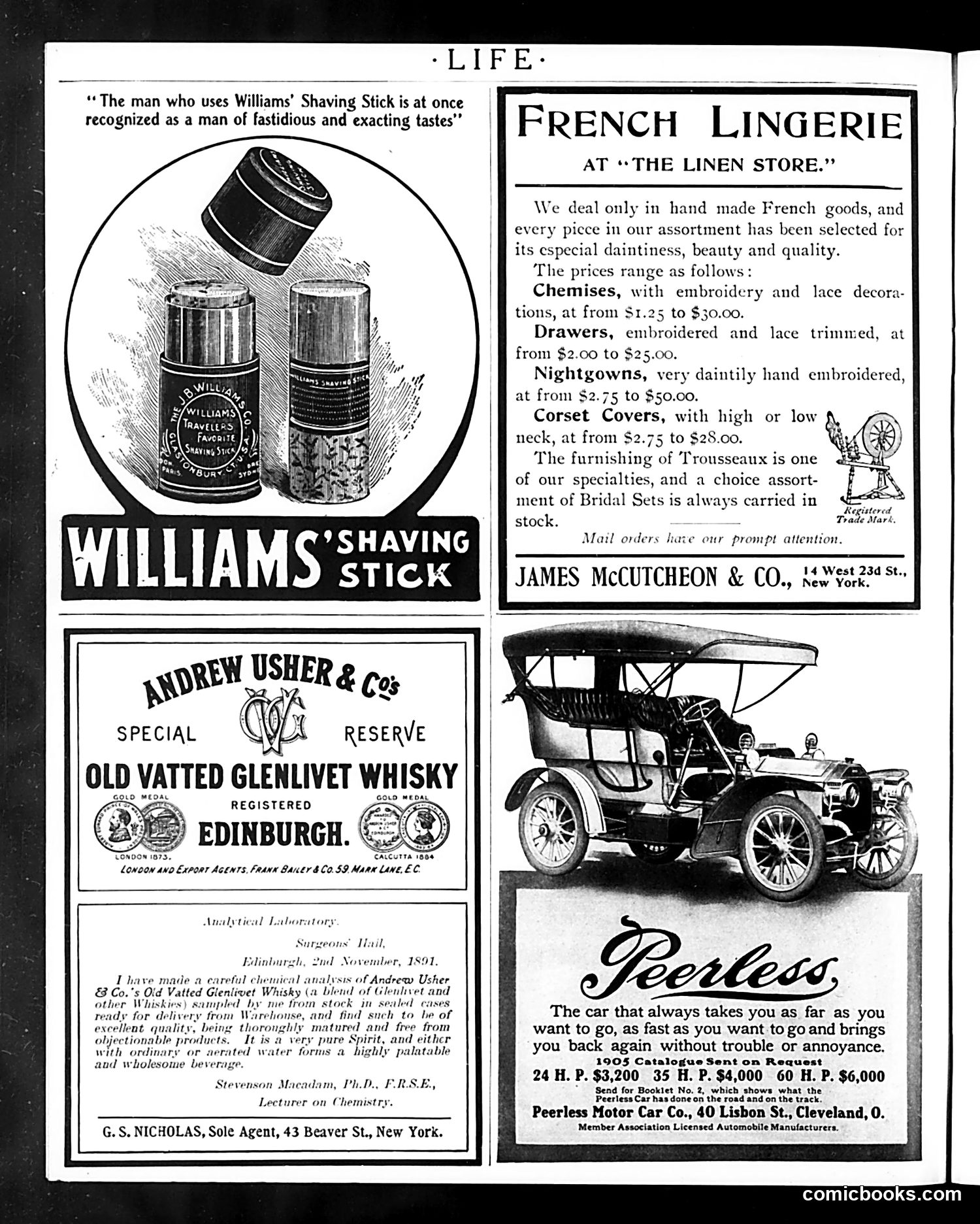
This page consists entirely of **advertisements**, not political cartoons or satire. The ads promote: 1. **Williams' Shaving Stick** - positioned as a marker of refined taste and "fastidious" masculinity 2. **French Lingerie** from The Linen Store (James McCutcheon & Co., NYC) - emphasizing hand-made quality and exclusivity 3. **Andrew Usher & Co's Old Vatted Glenlivet Whisky** from Edinburgh, with a chemical analysis endorsement 4. **Peerless automobiles** - available in multiple horsepower models, marketed as reliable for both long-distance and local travel These luxury goods target wealthy consumers. The Peerless ad notably emphasizes reliability and ease of use—relevant to early automobiles when mechanical failure was common. All reflect early 1900s consumer culture and class aspiration rather than satirical commentary.
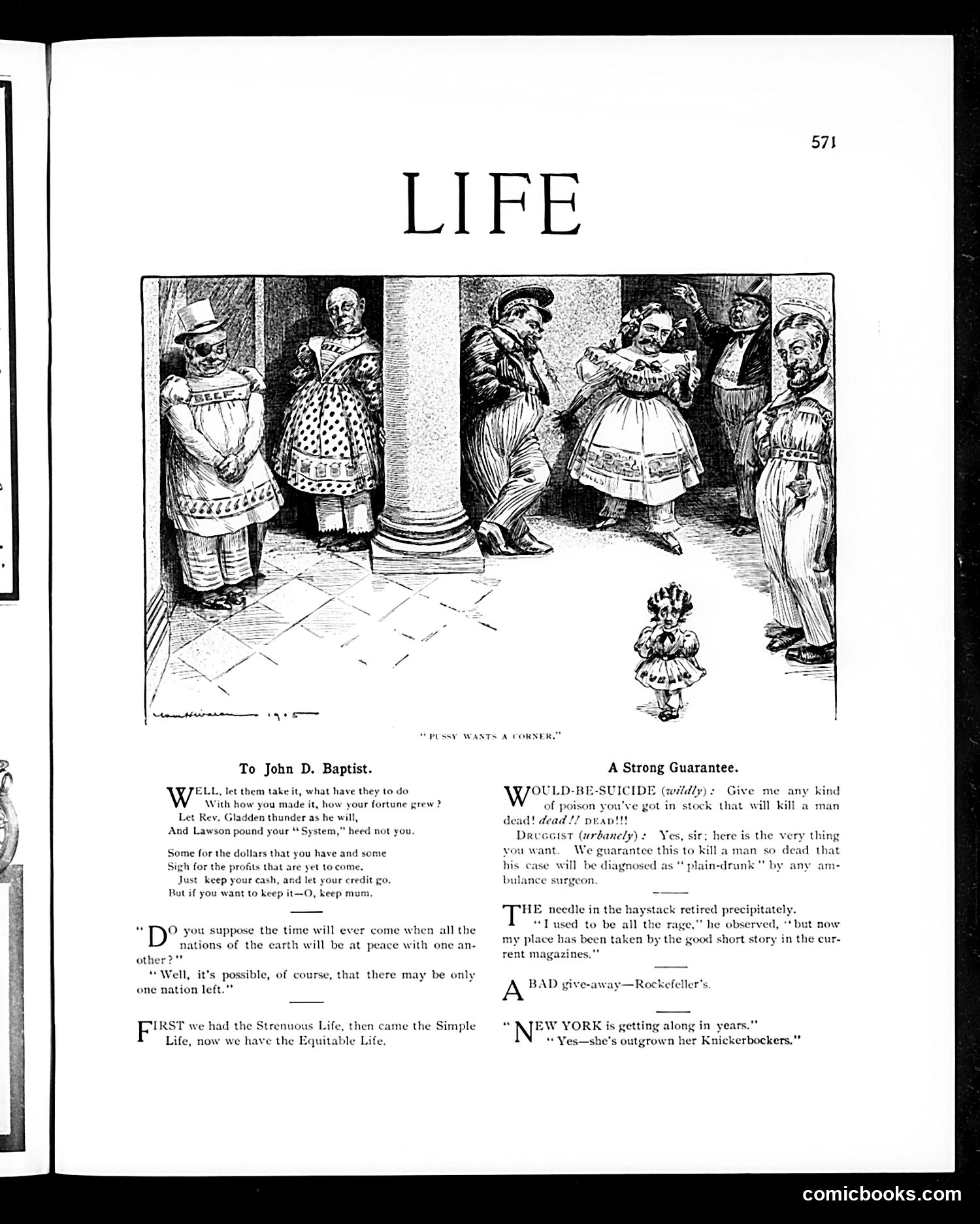
The main cartoon depicts a small child surrounded by adult figures in what appears to be a public space, captioned "Pussy Wants a Corner." This is a visual reference to the children's game, likely satirizing adult competition or conflict. Below are various satirical quips and observations. "To John D. Baptist" appears to reference John D. Rockefeller, the wealthy industrialist, mocking his business practices and wealth accumulation. "A Strong Guarantee" jokes darkly about poison and medical diagnosis. Other brief items mock New York's social evolution and changing fashions ("Knickerbocker" styles). The page represents typical Life magazine humor: biting social commentary on wealth inequality, American life, and contemporary fashions, presented through short satirical pieces rather than sustained narrative.
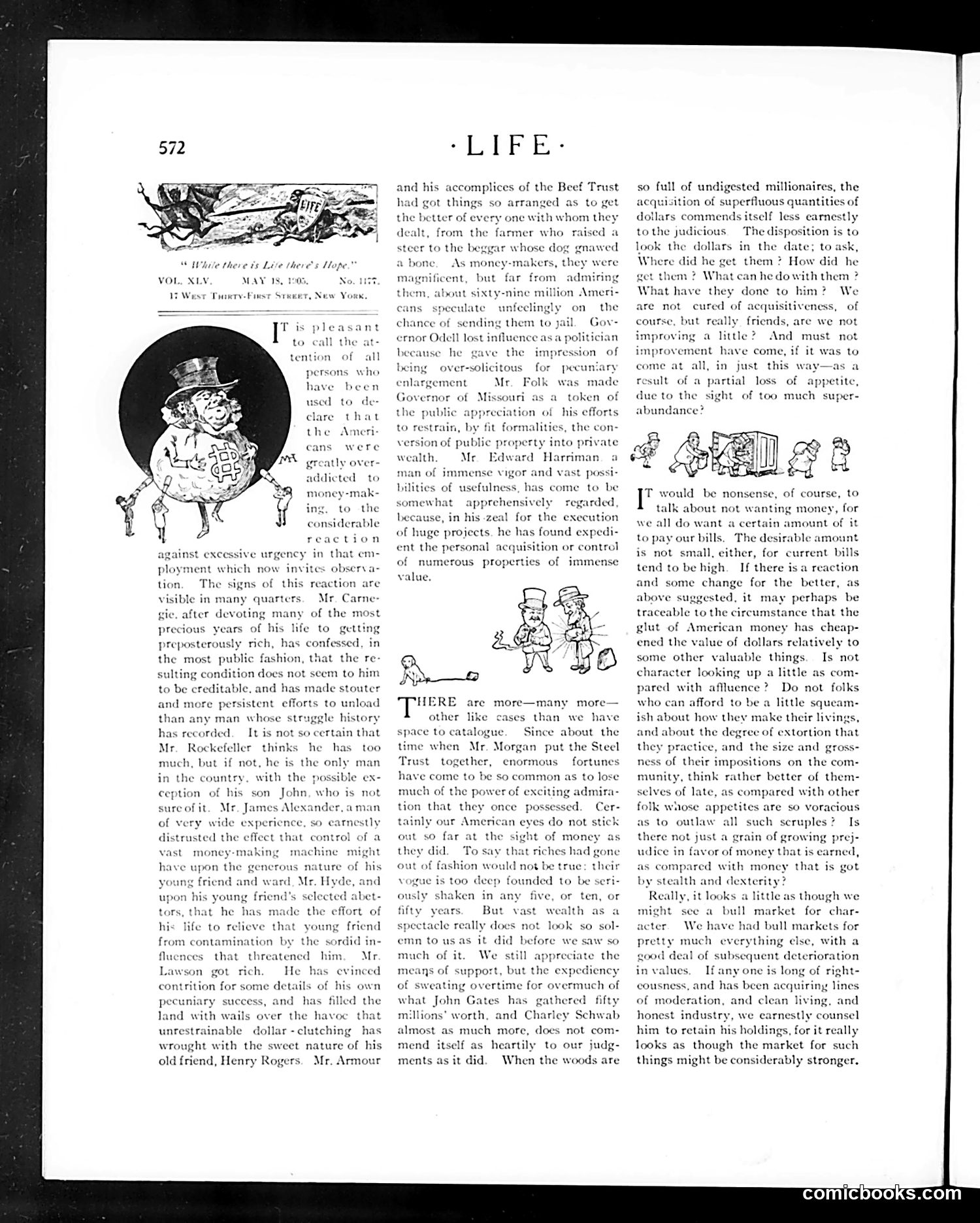
This *Life* magazine page satirizes American wealth concentration during the Gilded Age. The central cartoon depicts a grotesquely fat figure labeled with money symbols, surrounded by tiny supplicants—a visual metaphor for how millionaires control society. The text criticizes wealthy industrialists like those involved in the Beef Trust (a monopoly controlling cattle markets) for accumulating "superfluous quantities of dollars" through exploitative practices. It mocks their attempts to buy respectability through charitable gestures while remaining fundamentally greedy. The satire targets the hypocrisy of the era: millionaires who "character looking up a little as compared with affluence" while ordinary citizens suffer. The piece argues their wealth hasn't elevated American morality—instead, money has become shamefully cheap relative to actual values.
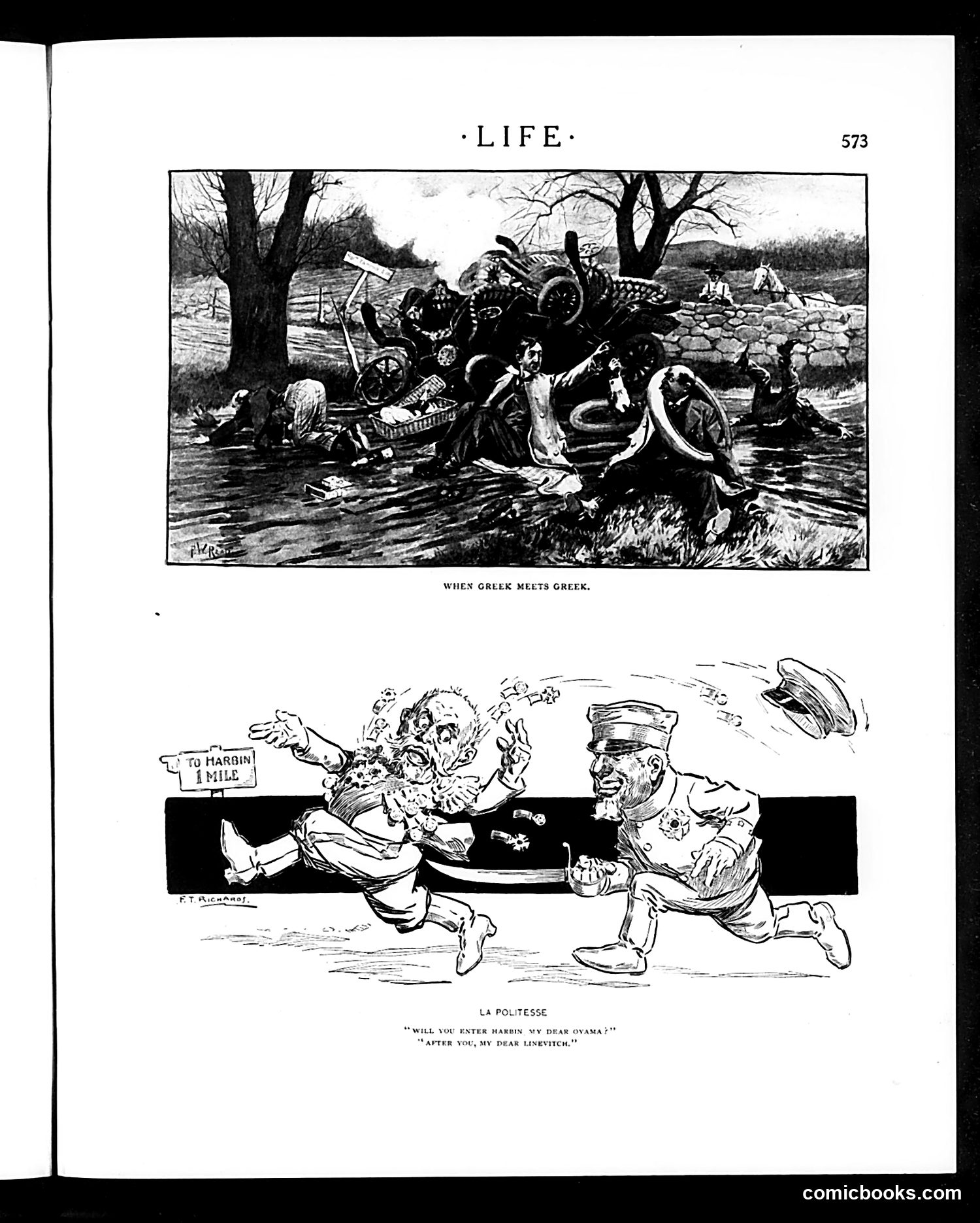
**Top illustration** ("When Greek Meets Greek"): Shows figures in classical/mythological dress meeting at a stream, apparently referencing a proverb about conflict between equals. **Bottom cartoon** ("La Politesse"): Depicts two caricatured figures in military dress running toward each other. One is labeled "To Hardin Hall." The dialogue reads: "Will you enter Hardin, my dear Oyama?" / "After you, my dear Liventch." This appears to satirize diplomatic protocol or military courtesy between rival powers, likely referencing early 20th-century international relations. The names suggest Japanese (Oyama) and European figures, though the specific historical context remains unclear without additional dating information. The humor derives from exaggerated politeness masking competitive tension.
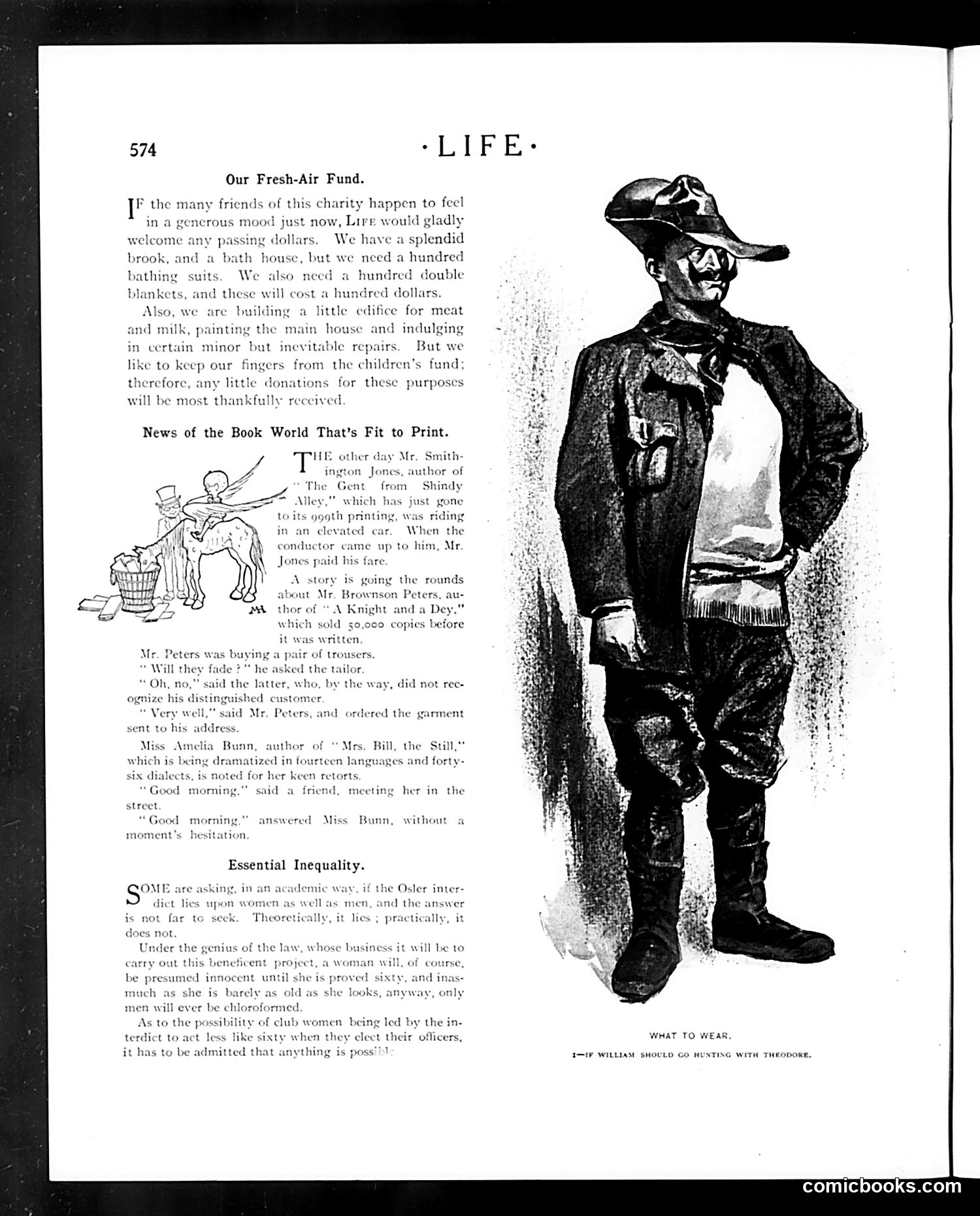
This page contains three distinct sections: 1. **"Our Fresh-Air Fund"** - A charity appeal for a children's organization needing bathing suits, blankets, and building repairs. 2. **"News of the Book World"** - Brief anecdotes about authors, including a humorous story about Mr. Brownson Peters, whose book "A Knight and a Dev" sold 50,000 copies. The joke involves Peters not recognizing a customer he'd met while buying trousers. 3. **"Essential Inequality"** - A satirical piece questioning whether women should have equal legal status to men, arguing theoretically women deserve equality but practically it doesn't work—with the implicit satire being this reveals hypocrisy in denying women's rights. 4. **The main illustration** (captioned "What William Should Go Hunting With Theodore") depicts a man in military/hunting attire, likely satirizing Theodore Roosevelt or a contemporary political figure.
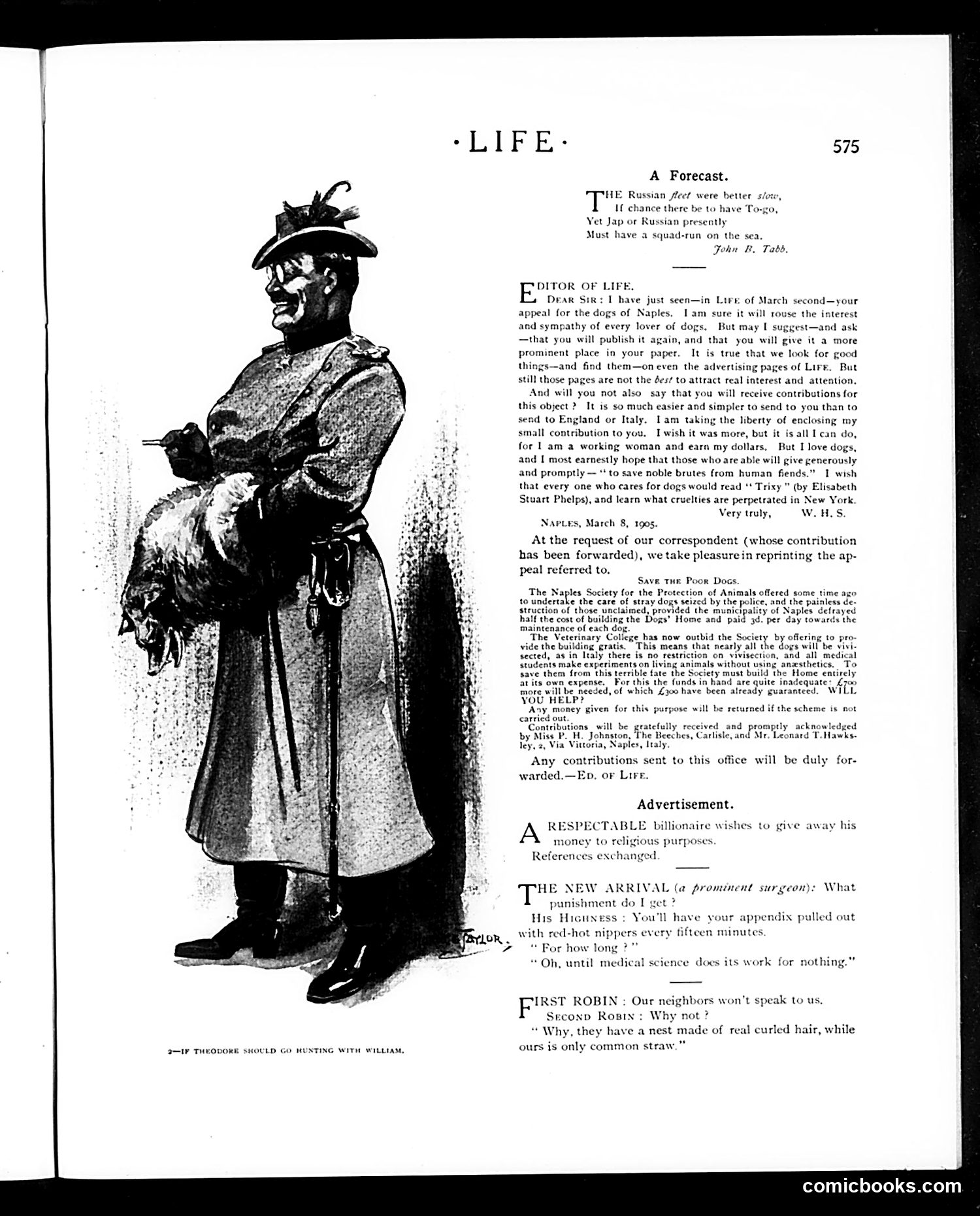
This page from Life magazine (March 8, 1905) contains several satirical pieces: **Main Cartoon**: Shows a figure (signed "Taylor") labeled "If Theodore Should Go Hunting with William"—likely referencing Theodore Roosevelt and William McKinley or another William, using the hunting metaphor satirically. **Content Focus**: The page primarily features reader correspondence about animal welfare, specifically a fundraising appeal for Naples' stray dogs. A working-class woman contributor urges Life to republish and promote donations for a Dogs' Home, fearing the alternative is vivisection without anesthetics by medical students in Italy. **Satirical Jokes Below**: - A surgeon arriving in Hell being tortured with hot pincers until "medical science does its work for nothing"—mocking doctors' reluctance to work without pay - Two robins whose neighbors won't associate with them because they have a fancy nest made of "real curled hair" versus common straw—satirizing class-based social snobbery The page reflects early 1900s concerns: animal cruelty, medical ethics, class divisions, and humane reform movements.
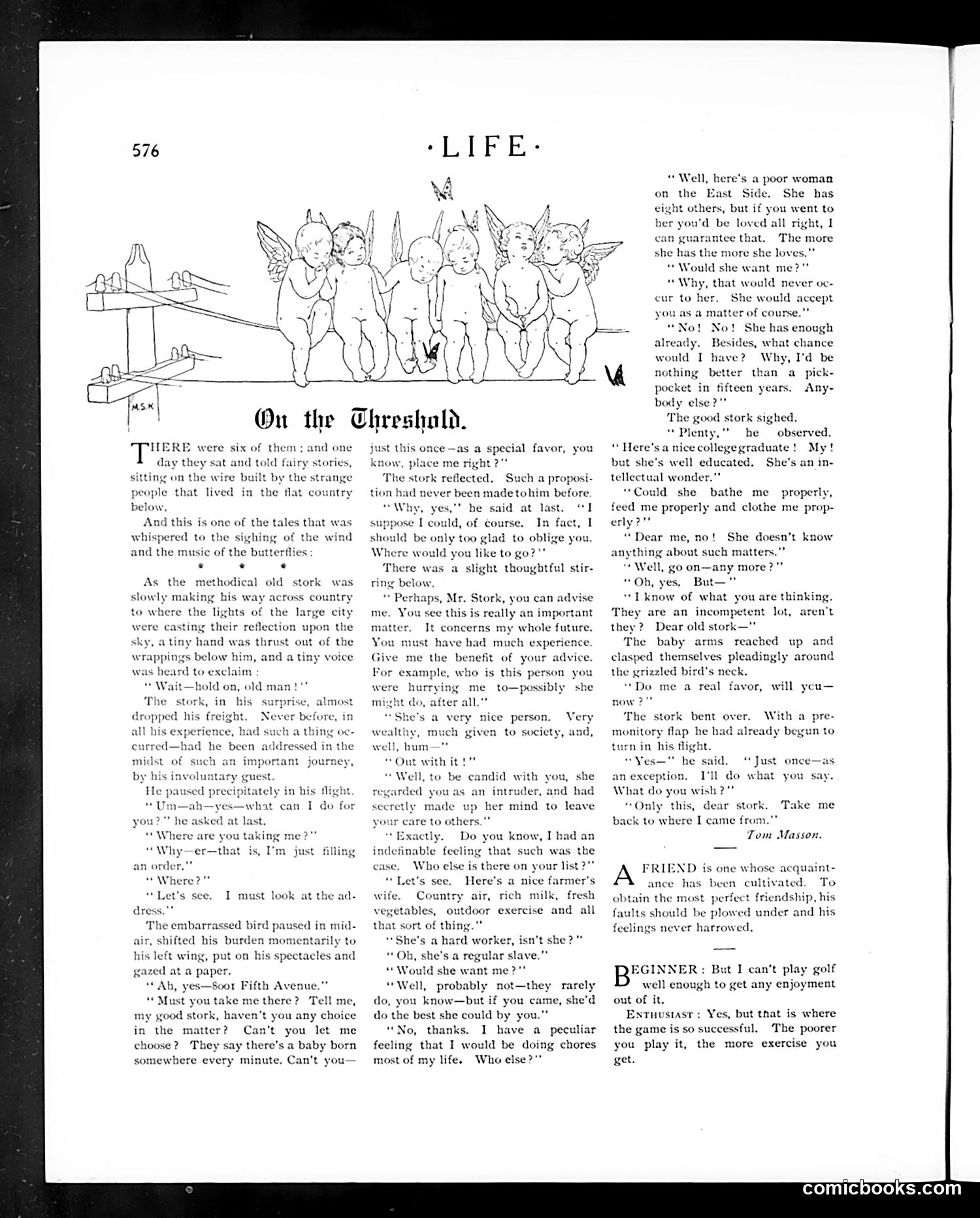
This story-cartoon satirizes turn-of-the-century anxieties about where babies should be born and raised. An unborn baby (represented as a cherub in the illustration) interrupts a stork's delivery, asking to choose its destination rather than accept the assigned poor family on the East Side. The satire mocks both the baby's ingratitude and contemporary class assumptions: the stork offers alternatives—a hard-working farm wife, an educated college graduate—but the baby rejects each, fearing poverty, servitude, or incompetence. The joke critiques privileged attitudes: even an unborn child refuses humble origins, yet finds every realistic option unsatisfactory. The story ultimately endorses the poor family's unconditional love as the best choice, making it a gentle moral tale disguised as comedy. It reflects Gilded Age debates about social mobility, education, and family values.
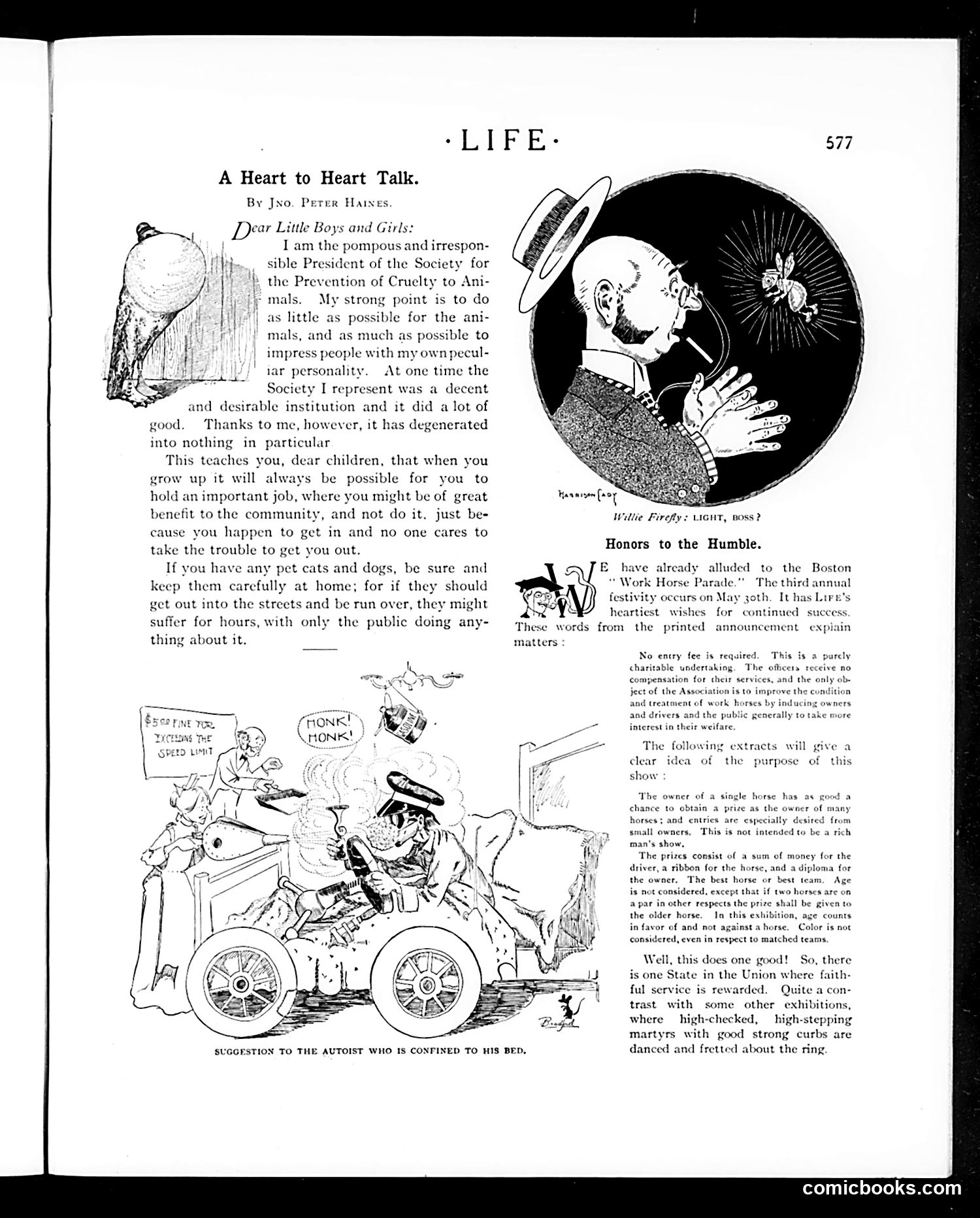
This page satirizes institutional corruption and incompetence. The main article mocks the president of the Society for the Prevention of Cruelty to Animals, who openly admits he does nothing for animals while self-aggrandizingly using the prestigious position to impress people. The satire's point: important jobs can be held by people who provide no actual benefit, simply because no one bothers removing them. The cartoon below—"Suggestion to the Autoist Confined to His Bed"—depicts a chaotic car full of bizarre mechanical contraptions, satirizing early automobiles as overcomplicated and absurd. The second article praises Boston's Work Horse Parade, celebrating a competition that judges working horses fairly, based on merit rather than cosmetic appearance or age—implicitly contrasting this democratic approach with other exhibitions that favor artificially groomed, high-strung show animals. It's a celebration of humble, honest labor over pretentious display.
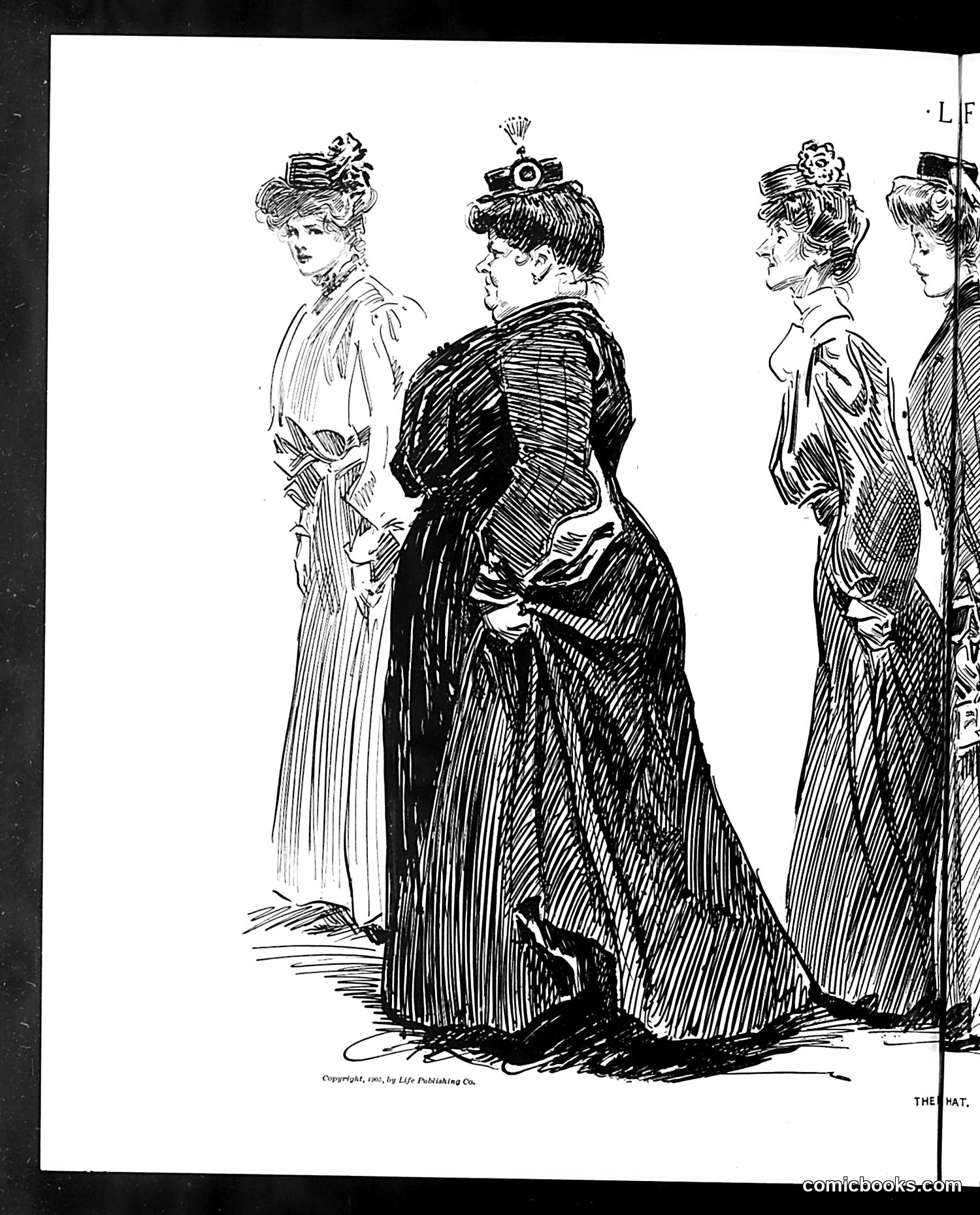
This is a pen-and-ink illustration from *Life* magazine (copyright 1901, per the visible text) depicting four fashionably dressed women in early 1900s attire. The central figure wears an elaborate black gown with a dramatic train and an ornate hat with a prominent feather or plume. The satire appears to target **extravagant women's fashion of the Edwardian era**, particularly the large, ostentatious hats that were popular among wealthy women. The women's poses—standing somewhat awkwardly, seemingly weighed down by their elaborate clothing—suggest mockery of the impracticality and excess of high fashion. The page heading references "THE HAT," indicating the focus is specifically on ridiculing the oversized, decorated millinery that dominated women's fashion during this period. This was a common subject of satirical commentary in *Life* magazine.
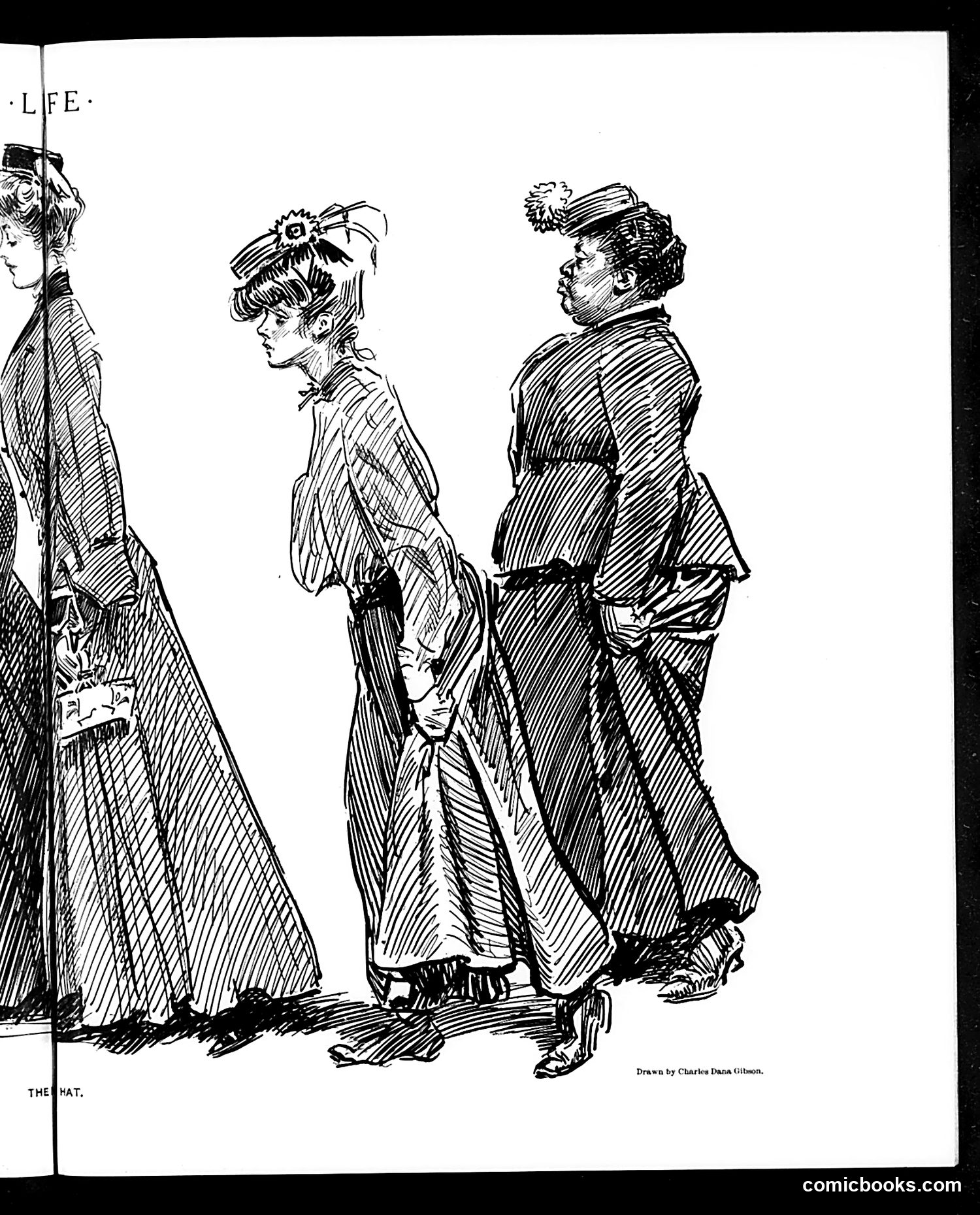
The OCR text is too corrupted to read reliably. However, the image shows a pen-and-ink illustration by Charles Dana Gibson (credited at bottom) depicting three fashionably dressed women in early 1900s attire, standing together. They wear elaborate hats, fitted jackets, and long skirts typical of the Edwardian era. The page header reads "LIFE" and "THE HAT," suggesting this satirizes women's fashions, particularly the extravagant hats that were status symbols and fashion obsessions of the period. Gibson was famous for his "Gibson Girl" illustrations depicting idealized upper-class women. Without readable text, the specific satirical point remains unclear—whether it mocks hat excess, female vanity, or social pretension among wealthy women—but the focus on elaborate millinery suggests commentary on frivolous fashion trends.
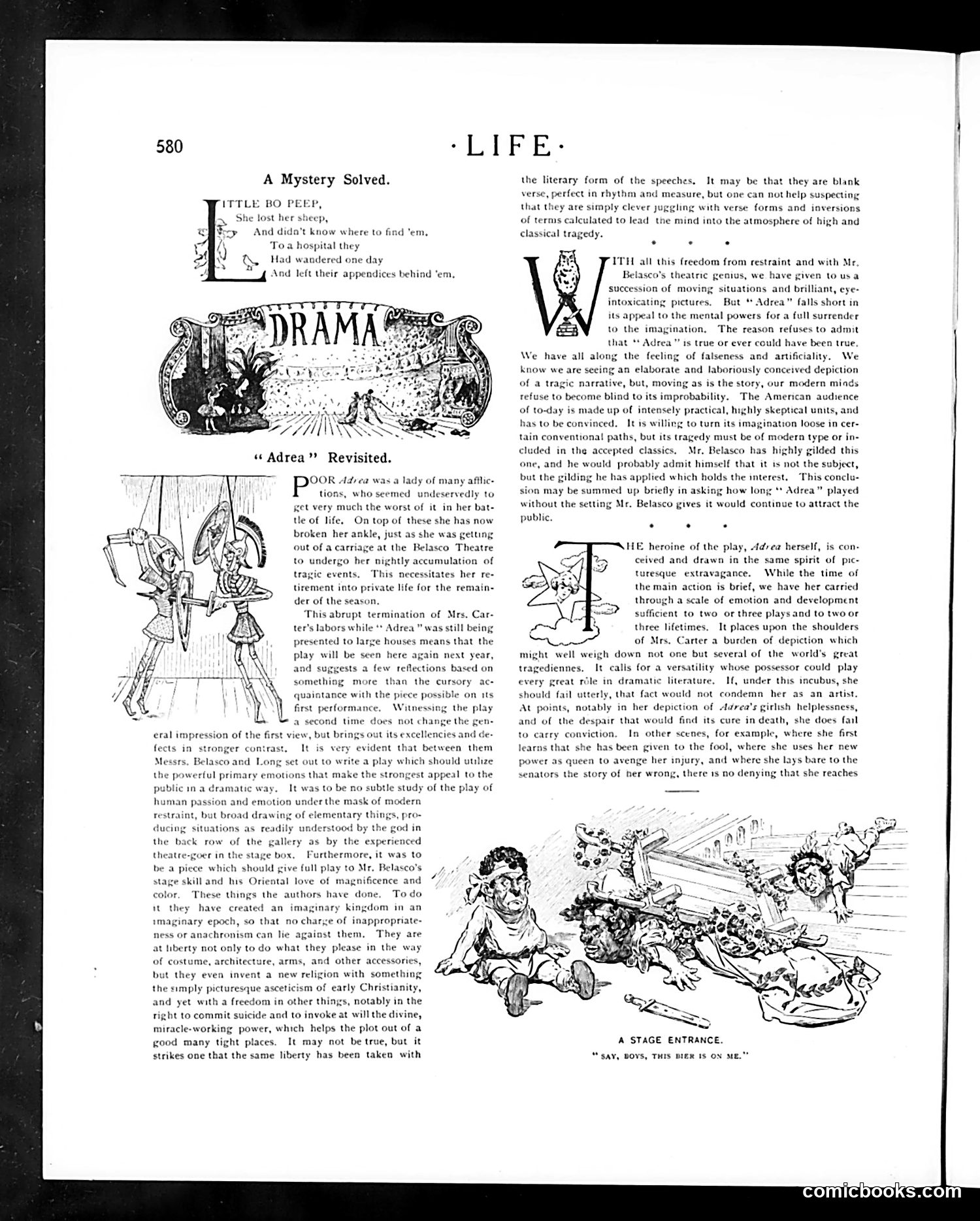
This page critiques the play *Adrea*, performed at the Belasco Theatre (starring Mrs. Carter, who broke her ankle). The opening "Little Bo Peep" poem is a lighthearted mystery solved—the lost sheep had their appendices removed at a hospital, likely referencing contemporary surgical trends. The main article praises producer David Belasco's theatrical spectacle and stagecraft while faulting the play's emotional impact. The critic argues that *Adrea*—set in an invented imaginary kingdom with fabricated religions—succeeds visually but fails intellectually. Modern American audiences, the reviewer contends, are too "practical" and "skeptical" to accept its artificial tragedy. They demand either contemporary settings or classical legitimacy, not ornate fantasy. Belasco "gilded" the work beautifully, but intellectual conviction eludes it—the audience sees elaborate artifice rather than truth.
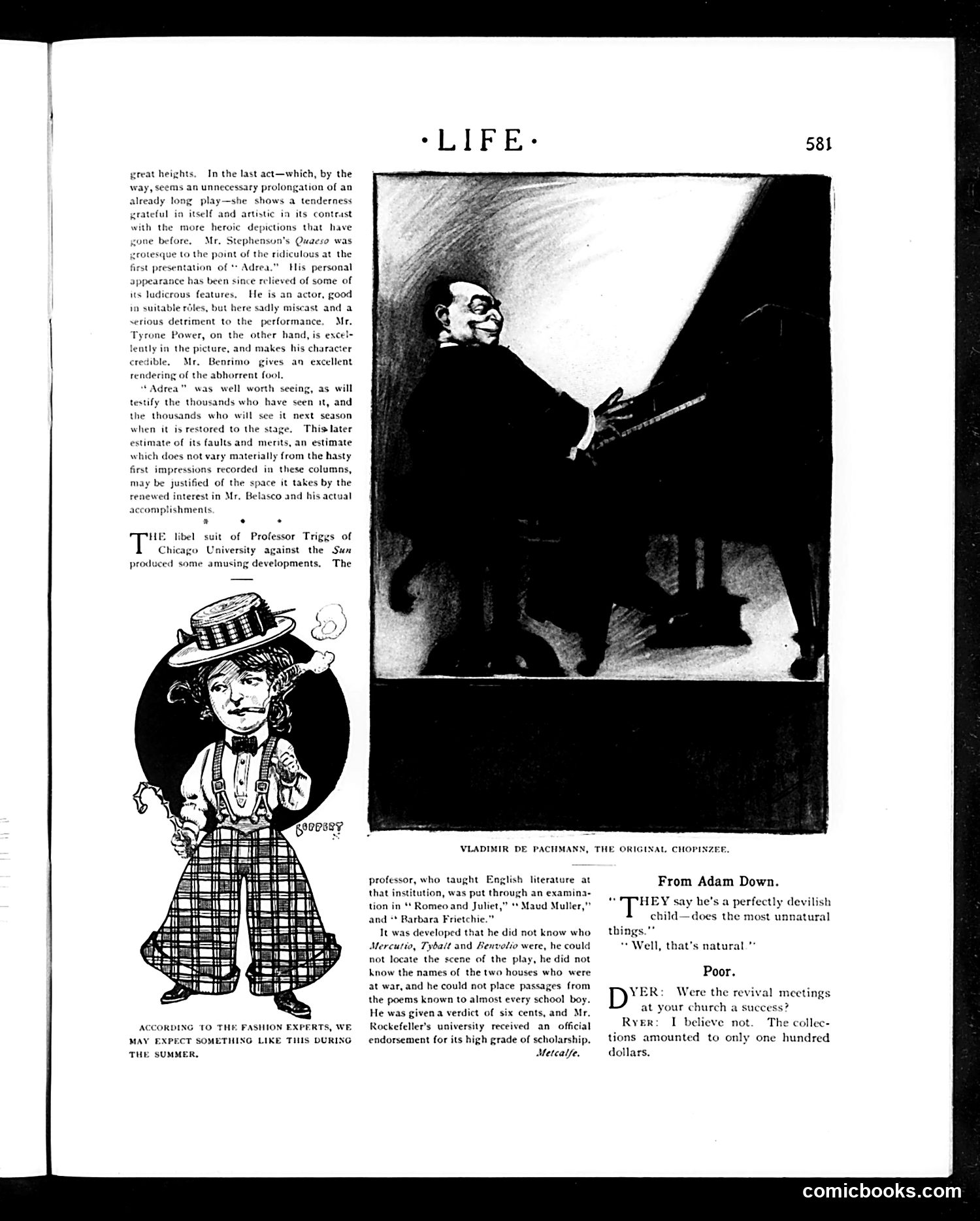
This page contains theater criticism and two satirical items: **Theater Review**: Discussion of the play "Adrea," critiquing actors Tyrone Power and others. The text praises Power's performance while criticizing another actor's portrayal as "grotesque" and "miscast." **Main Cartoon (top right)**: A photograph labeled "Vladimir de Pachmann, the Original Chopinzee"—a caricatured comparison of the pianist to a chimpanzee, mocking his appearance. **Libel Suit Story**: The page satirizes Professor Triggs of Chicago University, who sued the *Sun* newspaper. During the lawsuit examination, he was asked basic literary questions about "Romeo and Juliet" and classic poems. He failed to answer simple questions (character names, plot locations, famous passages). The joke: he taught English literature yet demonstrated profound ignorance, making the university's "high grade of scholarship" claim absurd. He received only six cents in damages. The bottom cartoon shows fashion predictions for summer fashions.
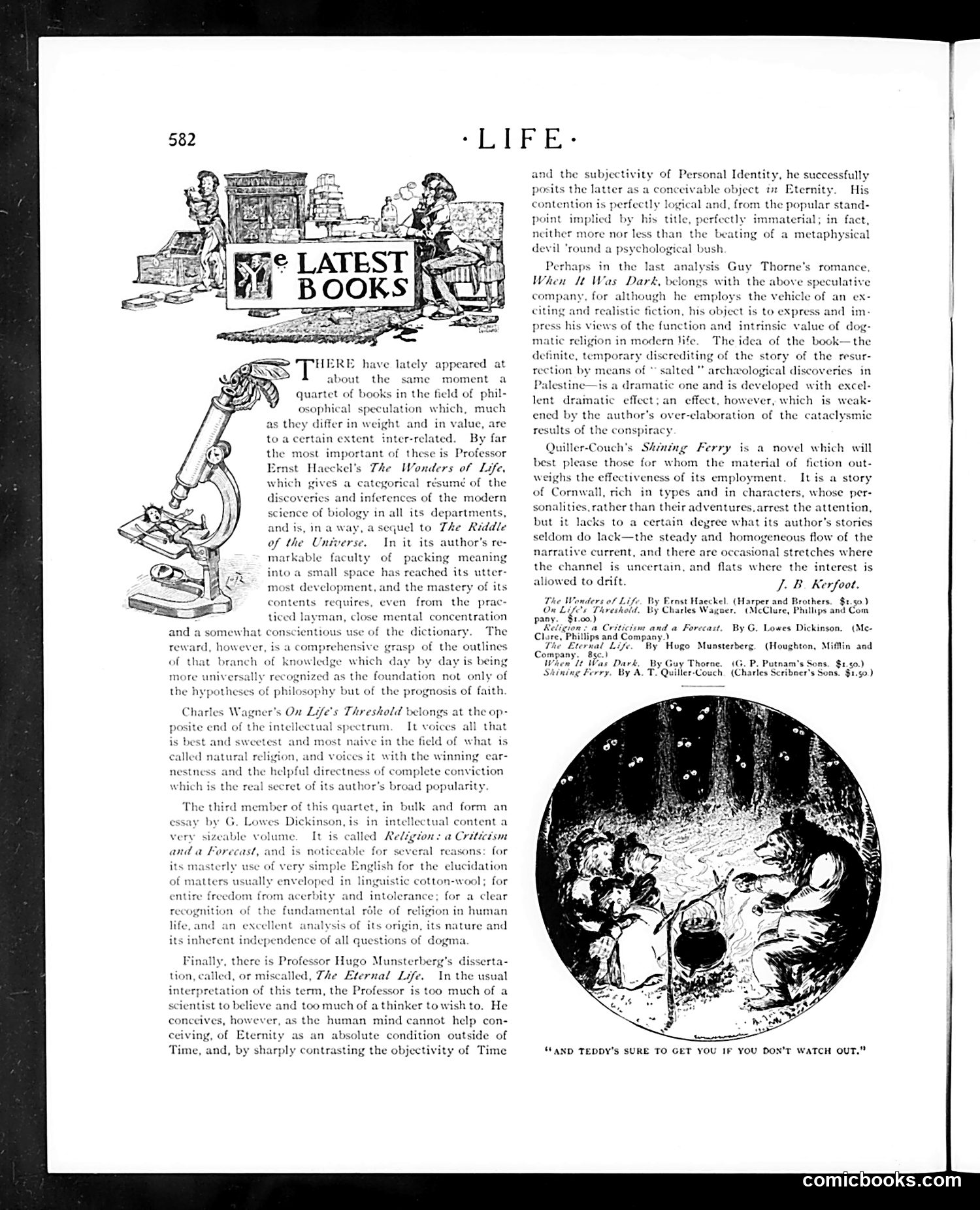
This page reviews four philosophical/religious books and one novel, reflecting turn-of-the-century intellectual debates about faith, science, and modernity. The main reviews discuss: - **Ernst Haeckel's *The Wonders of Life***: A scientific catalogue of biological discoveries, praised for densely packing information but criticized as requiring intense concentration to understand. - **Charles Wagner's *On Life's Threshold***: Positioned as the opposite end of the spectrum—appealing, naive, and emotionally earnest in its "natural religion." - **G. Lowes Dickinson's essay on religion**: Valued for clarity, avoiding jargon, and analyzing religion's role in human life without dogmatism. - **Hugo Munsterberg's *The Eternal Life***: A metaphysical argument about eternity and personal identity that the reviewer dismisses as ultimately circular reasoning. - **Guy Thorne's *When It Was Dark***: A dramatic novel using archaeological discoveries to challenge Christian resurrection—effective but over-elaborated. The illustration (bottom right) captioned "And Teddy's sure to get you if you don't watch out" appears unrelated to the book reviews, suggesting editorial variety typical of Life's format.
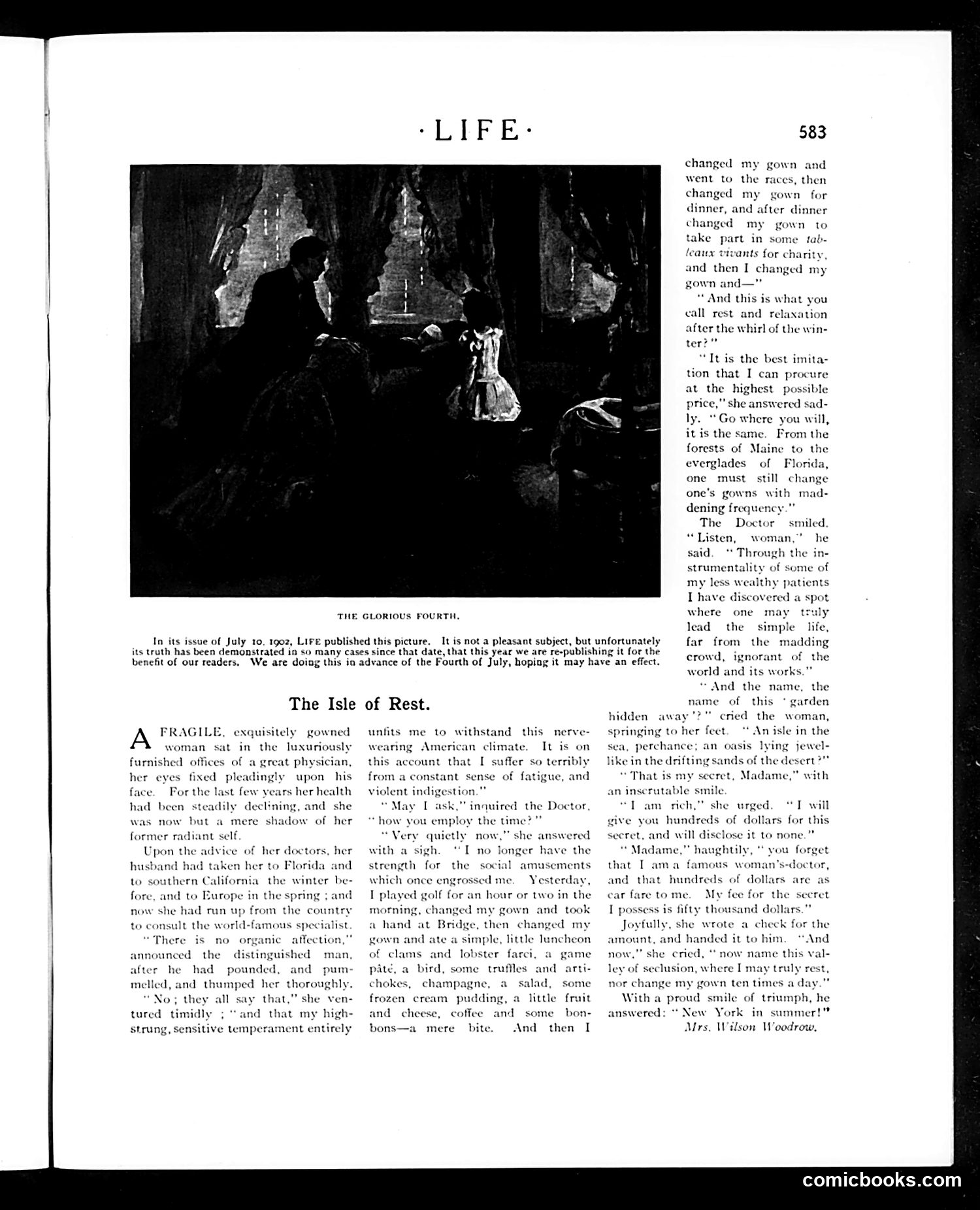
This story-cartoon satirizes wealthy American women's exhausting social lives in the early 1900s. A fragile, overworked woman visits a distinguished physician complaining of fatigue and nervous strain. She describes her supposed "rest" activities: playing golf, changing gowns repeatedly, attending charity tableaux, bridge games, and elaborate meals—all activities she considers relaxation. The doctor claims to know a secret place where one can live simply. When she pays him fifty thousand dollars for the location, he reveals the punchline: "New York in summer!" The satire mocks upper-class leisure as genuinely exhausting and performative. Even their "rest" involves constant costume changes and social obligations. The joke suggests that wealthy women cannot escape the social treadmill—there is no true refuge from the relentless demands of maintaining one's social position, not even in remote locations.
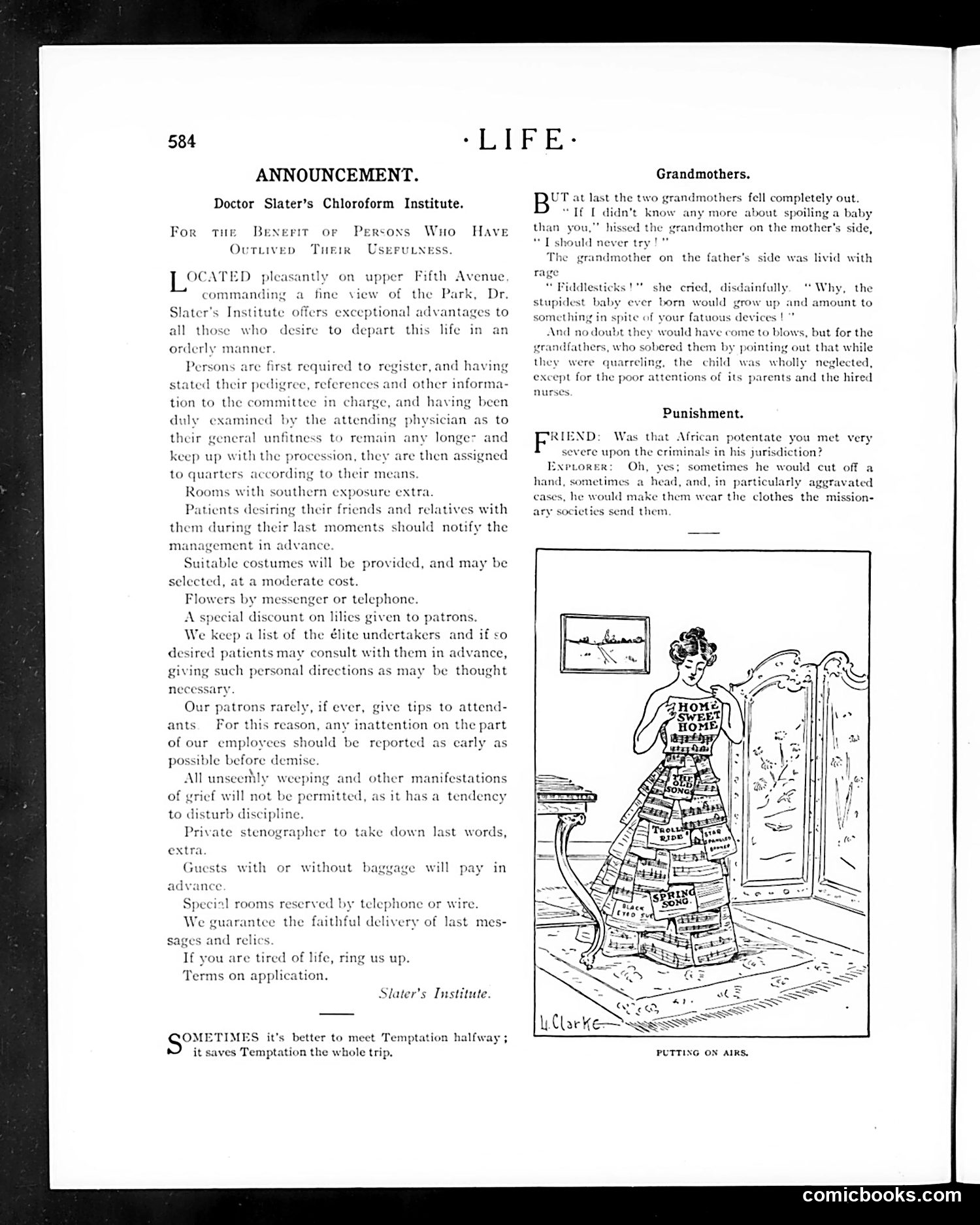
This page contains three distinct satirical pieces from *Life* magazine: **"Doctor Slater's Chloroform Institute"** is a dark mock-advertisement for a suicide clinic. It parodies upscale funeral homes by offering euthanasia services with euphemistic language ("depart this life in orderly manner"). The satire critiques both the wealthy's detachment from life and the era's fascination with chloroform as a medical cure-all. **"Grandmothers"** humorously depicts two grandmothers quarreling over child-rearing advice—a common domestic conflict. The satire pokes fun at interfering in-laws and contradictory parenting philosophies. **"Putting On Airs"** (cartoon) shows a woman dressed in corset advertisements, satirizing how women's fashion was literally constructed from commercial branding—her dress is made of product labels. This mocks both consumerism and women's objectification through fashion. The "Punishment" anecdote trivializes African colonial violence as comic material, reflecting the era's problematic racial attitudes.
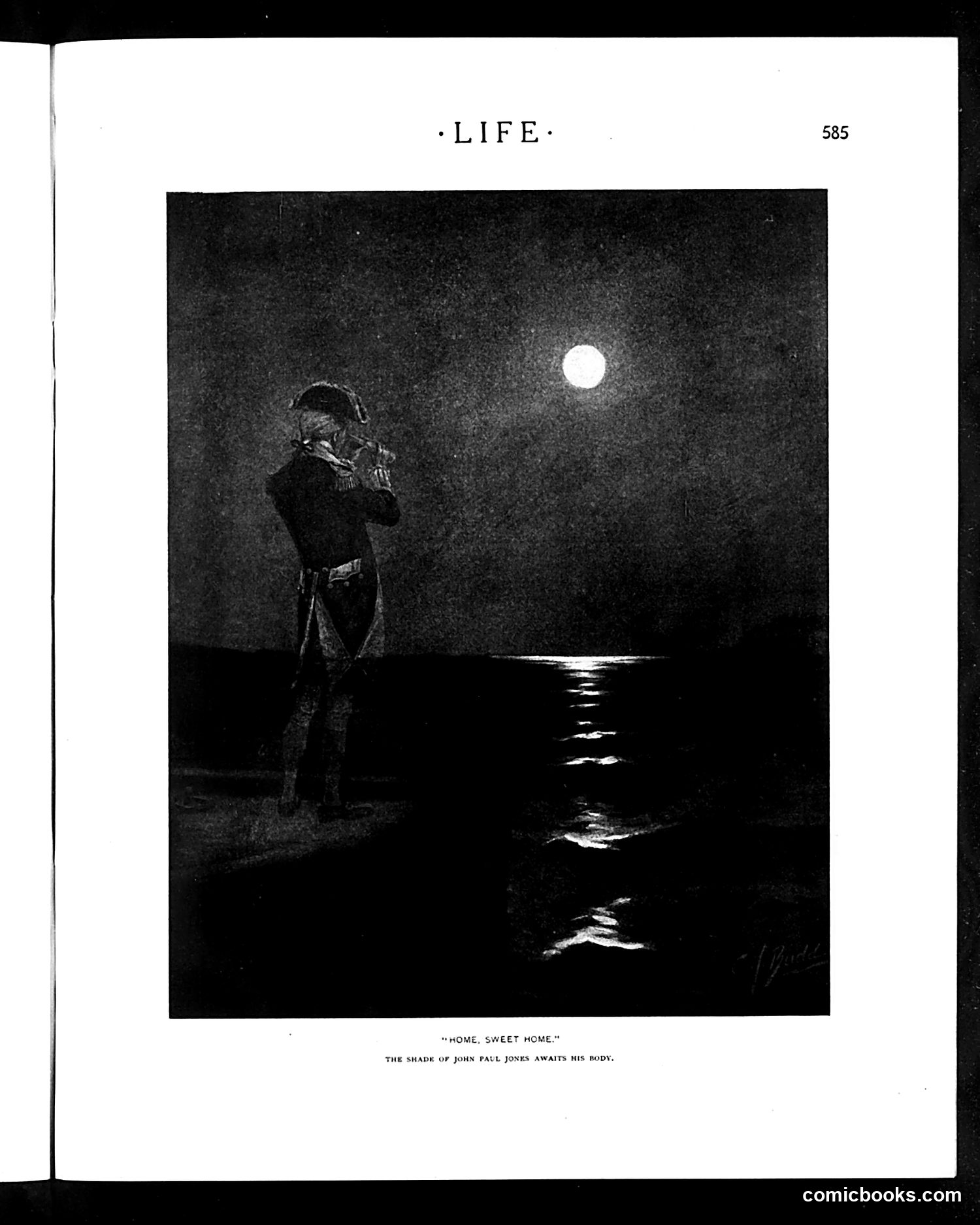
This political cartoon depicts the ghost or spirit of John Paul Jones, the Revolutionary War naval commander, standing by moonlit waters. The caption references the famous song "Home, Sweet Home" and indicates Jones's shade is waiting for his body. This likely refers to the long-delayed repatriation of John Paul Jones's remains. Jones died in France in 1792, and his body remained there for over a century before being recovered and returned to the United States in 1905 for a ceremonial burial in Annapolis. The cartoon appears to satirize either the lengthy delay or the ceremonial nature of finally bringing the naval hero "home" to American soil—presenting his restless ghost as waiting for proper burial honors.
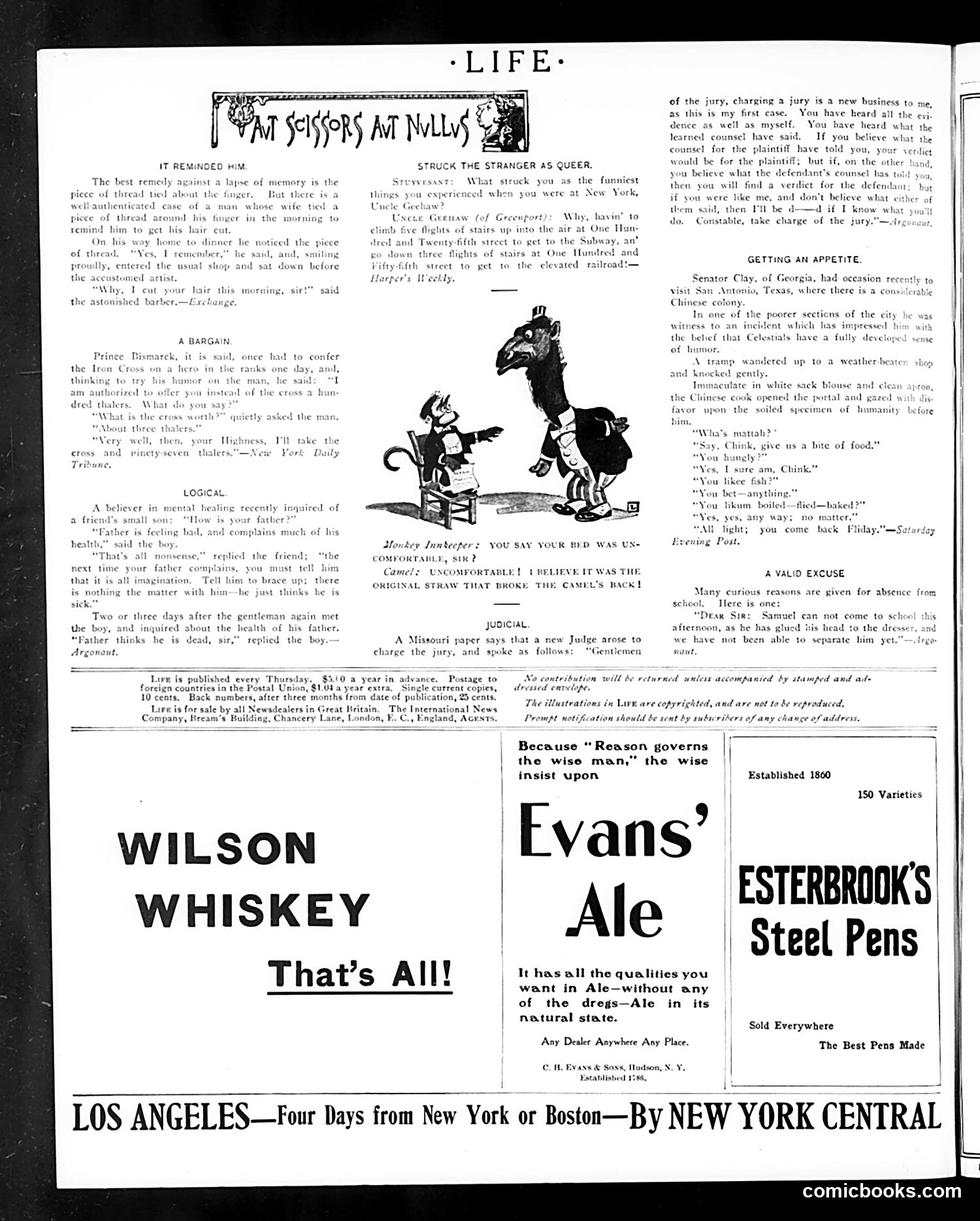
This page from the satirical magazine *Life* contains several humor pieces and advertisements typical of early 20th-century American publishing. The main cartoons mock everyday situations: "I'm Scissors at Nullus" jokes about a barber's memory; "A Bargain" references Prince Bismarck offering the Iron Cross; "Logical" presents a father-son exchange about imagination and healing; and "Judicial" depicts a judge's instructions to jurors, likely satirizing the tedium of jury duty for ordinary citizens. The cartoon labeled "Struck the Stranger as Queer" (center) shows what appears to be a stably keeper and patron—the humor likely turns on the visitor's surprise at local customs or behavior, though specifics are unclear from the OCR. The page is dominated by period advertisements (Wilson Whiskey, Evans' Ale, Esterbrook's Steel Pens, and New York Central Railway), reflecting *Life's* reliance on advertising revenue. Overall, the humor targets ordinary middle-class experiences: legal obligations, travel, domestic life, and consumer products.
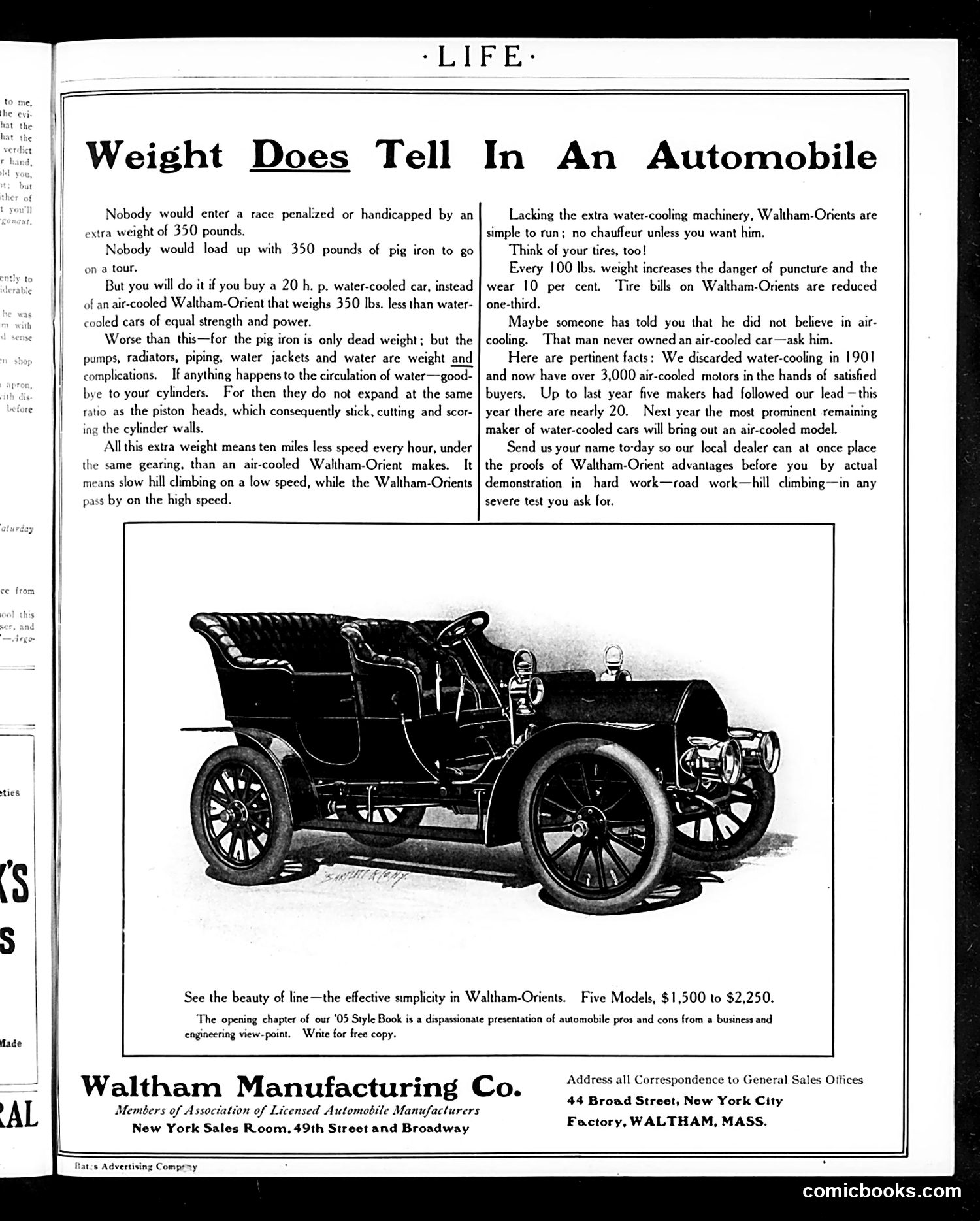
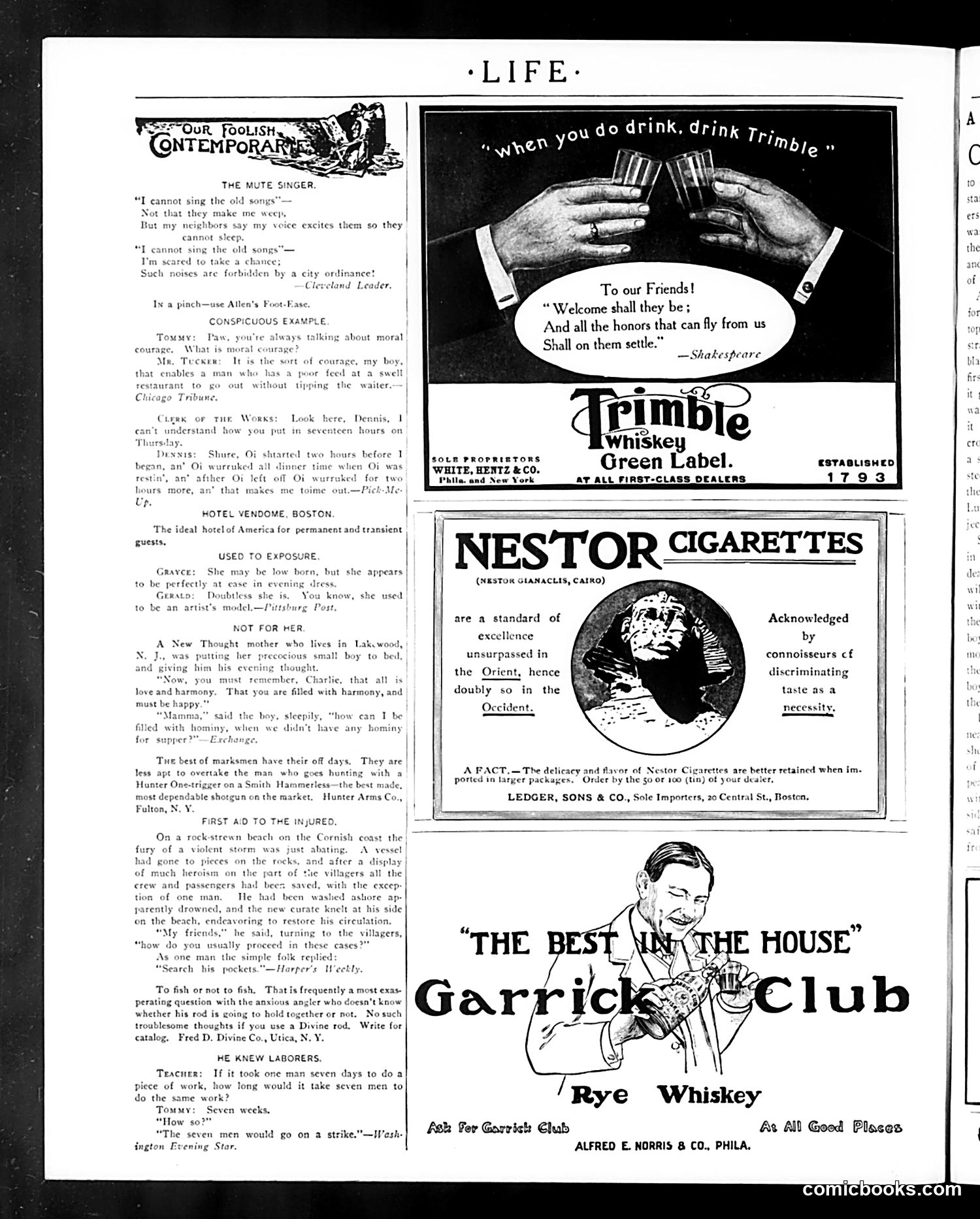
This page from *Life* magazine (established 1793, per the Trimble whiskey ad) consists primarily of **humorous anecdotes and advertising** rather than political cartoons. The satirical content includes short jokes mocking social pretension and labor disputes: a woman afraid to sing loudly due to city ordinances; a wealthy man's daughter who remains "perfectly at ease" despite humble origins; and most notably, a teacher's question about seven workers refusing to work together—implying labor solidarity or strikes would slow productivity. The advertisements dominate: **Trimble whiskey** (featuring a Shakespeare quote about hospitality), **Nestor cigarettes** (marketed as an Oriental luxury product), **Garrick Club rye whiskey**, and various other products. This appears to be a **turn-of-the-century American humor and lifestyle magazine**, mixing gentle social satire with commercial appeals to upper-middle-class readers. The labor joke suggests period anxieties about unionization and worker organization.
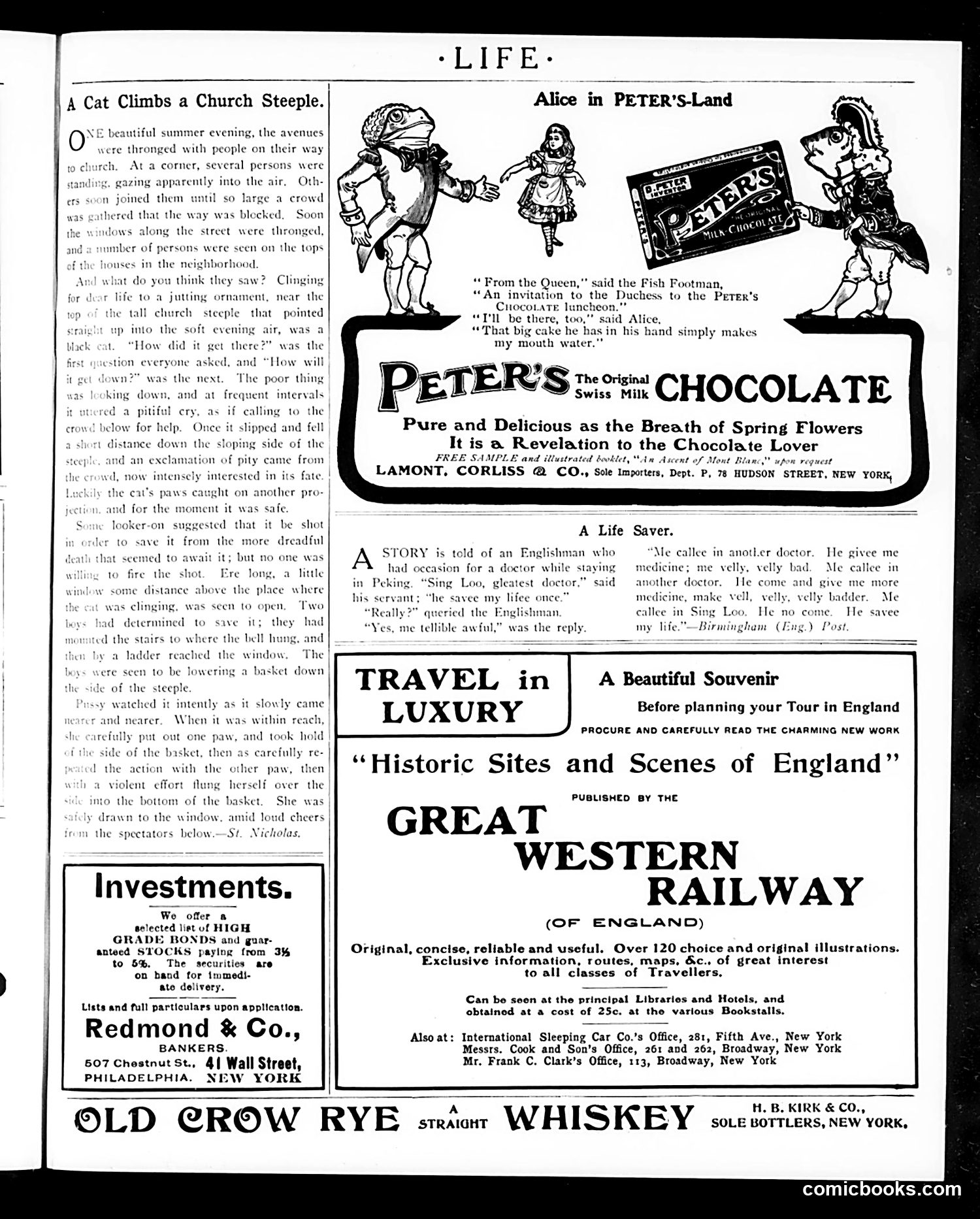
This page is primarily **advertising** interspersed with short humorous stories typical of Life magazine's format. The notable content includes: **"A Cat Climbs a Church Steeple"** — a sentimental anecdote about a cat stranded on a church spire that crowds gather to watch. Rescuers lower a basket to save it, demonstrating Victorian-era sentimentality about animal welfare. **"Alice in Peter's-Land"** — a brief literary reference playing on *Alice in Wonderland*, used to advertise Peter's Swiss Milk Chocolate, suggesting the product is as magical/desirable as Carroll's fictional realm. **"A Life Saver"** — a joke story with heavy ethnic dialect humor (the "Sing Loo" character speaking broken English), where a Chinese doctor's absence paradoxically saves an Englishman's life by preventing harmful medical intervention. This reflects period attitudes toward non-Western medicine and ethnic stereotyping common in early 1900s American humor. The remainder consists of advertisements for bonds, chocolate, whiskey, and travel guides — standard commercial content for the magazine.
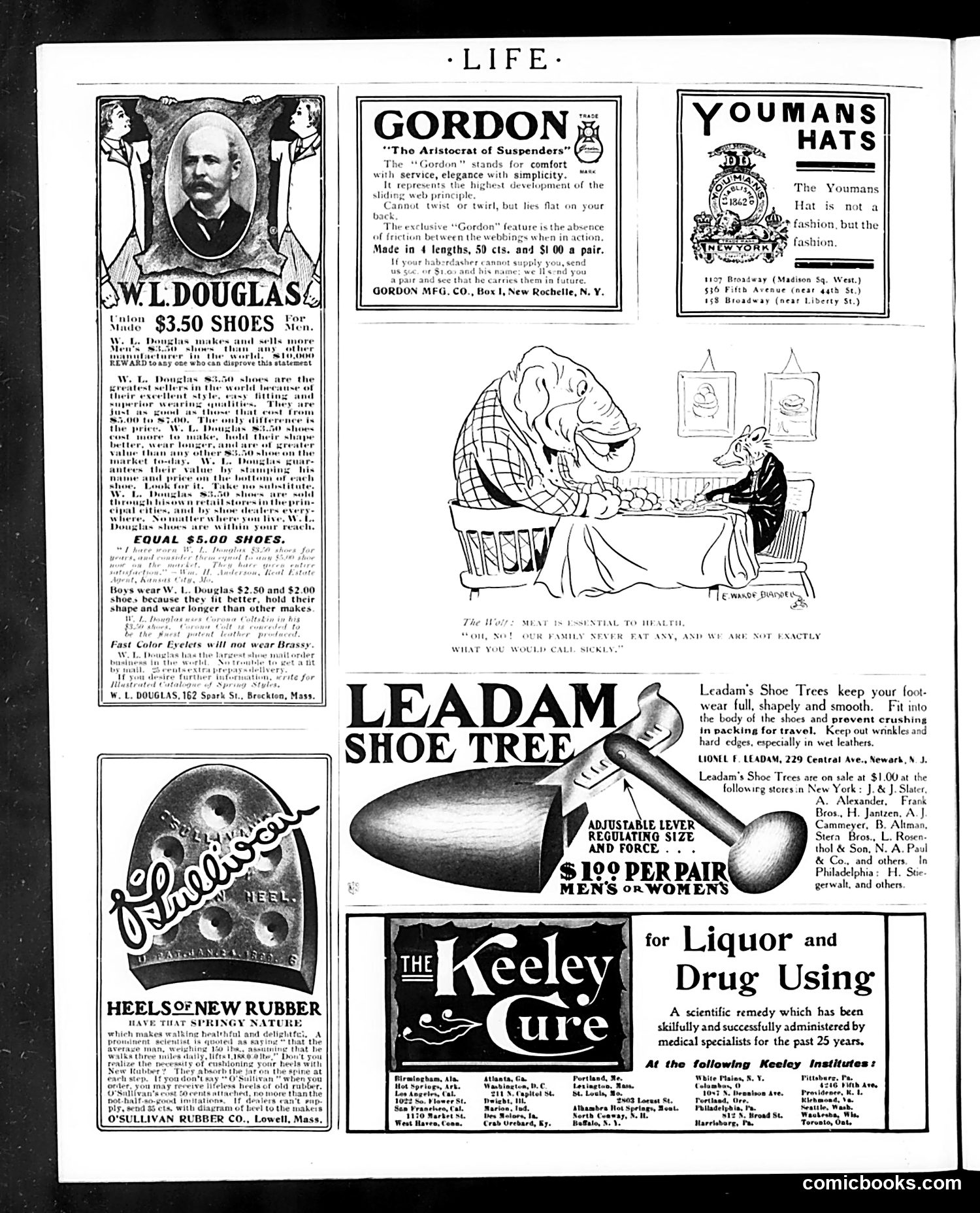
This is primarily an **advertising page** from Life magazine, not a political cartoon. The content consists almost entirely of commercial advertisements for products popular in the early 1900s. The one notable illustration is a small cartoon titled "The Wolf," depicting a large, menacing figure at a dining table with a thin, sickly family. The caption reads: "Meat is essential to wealth. 'Oh, no! Our family never eat any, and we are not exactly what you would call sickly.'" This appears to be **satirizing working-class poverty**—the "wolf" represents deprivation or hardship at the door, while the family ironically claims health despite their inability to afford meat, a marker of prosperity. The remaining advertisements promote shoes (W.L. Douglas, Leadam), suspenders (Gordon), hats (Youmans), shoe trees, rubber heels, and notably, the **Keeley Cure for "Liquor and Drug Using"**—reflecting contemporary anxieties about addiction treatment.
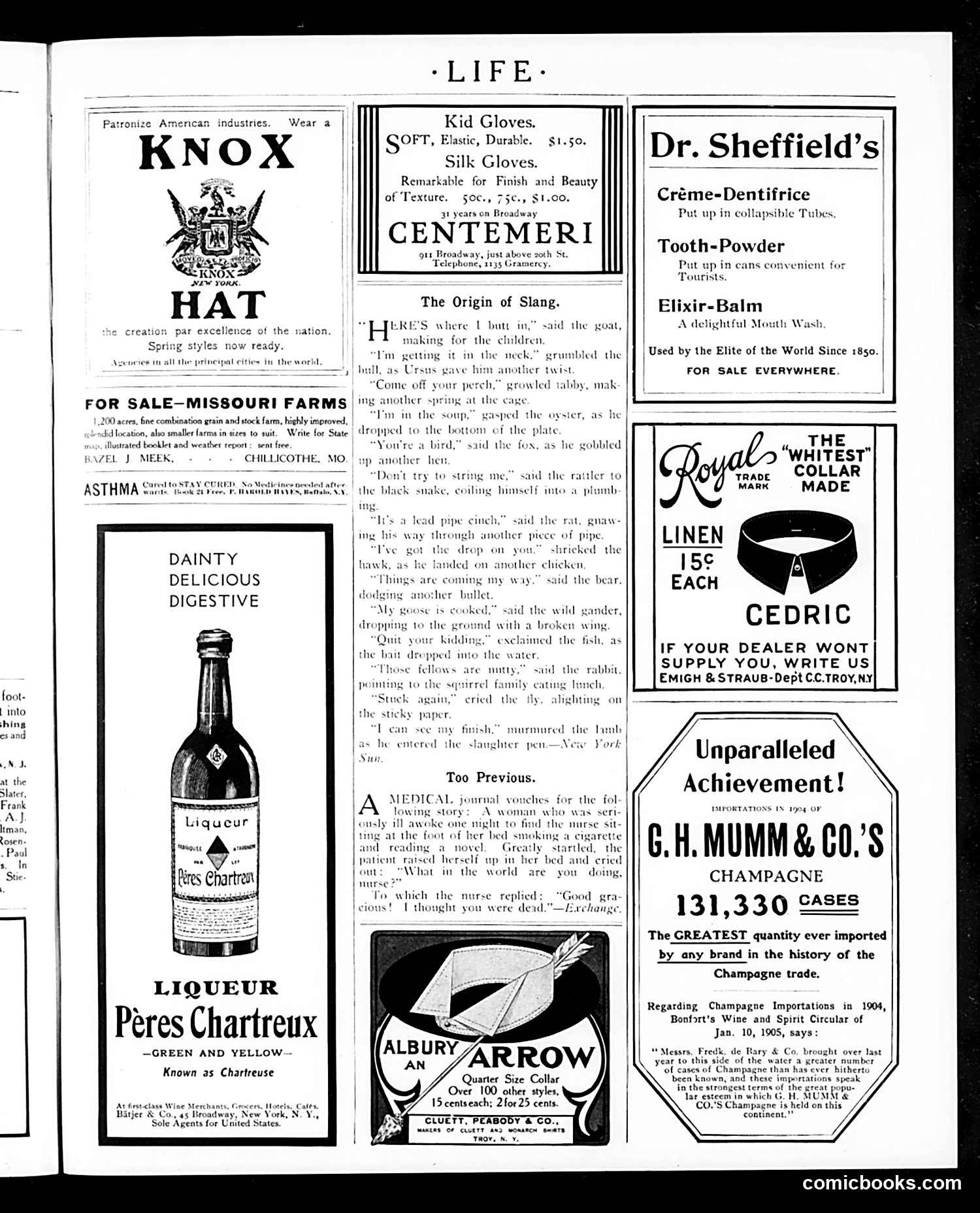
This is primarily an **advertising page** with minimal editorial content. The main feature is a brief humorous story titled "The Origin of Slang" and "Too Previous"—two unrelated jokes. **"The Origin of Slang"** presents a children's fable where various animals and objects make excuses for misbehavior, each inventing slang phrases ("I'm in the soup," "lead pipe cinch"). The joke satirizes how common slang expressions originated from mundane situations, presented through anthropomorphized creatures. **"Too Previous"** is a medical anecdote: a patient wakes to find a nurse smoking and reading novels at her bedside instead of attending to her. When startled, the patient confronts her. The nurse replies the patient was "dead"—implying the patient was unconscious/unaware. The joke mocks negligent nursing care. The remainder consists of product advertisements typical of early 1900s Life: liqueur, hats, gloves, tooth products, collars, and champagne—reflecting the magazine's mixed editorial-advertising format of the era.
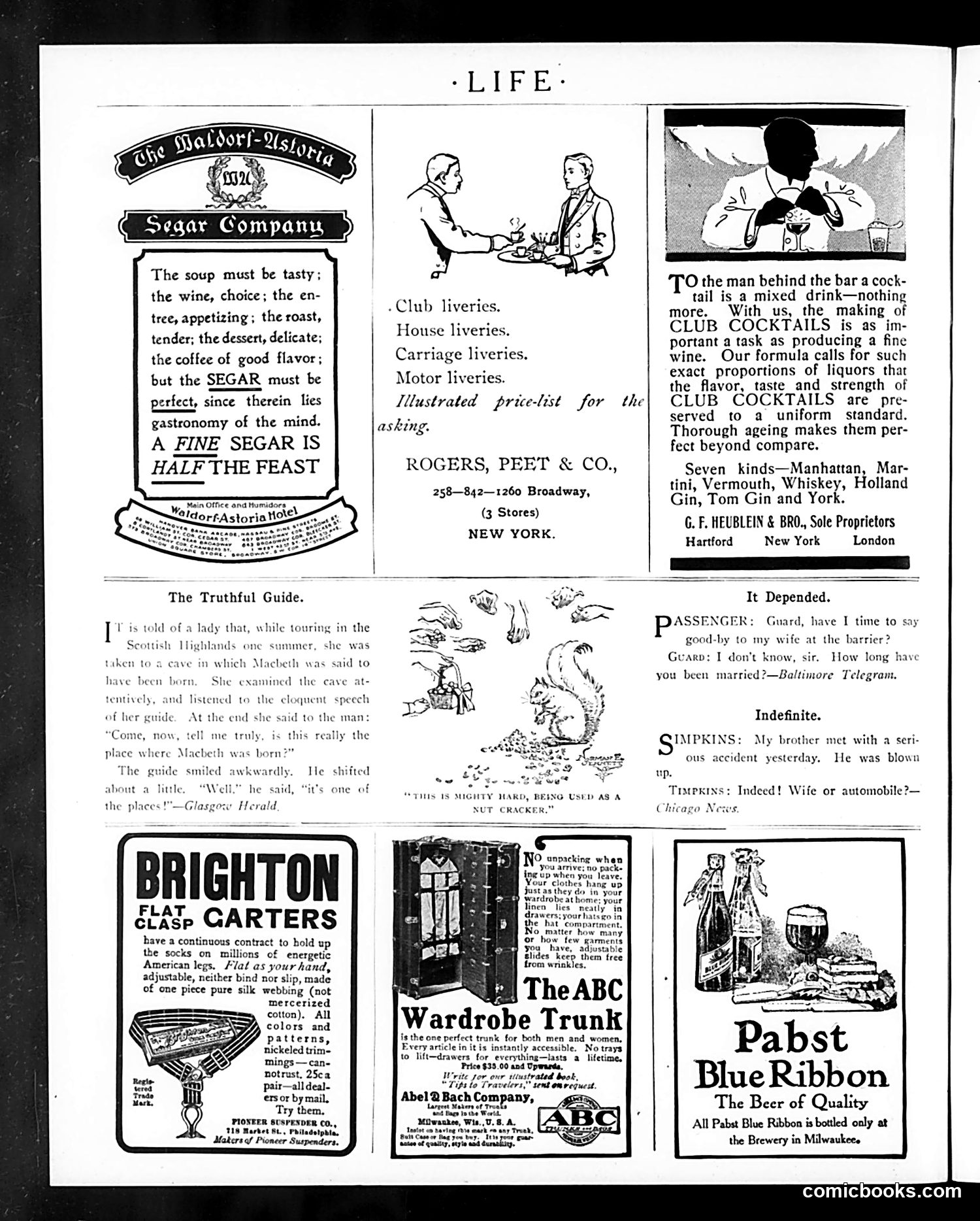
This page is primarily **advertisements** interspersed with brief humorous anecdotes, typical of early 20th-century Life magazine. **The humor sections** include: - "The Truthful Guide": A Scottish guide's candid admission that a cave's historical claims are fabricated—satirizing tourist industry dishonesty - "It Depended": A railroad guard's evasive answer about time—joking that how long one has been married determines if he has time to say goodbye - "Indefinite": A dark joke about whether a brother's accident involved a wife or automobile—satirizing early automobile dangers **Advertisements** dominate, promoting: - Segar Company cigars (emphasizing quality) - Rogers, Peet & Co. (livery services) - Club Cocktails (seven varieties listed) - Brighton garters, ABC Wardrobe Trunk, and Pabst Blue Ribbon beer The page reflects early 1900s consumer culture and period attitudes toward masculinity (garters, cocktails, beer), travel, and emerging automobile dangers.
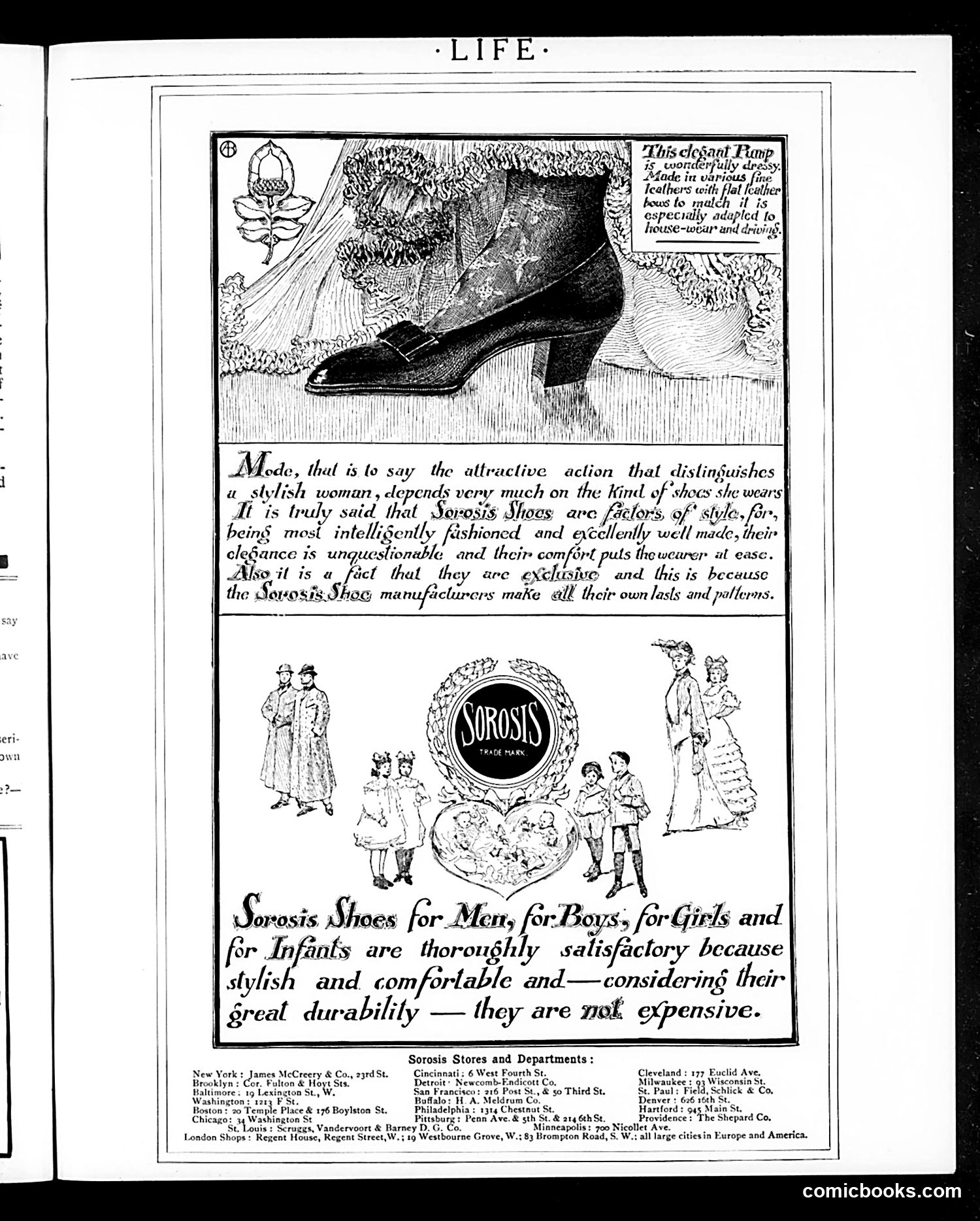
This is a **fashion advertisement**, not a political cartoon. It promotes Sorosis brand shoes for the entire family across multiple store locations. The page argues that a stylish woman's elegance depends heavily on her footwear. Sorosis shoes are presented as "factors of style"—intelligently designed, comfortable, and exclusive because the manufacturer makes its own lasts (shoe molds) and patterns. The ad emphasizes that despite their quality and durability, they're "not expensive." The illustration shows an elegant women's shoe in black leather with decorative detailing. Below, various figures (men, boys, girls, and infants) demonstrate that Sorosis makes shoes for the entire family—all described as "thoroughly satisfactory" in style, comfort, and durability. The page is primarily commercial messaging, reflecting early 20th-century advertising conventions in *Life* magazine.
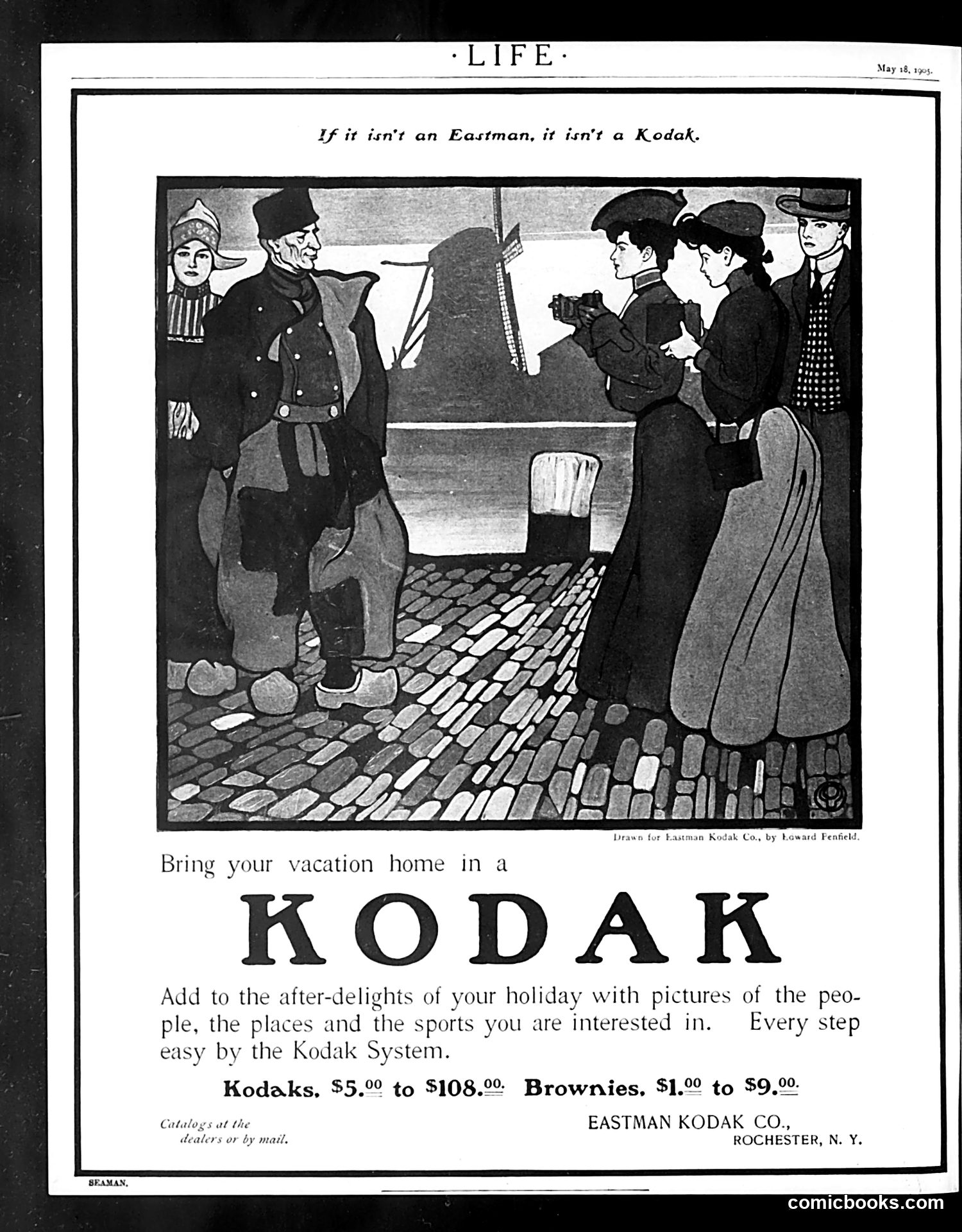
This is primarily a **Kodak camera advertisement**, not political satire. The illustration depicts what appears to be early 20th-century travelers or tourists at a ship or dock, with the tagline "If it isn't an Eastman, it isn't a Kodak"—emphasizing brand authenticity. The humor is gentle commercial messaging: the scene suggests tourists documenting their vacation experiences. The ad promotes Kodak and Brownie cameras (ranging $1–$108) as accessible tools for capturing holiday memories. The reference to "bring your vacation home" reflects the emerging consumer culture around amateur photography. This advertisement capitalizes on the growing leisure travel trend and the desire to preserve and share vacation experiences—a novel concept at the time. The illustration's style and clothing suggest this is from the 1910s-1920s era.