
Life, 1905-05-18 · page 18 of 32
Life — May 18, 1905 — page 18: what you’re looking at
What you’re looking at
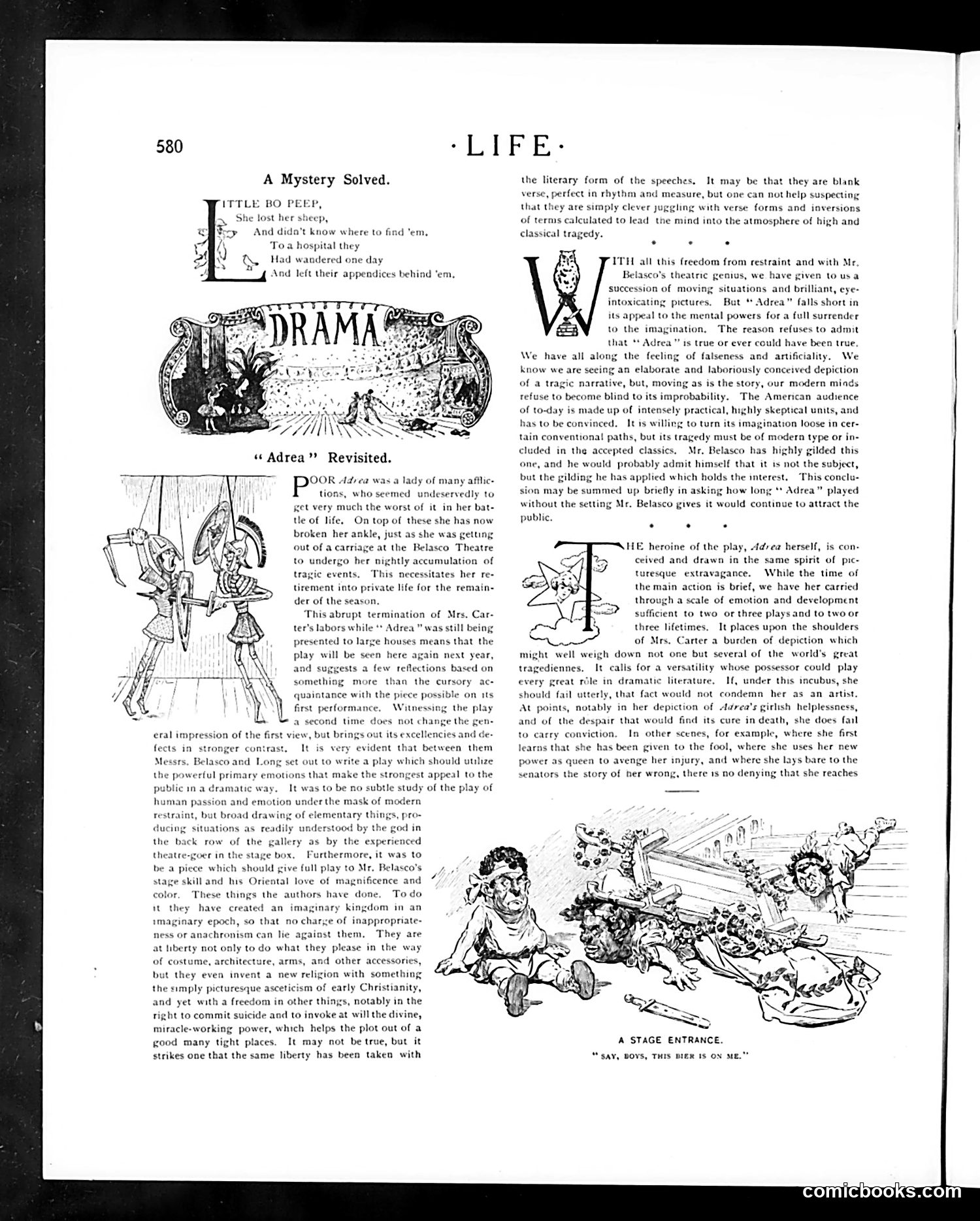
This page critiques the play *Adrea*, performed at the Belasco Theatre (starring Mrs. Carter, who broke her ankle). The opening "Little Bo Peep" poem is a lighthearted mystery solved—the lost sheep had their appendices removed at a hospital, likely referencing contemporary surgical trends. The main article praises producer David Belasco's theatrical spectacle and stagecraft while faulting the play's emotional impact. The critic argues that *Adrea*—set in an invented imaginary kingdom with fabricated religions—succeeds visually but fails intellectually. Modern American audiences, the reviewer contends, are too "practical" and "skeptical" to accept its artificial tragedy. They demand either contemporary settings or classical legitimacy, not ornate fantasy. Belasco "gilded" the work beautifully, but intellectual conviction eludes it—the audience sees elaborate artifice rather than truth.
📄 Transcribed text from this page (OCR, searchable)
Machine-transcribed from the original scan — historical spelling and the odd misread are preserved.
A Mystery Solved. ITTLE BO PEEP, >, She lost her sheep, 4 And dida’t know where to find ‘em, \ ‘To a hospital they a Q. Had wandered or And left their appendices behind ‘em, e day « Adrea”’ Revisited. OOR Ady ea was a lady of many afflic- tions, who seemed undeservedly to get very much the worst of it in her bat- tle of life. On top of these she has now broken her ankle, just as she was getting out of a carriage at the Belasco Theatre to undergo her nightly accumulation of tragic events, This necessitates her re- tirement into private life for the remain- der of the season, This abrupt termination of Mrs, Car- + Adrea " was still being ter’s labors whil presented to la play will be seen ns that the ge houses me here again next year, and suggests a few reflections based on something more than the cursory ac- on its quaintance with the piece possib! Witnessing the play the gen- its excellencies and 4 first performance. a second time does not cha eral impression of the first view, but brings o nger contrast. It is very evident that between them Messrs, Belasco and I ry emotions that mak It was to be no subtle study of the pl J set out to write a play which should utilize tothe of e the stro! the powerful prim gest appe: public in ad an pass! atic way, 2 and emotion under the mask of modern mentary things, pro- god in the back row of the gallery as by the experienced Furthermore, it was to be a piece which should give full play to Mr, Belasco’s stage skill and his Oriental love of magnificence and color. These things the authors have done, Todo tt ated an imaginary kingdom in an imaginary epoch, so that no charge of inappropriate- They are t broad drawing of ng situations as readily u theatre-goer in the stage box. y have er ness or anachronism can lie against them, at liberty not only to do what they please in the way re, arms, and other accessories, nt a new religion with something of costume, archite but they even inve; the simply picturesque asceticism of early Christianity, and yet with a freedom in other things, notably in the right to commit suicide and to invoke at will the divine, miracle-working power, which helps the plot out of a good many tight places. It may not be true, but it strikes one that the same liberty has been taken with “LIFE: the literary form of the speeches, verse, perfect in rhythm and measure, but one can not help s It may be that they are blank pecting that they are simply clever juggling with verse forms and inversions of terms calculated to lead the mind into the atmosphere of bigh and classical tragedy. z ITH all this freedom from restraint and with Mr Belasco’s theatric genius, we have given to usa succession of moving situations and brilliant, 4 intoxicating pictures. But * Adrea” falls short in its appeal to the mental powers for a full surrender to the imagination, The reason refuses to admit that * Adrea "1s true or ever could have been true. wg the feeling of falseness and artificiality. We know we are secing an elaborate and laboriously conceived depiction of a tragic narrative, but, moving as is the story, our modern minds refuse to become blind to its improbability, The American audience of to-day y practical, highly skeptical units, and has to be convinced, It is willing to turn its imagination loose in cer- tain conventional paths, but its tragedy must be of modern type or in- cluded in the accepted classics. Mr. Belasco has highly gilded this one, and he would probably admit himself that it 1s not the subject, We have all alo s made up of intense! but the gilding he has applied which holds the interest, This conclu- sion may be sun Adrea” played without the setting Mr. Belasco gives it would continue to attract the ed up briefly in asking how long public. . . HE heroine of the play, Advea herself, is con- ceived and drawn in the same spirit of pic- extravagance. While the time of the main action is brief, we have her carried through a scale of emotion and development sufficient to two or three playsand to two or three lifetimes, It places upon the shoulders of Mrs. Carter a burden of depiction which might well weigh down not one but several of the world’s great turesque tragediennes, It calls for a versatility whose possessor could play every great rile in dramatic literature. If, under this incubus, she should fail utterly, that fact would not condemn her as an artist. At points, notably in her depiction of Area's girhsh helplessness, and of the despair that would find its cure in death, she does fail to carry conviction. In other scenes, for example, where she first learns that she has bee power as queen to aveng senators the story of ber wrong, there 1s no denying that she reaches given to the fool, where she uses her new e her injury, and where she lays bare to the A STAGE ENTRANCE. “SAY, DOVS, THIS BIER 1s ON MIE."