
Life, 1905-05-18 · page 20 of 32
Life — May 18, 1905 — page 20: what you’re looking at
What you’re looking at
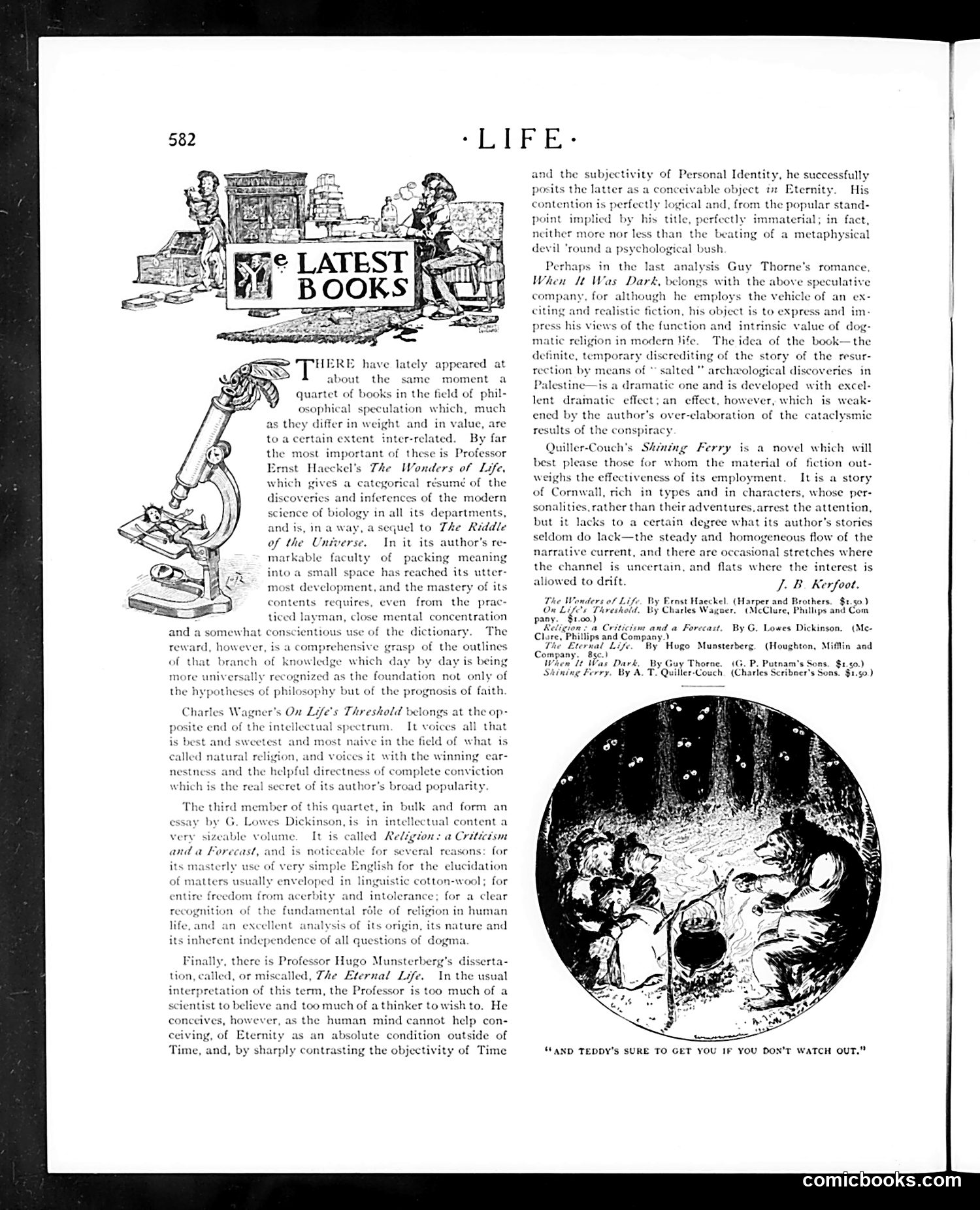
This page reviews four philosophical/religious books and one novel, reflecting turn-of-the-century intellectual debates about faith, science, and modernity. The main reviews discuss: - **Ernst Haeckel's *The Wonders of Life***: A scientific catalogue of biological discoveries, praised for densely packing information but criticized as requiring intense concentration to understand. - **Charles Wagner's *On Life's Threshold***: Positioned as the opposite end of the spectrum—appealing, naive, and emotionally earnest in its "natural religion." - **G. Lowes Dickinson's essay on religion**: Valued for clarity, avoiding jargon, and analyzing religion's role in human life without dogmatism. - **Hugo Munsterberg's *The Eternal Life***: A metaphysical argument about eternity and personal identity that the reviewer dismisses as ultimately circular reasoning. - **Guy Thorne's *When It Was Dark***: A dramatic novel using archaeological discoveries to challenge Christian resurrection—effective but over-elaborated. The illustration (bottom right) captioned "And Teddy's sure to get you if you don't watch out" appears unrelated to the book reviews, suggesting editorial variety typical of Life's format.
📄 Transcribed text from this page (OCR, searchable)
Machine-transcribed from the original scan — historical spelling and the odd misread are preserved.
the same moment a quartet of books in the field of phil- much osophical speculation which as they differ in weight and in value, are to acertain extent inter-related. By far the most important of these is Professor st Haeckel’s The Wonders of Life, egorical résumé of the discoveries and infere s of the modern science of biology in all its departments, sequel to The Riddle of the Universe. In it its author's re- r culty of packing meaning into a small space has reached its utter- and is, in a way arkable most development, and the mastery of its ents requires, even from the prac ticed laym and a somewhat © reward, however, i of th n, close mental concentration nscientious use of the dictionary. The a comprehensive grasp of the outlines at branch of knowledge which day by day is being niversally recognized as the foundation not only of theses of philosophy but of the prognosis of faith. Charles Wagner's On Life's Threshold belongs at the op- posite end of the intellectual spectrum It voices all that is best and sweetest and most naive in the field of what is called natural religi es it w and ve the winning ear- nestness and the helpful directness of cc aplete conviction which is the real secret of its a or of nd form an The third mem artet, in bulk essay by G. Lowes Dickinson, is in intellectual content a It is called Religion: a Criticism ul sh for the ¢ his q very sizeable volume. and a Forecast, and is sterly use of very simple Eni asons: for its 9 idation of matters usually enveloped in linguistic cotton-wool; for entire freed vacerbity and intolerance; for a clear m f he fundamental réle recognition of { religion in human lif its in, its nature and of dogma and an excellent a ysis of its ori pendence of all questi stion nt inc Finally, there is Professor Hugo Munsterberg’s disserta- d, or misealled, The Eternal L In the usual retation of t term, the Professor is too much of a tion, ¢ inter} scientist to believe and too much of a thinker towish to. He conceives, however, as the human mind cannot help con- ceiving, of Eternity as an absolute condition outside of Time, and, by sharply contrasting the objectivity of Time -LIFE- and the subjectivity of Personal Identity, he successfully posits the latter as a conceivable object tt Eternity. His tion is perfectly logical and, from the popular stand- point implied by his title, perfectly immaterial; in fact, neither more nor less than the beating of a metaphysical devil ‘round a psychological bush conte Perhaps in the last analysis Guy Thorne’s romance, When It Was Dark, delongs with the above speculative company, for altho! citi >of an ex- and realistic fiction, his object is to express and im- press his views of the function and intrinsic value of dog- matic religion in modern life. The idea of the book—the mporary discrediting of the story of the resur- means of n he em loys the vehic definite, ter rection by salted " archeological discoveries in Palestine—is a dramatic one and is developed with excel- lent dramatic effect; an effect, however, which is weak- ened by the author's over-cl aboration of the cataclysmic results of the conspiracy Quiller-Couch's Shining Ferry is a novel which will best please those for whom the material of fiction out- weighs the effectiveness of its employment of Cornw It is a story .tich in types and in characters, whose per- lities, rather than their adventures, arrest the attention, son but it lacks to a certain degree what its author's stories seldom do lack—the steady and homog' narrative current, and there are occasional stretches where the channel is uncertain, and flats where the interest is allowed to drift. J.B. Kerfoot. y Ernst Haeckel. (Harper and Brothers. $1.50) y Charles Wagner. (McClure, Phillips and Com, neous flow of the The Wonders of Life On Lifes Threshold. any. $1.00.) exeligion @ Criticism and a Forecast. ips and Company.) vernal Life. By Hugo Munsterberg. (Houghton, Miflin and pany. Bsc.) emit Was Dark. By ning Ferry. By A. T. Qu By G. Lowes Dickinson. (Mc- y Thorne, le (G. P. Putnam's Sons, $1.50.) Couch (Charles Scribner's Sons. $1.50) “AnD TEDDY'S SURE TO GET YOU IF YOU DON'T WaTCH OUT." comicbooks.com