
A complete issue · 22 pages · 1905
Life — April 13, 1905
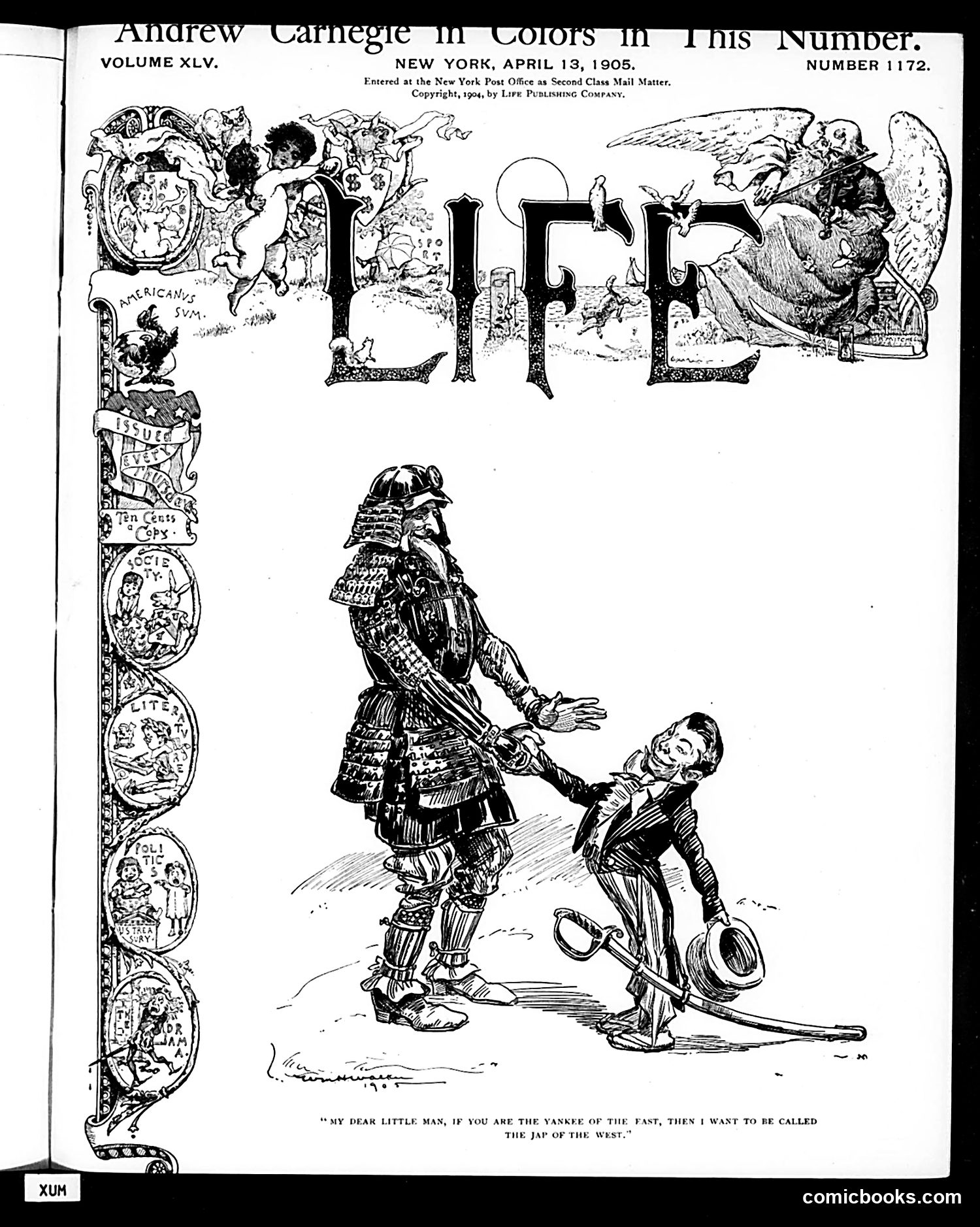
This satirical cartoon depicts a figure in Japanese samurai armor (representing Japan) towering over a small American businessman or diplomat. The caption reads: "My dear little man, if you are the Yankee of the fast, then I want to be called the Jap of the West." The cartoon references Japan's military ascendancy following its 1904-1905 victory in the Russo-Japanese War. The samurai armor symbolizes Japan's military prowess and aggressive expansion. The diminished American figure suggests anxiety about Japan's rising power in the Pacific. The dialogue conveys Japan's confidence and implicit challenge to American dominance in the region—Japan claiming equal or superior status as an imperial power.
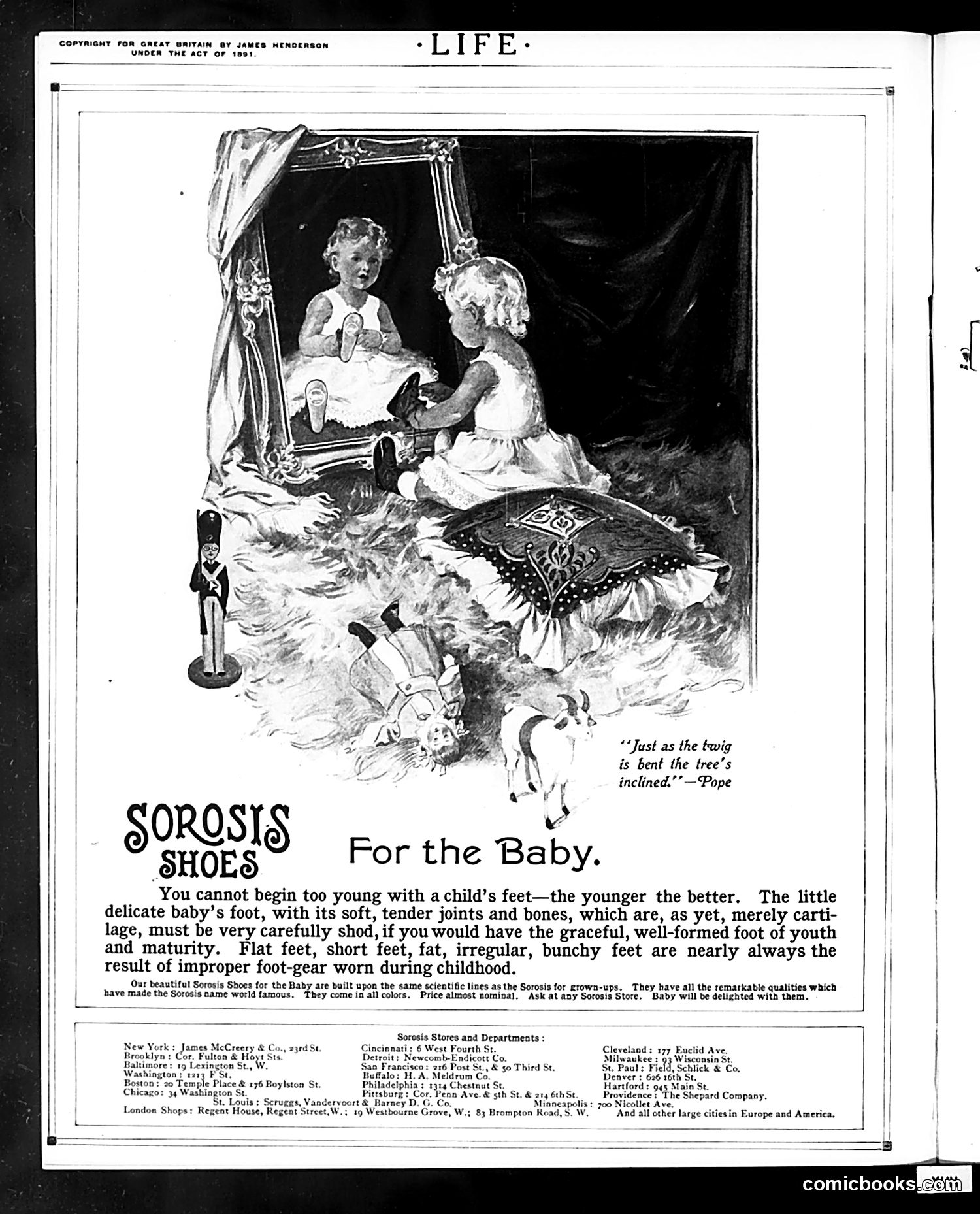
This is primarily an advertisement for Sorosis Shoes, not political satire. The illustration depicts young children admiring themselves in a mirror while playing outdoors, with a small dog nearby. The ad's argument is that proper footwear during childhood is crucial for developing healthy feet in adulthood. It claims flat feet, bunions, and irregular foot development result from inadequate shoes during youth. The quoted epigraph from Pope ("Just as the twig is bent the tree's inclinded") reinforces this message—early intervention matters. The ad emphasizes that Sorosis applies "scientific lines" developed for adult shoes to children's footwear. This reflects early 20th-century Progressive Era confidence in scientific solutions to everyday problems. The layout and artistic style are typical of period magazine advertising rather than editorial cartooning.
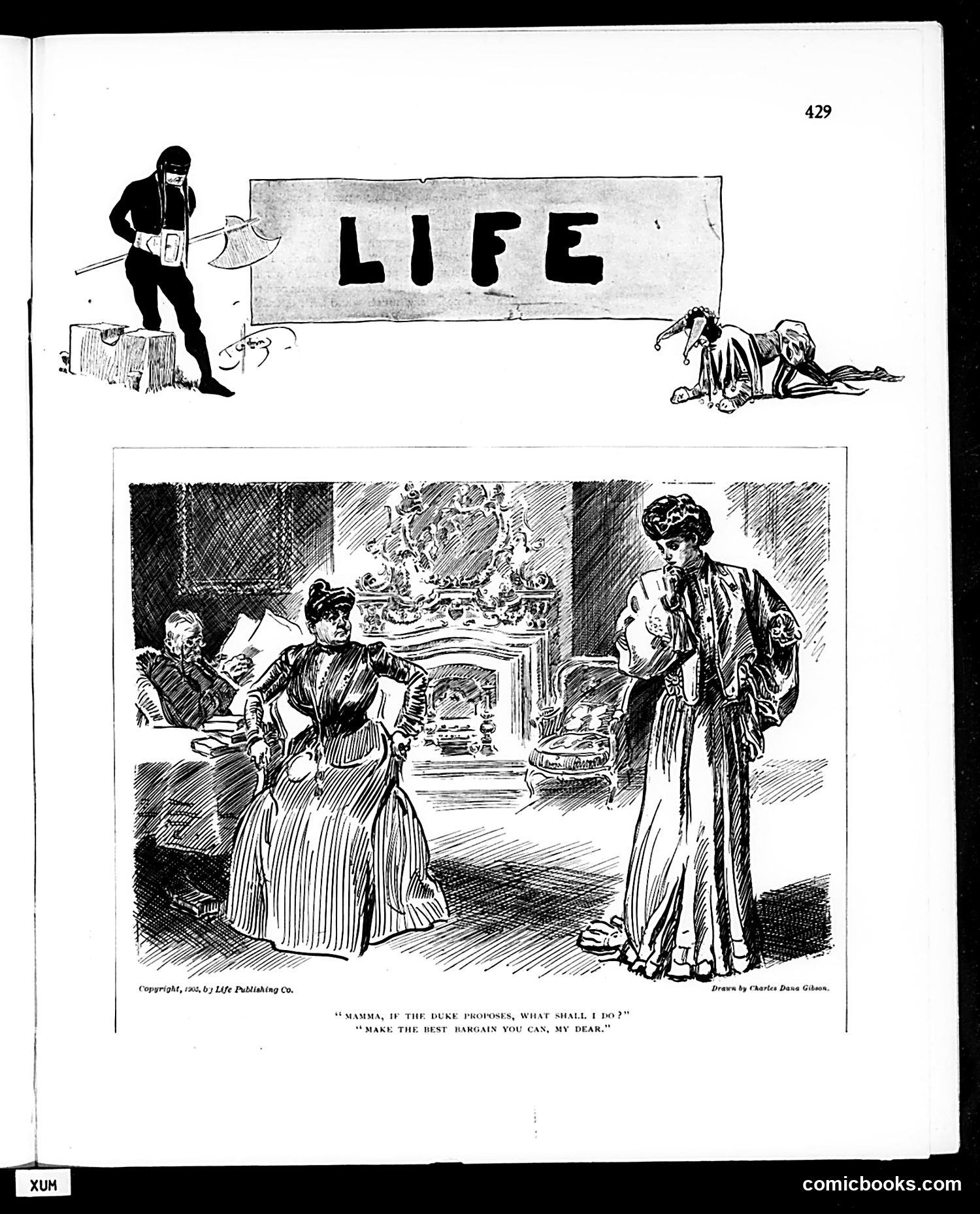
This page contains a single illustration titled "MAMMA, IF THE DUKE PROPOSES, WHAT SHALL I DO?" with the response "MAKE THE BEST BARGAIN YOU CAN, MY DEAR." The cartoon satirizes marriage negotiations among the wealthy and aristocratic classes, likely from the early 1900s. It depicts two well-dressed women in an elegant interior—presumably a mother advising her daughter about a potential proposal from a duke (a high-ranking nobleman). The satire's point: mothers cynically coached daughters to view marriage as a financial transaction rather than a romantic union, treating aristocratic suitors as commercial opportunities to be negotiated shrewdly. This critiques both the mercenary nature of upper-class marriages and parental manipulation of daughters' matrimonial choices.
This page satirizes the conflict between literary merit and commercial success in early 20th-century publishing. The text criticizes "big-sellers"—publishers who prioritize profit over quality, flooding the market with mediocre books. The small illustrations show a child figure and animals, likely accompanying the satirical commentary rather than serving as the main cartoon. The article defends actual literature (mentioning *Sherlock Holmes*, *Ben Hur*, and Rudyard Kipling as respectable sellers), while mocking the "Hostiles"—apparently publishers' derogatory term for critics who resist popular trash. The author argues that advertising can't redeem bad books, and that good literature remains scarce because commercial incentives corrupt the market. This reflects Progressive-era concerns about capitalism degrading cultural standards.
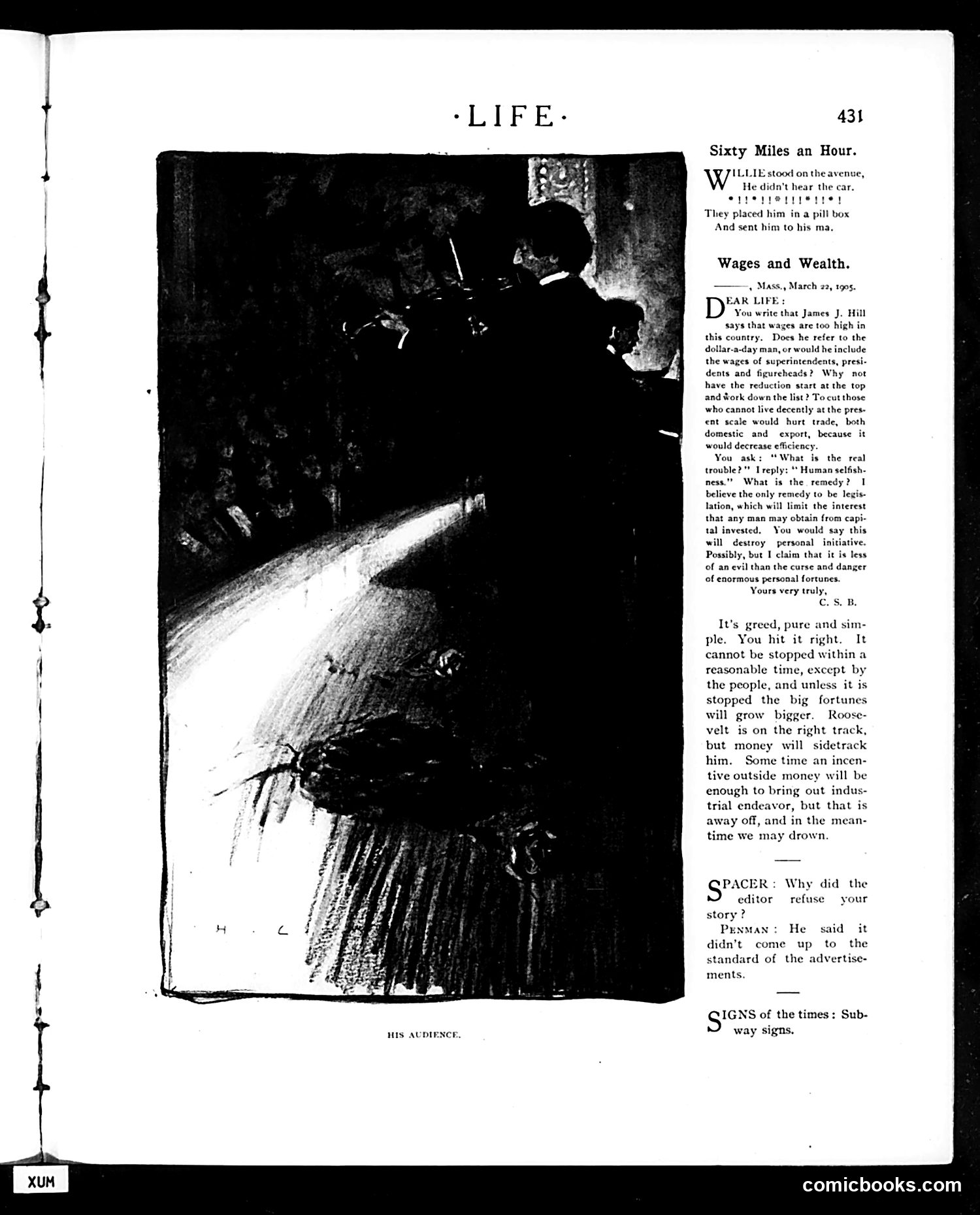
The main illustration titled "His Audience" depicts a street scene where a figure sits on a curb, apparently addressing passersby—though the image quality makes specific details difficult to discern. This appears to be social commentary on urban life or public discourse. The text sections include "Sixty Miles an Hour" (a brief satirical verse about someone named Willie), and "Wages and Wealth," a reader's letter debating whether wages are too high and discussing economic inequality and labor policy. A brief humorous exchange between "Spacer" and "Penman" comments on editorial standards and advertising. "Signs of the Times: Subway signs" appears to be another satirical item, likely commenting on contemporary urban society or public transit culture.
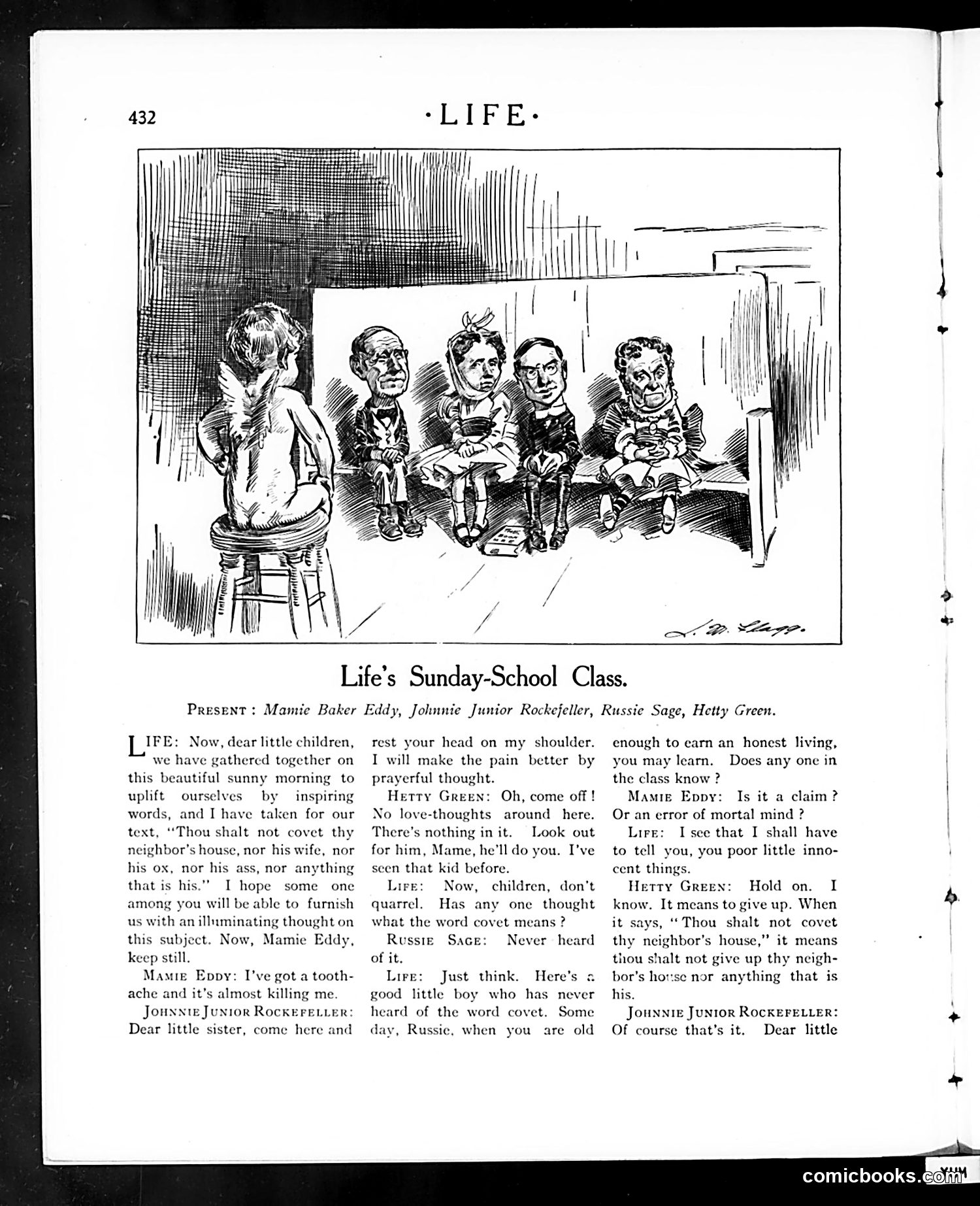
This satirical cartoon mocks wealthy industrialists masquerading as moral educators. The five caricatured figures seated—identified as Mamie Baker Eddy, Johnnie Junior Rockefeller, Russie Sage, and Hetty Green—represent prominent wealthy Americans of the Gilded Age. The satire centers on their hypocrisy: "Life" (personified, teaching) attempts to instruct these men about morality and the Biblical commandment "Thou shalt not covet," while the figures represent exactly the kind of ruthless wealth-accumulation that violates such principles. The joke is that these notorious robber barons and their associates are the last people qualified to learn—or teach—ethical behavior, making the "Sunday-school" framing deeply ironic.
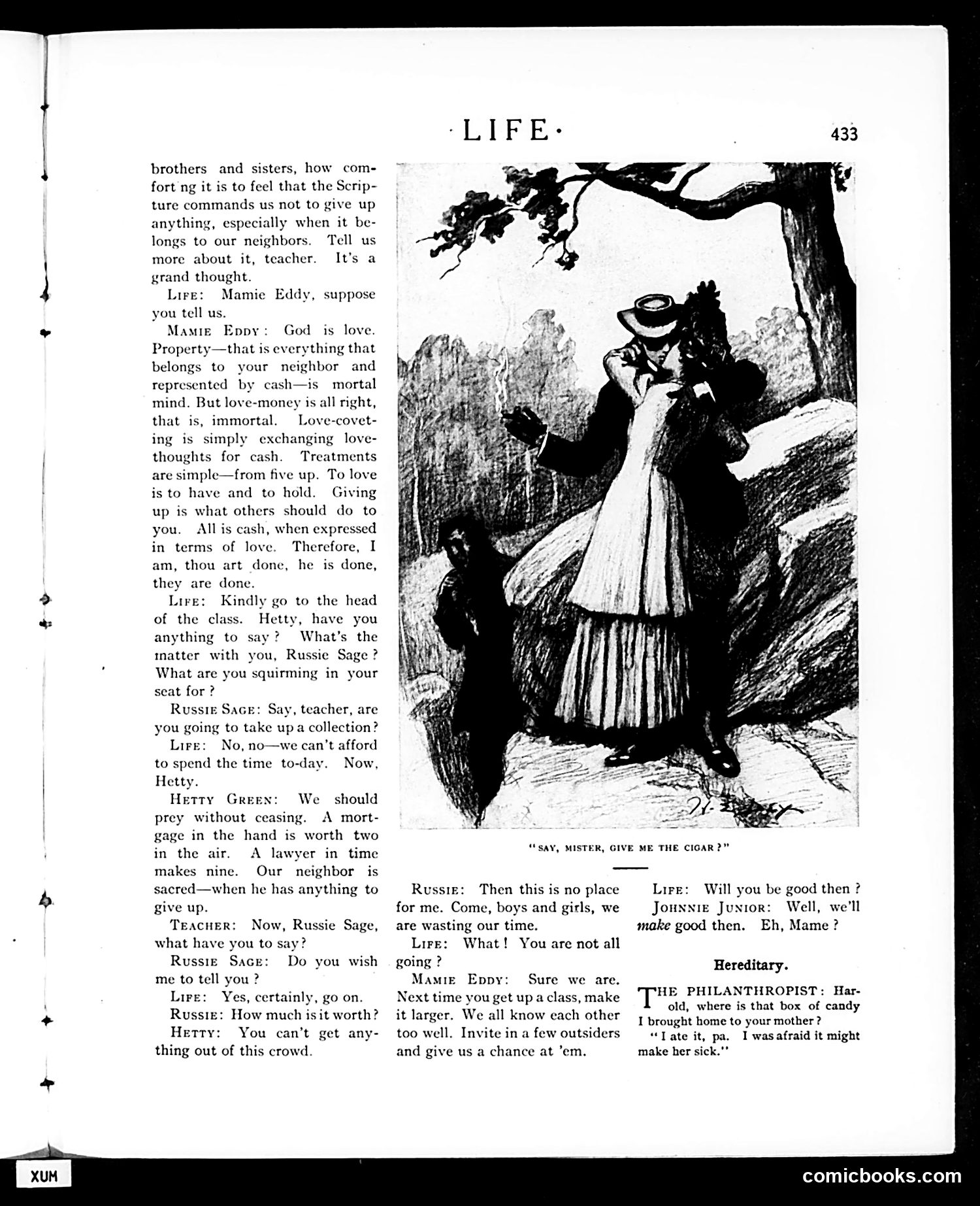
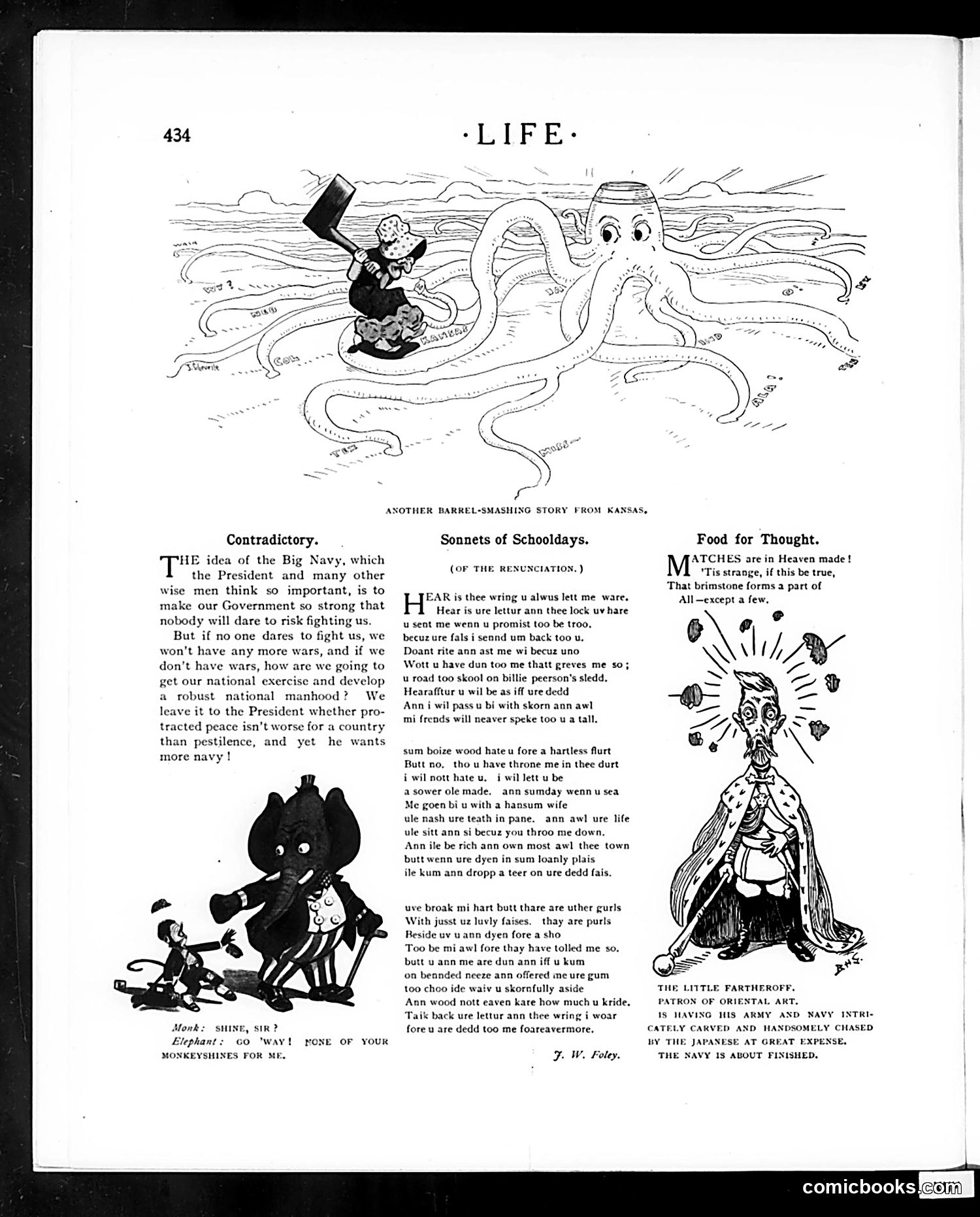
The top cartoon depicts an absurdist scene labeled "Another Barrel-Smashing Story from Kansas"—showing a man riding what appears to be a giant octopus or sea creature with anthropomorphic features. This likely satirizes tall tales and exaggerations associated with Kansas frontier stories popular in American folklore. The lower left cartoon shows a small figure addressing an elephant, with dialogue "Monk: SHINE, SIR? / Elephant: GO 'WAY! PONE OF YOUR MONKEYSHINES FOR ME." This appears to be a racial caricature joke, though the exact satirical target is unclear. The right illustration titled "Food for Thought" depicts a figure with objects radiating from their head, likely satirizing how ideas or anxieties overwhelm the mind. The page mixes visual humor with poetry and editorial commentary typical of Life's satirical format.
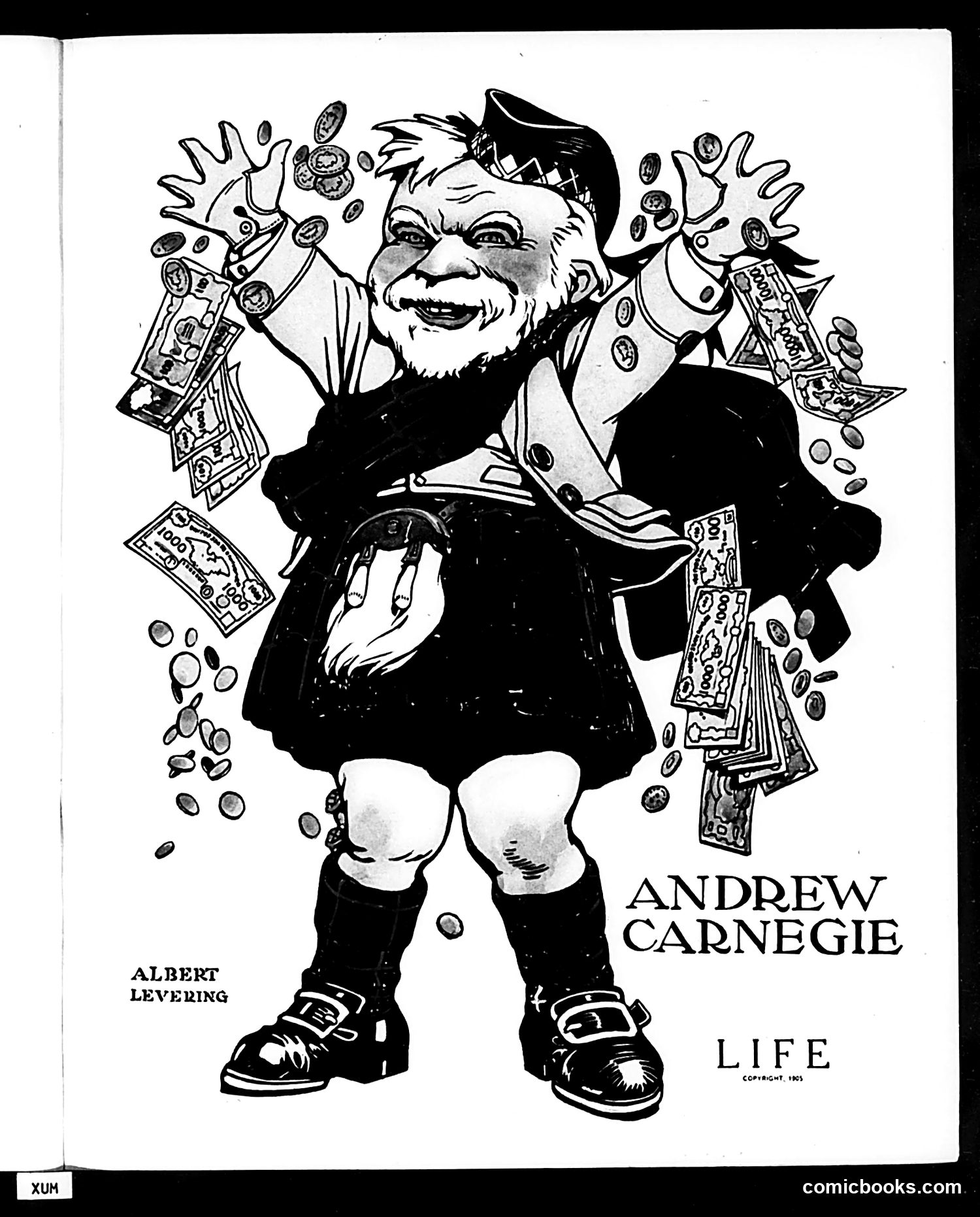
This is a satirical illustration by Albert Levering depicting **Andrew Carnegie**, the Scottish-American steel magnate and industrialist. The cartoon portrays Carnegie as a gleeful character showering money—bills and coins—in all directions from his hands and pockets. The satire targets Carnegie's enormous wealth accumulated through steel manufacturing. The exaggerated, almost cartoonish expression and the cascade of currency suggest mockery of his lavish spending or philanthropic displays. Carnegie was famous for his controversial labor practices and subsequent massive charitable donations, which critics viewed as attempts to rehabilitate his reputation. The image serves as commentary on wealth inequality and the ostentatious nature of American industrial fortunes during the Gilded Age.
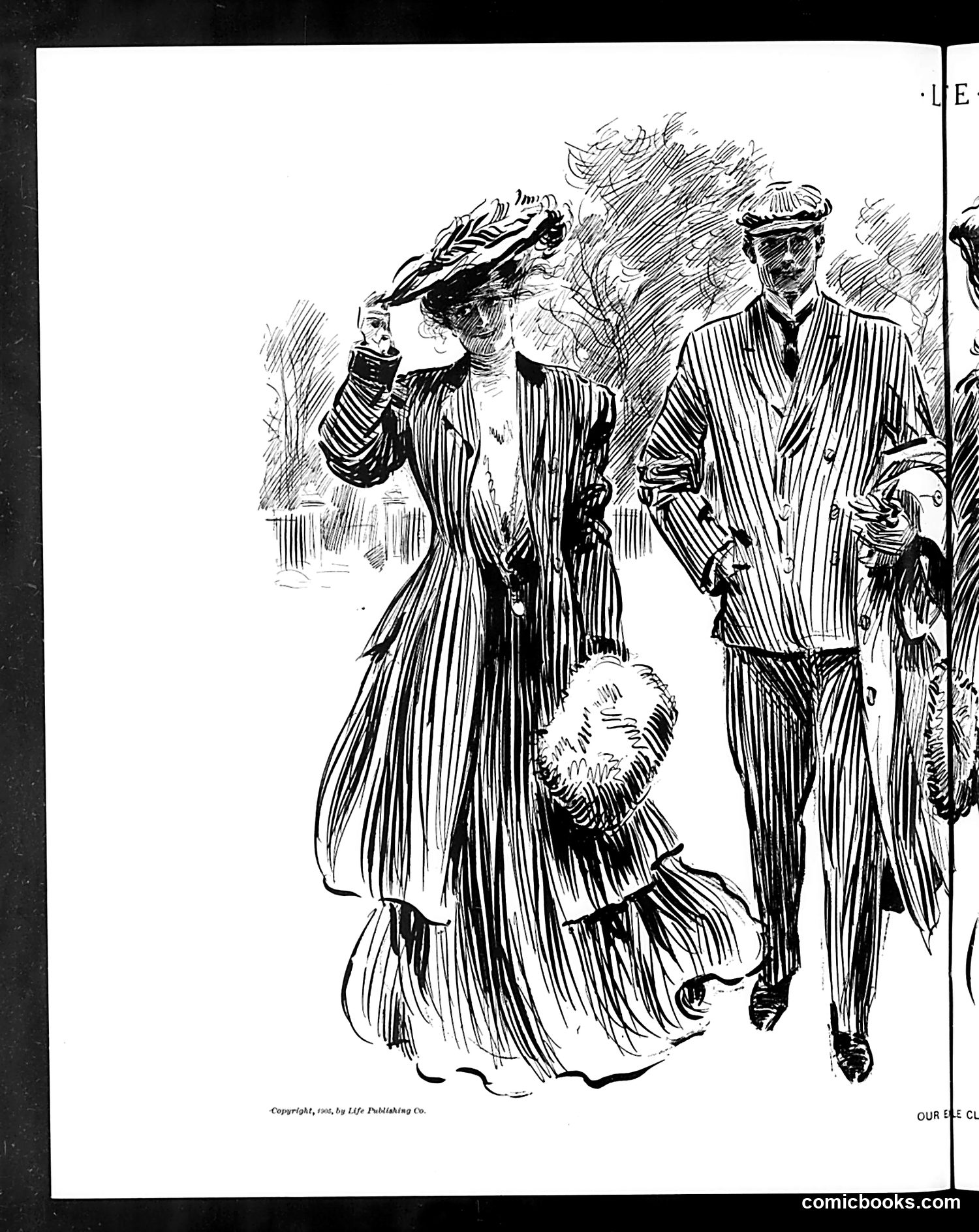
This appears to be a fashion illustration rather than political satire. The image shows three figures in early 1900s attire: a woman in an elaborate pleated dress and wide-brimmed hat with feathers, accompanied by two men in pinstriped suits and caps. The copyright notice reads "1903, by Life Publishing Co." The satire likely targets **fashion excess and women's clothing of the Edwardian era**—specifically the impractical, ornate styles that were fashionable among wealthy women. The woman's dramatically voluminous skirts, corseted silhouette, and oversized hat exemplify the era's conspicuous consumption and restrictive fashion standards. The two men appear to be her escorts or suitors, suggesting commentary on gender dynamics and courtship rituals of the period.
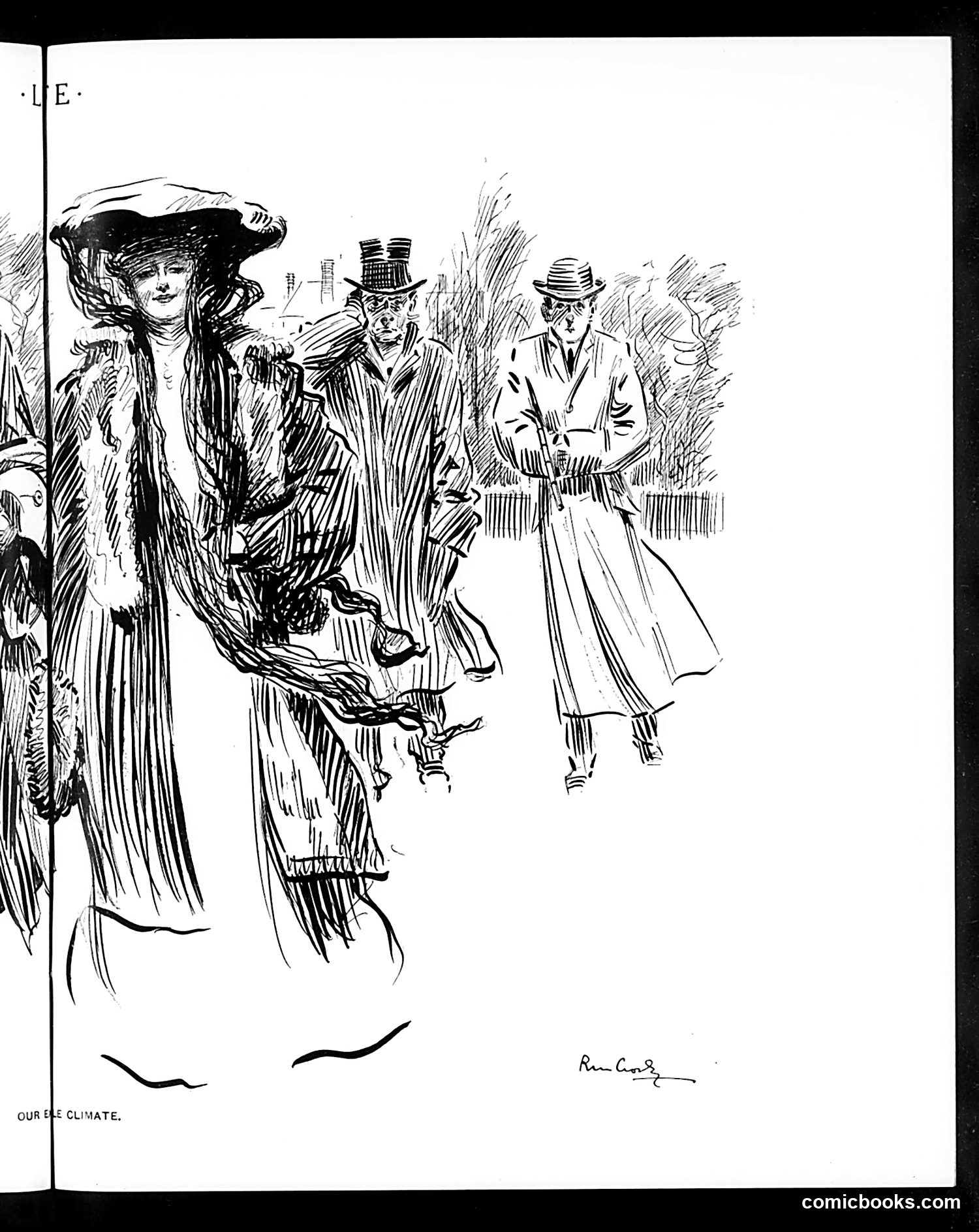
This satirical cartoon depicts three figures in early 20th-century dress observing a woman in an elaborate fur coat and fashionable hat. The title "Our Ice Climate" appears to mock the fashion trend of wearing expensive furs as winter wear among wealthy women. The two men in bowler hats and coats represent conventional observers, while the extravagantly dressed woman—rendered in bold, expressive line work—embodies the excesses of upper-class fashion. The satire likely critiques either the impracticality of such ostentatious dress or the class disparity it represents. The cartoon's style and subject matter are typical of Life magazine's social commentary on American manners and fashion during the early 1900s. The artist's signature appears lower right.
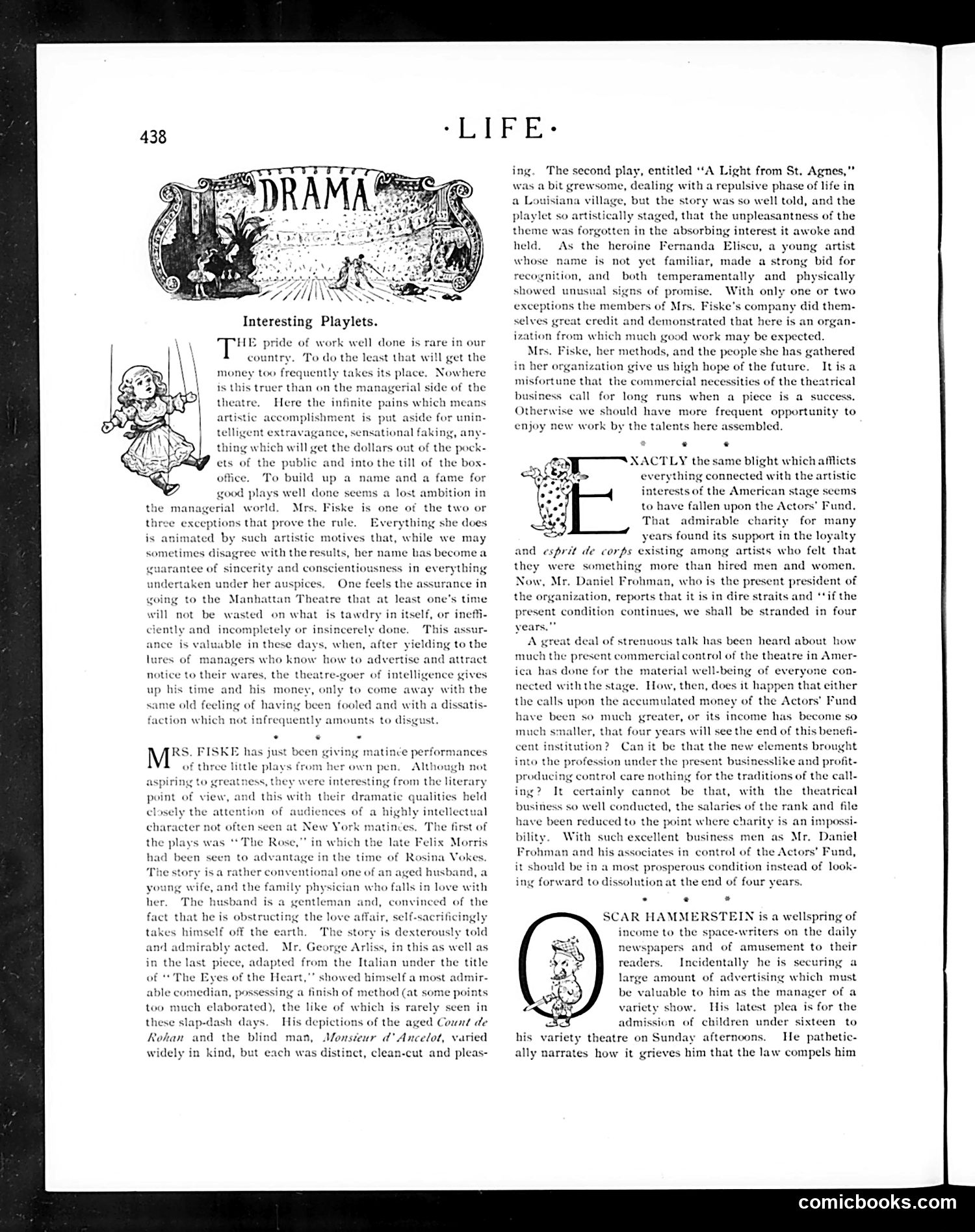
This page discusses Mrs. Fiske's theatrical company and recent playwriting efforts. The text praises the "pride of work well done" in theater management, noting Mrs. Fiske's success in producing quality plays despite theatrical industry challenges. The page reviews three recent plays Mrs. Fiske presented: "The Rose," "The Eyes of the Heart," and "A Light from St. Agnes." The text commends both the literary quality and dramatic execution of these productions, particularly praising the performances and artistic staging. A decorative "DRAMA" header and small illustrations of theatrical figures accompany the text. The overall tone celebrates professional theatrical management that prioritizes artistic merit over purely commercial considerations—a notable position given early 1900s theater economics.
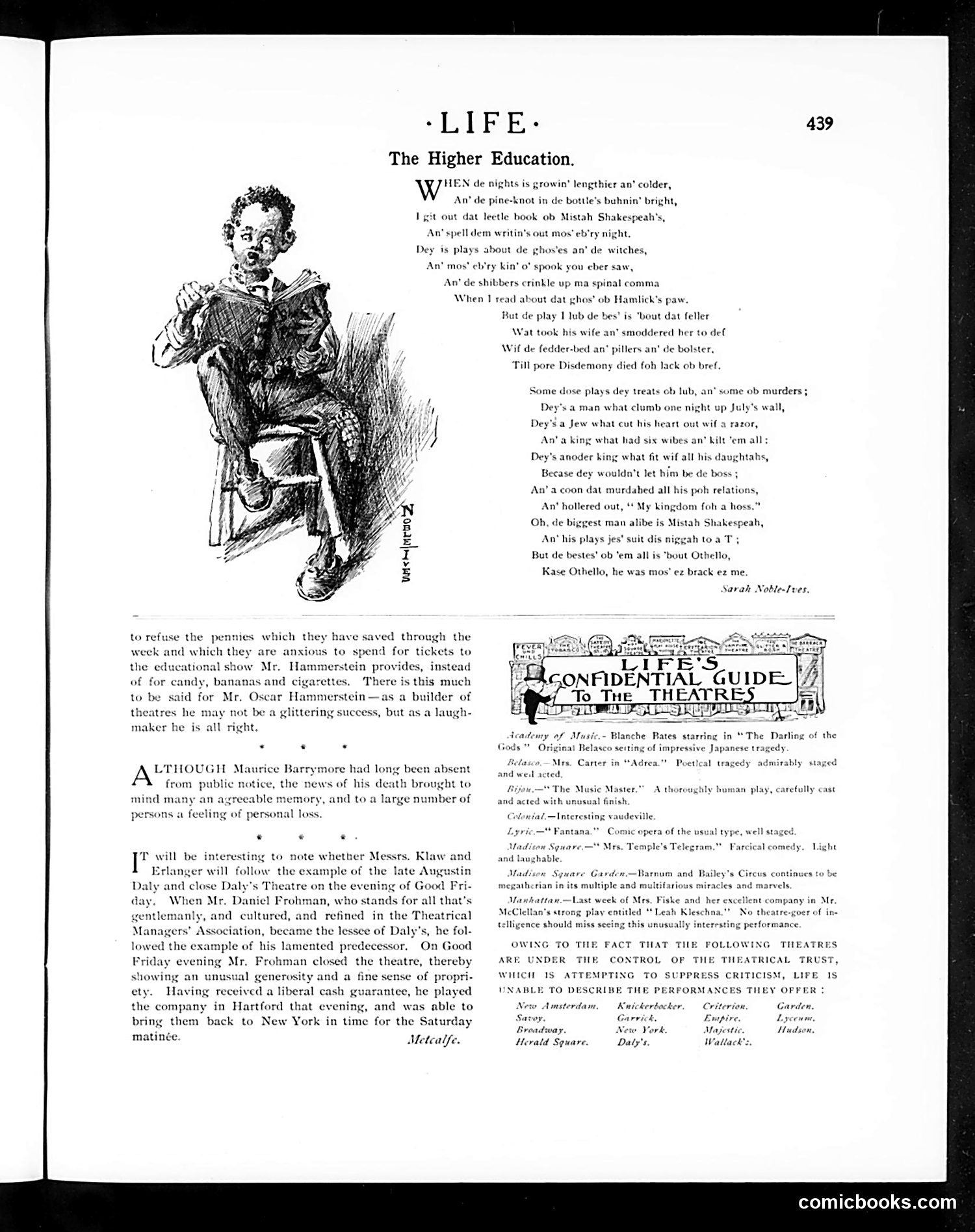
This poem by Sarah Noble-Ives satirizes the pretensions of African American self-education through phonetic dialect writing. The speaker, rendered in exaggerated Black vernacular, claims to study Shakespeare during winter evenings by firelight—a marker of self-improvement and gentility. The satire operates on multiple levels: it mocks both the speaker's garbled comprehension of Shakespeare's plots (confusing characters, mangling titles like "Hamlick's paw" for Hamlet) and, implicitly, the condescension of educated whites who find such efforts laughable. The punchline—that the speaker identifies most with Othello "because Othello, he was mos' ez brack ez me"—undercuts any genuine appreciation while reducing the tragedy to racial identity alone. This reflects early 20th-century attitudes: simultaneously mocking working-class/Black aspirations toward "high culture" while the dialect writing itself embodies racist caricature conventions of the era.
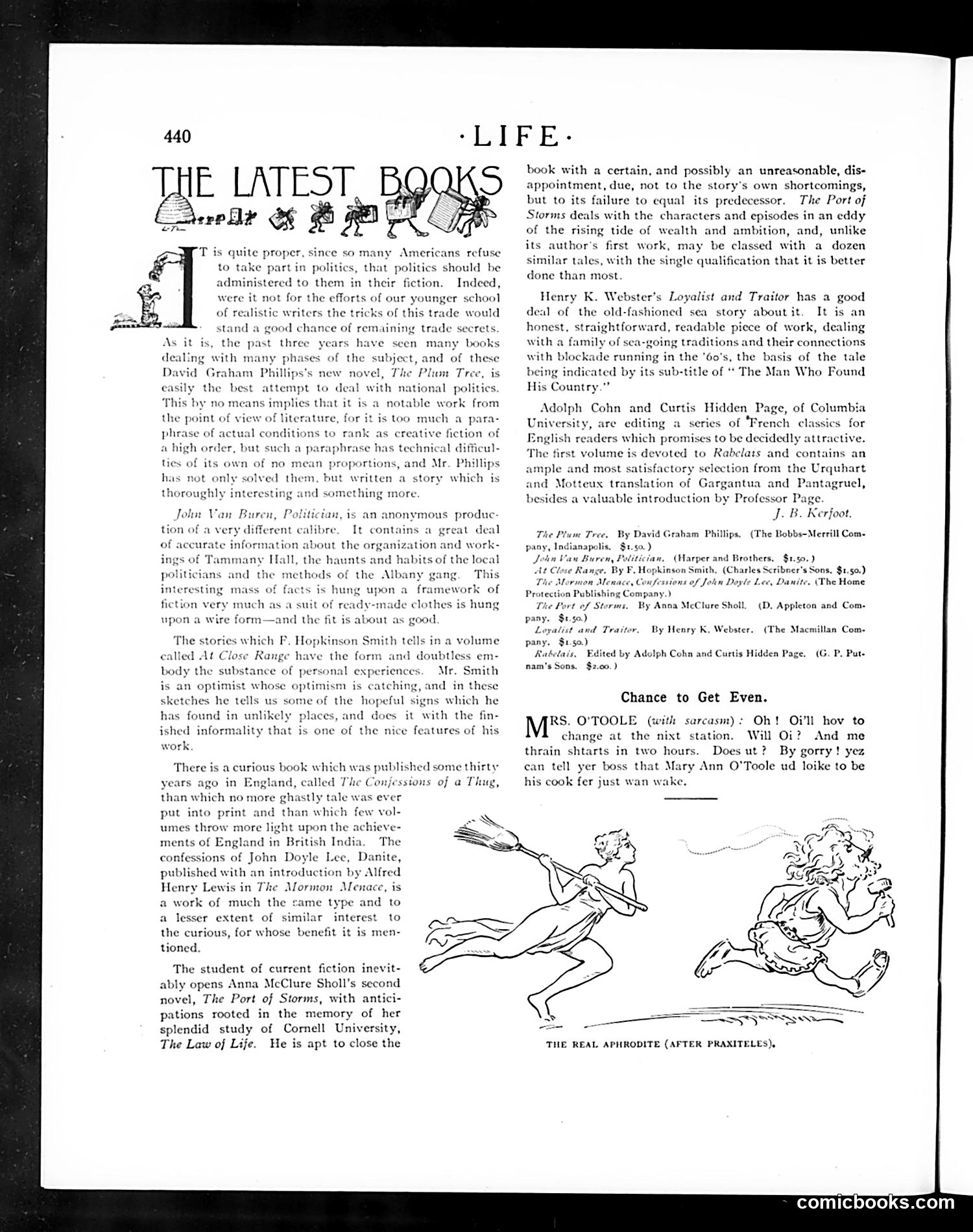
This single-panel cartoon illustrates a humorous domestic scene unrelated to the book reviews on the page. It depicts a man being blown backward by wind, clinging to a broom or similar object, while a woman chases after him with apparent determination. The caption—"Chance to Get Even"—suggests the woman is retaliating against the man for some previous domestic transgression. The humor derives from the visual comedy of role reversal: the woman actively pursues the man in a slapstick manner, inverting typical gender dynamics of the era. The "real aphrodite (after Praxiteles)" subtitle references the classical Greek sculpture, mockingly comparing the woman's aggressive stance to idealized beauty. The joke reflects early-20th-century domestic humor common in *Life* magazine, playing on marital conflict and the woman "getting even" through physical comedy rather than verbal sparring.
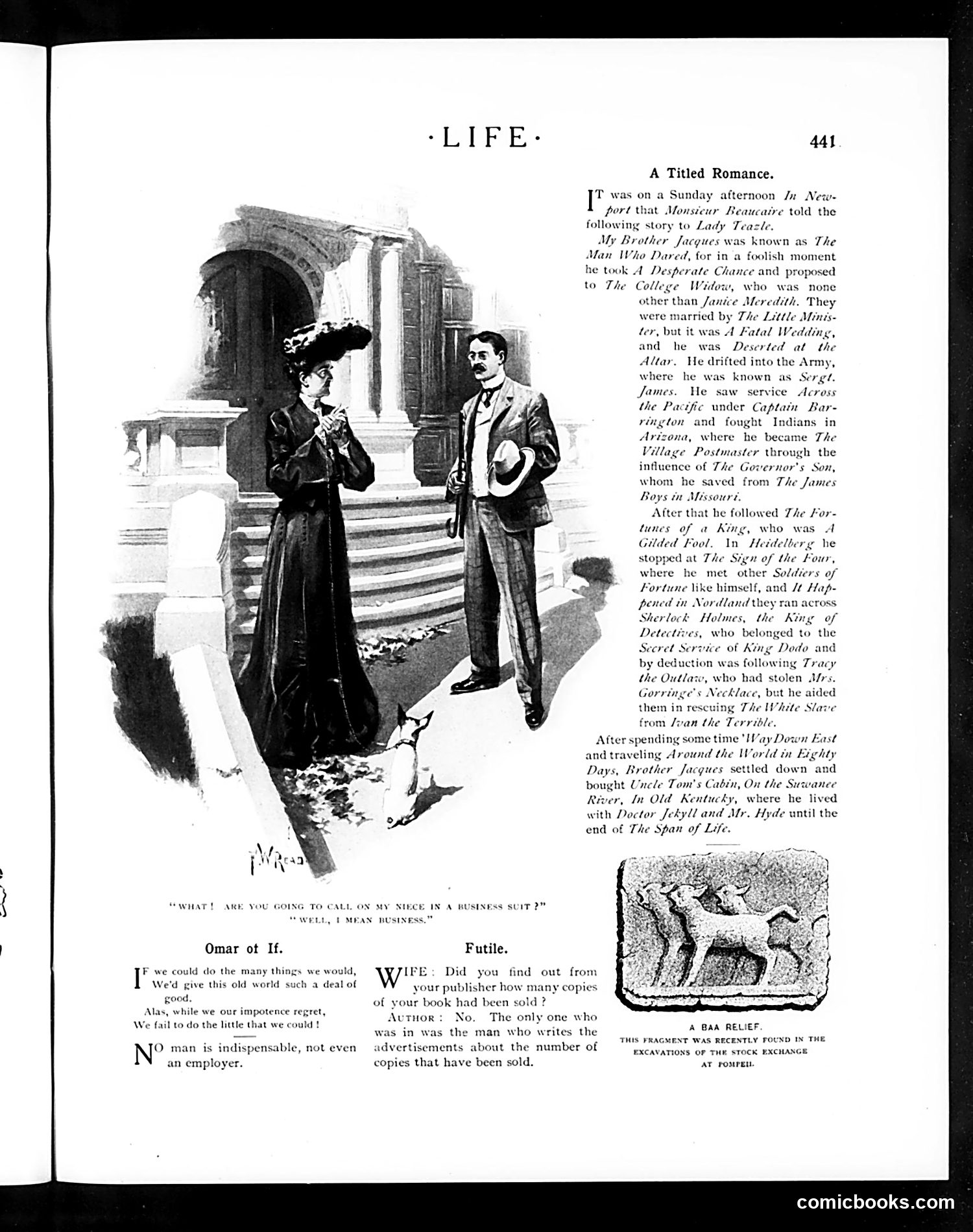
This page contains satirical literary commentary. "A Titled Romance" mocks the absurd plot of a serialized adventure novel by listing its protagonist's implausibly interconnected encounters with famous fictional characters—*Sherlock Holmes*, *Doctor Jekyll and Mr. Hyde*, *Uncle Tom's Cabin*, *Around the World in Eighty Days*—strung together nonsensically. The satire targets the era's popular serialized fiction, which prioritized sensational plot twists over coherent storytelling. The main cartoon shows a man in casual business attire confronted by a woman demanding he wear formal dress to call on her niece, illustrating class anxieties about proper social presentation. Below, two brief comedic exchanges mock publishers (who won't disclose sales figures) and employers (who consider all workers essential yet dispensable). The "Baa Relief" section references a fragmentary Bas relief sculpture recently excavated at Pompeii—a tongue-in-cheek juxtaposition with the magazine's lighter content above.
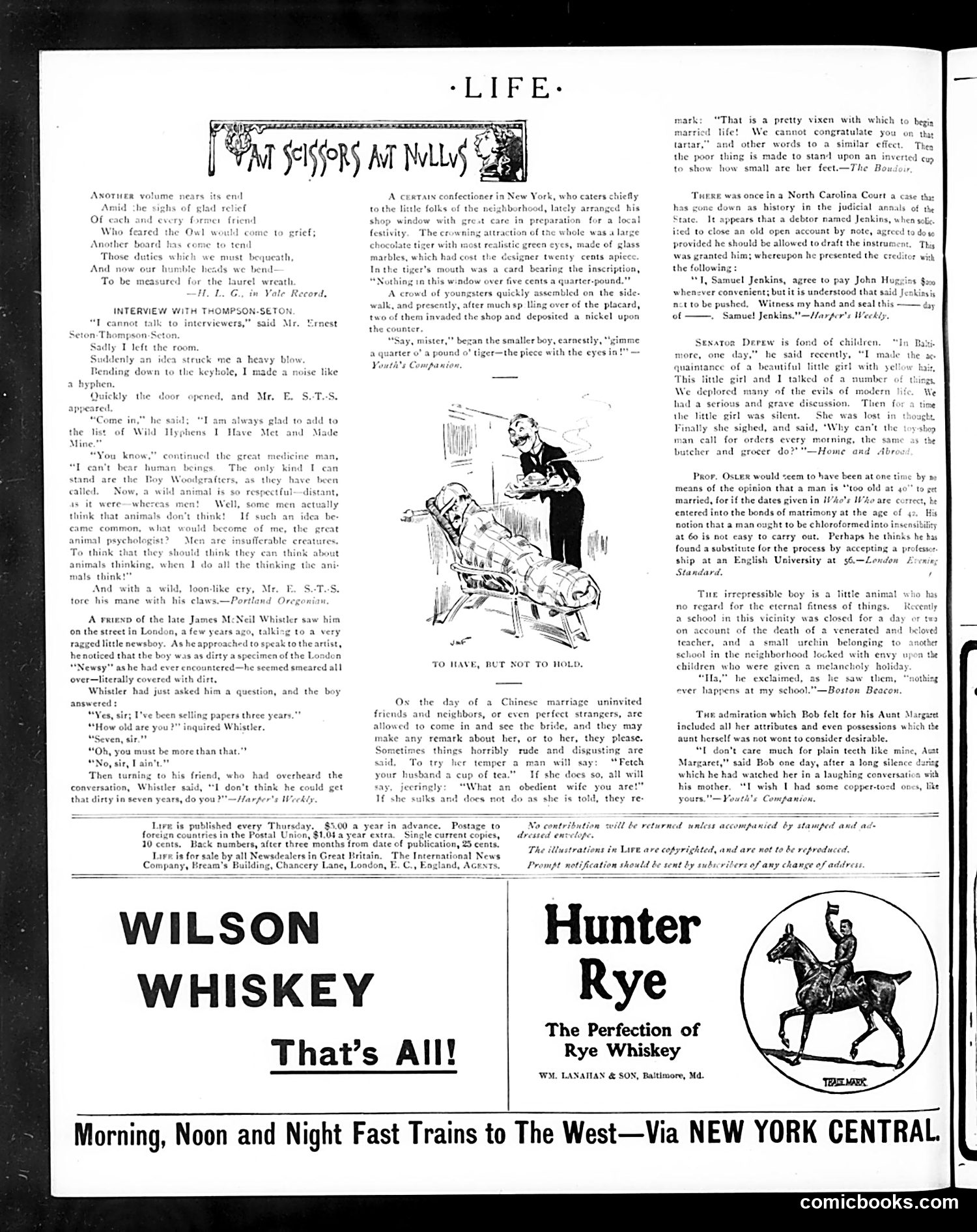
This page from *Life* magazine contains several humorous anecdotes and interviews typical of early 20th-century satirical journalism. The main cartoon shows a man sitting in a chair while another figure operates what appears to be a dental or medical device. The caption reads "TO HAVE, BUT NOT TO HOLD," suggesting marital dissatisfaction—a common satirical theme of the era. The text includes interviews and stories mocking various subjects: Ernest Thompson Seton (a naturalist), discussing animal psychology; James McNeill Whistler (the famous artist), encountering a dirty London newsboy; and various other anecdotes about confectioners, judges, and children. The humor relies on wordplay, ironic observations about human nature, and social commentary. The advertisements at the bottom (Wilson Whiskey, Hunter Rye, and New York Central trains) are typical period advertising integrated into editorial content. Overall, this represents *Life*'s formula of mixing satirical commentary on contemporary figures with humorous social observations.
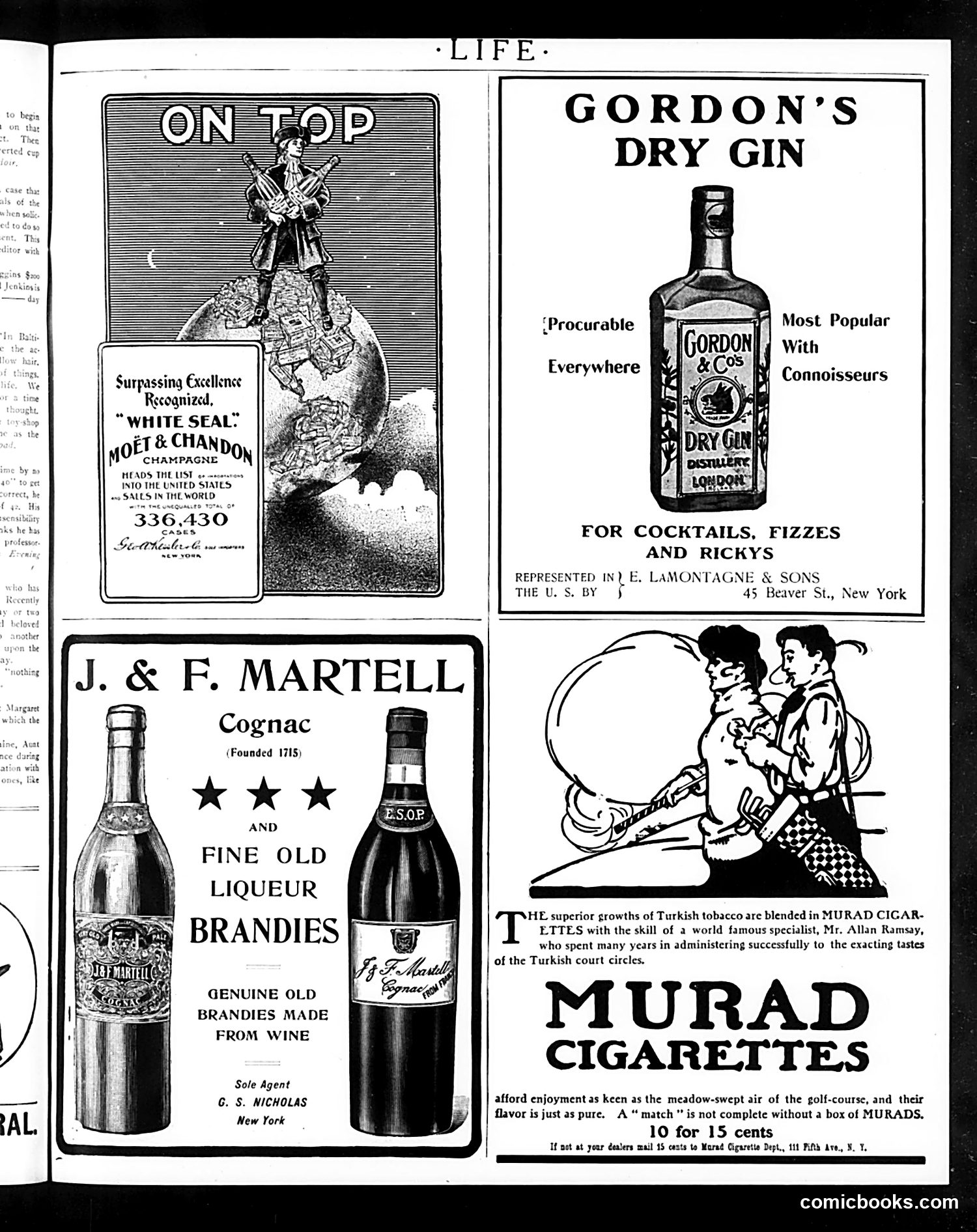
This is primarily an **advertising page**, not satire or political commentary. It contains four distinct liquor and tobacco advertisements typical of early 20th-century American magazines: 1. **"On Top"** - Champagne ad featuring Britannia atop a globe, emphasizing that "White Seal" Moët & Chandon is the world's top-selling champagne imported to America. 2. **Gordon's Dry Gin** - Straightforward product advertisement highlighting its popularity with connoisseurs for cocktails. 3. **J. & F. Martell Cognac** - Period-appropriate brandy promotion (founded 1715), emphasizing authenticity and age. 4. **Murad Cigarettes** - Features two men smoking while golfing. Copy claims Turkish tobacco blended by "world famous specialist Mr. Allan Ramsay" provides superior flavor comparable to "meadow-swept air." The page reflects pre-Prohibition-era advertising norms and lacks satirical intent. Modern readers should note the casual cigarette/alcohol marketing and the appeals to status and sophistication that characterized this era's advertising.
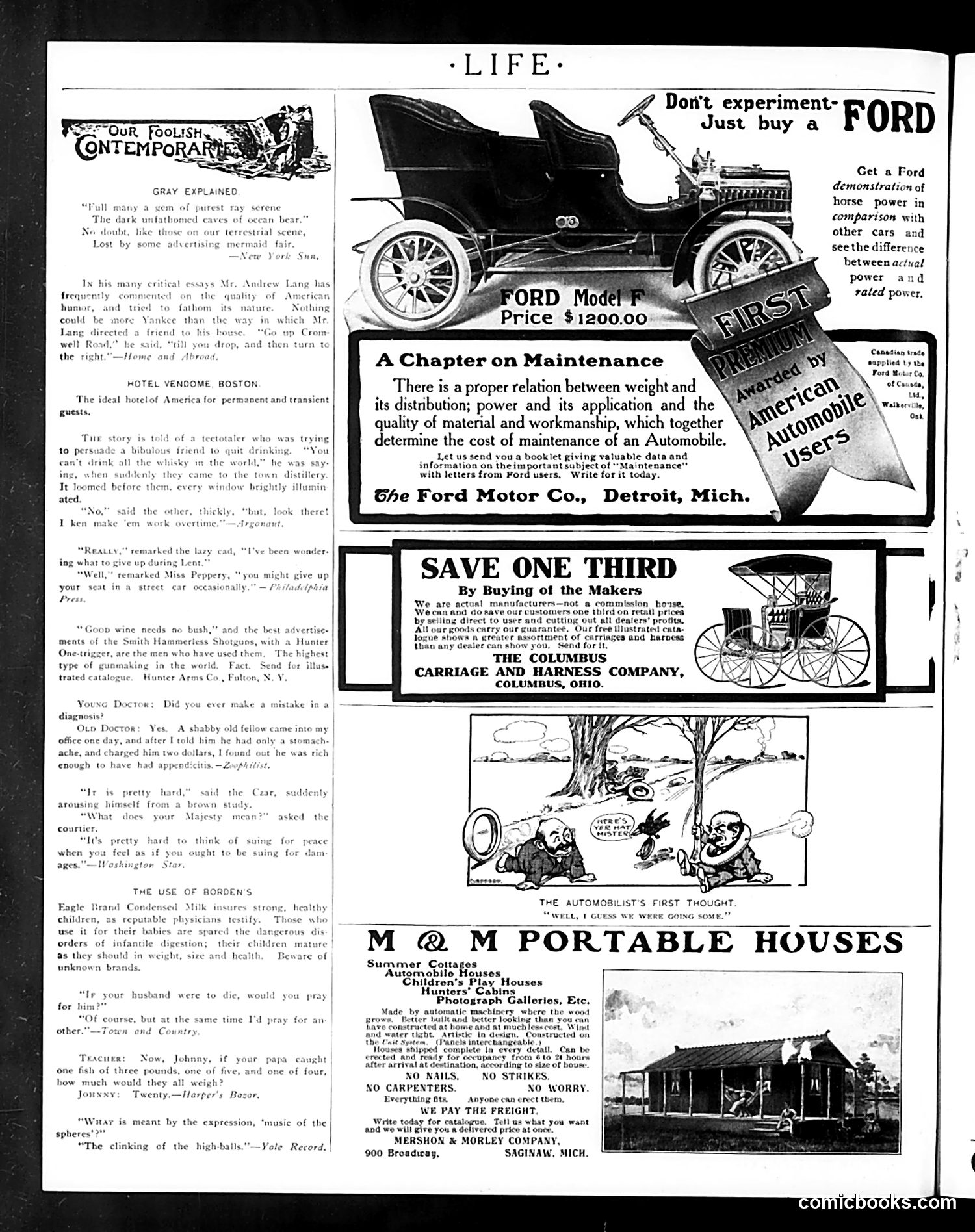
This Life magazine page mixes satirical commentary with period advertisements. The top section, "Our Foolish Contemporaries," collects absurd quotes from newspapers—including a debate about whether a czar's "majesty" means something, and a doctor who misdiagnosed a wealthy patient as having stomach trouble. These represent the magazine's recurring feature mocking contemporary public discourse and incompetence. The advertisements dominate: Ford promotes its Model T at $1200, emphasizing "actual power" versus competitors' inflated claims. A Columbus Carriage Company ad touts buying direct from manufacturers to "save one third." The cartoon "The Automobilist's First Thought" gently satirizes early car owners' anxieties. An M&M Portable Houses ad showcases prefabricated dwellings—a novel concept suggesting modernization and convenience. The page reflects early 1900s concerns: automobile technology's superiority over horses, manufacturing efficiency, and mass-produced innovation.
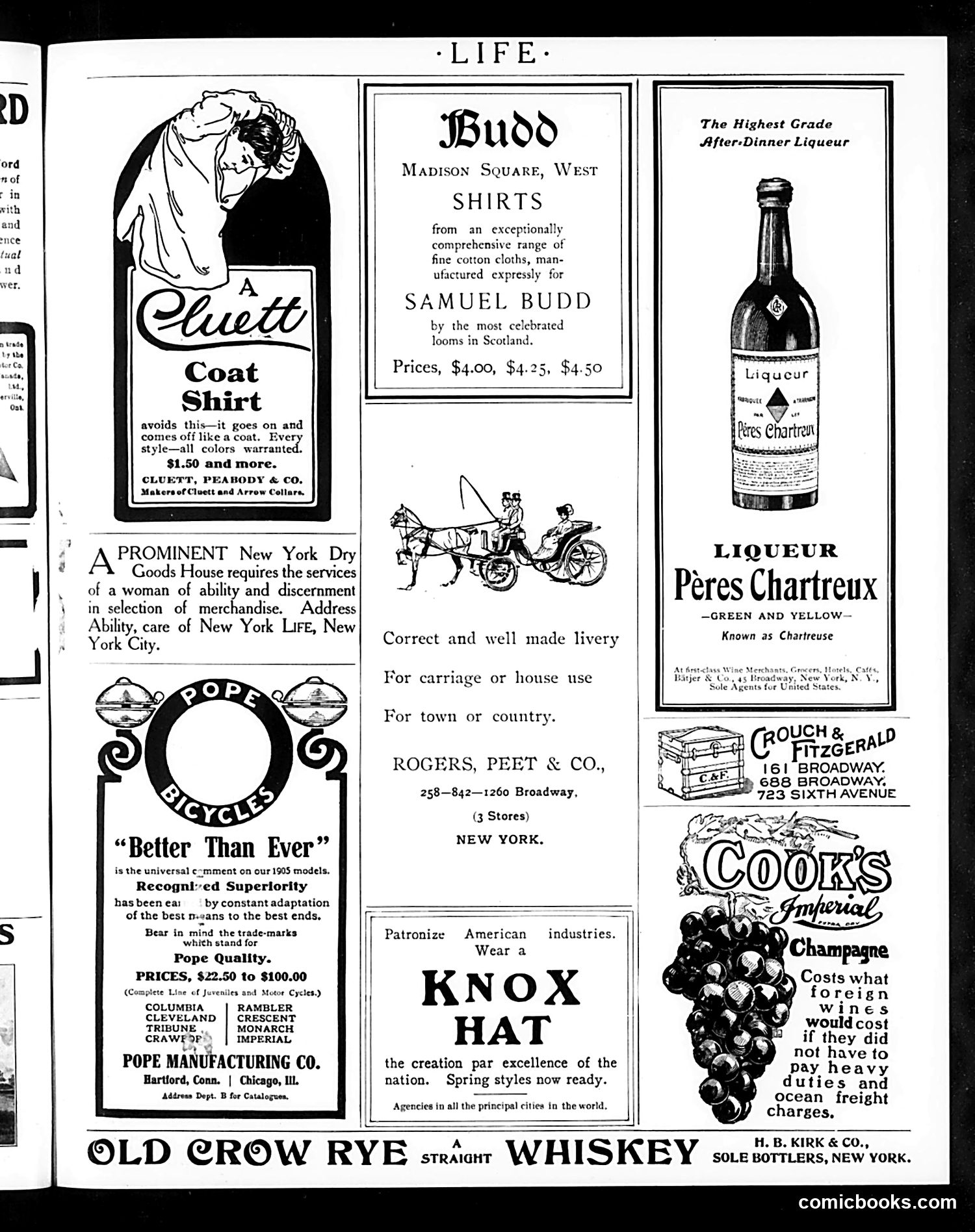
This page is primarily **advertising**, not satire or political commentary. It contains various product advertisements typical of an early 1900s *Life* magazine, including: - Cluett coat shirts and Arrow collars - Pope bicycles ("Better Than Ever") - Budd shirts from Scotland - Rogers, Peet & Co. livery services - Knox hats - Liqueurs (Pères Chartreux, Cook's Imperial Champagne, Old Crow Rye Whiskey) There is one small employment notice seeking a woman with "ability and discernment" for a New York dry goods house. The ads reflect period consumer goods and social conventions (livery services, formal wear). The Knox hat ad includes nationalist messaging ("Patronize American industries"), while the liqueur ad emphasizes avoiding import duties and ocean freight charges—likely referencing contemporary tariff debates. No satirical cartoon is prominently featured on this page.
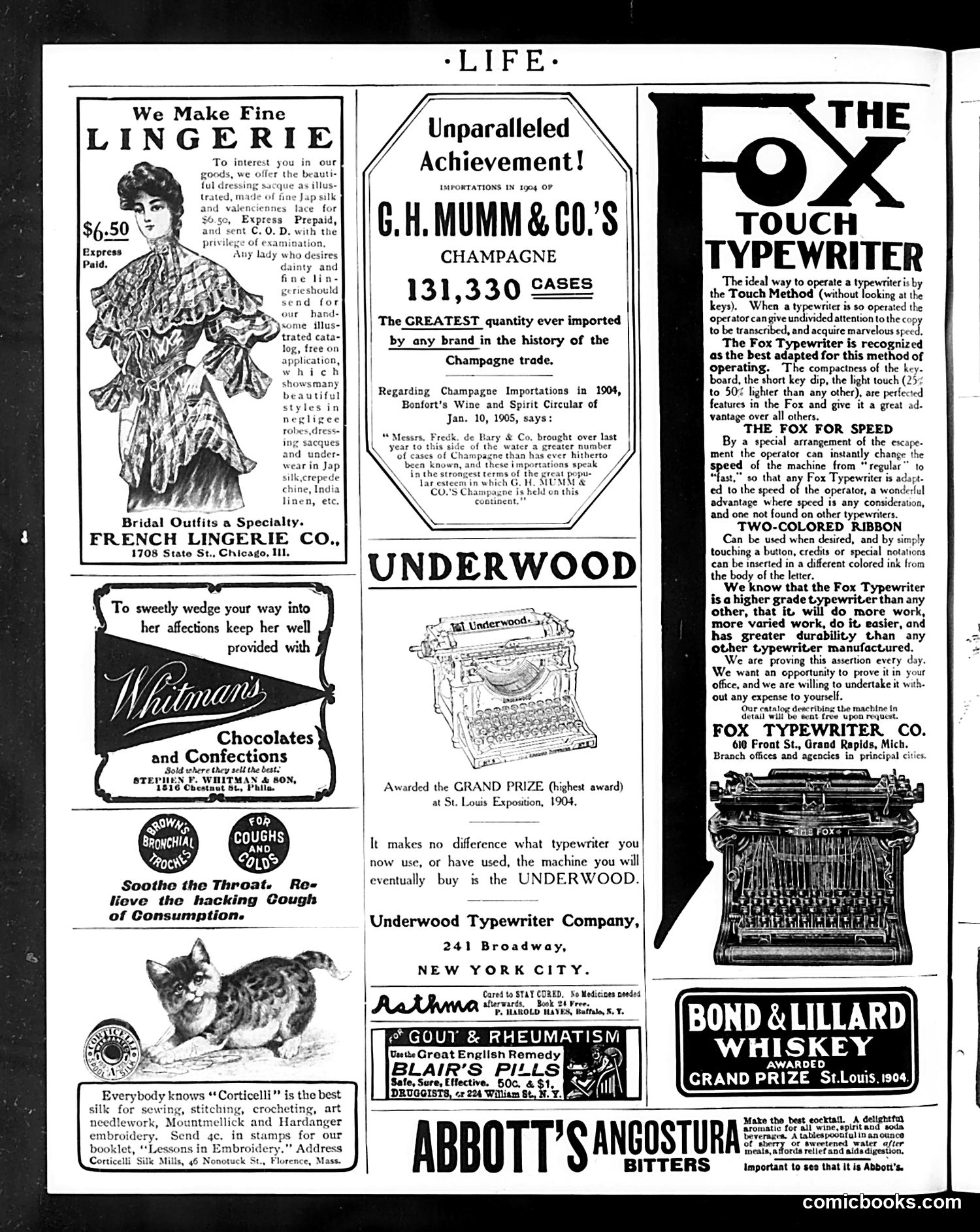
This is primarily an **advertising page** from Life magazine, not satirical content. It features product advertisements typical of the early 1900s: **Key Advertisements:** - **French Lingerie Co.**: High-end women's undergarments ($6.50, mail-order) - **G.H. Mumm Champagne**: Boasts record importation of 131,330 cases in 1904—a competitive claim emphasizing dominance in the luxury goods market - **Fox and Underwood Typewriters**: Both claim superiority; Underwood confidently asserts it will eventually outsell competitors - **Whitman's Chocolates, Bond & Lillard Whiskey, Abbott's Bitters**: Luxury consumables marketed with "Grand Prize" claims from the 1904 St. Louis Exposition **Historical Context for Modern Readers:** These ads reflect Gilded Age consumer culture emphasizing imported luxury goods and mail-order shopping. The typewriter competition reflects the machine's recent introduction as essential office technology. Claims of "unparalleled achievement" and exposition prizes were common marketing tactics to establish prestige among competing brands.
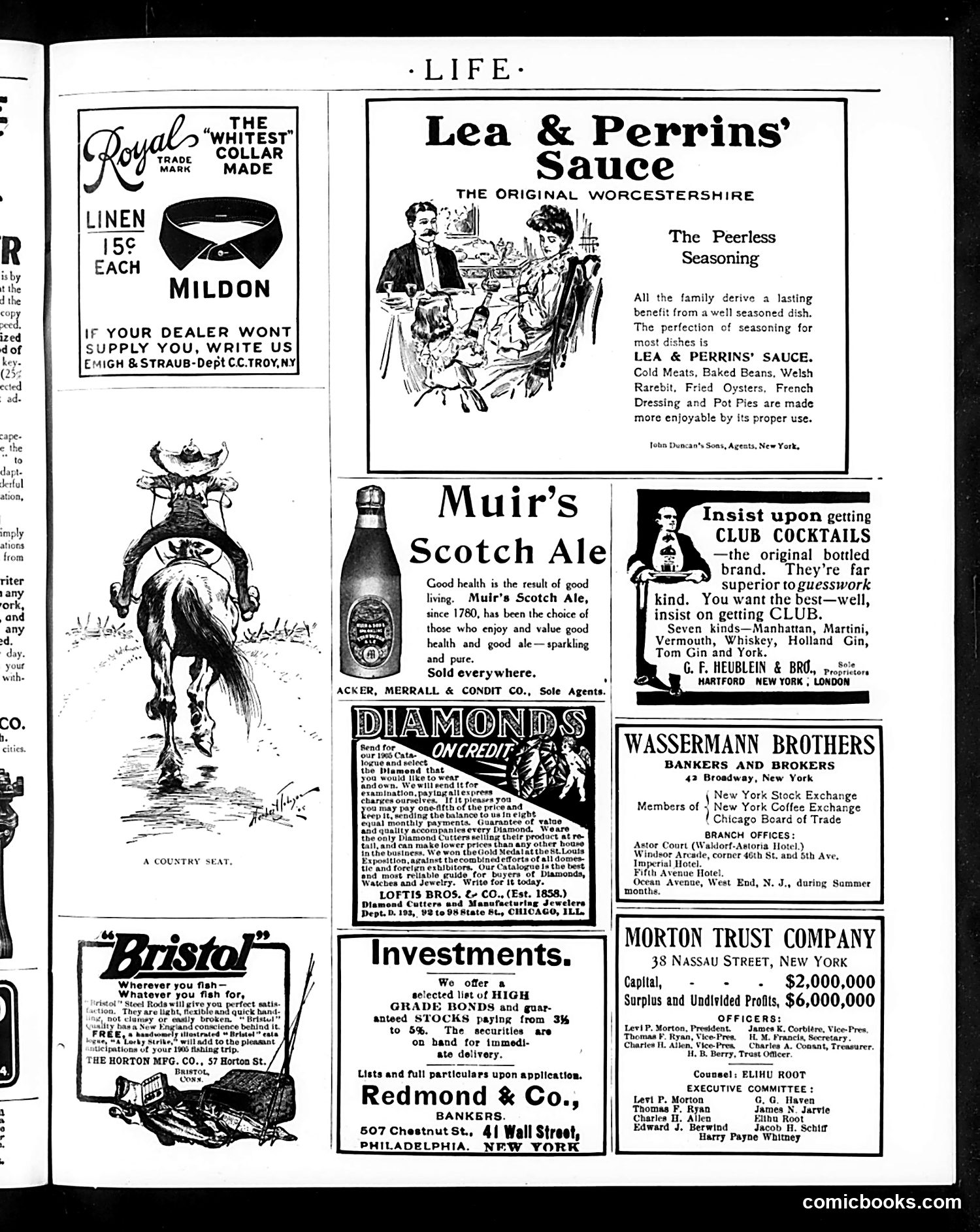
This page is primarily **advertising**, not editorial satire. The content consists of commercial advertisements for various consumer products and financial services typical of early 20th-century America. Notable ads include: - **Royal Linen Collar** (15¢): Men's formal wear - **Lea & Perrins' Worcestershire Sauce**: A condiment marketed as essential seasoning - **Muir's Scotch Ale**: Alcohol advertised as promoting "good health" - **Bristol Steel Fishing Rods**: Sporting equipment - **Diamonds on Credit**: Jewelry with installment payment plans - **Financial services**: Banks and investment firms (Redmond & Co., Wassermann Brothers, Morton Trust Company) The left side includes a small illustration labeled "A Country Seat" showing rural/pastoral imagery. **No political cartoons or satire appear on this page.** It represents straightforward commercial messaging aimed at middle and upper-class readers, reflecting consumer culture and financial opportunities of the era.
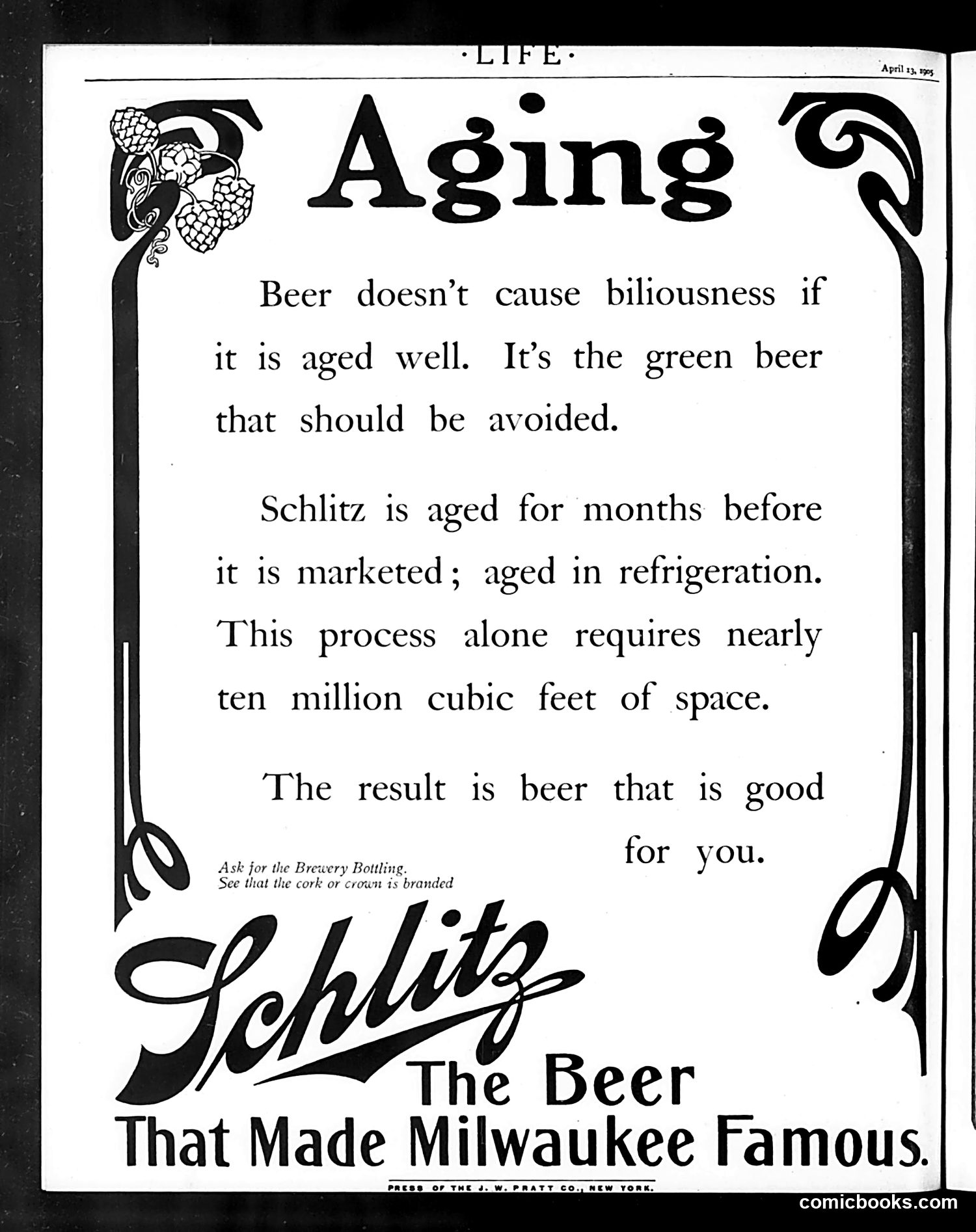
This is a **beer advertisement**, not political satire. The page promotes Schlitz beer by claiming superior quality through proper aging. The ad's argument: "green beer" (newly brewed, unaged beer) causes biliousness (nausea/digestive upset), but Schlitz avoids this by aging for months in refrigeration—requiring enormous storage space (10 million cubic feet). The tagline "The Beer That Made Milwaukee Famous" emphasizes Schlitz's reputation as a premium Milwaukee product. The decorative art-nouveau borders with hops suggest quality and sophistication. This was typical early-1900s advertising that made health claims about products—here, positioning careful aging as a health benefit rather than mere marketing.