
Life, 1905-04-13 · page 14 of 22
Life — April 13, 1905 — page 14: what you’re looking at
What you’re looking at
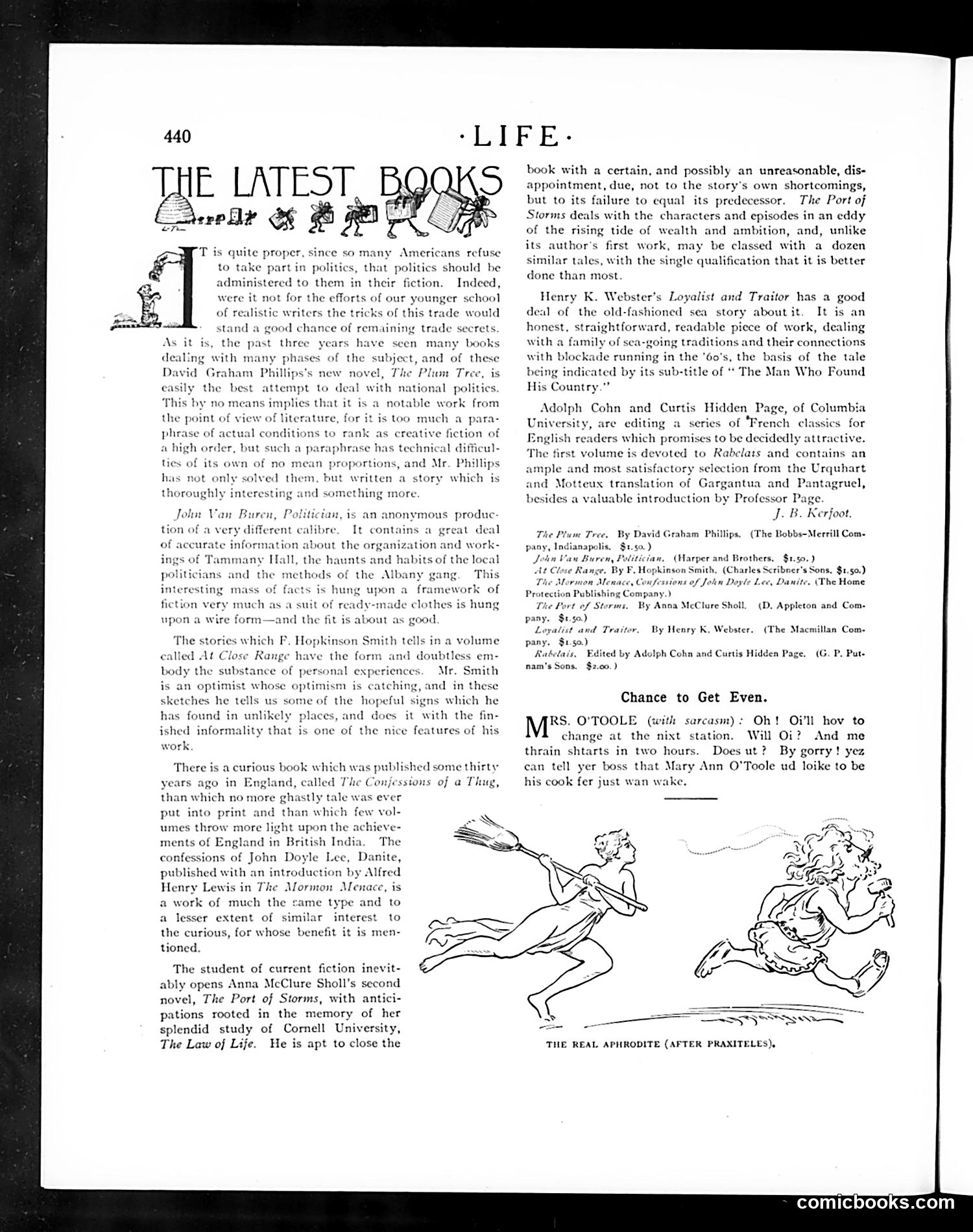
This single-panel cartoon illustrates a humorous domestic scene unrelated to the book reviews on the page. It depicts a man being blown backward by wind, clinging to a broom or similar object, while a woman chases after him with apparent determination. The caption—"Chance to Get Even"—suggests the woman is retaliating against the man for some previous domestic transgression. The humor derives from the visual comedy of role reversal: the woman actively pursues the man in a slapstick manner, inverting typical gender dynamics of the era. The "real aphrodite (after Praxiteles)" subtitle references the classical Greek sculpture, mockingly comparing the woman's aggressive stance to idealized beauty. The joke reflects early-20th-century domestic humor common in *Life* magazine, playing on marital conflict and the woman "getting even" through physical comedy rather than verbal sparring.
📄 Transcribed text from this page (OCR, searchable)
Machine-transcribed from the original scan — historical spelling and the odd misread are preserved.
440 Cra a Be T is quite proper, since so many Americans refuse part in politics, that politics should be iction. Indeed, younger school to tak administered to them in their were it not for the efforts of our salistic writers the tricks of this trade would chance of remaining trade secrets. the past three years have seen many books many phases of the subject, and of these Phon Tree, is nt to deal with national politics. Phillips's new novel, The casily the best atter q yy no means implies that it is a notable work from the point of view of literature, for it is too much a pa phrase of actual conditions to rank as creative fiction of a high order, but such a paray has technical difficul- ties of its own of no mean proportions, and Mr. Phillips has not only solved them, but written a story which is thoroughly mm Buren, Po avery different calibre. It contains hing more ician, is an anonymous produc tion « eat deal of aceur: ition about the organization and wo: ings of Tammany Hall, the haunts and habits of the local nany gang. This ework of pe ns and the methods of the A interesting mass of facts is hung upon a fr: fiction very much as a suit of ready-made clothes is hung upon a wire form—and the fit is about as good The stories which PF. Hopkinson Smith tells in a volume called At Close Range have the for body the substance of personal experiences und doubtless em- Mr. Smith is an optimist whose optimism is catching, and in these sketches he tells us some of the hop has found in unlikely does it with the fin- ished informality that is one of the nice features of his ul signs which he places, an work There is a curious book which was published some thirty years ago in England, called The Conjessions of a Thuy than which no more ghastly tale was ever put into print and than wh umes throw more light upon the achiev: ments of England in British India. confessions of John Doyle Lee, Danite, published with an introduction by Alfred Henry Lewis in The Mormon Menace, is a work of much the came type and to a lesser extent of similar interest to the curious, for whose benefit it is m tioned. The student of current fiction inevit- ably opens Anna McClure Sholl’s second novel, The Port of Storms, with antici pations rooted in the memory of her splendid study of Cornell University, The Law oj Lije. He is apt to close the "LEE book with a certain, and possibly an unreasonable, dis- appointment, due, not to the story’s own shortcomings, but to its failure to equal its predecessor. The Port of Storms deals with the characters and episodes in an eddy of the rising tide of wealth and ambition, and, unlike its author’s first work, be classed with a dozen similar tales, with the single qualification that it is better done than most. Henry K. Webster’s Loyalist and Traitor has a good deal of the old-fashioned sea story about it. It is an honest, straightforward, readable picce of work, dealing with a family of sea-going traditions and their connections with blockade running in the ‘60's, the basis of the tale being indicated by its sub-title of * The Man Who Found His Country Adolph Cohn and Curtis Hidden Page, of Columbia University, are editing a series of ‘French classics for nglish readers which promises to be decidedly attractive. The first volume is devoted to Rabelats and contains ample and most satisfactory selection from the Urquhart and Mo} gruel, besides a valuable introduction by Professor Page. J.B. Kerjoot. The Plum Tree. By David Graham Phillips, (The Bobbs-Merrill Com- ny, Indianapolis. $1.50.) John Van Buren, Politician, (Harper and Brothers. $1.50.) wit Close Range. By FH. (Charles Scribner's Sons, $1.50.) The Mormon Menac n Doyle Lee, Danite, (The Home Protection Publishing C The Port of Storms. pany. $1.50.) $150.) 2is, Edited by Adolph Cohn and Curtis Hidden Page. (G. P, Pate ram's Sons. $2.00.) x translation of Gargantua and Pani By Anoa McClure Sholl. (D. Appleton and Com- By Henry K, Webster. (The Macmillan Com. Chance to Get Even. RS. O'TOOLE ith sarcasm): Oh! Qi’ll hov to change at the nixt station. Will O1 And me thrain shtarts in two hours. Does ut? By gorry! yez can tell yer boss that Mary Ann O'Toole ud loike to be his cook fer just wan wake. THE REAL APHRODITE (AFTER PRAXITELES), comicbooks.com