
Life, 1905-04-13 · page 12 of 22
Life — April 13, 1905 — page 12: what you’re looking at
What you’re looking at
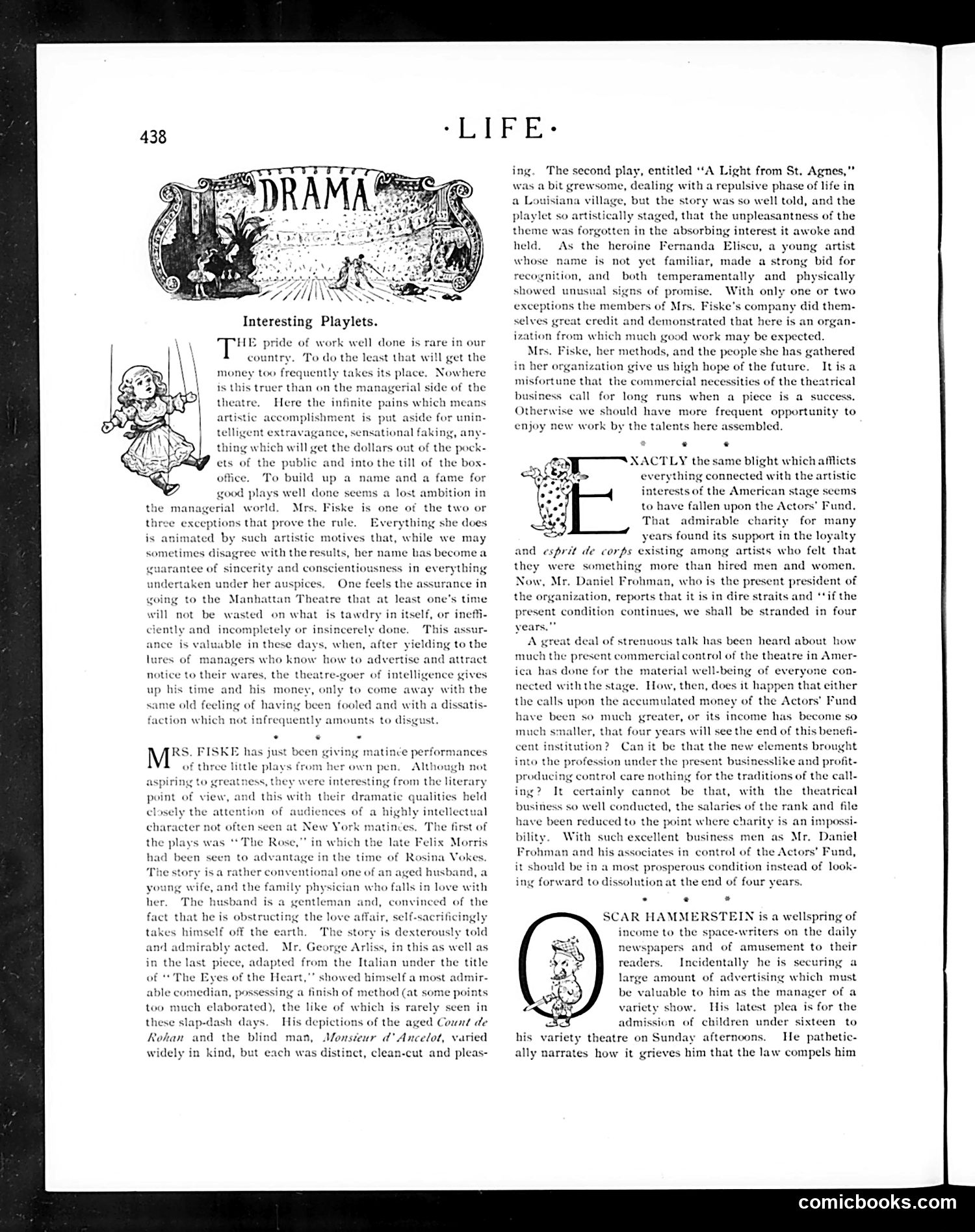
This page discusses Mrs. Fiske's theatrical company and recent playwriting efforts. The text praises the "pride of work well done" in theater management, noting Mrs. Fiske's success in producing quality plays despite theatrical industry challenges. The page reviews three recent plays Mrs. Fiske presented: "The Rose," "The Eyes of the Heart," and "A Light from St. Agnes." The text commends both the literary quality and dramatic execution of these productions, particularly praising the performances and artistic staging. A decorative "DRAMA" header and small illustrations of theatrical figures accompany the text. The overall tone celebrates professional theatrical management that prioritizes artistic merit over purely commercial considerations—a notable position given early 1900s theater economics.
📄 Transcribed text from this page (OCR, searchable)
Machine-transcribed from the original scan — historical spelling and the odd misread are preserved.
oe a oe Interesting Playlets. HE pride of work well done is rare in our country. To do the least that will get the money too frequently takes its place. Nowhere is this truer than on the managerial side of the theatre. Here the infinite pains which means is put aside nin- ance, sensational faking, any- artistic accomplishr telligent extrav thing which will get the dollars out of the pock- ets of the public and into the till of the bos- ofice. To build up a name and a fame for good plays well done seems a lo ion in Mrs. Fiske is one of the two or Everything she does is animated by such artistic motives that, while we may sometimes disagree with the results, her name has become the managerial world three exceptions that prove the rule. guarantee of sincerity and conscientiousness in everything undertaken under her auspices. One feels the assurance in going to the Manhattan Theatre that at least one’s time will not be wasted on what is tawdry in itself, or inefi- This assur- Iding to the ciently and incompletely or insincerely done. ance is valuable in these days, when, after 5 o advertise and attract lures of managers who know notice to their wares, the theatre f intelligence gives up his time and his money, only to come away with the same old f ving been fooled and with a dissatis- not infrequently amounts to disgust. ing of faction whict RS. FISKE has just been giving of three little plays from her own pen tince performances Althou aspiring to gre they were interesting point of view, and this with their dramatic qualities he closely the attention of audiences of a highly intellec often seen at New York matinces, The first of character r the plays was The Rose,” in which the late Felix Morris had been seen to advantage in the time of Rosina Vokes ‘The story isa rather conventional one of an and the family ged husband, a physician who falls in love with her. The husband is a gentleman and, convinced of the fact that he is obstructing the love a Mr. George Arliss, in this as well as air, self-sacrificingly takes himself off the earth and admirably acted. in the last piece, adapted from the Italian under the title of “The Eyes of the Heart,"’ showed himself a most admir- y is desterously told able comedian, possessing a finish of method (at some points too much elaborated), the like of which is rarely seen in these slap-dash days. His depictions of the aged Count de Rohan and the blind man, Monsteur d’Ancelot, varied widely in kind, but each was distinct, clean-cut and pleas- ing. The second play, entitled ‘A Light from St, Agne: was a bit grewsome, dealing with a repulsive phase of life in a Louisiana village, but the story was so well told, and the playlet so artistically staged, that the unpleasantness of the nin the absorbing interest it awoke and held. As the heroine Fernanda Eliscu, a young artist whose name is not yet familiar, made a strong bid for recognition, and both temperamentally and physically showed unusual signs of promise. With only one or two exceptions the members of Mrs. Fiske’s company did them- theme was forg selves great credit and demonstrated that here is an organ- ization from which much good work may be expected. Mrs, Fiske, her methods, and the people she has gathered Ttisa misfortune that the commercial necessities of the theatrical in her organization give us high hope of the future. business call for long runs when a piece is a success. Otherwise we should have more frequent opportunity to enjoy new work by the talents here assembled. . * ACTLY the same blight which afl everything connected with the artistic interests of the American stage seems to have fallen upon the Actors’ Fund. That admirable charity for 1 years found its support in the loy and esprit de corps existing among artists who felt that they were something more than hired men and women. Now, Mr. Daniel Frohman, who is the present president of the organization, reports that it is in dire straits and ‘tif the present condition continues, we shall be stranded in four years.” A great deal of strenuous talk has been heard about how much the present commercial control of the theatre in Amer- ica has done for the material well-being of everyone con- nected withthe stage. How, then, does it happen that either the calls upon the accumulated money of the Actors’ Fund have been so much greater, or its income has become so much smaller, that four years will see the end of this ben cent institution? Can it be that the new elements brought 1e profession under the present businesslike and profit- producing control care nothing for the traditions of the call- ing? It certainly cannot be that, with the theatrical business so well conducted, the salaries of the rank and file have been reduced to the point where charity is an impossi- bility. With such excellent business men as Mr. Daniel of the Actors’ Fund, it should be in a most prosperous condition instead of look- ing fory Frohman and his associates in cont d to dissolution at the end of four years. - . . SCAR HAMMERSTEIN is a wellspring of income to the space-writers on the daily newspapers and of amusement to their readers. Incidentally he is securing a large amount of advertising which must be valuable to him as the manager of a His latest plea is for the admission of children under sixteen to his variety theatre on Sunday afternoons. He pathetic- ally narrates how it grieves him that the law compels him variety show. comicbooks.com