
A complete issue · 24 pages · 1905
Life — March 30, 1905
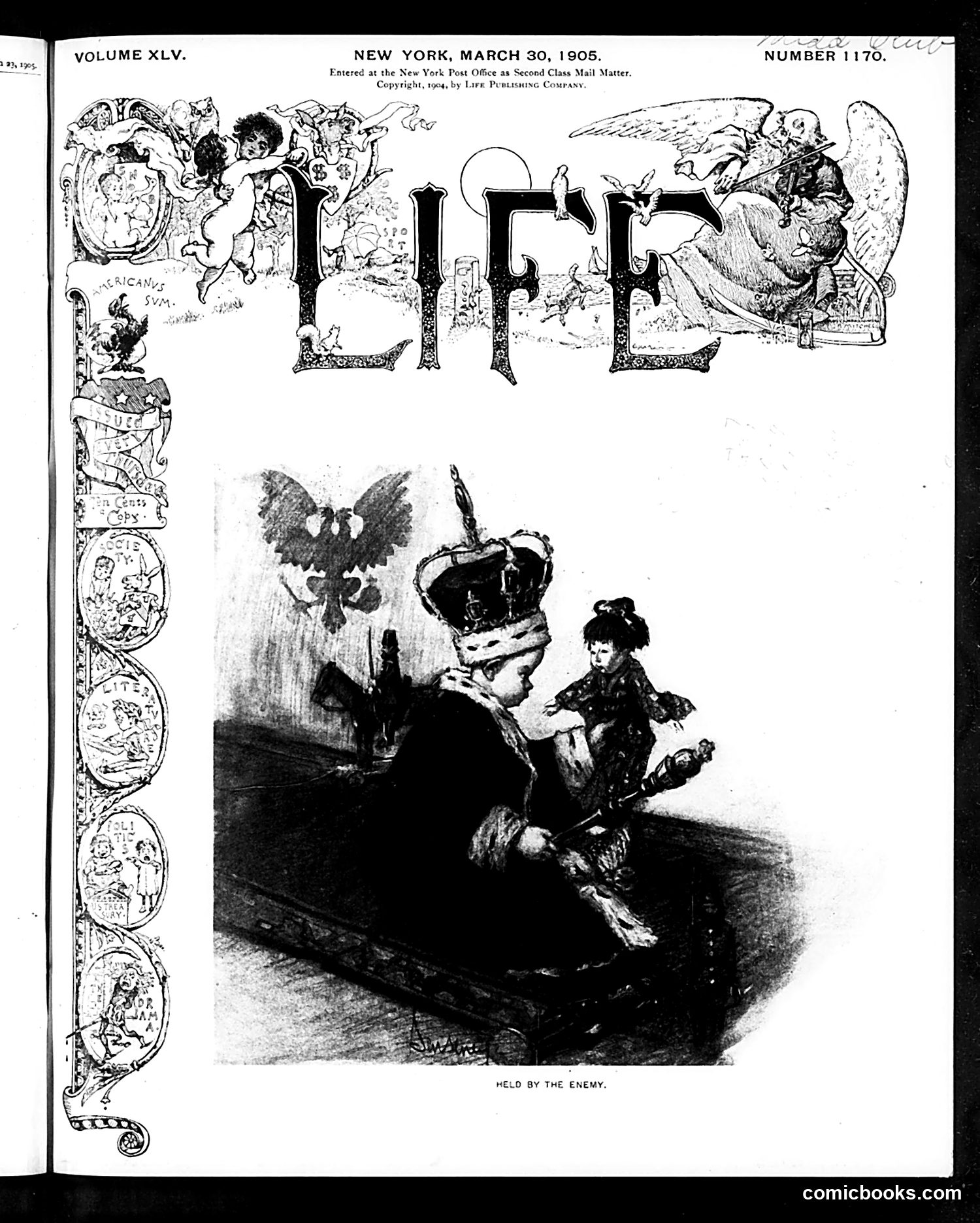
The main cartoon, captioned "Held by the Enemy," depicts a crowned military figure (likely representing a European monarch or emperor) clutching a small doll or child-like figure while an eagle (symbol of American power) looms menacingly above. The satire appears to address international tensions or diplomatic conflicts of the early 1900s, suggesting that some foreign power is "held captive" by enemy forces—possibly referencing the Russo-Japanese War (1904-1905) or broader imperial rivalries of the era. The ornate border decorations and "LIFE" masthead design employ classical and allegorical imagery typical of Life's satirical style during this period of American imperial expansion and great-power competition.
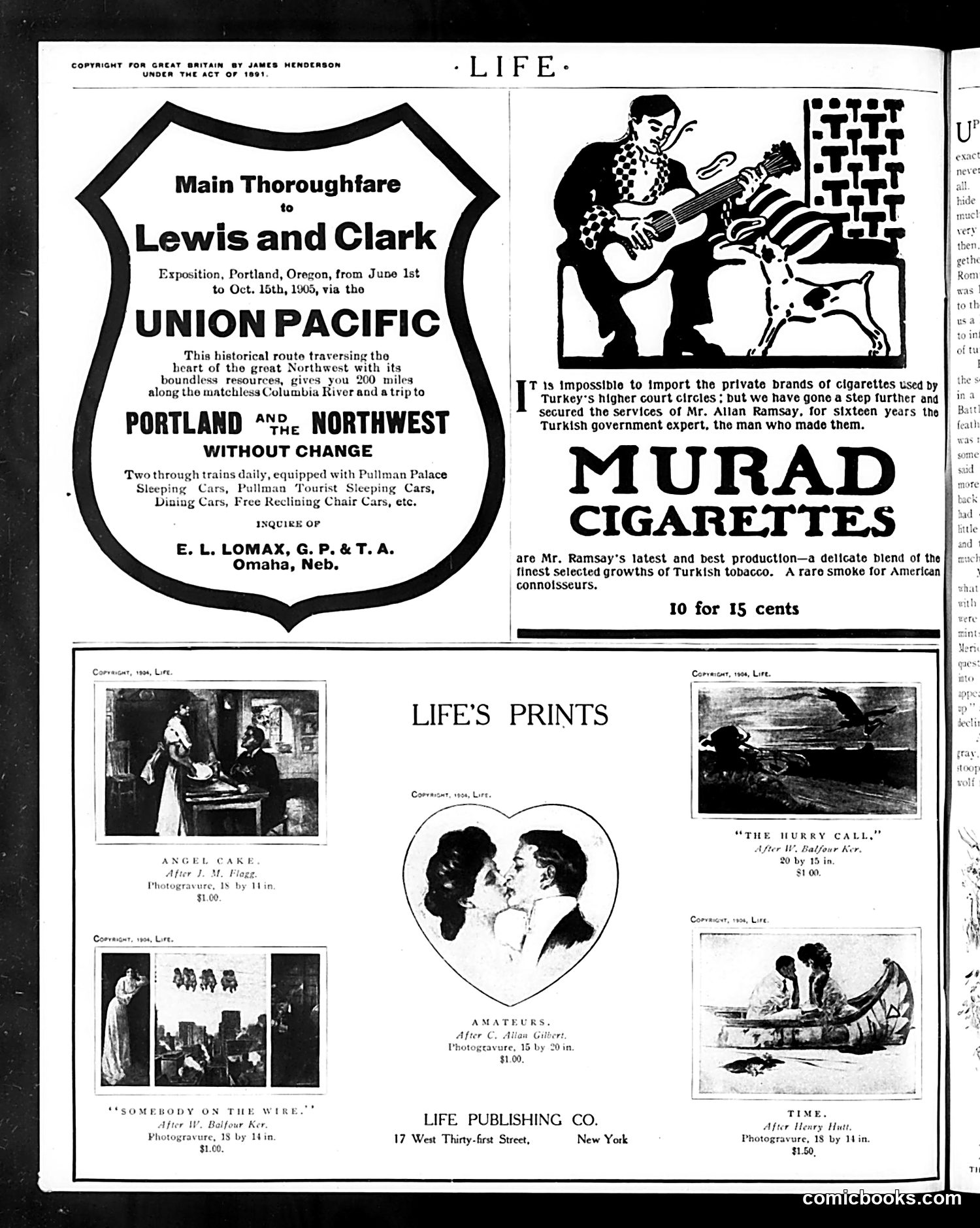
This page is primarily **advertising** rather than editorial content or political satire. The main advertisements include: 1. **Union Pacific Railroad** - promoting train service to the Lewis and Clark Exposition in Portland, Oregon (1905) 2. **Murad Cigarettes** - featuring an illustration of a man playing guitar, advertising Turkish tobacco cigarettes at "10 for 15 cents" 3. **Life's Prints** - a section selling art reproductions, including works titled "Angel Cake," "Somebody on the Wire," "Amateurs," "The Hurry Call," and "Time," priced between $1.00-$1.50 The guitar player in the Murad ad appears to be a generic figure representing leisure/entertainment, not a specific political caricature. The overall page reflects early 1900s consumer advertising rather than satirical commentary.
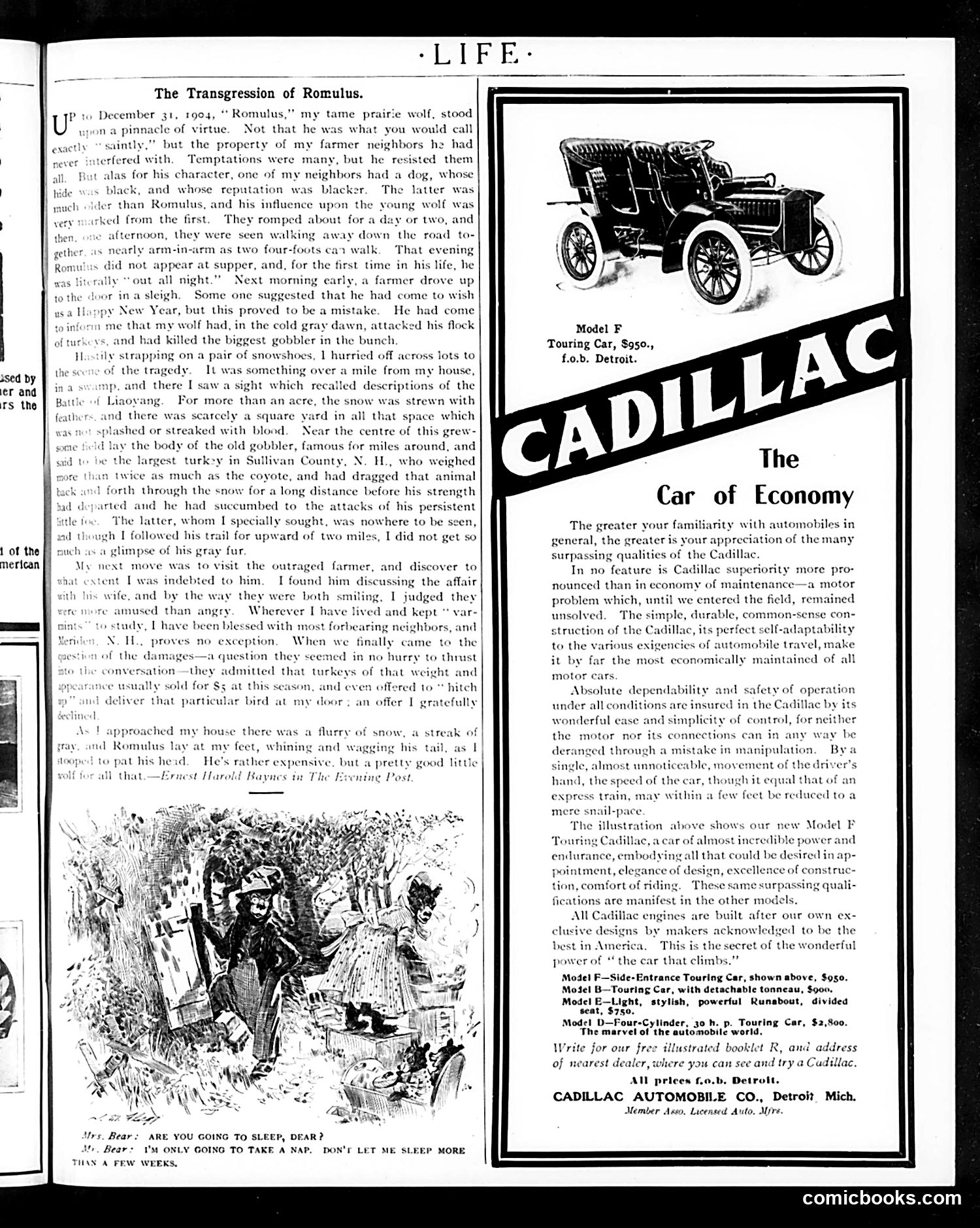
This page contains two distinct elements: **Left side:** A short story titled "The Transgression of Romulus" by Ernest Seton-Thompson about a prairie wolf who kills livestock and is hunted by farmers. It includes an illustration showing rural conflict between wildlife and human settlement—a common American frontier theme. **Right side:** A Cadillac automobile advertisement featuring the Model F Touring Car ($950, f.o.b. Detroit). The ad emphasizes the car's reliability, simplicity of control, and durability under various conditions. It positions Cadillac as "the car that climbs," highlighting engineering superiority. The page juxtaposes a narrative about human-animal conflict with consumer messaging about technological progress and personal mobility—reflecting early 1900s American tensions between wilderness and industrialization.
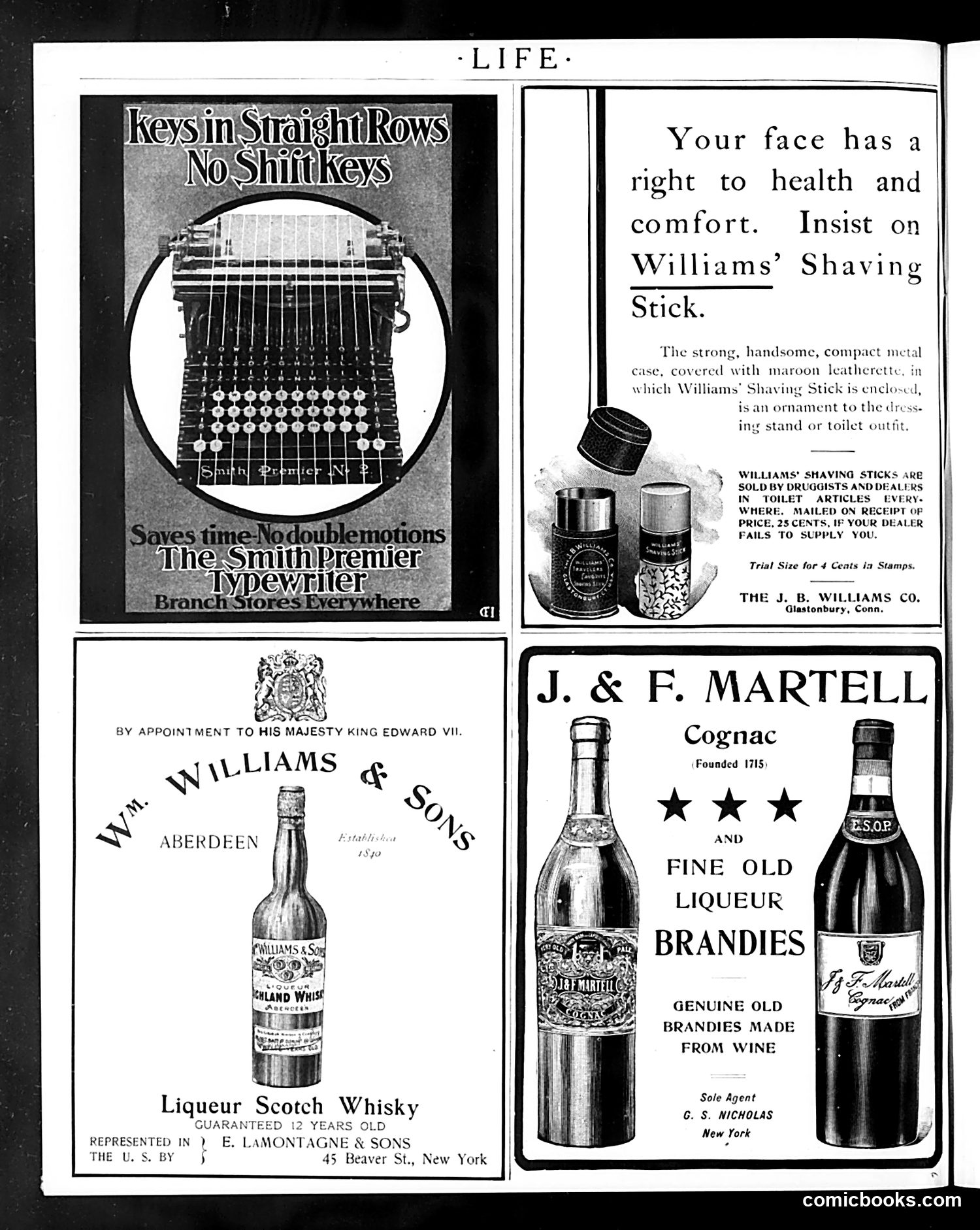
This page is **primarily advertising**, not satire or political commentary. It contains four product advertisements: 1. **Smith-Premier Typewriter** - promoting a model with keys in straight rows and no shift keys 2. **Williams' Shaving Stick** - emphasizing facial health and comfort, sold by druggists 3. **W.M. Williams & Sons Highland Whisky** - a 12-year-old Scotch whisky from Aberdeen 4. **J. & F. Martell Cognac** - fine brandies and liqueurs, founded 1715 The page reflects early 20th-century consumer advertising aimed at middle-class readers. There is **no political cartoon or satire present**—these are straightforward product promotions typical of *Life* magazine's commercial content during this era, when the publication mixed editorial cartoons with paid advertisements.
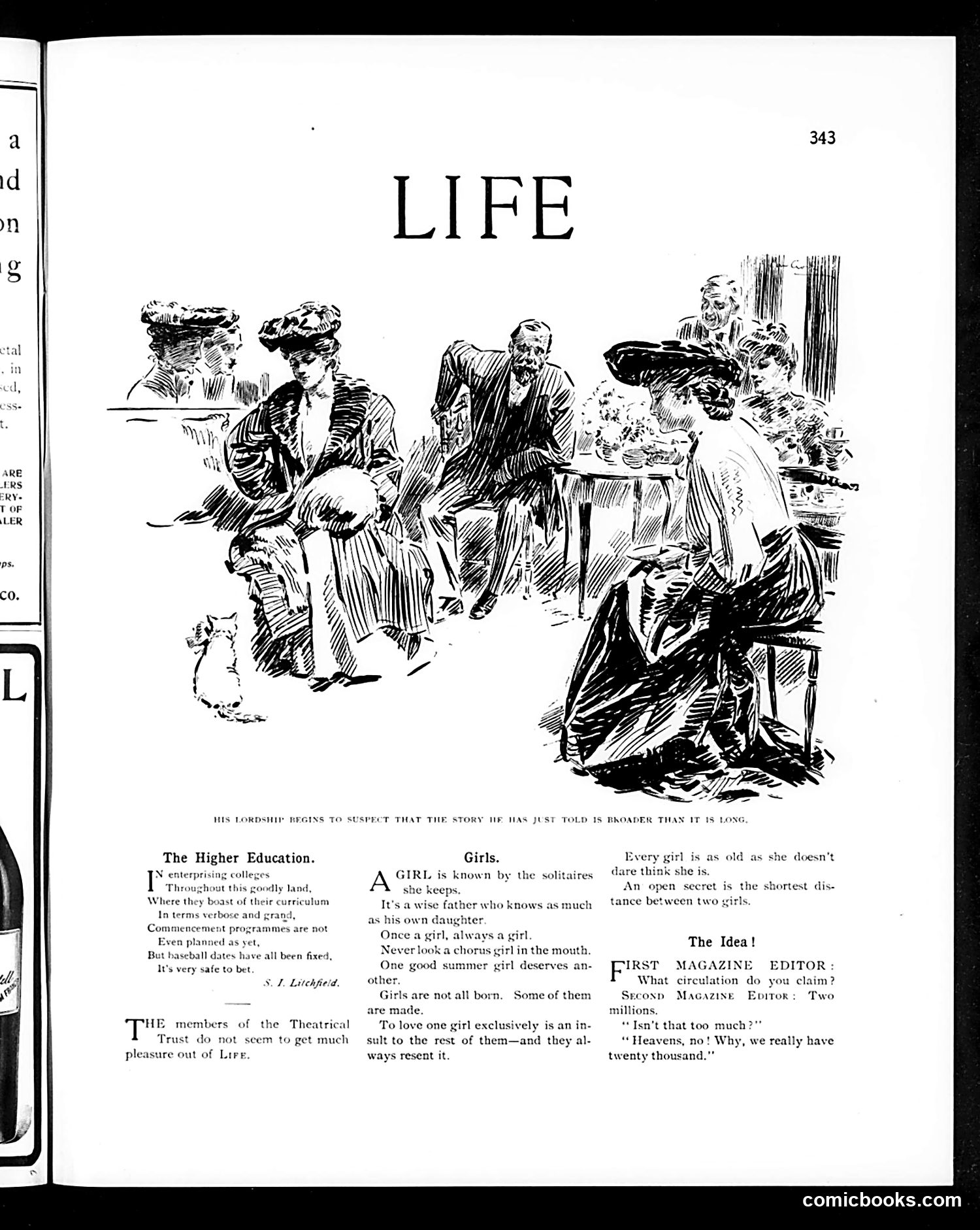
This page contains several satirical pieces typical of early 20th-century Life magazine humor: **Main Cartoon**: Shows a social gathering where "His Lordship begins to suspect that the story he has just told is broader than it is long"—a joke about an awkward moment when someone realizes their anecdote was more risqué than appropriate for the company. **"The Higher Education"**: Mocks pretentious colleges' grandiose curricula while noting "baseball dates have all been fixed, it's very safe to bet"—satirizing corruption in collegiate athletics. **"Girls"**: A humorous piece about female stereotypes and romantic behavior, reflecting period attitudes about women. **"The Idea!"**: A brief joke between magazine editors about circulation numbers, using exaggeration for comedy. The overall tone reflects genteel, upper-class social satire typical of Life's editorial voice.
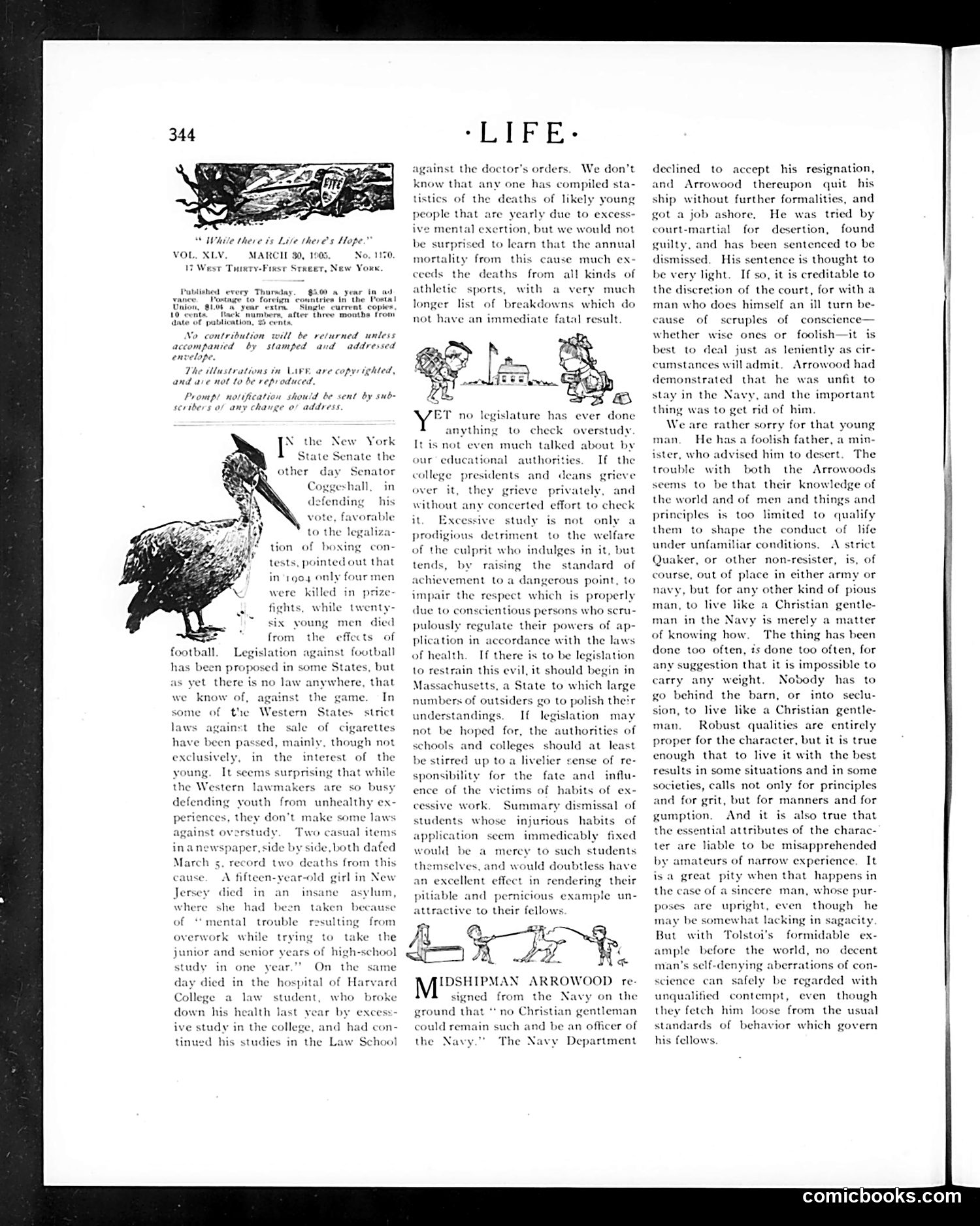
This page contains two distinct editorial cartoons addressing early 20th-century American social issues. **Top cartoon**: A crane or stork appears to comment on "Who Does the Life There's Hope"—likely satirizing debates over mortality rates and health conditions in institutions. **Bottom cartoon**: Depicts Midshipman Arrowood's resignation from the Navy, with accompanying editorial text. The cartoon illustrates the controversy over whether "no Christian gentleman could remain such and be an officer of the Navy." This appears to reference tension between religious principles and military service requirements during the Progressive Era, when debates over military discipline and character formation were active. The editorial argues these tensions reflect broader concerns about institutional authority and personal conscience—issues central to early-1900s American reform discussions.
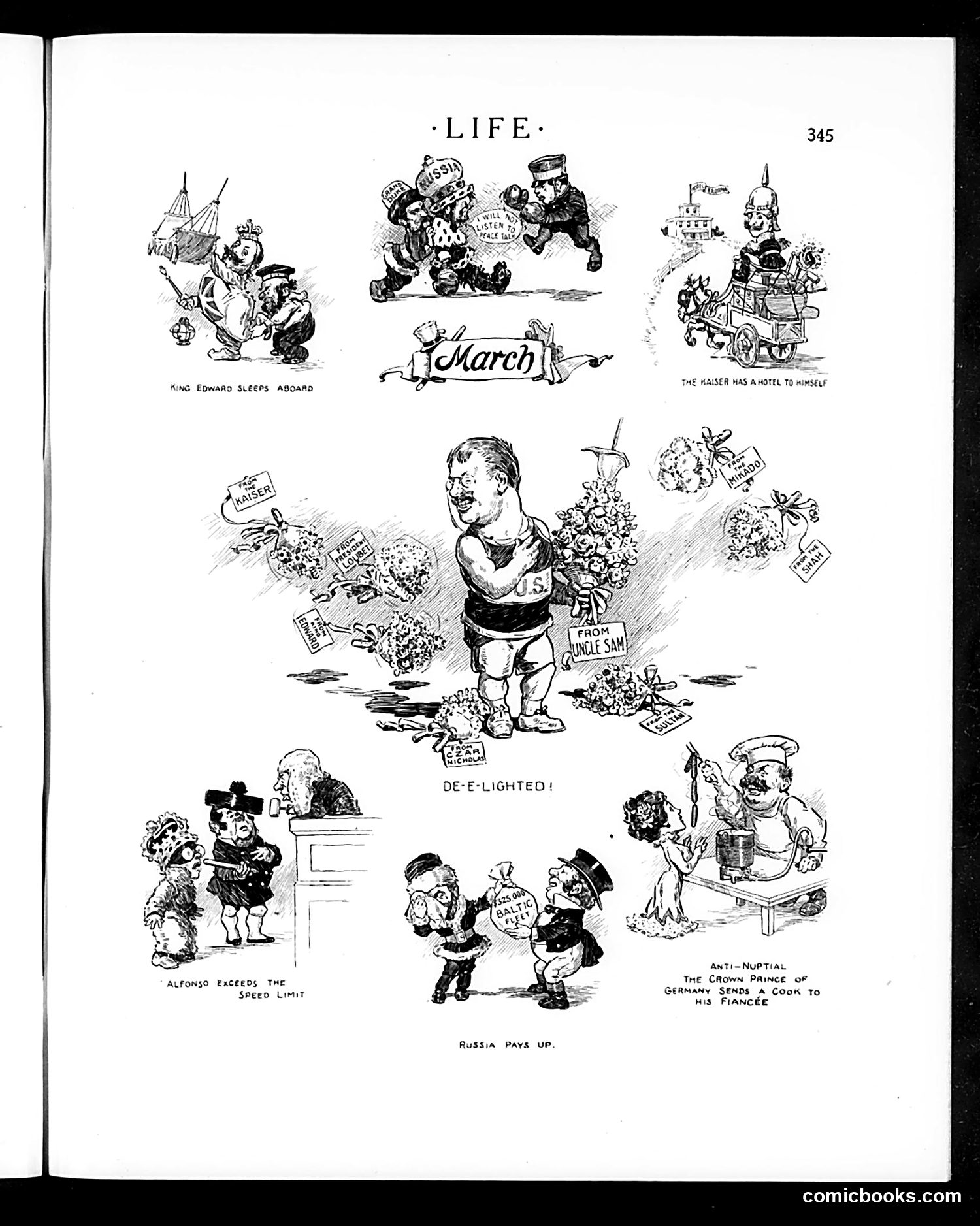
This page collects satirical cartoons commenting on early 20th-century politics and international relations: **Top section**: References King Edward sleeping aboard ship and the Kaiser's hotel, likely mocking European royal figures. **Center ("De-lighted!")**: A caricatured American figure (marked "U.S.") juggles flowers labeled with various countries, suggesting America's balancing act in foreign relations. **"Alfonso Exceeds the Speed Limit"**: Appears to mock Spanish King Alfonso's recklessness. **"Russia Pays Up"**: Shows two figures in negotiation, likely referencing financial or diplomatic settlement. **Bottom right**: References Germany sending a "good" to someone's fiancée, unclear without additional context. The cartoons employ exaggerated caricature and visual metaphor typical of Life's political satire from this era.
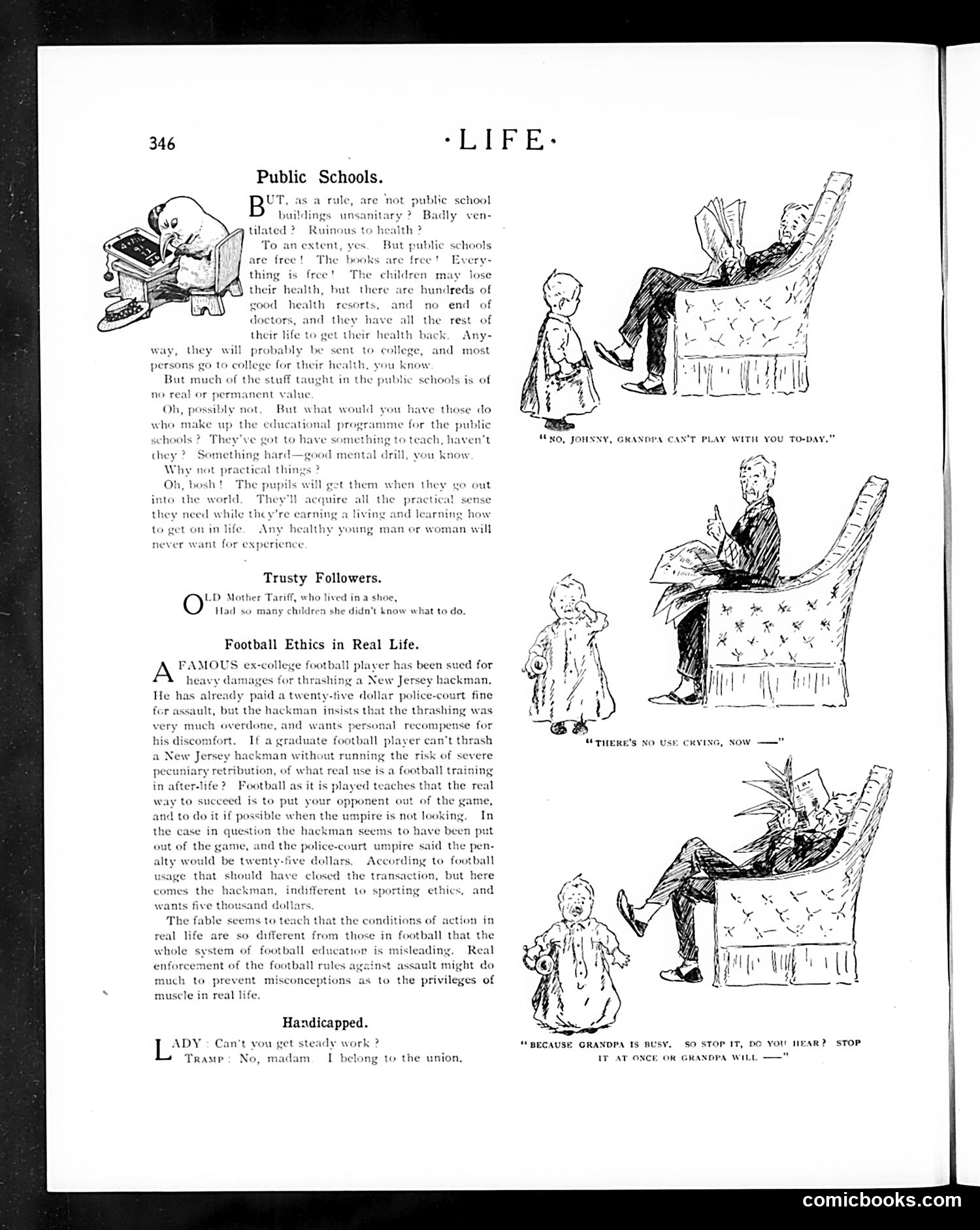
This page contains several distinct satirical pieces: **"Public Schools"** critiques the limitations of free public education, arguing that while schools provide basics, they don't genuinely prepare students for real-world challenges or health concerns. **"Trusty Followers"** appears to be a brief, incomplete anecdote about poverty (Mother Tariff and her children). **"Football Ethics in Real Life"** satirizes how football's aggressive culture differs from real-world consequences. It describes a lawsuit where a football player thrashed a backman, arguing the violence was excessive outside athletic contexts. The satire highlights how football normalizes brutality that would constitute assault elsewhere. **"Handicapped"** begins a dialogue between a lady and tramp about union membership and employment. The right side features cartoon illustrations of family scenes, likely accompanying the social commentary themes.
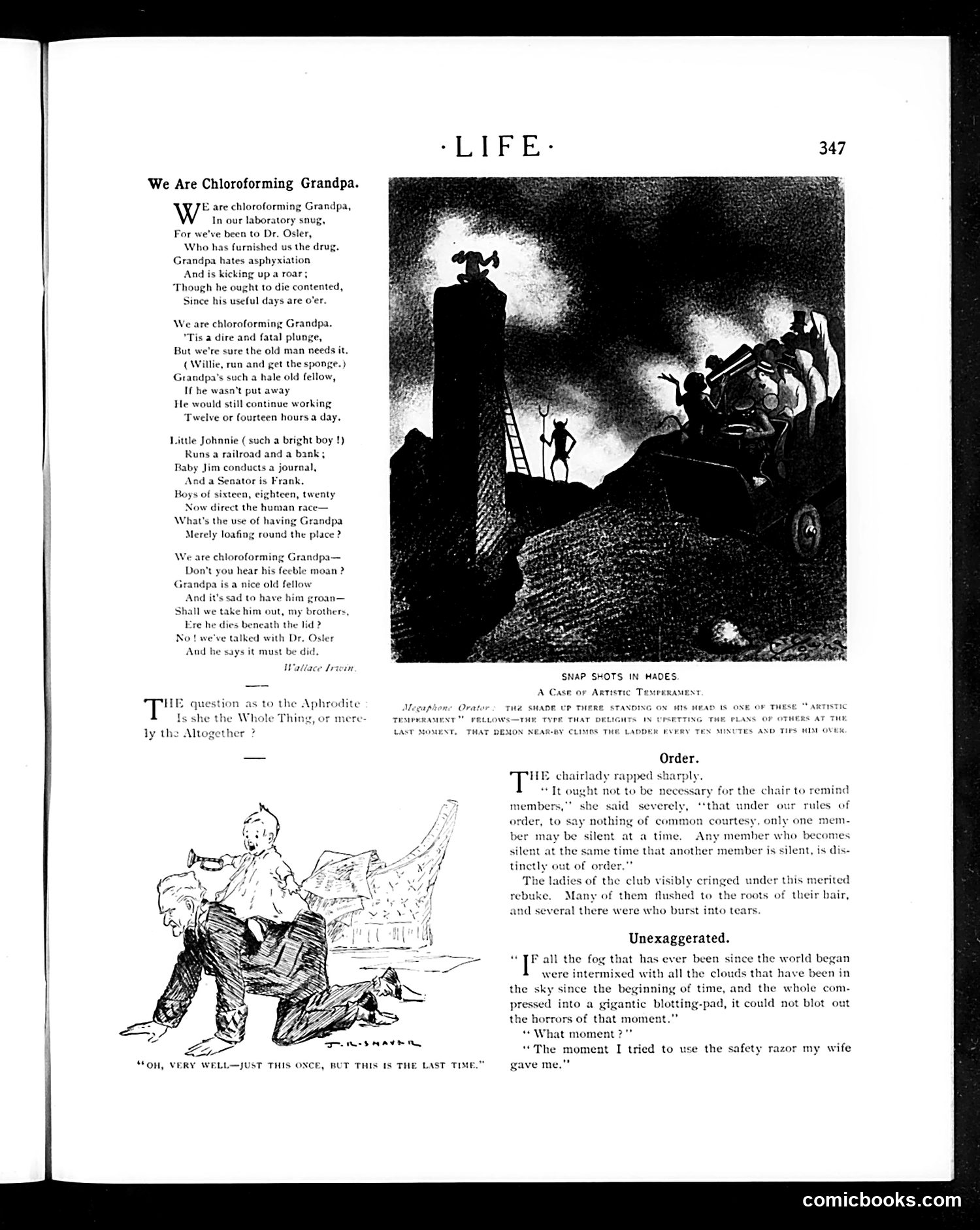
This page contains **three distinct pieces of satirical content**: 1. **"We Are Chloroforming Grandpa"** (poem, top left): A darkly humorous verse about elderly relatives becoming burdensome. The satire mocks the callousness of families viewing aging parents as inconvenient obstacles to be medicated or removed, while pretending concern for their welfare. 2. **"Snap Shots in Hades" (illustration, top right)**: A theatrical scene depicting souls or figures in the underworld, likely satirizing artistic temperament or pretension among creative types. 3. **"Order" and "Unexaggerated" (bottom sections)**: Short anecdotal pieces. The first ridicules women's club meeting decorum; the second jokes about war's horrors, with a punchline about safety razors—contemporary consumer humor rather than political satire. The overall tone targets domestic absurdities and social pretension.
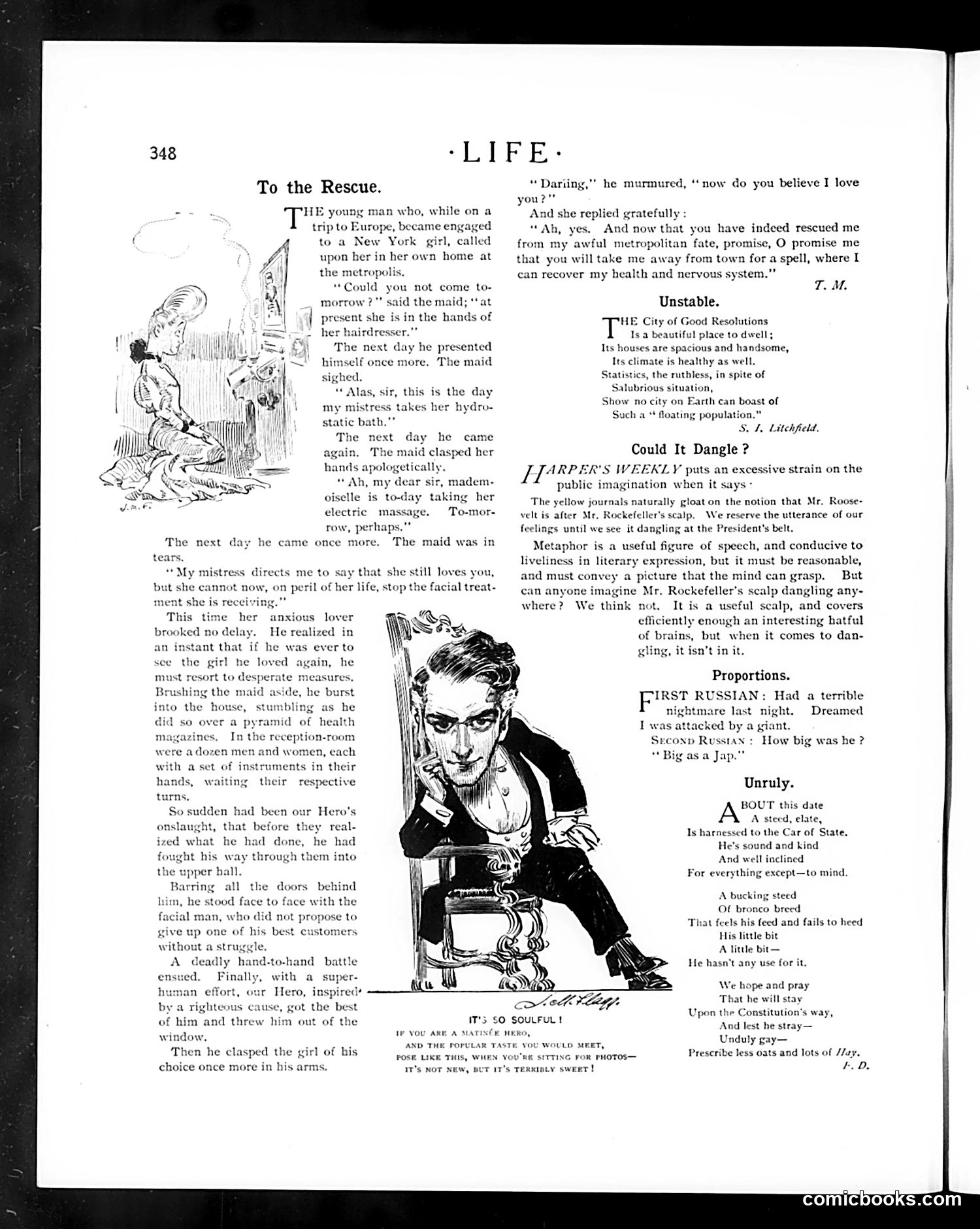
This page contains three distinct satirical pieces: **"To the Rescue"** (left): A romantic story about a young man who pursues his fiancée to stop her from undergoing a "hydrostatic bath" (facial treatment). The satire mocks both Victorian melodrama and the era's obsession with beauty treatments and "electrical massage" procedures—treating cosmetic procedures as dire threats requiring dramatic rescue. **"Could It Dangle?"** (right, top): Criticizes Harper's Weekly for using the metaphor of Rockefeller's "scalp" dangling. The satire suggests this language is excessive and inappropriate for serious editorial discourse, mocking sensationalist newspaper rhetoric. **Bottom sections**: Brief humorous poems on various topics—"Unstable" (cities), "Proportions" (a joke), and "Unruly" (a horse)—typical of Life's miscellaneous satirical content. The overall tone targets Victorian excess, beauty-obsession, and hyperbolic journalism.
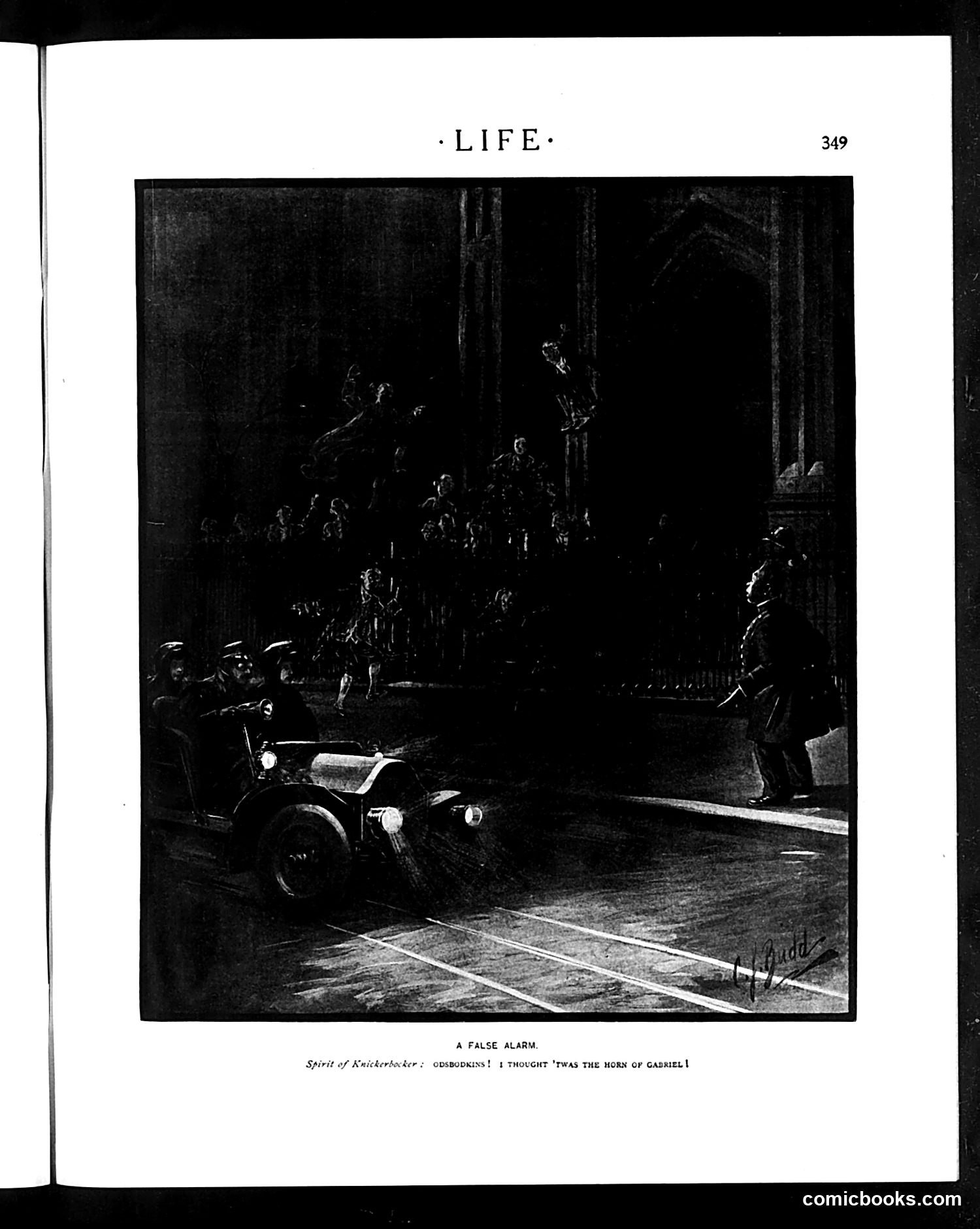
This cartoon depicts a dramatic interior scene, likely a cathedral or grand hall based on the Gothic architecture visible. A automobile has crashed or driven into the space, causing alarm among formally-dressed figures in the background who appear to be reacting in shock. The caption attributes the scene to "Spirit of Kaisersberke" with the quoted line: "GOODBODKINS! I THOUGHT 'TWAS THE HORN OF GABRIEL!" The satire appears to reference early automobile culture's disruptive intrusion into formal, traditional spaces. The speaker mistakes the car's horn for Gabriel's trumpet (signaling the apocalypse in Christian tradition), treating the automobile as an almost apocalyptic threat to established order. This mocks both the surprising novelty of automobiles in polite society and perhaps anxieties about technological disruption to tradition.
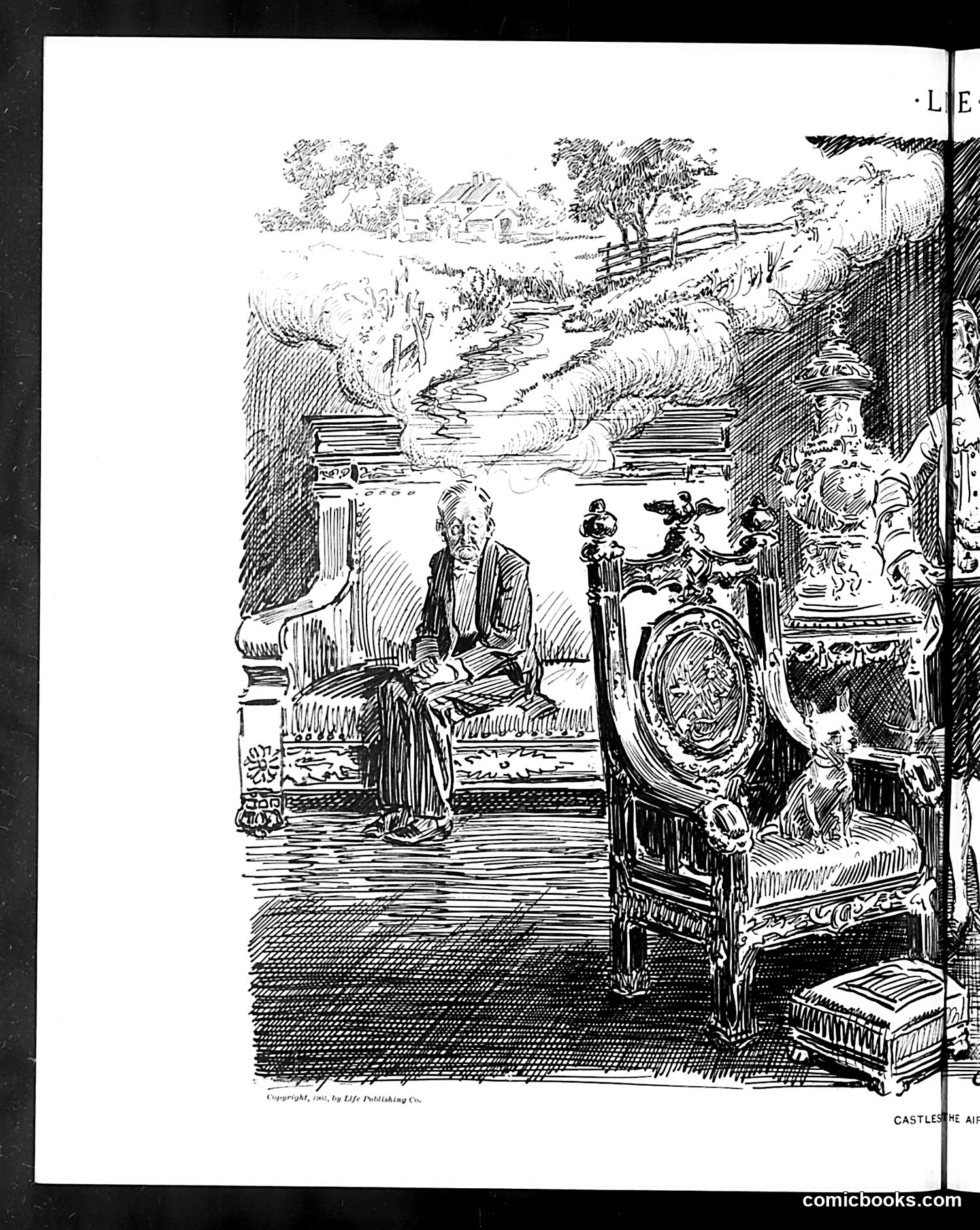
This is a single illustration showing an interior scene. An elderly man in formal attire sits on a bench beside a fireplace, gazing out through open doors toward a pastoral landscape with a stream, fence, and cottage. The room contains ornate furniture and decorative elements. The satire appears to comment on **longing for simpler rural life**. The contrast between the wealthy, formal interior (suggesting urban affluence) and the idealized pastoral scene beyond suggests a critique of **nostalgia or escapism**—perhaps mocking those who romanticize country living while remaining trapped in civilized constraints. The figure's contemplative pose and the composition emphasize this tension between desire for nature and actual circumstances. The specific political or social reference remains **unclear without additional context** or visible caption text.
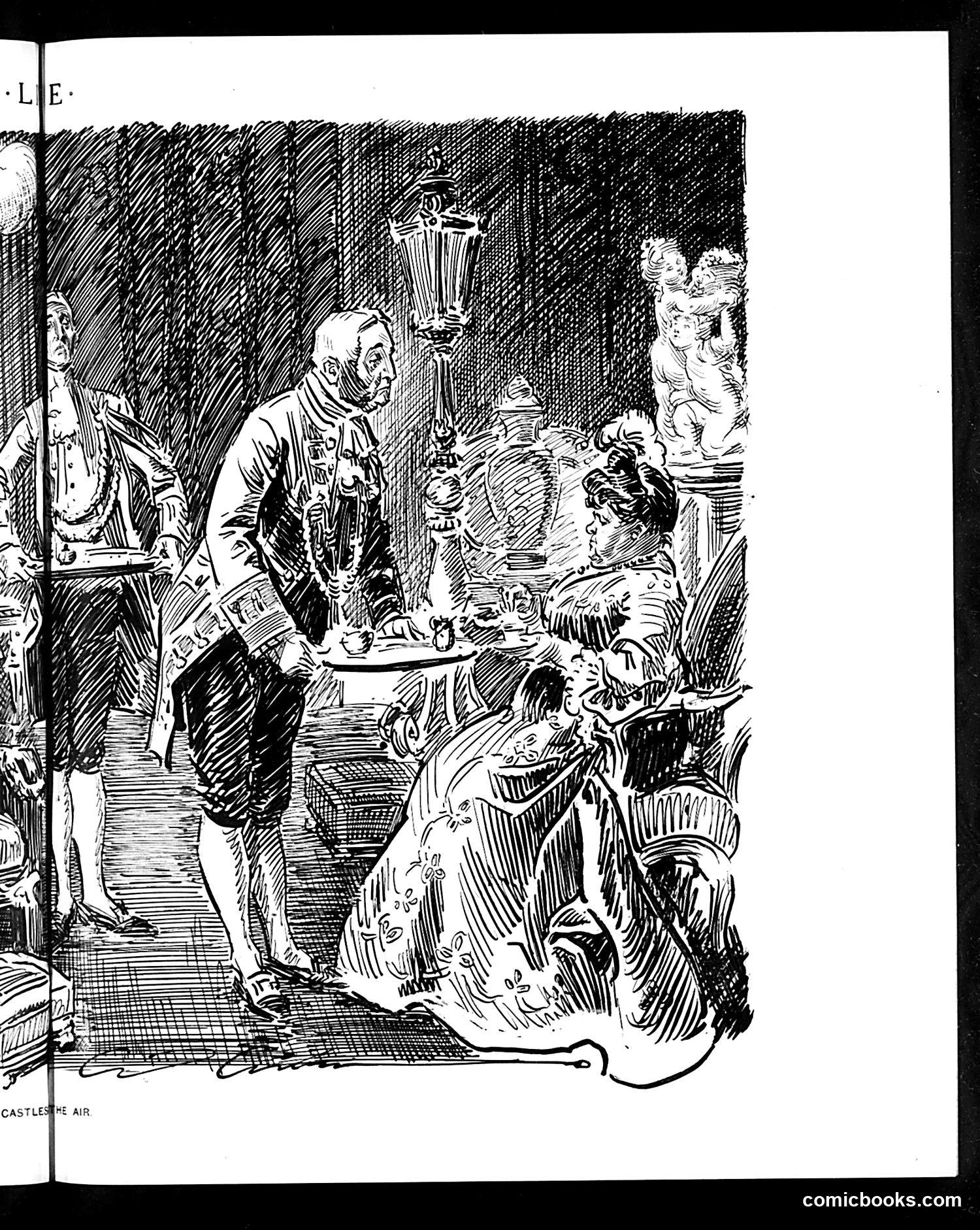
This is a satirical illustration from *Life* magazine showing what appears to be a formal court or palace scene. A military or official figure (identifiable by his decorated uniform and stern expression) stands conversing with a seated woman in an elaborate gown. Other figures populate the ornate interior with its hanging lamp and classical architecture. The caption reads "CASTLES IN AIR," a phrase meaning impractical daydreams or fantasies. The satire likely mocks either: (1) grandiose military ambitions or pretensions, (2) courtly romance or social climbing, or (3) inflated expectations of aristocratic life. The contrast between the pompous setting and the idiom "castles in air" suggests the entire scene represents empty fantasies rather than reality—critiquing either the characters' delusions or the society they inhabit. Without additional context, the specific political figures remain unclear.
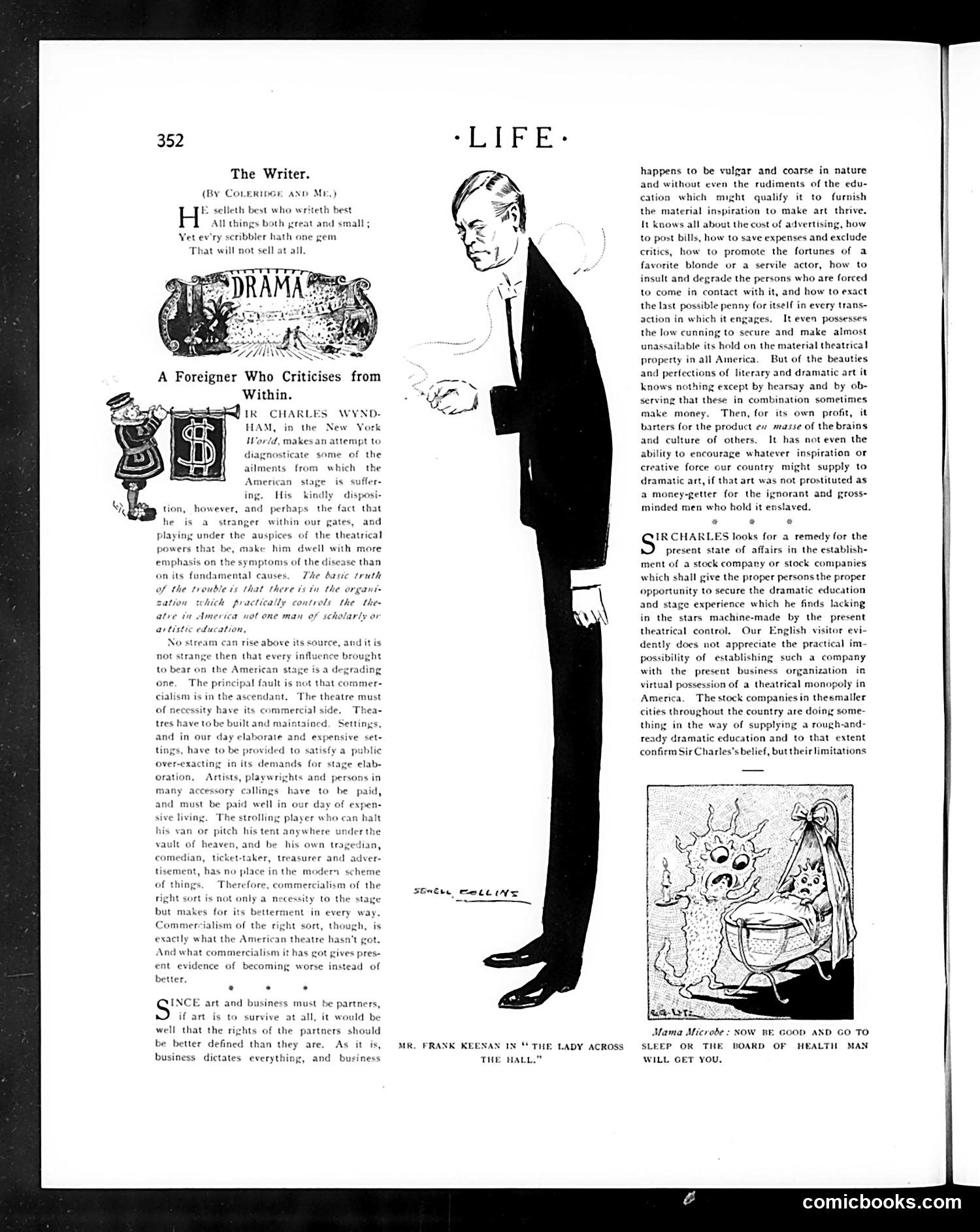
This page critiques the American theater's commercial exploitation of dramatic art. The main essay, attributed to playwright Charles Wyndham, argues that American theater prioritizes profit over artistic merit. **The argument:** While commercialism is necessary, American theater's version is destructive. Theater owners know only cost-cutting, bill-posting, and profit-extraction—they lack education in dramatic arts. The essay claims this "gross-minded" commercialism corrupts artists and prevents proper theatrical education. **Wyndham's solution:** Establish stock companies offering proper dramatic training and experience, independent of the current theatrical monopolies that "machine-make" stars. **The cartoon (bottom right):** Shows a witch-like figure stirring a cauldron, captioned with theatrical advice about sleep and health—likely satirizing the charlatan or exploitative nature of those controlling theater. **Context:** This reflects early-20th-century tensions between "art theater" advocates and commercial Broadway interests—a debate about whether theater should prioritize artistic integrity or profit.
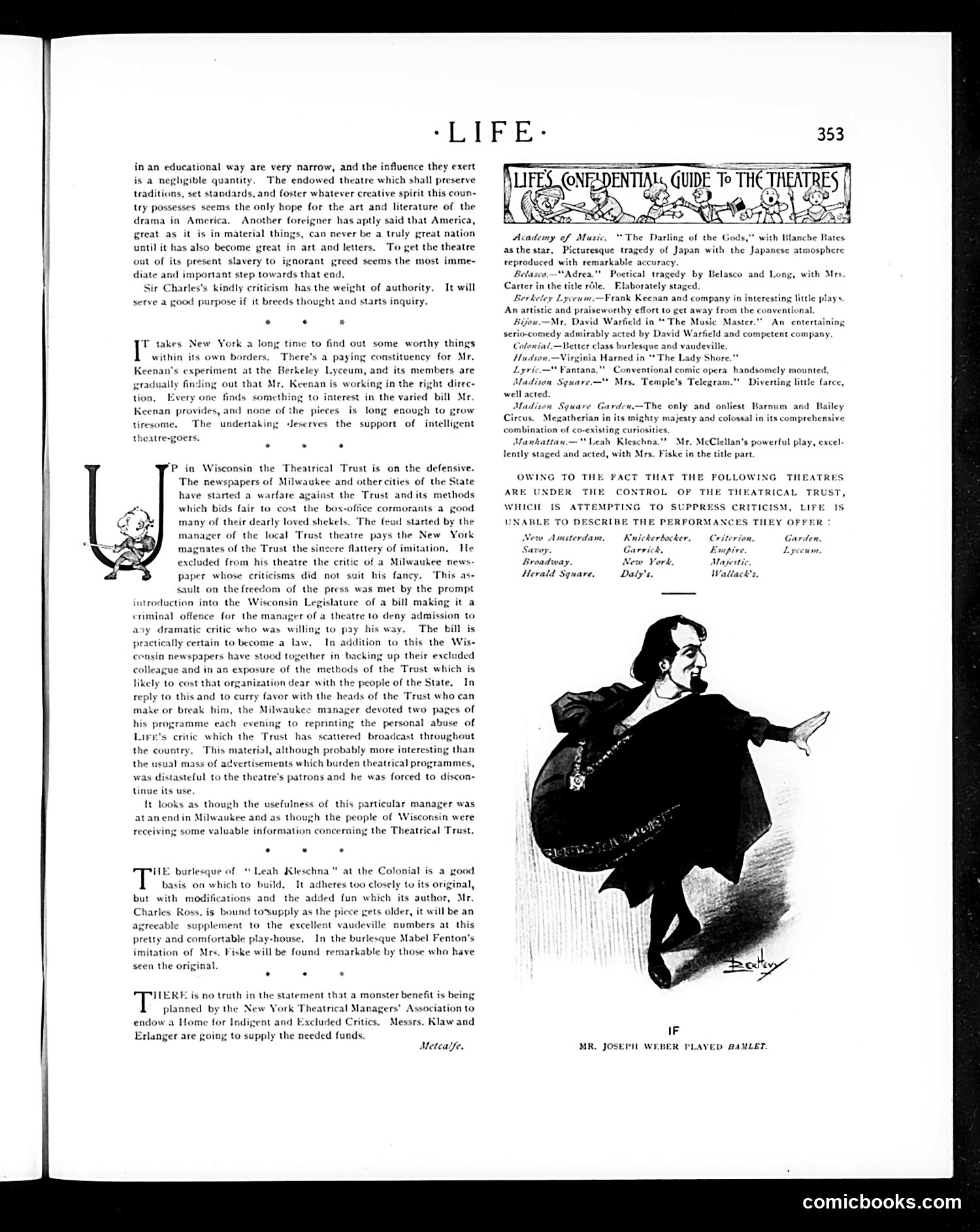
This page discusses American theater through multiple lenses. The main text criticizes the "Theatrical Trust"—an apparent monopoly controlling theaters—which has excluded a Milwaukee newspaper critic, prompting Wisconsin legislators to criminalize such censorship. Life praises this resistance to the Trust's control. The accompanying illustration depicts **Joseph Weber as Hamlet**, a caricatured profile. This likely mocks Weber as an inappropriate choice for Shakespeare's tragic role—suggesting either his comedic reputation made him unsuitable, or Life questioned whether commercial theater (Weber's domain) could properly stage serious drama. The page reflects early 20th-century concerns about theater's artistic integrity versus commercial exploitation. The Trust's attempt to suppress criticism through exclusion and the subsequent legislative response represents a battle between corporate monopoly and press freedom—issues resonating even today.
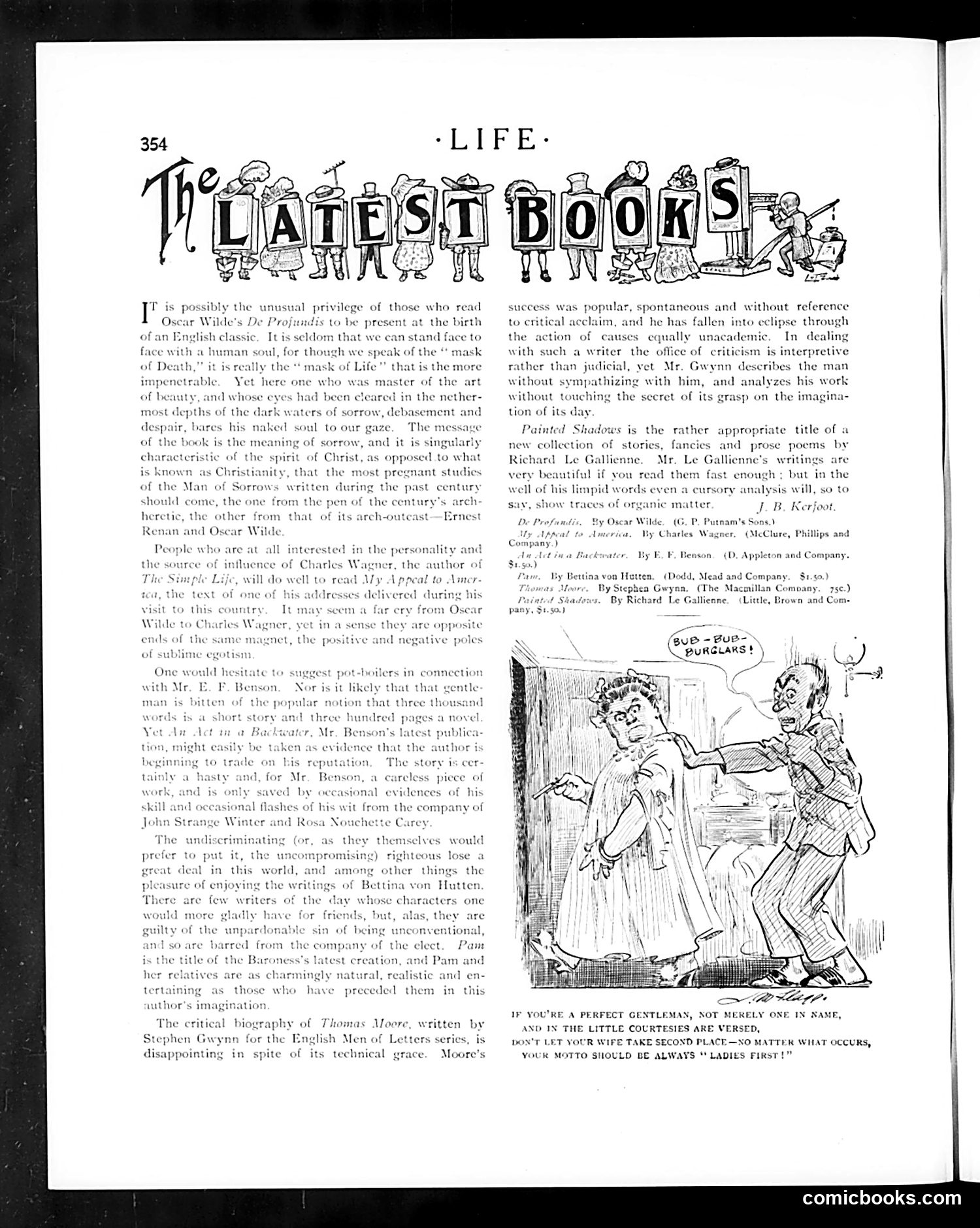
This is a literary review section from *Life* magazine discussing recent publications, including works by Oscar Wilde, Charles Wagner, and Richard Le Gallienne. The main cartoon illustrates etiquette advice: a husband forcefully pushes his wife aside while exclaiming "Gup—ugh—burglars!", violating the social convention of "ladies first." The joke satirizes Victorian gentlemen who claim refined manners but abandon chivalry during crisis. The caption's mock-serious tone ("IF YOU'RE A PERFECT GENTLEMAN... YOUR MOTTO SHOULD BE ALWAYS 'LADIES FIRST!'") undercuts the husband's panicked self-preservation, mocking men who profess gentlemanly principles yet act selfishly when danger appears. This reflects *Life*'s characteristic social satire of upper-class hypocrisy regarding gender courtesies and masculine propriety.
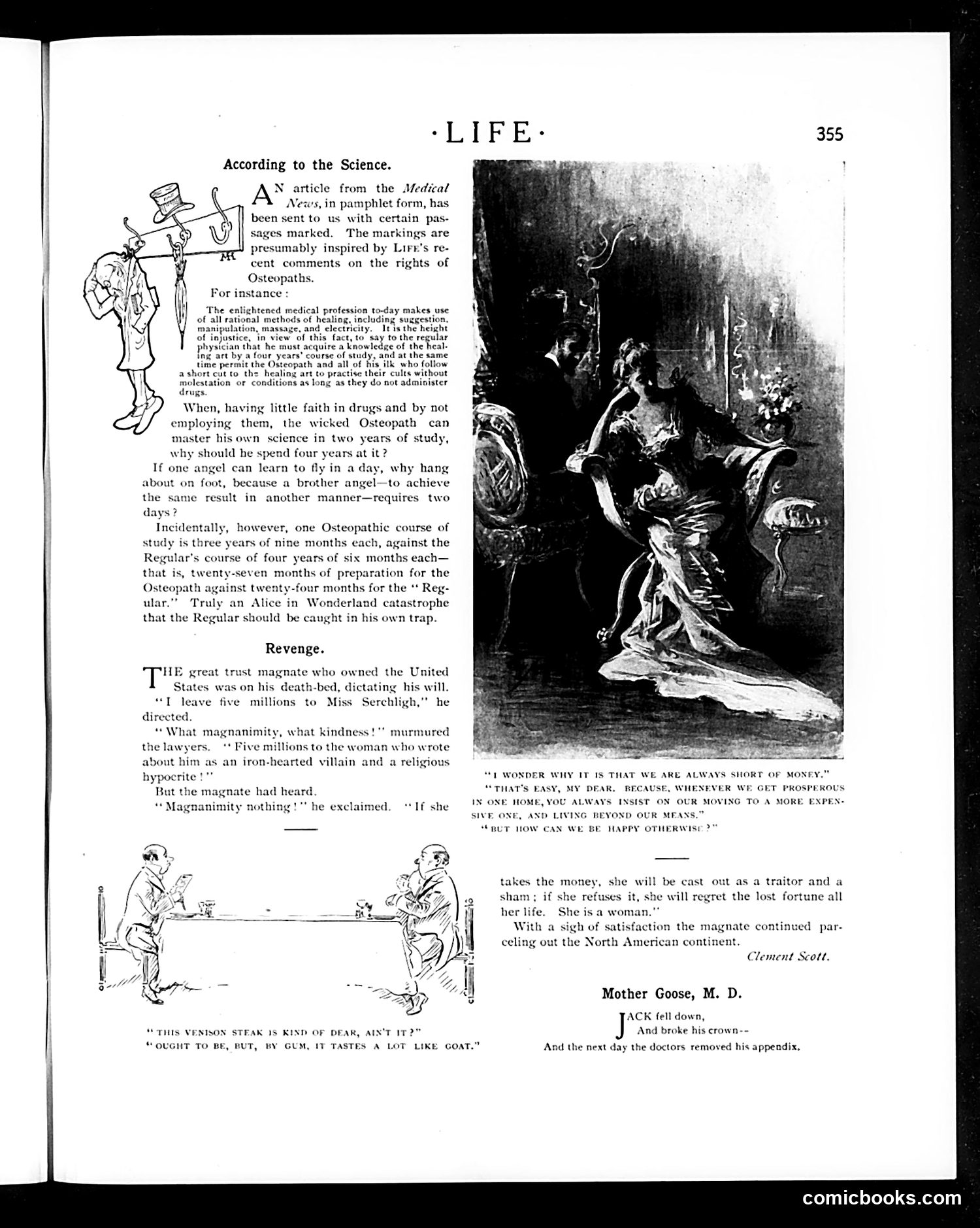
**"According to the Science"** critiques medical licensing double standards. The text argues that if osteopaths can master their field in two years without drugs, why require regular physicians four years of study? The cartoon doctor figure sarcastically illustrates this logical absurdity—the "wicked Osteopath" learns faster despite fewer credentials, exposing regulatory inconsistency. Life sides with osteopaths here, mocking the medical establishment's gatekeeping. **"Revenge"** satirizes wealthy magnate hypocrisy. A dying tycoon leaves $5 million to a woman who wrote critically about him, claiming magnanimity. His lawyers praise his kindness, but he reveals pure spite—she's trapped: accepting makes her a traitor; refusing means lifelong regret. The joke exposes calculated cruelty disguised as generosity. **"Mother Goose, M.D."** is a dark medical humor piece: Jack's appendix removal follows a mishap, suggesting doctors operate unnecessarily or incompetently. The venison/goat steak joke (below) implies questionable medical practices.
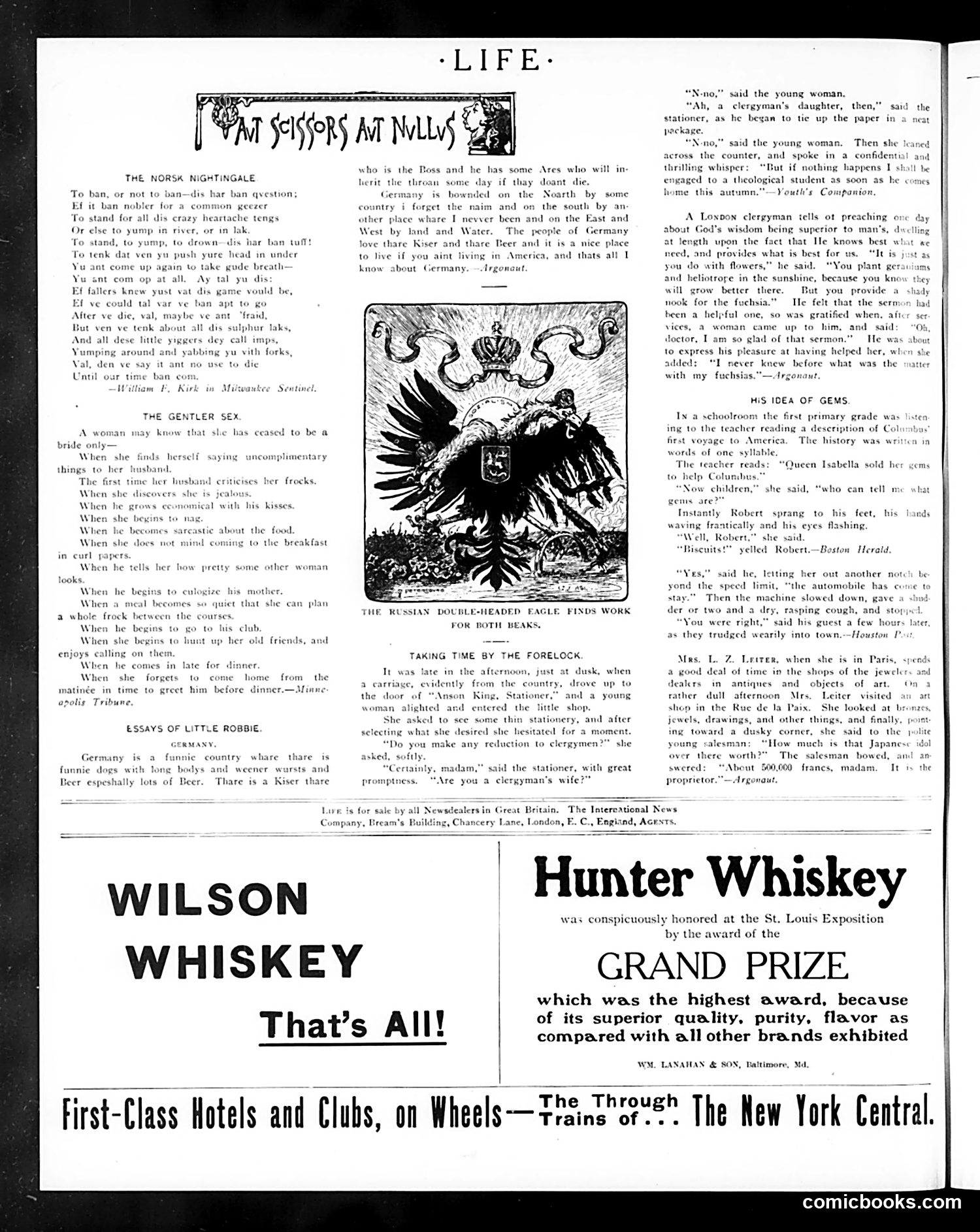
This page contains **three distinct humor pieces** typical of the magazine's satirical format: 1. **"Pam Scissors at Nulls"** (top): A mock-German dialect poem mocking German national pride and geography, presented as humorous "broken English" stereotyping of German immigrants or Germans generally. 2. **"The Gentler Sex"** (left column): A satirical list cataloging the moments a woman "ceases to be a bride"—tracking the deterioration of romance through domestic life (husband criticizing her clothes, becoming economical, etc.). This reflects early-1900s gender humor about marriage's disillusionment. 3. **"His Idea of Gems"** (right): A short anecdote where schoolboy Robert misunderstands "Queen Isabella sold her gems to help Columbus," apparently thinking "gems" means something else—likely a crude joke the text obscures. The page also contains **advertisements** for Wilson Whiskey and Hunter Whiskey (awarded a Grand Prize). Overall, this reflects *Life*'s focus on domestic comedy, ethnic humor, and mild social satire aimed at middle-class American readers.
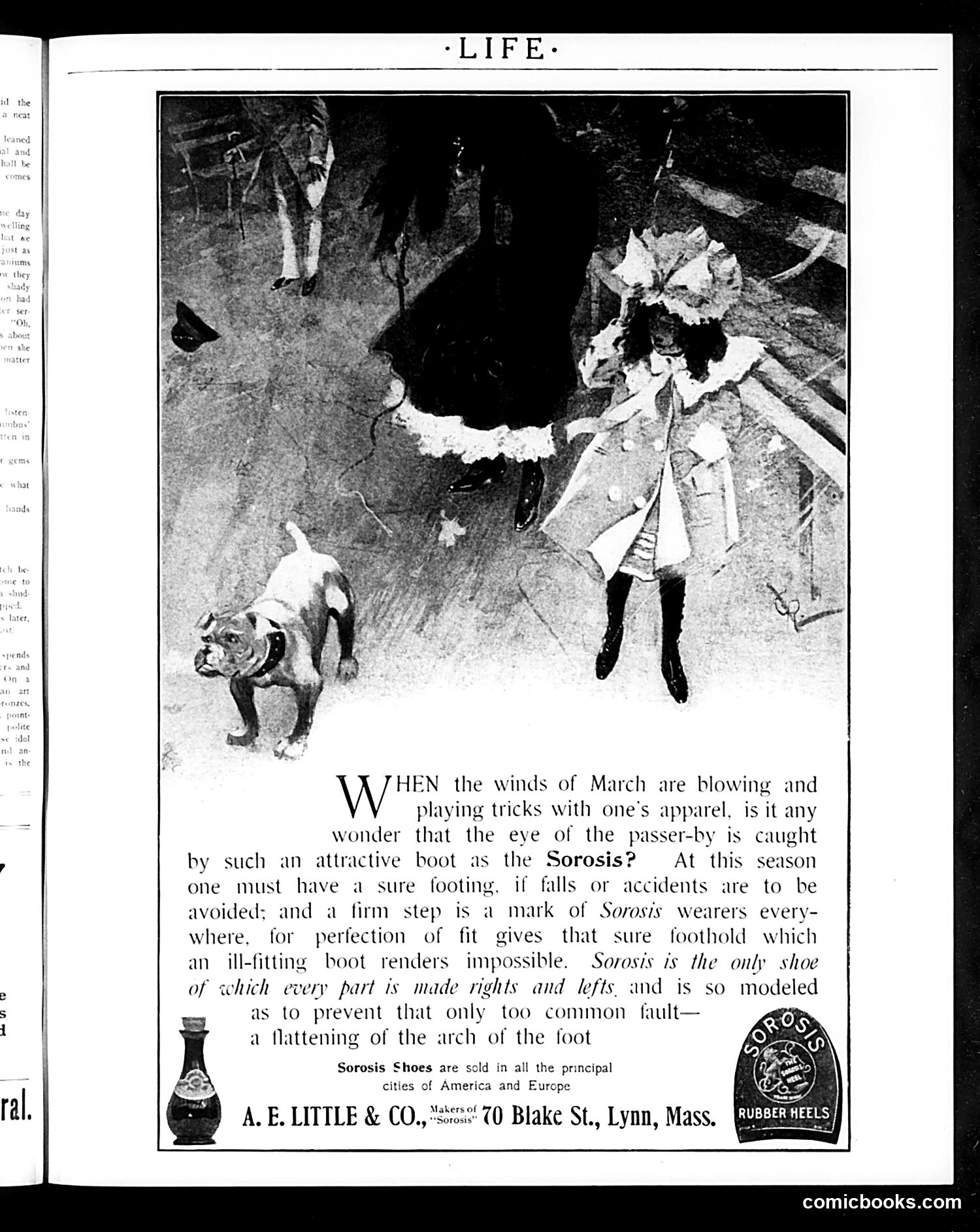
This is primarily an **advertisement**, not satire or political commentary. It promotes Sorosis brand shoes manufactured by A.E. Little & Co. in Lynn, Massachusetts. The image shows a fashionable woman in early 20th-century dress with a small dog, illustrating the shoe in practical use during windy March weather. The advertisement's humor is gentle and sales-focused rather than satirical. The key selling points are: Sorosis shoes feature individually made left and right feet (innovative for the era), provide secure footing to prevent slips and falls, and prevent arch flattening—a common foot problem. The copy emphasizes that proper fit requires anatomically-correct shoe construction. This represents typical early 1900s magazine advertising that blended lifestyle imagery with product benefits. The "trick" referenced is wind affecting clothing, not social commentary—just a seasonal sales angle appealing to readers concerned about safety and foot health.
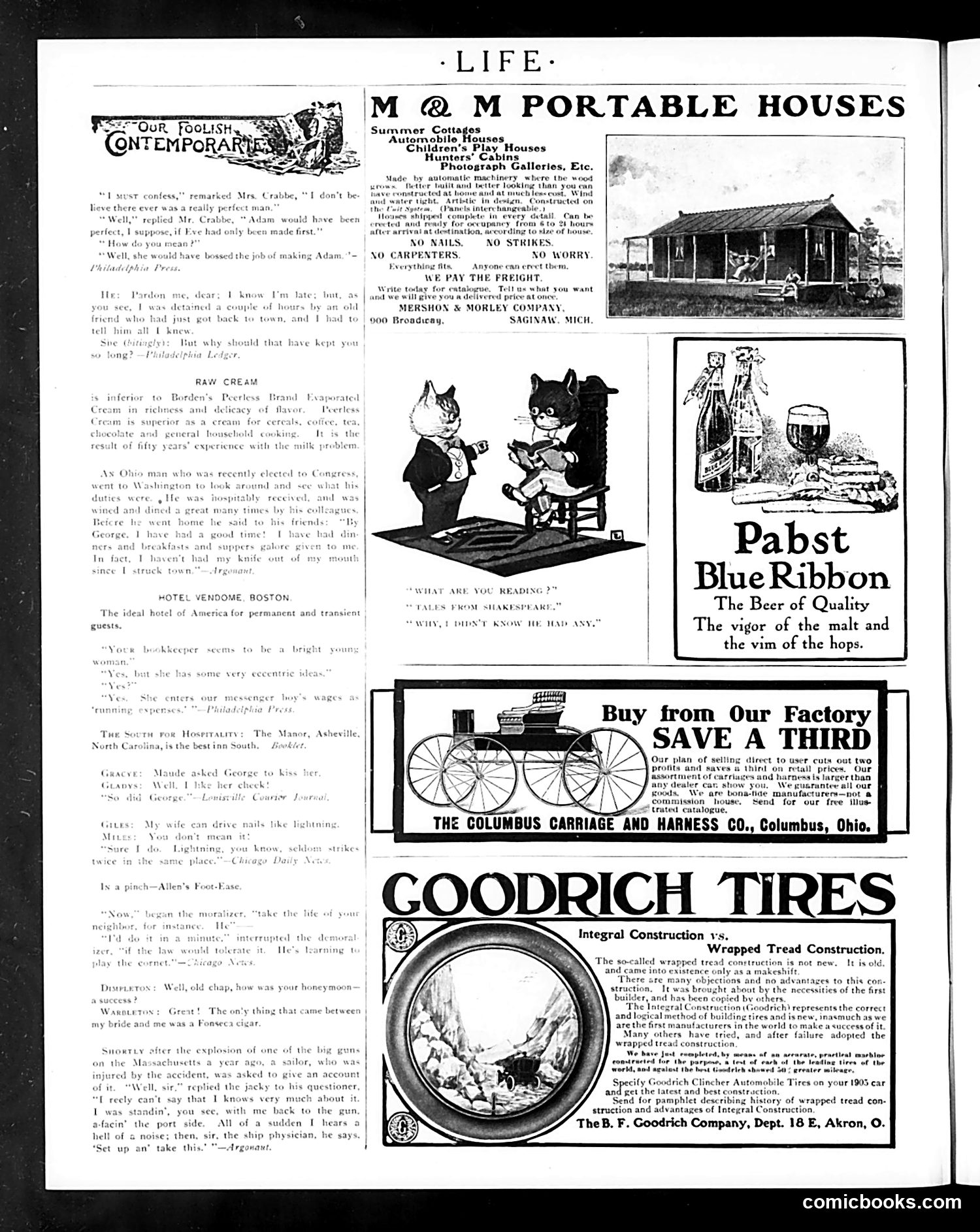
This page is primarily **advertising**, not political satire. The main content consists of several product advertisements interspersed with brief humorous anecdotes. The cartoon shows **anthropomorphic cats** reading Shakespeare, captioned with phrases like "PALES FROM SHAKESPEARE" and "WHY, I DIDN'T KNOW HE HAD ASS." This appears to be simple visual humor about animals engaging in human intellectual pursuits—a common early 20th-century joke format with no deeper political meaning. The advertisements promote portable houses, Pabst Blue Ribbon beer, Columbus carriages, and Goodrich tires. The brief stories scattered throughout (about Mrs. Crabbe, hotel employees, and gunfire incidents) are humorous anecdotes typical of Life's miscellaneous "filler" content from this era. The page reflects early 1900s consumer culture and advertising practices rather than political commentary.
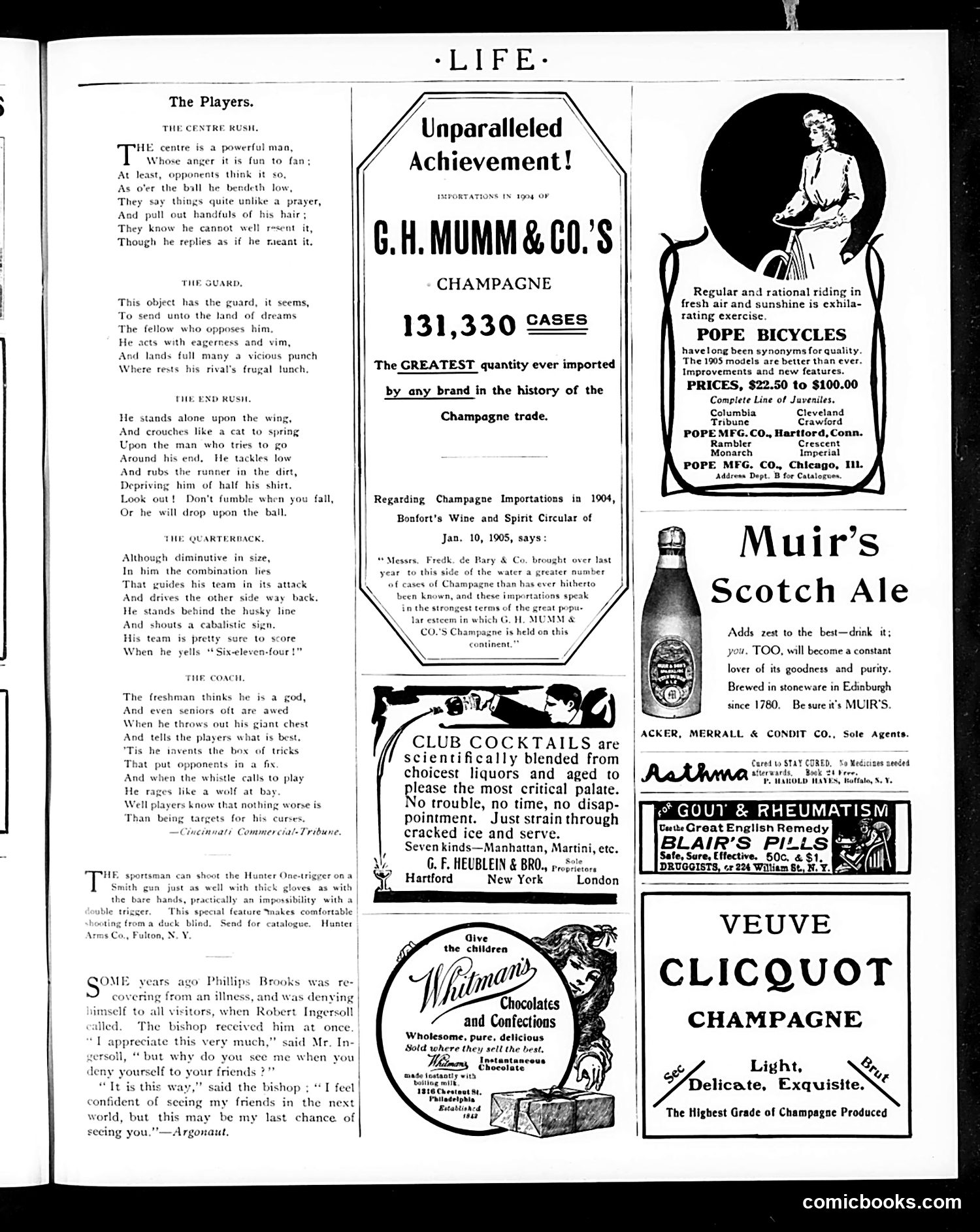
This page is primarily **advertisements and poetry about football players**, not political satire. The left column contains **verse descriptions of football positions**—the center rush, guard, end rush, quarterback, and coach. These are satirical character sketches mocking player stereotypes: the aggressive center who pulls opponents' hair, the guard who lands "vicious punches," the end who "tackles low / And rubs the runner in the dirt." The humor targets football's brutality and unsportsmanlike conduct, presenting players as comically violent rather than athletic. The central feature advertises **G.H. Mumm & Co. Champagne**, claiming an unprecedented 131,330 cases imported in 1904—a commercial boast rather than satire. Surrounding this are various **product advertisements** (Pope bicycles, Muir's Scotch ale, club cocktails, chocolates, Blair's pills, Veuve Clicquot champagne) typical of Life's commercial pages. A brief anecdote at bottom recounts Phillips Brooks and Robert Ingersoll's exchange about friendship—sentimental rather than satirical. The page is **largely commercial**, mixing light football humor with ads.
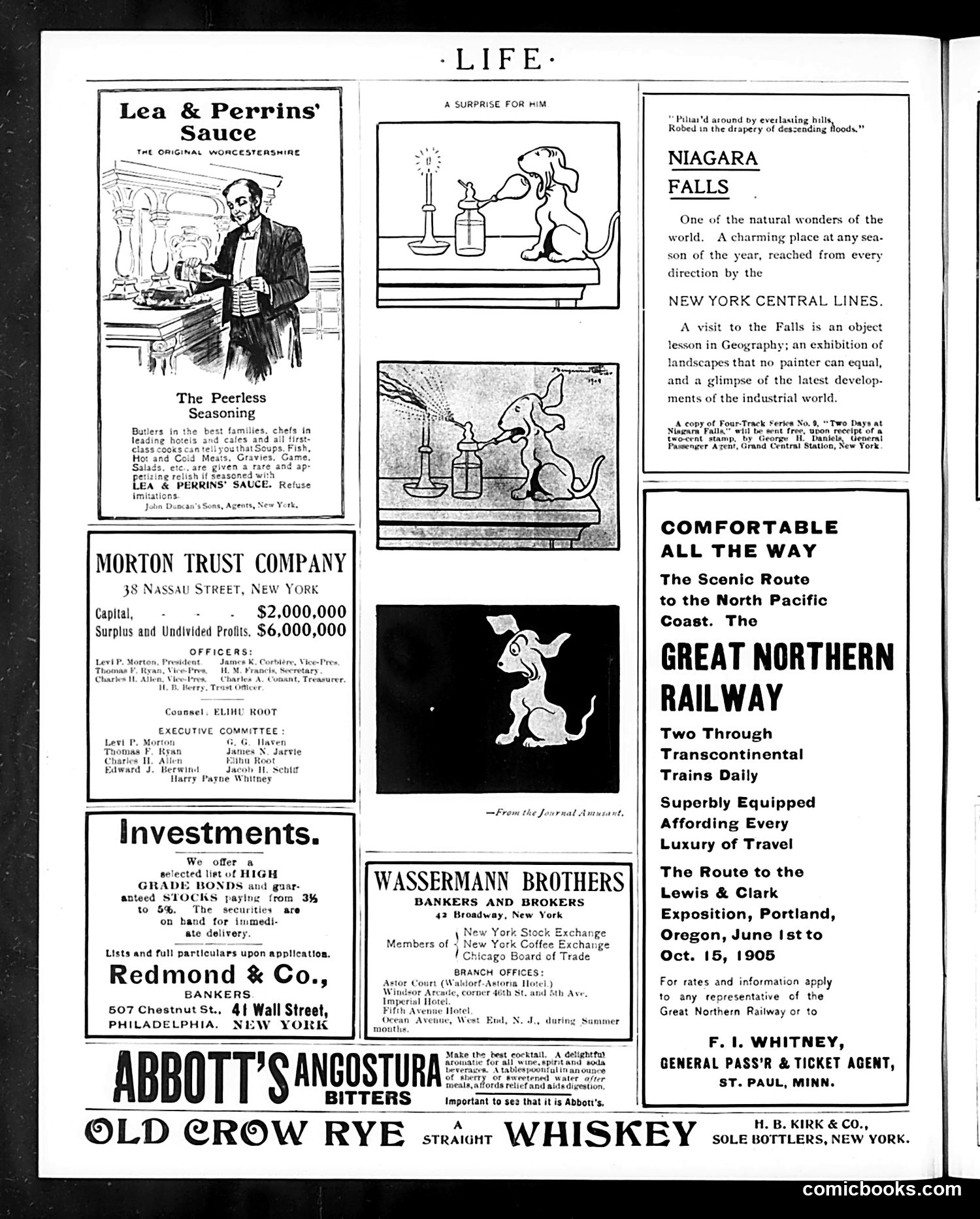
This page is primarily **advertising**, not political satire. The central cartoon depicts a domestic scene: a woman pouring liquid (likely alcohol) onto a table where a dog sits, captioned "A Surprise for Him." The joke appears to be a mild marital gag—the woman is preparing an unexpected (and inappropriate) "treat" for her husband, playing on period humor about drinking and domestic life. The surrounding ads target affluent readers: investment firms (Redmond & Co., Morton Trust Company), fine food products (Lea & Perrins sauce), spirits (Abbott's Angostura Bitters, Old Crow Rye Whiskey), and travel services promoting Niagara Falls and the Great Northern Railway's Lewis & Clark Exposition route (1905). The small dog cartoon is the only humorous content; the rest is straightforward commercial promotion typical of early 1900s *Life* magazine's revenue model.
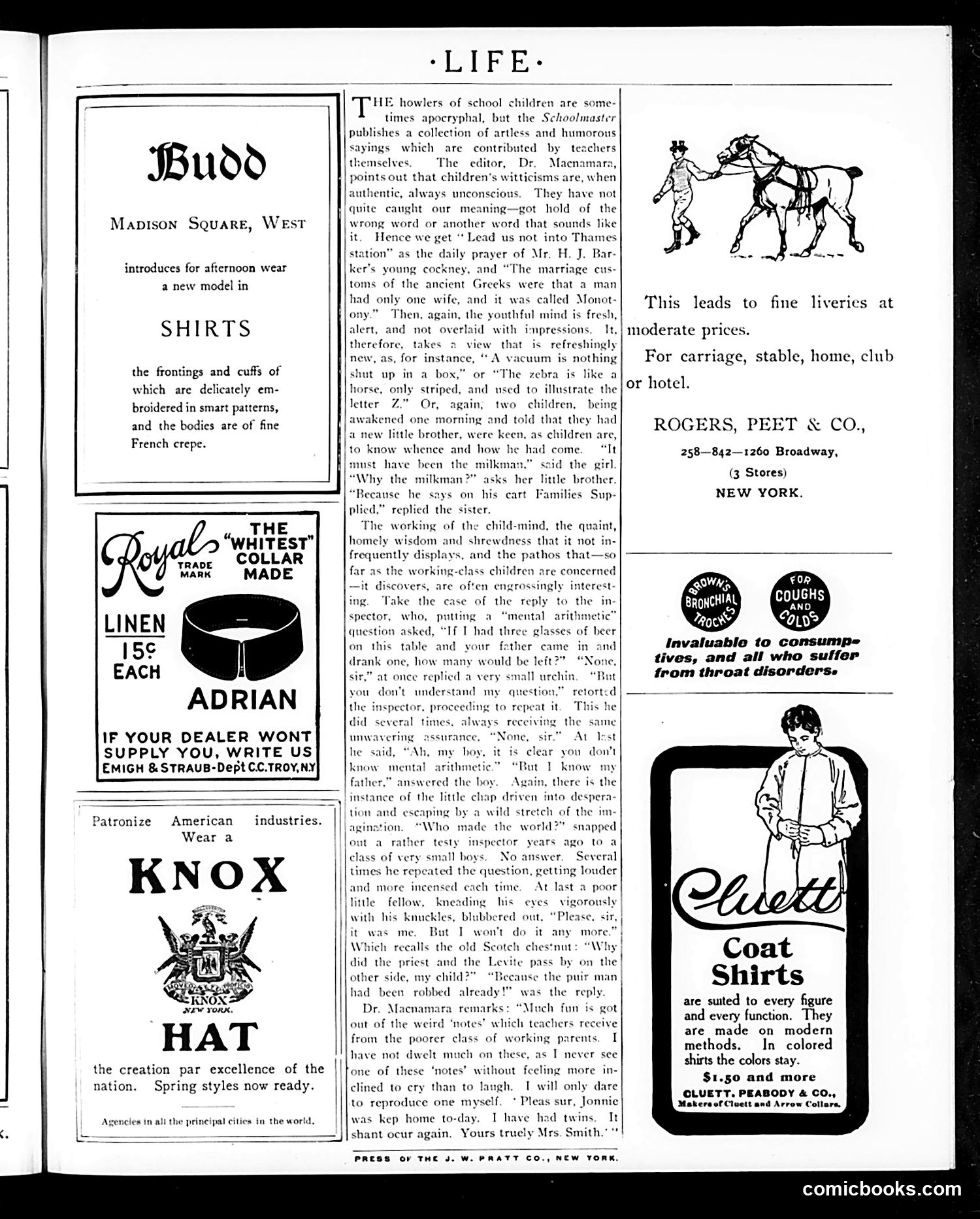
This page is primarily **advertisements for men's clothing and accessories** (Budd shirts, Adrian collars, Knox hats, Cluett coat shirts, Rogers Peet & Co. liveries). The main textual content is **not satirical cartoon commentary** but rather an editorial essay titled "Life" discussing children's unintentional wit. Dr. Macnamara (editor of *The Schoolmaster*) collects amusing remarks from schoolchildren—examples include a cockney boy saying "Lead us not into Thames station" instead of "temptation," and a child explaining his newborn brother came from the milkman (who advertises "Families Supplied"). The piece celebrates how children's fresh, unschooled minds produce charming non sequiturs: a boy told to imagine three beers, then his father drinks one—answers "None, sir" because he knows his father drinks everything. Another, asked "Who made the world?", cries "It was me. But I won't do it any more." **No political cartoon appears here.** This is a humorous essay celebrating working-class children's innocent logic—gentle, sentimental humor typical of early 20th-century *Life* magazine.
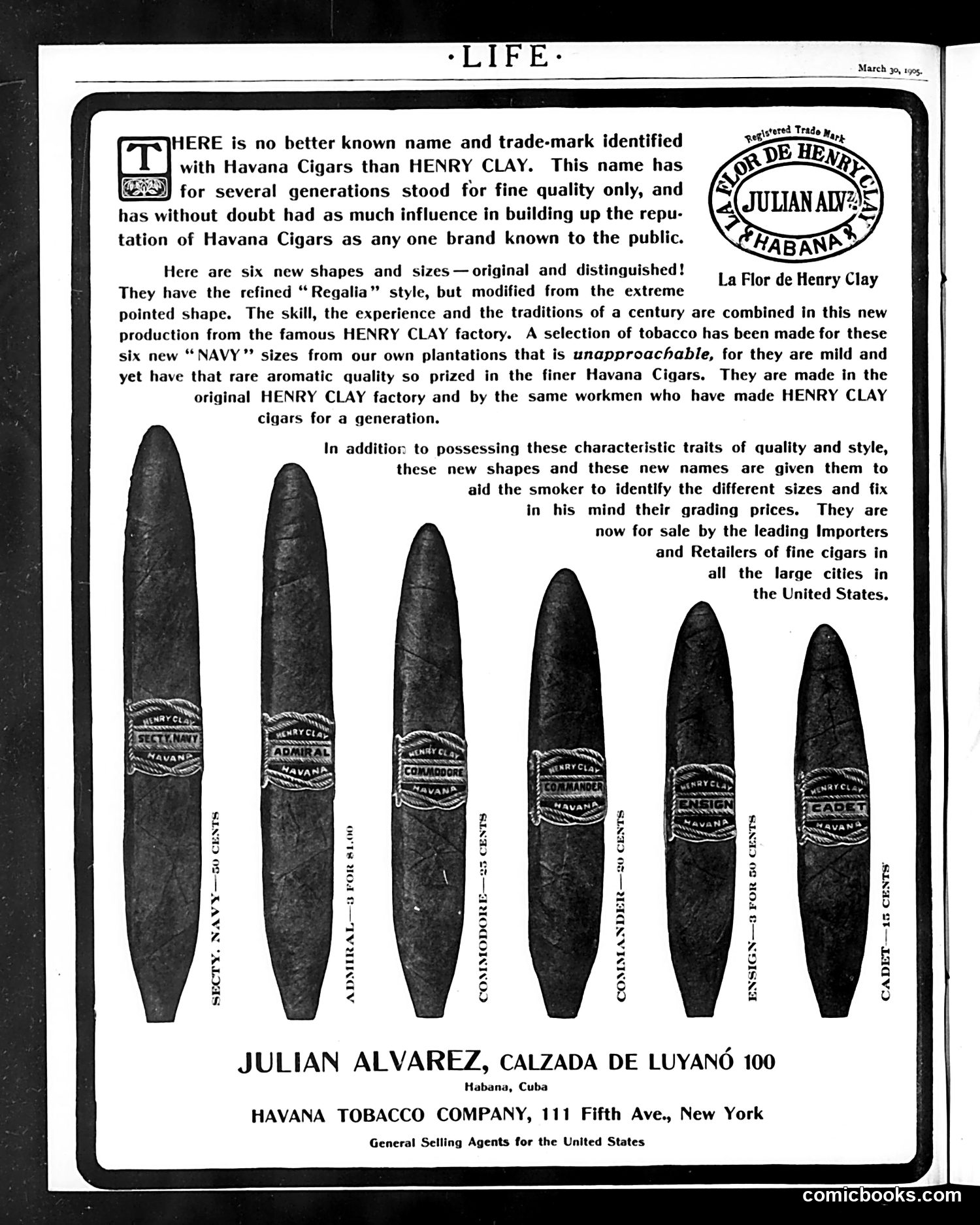
This is a full-page advertisement, not a political cartoon. It promotes Henry Clay brand Havana cigars manufactured in Cuba and sold by the Havana Tobacco Company in New York (dated March 30, 1905). The ad showcases six new cigar sizes with names drawn from naval military ranks: Secretary Navy, Admiral, Commodore, Commander, Ensign, and Cadet. These military titles served a marketing purpose—they helped consumers identify different sizes and price points (ranging from 15 cents to 50 cents). The advertisement emphasizes the brand's century-long reputation, the use of tobacco from "our own plantations," and that cigars are hand-rolled by experienced workers in the original Havana factory. The branding strategy reflects the era's association of quality imported Havana cigars with prestige and sophistication among American consumers.