
Life, 1905-03-30 · page 14 of 24
Life — March 30, 1905 — page 14: what you’re looking at
What you’re looking at
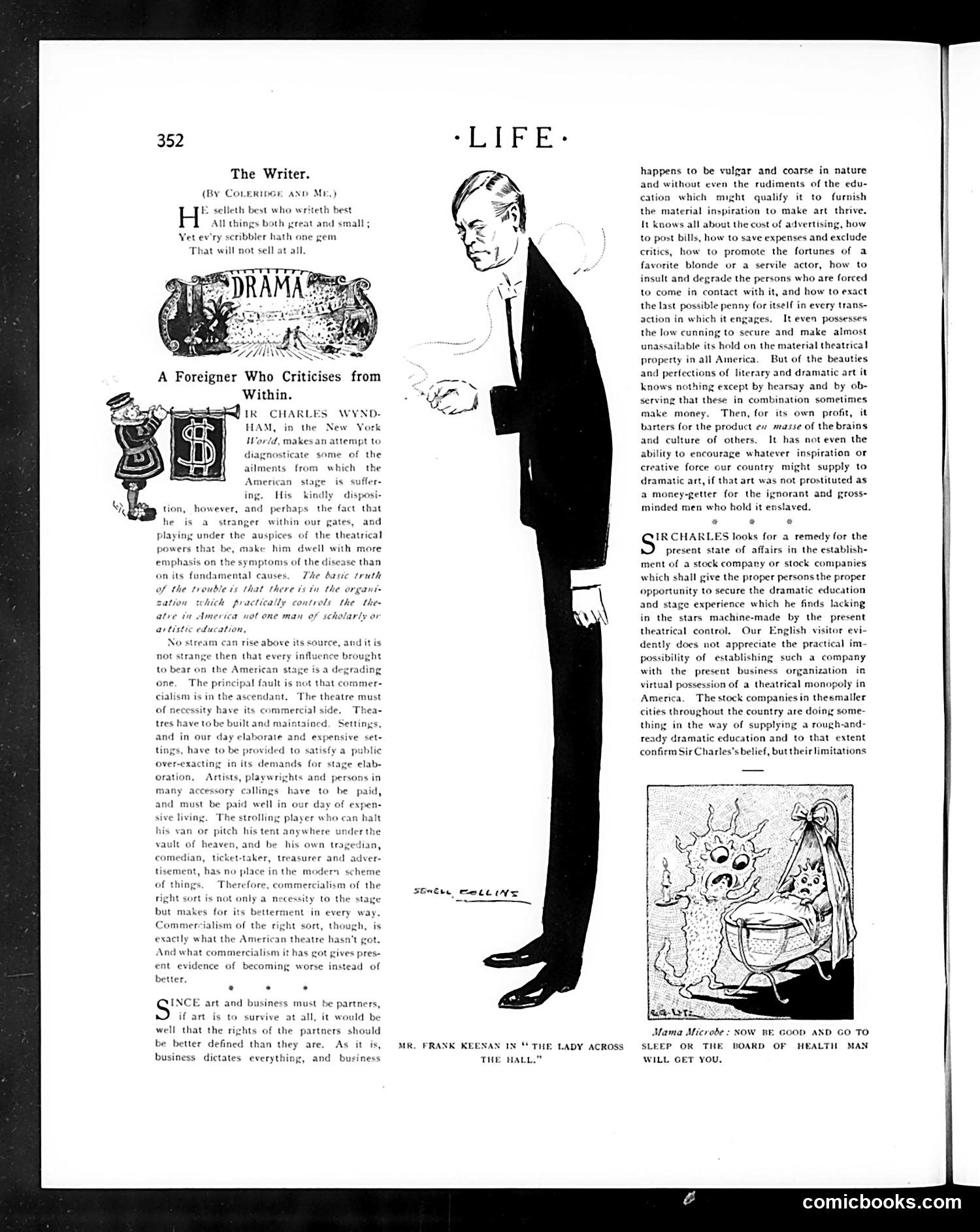
This page critiques the American theater's commercial exploitation of dramatic art. The main essay, attributed to playwright Charles Wyndham, argues that American theater prioritizes profit over artistic merit. **The argument:** While commercialism is necessary, American theater's version is destructive. Theater owners know only cost-cutting, bill-posting, and profit-extraction—they lack education in dramatic arts. The essay claims this "gross-minded" commercialism corrupts artists and prevents proper theatrical education. **Wyndham's solution:** Establish stock companies offering proper dramatic training and experience, independent of the current theatrical monopolies that "machine-make" stars. **The cartoon (bottom right):** Shows a witch-like figure stirring a cauldron, captioned with theatrical advice about sleep and health—likely satirizing the charlatan or exploitative nature of those controlling theater. **Context:** This reflects early-20th-century tensions between "art theater" advocates and commercial Broadway interests—a debate about whether theater should prioritize artistic integrity or profit.
📄 Transcribed text from this page (OCR, searchable)
Machine-transcribed from the original scan — historical spelling and the odd misread are preserved.
The Writer. (By CoLeripce H" ev'ry scribbler hath ¢ That will not sell at AND ME.) selleth best who writeth best All things both reat and small ; CHARLES WYND- HAM, in New Vork World, makesan attempt to the the suff the ysticate some of ailments from A a His and perhaps diagn which stage is ing. kindly disposi- however, the fact that stranger within our gates, and s under the ces of the theatrical a ausp powers that be, make him dwell with more emphasis on the symptoms of the disease than The basic the thes on its fundamental cai truth Of the trouble is that there és tn atve in America not one man of s artistic education, No stream not strang. n rise above its source, and it is then that every influence br isad t that con The theatre must Thea- to bear on the American stage one. The principal fault is 1 nt. of necessity have its com cialism is in the asc ercial side. ve be built and maintained. Setting and in our day elaborate and expensive set- tings, have to be provided to satisfy a public over-exacting in its demands for stage elab- 4 persons in paid, expen- oration, Artists, playwrights a ny accessory callings have to be and must be paid well in our day of ve living. ‘The strolling player who can halt s van oF pitch his tent anywhere under the vault of heaven, and be his own tragedian, treasurer and adver- comedian, ticket-taker, tisement, has no place in the modern scheme fore, commercialism of the only a necessity to the stage ent in every way. Commercialism of the right sort, though, is exactly what the American theatre hasn't got. And what commercialism it has got gives pres- ent evidence of becoming worse instead of be . . . INCE art and business must be partners, if art is to survive at all, it would be well that the rights of the partners should be better defined than they are. As it is, busine: and_ business dictates everything, SEnCte HOLEINS — MR. FRANK KEE SAN THE IN “THE LADY ACROSS MALL.” happens to be vulgar and coarse in nature and without even the rudiments of the edu- cation might qualify it to furnish the material inspiration to make art thrive. It knows all about the cost of adver to post bills, how to save expenses and exclude critics, how to promote the fortunes of a actor, how to insult and degrade the persons who are forced to come in contact with it, and how to exact the last possible penny for itself in every trans- It even possesses which ising, how Es favorite blonde or a servile action the low cunning to secure and make almost unassailable its hold on the material theatrical property in all America, But of the beauties and perfections of literary and dramatic art it knows nothing except by hearsay and by ob- serving that these in combination sometimes which it engages. make money, Then, for its own profit, it barters for the product e masse of the brains and culture of others. It has not even the ability to encourage whatever inspiration or creative force our country might supply to dramatic art, if that art was not prostituted as a money-getter for the ignorant and gross- minded men who hold it enslaved. * ® ® R CHARLES looks for a remedy for the present state of affairs in the establish= ment of a stock company or stock companies which shall give the proper persons the proper opportunity to secure the dramatic education and stage experience which he finds lacking in the stars machine-made by the present theatrical control, Our English visitor evi- dently does not appreciate the practical im- possibility of establishing such a company with the present be organization in virtual possession of a theatrical monopoly in The stock companiesin thesmaller cities throughout the country are doing some- ness America thing in the way of supplying a rough-and- ready dramatic education and to that extent confirm Sir Charles's belief, but theirlimitations Mama Microbe: NOW BEG SLEEP OK THE BOARD OF WILL GET You. OD AND GO TO HEALTH MAN comicbooks.com