
A complete issue · 20 pages · 1904
Life — June 9, 1904
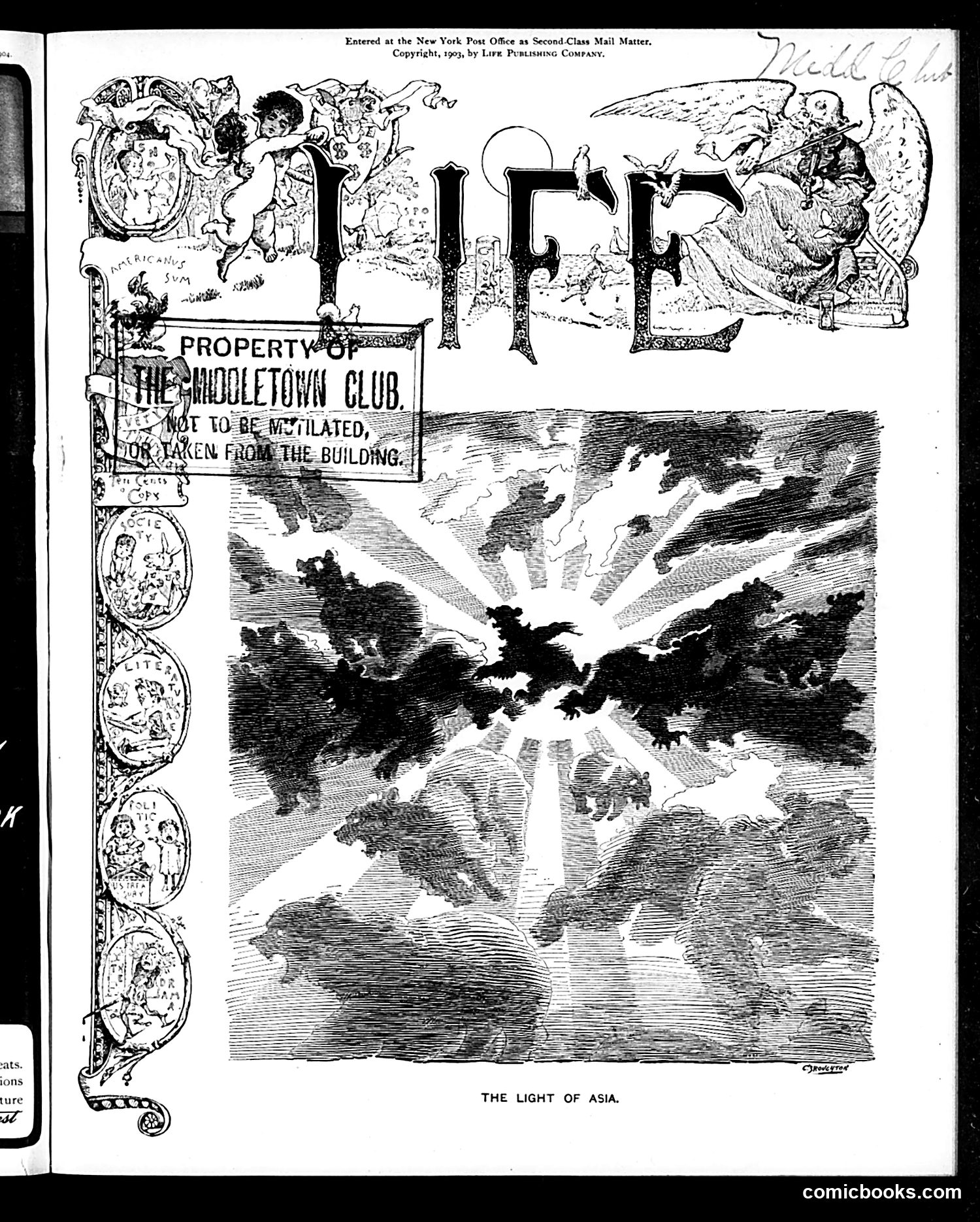
This page features a satirical illustration titled "The Light of Asia," depicting what appears to be a celestial or divine light radiating downward onto a map or landscape of Asia below. The ornate left border contains decorative medallions with classical figures. The imagery suggests commentary on Western (likely American or European) influence or intervention in Asia—portraying it ironically as enlightenment or civilization. The "light" metaphor likely critiques imperial or colonial ambitions presented as benevolent uplift. The ornamental framing and classical references reinforce the satire, contrasting grandiose rhetoric about "civilizing" Asia with the actual impact shown. Without the magazine's date and article text, the specific geopolitical event referenced remains unclear, but this reflects turn-of-the-century anxieties about Western expansion into Asian territories.
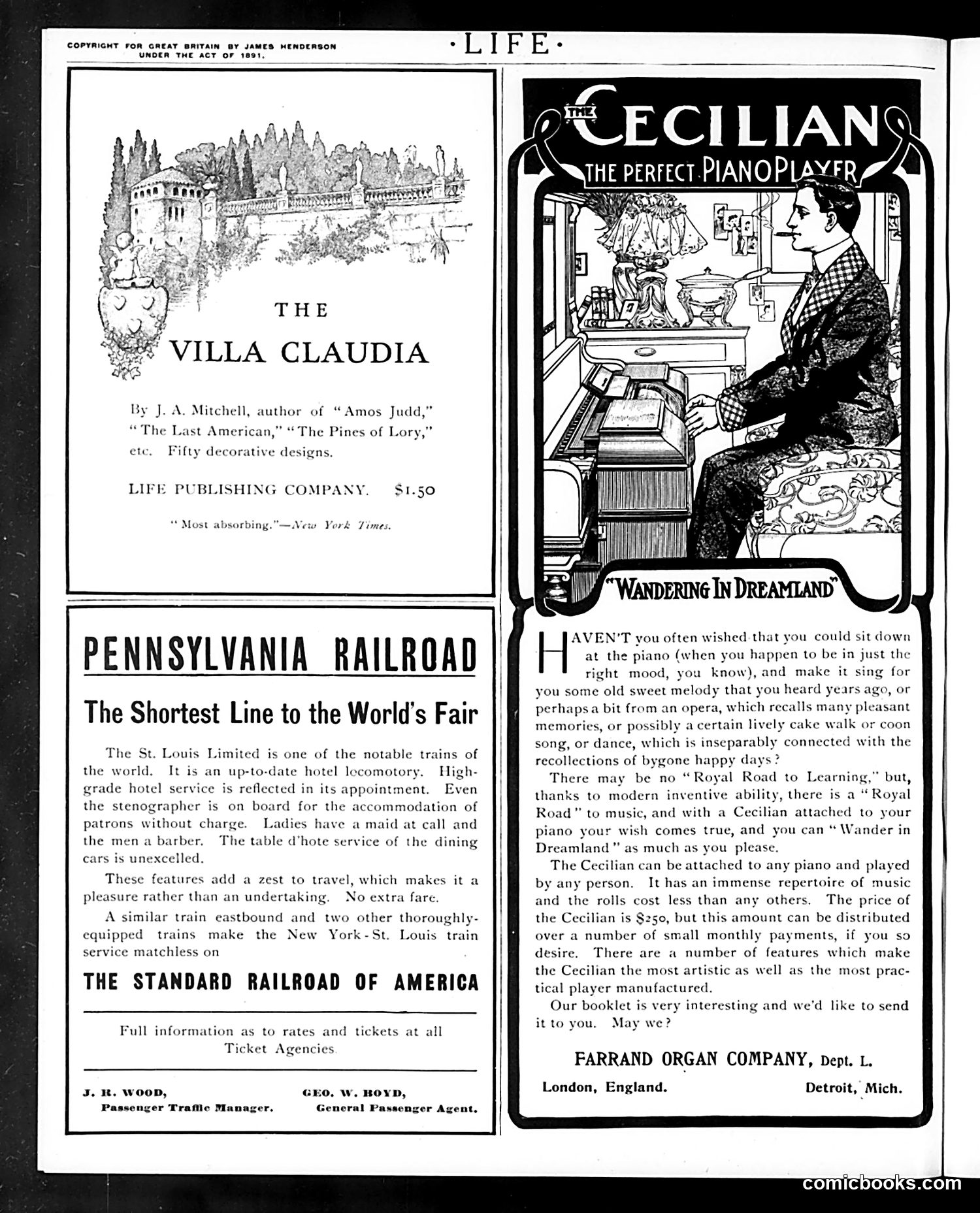
This page consists primarily of **advertisements rather than satirical content**. The left side advertises J.A. Mitchell's book *The Villa Claudia* (published by Life Publishing Company, $1.50) and a Pennsylvania Railroad advertisement for the St. Louis Limited train to the World's Fair. The right side features an ad for the **Cecilian player piano** ("The Perfect Piano Player"), illustrating a woman enjoying automated music. The accompanying text humorously suggests the device allows listeners to enjoy classical music and pleasant memories without requiring musical skill themselves—a satirical jab at the aspiration to appear cultured without actual effort or talent. This reflects early 20th-century consumer culture and middle-class aspirations to gentility.
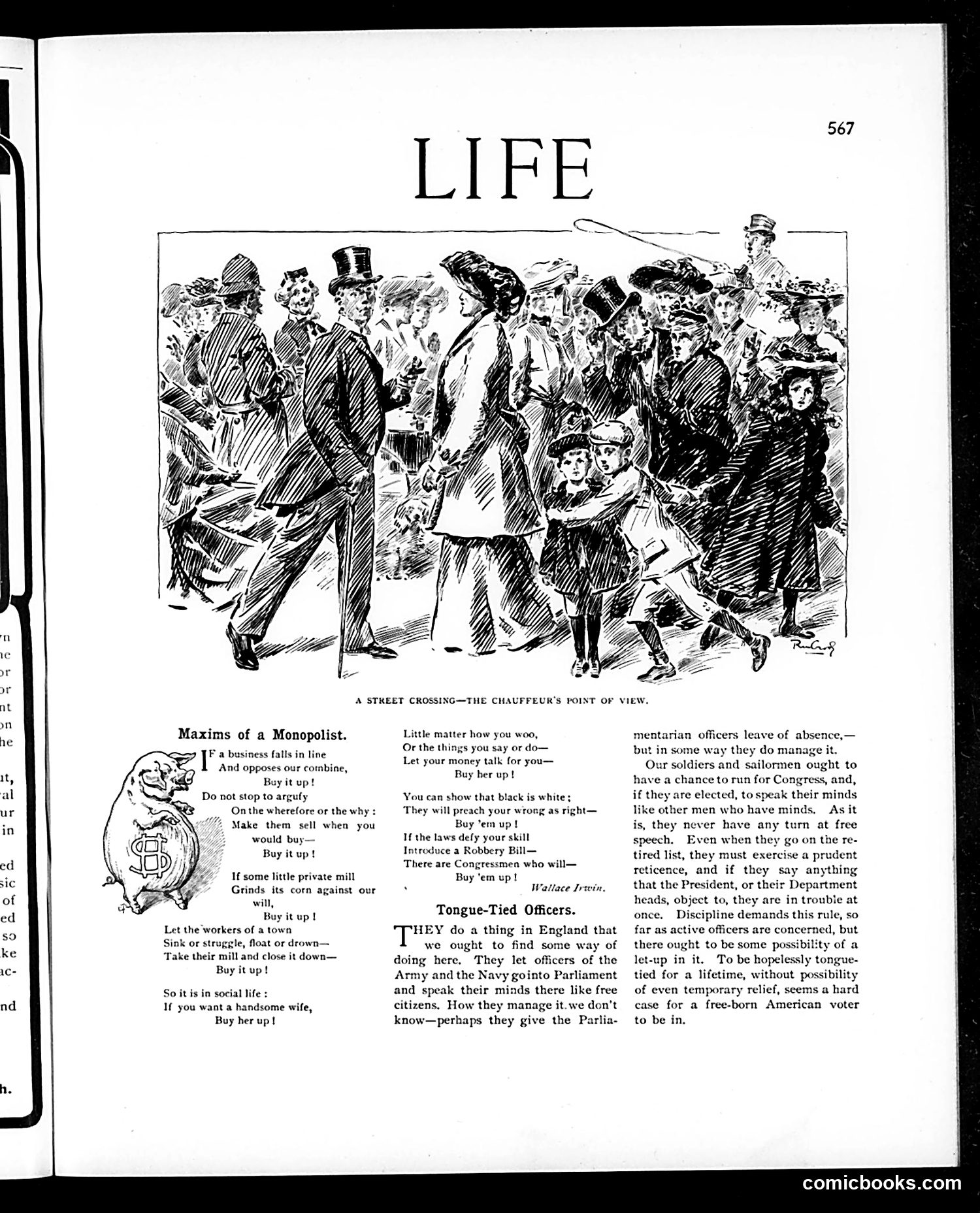
**Main Cartoon:** "A Street Crossing—The Chauffeur's Point of View" depicts a wealthy automobile driver (chauffeur) navigating pedestrians crossing the street, satirizing early automotive culture's clash with pedestrian life. **"Maxims of a Monopolist"** section mocks corrupt business practices—bribing officials, crushing competition, and manipulating workers. The dollar-sign character emphasizes greed as the underlying principle. **"Tongue-Tied Officers"** criticizes American military officers who cannot speak freely in Congress, contrasting this unfavorably with British Parliamentary tradition where military officers can address Parliament openly. The satire suggests American democratic values are undermined when officers lack such liberty. Together, these pieces critique monopolistic capitalism, corruption, and restrictions on free speech.
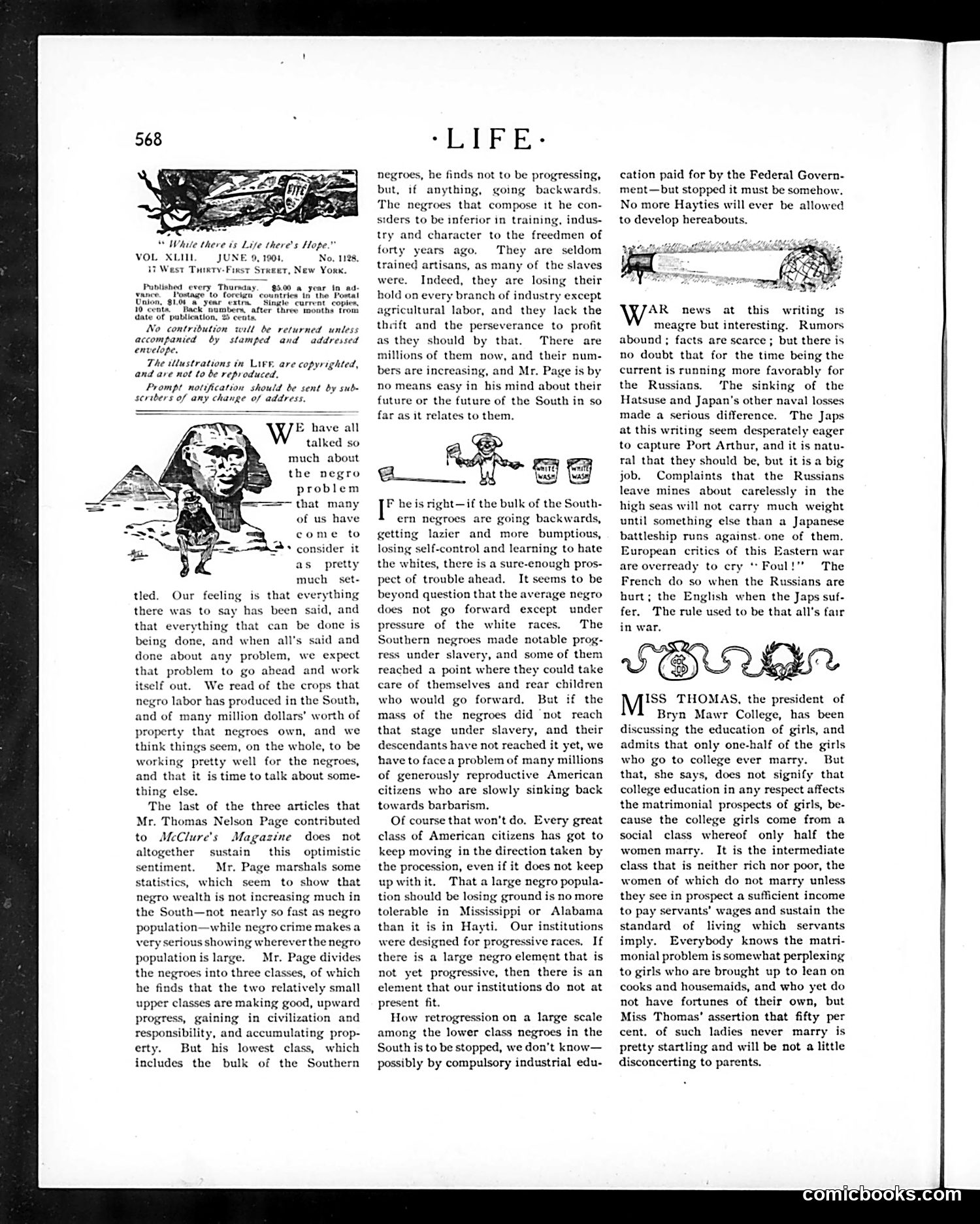
This page contains editorial commentary on racial issues in the American South, not political cartoons. The left margin features a caricatured figure—appearing to be a racist stereotype—though its specific satirical purpose is unclear from the image alone. The text discusses the "negro problem," arguing that Southern Black populations are stagnating rather than progressing. The author contends that slavery previously motivated some advancement, but freedom has allegedly produced regression. The piece advocates for "compulsory industrial education" as a solution. The right column shifts to discuss Miss Thomas and women's college education, unrelated to the racial commentary. This reflects deeply problematic early-1900s racial attitudes common in mainstream American publications of the era, presenting discriminatory views as reasoned commentary.
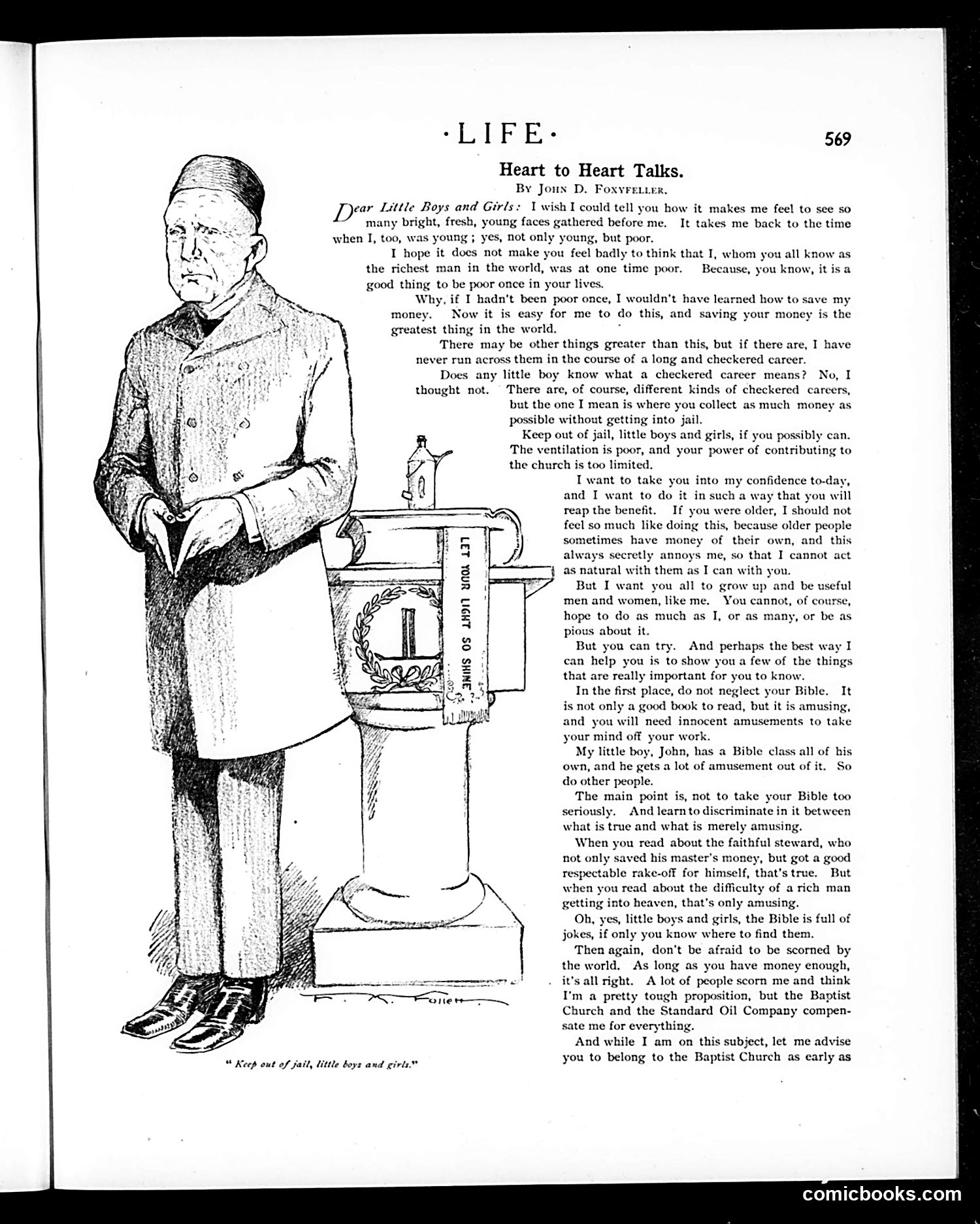
This is a satirical piece featuring John D. Rockefeller (identifiable by the caption "Keep out of jail, little boys and girls") addressing young people. The satire works through ironic contrast: Rockefeller—America's richest man and a controversial industrialist—lectures children about saving money and virtue while holding a massive oil can (referencing Standard Oil Company). The humor lies in Rockefeller's hypocrisy: he advises avoiding jail while his own business practices faced legal scrutiny. His recommendation to join the Baptist Church appears darkly comic given Standard Oil's notorious labor practices and monopolistic tactics. The cartoon mocks both Rockefeller's self-righteousness and the era's wealthy industrialists who presented themselves as moral exemplars to the public.
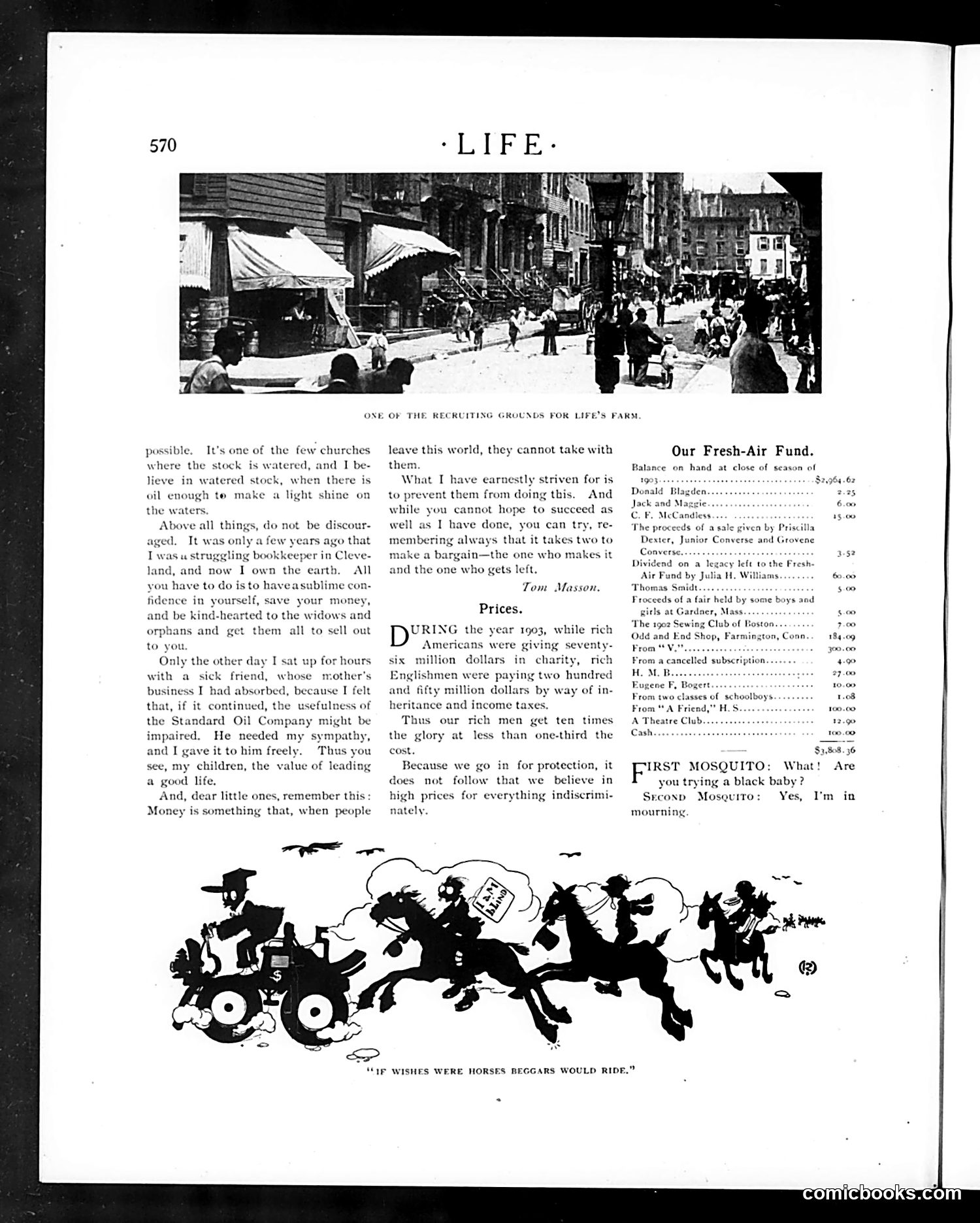
The page contains a photograph labeled "One of the Recruiting Grounds for Life's Farm" showing a busy urban street scene, likely depicting a location where Life magazine recruited contributors or found story material. The main cartoon at bottom, captioned "If Wishes Were Horses Beggars Would Ride," depicts figures on horseback in exaggerated motion—a visual pun on the proverb. The silhouetted style was typical of early 20th-century satirical illustration. The accompanying text discusses charitable giving and financial inequality in 1923, contrasting wealthy Americans donating "seventy million dollars in charity" while "rich Englishmen were paying two hundred and fifty million dollars by way of inheritance and income taxes." The satire critiques disparities in wealth taxation and charitable obligations between nations.
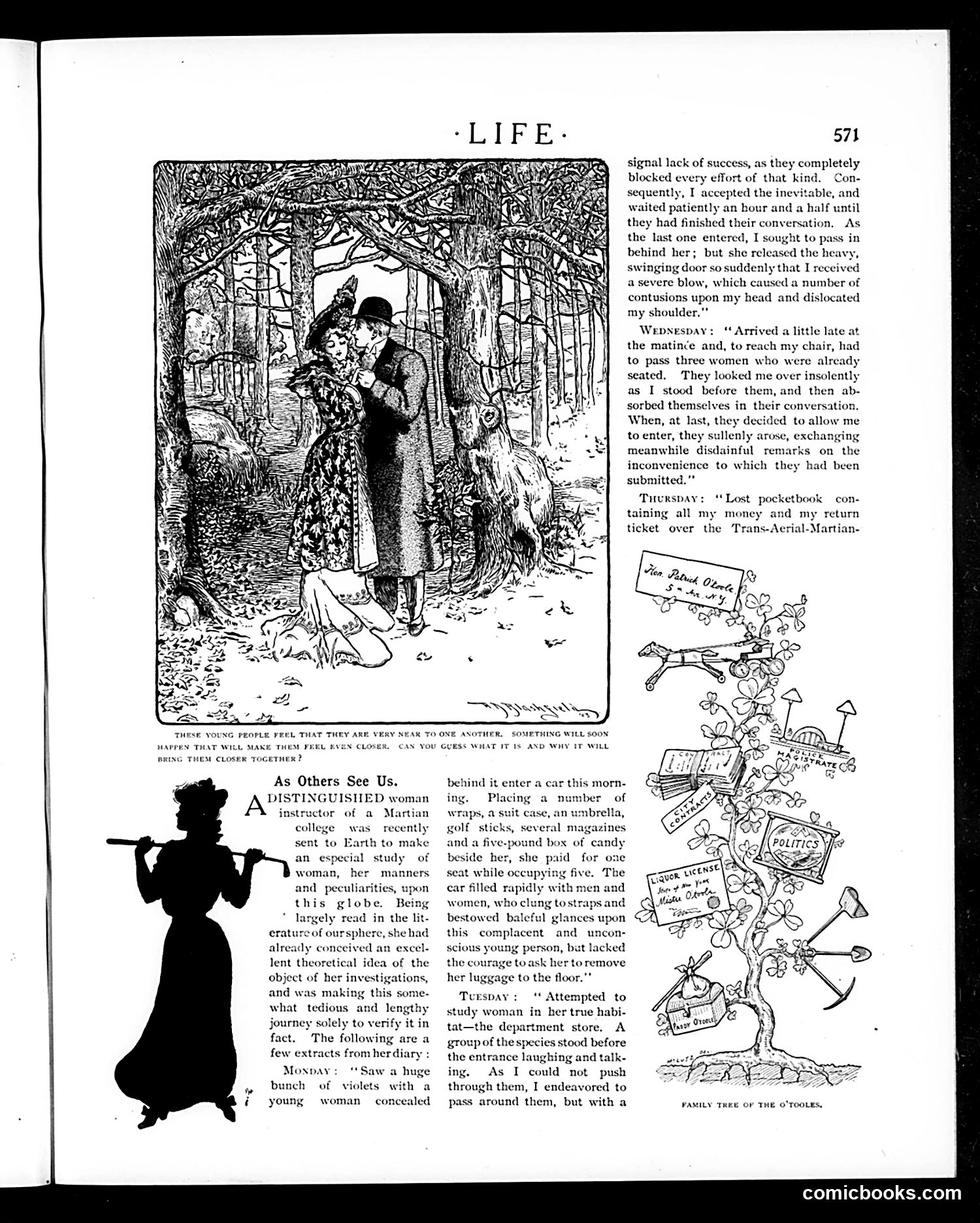
This page features a satirical diary entry from a "distinguished woman instructor of a Martian college" observing Earth women. The humor relies on defamiliarization—an alien perspective highlighting American women's peculiar behaviors as absurd. The main illustration shows a couple in a wooded setting; the caption notes young people feel "very near to one another," suggesting romantic coupling will increase closeness. The diary entries mock women's consumer culture and materialism: she observes women laden with luggage, shopping at department stores, and clutching possessions. The "Family Tree of the O'Tooles" illustration satirizes Irish-American consumerism, depicting a family literally sprouting commercial goods (licenses, politics magazines, etc.). The satire targets American materialism and gender norms through outsider perspective.
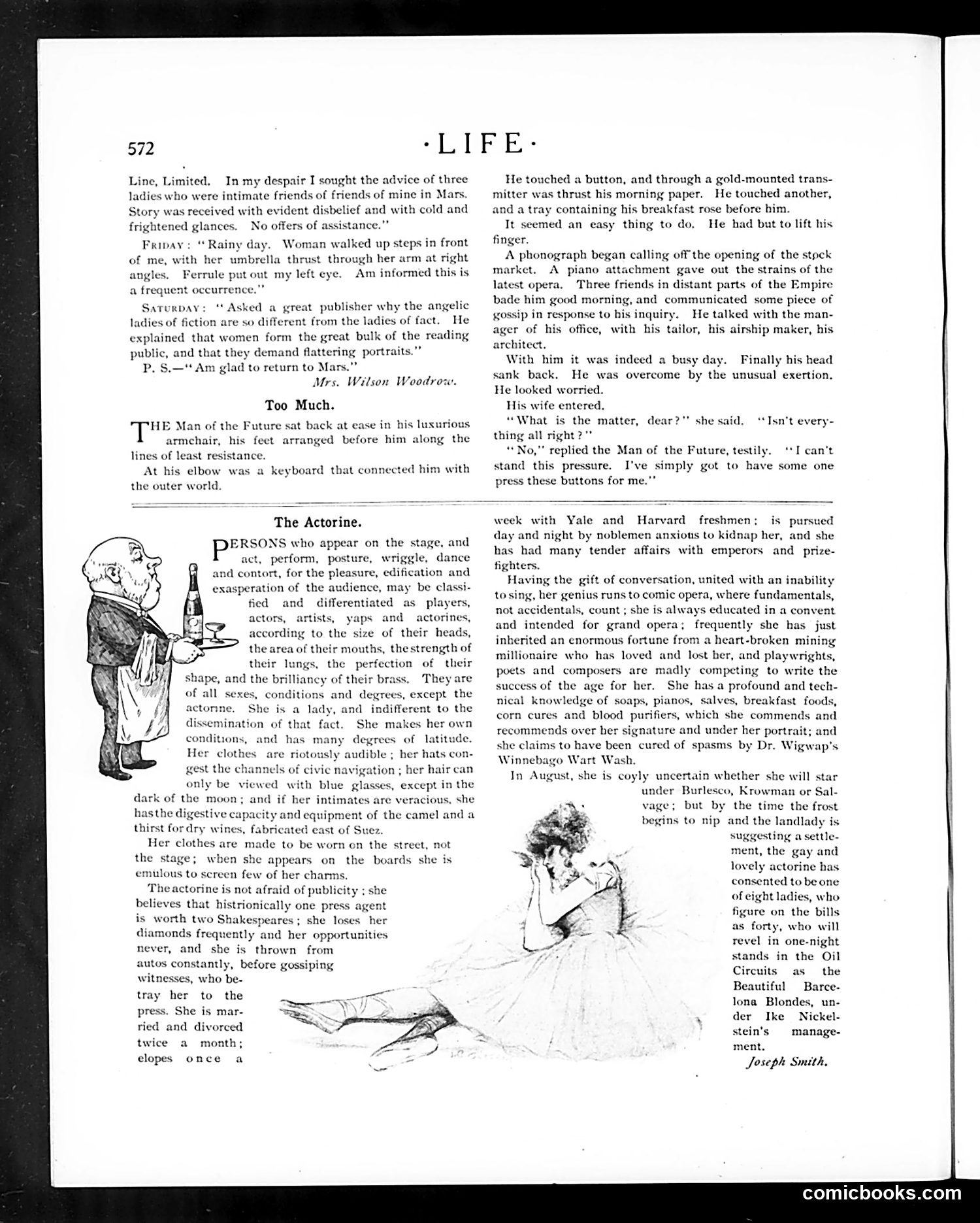
This page contains two distinct articles with illustrations. "Too Much" features a cartoon of a portly gentleman in formal dress holding a bottle, illustrating a story about "The Man of the Future" overwhelmed by modern life's pressures—particularly the stress of operating mechanical devices (pressing buttons for his morning paper and breakfast). "The Actorine" is a satirical essay about female stage performers, accompanied by a sketch of a woman in theatrical costume. The text mocks actresses as vain, ambitious figures obsessed with fame and fortune, describing their typical characteristics and social behavior with evident disdain. Both pieces exemplify Life's satirical approach to contemporary society, poking fun at modern anxieties and theatrical culture.
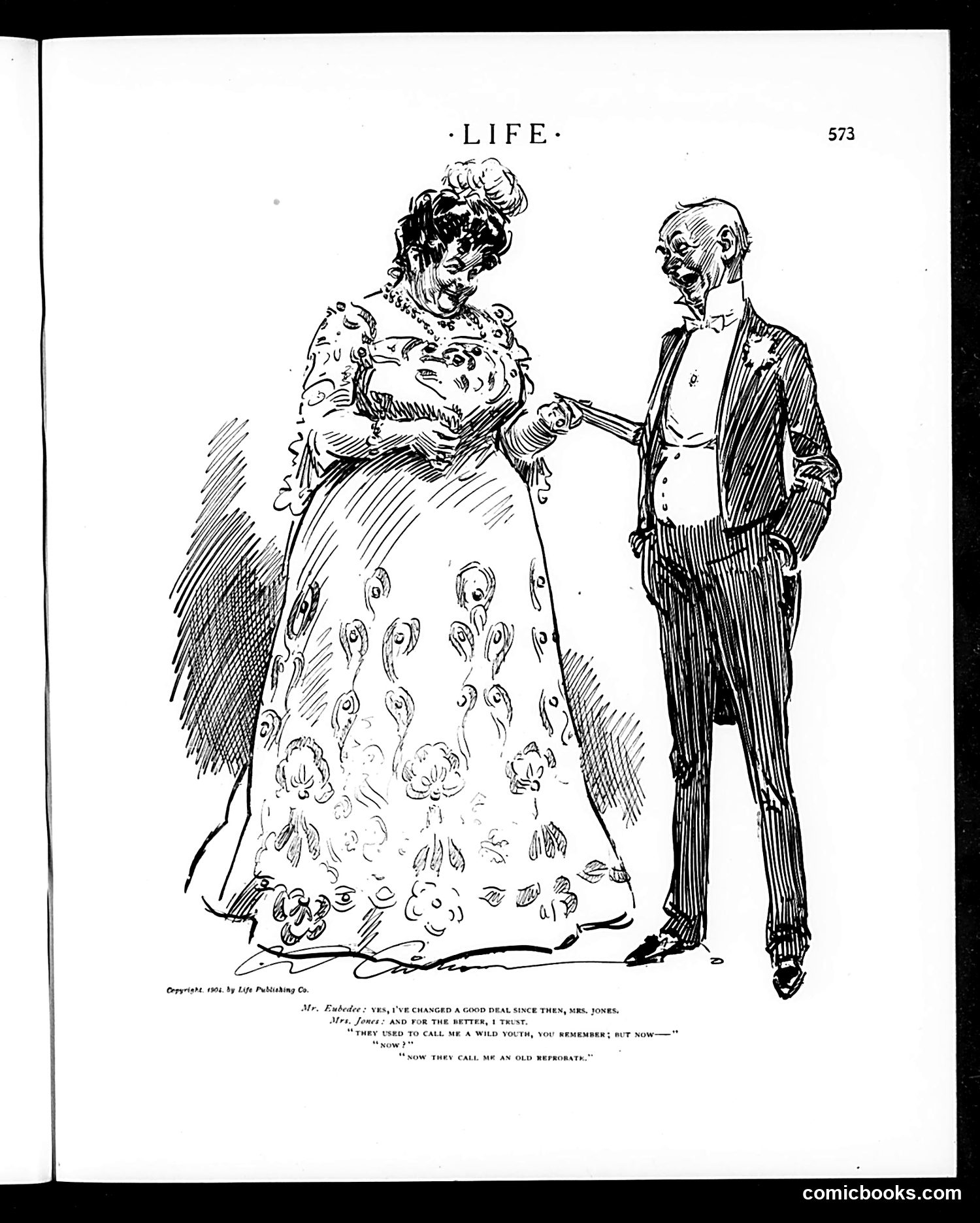
This is a satirical cartoon from Life magazine (copyright 1901) depicting two figures in conversation. The dialogue suggests a social commentary about aging and reputation: The woman, elaborately dressed with jewelry and an ornate gown, remarks to the man that she has "changed a good deal since then" and asks him to trust her improvements. The man responds that "they used to call me a wild youth," but now "they call me an old reprobate." The satire targets **social hypocrisy about aging and respectability**. Both figures claim personal transformation, yet the man's sardonic final comment suggests their reputations remain unchanged despite their self-perceived improvements. The cartoon mocks how people attempt to reinvent themselves socially as they age, while society's judgments persist unchanged.
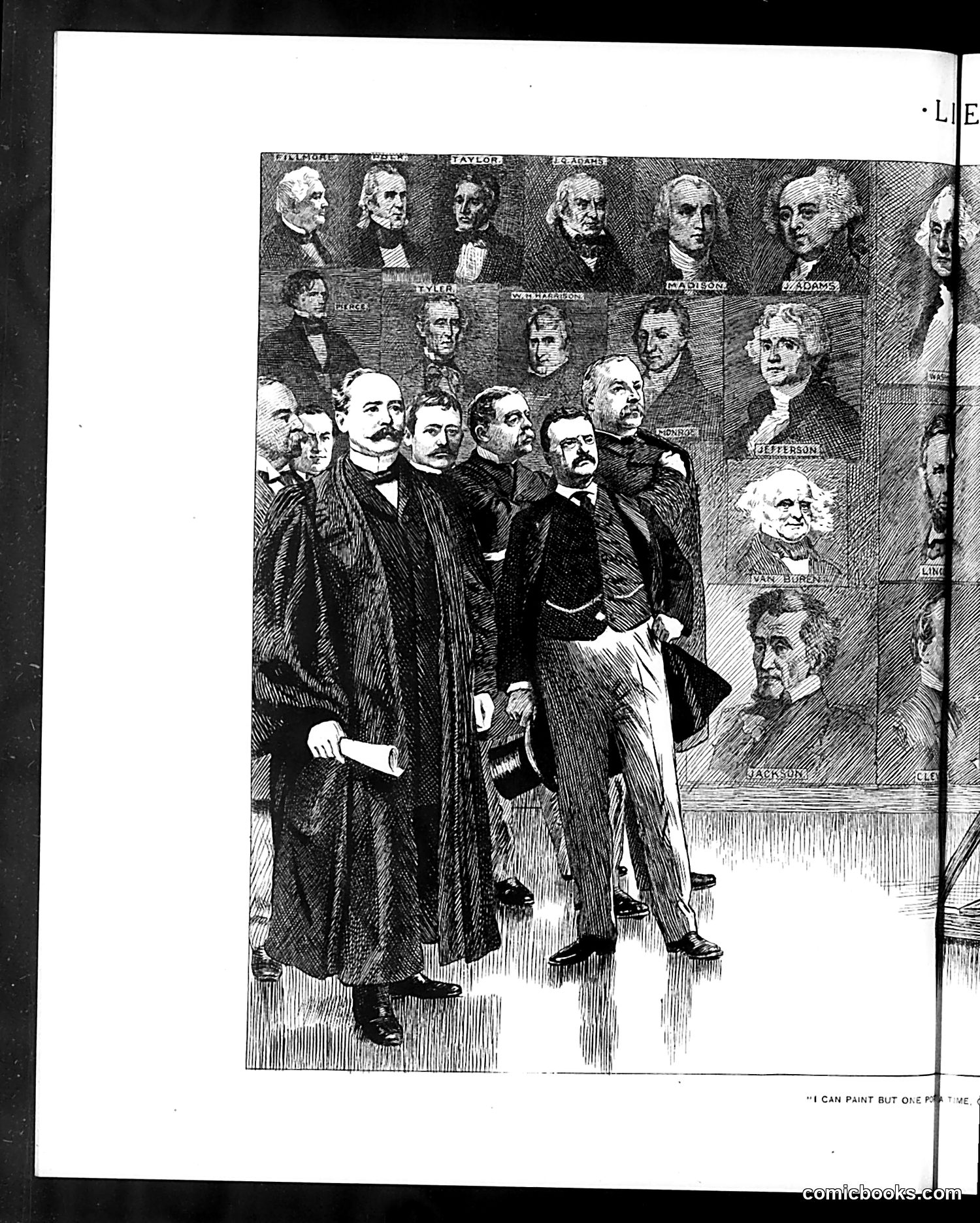
This engraving depicts a gallery of American historical figures arranged as portrait busts or head studies surrounding a central scene. The main composition shows several 19th-century gentlemen in formal dress examining what appears to be an artist's work or document. The surrounding portraits are labeled with names of prominent American figures, though the specific OCR text is incomplete. The style and composition suggest this is satirizing artistic or political judgment—possibly critiquing how historical figures are evaluated or remembered. The caption at bottom reads "I CAN PAINT BUT ONE FACE," suggesting commentary on artistic limitation, authenticity, or perhaps political/social conformity during this period. Without complete OCR text, the precise satirical target remains unclear, but this appears to comment on American political or cultural establishment perspectives.
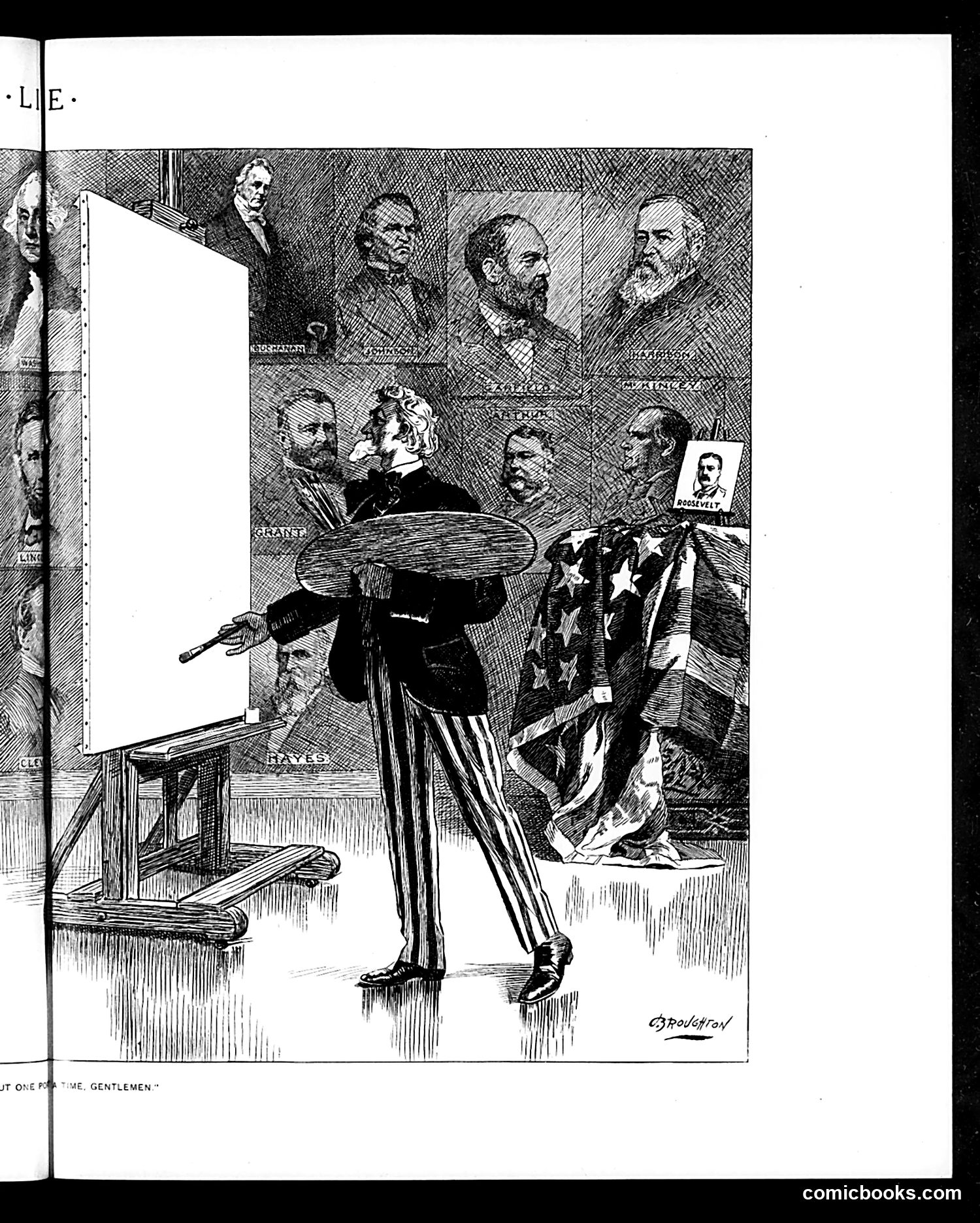
This appears to be a satirical cartoon from *Life* magazine showing Uncle Sam (identifiable by his characteristic striped pants and top hat) presenting or displaying something to an audience of political figures shown in portrait form behind him. The cartoon likely satirizes American political leadership or policy during a specific historical moment. The blank white space Uncle Sam gestures toward suggests he's presenting something—possibly an empty policy, broken promise, or failed initiative—to skeptical observers. The formal gathering and the deliberate presentation style indicate this mocks some aspect of political theater or governmental deception. Without clearer text identifying the specific figures or date, the precise political event remains unclear, but the composition suggests criticism of American political leadership's credibility or sincerity.
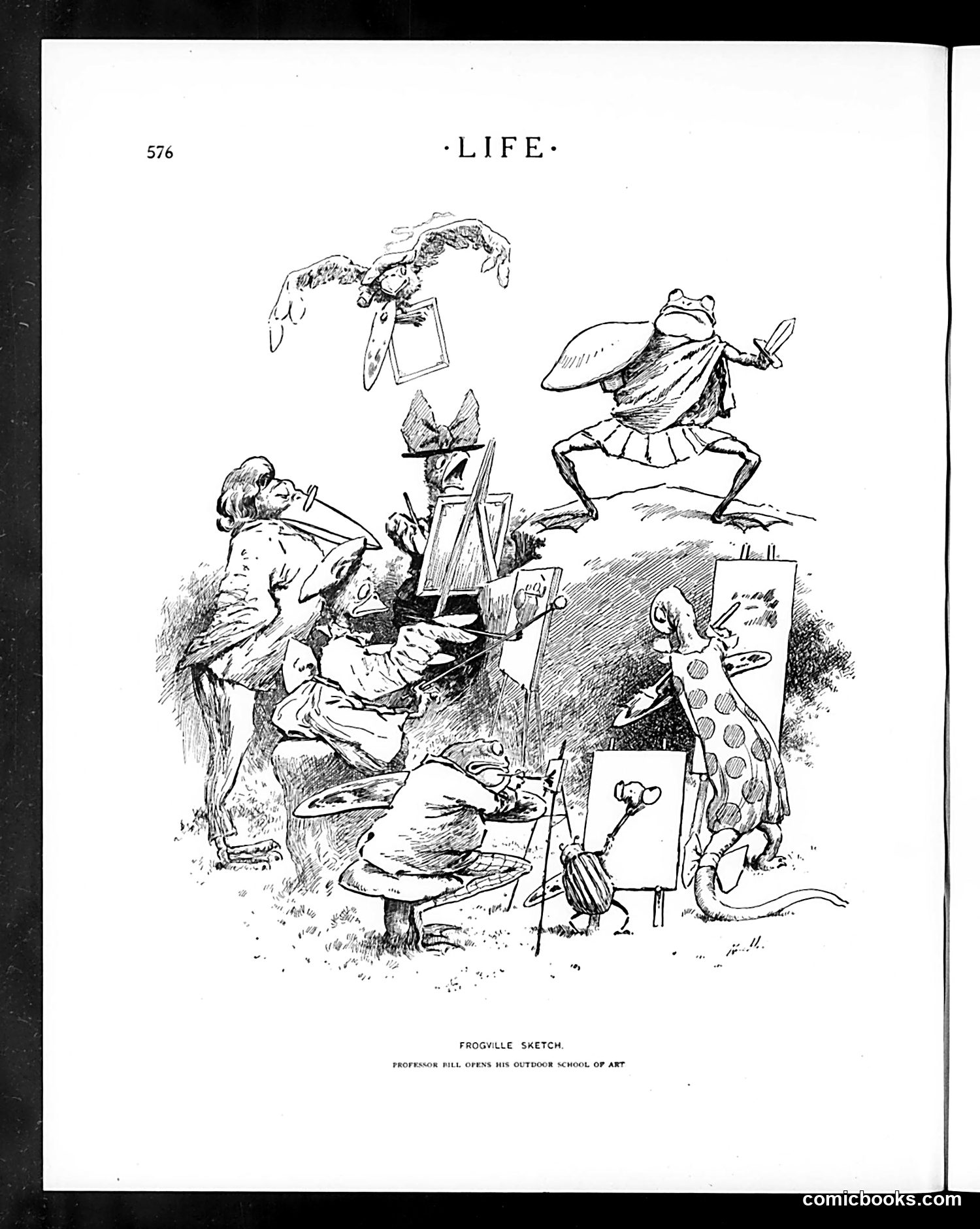
This is a whimsical cartoon titled "Frogville Sketch," subtitled "Professor Bull Opens His Outdoor School of Art." The image depicts anthropomorphic frogs engaged in an art class outdoors. A frog "professor" instructs students who are drawing or painting on easels and canvases. The scene is playful rather than overtly political. The satire appears gentle—likely mocking pretentious or absurd artistic instruction. The anthropomorphic frogs and the notion of a "Professor Bull" conducting an "outdoor school of art" create humor through the incongruity of animals attempting human intellectual pursuits. This reflects turn-of-the-century American satire's tendency to use animal characters to gently ridicule human vanities and follies, particularly regarding artistic pretension.
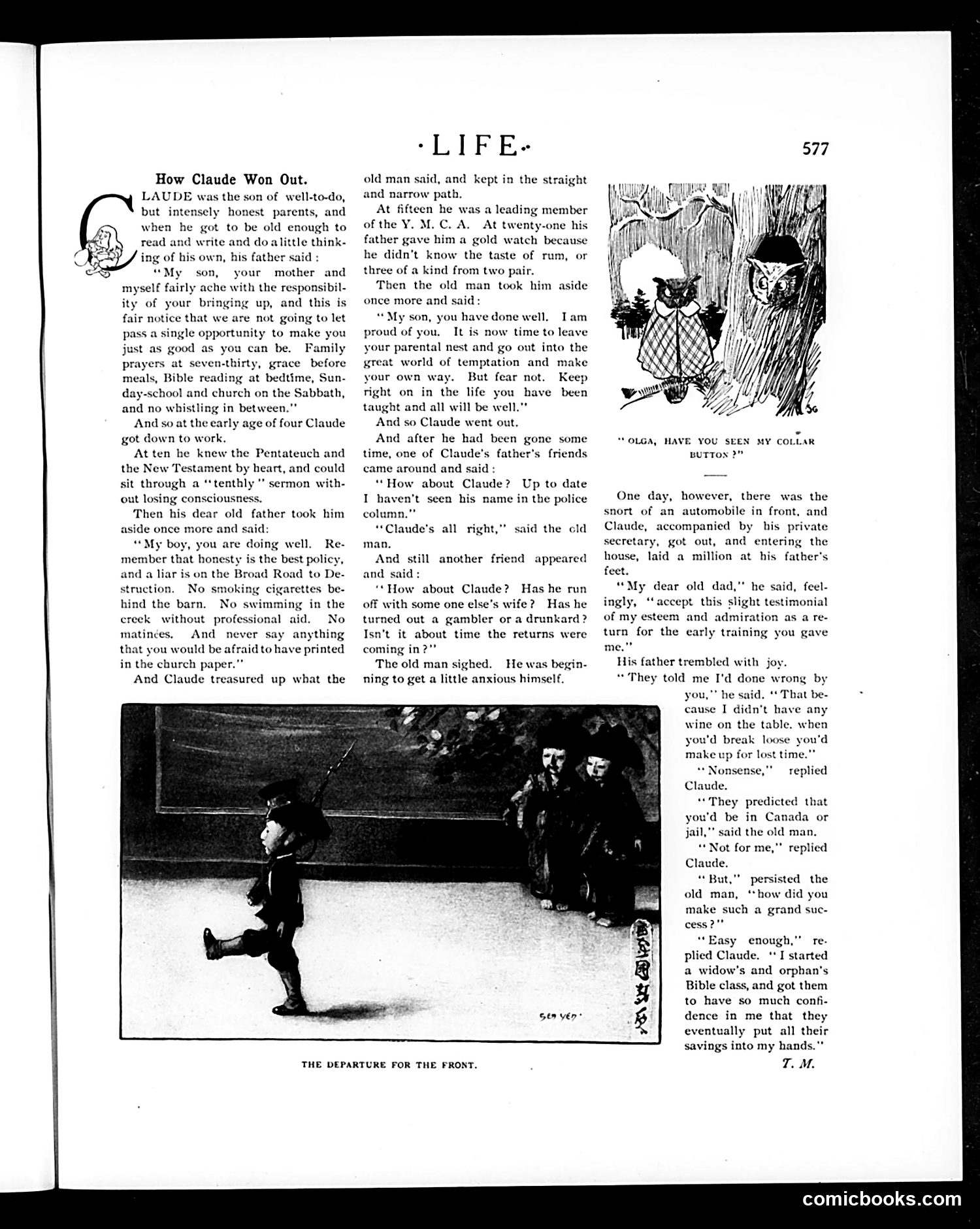
This story satirizes the hypocrisy of the "self-made man" narrative and religious moral instruction. Claude is raised by intensely pious parents who drill strict Victorian morality into him—no drinking, smoking, gambling, or worldly vices. He becomes a model Y.M.C.A. member. However, the punchline reveals the joke: Claude's spectacular financial success comes from running a widows-and-orphans investment scheme—a classic Ponzi/fraud operation. His parents' rigorous moral training didn't actually create virtue; it merely created a convincing *appearance* of trustworthiness that Claude exploits to defraud vulnerable people. The satire targets early 20th-century confidence men who weaponized respectability and religious piety as cover for financial crimes. The cartoon suggests that strict moral upbringing and good reputation can paradoxically become tools for deception when divorced from actual integrity.
This page is primarily a **book review section** with minimal cartooning. The main satirical content appears in the opening essay titled "The Treasure of the Humble," which discusses **President Roosevelt's democratic values**. The piece praises Roosevelt for permitting his children to associate with poor children without caste distinctions, calling this "sturdy democracy." The author uses this as a springboard to argue that true humility and equality—not artificial class pretense—represent genuine American virtue. The essay celebrates Roosevelt's willingness to let his children play with "those nice little children of the people" as evidence of authentic democratic principles. The remaining content consists of **book reviews** covering Lord Acton's letters, adventure novels, Persian poetry, and a field guide to American birds. The Scottish dialect passage appears to be a humorous literary excerpt rather than political commentary. The page reflects early 1900s Progressive-era values emphasizing social equality and Roosevelt's accessible, egalitarian public image.
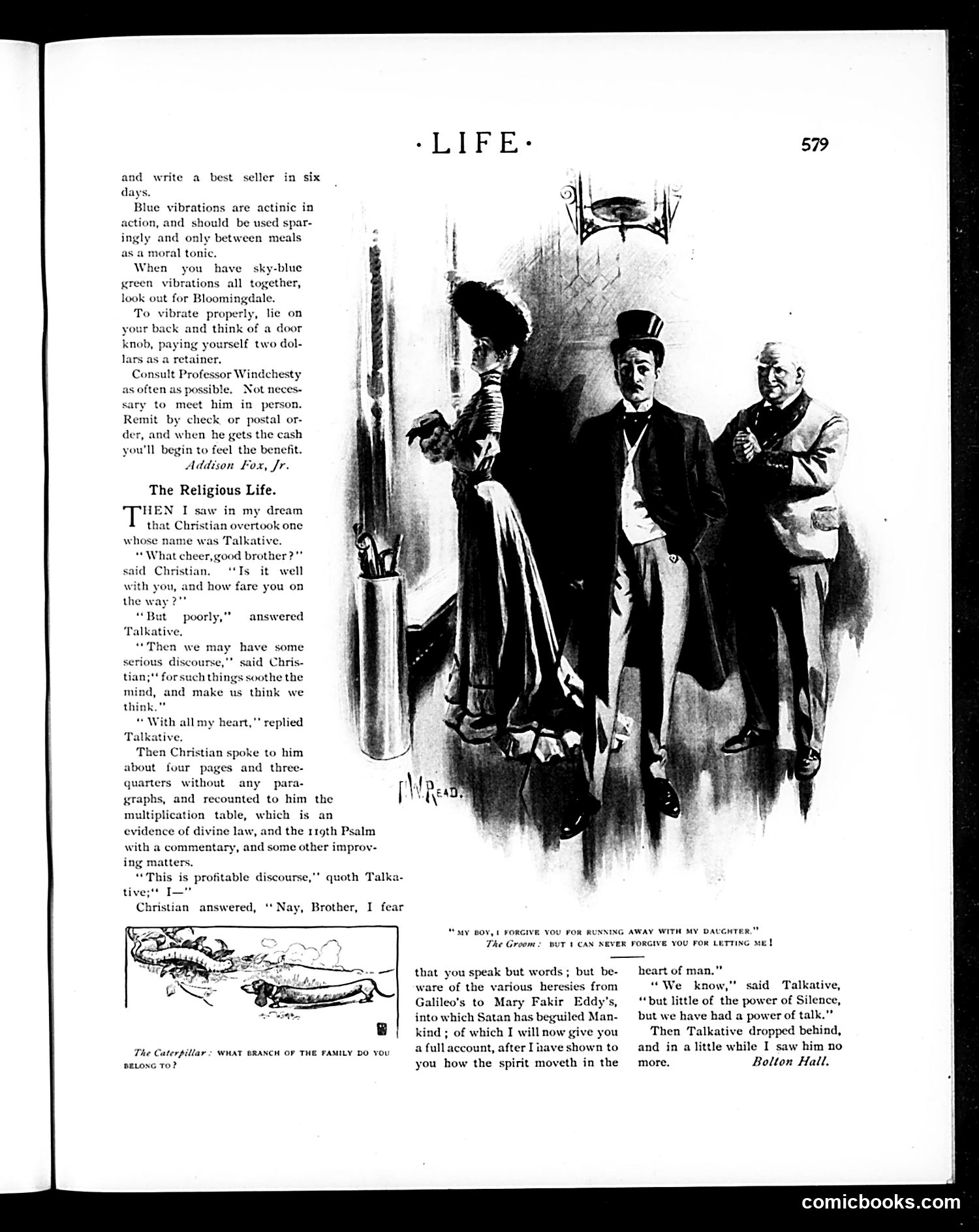
This page contains two distinct pieces of satire: **"The Religious Life"** is a parody of Bunyan's *Pilgrim's Progress*, mocking verbose religious discourse. Christian and Talkative represent archetypal figures—one thoughtful, one garrulous. The satire ridicules religious pedantry: Talkative delivers pages of tedious theological argument (multiplication tables, psalm commentaries) without spiritual substance. Christian eventually abandons him, suggesting that excessive talk obscures genuine faith. The joke targets 19th-century religious verbosity and spiritual charlatanism. **"The Caterpillar"** cartoon shows three men examining an insect, with the caption asking what family branch it belongs to—likely satirizing either biological classification debates or, more probably, social-climbing pretension about family lineage and class distinction. **The header section** mocks pseudoscientific wellness trends (color vibrations, "Professor Windchesty"), common targets in *Life*'s satire of quack medicine and mail-order self-improvement schemes popular in the era. The overall theme: satirizing empty rhetoric, false expertise, and cultural pretension.
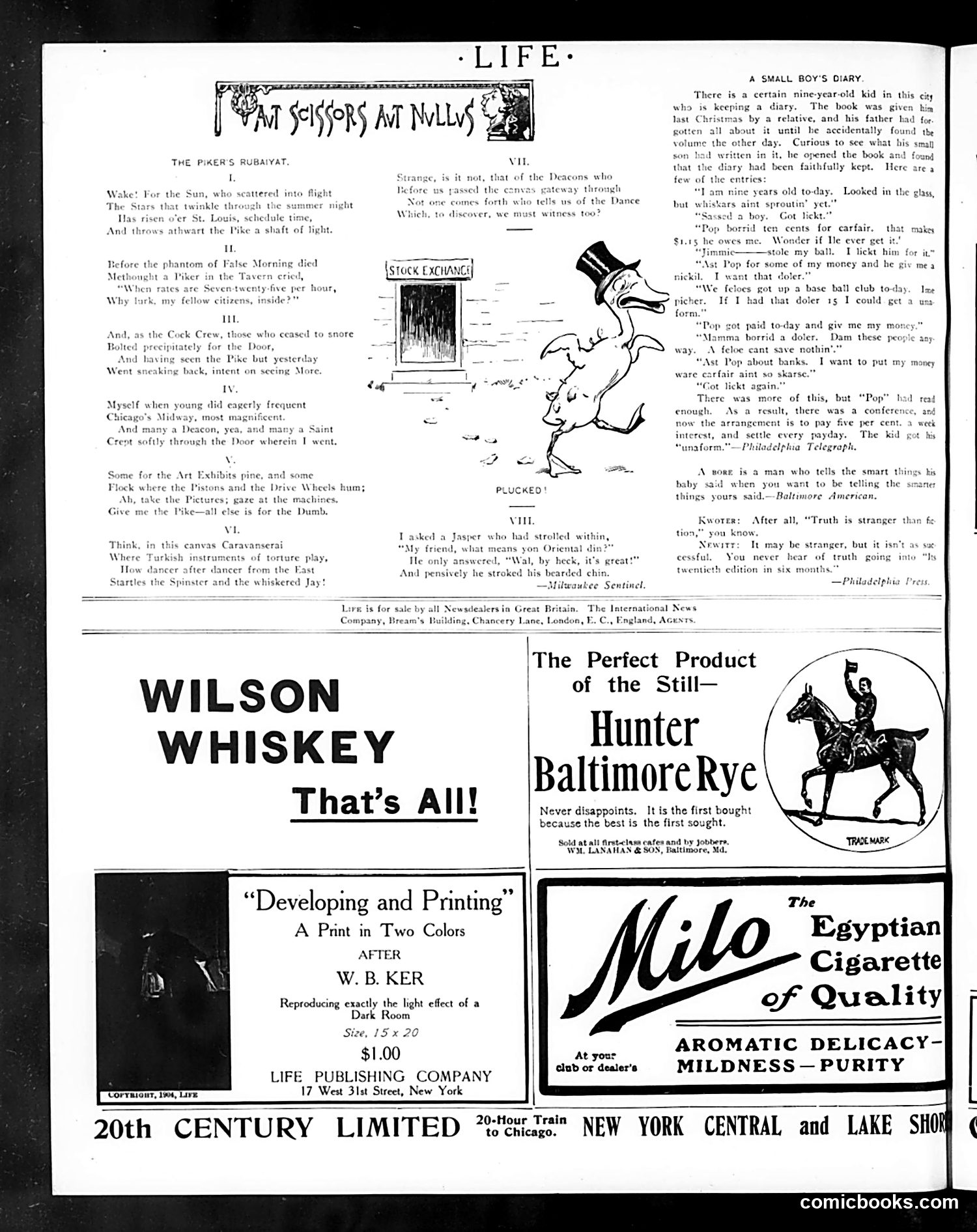
This page contains primarily **advertising and literary content** rather than political satire. The main feature is "A Small Boy's Diary"—a humorous essay about a nine-year-old keeping a journal. The diary entries satirize childhood concerns (money for carfare, joining a baseball club, saving allowance) mixed with precocious observations about adult behavior. The humor derives from the contrast between the boy's innocent voice and his attempts at philosophical wisdom (quoted at bottom: "Truth is stranger than fiction"). The page also includes poetry titled "I Am Scissors at Nulls" and "The Piker's Rubaiyat" (literary parodies). **Advertisements dominate the lower half**: Wilson Whiskey, Hunter Baltimore Rye (liquor), Milo Egyptian Cigarettes, a photographic print reproduction service, and the 20th Century Limited train service. These ads are typical of *Life* magazine's commercial content during this era (early 1900s based on styling). The overall page is **miscellaneous editorial and commercial content** without sustained political commentary or social satire beyond gentle mockery of childhood behavior.
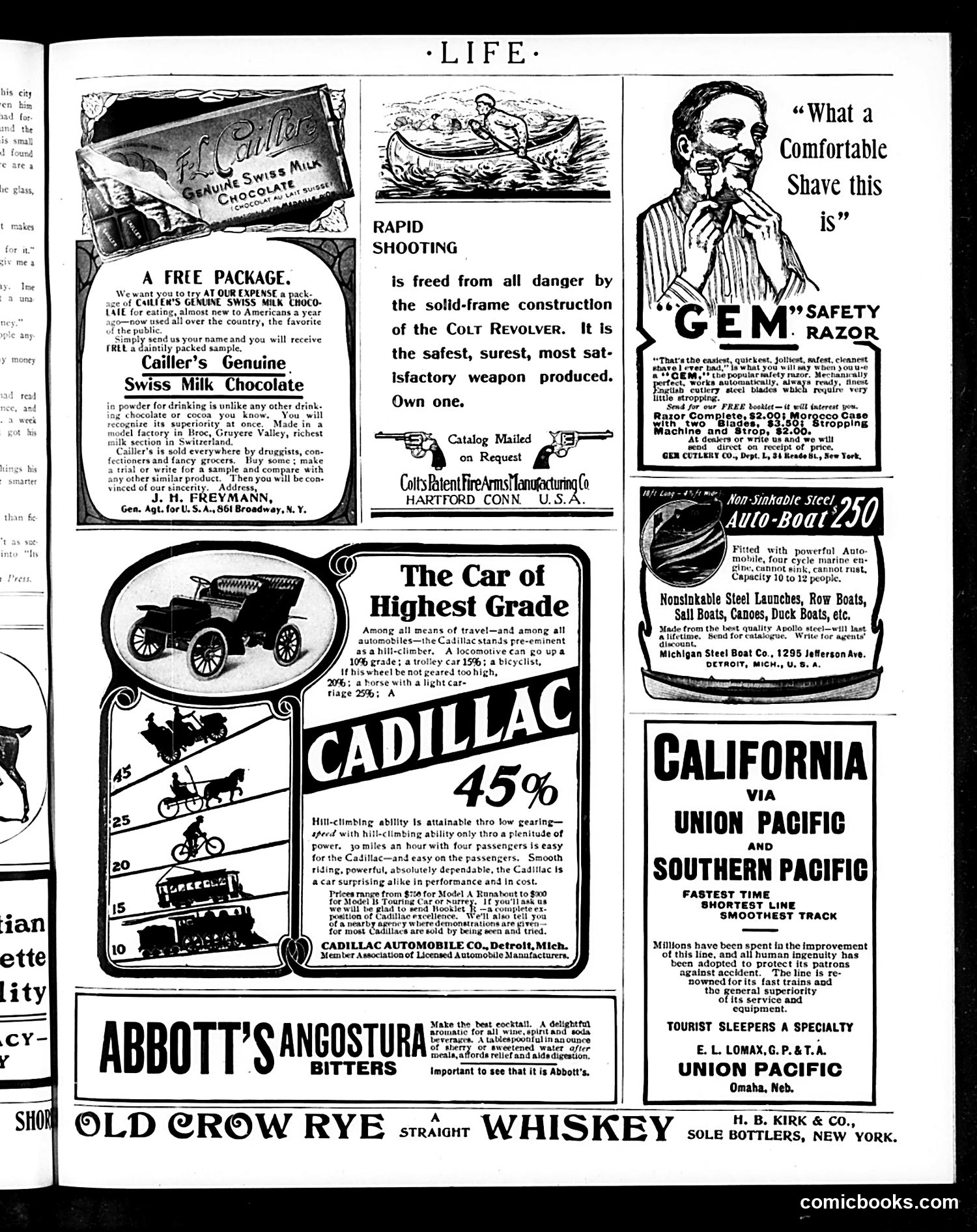
This is primarily an **advertising page** from Life magazine, not a satirical cartoon. The page contains various commercial advertisements typical of the early 1900s, including: - **Cailler's Swiss Milk Chocolate** (free sample offer) - **Colt Revolver** (emphasizing safety) - **Gem Safety Razor** (highlighting ease and comfort of shaving) - **Cadillac automobiles** (comparing hill-climbing ability to locomotives, trolleys, bicycles, and horses) - **Auto-Boat 250** (non-sinkable steel boats) - **Abbott's Angostura Bitters** (cocktail ingredient) - **California railroads** (Union Pacific and Southern Pacific) - **Old Crow Rye whiskey** The Cadillac ad is the most prominent, using comparative graphics showing different vehicles' climbing grades. There is **no political satire** on this page—it's straightforward product marketing reflecting consumer goods and technology of the period.
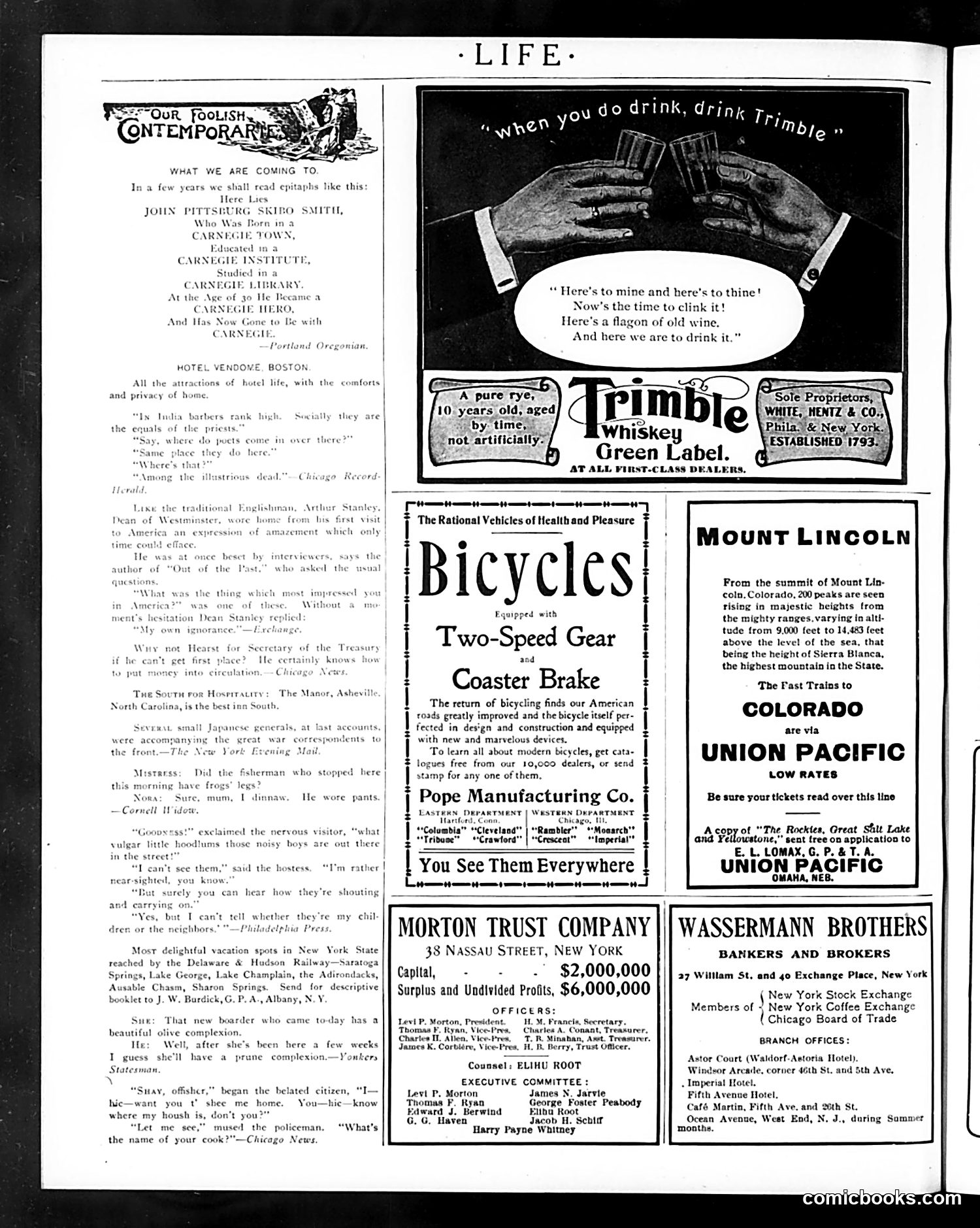
The main cartoon mocks the dominance of Andrew Carnegie's philanthropic reach. It presents a satirical epitaph for "John Smith," a fictional person whose entire life—from birthplace to education to career—was shaped by Carnegie institutions (Carnegie Town, Carnegie Institute, Carnegie Library, Carnegie Hero Fund). The joke critiques how Carnegie's wealth and charitable giving had become so pervasive that an individual's identity was essentially absorbed by Carnegie's name and institutions. For modern readers: this is satire about billionaire philanthropy, suggesting that massive charitable giving, while seemingly beneficial, creates a kind of cultural monopoly where the donor's name overshadows individual achievement and autonomy. The surrounding page is primarily **advertisements** (Trimble Whiskey, bicycles, railroads, banks), typical of *Life* magazine's mixed content format.
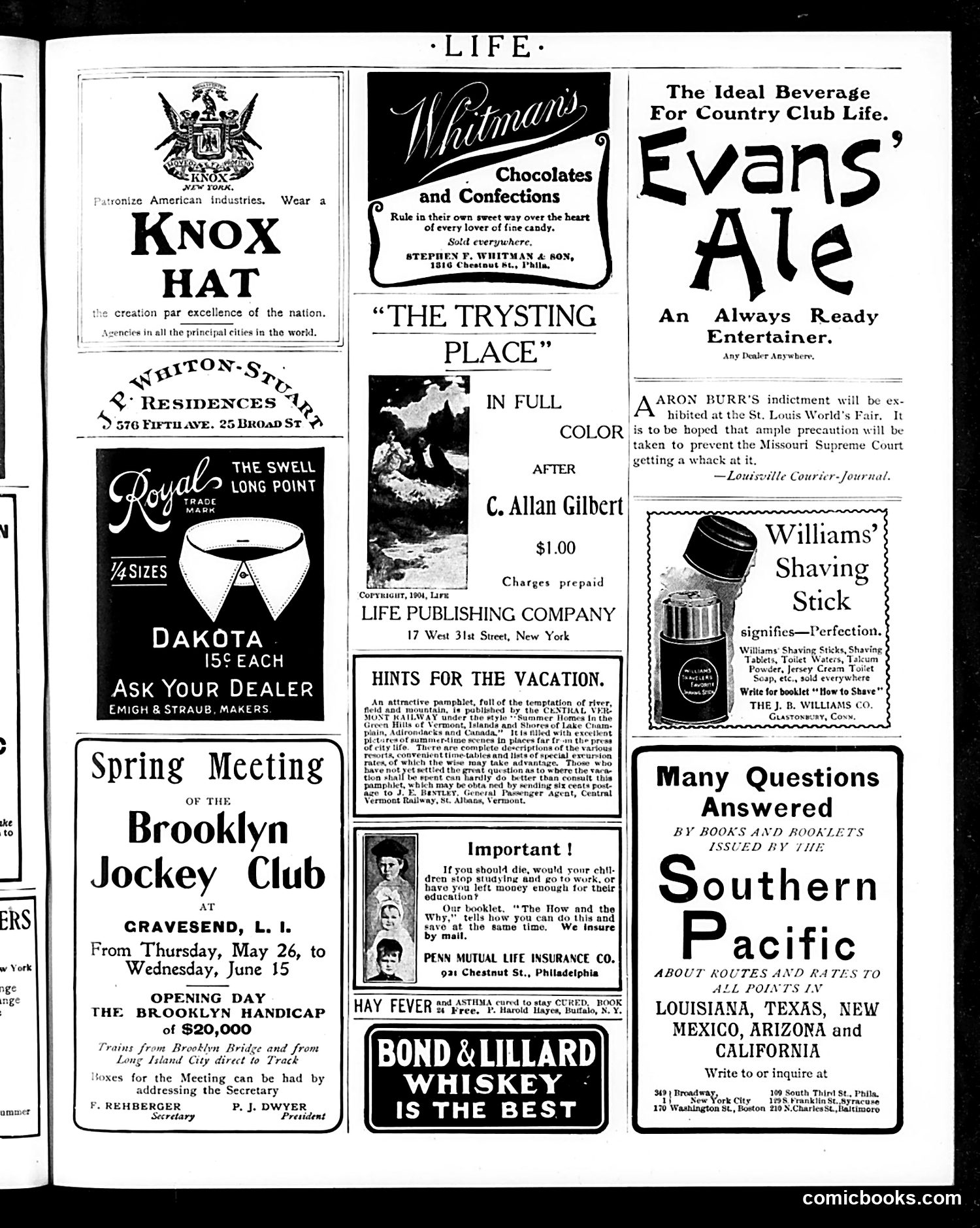
This is primarily an **advertising page** from an early 20th-century *Life* magazine, containing no political cartoons or satire. Instead, it showcases period consumer products and events typical of affluent American life circa 1900s-1910s. **Notable advertisements include:** - **Knox Hat** — positioning itself as patriotic ("Patronize American Industries") - **Evans' Ale** — marketed as suitable for "Country Club Life" - **Bond & Lillard Whiskey** — another luxury beverage - **Brooklyn Jockey Club Spring Meeting** — a prestigious horse-racing event - **C. Allan Gilbert's "The Trysting Place"** — appears to be a theatrical or literary work being promoted - **Williams' Shaving Stick** and **Penn Mutual Life Insurance** — practical consumer goods The page reflects the interests and purchasing power of the magazine's wealthy, urban readership: leisure activities (horse racing, country clubs), grooming products, alcoholic beverages, and insurance—establishing aspirational lifestyles for early-20th-century American gentlemen.
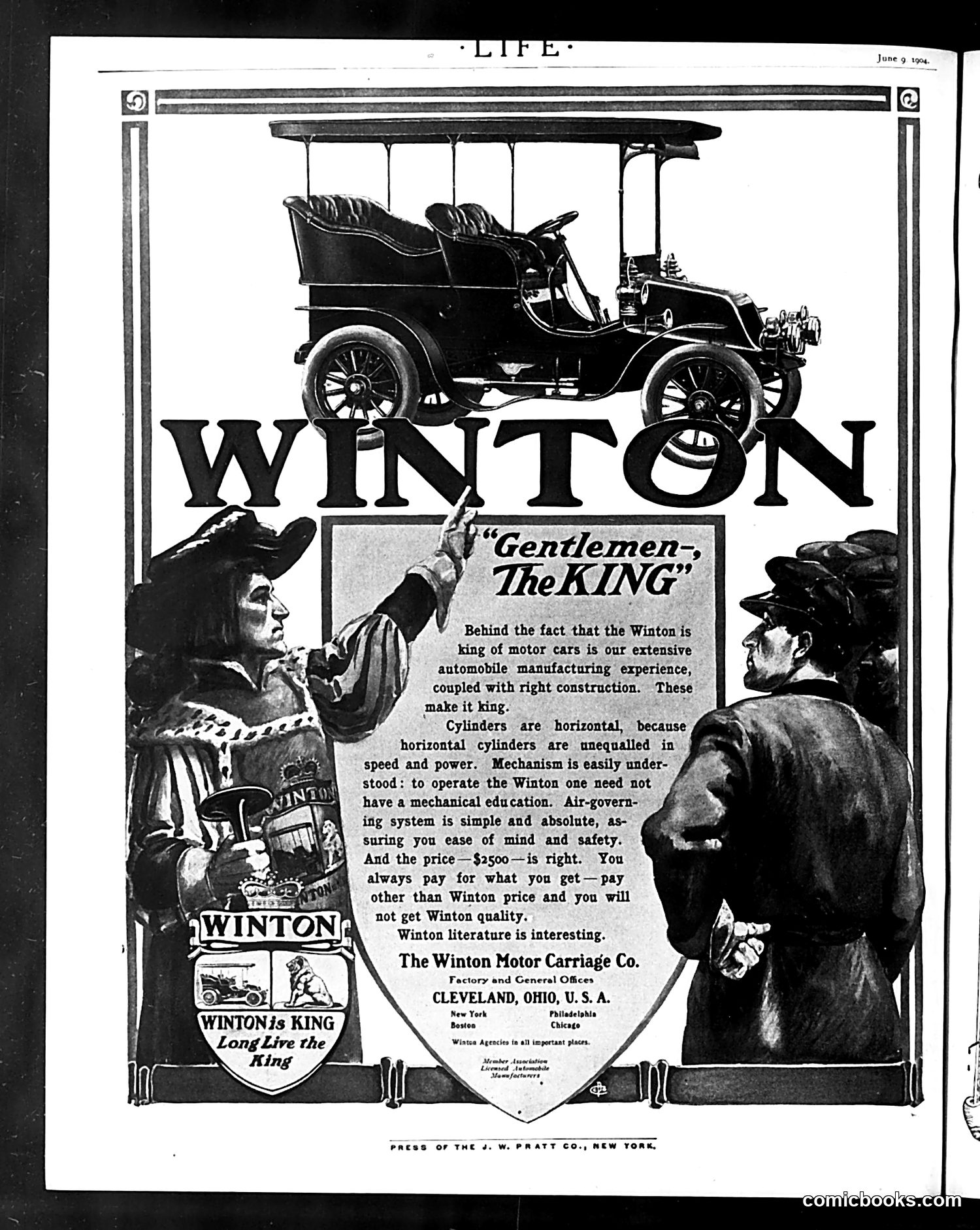
This is a **commercial advertisement**, not satire or political commentary. The Winton Motor Carriage Company (Cleveland, Ohio) is marketing their automobile as "king of motor cars." Two robed, crown-wearing figures (styled as medieval kings or nobility) flank an early automobile suspended from above. This visual metaphor equates owning a Winton with royal status—a common early 20th-century marketing device suggesting luxury and prestige. The text emphasizes practical selling points: horizontal cylinders for power, simple operation requiring no mechanical expertise, and an air-governing safety system. The $2,500 price is positioned as fair value. The shield at bottom declares "WINTON IS KING / Long Live the King," reinforcing the monarchical branding. This appears designed for wealthy readers who could afford an automobile when they remained rare luxury items.