
Life, 1904-06-09 · page 4 of 20
Life — June 9, 1904 — page 4: what you’re looking at
What you’re looking at
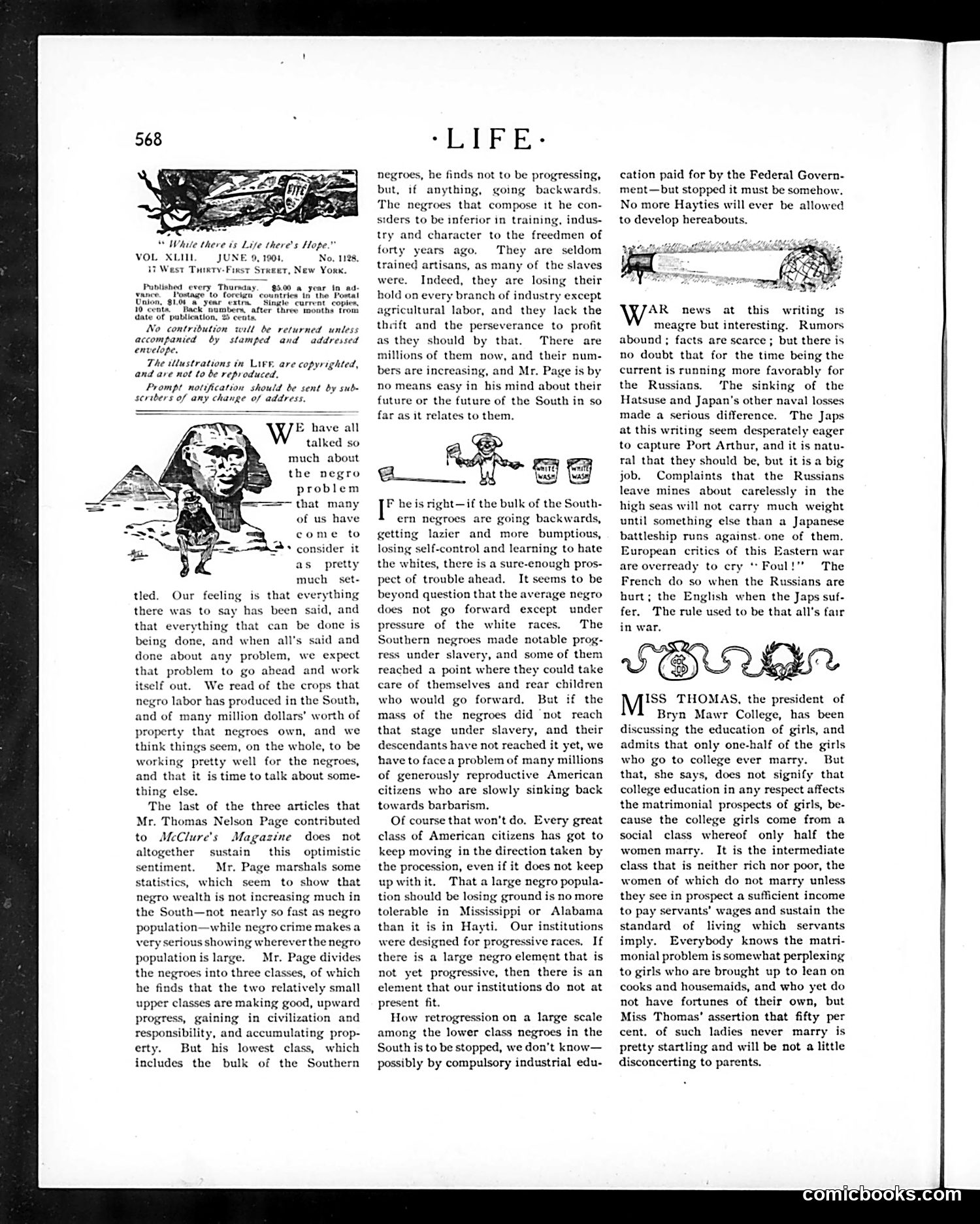
This page contains editorial commentary on racial issues in the American South, not political cartoons. The left margin features a caricatured figure—appearing to be a racist stereotype—though its specific satirical purpose is unclear from the image alone. The text discusses the "negro problem," arguing that Southern Black populations are stagnating rather than progressing. The author contends that slavery previously motivated some advancement, but freedom has allegedly produced regression. The piece advocates for "compulsory industrial education" as a solution. The right column shifts to discuss Miss Thomas and women's college education, unrelated to the racial commentary. This reflects deeply problematic early-1900s racial attitudes common in mainstream American publications of the era, presenting discriminatory views as reasoned commentary.
📄 Transcribed text from this page (OCR, searchable)
Machine-transcribed from the original scan — historical spelling and the odd misread are preserved.
“ While there is Life there's Hope.” VOL XLII. JUNE 9, 1901, No, 1128, 17 West Tounry-First Sreeer, New Yorx. Published every Thursday. $300 a year In ad. vance. Postage to forcize countries ta the Postal Salon, $1.00 & year extra. ‘Single Current. copies lo'conts. Rack numbern after three months trou date of publication, 23 cents, No contribution accompanied by envelope, The illustrations in Luv®, are copyrighted, and are not to be reproduced. Prompt notification should be sent by sub seribers of any change of address, W E have talked so much about the negro problem =— that many of us have come to it be returned unless stamped and addressed consider it as pretty much s tled. Our feeling is that everything there was to say has been said, and that everything that can be done is being done, and when all's said and done about any problem, we expect that problem to go ahead and work If out. We read of the crops that negro labor has produced in the South, and of many million dollars’ worth of property that negroes own, and we think things seem, on the whole, to be working pretty well for the negroes, and that it is time to talk about some- thing else. The last of the three articles that Mr. Thomas Nelson Page contributed to McClure’s Magazine does not altogether sustain this optimistic sentiment. Mr. Page marshals some statistics, which seem to show that negro wealth is not increasing much in the South—not nearly so fast as negro population—while negro crime makes a very serious showing wherever the negro population is large. Mr. Page divides the negroes into three classes, of which he finds that the two relatively small upper classes are making good, upward progress, gaining in civilization and responsibility, and accumulating prop- erty. But his lowest class, which includes the bulk of the Southern -LIFE:- negroes, he finds not to be progressing, but, if anything, going backwards. The negroes that compose it he con- lers to be inferior in training, indus- try and character to the freedmen of forty years ago, They are seldom trained artisans, as many of the slaves were. Indeed, they are losing their hold on every branch of industry except agricultural labor, and they lack the theift and the perseverance to profit as they should by that. There are millions of them now, and their num- bers are increasing, and Mr. Page is by no means easy in his mind about their future or the future of the South in so far as it relates to them. was F he is right—if the bulk of the South- ern negroes are going backwards, getting lazier and more bumptious losing self-control and learning to hate the whites, there is a sure-enough pros- pect of trouble ahead. It seems to be beyond question that the average negro does not go forward except under pressure of the white races. The Southern negroes made notable prog- ress under s ry, and some of them reached a point where they could take care of themselves and rear children who would go forward, But if the mass of the negroes did ‘not reach that stage under slavery, and their descendants have not reached it yet, we have to facea problem of many millions of generously reproductive American citizens who are slowly sinking back towards barbarism. Of course that won't do. Every great class of American citizens has got to keep moving in the direction taken by the procession, even if it does not keep upwithit, That a large negro popula- tion should be losing ground is no more tolerable in Mississippi or Alabama than it is in Hayti. Our institutions were designed for progressive races. If there is a large negro element that is not yet progressive, then there is an element that our institutions do not at present fit. How retrogression on a large scale among the lower class negroes in the South is to be stopped, we don’t know— possibly by compulsory industrial edu- cation paid for by the Federal Govern- ment—but stopped it must be somehow. No more Hayties will ever be allowed to develop hereabouts. Wwe news at this writing 1s meagre but interesting. Rumors abound ; facts are scarce ; but there is no doubt that for the time being the current is running more favorably for the Russians. ‘The sinking of the Hatsuse and Japan’s other naval losses made a serious difference. The Japs at this writing seem desperately eager to capture Port Arthur, and it is natu- ral that they should be, but it is a big job. Complaints that the Russians leave mines about carelessly in the high seas will not carry much weight until something else than a Japanese battleship runs against. one of them. European critics of this Eastern war are overready to cry ‘Foul!’ The French do so when the Russians are hurt; the English when the Japs suf- fer. The rule used to be that all's fair in war, ISS THOMAS, the president of Bryn Mawr College, has been discussing the education of girls, and admits that only one-half of the girls who go to college ever marry. But that, she says, does not signify that college education in any respect affects the matrimonial prospects of girls, be- cause the college girls come from a social class whereof only half the women marry. It is the intermediate class that is neither rich nor poor, the women of which do not marry unless they see in prospect a sufficient income to pay servants’ wages and sustain the standard of living which servants imply. Everybody knows the matri- monial problem is somewhat perplexing to girls who are brought up to lean on cooks and housemaids, and who yet do not have fortunes of their own, but Miss Thomas’ assertion that fifty per cent. of such ladies never marry is pretty startling and will be not a little disconcerting to parents.