
Life, 1904-06-09 · page 14 of 20
Life — June 9, 1904 — page 14: what you’re looking at
What you’re looking at
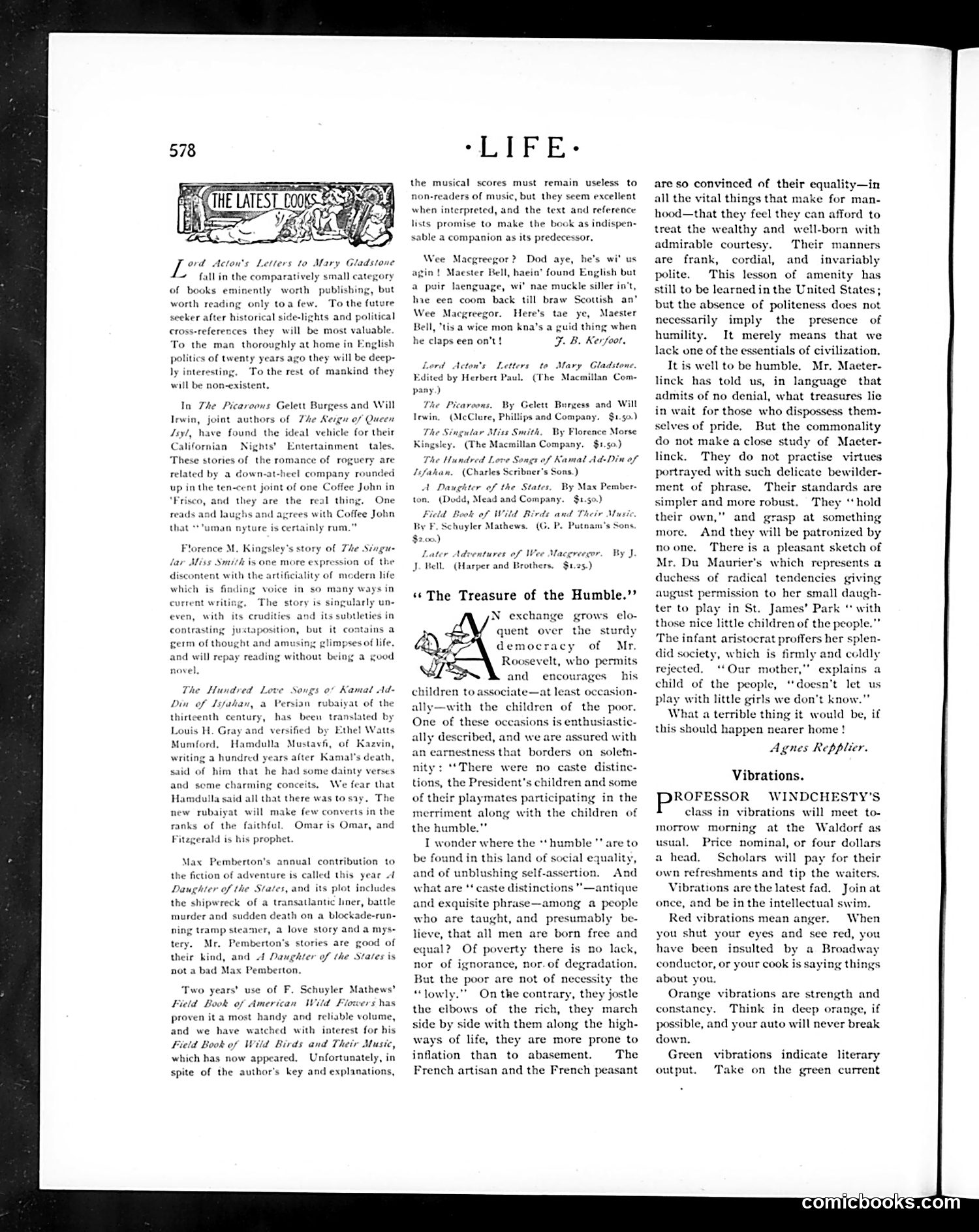
This page is primarily a **book review section** with minimal cartooning. The main satirical content appears in the opening essay titled "The Treasure of the Humble," which discusses **President Roosevelt's democratic values**. The piece praises Roosevelt for permitting his children to associate with poor children without caste distinctions, calling this "sturdy democracy." The author uses this as a springboard to argue that true humility and equality—not artificial class pretense—represent genuine American virtue. The essay celebrates Roosevelt's willingness to let his children play with "those nice little children of the people" as evidence of authentic democratic principles. The remaining content consists of **book reviews** covering Lord Acton's letters, adventure novels, Persian poetry, and a field guide to American birds. The Scottish dialect passage appears to be a humorous literary excerpt rather than political commentary. The page reflects early 1900s Progressive-era values emphasizing social equality and Roosevelt's accessible, egalitarian public image.
📄 Transcribed text from this page (OCR, searchable)
Machine-transcribed from the original scan — historical spelling and the odd misread are preserved.
Letters to Mary Gladstone fall in the comparatively small category of books eminently worth publishing, but worth reading only toa few, To the future seeker afte rical side-lights and political cross-references they will be most valuable, ‘0 the man thoroughly at home in English ord Acton's politics of twenty years ago they will be deep- the rest of mankind they will be non-existent, ly interesting. In The Picaroons Gelett Burgess and Will Irwin, joint authors of The Kergn of Queen Jsyt, have found th Nights’ These stories of the romance of ro deal vehicle for their tales. very are Californian Entertainment related by a down-at-heel company rounded up inthe t John in ‘Frisco, an One n-cent joint of one Cof they are the real thing. reads and laughs and agrees with Coffee John that *’uman nyture is certainly rum, Florence M, K of 7 ¢ Singu- lar Miss Smith is one more expression of th discontent with the artificiality of modern life which is finding voice in so many ways in current writing, The story is singularly un- even, with its crudities and its subtleties in contrasting juxtaposition, but it contains a 1m of thought and amu: and will repay reading without being a good iz glimpses of life, The Hundred Love Kamat Ad- Din of Isfahan, a Persian rubaiyat of the been translated by Louis H. Gray and versified by Ethel Watts Hamdulla Mustavfi, of Kazvin, za hundred years after Kamal's death, Songs 0 thirteenth century, has Mumford, writ im that he had some da and some charming conceits, We fear that Hamdulla said all that there was to say. The new rubaiyat make few converts in the ranks of the fa Omar is Omar, and Fitzgerald is his prophet. said of nty verses Max Pemberton’s annual contribution to the fiction of adventure is called this year Daughter of the States, and its plot includes the shipwreck of a transatlantic liner, battle murder and sudden d blockade-run- ning tramp steamer, a love story and a mys- . Mr. Pemberton’s stories are good of their kind, and A Daughter of the States is pot a bad Max Pemberton, Two years’ use of F. Schuyler Mathews’ Field Book of American Wild Flowers has proven it a most handy and reliable volume, and we have watched with interest for his Field Book of Wild Birds and Their Music, which has now appeared, Unfortunately, in spite of the author's key and explanations, “LIF E+ the musical scores must remain useless to non-readers of music, but they seem excellent when interpreted, and the text and reference lists promise to make the book as indispen- sable a companion as its predecessor, Wee Macgreegor ? agin ! Maester Bell, haein’ found English but r laenguage, wi’ nae muckle Dod aye, he’s wit us ier in't, outish an’ Maester a pi hie een coom back till braw Here's tae ye, mon kna’ id thing when J. B. Kerfoot, mis Letters Edited by Herbert Paul. pany.) to Mary Gladstone. (The Macmillan Com- ie Picaroons. By Gelett Burgess and Will Iewin, (McClure, Phillips and Company. $1.50.) The Singular Miss Smith. Kingsley. (The Macmillan Company. By Florence Morse $1.30) The Hundred Love Songs of Kamal Ad-Din of Lsfakan, (Charles Scribner's Sons.) A Daughter of the States, By Max Pember- ton, (Dodd, Mead and Company. Field Book of Witd Birds and Their Music. Ty F. Schuyler Mathews. $2.00.) $1.50) (G. P. Putnam's Sons. J. Bell tures of Wee (Harper and Brothers, Macgreecor $tzs.) By J ‘©The Treasure of the Humble.’ N exchange grows elo- quent over the sturdy democracy of Mr. Roosevelt, who permits and children to associate—at least occasion- ally—with the children of the poor. One of these occasions is enthusiastic- ally described, and we are assured with an earnestness that borders on soletn- There were no caste distin tions, the President's children and some of their playmates participating in the merriment along with the children of the humble. 1 wonder where the "humble "' are to be found in this land of social equality, and of unblushing self-assertion. And what are ** caste distinctions "—antique and exqu among a people who are taught, and presumably be- lieve, that all men are born free and equal? Of poverty there is no nor of ignorance, nor.of degradation. But the poor are not of necessity the " On the contrary, they jostle the elbows of the rich, they march side by side with them along the high- ways of life, they are more prone to inflation than to abasement. The French artisan and the French peasant encourages his ite phrase “lowly. are so convinced of their equality—in all the vital things that make for man- hood—that they feel they can afford to treat the wealthy and well-born with admirable courtesy. ‘Their manners are frank, cordial, and invariably polite. This lesson of amenity ha: still to be learned in the United States; but the absence of politeness does not necessarily imply the presence of humility. It merely means that we lack one of the essentials of civilization, Tt is well to be humble. Mr. Maeter- linck has told us, in language that admits of no denial, what treasures lie in wait for those who dispossess them- selves of pride. But the commonality do not make a close study of Macter- linck. They do not practise virtues portrayed with such delicate bewilder- ment of phrase. Their standards are simpler and more robust. They ‘hold their own,” and grasp at something more. And they will be patronized by noone. There is a pleasant sketch of Mr. Du Maurier’s which represents a duchess of radical tendencies giving august permission to her small daugh- ter to play in St. * Park “with those nice little children of the people.” ‘The infant aristocrat proffers her splen- did society, which is firmly and coldly rejected. “Our mother,” explains child of the people, “doesn’t let us play with little girls we don’t know.” What a terrible thing it would be, if this should happen nearer home ! Agnes Repplier. Vibrations. ROFESSOR WINDCHESTY’S class in vibrations will meet to- morrow morning at the Waldorf as usual. Price nominal, or four dollars a head, Scholars will pay for their own refreshments and tip the waiters. Vibrations are the latest fad. Join at once, and be in the intellectual swim. Red vibrations mean anger. When you shut your eyes and see red, you have been insulted by conductor, or your cook is about you. Orange vibrations are strength and constancy. Think in deep orange, if possible, and your auto will never break down. Green vibrations indicate literary output. Take on the green current a Broadway ying things