
A complete issue · 20 pages · 1904
Life — May 12, 1904
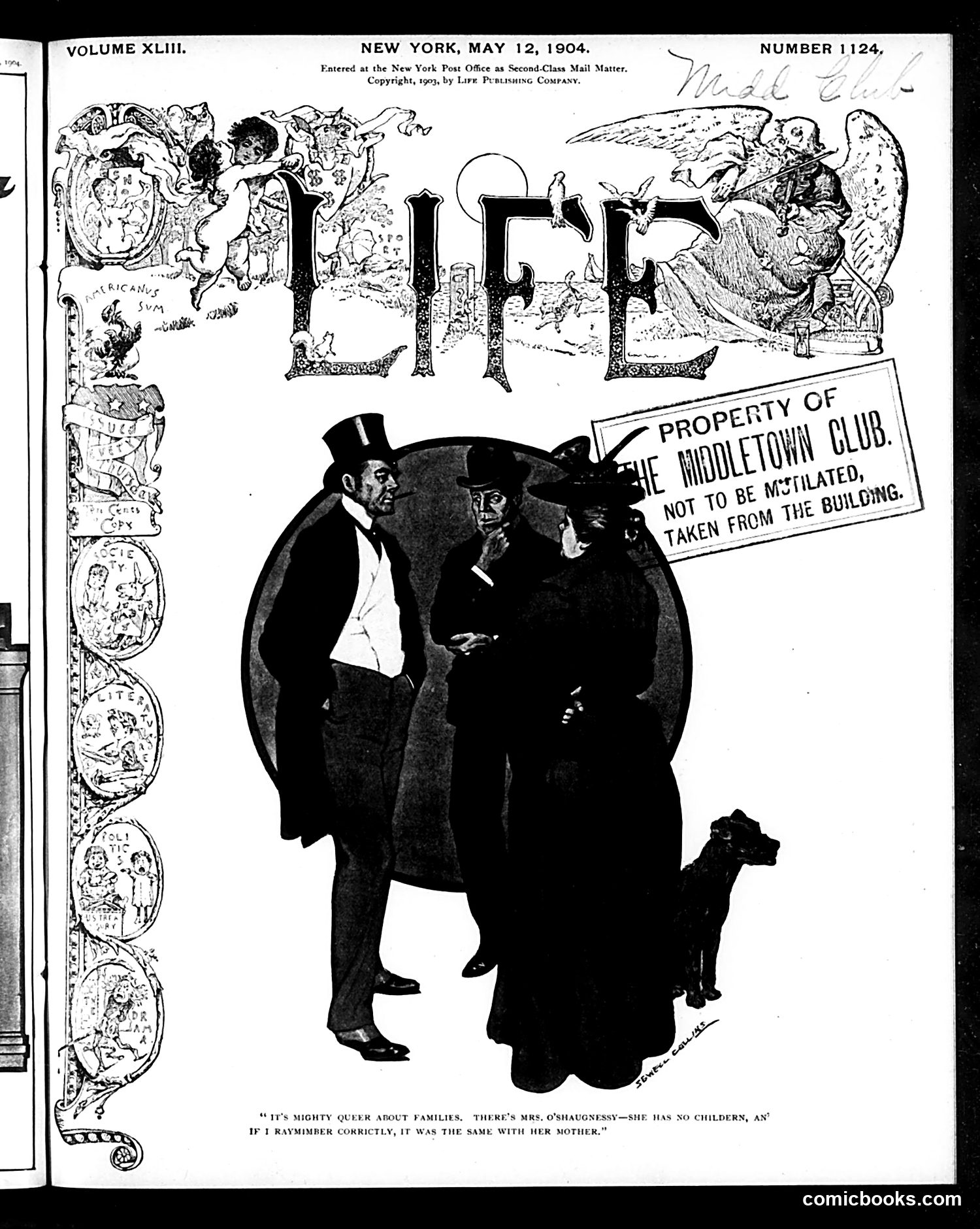
This page features a satirical cartoon about social gossip and family matters. The caption reads: "It's mighty queer about families. There's Mrs. O'Shaughnessy—she has no children, an' if I raymimber correctly, it was the same with her mother." The cartoon depicts three well-dressed figures (a man in top hat and two women) engaged in conversation, with a dog present. The joke appears to mock Victorian-era gossiping about unmarried or childless women, suggesting a family pattern of infertility or spinsterhood. The humor relies on contemporary class and gender stereotypes—mocking working-class Irish surnames ("O'Shaughnessy") while satirizing the small-minded nature of neighborhood gossip about women's reproductive status and marital circumstances.
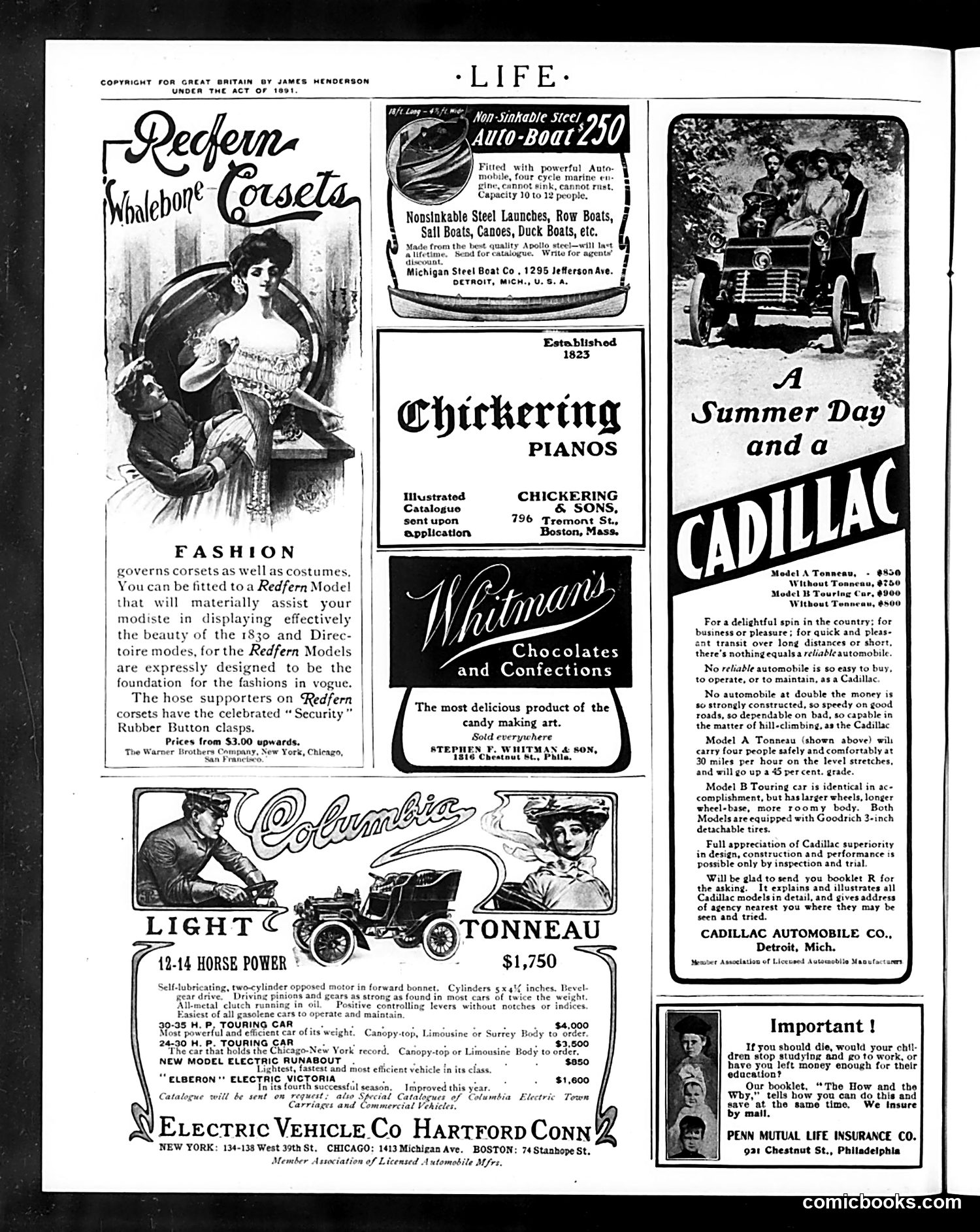
This page is primarily **advertising rather than political satire**. It contains five commercial advertisements from the early 1900s: 1. **Redfern Whalebone Corsets** - promotes fashionable women's corsetry 2. **Auto-Boat 250** - a multipurpose vehicle that functions as both automobile and boat 3. **Chickering Pianos** - established 1823, musical instruments 4. **Whitman's Chocolates** - candy products 5. **Cadillac automobiles** and **Columbia Light Tonneau** - vehicles with detailed specifications and pricing 6. **Penn Mutual Life Insurance** - insurance services The page reflects early 20th-century consumer culture, showcasing luxury goods for wealthy Americans: automobiles (then novel), fine pianos, premium chocolates, and fashionable women's wear. There is no political cartoon or satirical content visible—this is a straightforward commercial advertisement section typical of *Life* magazine's revenue model.
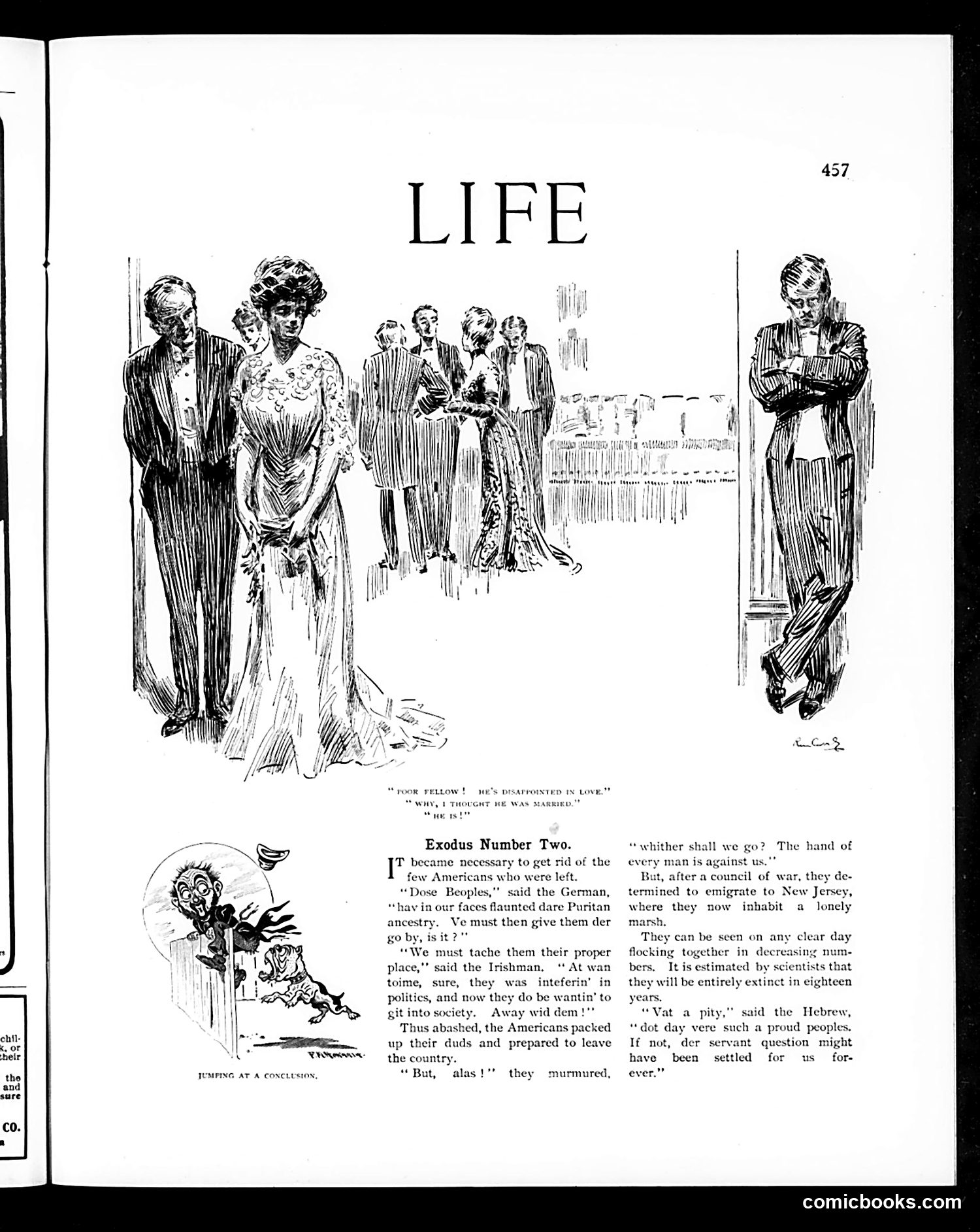
This page satirizes American xenophobia following World War I. The headline "Exodus Number Two" references Biblical expulsion, comparing forced deportation of immigrants to the Exodus narrative. The dialogue mocks anti-immigrant sentiment: German and Irish characters speak broken English while discussing how to "get rid of" remaining Americans, suggesting they're "interferin' in politics." The bitter irony—foreigners planning to expel native Americans—inverts nativist fears about immigrant takeover. The small cartoon "Jumping at a Conclusion" reinforces the theme through caricature and physical comedy. The satirical point: American nativists' deportation schemes are absurd and morally equivalent to authoritarian expulsion. The piece criticizes post-WWI anti-immigrant hysteria by exposing its logical contradictions and cruelty.
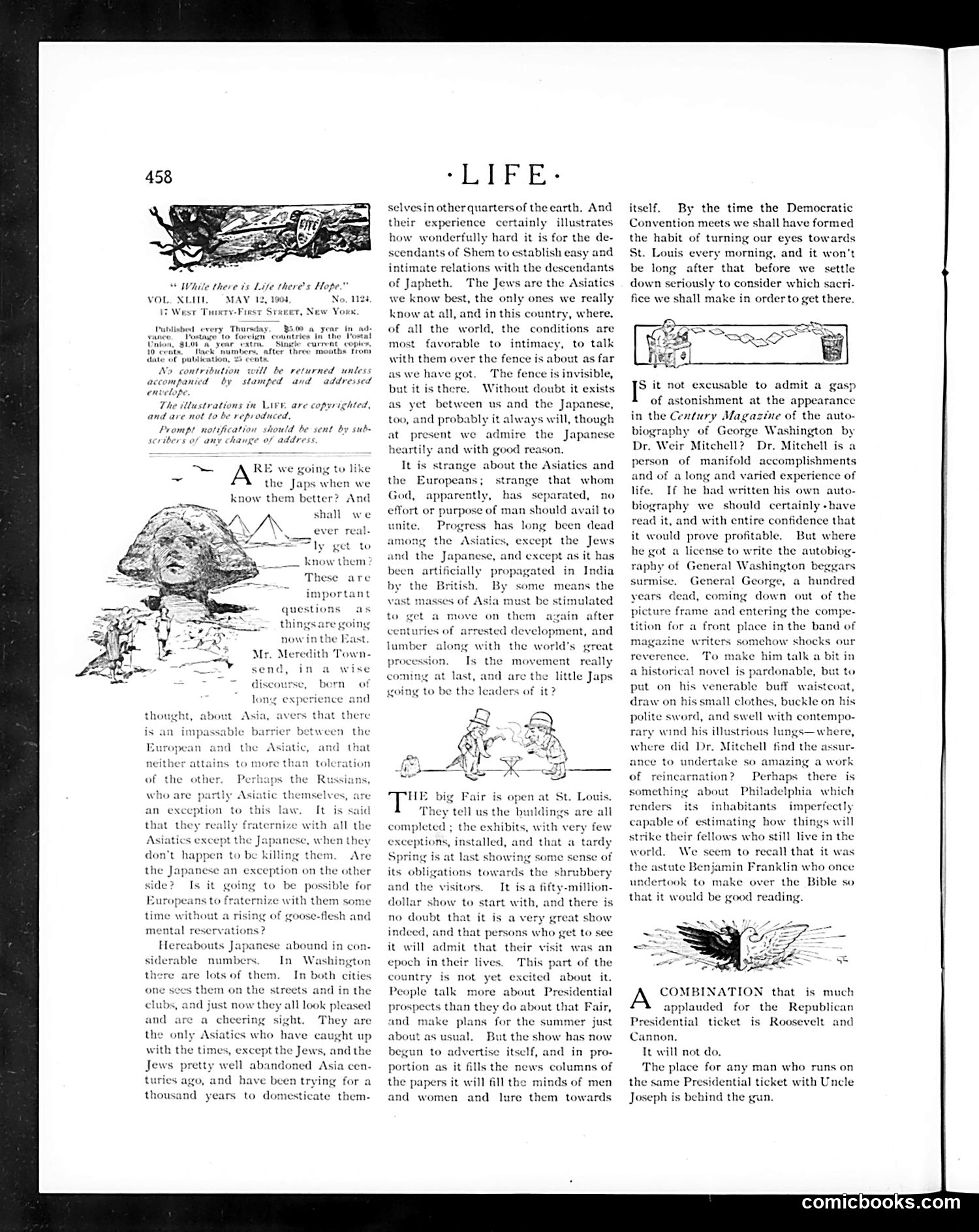
This page contains two satirical cartoons and accompanying text about Asian immigration and American politics circa 1904. The **first cartoon** depicts a figure (appearing to be an Asian person) being kept behind an "invisible fence" - satirizing the barrier between Europeans and Asians in America, with text discussing Japanese-American relations and whether progress toward equality is possible. The **second cartoon** shows small figures (likely representing Japanese people) in a diminished scale, accompanying discussion of Japanese presence in American cities and their social integration. The text references the **St. Louis World's Fair** and discusses whether Japanese people can truly assimilate into American society, touching on xenophobic concerns of the era. The final section mentions the **1904 Presidential election**, with Roosevelt and Cannon as Republican candidates. The satire targets both American prejudice against Asians and contemporary political anxieties.
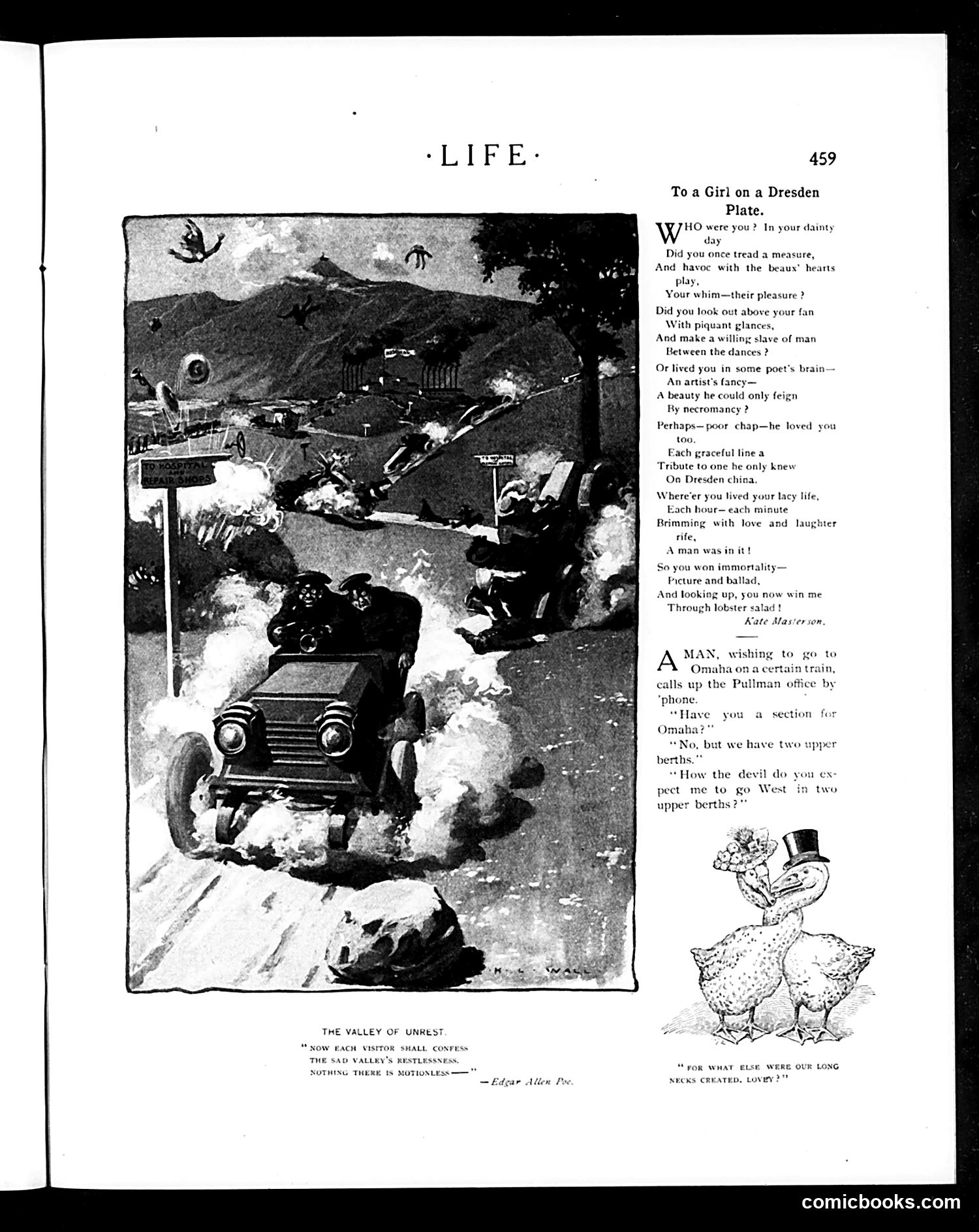
The page contains two distinct pieces: **"To a Girl on a Dresden Plate"** (poem by Kate Masterson): A romantic poem addressing a woman depicted on fine china, playing with the conceit that she's a painted figure on porcelain. It's sentimental Victorian verse mocking idealized feminine beauty in decorative art. **"The Valley of Unrest"** (main illustration): A chaotic scene showing an automobile navigating treacherous terrain—appears to be satirizing early automobile travel's dangers and unpredictability. The vehicle struggles through rocky, dramatic landscape, likely commenting on the nascent automotive age's hazards. **The anecdote** about train berths is a brief comedic exchange about travel accommodations, unrelated to the cartoons. The small illustration of anthropomorphic birds appears to be a separate decorative comic element about long necks.
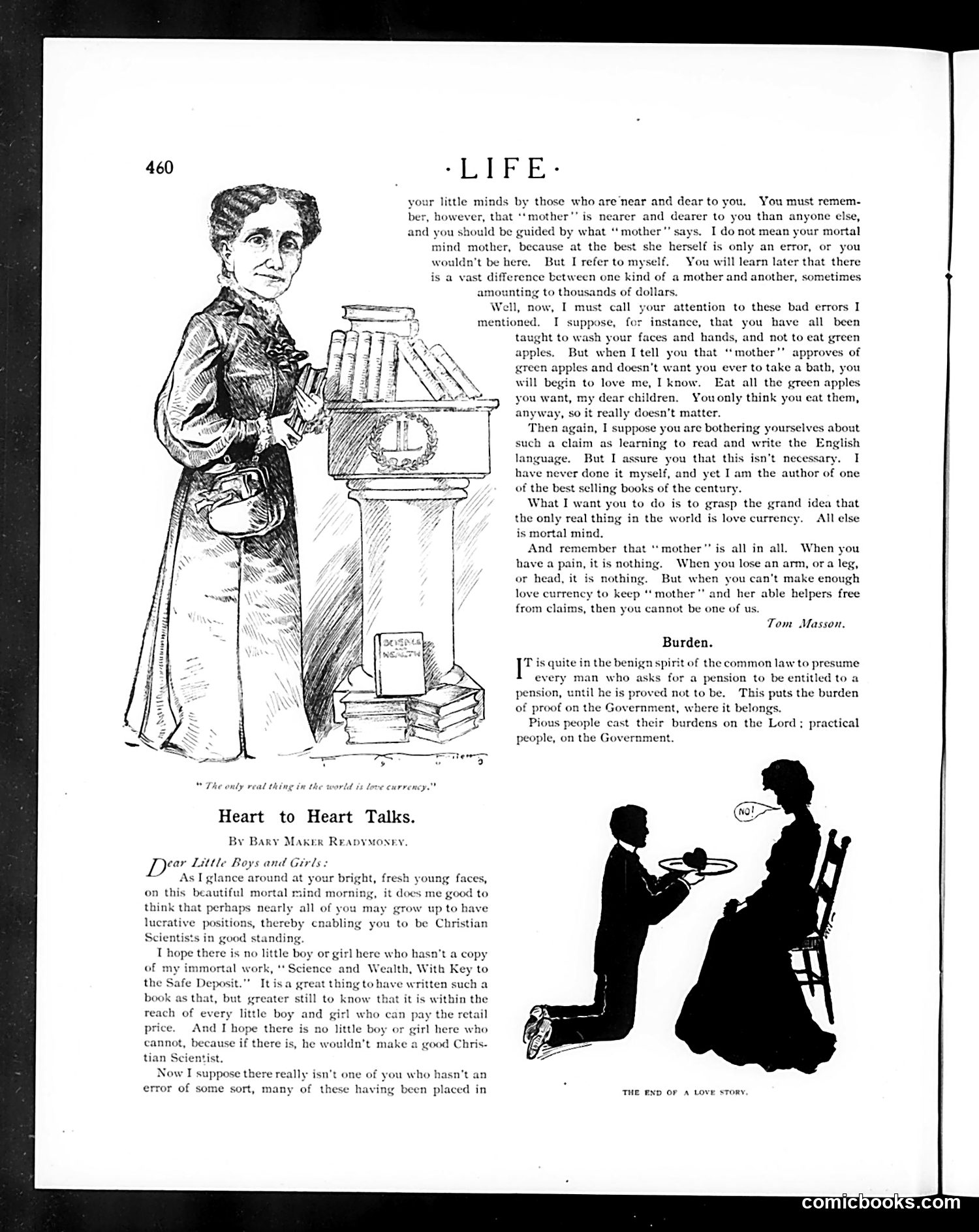
This page contains two distinct pieces: **"Heart to Heart Talks"** — A column by "Baby Maker Readymoney" addressing young readers about Christian morality and self-improvement. The accompanying illustration shows a woman (likely representing an authority figure or teacher) with books, emphasizing education and proper values. **Lower section** — A silhouette cartoon titled "The End of a Love Story" depicting a romantic scene between a young couple, with one figure offering what appears to be food or an object to the other. The page also includes a brief section on "Burden" regarding pensions and government proof requirements. The overall tone reflects turn-of-the-century American values emphasizing morality, education, and proper social conduct. The satire appears gentle rather than sharp, typical of Life's editorial approach to social improvement during this era.
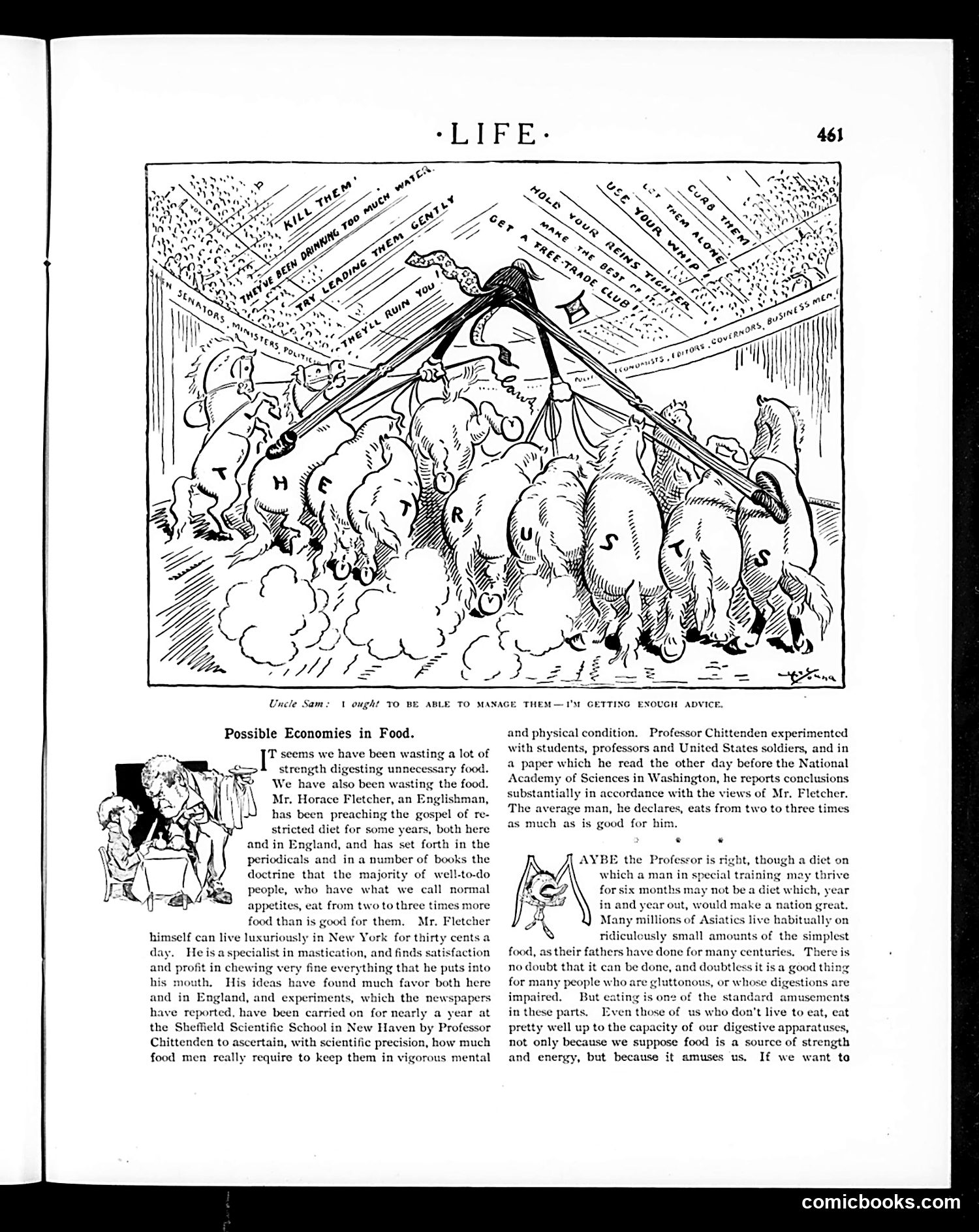
The top cartoon depicts Uncle Sam struggling to manage a herd of pigs labeled with letters spelling "HURTS"—likely representing various government agencies or spending categories. Uncle Sam says he "ought to be able to manage them—I'm getting enough advice," satirizing the proliferation of unsolicited suggestions about federal budgeting and food policy. The accompanying article discusses food waste and nutritional science, referencing Mr. Fletcher (likely Horace Fletcher, a real nutrition advocate) who promoted eating less food more thoroughly. Professor Chittenden's experiments on minimal caloric requirements are cited as evidence. The satire mocks competing advice about government efficiency and food consumption during an era of progressive-era reform and growing scientific interest in nutrition.
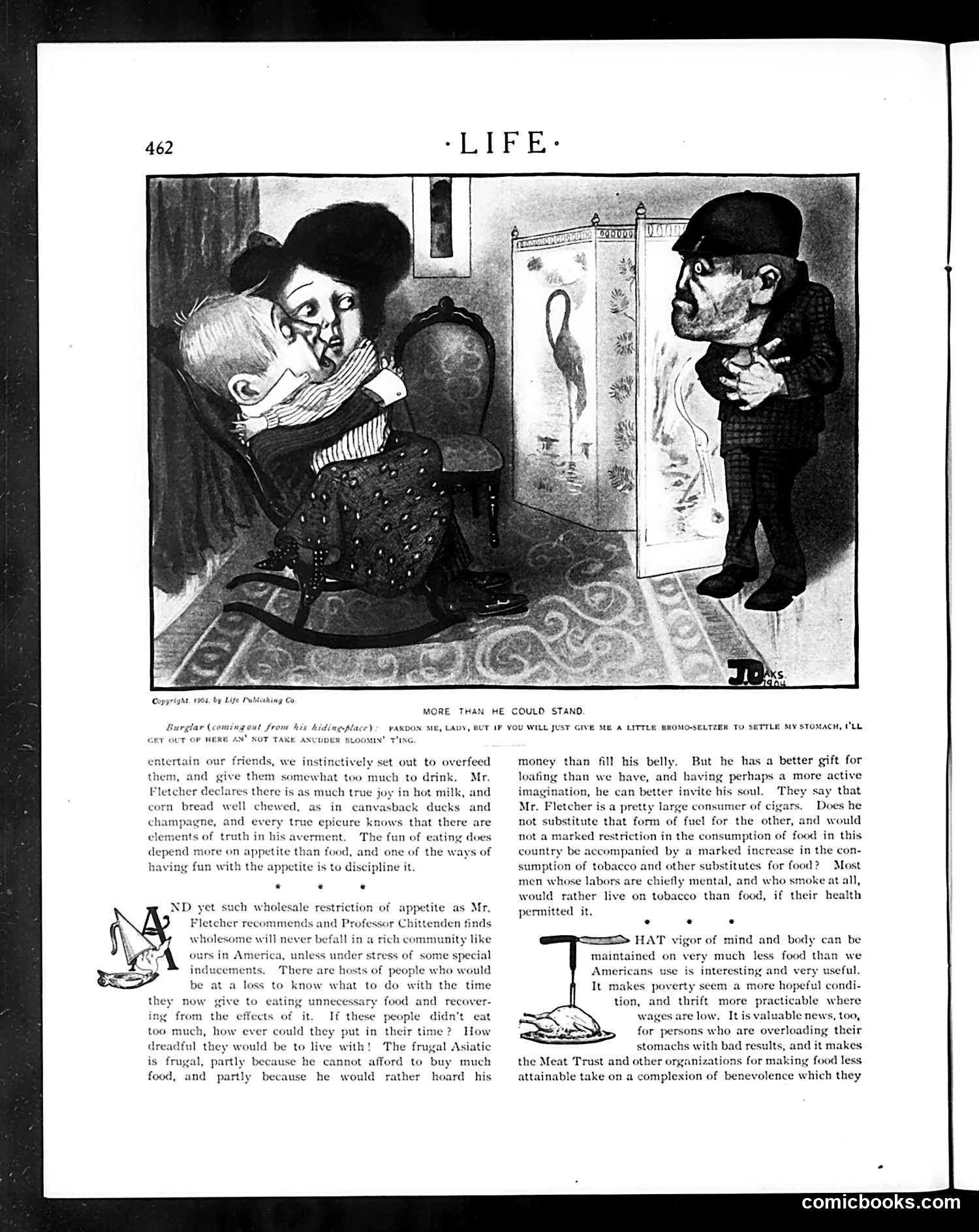
This satirical cartoon titled "MORE THAN HE COULD STAND" depicts a man (identified as "Burglar" in the caption) arriving at a home where a woman holds a baby. The burglar appears distressed, asking the lady to give him "a little bromo-seltzer to settle my stomach" before he can proceed with his theft. The satire mocks excessive food consumption and digestive discomfort. The accompanying article discusses Mr. Fletcher's recommendation to restrict appetites and food intake. The joke suggests that even a criminal cannot stomach—literally—the overeating habits of the household, making digestive distress so universal that it affects everyone, regardless of social station or intent. The cartoon ridicules both overconsumption and the era's popular digestive remedies like Bromo-Seltzer.
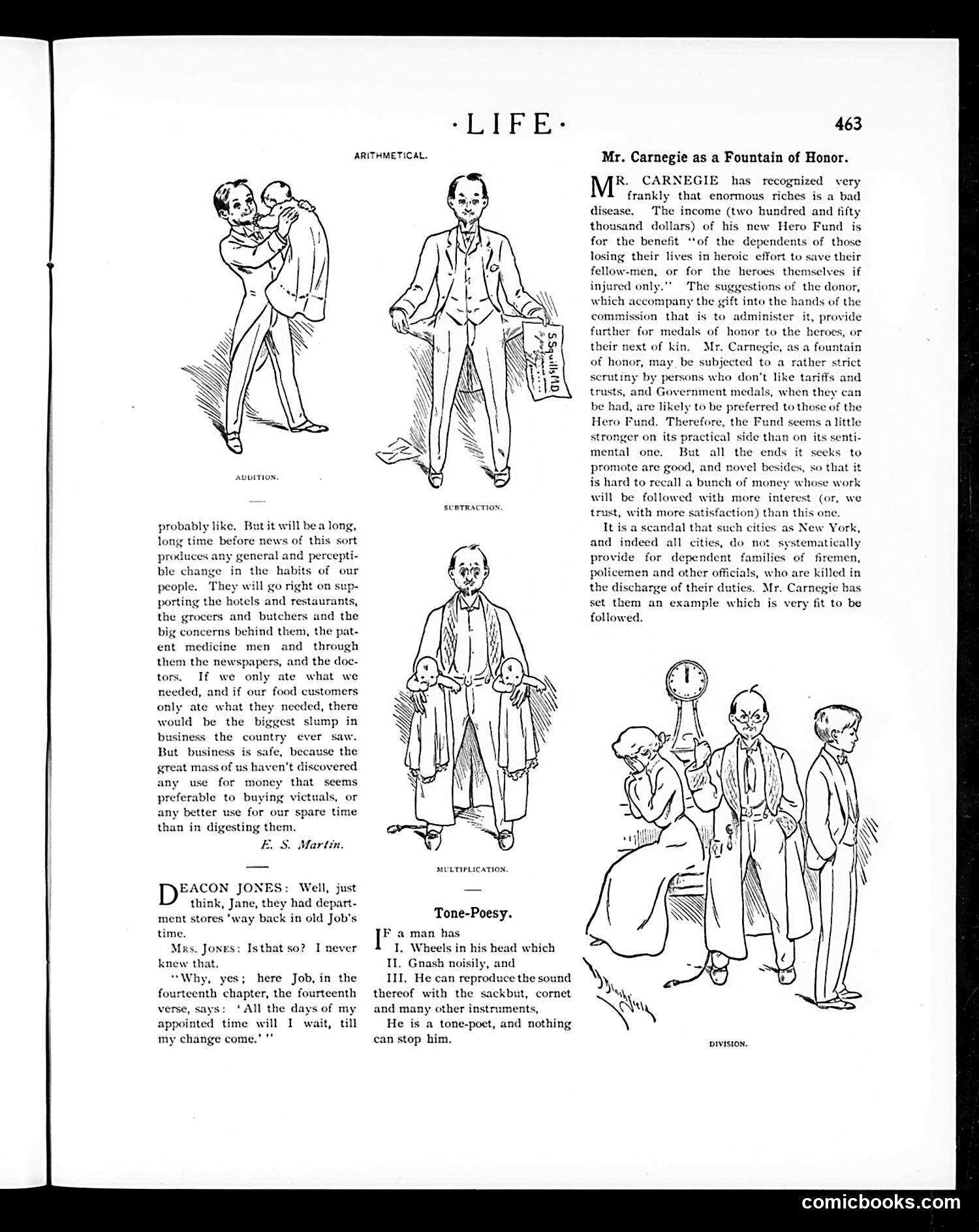
This page satirizes wealthy industrialist **Andrew Carnegie** and his charitable giving. The right-hand article "Mr. Carnegie as a Fountain of Honor" discusses his new "Hero Fund"—established to support families of firefighters, police, and rescue workers killed in service. The satire's point: Carnegie's enormous wealth ($200,000 gift) is simultaneously praised as noble *and* criticized as inadequate—mere "spare time" spending for the ultra-rich. The author notes it's scandalous that cities don't systematically support dependent families of public servants, making Carnegie's charity necessary only because of systemic failure. The left side contains unrelated humor pieces: mathematical jokes about "Addition" and "Subtraction," and a dialogue between Deacon Jones and Mrs. Jones about department store jobs—typical period humor.
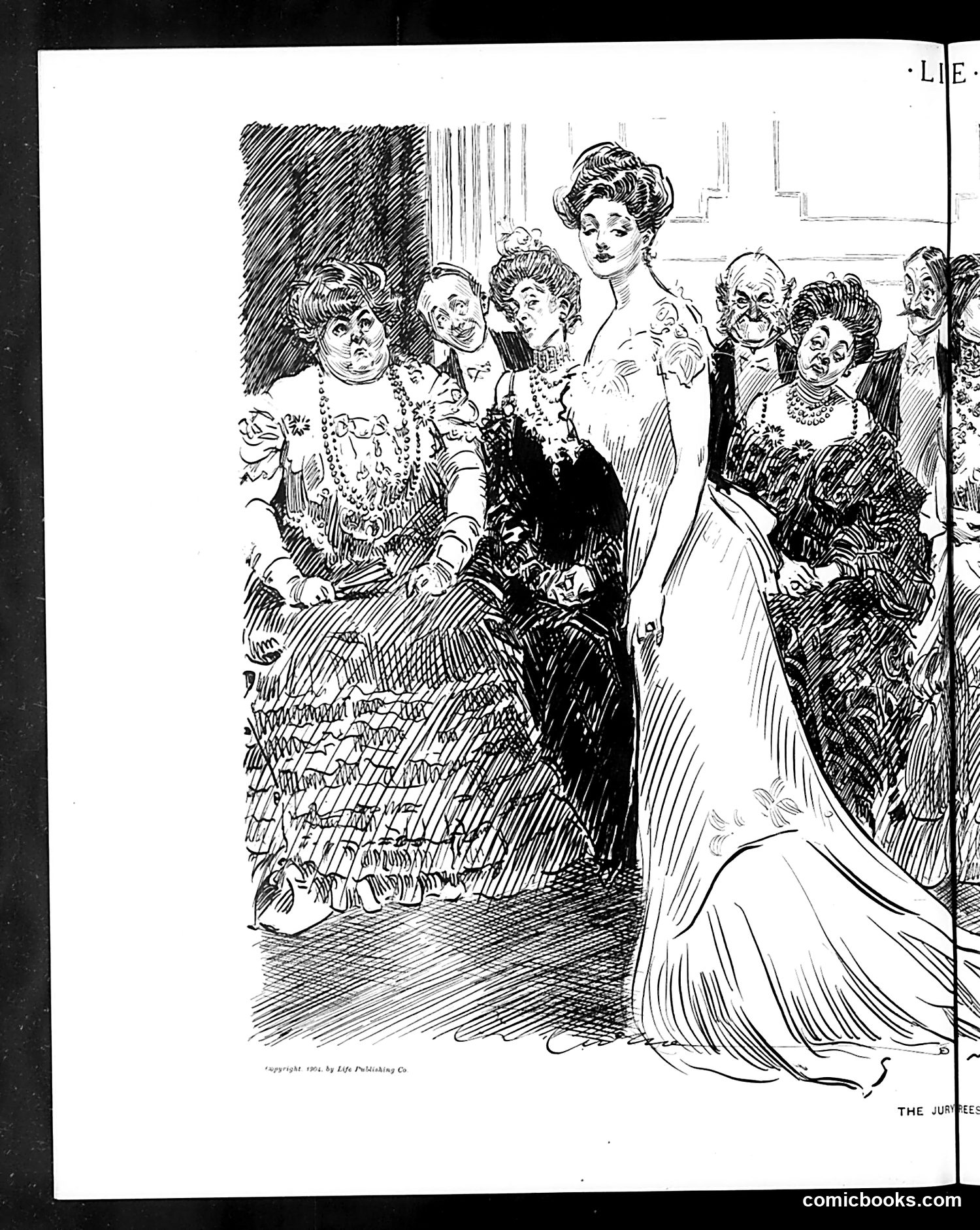
This cartoon satirizes wealthy socialites or high-society women serving as jurors. The image shows an elegant woman in an elaborate white gown kneeling before a group of formally-dressed jurors (mostly women in ornate clothing with jewels and feathers), suggesting she's either a defendant or petitioner before them. The satire likely mocks the notion of fashionable society women taking on serious judicial duties. The exaggerated clothing, jewelry, and theatrical poses suggest these jurors are more concerned with appearance and social status than justice. The title "The Juryees" appears to pun on "jurors," implying these women are performing jurydom rather than executing it seriously—a commentary on whether such women could be trusted with real legal responsibility, a contemporary concern regarding women's expanding civic participation.
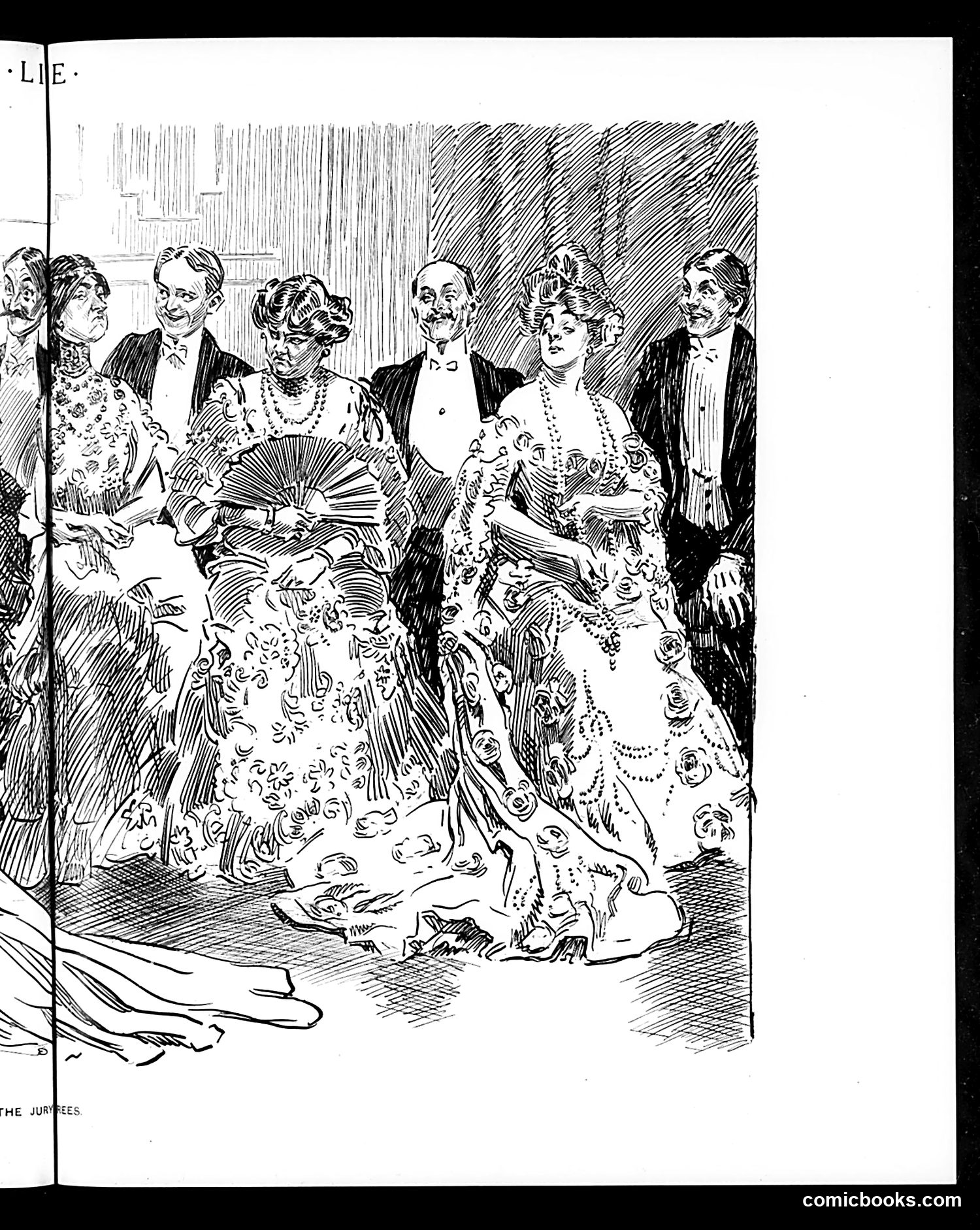
This satirical illustration depicts wealthy, elaborately dressed society figures in formal evening wear at what appears to be a social gathering. The caption "THE JURY FEES" suggests social commentary on jury duty compensation. The satire likely critiques how wealthy elites viewed jury service: the ornate clothing, jewelry, and refined setting suggest these are society people for whom jury duty would be a mere social inconvenience rather than a serious civic responsibility. The joke appears to be that such wealthy individuals would serve on juries primarily for the modest fees involved, treating the obligation as a fashionable social event rather than an important legal duty. The detailed caricatures and elaborate dress emphasize the frivolousness Life's editors associated with this attitude toward civic participation.
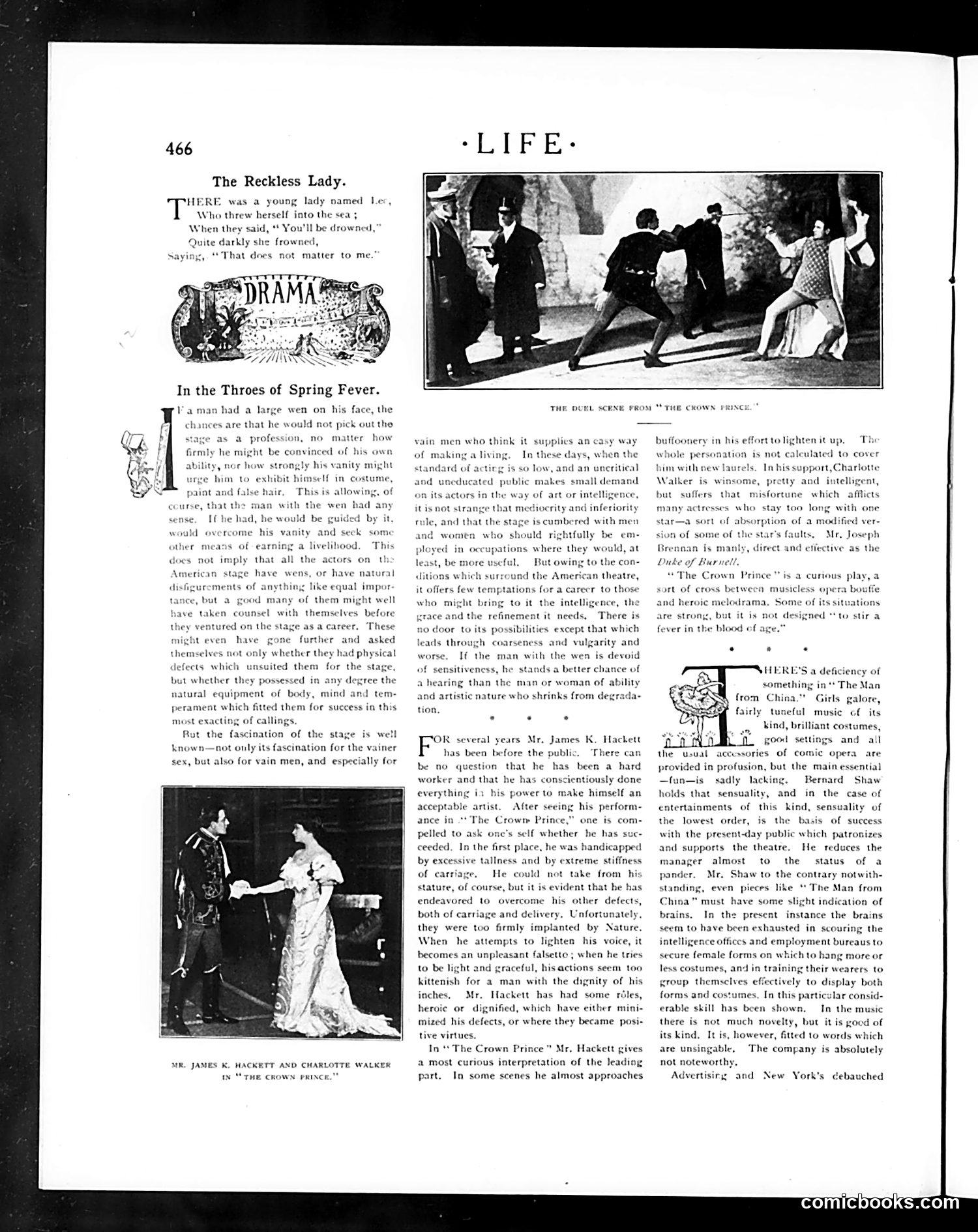
This page contains theatrical criticism and reviews of contemporary stage productions, not political cartoons. The main content discusses dramatic performances, particularly focusing on "The Crown Prince" starring actor James K. Hackett and Charlotte Walker (shown in the photograph). The text critiques American theater standards of the era, lamenting that mediocrity and inferior talent dominate the stage. It discusses how actors with physical defects or limited natural ability have pursued stage careers despite lacking proper training or refinement. The accompanying photographs show scenes from theatrical productions. This appears to be entertainment criticism rather than satire—evaluating the quality and merit of professional actors and stage performances of the period.
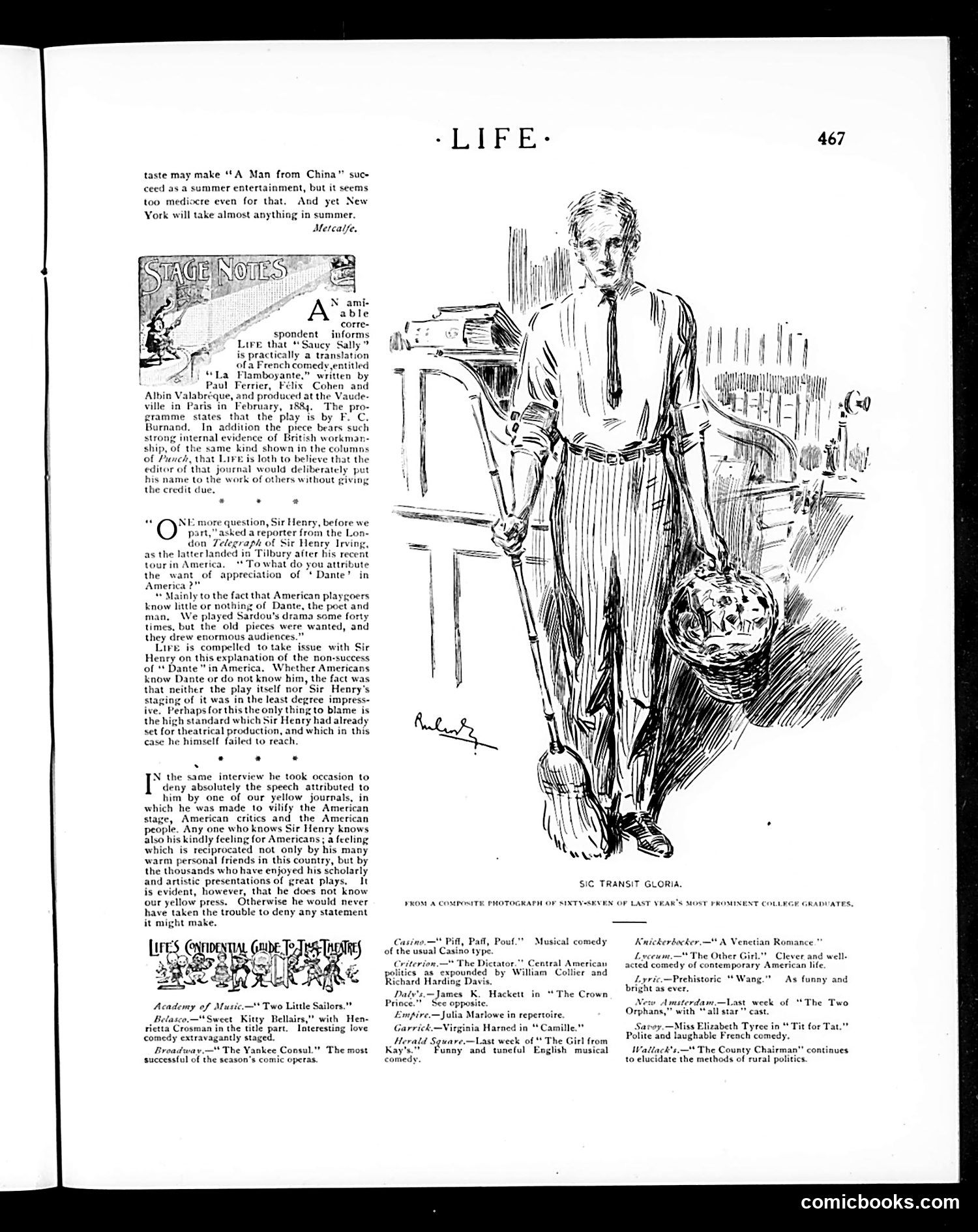
This page primarily contains **theater reviews** and gossip. The main illustration, captioned "Sic Transit Gloria" (Latin: "thus passes away glory"), shows a young man in office attire at a desk—a composite photograph of "sixty-seven of last year's most prominent college graduates." The satire is straightforward: these celebrated college stars of the previous year have already faded into obscurity, now working as ordinary office clerks. Their former prominence and promise have evaporated into mundane adult life. The page also includes critical commentary on Sir Henry Irving's recent American tour and theatrical productions. Life challenges Irving's claim that Americans lack appreciation for Dante, arguing instead that his staging simply failed to impress—a pointed critique that even great artists sometimes miss their mark. The remaining content lists current Broadway productions and theater reviews.
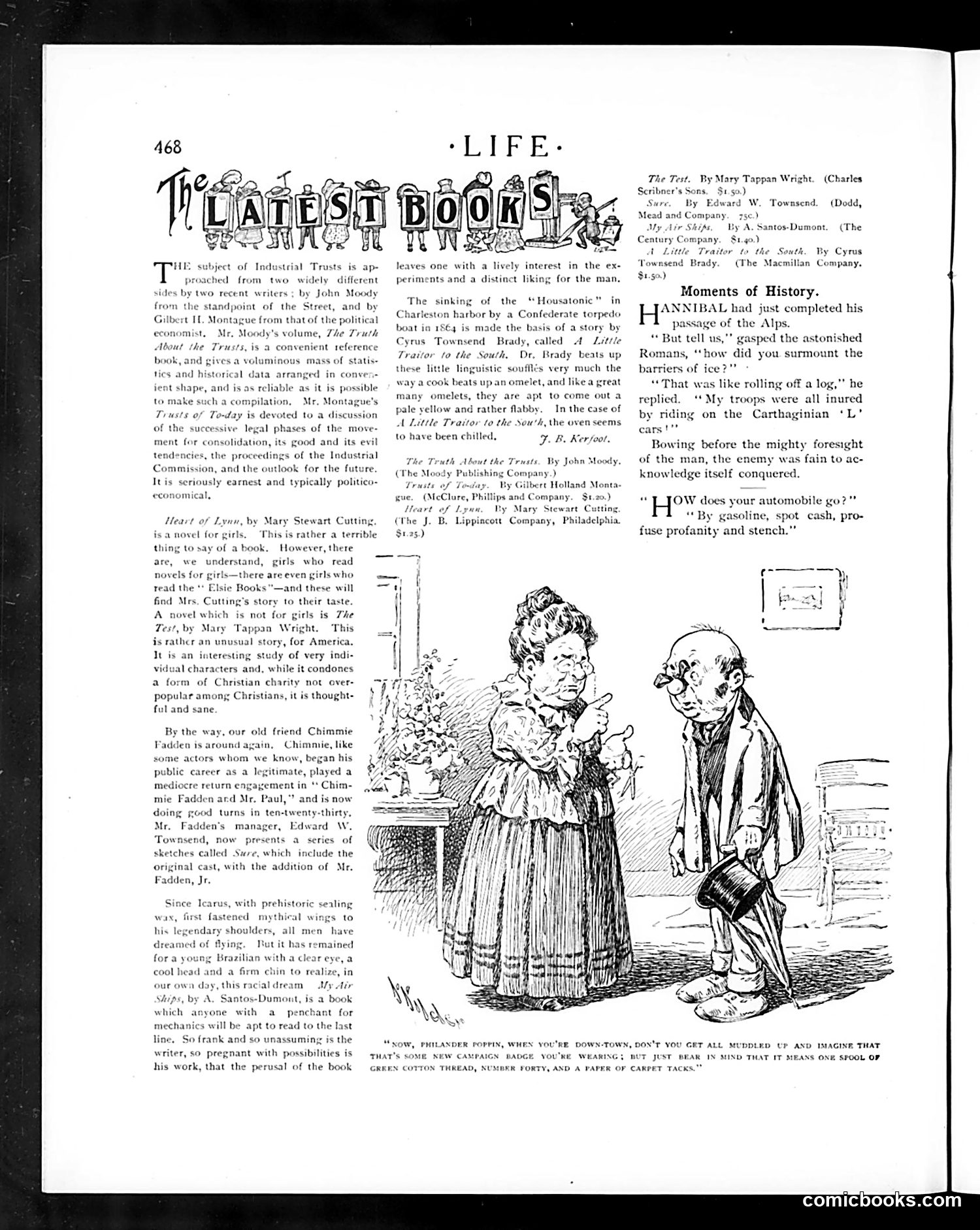
This page reviews several contemporary books on industrial trusts and fiction, but the notable satirical content appears in the small cartoon at bottom right titled "Moments of History." The cartoon presents two historical anecdotes as parallel jokes. The first depicts Hannibal explaining his Alps crossing to Romans—a setup for the punchline that his success came simply from rolling logs downhill, treating an epic military feat as trivial. The second anecdote shifts to modern times, asking how an automobile operates. The response—"gasoline, spot cash, profuse profanity and stench"—satirizes contemporary automobiles as unreliable, expensive contraptions requiring cursing and producing pollution. The joke's point: comparing ancient military engineering prowess unfavorably to modern automobile technology, which despite pretensions to progress, remains temperamental and unpleasant. This reflects early 1900s skepticism toward nascent motorcar technology—viewed as problematic novelties rather than genuine advances over established transportation methods.
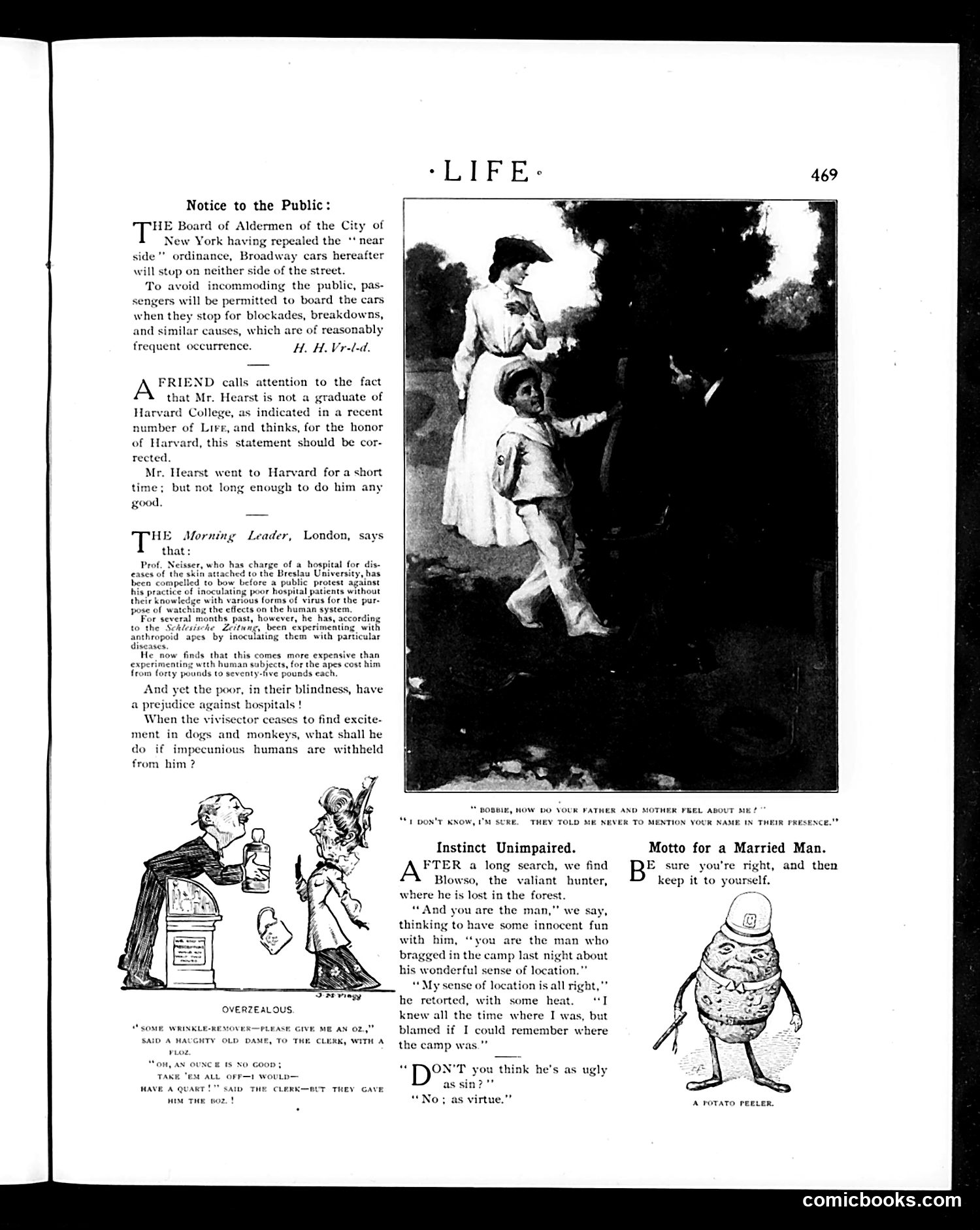
This page contains several satirical items typical of Life's editorial humor: **Top cartoon**: Mocks New York City's absurd street-car ordinance repealing rules about where Broadway cars must stop, now allowing them to board passengers anywhere—even during blockades and breakdowns. The satire highlights bureaucratic incompetence. **Hearst correction**: A brief jab at newspaper magnate William Randolph Hearst, clarifying he didn't graduate from Harvard (attended briefly). The cutting final line—"not long enough to do him any good"—is personal mockery of Hearst's intellect or character. **Medical ethics piece**: Reports on Professor Neisser's controversial human experimentation on poor hospital patients without consent, noting he's switched to testing on apes (expensive at 40-75 pounds each). The satire criticizes both unethical medical practice and society's indifference to exploiting the poor. **Humorous anecdotes**: Include a lost hunter claiming superior navigation skills while admitting he can't locate camp, and jokes about wrinkle-removers and potato peelers—light domestic humor. The page reflects turn-of-century concerns: municipal corruption, sensationalist press, medical ethics violations, and marital comedy.
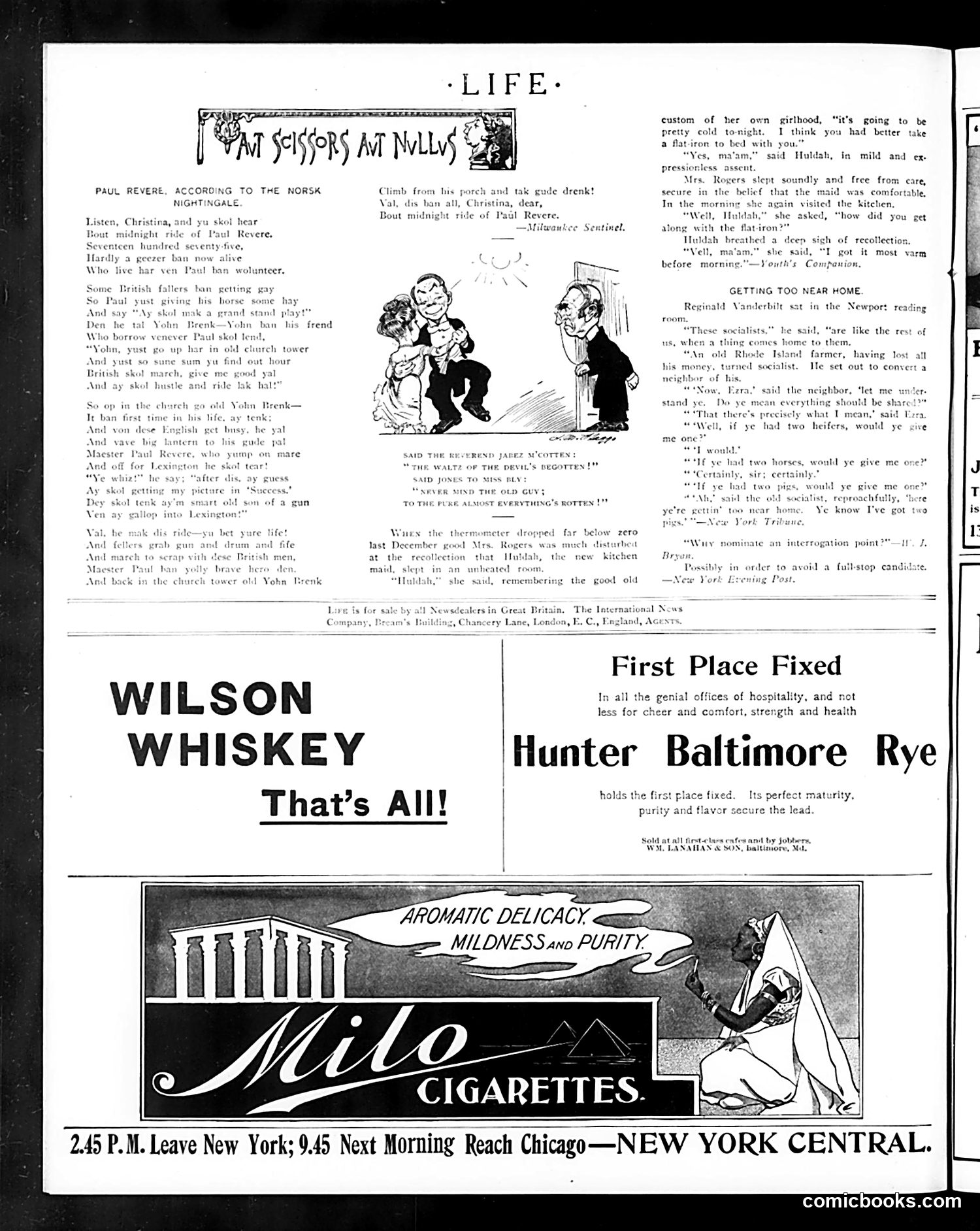
This page contains **primarily advertisements** rather than political cartoons. The main content includes: 1. **"Paul Revere According to the Norse Nightingale"** — a humorous poem with illustrated vignettes mocking working-class or immigrant dialect humor, common in early 20th-century American comedy. The cartoon shows characters in exaggerated poses reflecting the poem's jokes about pronunciation and cultural differences. 2. **"Getting Too Near Home"** — a short story snippet about class conflict: a wealthy Newport resident (Reginald Vanderbilt—a real wealthy family name) attempts to "convert" a socialist Rhode Island farmer to capitalist views. The satire mocks both the farmer's socialist rhetoric and the wealthy man's condescension. The page is otherwise dominated by **period advertisements** for Wilson Whiskey, Hunter Baltimore Rye whiskey, Milo Cigarettes, and New York Central Railroad service, reflecting Life's commercial revenue model. The satire targets **class divisions and immigrant humor** typical of the era.
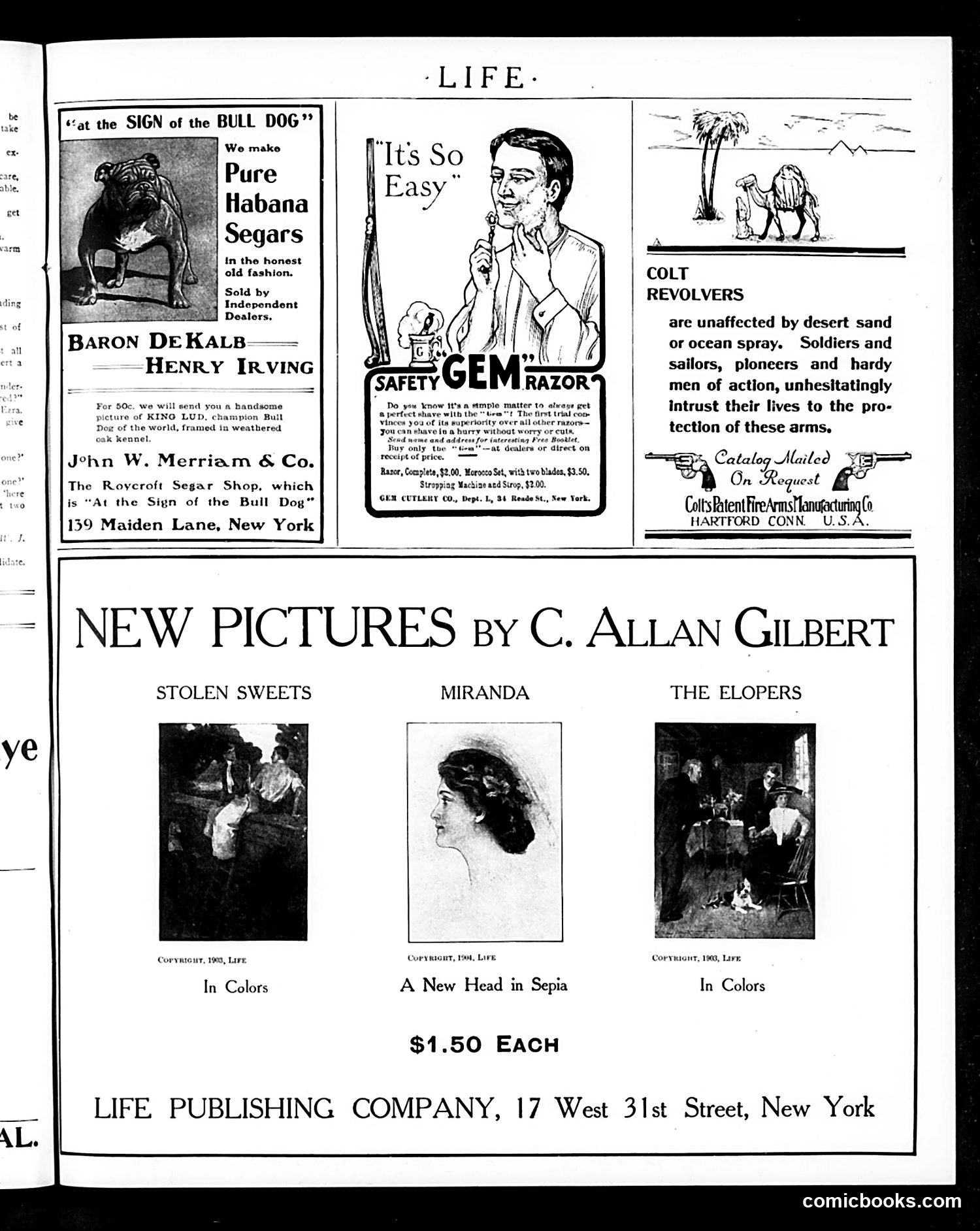
This is primarily an **advertising page** from an early 1900s issue of Life magazine, with minimal satirical content. The ads include: - **Baron DeKalb Henry Irving cigars** ("Pure Habana Segars") sold at the Roycroft Segar Shop in New York - **Safety Gem Razor** advertisement featuring a man shaving, emphasizing ease of use - **Colt Revolvers** ad appealing to soldiers, sailors, and "pioneers"—positioning firearms as trustworthy tools for "men of action" The lower section advertises **three pictures by artist C. Allan Gilbert** available from Life Publishing Company for $1.50 each: "Stolen Sweets" (in color), "Miranda" (sepia portrait), and "The Elopers" (in color). These appear to be romantic or narrative scenes popular as home art prints of that era. No specific political satire is evident; this is standard commercial content typical of Life's revenue model—mixing advertising with editorial matter.
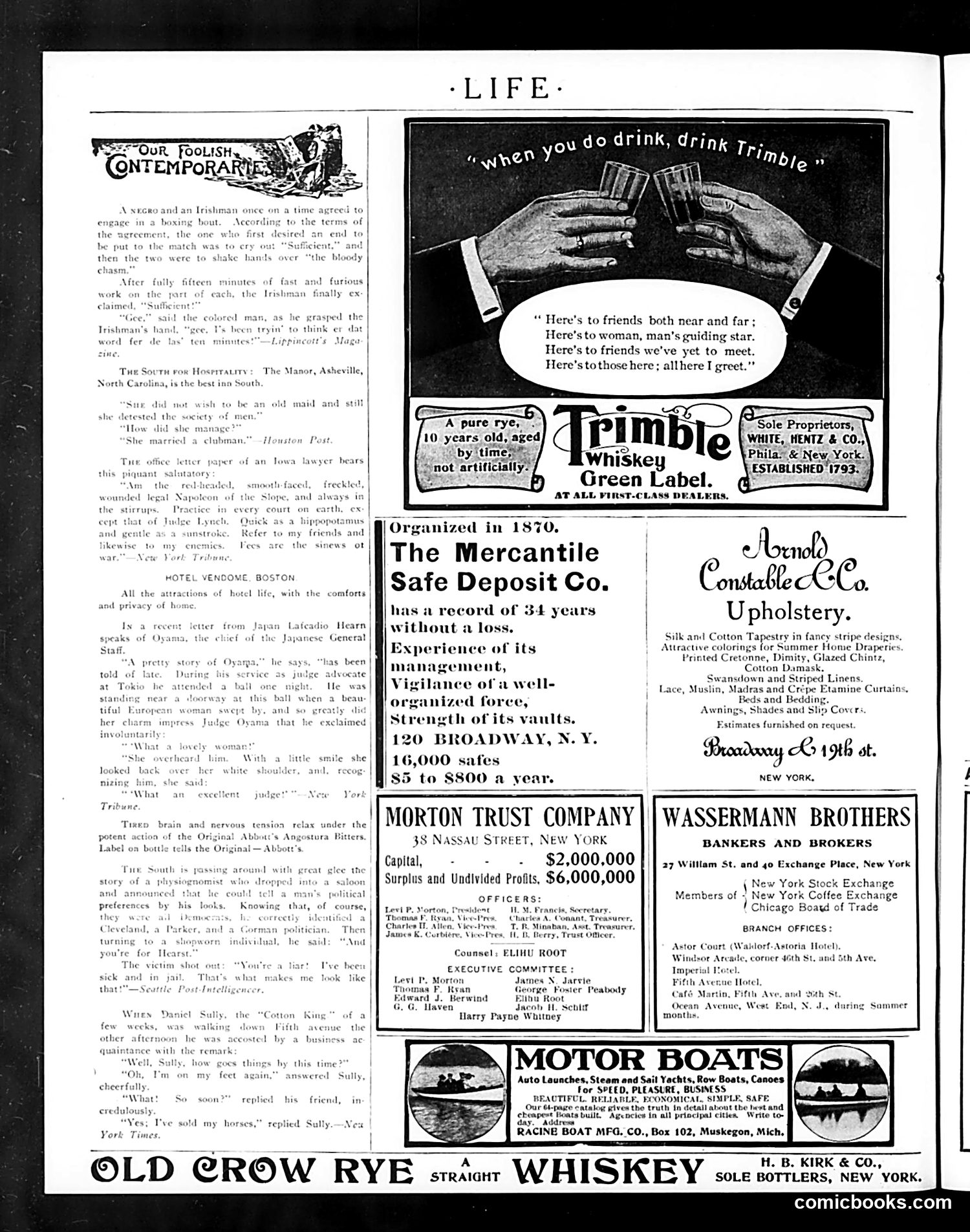
This page is primarily **advertising**, not political satire. The main content features commercial advertisements for financial institutions, household goods, and consumer products typical of early 1900s America. The notable image is a **Trimble Whiskey advertisement** showing two hands toasting with a sentimental drinking toast ("Here's to friends both near and far..."). This represents typical period advertising that used emotional appeals rather than hard-sell tactics. The text snippets labeled "Our Foolish Contemporaries" appear to be **humorous anecdotes** about everyday social situations—an Irishman and a colored man settling a dispute, a Southern hotel keeper's malapropism, a Japanese judge's cultural misunderstanding—representing the magazine's satirical approach to regional and ethnic humor common to that era. The **lower advertisements** promote financial services (Morton Trust Company, Wassermann Brothers banking) and consumer goods (upholstery, motor boats, whiskey), reflecting the magazine's target audience of middle and upper-class readers. No specific political figures or events are referenced on this visible page.
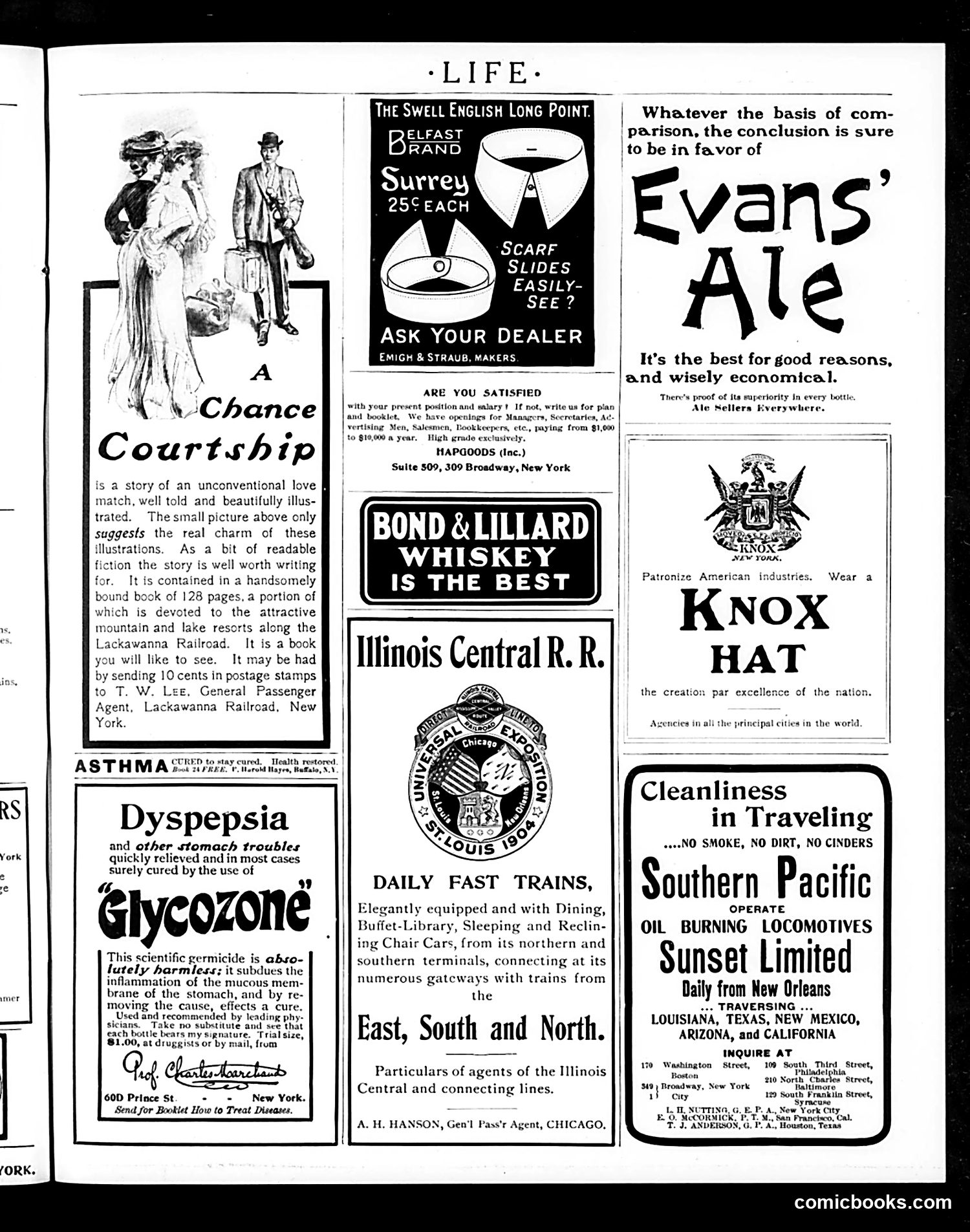
This page is primarily **advertising**, not satire or editorial content. It features period advertisements (likely early 1900s based on style) promoting various products and services: **Notable ads include:** - **"A Chance Courtship"** — a book promotion for the Lackawanna Railroad, using romantic illustration to advertise railroad resorts - **Glycozone** — a patent medicine claiming to cure dyspepsia and stomach troubles - **Evans' Ale** — beverage advertisement - **Knox Hat** — men's fashion, emphasizing American manufacturing - **Illinois Central Railroad** and **Southern Pacific's Sunset Limited** — competing rail services - **Bond & Lillard Whiskey** The page reflects early advertising strategy: using lifestyle imagery and health claims (now recognized as dubious) to sell products. The romantic couple in the Courtship ad exemplifies how advertisers used aspirational imagery to market unrelated goods like railroad travel. This is a straightforward historical document showing consumer culture and advertising practices of the era, rather than satirical content.
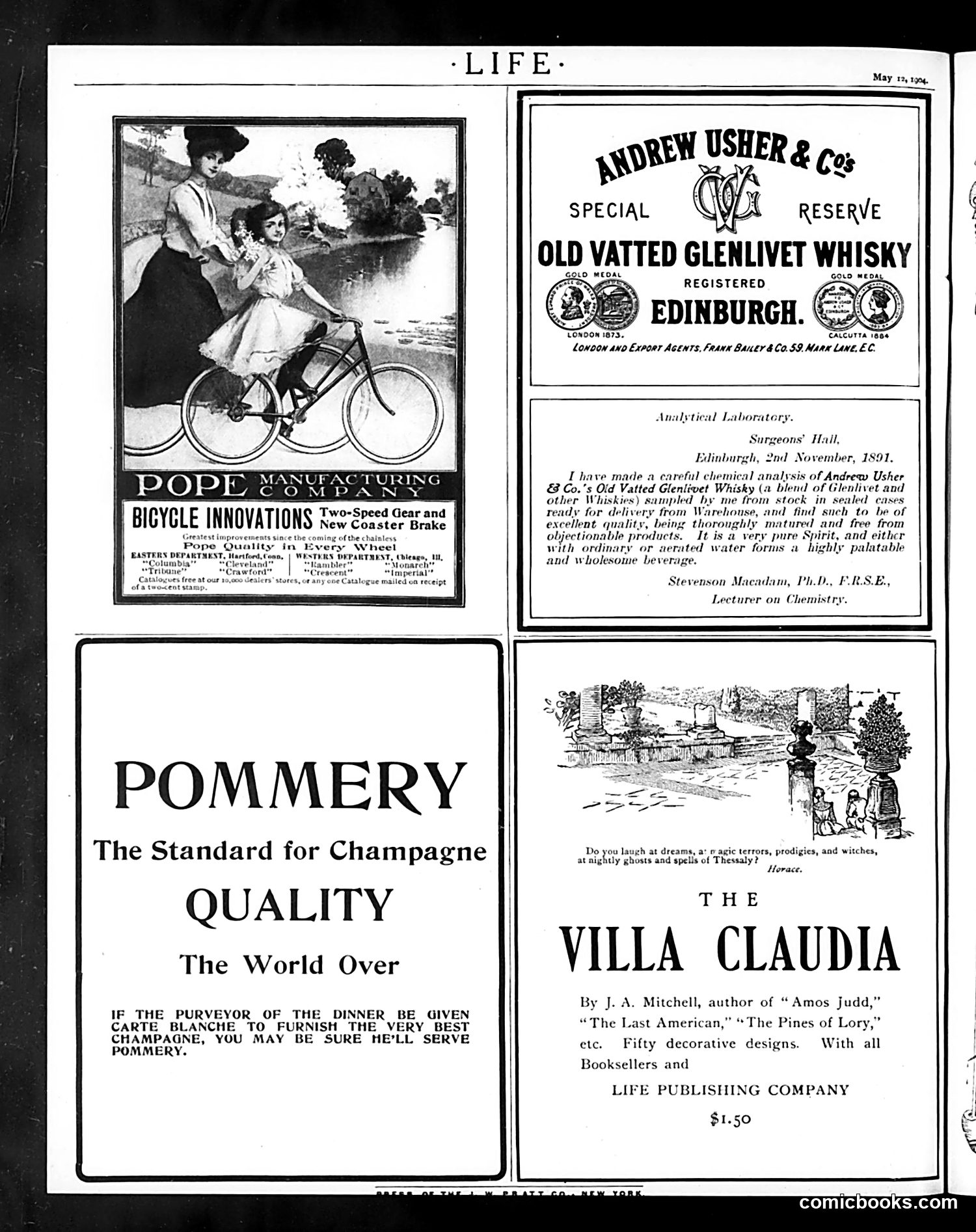
This is primarily an **advertising page** with four distinct ads, not political satire. **Top left:** A Pope Manufacturing Company bicycle advertisement featuring two women with a bicycle by a riverside. It promotes "Two-Speed Gear and New Coaster Brake" innovations—marketing bicycles as leisure equipment for women, reflecting the bicycle craze of the 1890s-1900s. **Top right:** An Andrew Usher & Co. Scotch whisky advertisement, featuring a scientific endorsement from an Edinburgh chemist certifying the whisky's purity and quality (dated 1891). **Bottom left:** A Pommery Champagne ad emphasizing brand prestige and quality. **Bottom right:** A book advertisement for *The Villa Claudia* by J.A. Mitchell, published by Life Publishing Company. The page reflects turn-of-the-century consumer culture and advertising strategies—using scientific credentials, luxury positioning, and lifestyle imagery to market products to middle-class readers.