
Life, 1904-05-12 · page 7 of 20
Life — May 12, 1904 — page 7: what you’re looking at
What you’re looking at
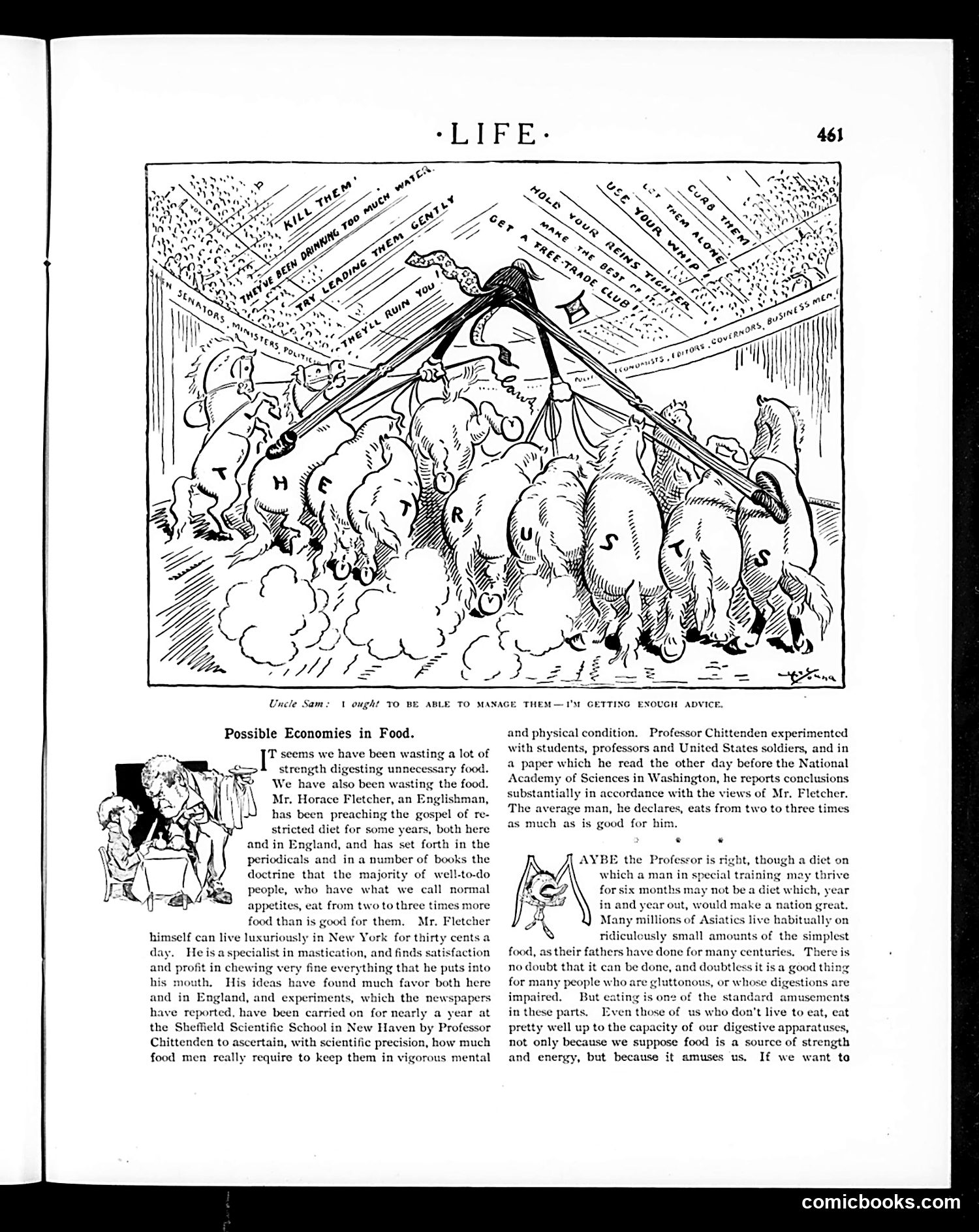
The top cartoon depicts Uncle Sam struggling to manage a herd of pigs labeled with letters spelling "HURTS"—likely representing various government agencies or spending categories. Uncle Sam says he "ought to be able to manage them—I'm getting enough advice," satirizing the proliferation of unsolicited suggestions about federal budgeting and food policy. The accompanying article discusses food waste and nutritional science, referencing Mr. Fletcher (likely Horace Fletcher, a real nutrition advocate) who promoted eating less food more thoroughly. Professor Chittenden's experiments on minimal caloric requirements are cited as evidence. The satire mocks competing advice about government efficiency and food consumption during an era of progressive-era reform and growing scientific interest in nutrition.
📄 Transcribed text from this page (OCR, searchable)
Machine-transcribed from the original scan — historical spelling and the odd misread are preserved.
Uncle Sam: Possible Economies in Food. ‘'T seems we have been wasting a lot of strength digesting unnecessary food. We have also been wasting the food. Mr. Horace Fletcher, an Englishman, has been preaching the gospel of re- stricted diet for some years, both here and in England, and has set forth in the periodicals and in a number of books the doctrine that the majority of well-to-do people, who have what we call normal appetites, eat from two to three times more food than is good for them. Mr. F himself can live luxuriously in New York for thirty cents a day, Hei ion, and finds satisfaction and profit in chewing very fine everything that he puts into his mouth, His ic have found much favor both here and in England, and experiments, which the newspapers have reported, have been carried on for nearly a year at the Sheffield Scientific School in w Haven by Professor Chittenden to ascertain, with scientific precision, how much food men really require to keep them in vigorous mental cher list in mastic: 1 ought YO BE ABLE TO MANAGE THEM—I'M GETTING ENOUGH ADVICE. and physical condition. Professor Chittenden experimented with students, professors and United States soldiers, and in a paper which he read the other day before the National Academy of Sciences in Washington, he reports conclusions substantially in accordance with the views of Mr, Fletcher. The average man, he declares, eats from two to three times as much as is good for him. ‘ AYBE the Professor is right, though a diet on ing may thriv a diet which, ¢ a nation g which a man in spe for six months 1 nd year out, would m: Many millions of Asiatics live habitually on ridiculously small amounts of the simplest food, as their fathers have done for many centuries. There no doubt that it can be done, and doubtless it is a good t for many people who are gluttonous, or whose digestions are impaired. But cating is one of the standard amusements in these parts. Even those of us who don't live to eat, eat pretty well up to the capacity of our digestive apparatuses, not only because we suppose food is a source of strength and energy, but because it amuses us. If we want to comicbooks.com