
Life, 1904-05-12 · page 12 of 20
Life — May 12, 1904 — page 12: what you’re looking at
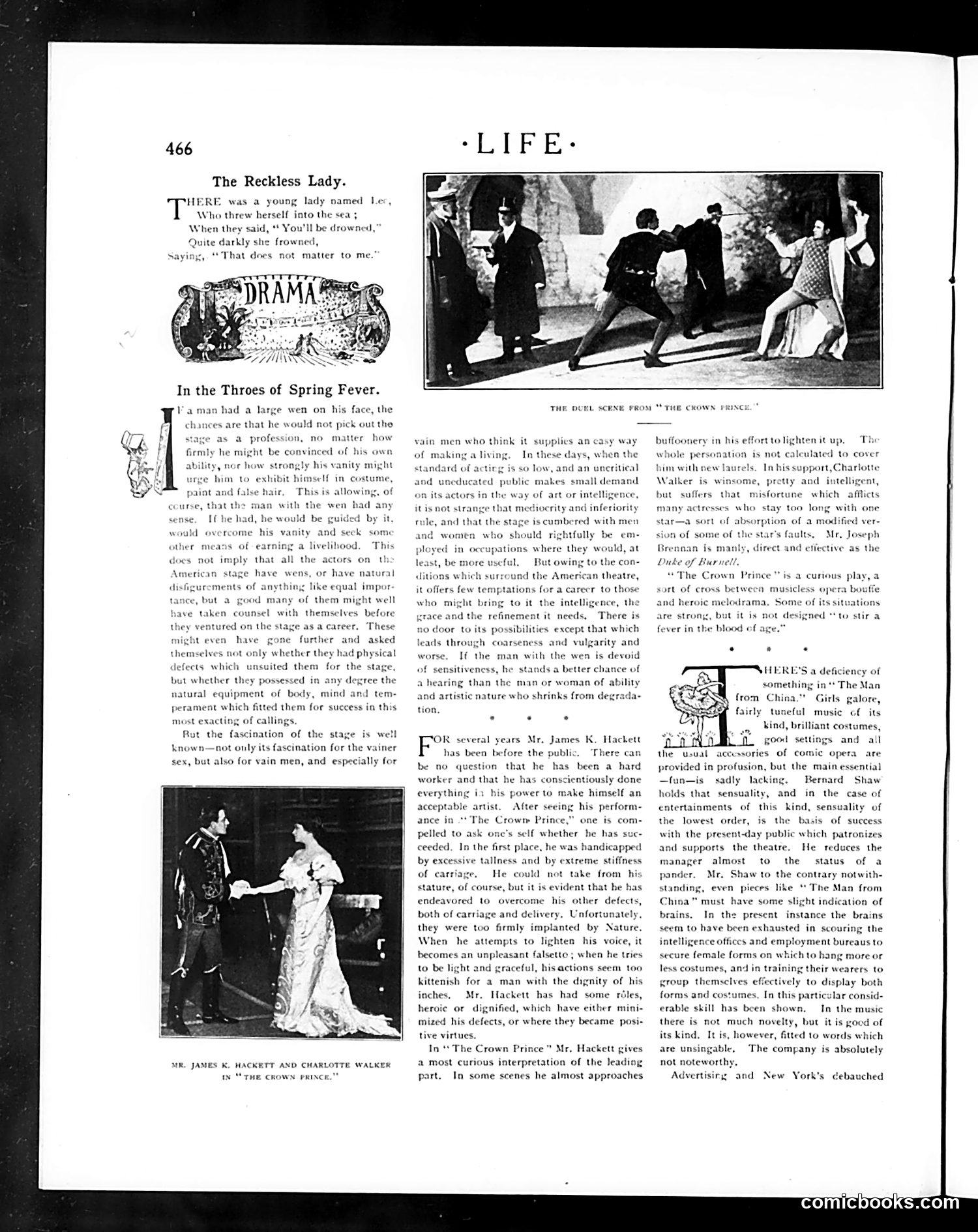
What you’re looking at
This page contains theatrical criticism and reviews of contemporary stage productions, not political cartoons. The main content discusses dramatic performances, particularly focusing on "The Crown Prince" starring actor James K. Hackett and Charlotte Walker (shown in the photograph). The text critiques American theater standards of the era, lamenting that mediocrity and inferior talent dominate the stage. It discusses how actors with physical defects or limited natural ability have pursued stage careers despite lacking proper training or refinement. The accompanying photographs show scenes from theatrical productions. This appears to be entertainment criticism rather than satire—evaluating the quality and merit of professional actors and stage performances of the period.
📄 Transcribed text from this page (OCR, searchable)
Machine-transcribed from the original scan — historical spelling and the odd misread are preserved.
The Reckless Lady. was a young lady named Lec, Who threw herself into the sea ; When they said, * You'll be drowned,” Quite darkly she frowned, yy That does not matter to me. In the Throes of Spring Fever. Va man had a large wen on his face, the chances are that he would not pick out the as a profession, no matter how firmly he might be convinced of his own ability, nor how strongly his vanity might urge him to exhibit himself in ec at and false hair, This is allowii course, that the man with the wen | nse. If he had, he would be guid and seck fr means of earning a liv would overcome his vanity jot imply that all the actors on t stage have wens, or have natural s of anything lisfigueem like equ ce, but «od many of them might well have taken counsel with themselves before they ventured on the sta; These asked physical © as a career, and they ha for th might even have gone further themselves not only wheth defects which unsuited them stage, but whether they possessed in any degree the natural equipment of body, mind and tem- perament which fitted them for success in this most exacting of callings. t the fascination of the stag known—not only its fascination for the vainer sex, but also for vain men, and especially for MR. JAMES K, HACKETT AND CHARLOTTE WALKER ty “THE CROWN PRINCE,” THE DUEL SCENE FROM “THe CROWN PRINCE vain men who think it supplies an casy way living, In e days, when the tandard of acting is so low, and an uncritical I demand actors ia the way of art or intelligence, Jucated public makes sm; it is not strang: that mediocrity and inferiority at the stage iscumbered with men who should rightfully be em- sid, at But owing to the con- 1 the Am it offers few temptations for a career to those ployed in occupations where they w least, be more useful, ditions which surre n theatre, who might bring to it the intelligence, th There is oF to its possibilities except that which Krace and the refinement it needs, leads through coarseness and vulgarity and worse. If of sensitiveness, he the man with the wen is devoid stands a better chance of hearing than the man of woman of a and artistic nature who shrinks from ¢ tion. Hackett here can Fe several years Mr, James K has be be no n before the public. question that he has been a hard worker and that he has conscientiously done everyth acceptabl ance in his power to make himself an After seeing his perform The Crowm Prince,” one artist. is com- pelled to ask one’s self whether he has suc- ceeded, In the first place, he was handicapped by excessive tallness and by extreme stiffness of carriage, He could not take from hi: stature, of course, but it is evident that he has endeavored to overcome his other defects, both of carriage and delivery, Unfortunately they were too firmly implanted by Nature. nn he attempts to lighten his voice, it becomes an unpleasant falsetto ; when he tries to be light and ¢ kittenish for a man with the dignity of his Mr. Hackett has had some rile heroic or dignified, which have either mini- aceful, his actions seem to inches, mized his defects, or where they became posi- tive virtues, In The Crown Prince” Mr, Hackett gives a most curious interpretation of the lead part, In some scenes he almost approaches buffoonery in his efforttolighten it up. Th whole personation is n Ink Walker is winsome, pretty and intel that which many actresses who stay too long with one calculated to cover m with new f support,Charlott but suffers misfortune afflicts tar—a sort of ab: ofa i ver- Mr. Joseph if pnan is manly, direct and efiective as the “The Crown Prince sort of wrpt n of some of the star's faults, is a curious play, a cross between musicless © bou and heroic melodrama, Some of its situations. are strong, but it is not designed “to stir a fever in the blood of age. HERE'S a deficiency of something in“ The Man from China.”* Is galore, fairly tuneful music of its an, kind, brilliant costumes, LL accessories of cor good settings and all the usual opera are provided in profusion, but the main essential —fan—is lacking. Bernard Shaw holds that and in the case of entertainments of this kind, sensuality of the with the present-day public which patronizes the theatre. He reduces the almost to the status of a Mr. Shaw to the contrary notwith- sadly sensuality, the lowest order, is basis of success and supports manager pander, standing, even pieces like “The Man from China" must have some slight indication of instance the brains seem to have been exhausted in scouring the brains. In the present intelligence offices and employment bureaus to secure female forms on which to hang more or less costumes, and in training their wearers to group themsclves effectively to display both forms and costumes. In this particular consid- In the music there is not much novelty, but it is good of its kind. It is, however, fitted to words which are unsingable, The company is absolutely erable skill has been shown, not noteworthy. Advertising and New York's debauched