
Life, 1904-05-12 · page 9 of 20
Life — May 12, 1904 — page 9: what you’re looking at
What you’re looking at
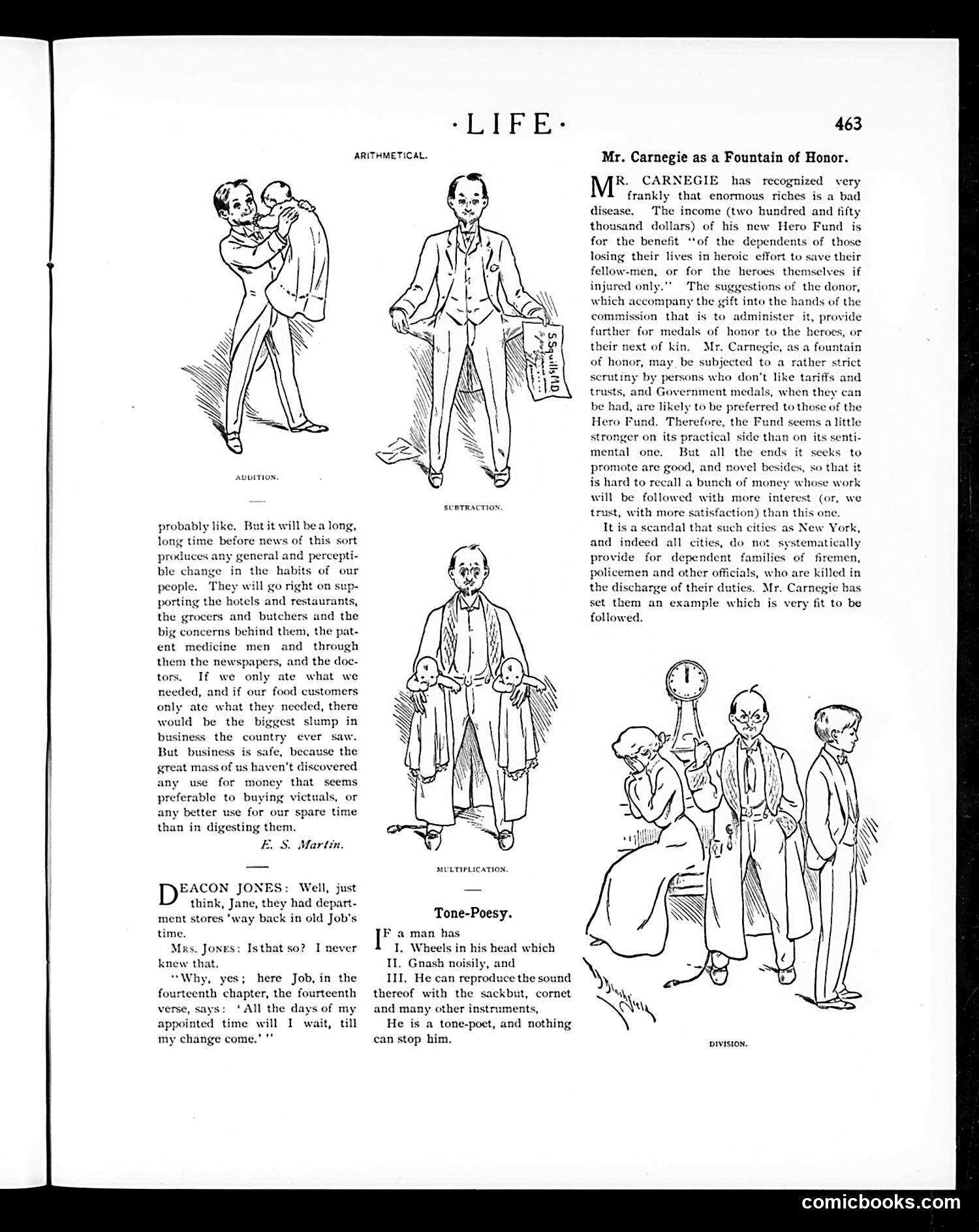
This page satirizes wealthy industrialist **Andrew Carnegie** and his charitable giving. The right-hand article "Mr. Carnegie as a Fountain of Honor" discusses his new "Hero Fund"—established to support families of firefighters, police, and rescue workers killed in service. The satire's point: Carnegie's enormous wealth ($200,000 gift) is simultaneously praised as noble *and* criticized as inadequate—mere "spare time" spending for the ultra-rich. The author notes it's scandalous that cities don't systematically support dependent families of public servants, making Carnegie's charity necessary only because of systemic failure. The left side contains unrelated humor pieces: mathematical jokes about "Addition" and "Subtraction," and a dialogue between Deacon Jones and Mrs. Jones about department store jobs—typical period humor.
📄 Transcribed text from this page (OCR, searchable)
Machine-transcribed from the original scan — historical spelling and the odd misread are preserved.
463 ARITHMETICAL, Mr. Carnegie as a Fountain of Honor. R. CARNEGIE has recognized very frankly that enormous riches is a bad c The income (two hundred and fifty thousand dollars) of his new Hero Fund is for the benefit ‘“‘of the dependents of those losing their lives in heroic effort to save their fellow-men, or for the heroes themselves if injured only.” The suggestions of the donor, which accompany the gift into the hands of the commission that is to administer it, provide further for medals of honor to the heroes, or their next of kin. Mr. Carnegie, as a fountain of honor, may be subjected to a rath! : by persons who don’t like tariffs and nment medals, when they ca be had, are likely to be preferred to tho: Hero Fund. Therefore, the Fund seems a little stronger on its practical side than on its senti- mental one, But all the ends it seeks to promote are good, and novel besides, so that it is hard to recall a bunch of money whose work will be followed h more interest (or, we trust, with more satisfaction) than this o: probably like. But it will bea long, It is a scandal th. ch cities as New York, long time before news of this sort and indeed all cities, do not systematically produces any general and percepti- for dependent fam { firemen, ble change in the habits of our ¢ en and other officials, who are killed in people. They will go right on sup- the discharge of their duties. Mr. Carnegie has porting the hotels and restaurants, set them an example which is very fit to be the grocers and butchers and the followed. big concerns behind them, the pat- ent medicine men and through them the newspapers, and the doc- tors, If we only ate what we needed, and if our food customers only ate what they needed, there would be the biggest slump in business the country ever saw. ADDITION. SUBTRACTION. But business is safe, because the great mass of us haven't discovered any use for money that seems preferable to buying victuals, or any better use for our spare time than in digesting them. E. S. Martin. MULTIPLICATION, EACON JONES: Well, just — think, Jane, they had depart- ment stores iy back in old Job's Tone-Poesy. time. a man has Mrs. Jones: Isthat so? I never I, Wheels in his head which knew that. II. Gnash noisily, and here Job, in the IIT. He can reproduce the sound fourteenth chapter, the fourteenth thereof with the sackbut, cornet verse, Say “All the days of my and many other instruments, appointed time will I) wait, till He is a tone-poet, and nothing my change come.’ can stop him. comet. comicbooks.com