
A complete issue · 20 pages · 1904
Life — April 28, 1904
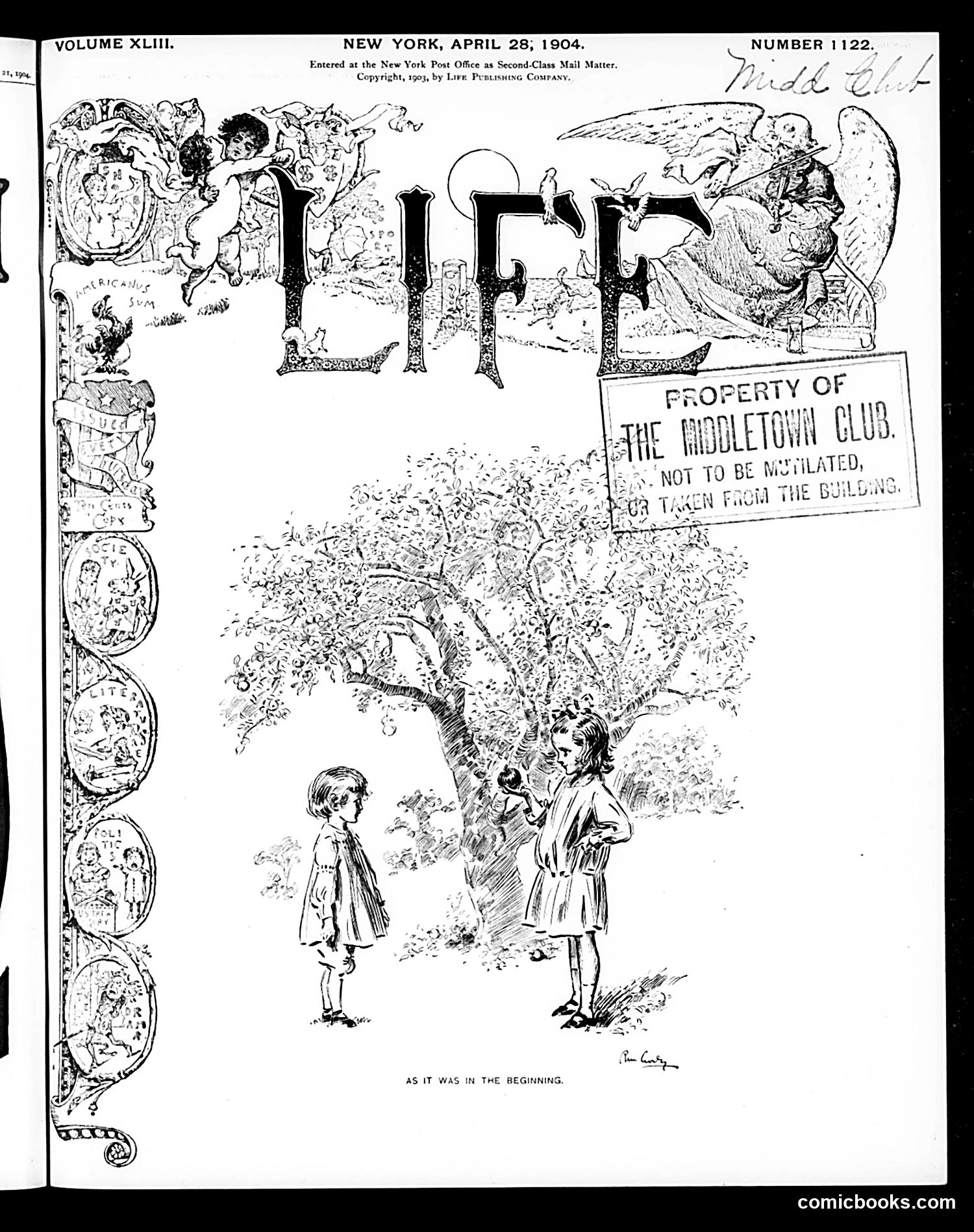
This page features a satirical illustration titled "AS IT WAS IN THE BEGINNING," showing two children beneath a large tree. The artwork appears to reference the biblical Garden of Eden story—likely a commentary on innocence or origins. The ornate left border contains classical medallions depicting various mythological or allegorical scenes, typical of Life magazine's decorative aesthetic. The stamp reading "PROPERTY OF THE MIDDLETOWN CLUB / NOT TO BE MUTILATED / OR TAKEN FROM THE BUILDING" indicates this was a library copy, standard for private club subscriptions in the era. The artist signature appears to be "Sam Cady" or similar. Without additional context, the specific satirical point remains unclear—it may reference social innocence, childhood, or a contemporary 1904 event now obscure to modern readers.
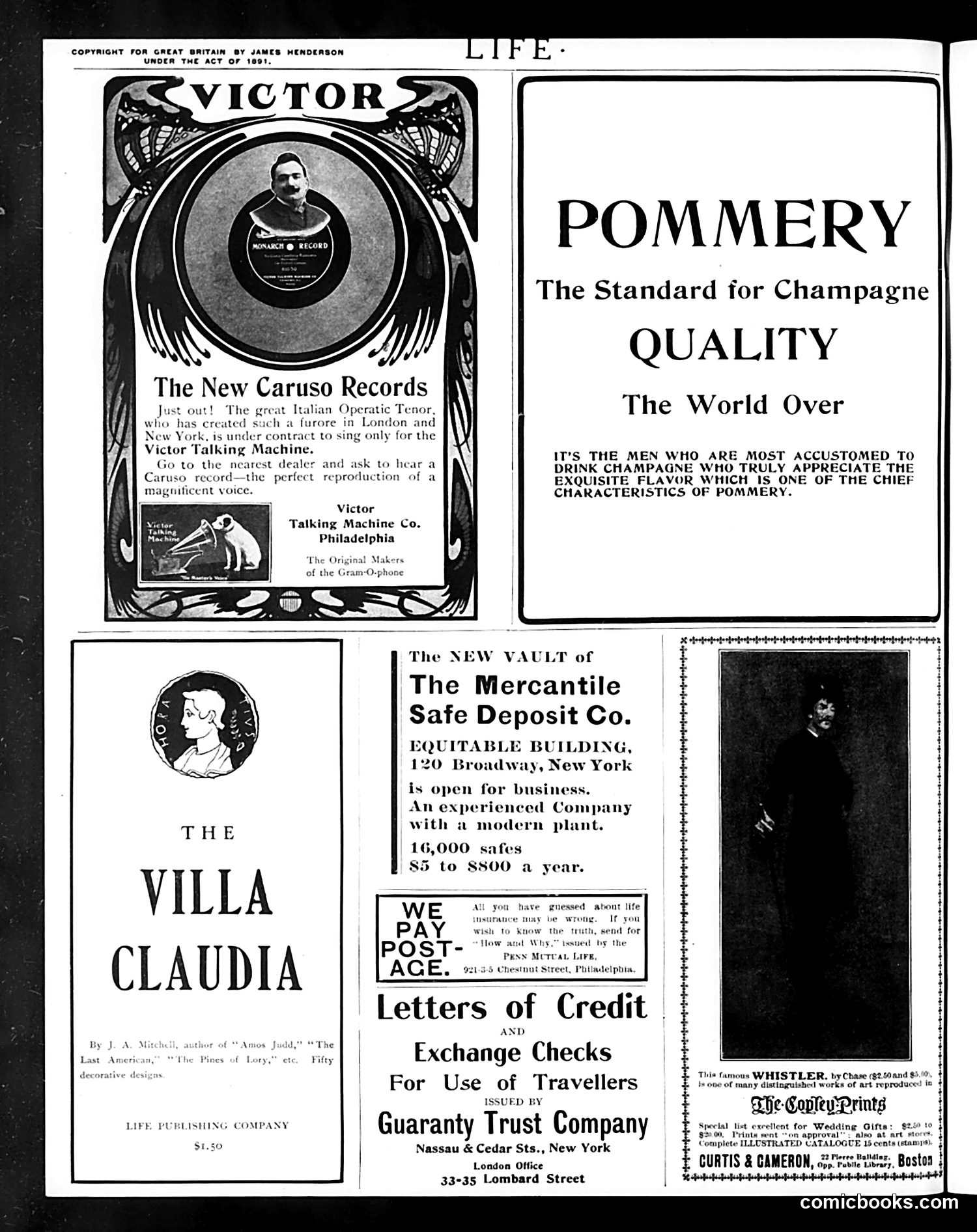
This page is **primarily advertising**, not political satire. It contains four distinct advertisements: 1. **Victor Talking Machine Co.** promotes Caruso Records, featuring the famous Italian tenor Enrico Caruso, emphasizing high-fidelity reproduction of his voice. 2. **Pommery Champagne** markets itself as the standard for quality champagne, targeting experienced drinkers who appreciate fine flavor. 3. **The Villa Claudia** book advertisement by J.A. Mitchell (Life's founder). 4. Additional ads for financial services (Mercantile Safe Deposit Co., Guaranty Trust Company) and art prints. The page reflects early 20th-century consumer culture, targeting affluent readers with luxury goods and services. No political cartoons or satirical commentary appears here.
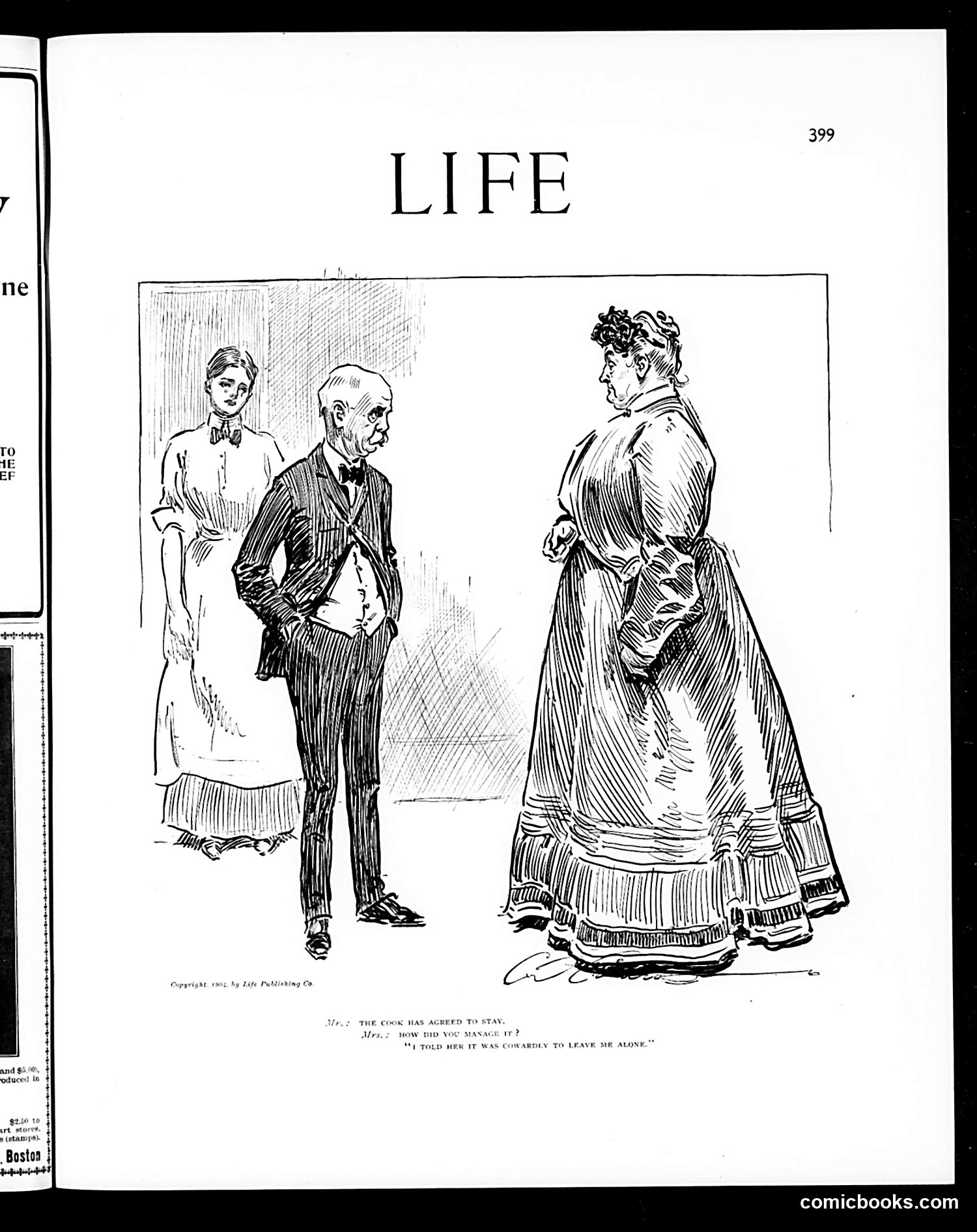
This is a satirical cartoon from *Life* magazine depicting a domestic dispute. The scene shows a thin, stern-faced man in formal attire confronting a larger, well-dressed woman, with a younger woman (likely a servant or maid) observing in the background. The caption reads: "He: 'The cook has agreed to stay.' / She: 'How did you manage it? / 'I told her it was cowardly to leave me alone.'" The humor satirizes masculine manipulation and emotional blackmail in marriage. The man attempts to retain household staff by appealing to the cook's sense of duty and guilt, rather than addressing legitimate grievances. The satire mocks both his transparent manipulation and the social dynamics where women's labor (domestic and otherwise) is extracted through guilt and appeals to loyalty rather than fair compensation or treatment.
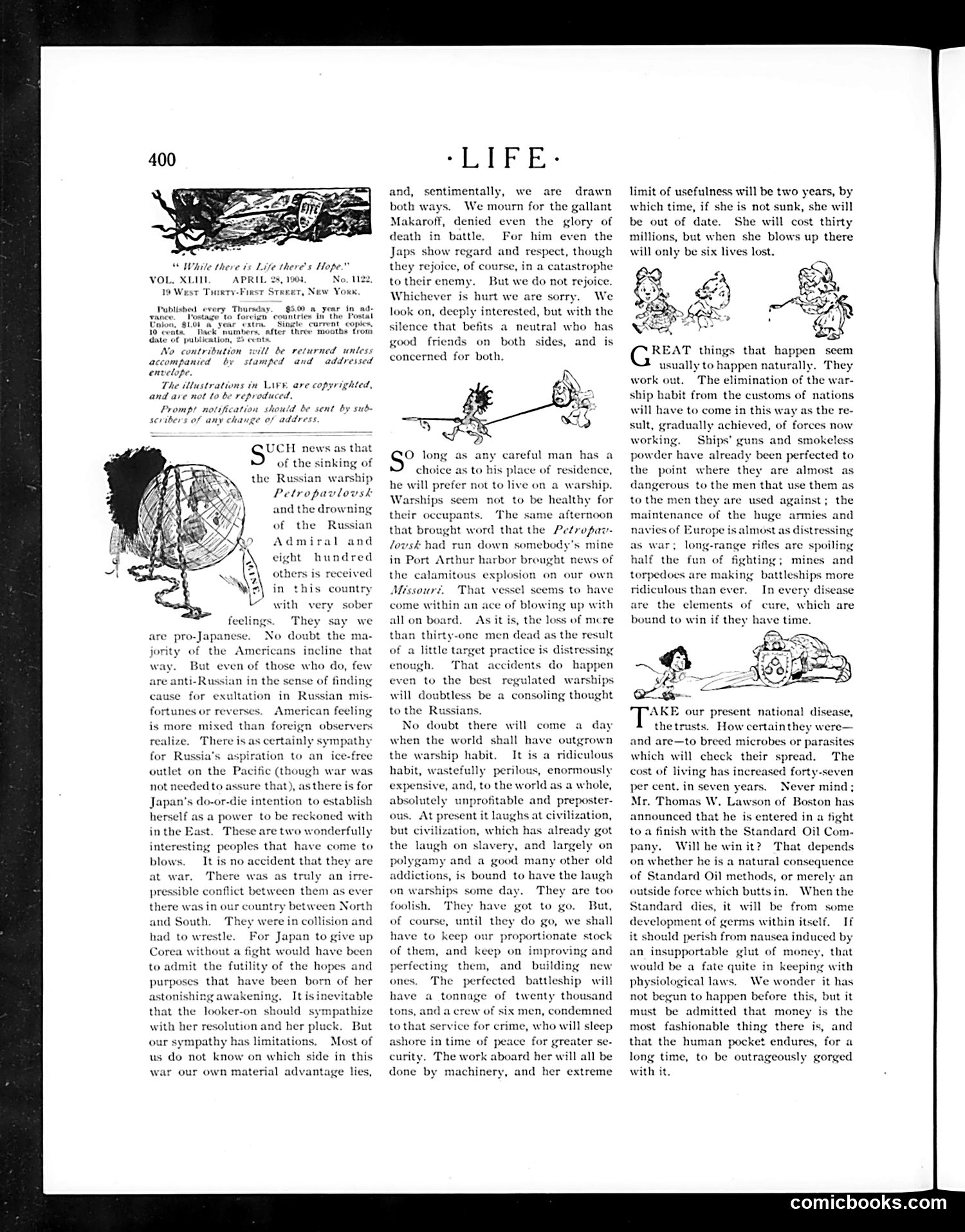
This page discusses the Russo-Japanese War, specifically the sinking of the Russian warship *Petropavlovsk* and losses at Port Arthur. The text expresses ambivalent American sympathy: while Americans have pro-Japanese leanings, the author argues neutrality is appropriate since both nations have "good friends on both sides." The decorative cartoon illustrations appear to show anthropomorphized figures engaged in various activities—possibly representing warships or nations as characters—though their specific identities are unclear from the image alone. The broader argument warns against warship-building as wasteful and advocates for peaceful resolution of international conflicts, using the escalating naval arms race as evidence of civilization's failures. The satire critiques militarism and the "warship habit" as fundamentally irrational.
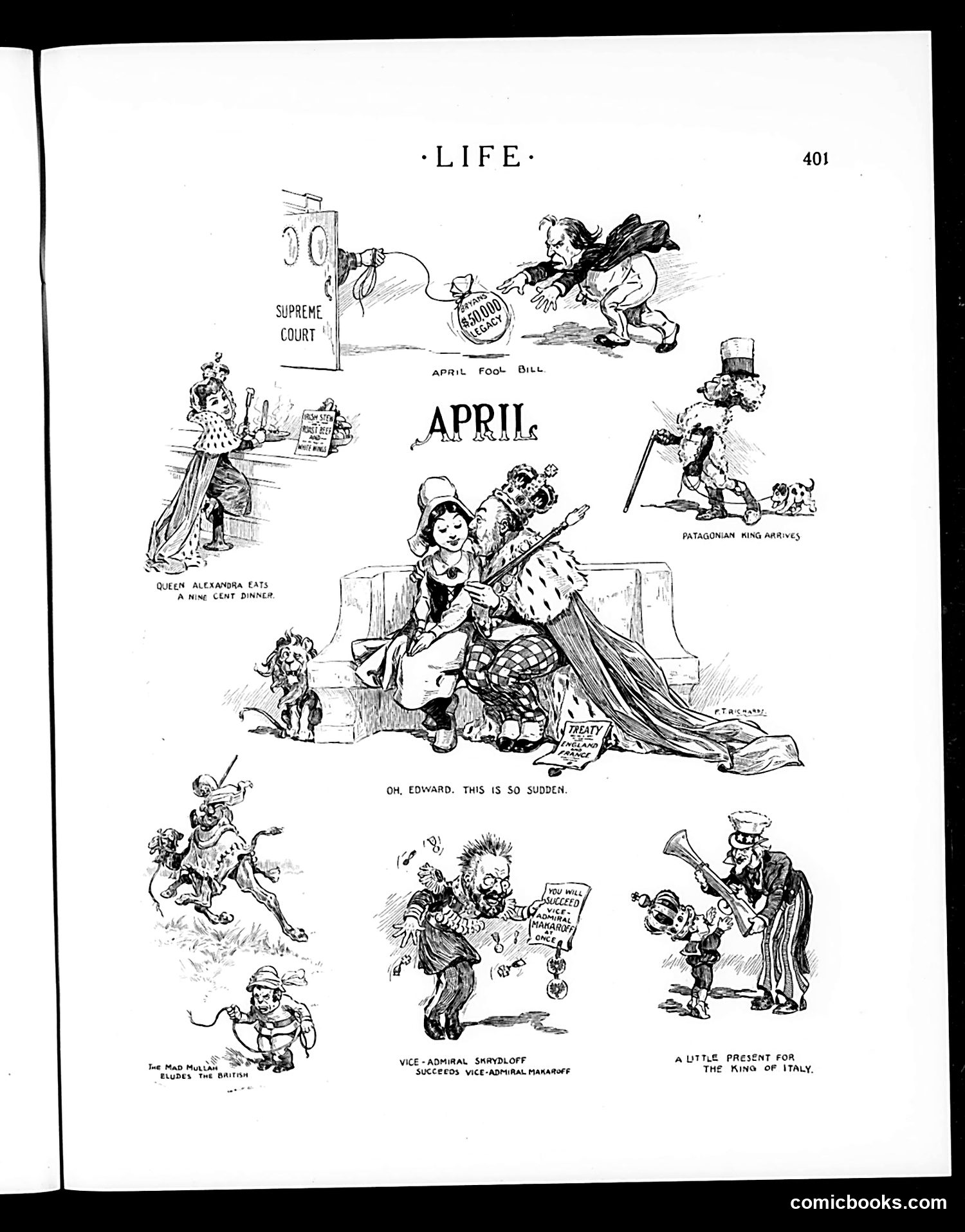
This page presents April Fools' Day satirical cartoons mocking current events and figures. Key cartoons include: **"April Fool Bill"**: Depicts someone being tricked by the Supreme Court, suggesting a legal matter was overturned or made absurd. **"Queen Alexandra Eats a Nine Cent Dinner"**: Likely mocks either British royalty or American wealthy elites pretending economic hardship. **"Patagonian King Arrives"**: Appears to satirize an exotic foreign dignitary's visit. **"Vice-Admiral Makaroff"**: References a Russian naval officer, possibly commenting on the Russo-Japanese War period. **"A Little Present for the King of Italy"**: Mocks Italian leadership through a gift-giving scenario. The cartoons employ exaggerated caricatures and absurdist scenarios typical of early 1900s political satire, though specific references require additional historical context to fully decode.
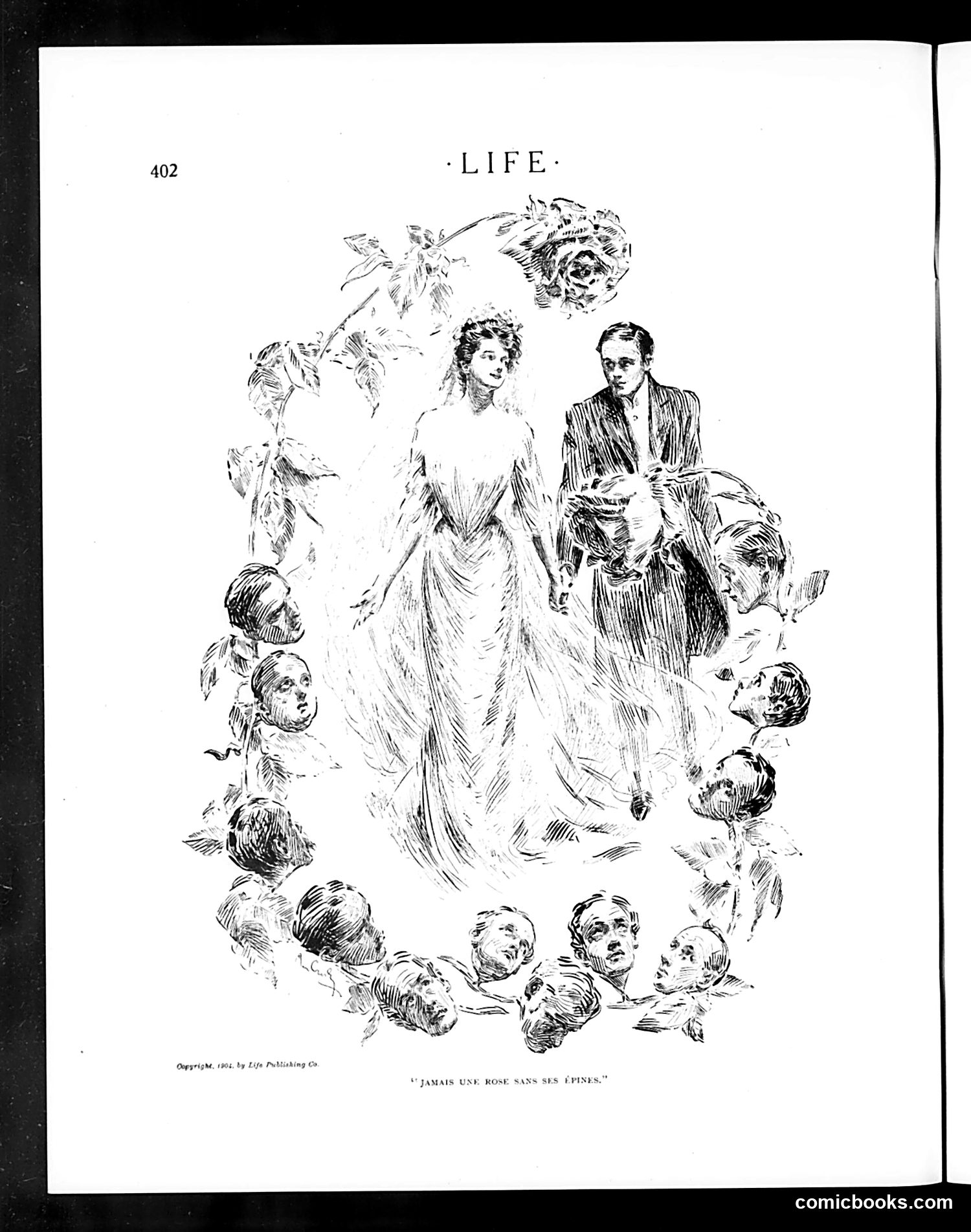
This is a satirical illustration from *Life* magazine (copyright 1902, Life Publishing Co.) titled "Jamais Use Rose Sans ses Épines" ("Never Use a Rose Without Its Thorns"). The image depicts a woman in an elegant dress surrounded by cherub heads—likely representing children or cupids. The composition suggests a commentary on motherhood, femininity, or romantic idealization. The French caption implies that beauty or romance (the "rose") inevitably comes with difficulties or pain (the "thorns"). Given the 1902 date and the allegorical presentation, this likely satirizes contemporary attitudes about women—possibly mocking the romanticized ideal of motherhood or the reality that feminine beauty and domestic life involve hidden struggles or complications. The cherubs surrounding the central female figure reinforce themes of fertility and family.
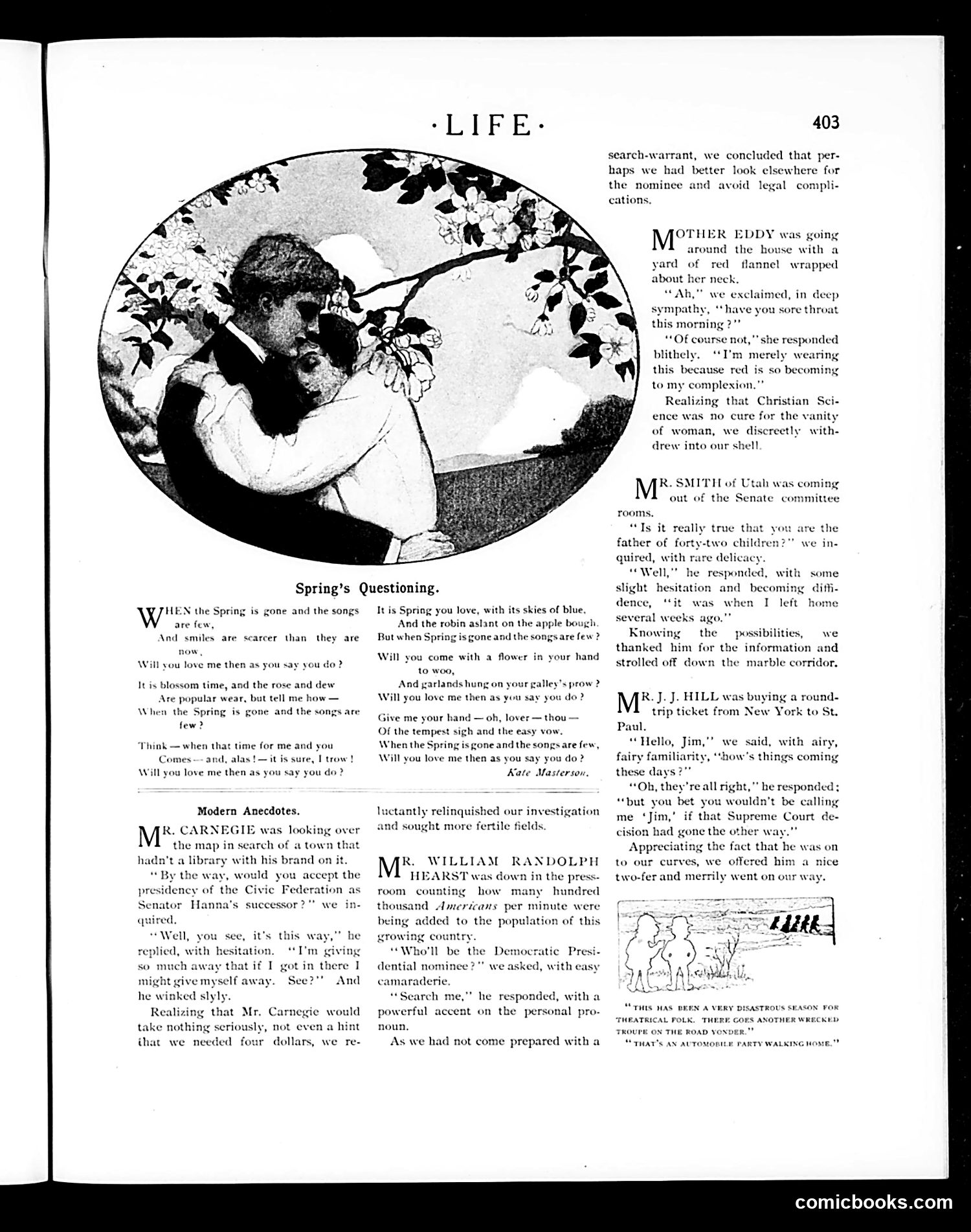
The main illustrated panel titled "Spring's Questioning" depicts a woman in a garden setting amid flowers and foliage. The accompanying poem explores romantic themes about spring's arrival and love's renewal—a conventional literary subject of the era. The text sections below include "Modern Anecdotes," humorous short stories satirizing contemporary political and social figures. One anecdote mocks Mr. Carnegie (the industrialist) for his reluctance to donate money. Another involves Mr. Smith of Utah, likely referencing polygamy controversies surrounding Utah statehood. A third satirizes Mr. William Randolph Hearst's media empire and Democratic politics. The small cartoon at bottom appears to depict a theatrical scene, though details are unclear from the image quality.
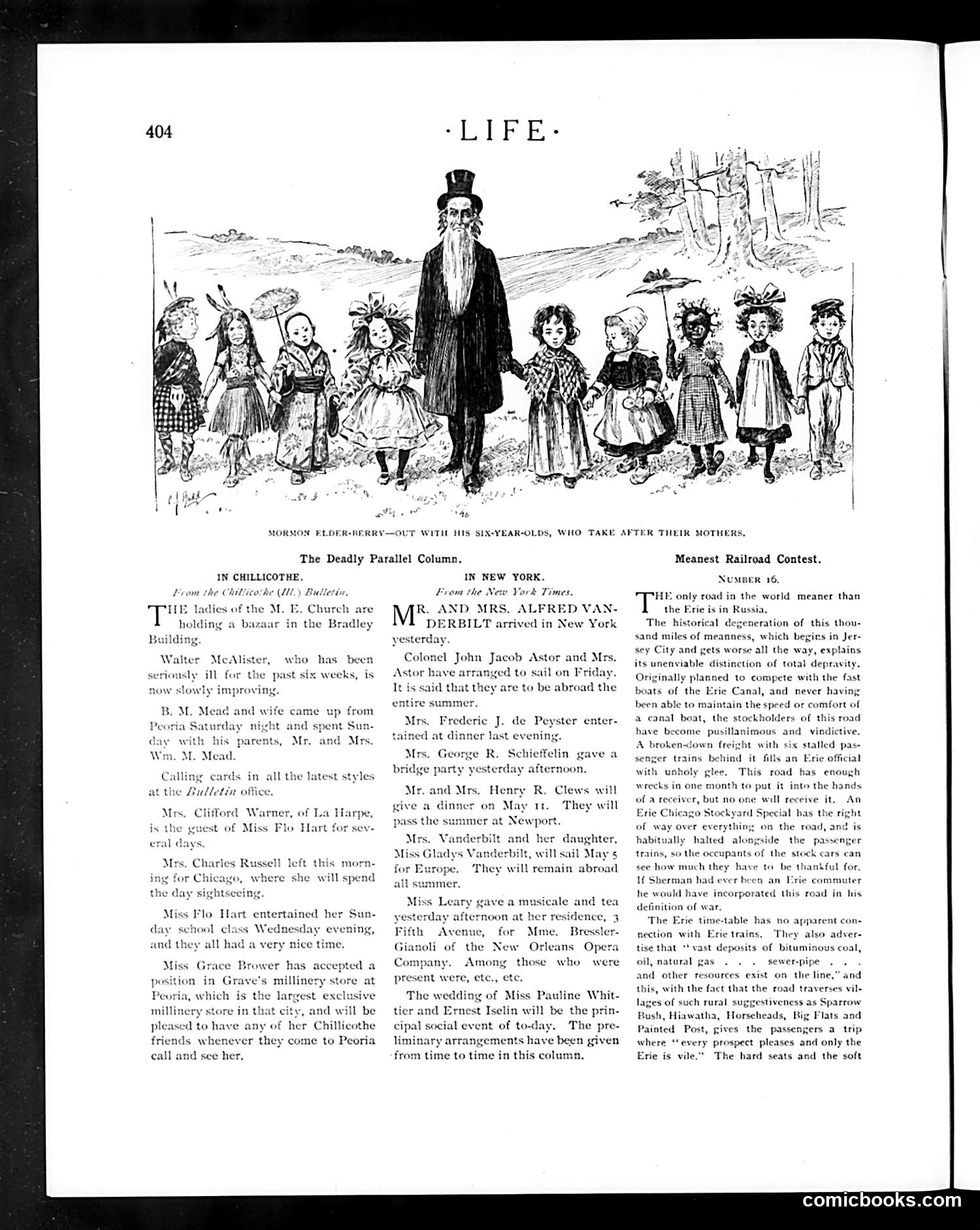
The main illustration depicts a tall bearded man in a top hat and long coat leading a group of children in various ethnic costumes—appearing to reference different nationalities and cultures. The caption identifies this as "Mormon Elder-Berry—Out with his Sixteen-Olds, Who Take After Their Mothers." This is satirical commentary on Mormon polygamy and the practice of multiple wives producing many children. The "Elder-Berry" pun mocks both the LDS church hierarchy ("Elder") and suggests proliferation ("berry"). The children's diverse appearances satirize concerns about mixed-race offspring from polygamous unions, a common prejudicial trope of the era used to criticize the Mormon faith. The page also contains society gossip columns unrelated to the cartoon.
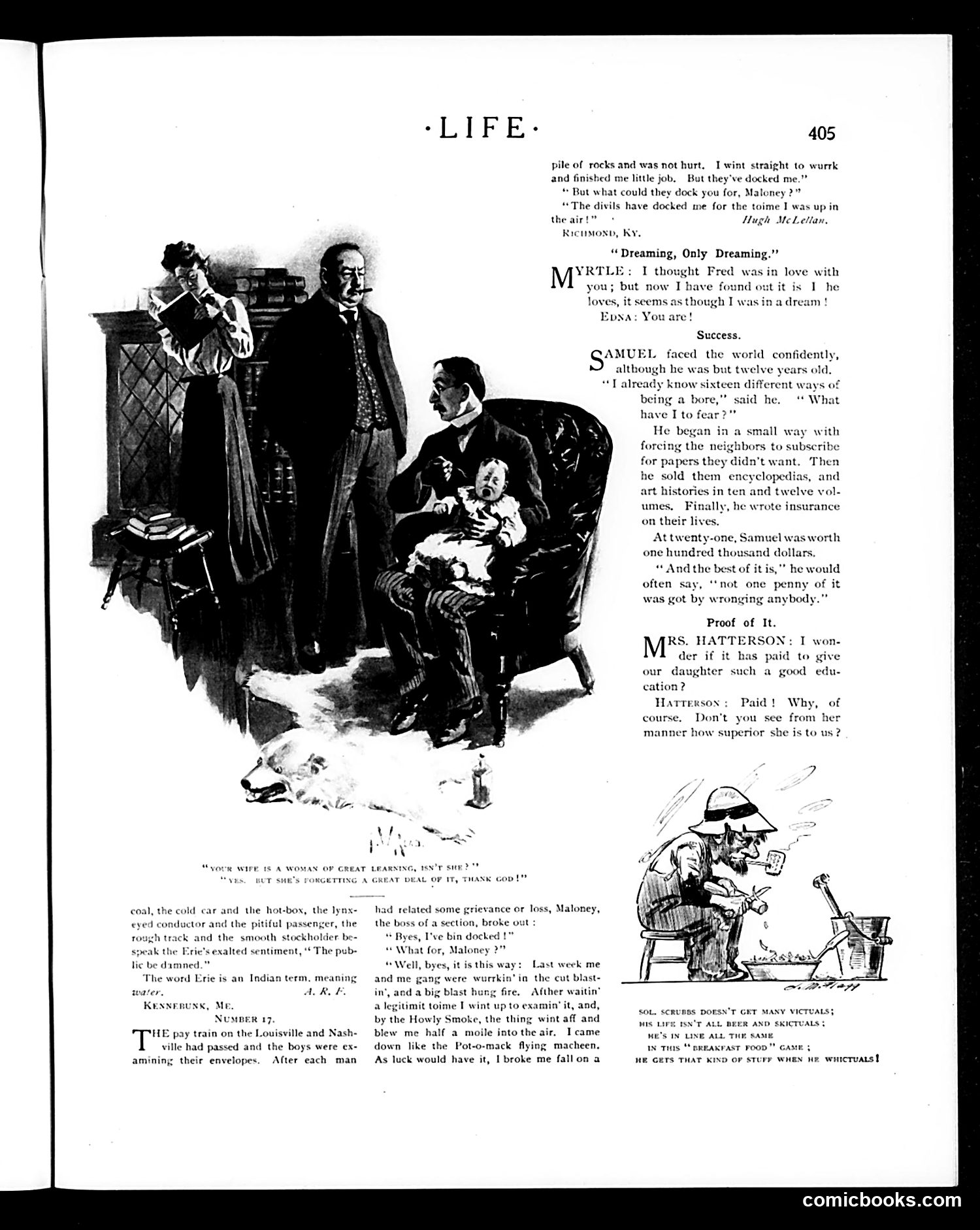
This page contains several satirical anecdotes and illustrations mocking American social pretension and business practices. The main illustration depicts a well-dressed man holding a child while others gather around—likely illustrating a story about social climbing or false claims of refinement (the "Proof of It" section discusses a daughter's supposedly superior education). A smaller cartoon shows a man at a desk, captioned with wordplay about avoiding "victuals" and "breakfast food"—apparently satirizing either food trends or business advertising claims. The anecdotes mock various character types: Samuel, a young man who bullies neighbors into purchasing unwanted goods; and Hatterson, whose pretensions about his daughter's education are undermined by her obvious superiority coming from elsewhere. The overall theme critiques American social aspiration, sharp business practices, and false gentility during the early 20th century.
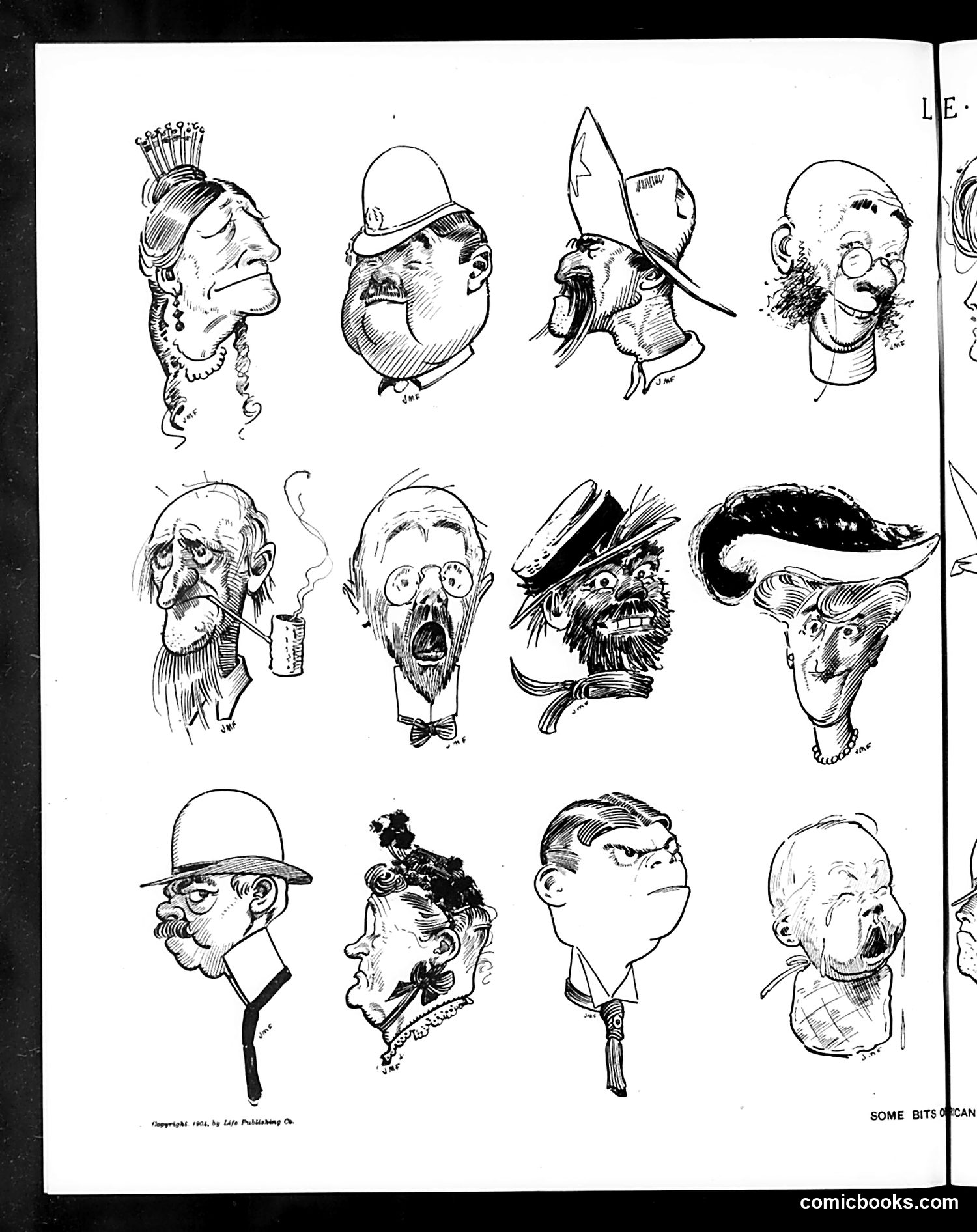
This page displays a collection of caricatured heads in exaggerated style, typical of Life magazine's satirical approach. The title "Some Bits of Can" appears to be a play on words, though the specific reference is unclear without additional context. The sketches show various male figures with distinctive features—crowns, military headgear, facial hair, and formal attire—suggesting political or public figures of the era. The exaggerated facial proportions and expressions are characteristic of early 20th-century political cartooning meant to mock or ridicule. The copyright notice indicates publication by Life Publishing Co., dating this as historical satire. However, without identifying labels or clearer context, I cannot definitively name the individuals caricatured or specify which political events or scandals they reference.
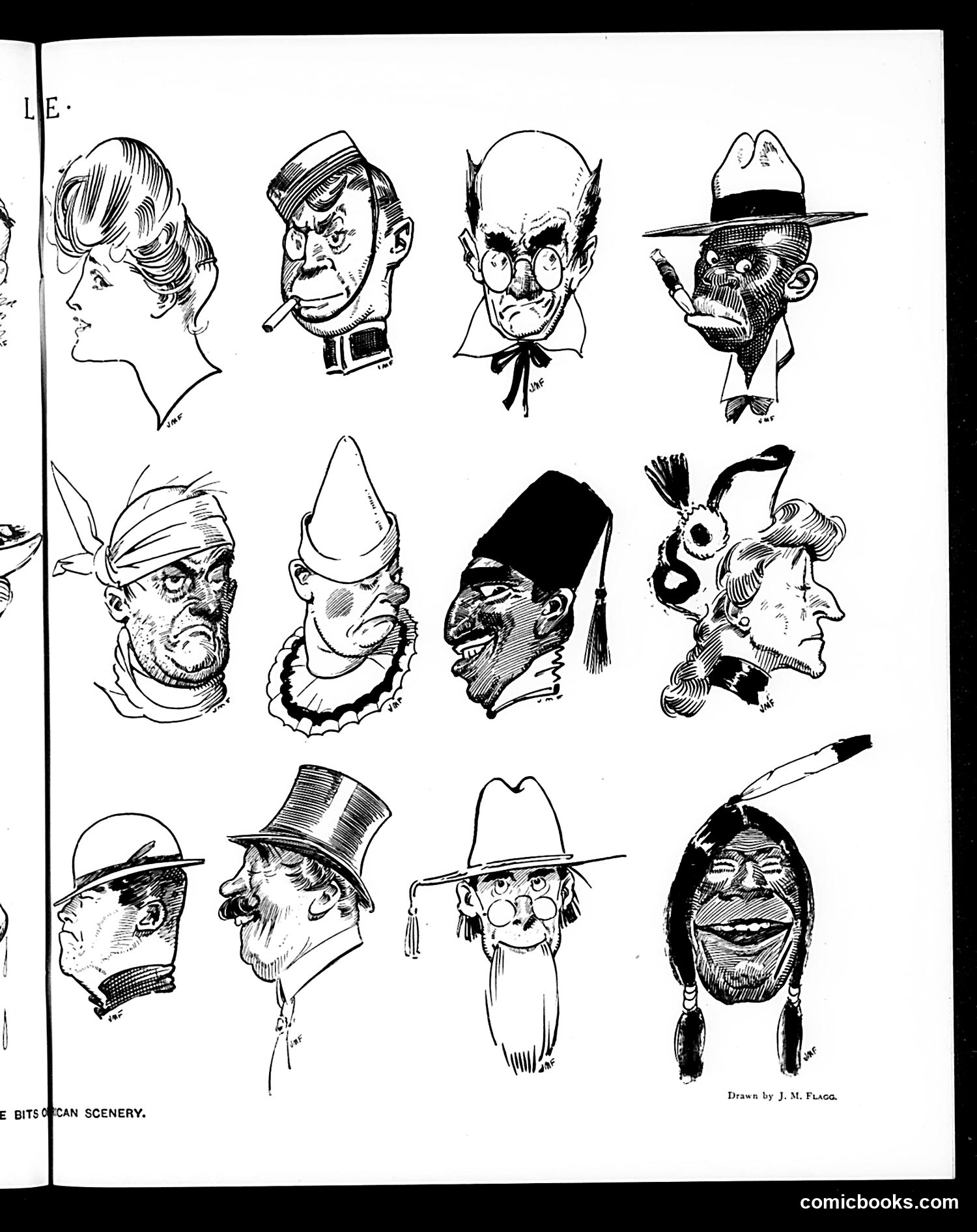
This page, drawn by J.M. Flagg, displays twelve caricatured character heads representing what the title calls "bits of can scenery"—likely referring to stock theatrical or entertainment character types of the era. The drawings showcase exaggerated facial features characteristic of early 20th-century satirical cartooning: bulbous noses, distorted expressions, and distinctive headwear (turbans, top hats, fezzes, feathered headdresses). These appear to be stereotypical character archetypes—possibly representing ethnic or national types common to vaudeville, theater, or film of the period. The title's reference to "can scenery" suggests these are standardized, mass-produced character designs used repeatedly in entertainment productions—mocking both theatrical conventions and popular entertainment's reliance on formulaic stereotypes.
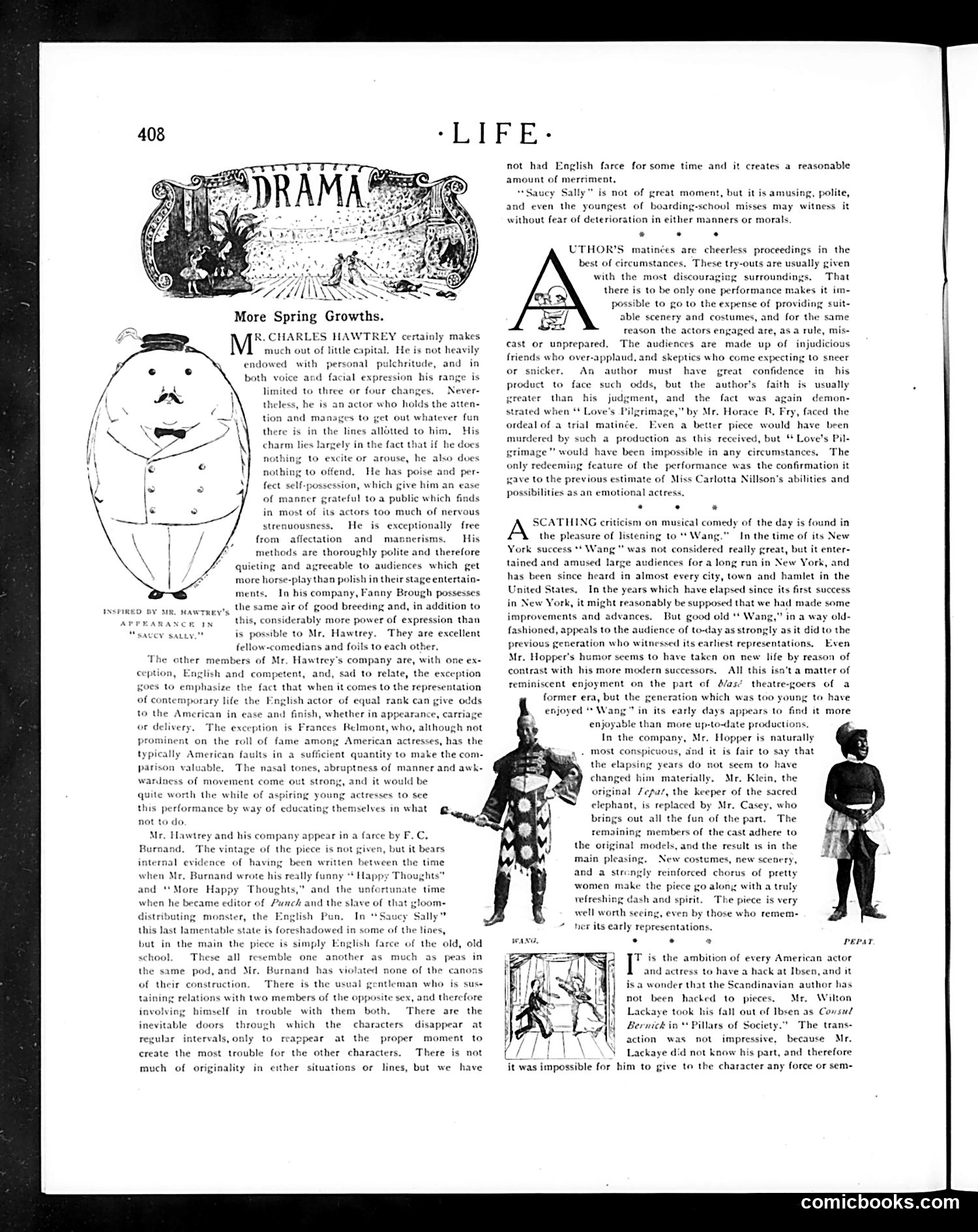
This page from *Life* magazine's "Drama" section discusses theatrical performances and actors of the era. The main illustration depicts **Mr. Charles Hawtrey**, labeled as the subject of a caricature showing a rotund, mustachioed man in formal dress. The text praises Hawtrey's comedic talents and range, noting his ability to entertain audiences through natural, unaffected performance. The article discusses various theatrical productions and actors, including references to a farce by F.C. Burnand and mentions of performers like Fanny Bough and Frances Helmond. The page includes period costume illustrations and discusses dramatic standards of the era, critiquing both theatrical conventions and the ambitions of American actors seeking recognition abroad. The overall tone is evaluative and somewhat satirical about theatrical pretension.
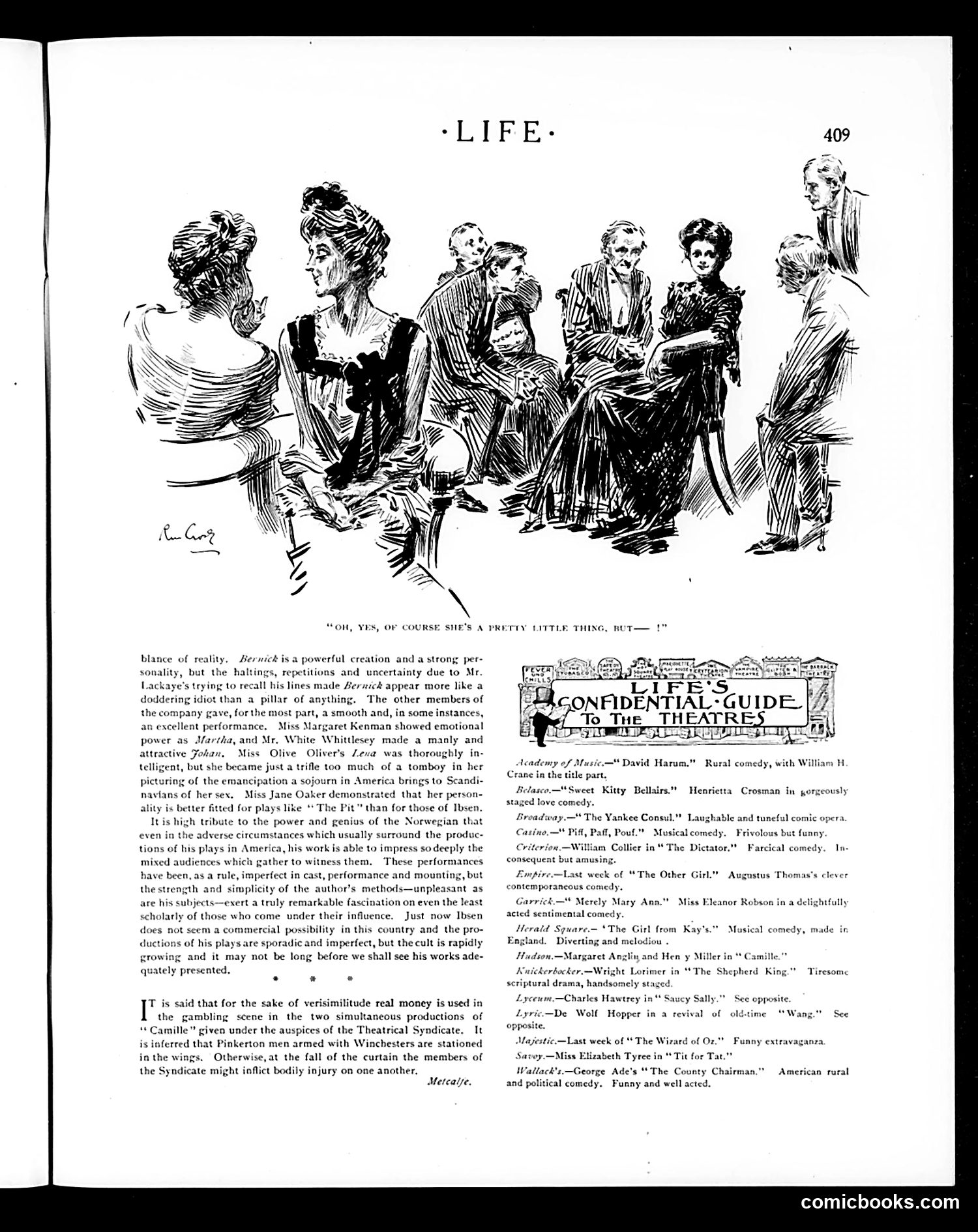
The page contains two distinct elements: a sketch depicting a social gathering and theater reviews. **The Sketch:** The illustration shows a group of well-dressed people in conversation. The caption reads: "Oh, yes, of course she's a pretty little thing, but—!" This appears to be satirizing polite society's backhanded compliments and gossip—a common Life magazine motif mocking upper-class social pretension and cattiness. **The Theater Section:** Below is "Life's Confidential Guide to the Theatre," listing current Broadway productions. The text includes a lengthy review of Ibsen's plays in America, noting that while his works are artistically powerful, they're poorly produced due to casting and budget limitations. The reviewer praises Ibsen's genius for affecting audiences despite these obstacles. A separate humorous note jokes about the Theatrical Syndicate's *Camille* productions, where "real money" is used onstage—so much so that Pinkerton guards with rifles supposedly stand in the wings to prevent cast members from fighting over it. This satirizes the Syndicate's commercial greed and the performers' venality.
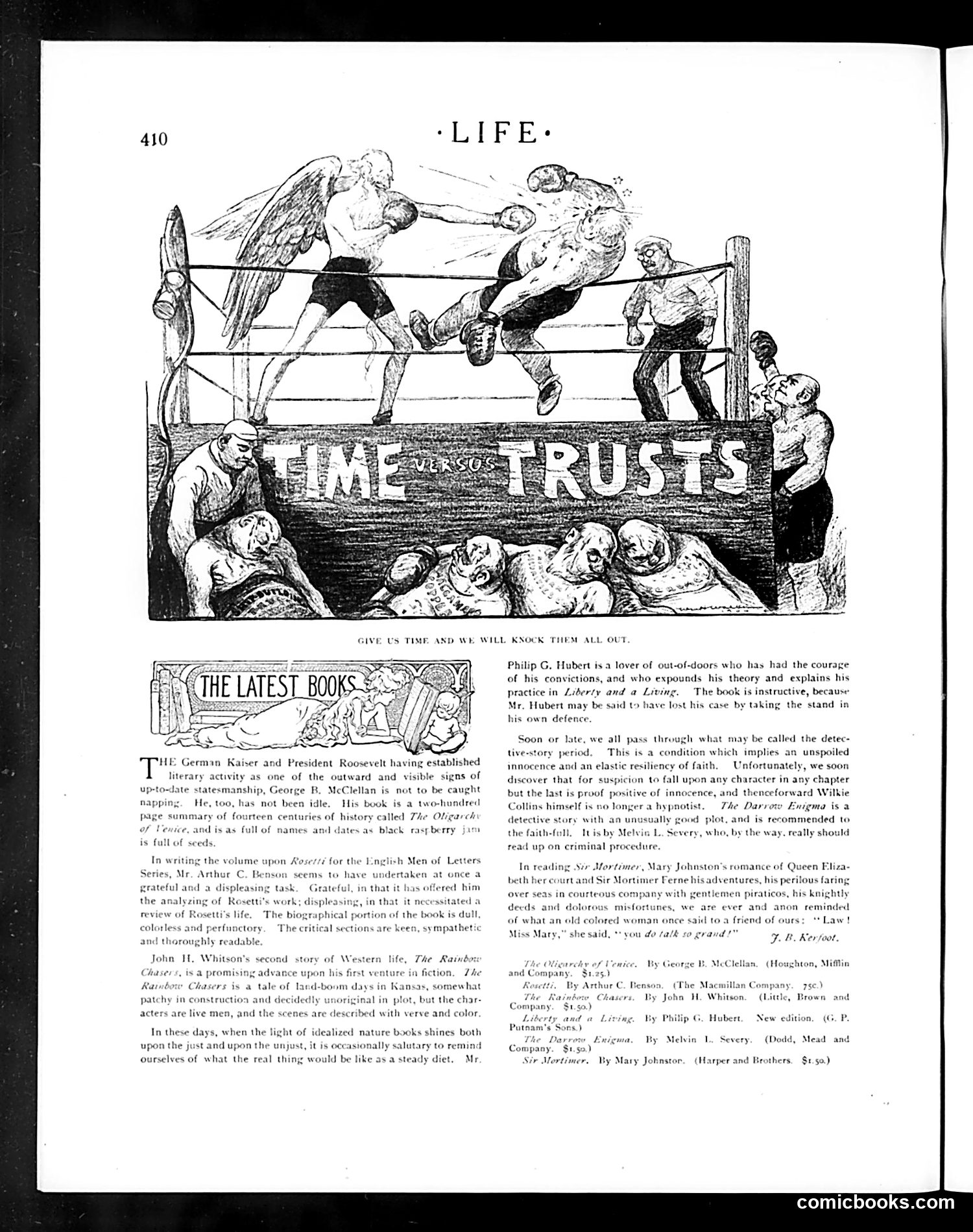
The main illustration depicts a boxing match labeled "TIME TRUSTS US," with an angelic figure (representing idealism or innocence) fighting muscular, brutish opponents representing cynicism or corruption. The caption reads "Give us time and we will knock them all out." This satirizes the optimism of Progressive Era reformers—likely alluding to President Roosevelt's trust-busting efforts and anti-corruption campaigns. The cartoon mocks the naive faith that good intentions and time alone can defeat entrenched corruption, suggesting the struggle is more physically brutal and uncertain than reformers admit. The page itself is a book review section, with the cartoon introducing commentary on detective fiction and romance novels—genres the reviewer notes appeal to readers' "unspoiled innocence" before they learn that suspicion signals guilt. The irony connects: just as detective readers eventually lose faith in narrative innocence, so too may reformers discover their optimistic crusades face harder resistance than imagined.
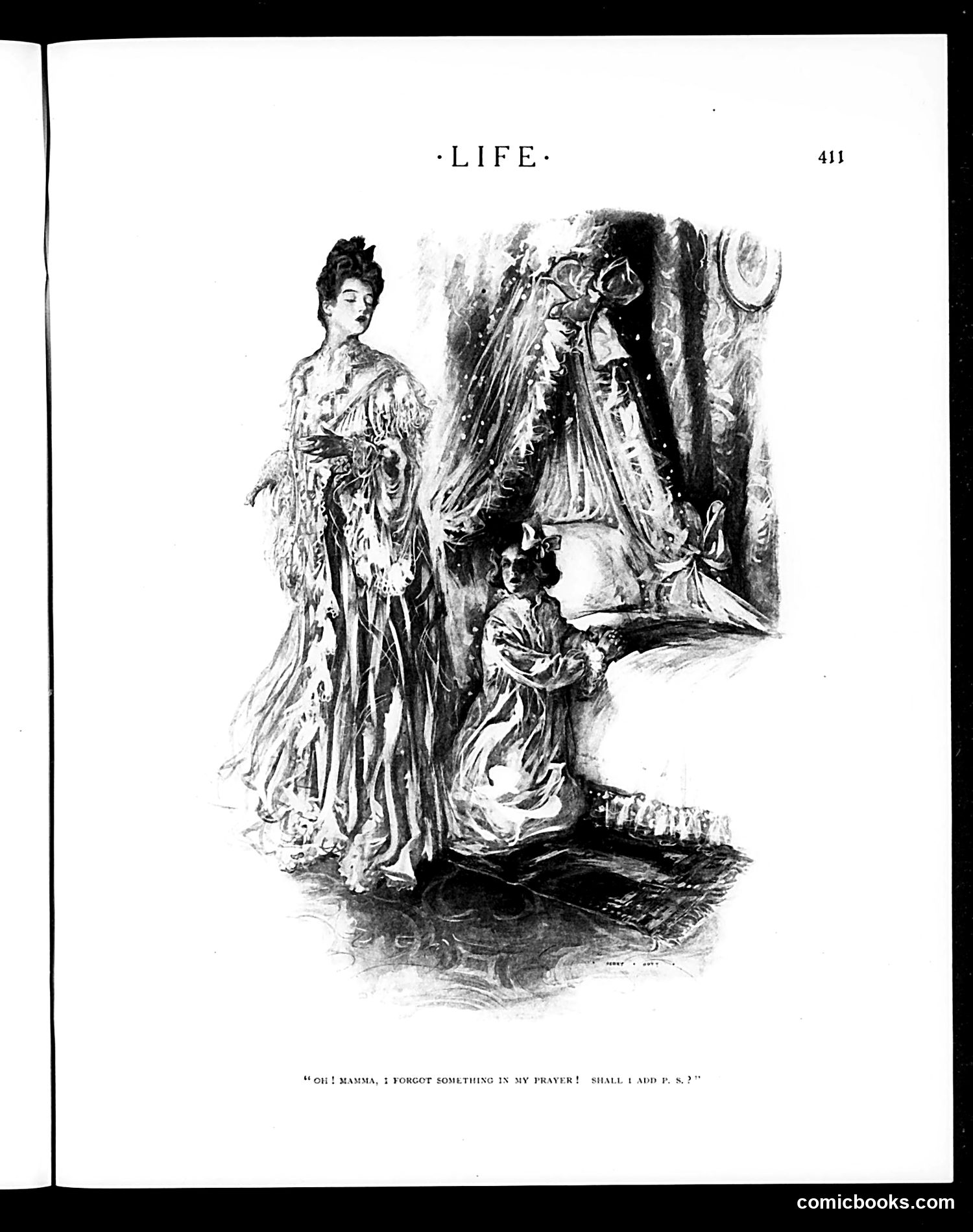
This appears to be a humorous domestic scene from *Life* magazine (page 411). The cartoon shows a woman in an elegant dress standing while a child in nightclothes kneels in prayer before bed. The child has apparently forgotten something in their bedtime prayer and asks their mother if they should add "pp. 8,2" (likely page numbers). The satire likely mocks either: 1. **Formal, rote religious practice** — suggesting prayers have become mechanical recitations of "pages" rather than genuine spiritual expression, or 2. **Parental oversight** — implying the mother may have instructed the child using written prayer guides, reducing prayer to reading assignments The humor targets the era's tendency to ritualize childhood religious instruction rather than encourage sincere devotion. The refined clothing and domestic setting suggest this critiques upper-class or respectable society's approach to children's spiritual upbringing.
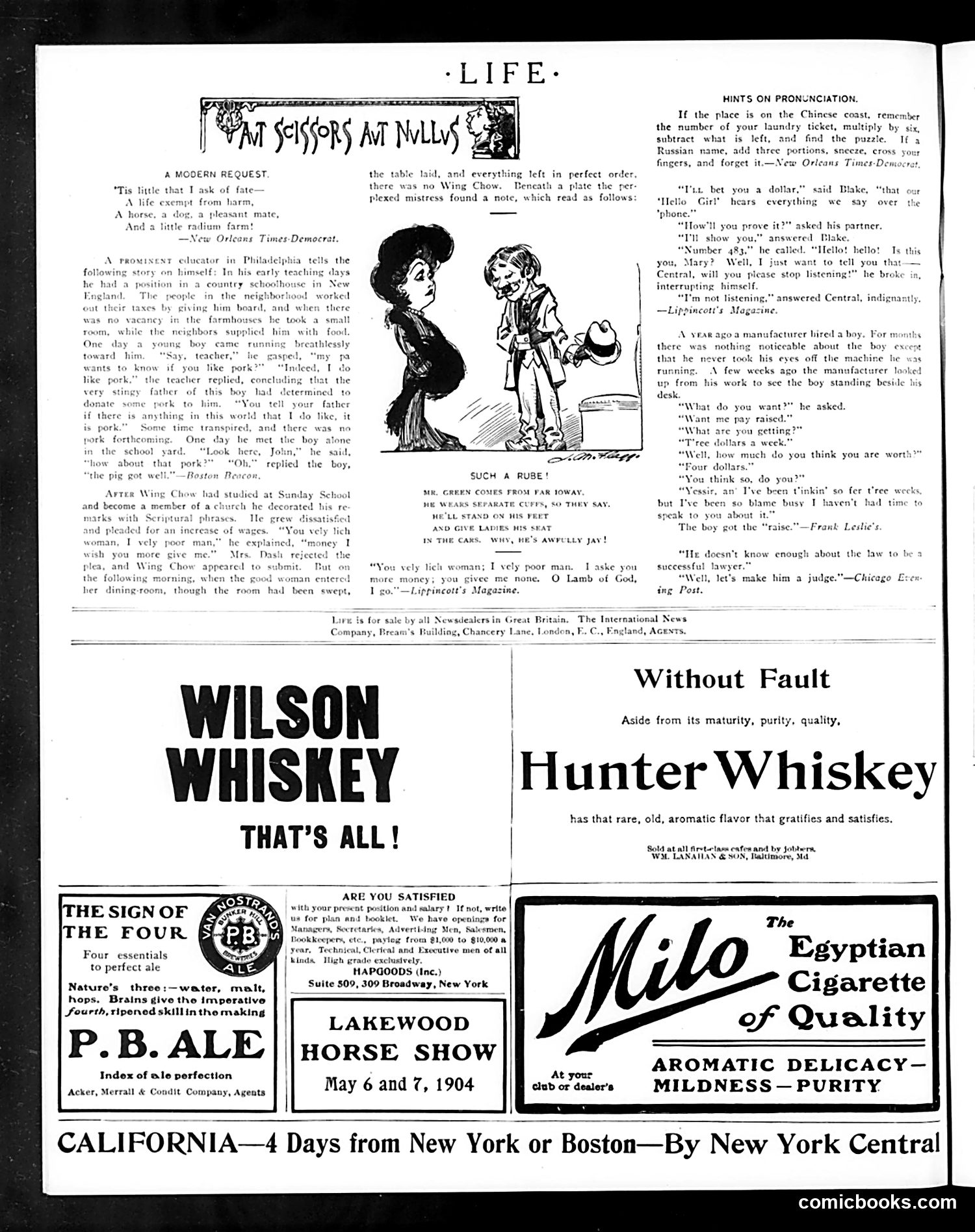
This page features a satirical cartoon titled "Sam Scissors at Nullus" (likely a play on words about a tailor or someone who "cuts" things). The main cartoon depicts an interaction between what appears to be a working-class boy and an adult authority figure, illustrating themes common to early 1900s American humor. The accompanying text stories—"A Modern Request," "A Rube," and others—employ gentle satire targeting rural or unsophisticated characters. "A Rube" specifically mocks a naive factory boy who expects raises despite lacking education, satirizing the clash between working-class ambitions and urban sophistication. The page also includes several advertisements (Wilson Whiskey, Hunter Whiskey, P.B. Ale, Milo Cigarettes, and a job placement service), reflecting *Life* magazine's dual nature as satirical publication and commercial vehicle. The humor is relatively mild by modern standards, relying on class-based comedy and predictable punchlines about rural naiveté versus urban worldliness.
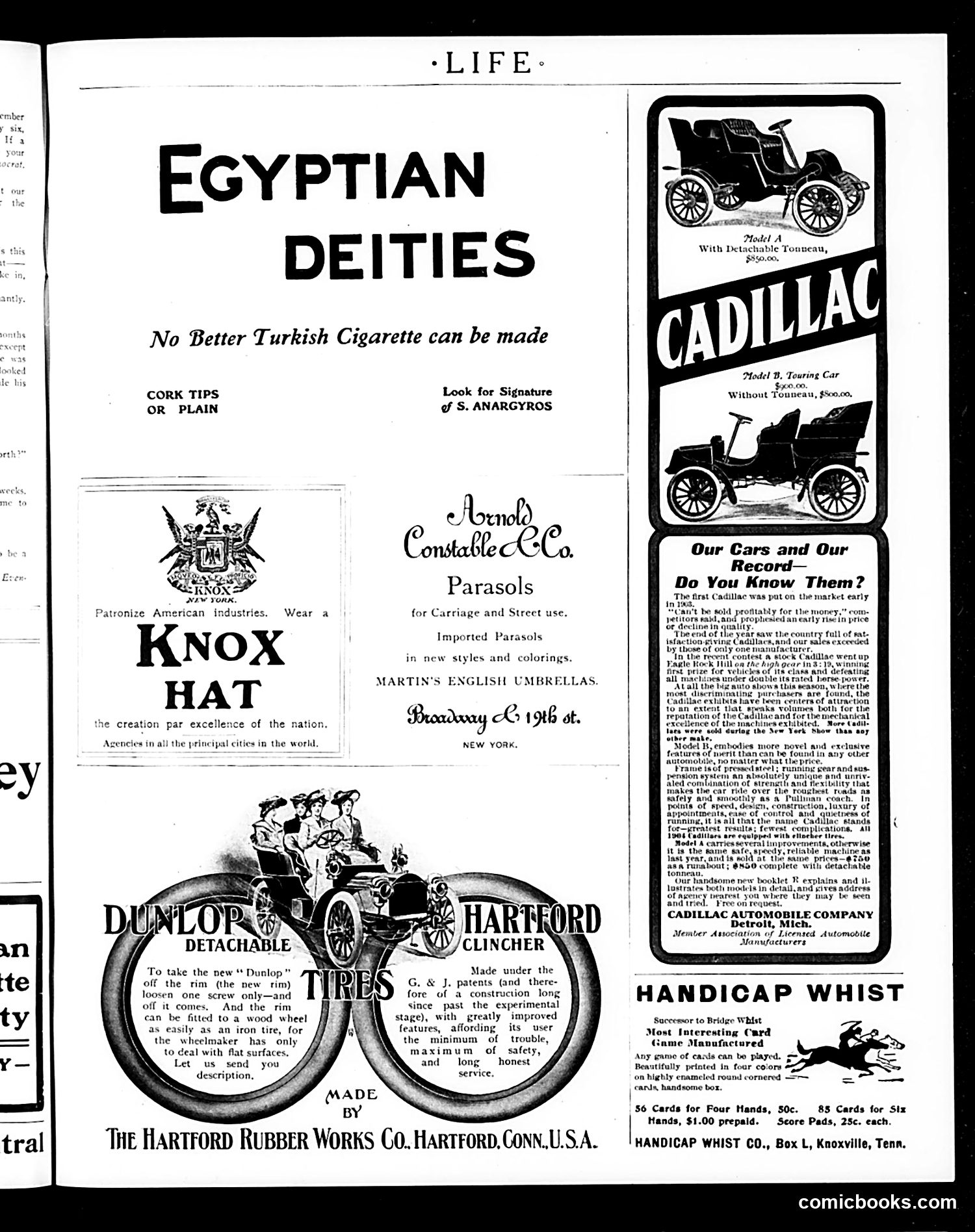
This Life magazine page is primarily **advertising**, not satire or political commentary. The title "Egyptian Deities" is a brand name for Turkish cigarettes by S. Anargyros—the humor lies in the grandiose, irreverent comparison of commercial products to ancient gods. The page showcases various early 1900s consumer goods: Knox Hats (emphasizing American manufacturing), Hartford Dunlop tires, Cadillac automobiles, parasols, and a card game. The tone is boastful and playful rather than satirical. The only potential social critique appears subtle: the "Patronize American industries" messaging for Knox Hats reflects era-specific economic nationalism, though this reads more as patriotic marketing than satire. The page reflects early 20th-century consumer culture where luxury goods were advertised through exaggeration and prestige appeals. This is fundamentally a **commercial document**, not a cartoon or satirical piece.
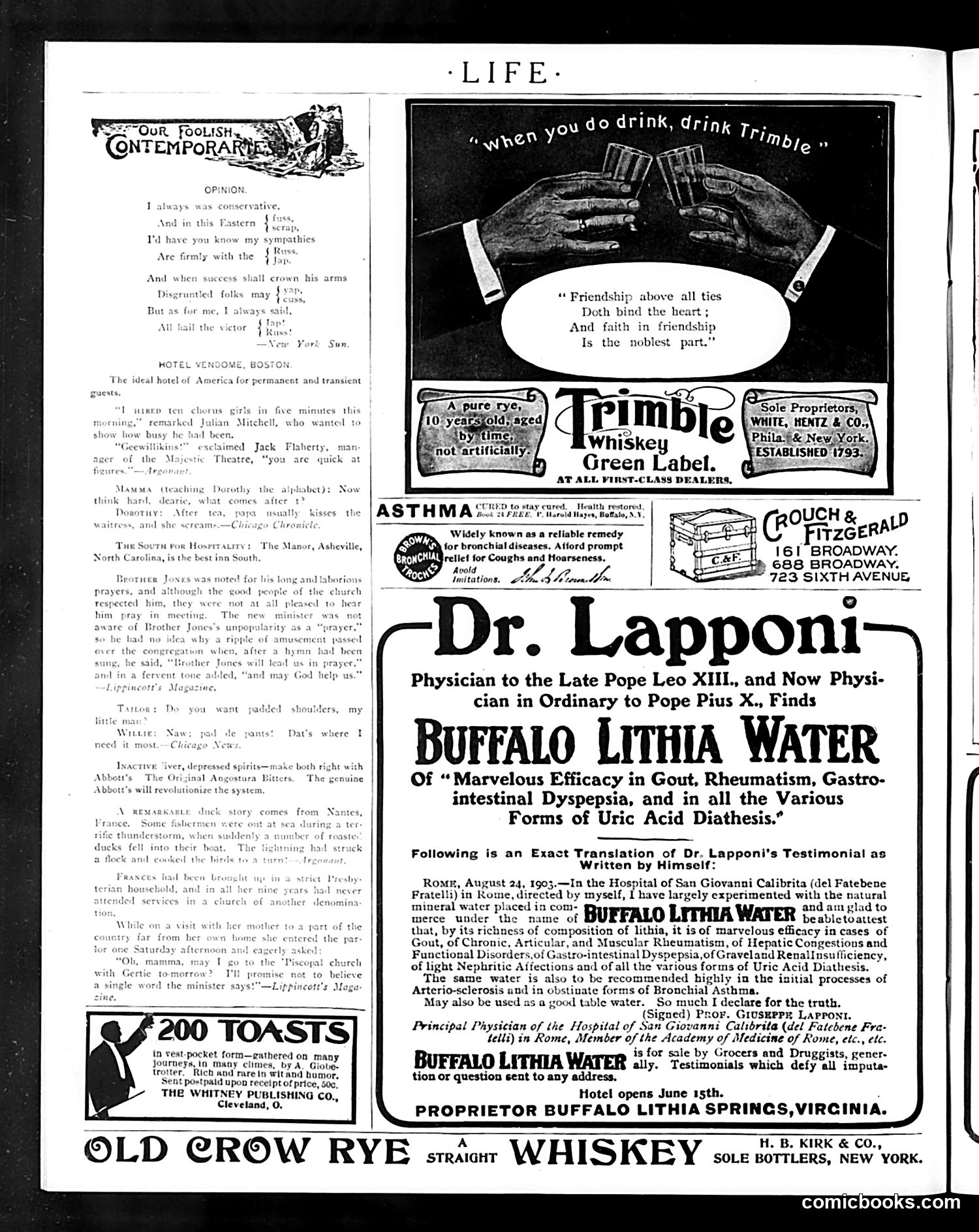
This page is primarily **advertising**, not satirical editorial content. The dominant feature is a large advertisement for Buffalo Lithia Water, a patent medicine marketed by Dr. Lapponi, allegedly physician to the Pope. The ad employs a common early-1900s marketing tactic: **celebrity endorsement through medical authority**. By claiming papal medical credentials and quoting a detailed testimonial "Written by Himself," the advertiser leverages the Pope's prestige to sell a mineral water supposedly treating gout, rheumatism, and digestive disorders. The upper portion contains minor editorial content—a "Foolish Contemporary" opinion column and a Trimble Whiskey advertisement featuring two hands toasting—but these are marginal. The page also advertises Old Crow Rye whiskey and period products like "200 Toasts" pocket books, typical of Life's commercial nature during this era. **The satire, if any, is incidental**: the very idea of papal endorsement for dubious patent medicines would strike modern readers as absurd, but contemporary audiences apparently found such claims credible enough to purchase.
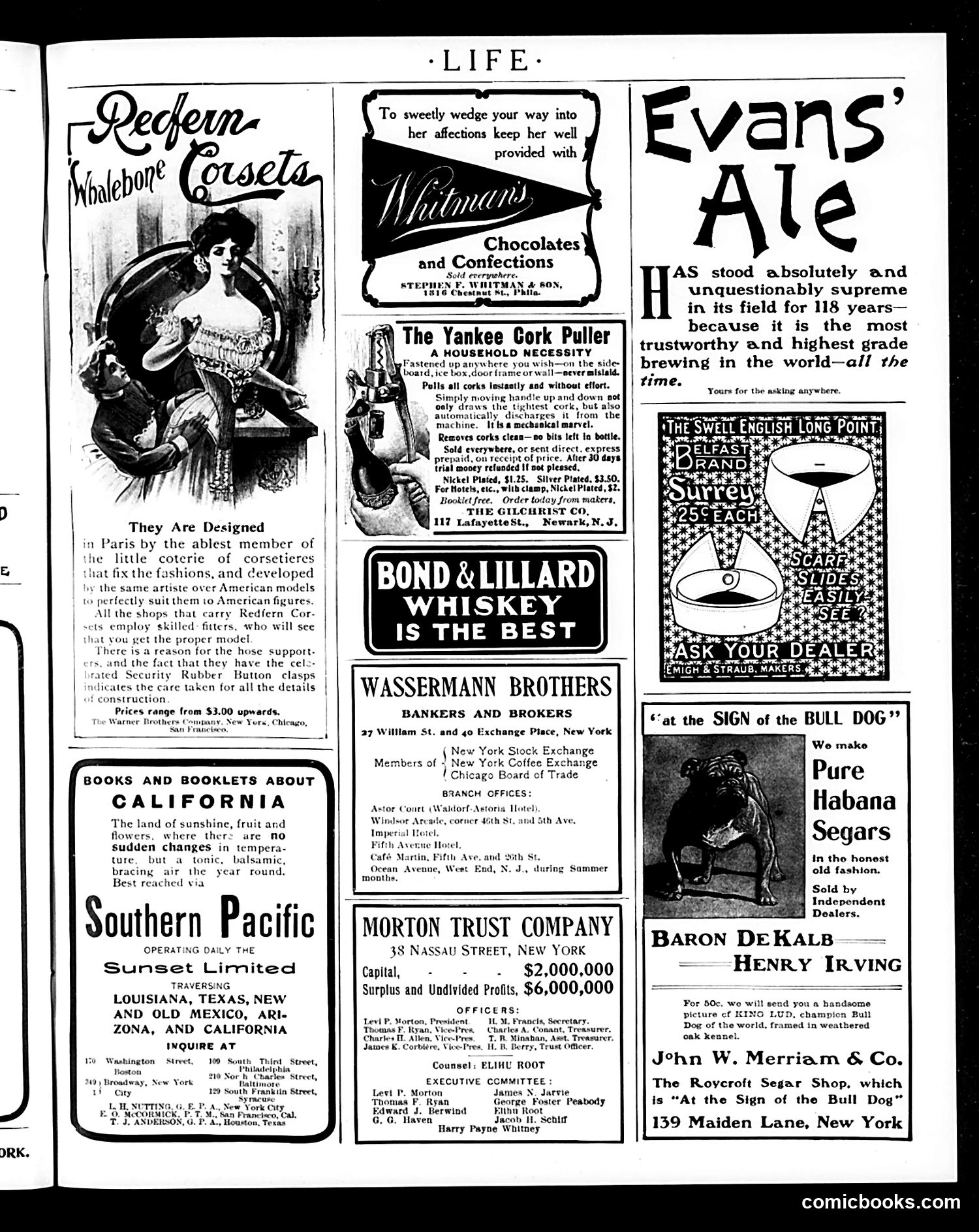
This is primarily a **commercial advertisement page** with no political cartoons or satirical content. The page consists entirely of product advertisements typical of early 20th-century American magazines. The ads promote luxury and household goods: Redfern corsets (designed in Paris), Whitman's chocolates, a mechanical cork puller, Bond & Lillard whiskey, Southern Pacific railroad travel, banking/brokerage services, Evans Ale (claiming 118 years of supremacy), English surrey carriages, and Cuban cigars. One notable visual element is an illustration of a bulldog accompanying cigar advertisements—this appears to be a brand mascot rather than satire. The page reflects the era's consumer culture and marketing strategies, featuring elegant illustrations of women and emphasis on quality/prestige. There is **no identifiable political satire or social commentary**—it is straightforward commercial promotion aimed at affluent readers.
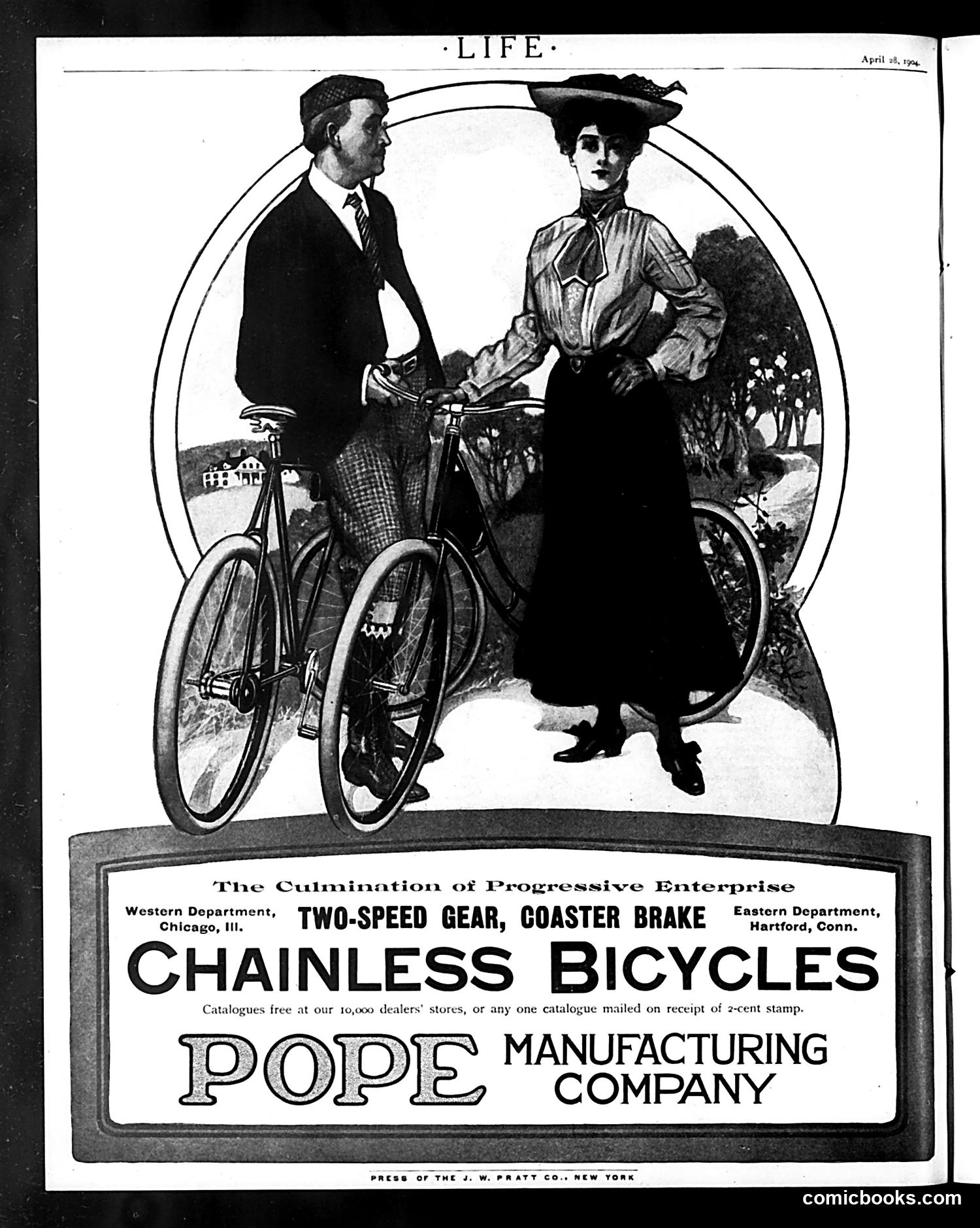
This is primarily a **bicycle advertisement**, not political satire. It depicts a well-dressed couple on chainless bicycles, presented as a modern luxury product. The ad emphasizes "Progressive Enterprise" and highlights technical features (two-speed gear, coaster brake) as cutting-edge innovations. The social commentary is implicit rather than satirical: the image presents bicycling as an attractive leisure activity for genteel, fashionable people—particularly noteworthy because it shows a woman cycling in formal attire. Early 1900s bicycles represented **women's mobility and independence**, a progressive social development. The Pope Manufacturing Company's marketing leverages this aspirational appeal to sell their chainless design as the height of modern convenience and style.