
Life, 1904-04-28 · page 4 of 20
Life — April 28, 1904 — page 4: what you’re looking at
What you’re looking at
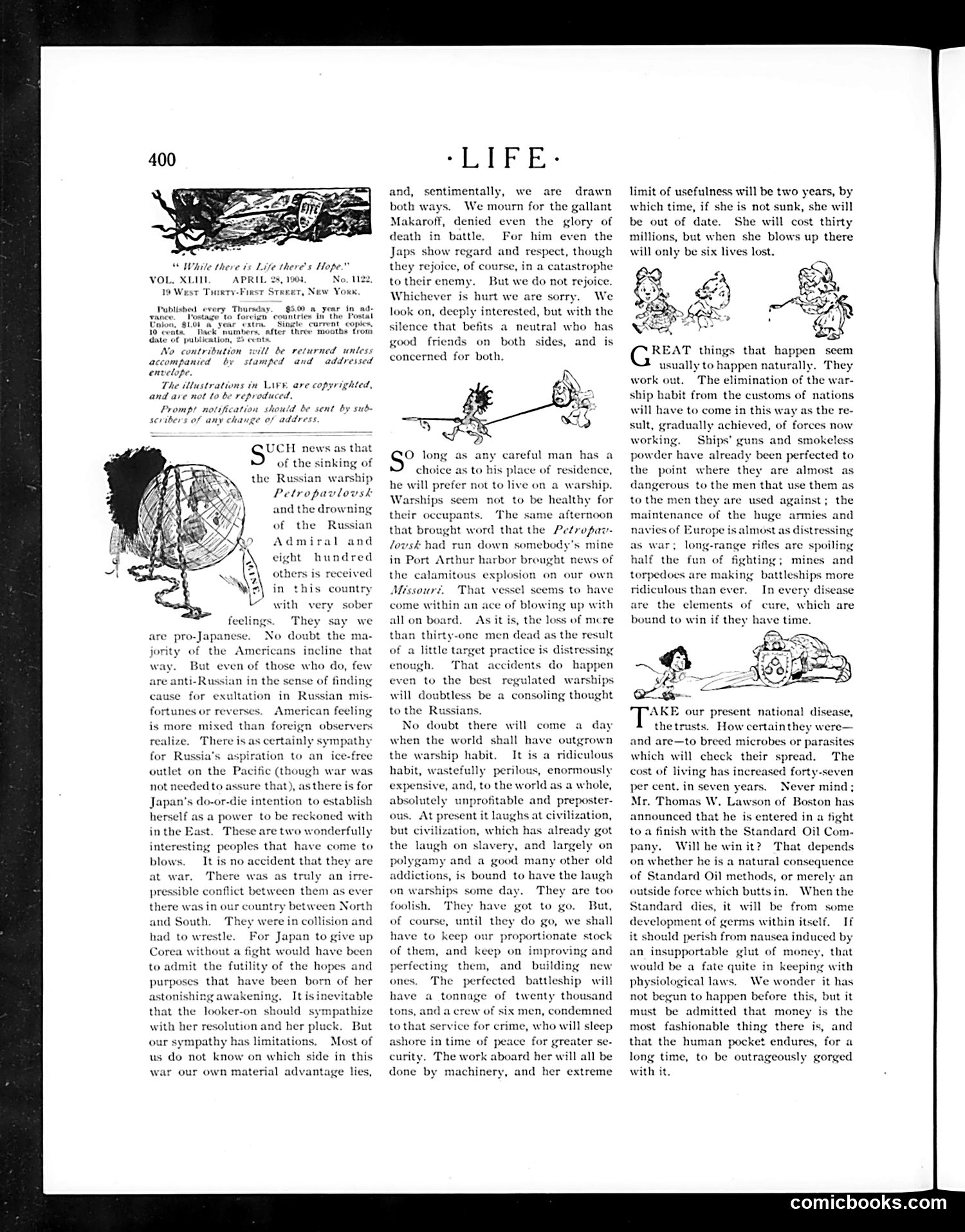
This page discusses the Russo-Japanese War, specifically the sinking of the Russian warship *Petropavlovsk* and losses at Port Arthur. The text expresses ambivalent American sympathy: while Americans have pro-Japanese leanings, the author argues neutrality is appropriate since both nations have "good friends on both sides." The decorative cartoon illustrations appear to show anthropomorphized figures engaged in various activities—possibly representing warships or nations as characters—though their specific identities are unclear from the image alone. The broader argument warns against warship-building as wasteful and advocates for peaceful resolution of international conflicts, using the escalating naval arms race as evidence of civilization's failures. The satire critiques militarism and the "warship habit" as fundamentally irrational.
📄 Transcribed text from this page (OCR, searchable)
Machine-transcribed from the original scan — historical spelling and the odd misread are preserved.
“ While there is Life there's Hope. XL APRIL 28, 1903, No. 1122, West Trurty-Fiest Street, New You $5.00 & year in ad: tries in the Postal le CUFrent Copies, numbe throe moutbs trom publication, 2 ¢ contribution accompanied by envelop The illustrations in LA¥¥, are copyrighted, and ave not to be reproduced. Prompt notification should be sent by sub- scriber's of any change of address returned untess addressed UCH news as that of the sinking of the Russian warship Petropavlovsk and the drowning of the Admiral hundred Russian and eight others is received in this country with very sober feelings © pro-Japanese. jority of the Ameri wa: But even of those who do, few re anti-Russian in the sense of finding cause for exultation in Russian mis- fortunes or reverses. American feeling is more mixed than foreign observers ‘There is as certainly sympathy for Russia's aspiration to an ice-free outlet on the Pacific (though war was us there is for They say we » doubt the ma- ‘ans incline that realize. not needed to assure that), Japan's do-or-die intention to establish herself in the East interesting peoples that have come to It is no accident that the: ‘There was as truly an irre- a power to be reckoned with These are two wonderfully blows. are at war, pressible conflict between them as ever North They were in collision and For Japan to give up Corea without a fight would have been to admit the futility of the hopes and purposes that have been born of her astonishingawakening. It isinevitable that the looker-on should sy athize with her resolution and her pluck. But our sympathy has limi Most of us do not know on which side in this war our own material advantage lies, there was in our country betwee and South. had to wrestle. ations, *LIF E- and, sentimentally, we are drawn both ways. We mourn for the gallant Makaroff, denied even the glory of death in battle. For him even the Japs show regard and respect, though they rejoice, of course, in a catastrophe to their enemy. But we do not rejoice. Whichever is hurt we a We look on, deeply interested, but with the silence that befits a neutral who has good friends on both sides, and is concerned for both, @ sorry. O long as any careful r choice as to his place of residence, he will prefer not to live on a warship. Warships seem not to be healthy for their occupants. ‘The same afternoon that brought word that the Petropav- lovsk had run down somebody's mine in Port Arth the calamitous explosion on our own harbor brought news of Missourt, That vessel seems to have come within an ace of blowing up with all on board. than thirty-one men dead as the result of a little target practice is distressing enough. ‘That accidents do happen even to the best regulated warships will doubtless be a consoling thought to the Russians. Yo doubt there will when the world shall hav the warship habit. It is a ridiculous habit, wastefully perilous, enormously expensive, and, to the world as a whole, absolutely unprofitable and preposter- ous. At present it laughs at civilization, but civilization, which has already got the laugh on slavery, and largely on polygamy and a good many other old addictions, is bound to have the laugh Th They have got to go. As it is, the loss of mere come a day outgrown on warships some ¢ are too foolish. But, of course, until they do go, we shall have to keep our proportionate stock of them, and keep on improving and perfecting them, and_ building he perfected battleship will tonnage of twenty thousand new ones. hav tons, and a crew of six men, condemned to that service for crime, who will sleep ashore in time of peace for greater se- curity. The work aboard her will all be done by machinery, and her extreme limit of usefulness will be two years, by which time, if she is not sunk, she will be out of e. She will cost thirty millions, but when she blows up there ly be six lives lost. REAT things that happen seem usually to happen naturally. They work out. The elimination of the w: ship habit from the customs of nations will have to come in this way as the re- sult, gradually achieved, of forces now Ships’ guns and smokeles ready been perfected to the point where they are almost as dangerous to the men that use them as to the men the the maintenance of the huge armies and working. powder hav ure used against ; navies of Europe is almost as distressing as war; long-range rifles are spoiling half the fun of fighting; mines and torpedoes are making battleships more ridiculous than ever. In every dise: are the elements of re, which are bound to win if they have time. 'AKE our present national disease, thetrusts. How certain they were— and are—to breed microbes or parasit which will check their spread, The cost of living has increased forty-seven per cent. in seven years. Never mind; Mr. Thomas W. Lawson of Boston has announced that he is entered in a fight to a finish with the Standard Oil Com- pany, Will he win it? That depends on whether he is a natural consequence of Standard Oil methods, or merely an outside force which buttsin. When the Standard dies, it will be from some development of germs within itself. If it should perish from nausea induced by an insupportable glut of money, that would be a fate quite in keeping with physiological laws. We wonder it has not begun to happen before this, but it must be admitted that money is the most fashionable thing there is, and that the human pocket endures, for a long time, to be outrageously gorged with it. comicbooks.com