
Life, 1904-04-28 · page 12 of 20
Life — April 28, 1904 — page 12: what you’re looking at
What you’re looking at
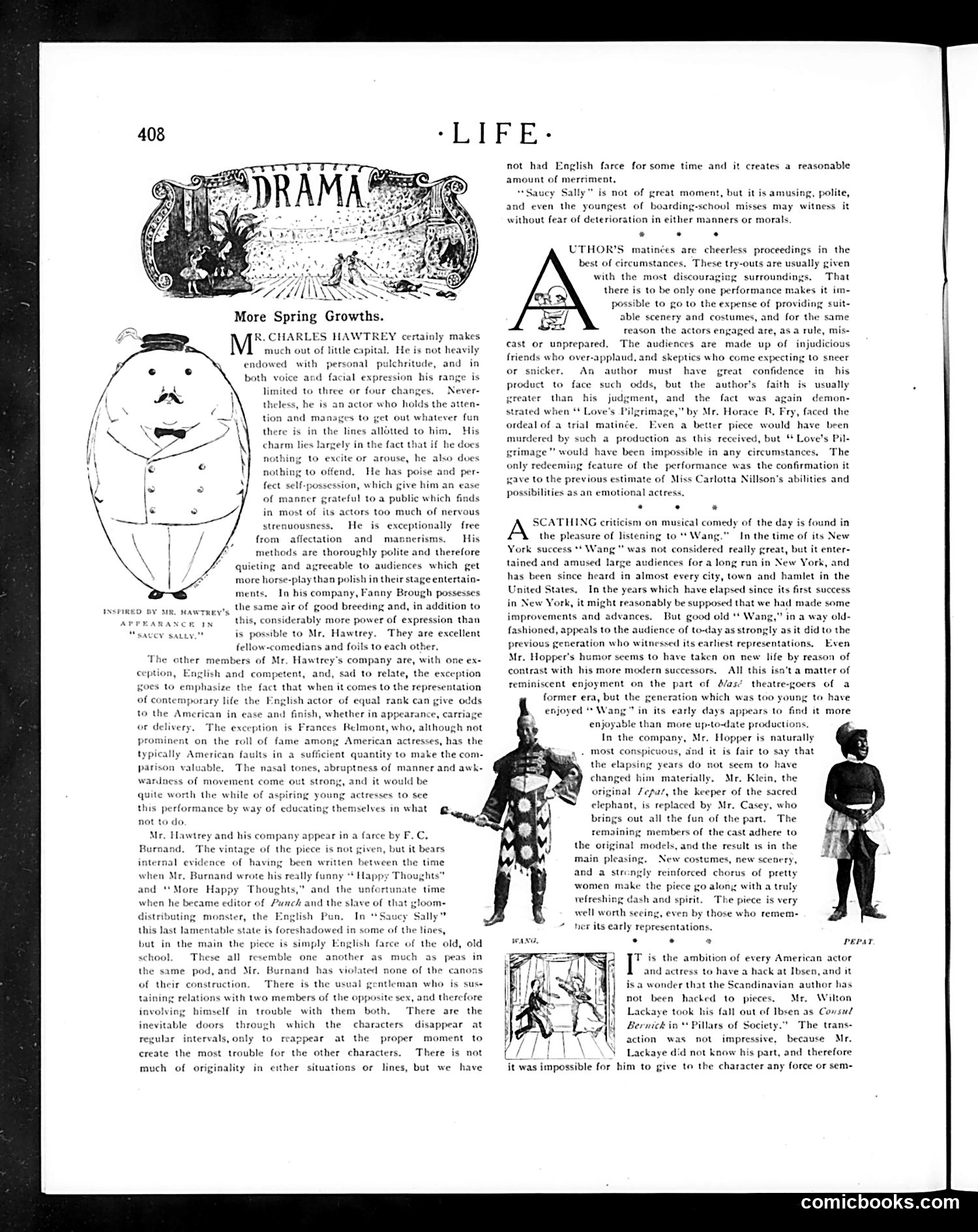
This page from *Life* magazine's "Drama" section discusses theatrical performances and actors of the era. The main illustration depicts **Mr. Charles Hawtrey**, labeled as the subject of a caricature showing a rotund, mustachioed man in formal dress. The text praises Hawtrey's comedic talents and range, noting his ability to entertain audiences through natural, unaffected performance. The article discusses various theatrical productions and actors, including references to a farce by F.C. Burnand and mentions of performers like Fanny Bough and Frances Helmond. The page includes period costume illustrations and discusses dramatic standards of the era, critiquing both theatrical conventions and the ambitions of American actors seeking recognition abroad. The overall tone is evaluative and somewhat satirical about theatrical pretension.
📄 Transcribed text from this page (OCR, searchable)
Machine-transcribed from the original scan — historical spelling and the odd misread are preserved.
‘LIF E- ee 7 ///||\ N More Spring Growths. R. CHARLES HAWTREY certainly makes much out of little capital. He is not heavily endowed with chritude, and in both voice and facial expression his range is limited to three or four ch theless, he is an actor who holds the ges. Never- tten- tion and manages to get out whatever fun His fact that if he does te or arousi there is in the lines allotted to him, charm lies largely in nothing to ex , he also does nothing to offend, He has poise and per- fect self-possession, which give him an ease of manner grateful to a public which finds in most of its actors too much of nervous strenuousness, He is exceptionally free from affectation and His methods are thoroughly polite and therefore mannerisms, quieting and agreeable to audiences which get ntertain- In his company, Fanny Brough possesses the same air of good breeding and, in addition to this, considerably more power of expression than ‘They are excellent fellow-comedians and foils to each other, more horse-play than polish in their stage ments, © bY MIR, MAWTREY'S PEARANCE IN SAveY SaLty."" is possible to Mr, Hawtrey. The other members of Mr. Hawtrey's company are, with one ex- ception, E ent, and, sad to relate, the exception - the fact that when it comes to the representation fe the English actor of equal rank cai nin ease and finish, whether in appear, glish and comp oes to empha of contemporary | to the Ameri or deliver, ive odds nce, carriage although not on the roll of fame among American actresses, has the American faults in a sufficient quantity to make the com- 1 valuable, The nasal tones, abruptness of manner and awk- {come out stron, The exception is Frances Belmont, whe oveme nd it would be the while of aspiring young actresses to see this performance by way of educating themselves in what not to do. Mr, Hawtrey and his company appear in a farce by F.C. Burnand, The vintage of the piece is not given, but it bears nal evidence of having been written between the time Mr. Burnand wrote his really funny “ Happy Thoughts’ More Happy Thoughts,” and th when he became editor of Punch and the slave of that gloom- 2 y Sally” state is foreshadowed in some of the lines, of the old, old much as inte whe! and unfortunate time distributing monster, the Pun, In “Sai this last lamentab! but in the main the piece is simply These all the same pod, and Mr. Burnand has violated nglish fare school resemble one another as peas. of the canons of their construction, ‘There is the usual gentleman who is sus« nd therefore here t relations with two members of the opposi imself in trouble them through the pear at create the most trouble for the other characters. much of sex, involving bh with the disappear at moment to both. are characters the inevitable doors which regular intervals, only to. re proper There is not originality in either situations or lines, but we have not had English farce for some time and it creates a reasonable amount of merriment, “Saucy S: is not of great moment, but it is amusing, polite, and even the youngest of boarding-school misses may witness it without fear of deterioration in either manners or morals. * . . THOR best of c with the most discouraging surroundings. matinées are cheerless proceedings in the umstances, These try-outs are usually given That there is to be only one performance makes it im- possible to go to the expense of providing suit- able scenery and costumes, and for the same Se! cast or unprepared. reason the actors engaged are, asa rule, mis- The audiences are made up of injudicious friends who over-applaud, and skeptics who come expecting to sneer or snicker, An have great product to face such odds, but the author's faith is usually greater than and the fact was again strated when “ Love's Vil "by Mr. Horace R, Fry, faced the lof a trial matinée. Even a better piece would have been murdered by such a pro author must confidence in his his ju emon- orde tion as this received, but “+ Love's Pil- been impossible in any circumstances, The feature of the performance was the confirmation it abilities and grimage ” would hav only redeeming Kave to the previous estimate of Miss Carlotta Nillson’s possibilities as. an emotional actress. . . * SCATHING criticism on musical comedy of the day is found in A the pleasure of listening to Wang.” In the time of its New ‘ork success ** Wang " was not considered really great, but it enter- ew York, and y city, town and hamlet in the In the years which have elapsed since its first success tained and amused large audiences for a long run in has been since heard in almost eve United States, in New York, it might reasonably be supposed that we had made some improvements and advances, But good old * Wang,” in a way old- fashioned, appeals to the audience of to-day as strongly as it did to the previous generation who witnessed its earliest representations, Even Mr. Hopper’s humor seems to have taken on new life by reason of All this isn't a matter of reminiscent enjoyment on the part of d/as’ theatre-goers of a former era, but the generation which was too young to have enjoyed * Wang? enjoyable than more up-to-d; contrast with his more modern successors, in its early days appears to find it more ¢ productions. In the company, Mr. Hopper is naturally dit is fair to say that lapsing years do not seem to have Mr. original Zepar, the keeper of the sacred clephant, is replaced by Mr. Casey, who brings out all the fun of the part, The remaining members of the cast adhere to the original models, and the result 1s in the main pleasing, New and a changed him materially, Xlein, the emes, new scenery, reinforced chorus of pretty women make the piece go along with a truly vefreshin; stron hand spi € piece is very well worth seeing, even by those who remem- her its early representation .- * e r is the ambition of every American actor and actress to have a hack at Ibsen, and it isa wonder that the Scandinavian author has not been hacked to pieces. Mr. Wilton Lackaye took his fall out of Ibsen as Covsud Bernich in Pillars of Sc * ‘The trans- action not because Mr. Lackaye did not know his part, and therefor ‘it was impossible for him to give to the character any force or sem- iety.” was impressive, PEPAT comicbooks.com