
A complete issue · 20 pages · 1904
Life — April 14, 1904
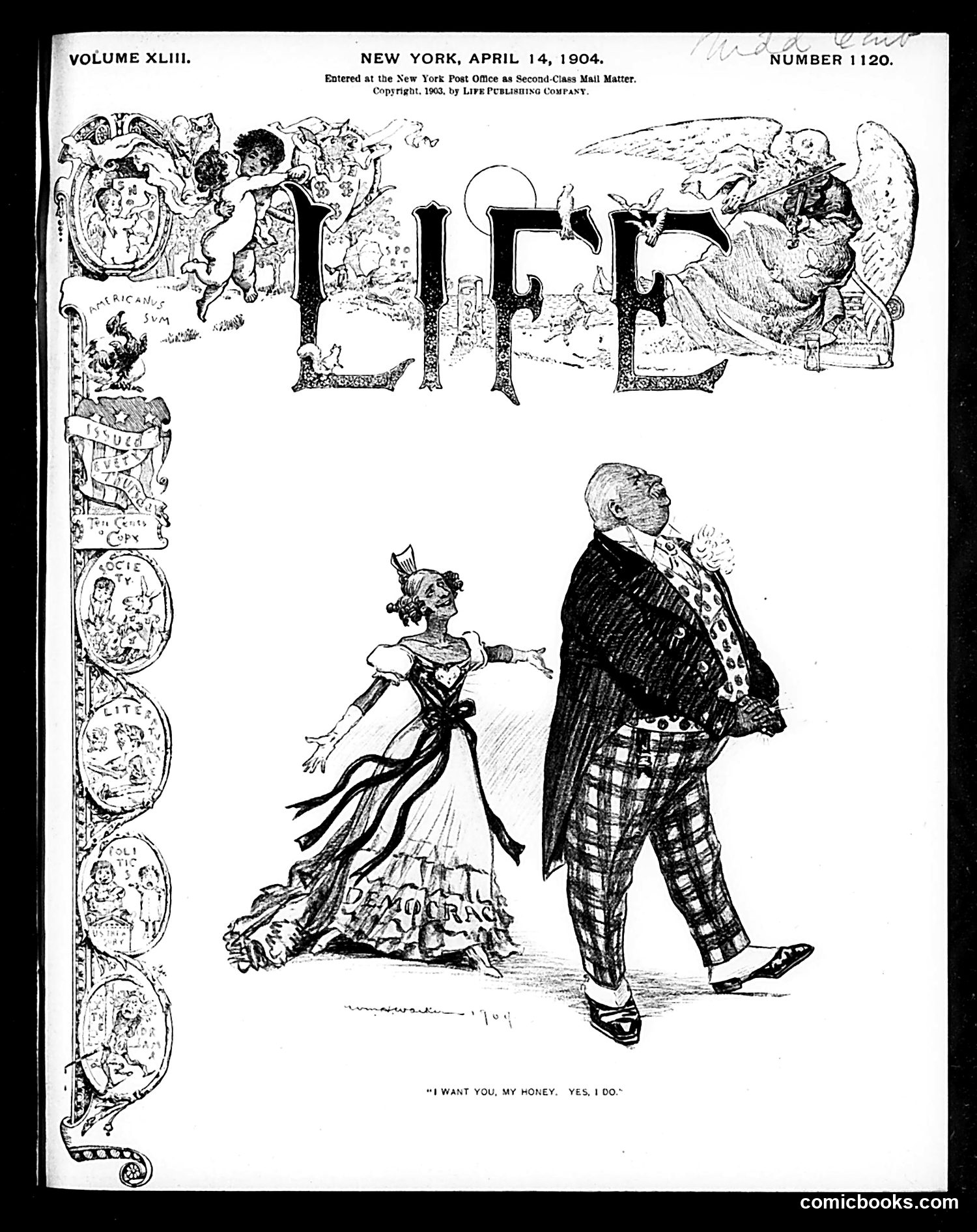
This satirical cartoon depicts a man in Scottish dress (identified by the plaid trousers and cape) proposing to a woman representing Democracy, whose dress trails across ground labeled "Democracy." The caption reads: "I WANT YOU, MY HONEY. YES, I DO." The cartoon appears to be political satire involving a Scottish figure—likely representing Scotland or a Scottish politician—attempting to court or win over American Democracy. The woman's hesitant or accommodating pose suggests tension or ambiguity about this political "courtship." Without additional context from the magazine's surrounding articles, the specific political event or figure referenced remains unclear, though the romantic proposal framing suggests commentary on political persuasion or alliance-building circa 1904.
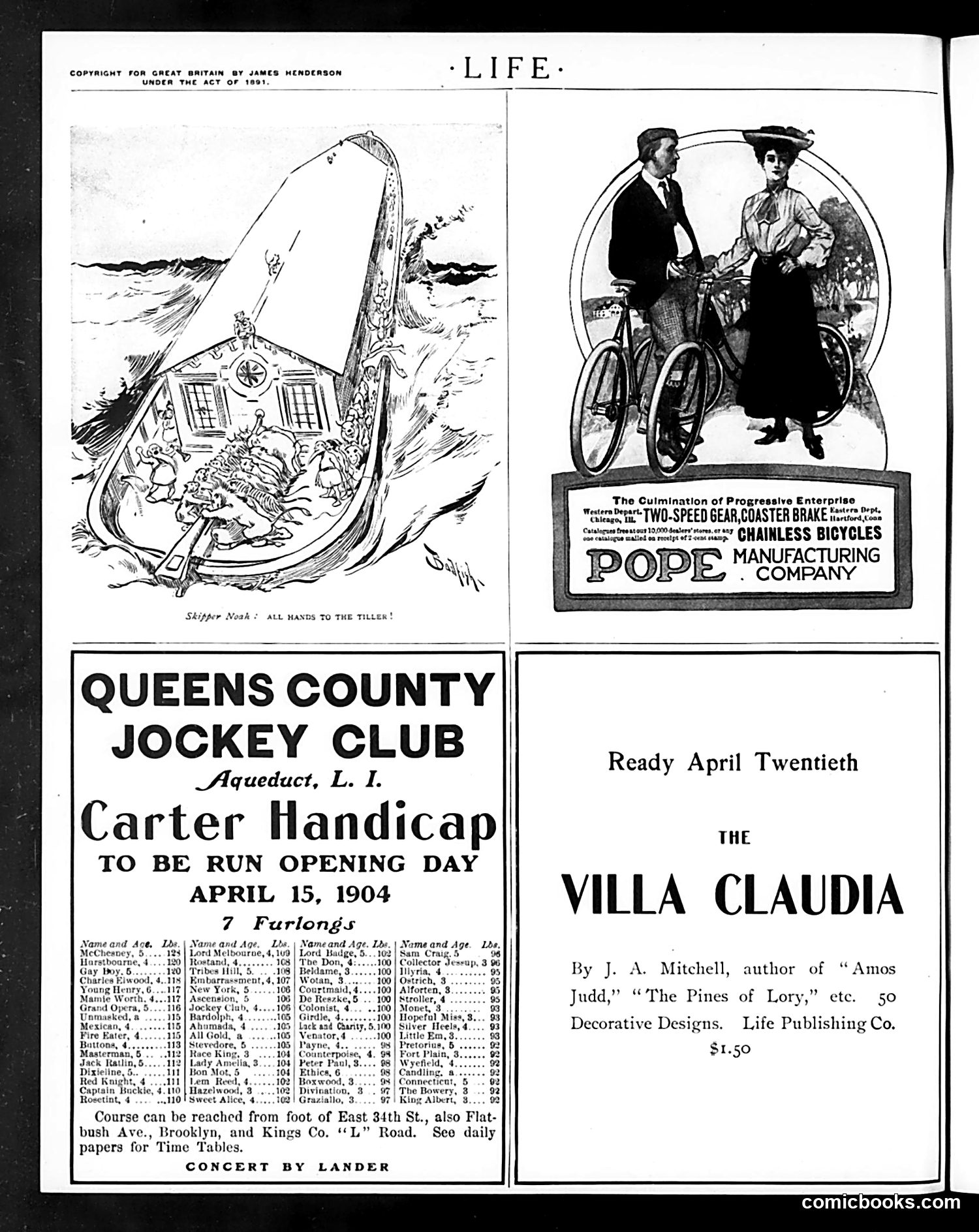
The top left cartoon depicts "Skipper Noah - All Hands to the Tiller!" showing a ship in distress with figures scrambling on deck. This appears to be political satire using the Noah's Ark metaphor, likely referencing a contemporary crisis or governmental situation requiring urgent coordinated action. The "skipper" (captain) metaphor suggests leadership during turbulent times. The page is primarily **advertising content**: a Pope Manufacturing Company bicycle ad, a Queens County Jockey Club racing announcement, and a book advertisement for *The Villa Claudia*. Without additional historical context about the publication date or contemporary events referenced, the specific political meaning of the Noah cartoon remains unclear, though it clearly employs maritime disaster imagery as metaphor for some pressing national or social concern requiring unified response.
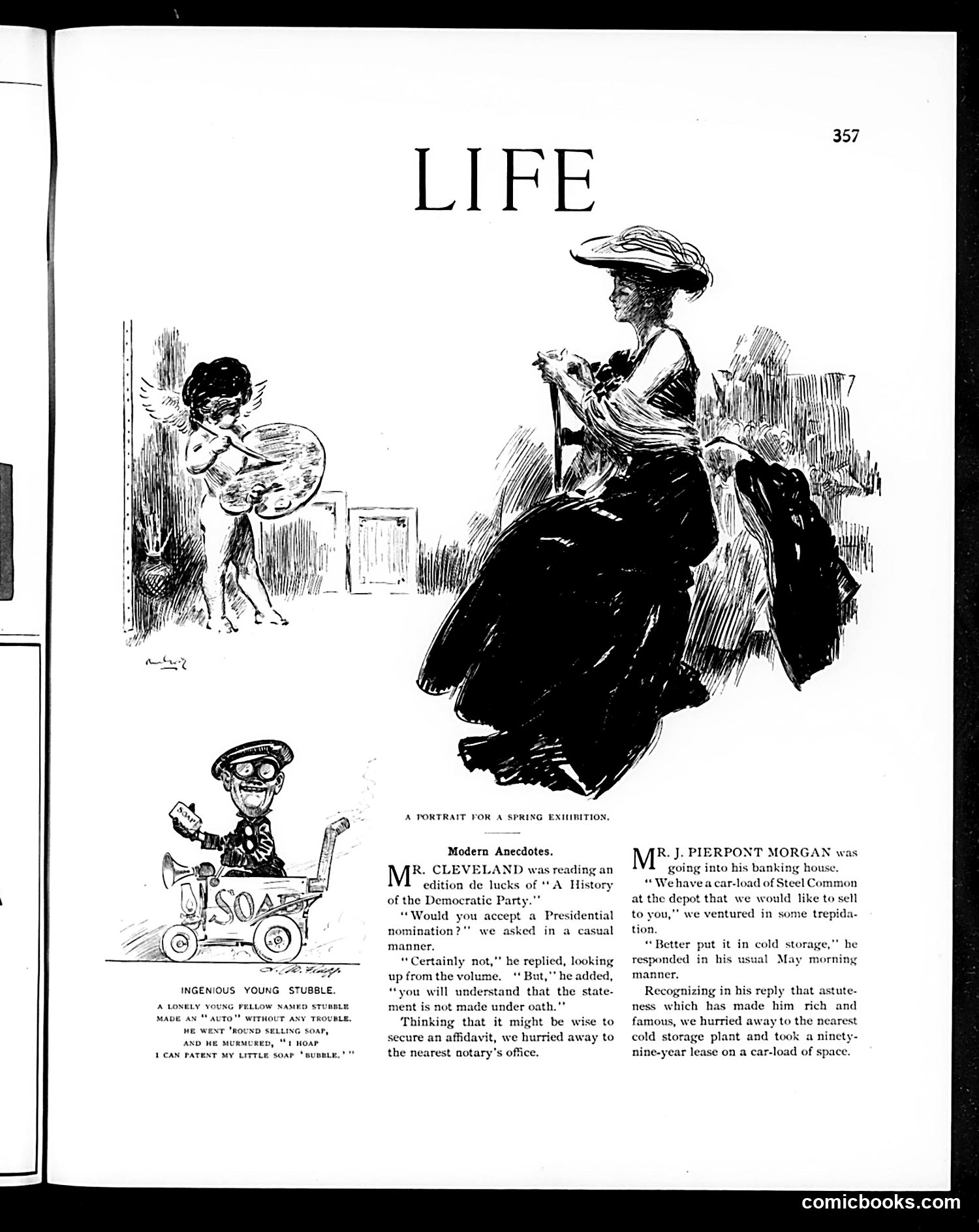
This page contains three satirical cartoons and two anecdotes mocking political and social figures of the early 20th century. **Top cartoon**: A woman artist (with palette) paints a portrait while Cupid watches—titled "A Portrait for a Spring Exhibition," likely satirizing contemporary art pretensions. **Bottom left**: "Ingenious Young Stubble" depicts a caricatured boy with a soap bubble maker, mocking a child who patented a "soap bubble" invention—satirizing both youthful ambition and frivolous patents. **Text anecdotes**: Two "Modern Anecdotes" mock prominent figures—Cleveland (likely President Grover Cleveland) rejecting a Democratic Presidential nomination, and J. Pierpont Morgan (the famous banker) dismissively refusing to sell his car-storage space in cold weather. Both anecdotes ridicule wealthy and powerful men's eccentricities and callousness. The page satirizes vanity, pretension, and elite indifference.
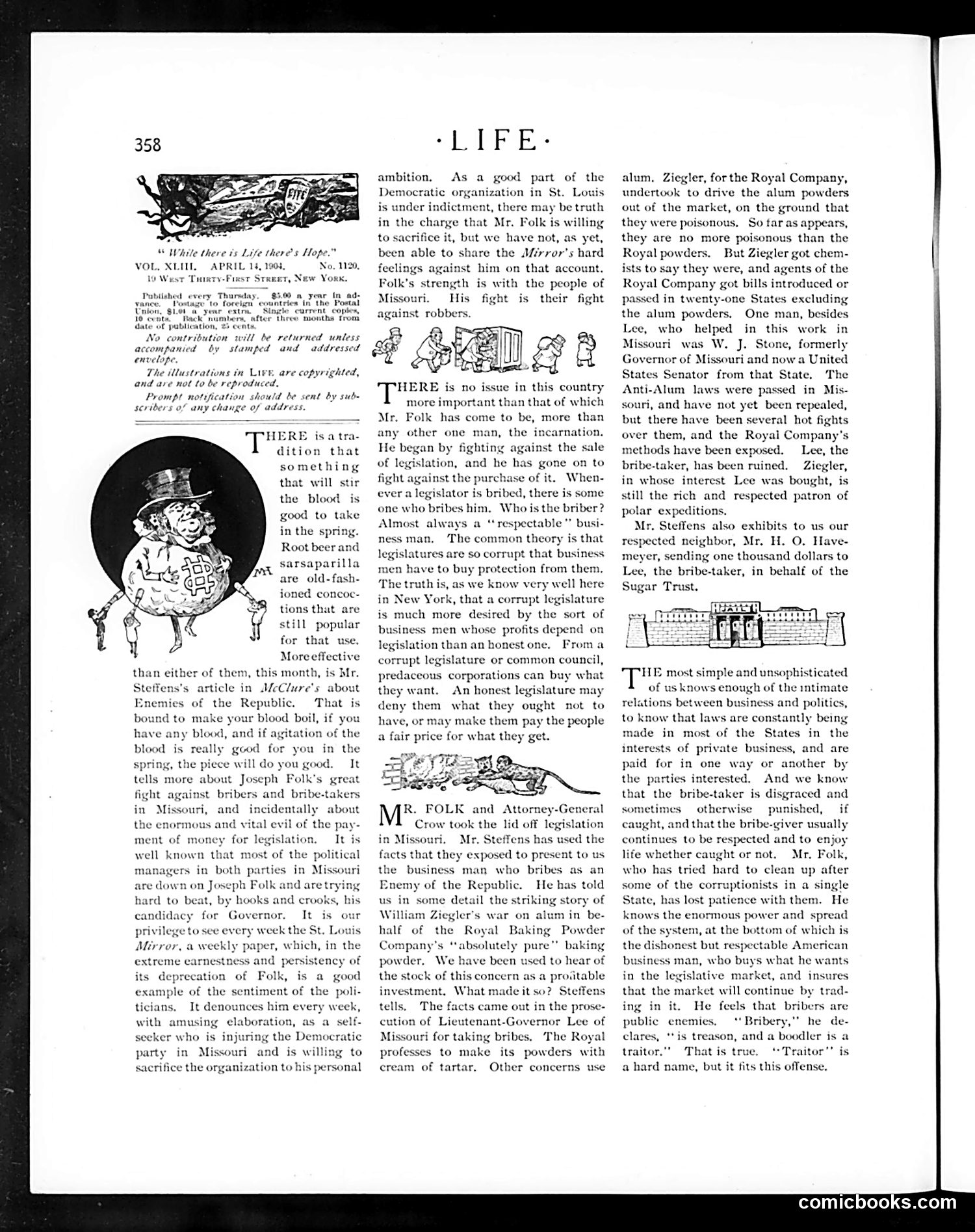
This page critiques corruption in Missouri politics, particularly focusing on Joseph Folk's anti-corruption campaign. The main cartoon depicts a bloated figure labeled "sarsaparilla" (likely representing a corrupt politician or business interest), visually satirizing how legislators can be "bought" through bribes. The article discusses Folk's fight against bribery in state legislation and his exposure of the Royal Baking Powder Company's use of poisonous alum in their products. The text argues that while business corruption exists nationwide, Missouri's legislature has been particularly susceptible to bribery. The satire targets the hypocrisy of politicians who claim respectability while secretly accepting bribes, and criticizes how corrupt legislatures are more desirable to certain business interests than honest ones.
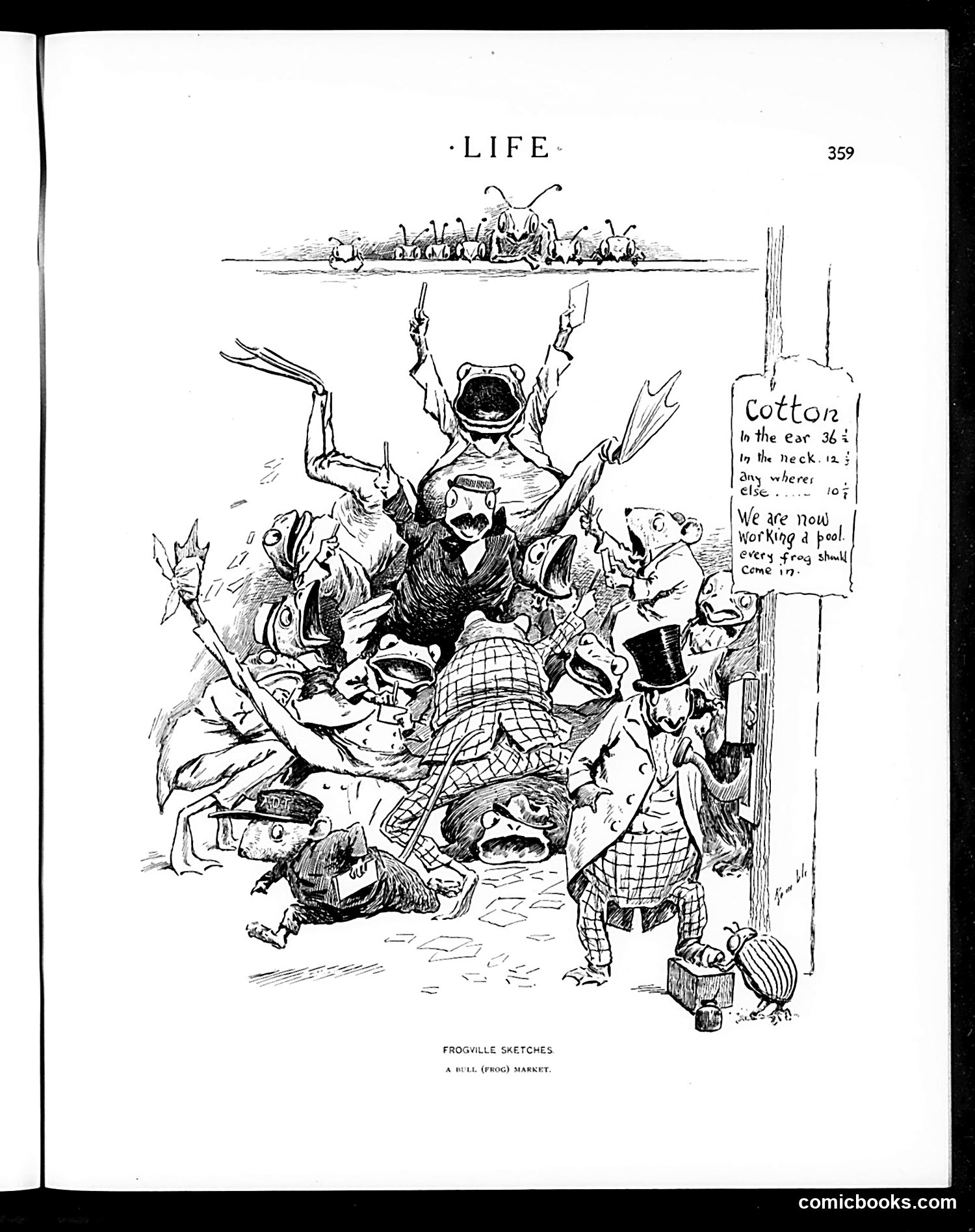
This is a satirical illustration titled "Frogsville Sketches" depicting anthropomorphic frogs engaged in market trading. The central large frog, elevated and gesturing triumphantly with raised arms, appears to be a stock market speculator or "bull" (one betting on price increases). The surrounding frogs represent various market participants in chaotic activity. A sign references "cotton" prices and mentions "working a pool"—likely referring to market manipulation schemes common in the early 20th century, where groups pooled resources to artificially drive up stock prices. The satire mocks financial speculation and market manipulation by depicting these activities through the absurd lens of frogs in a marketplace. This reflects contemporary concerns about stock market corruption and the dangers of unchecked speculation, presented as humorous animal caricature.
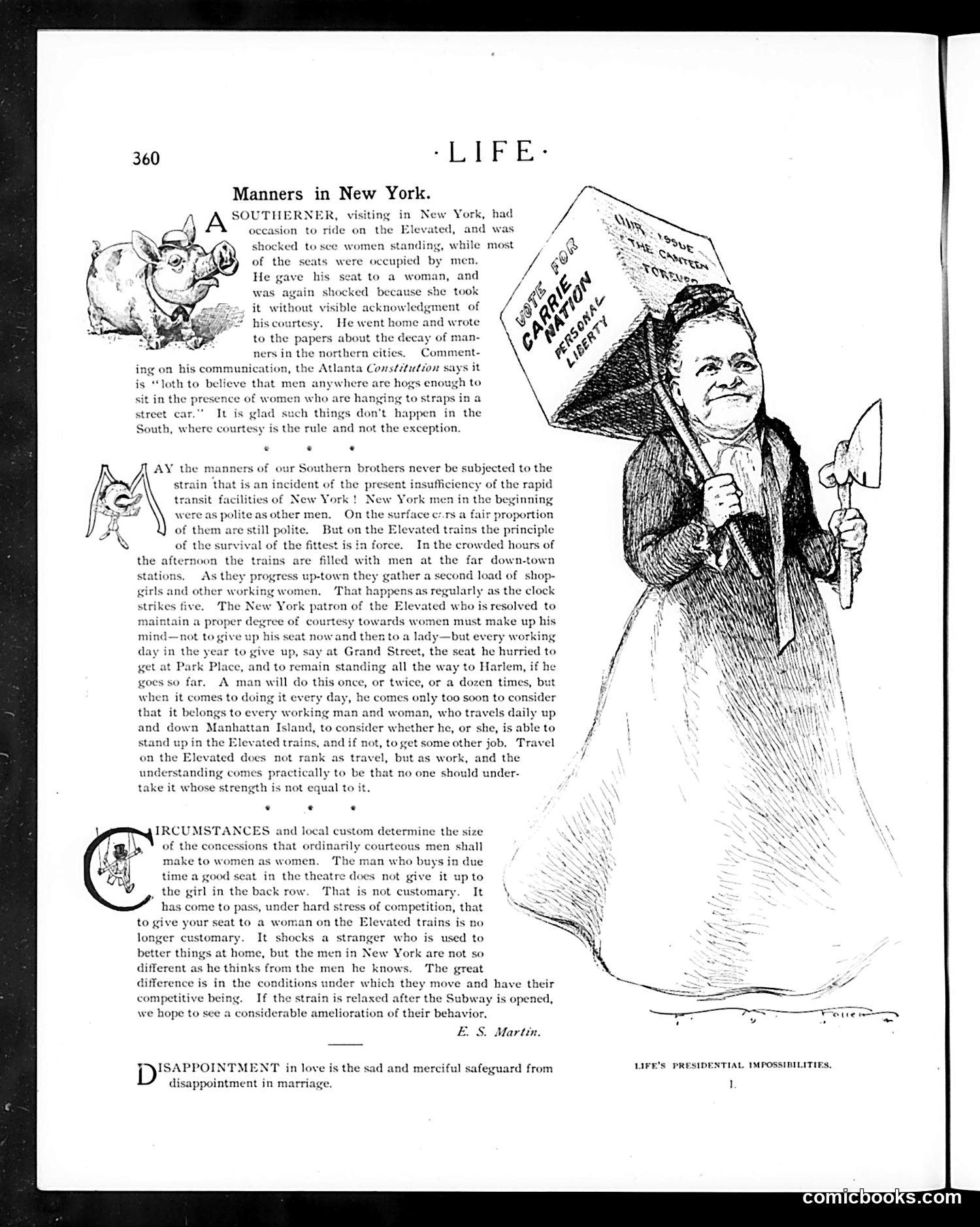
This satirical piece critiques declining courtesy on New York's Elevated trains (the "El"), comparing northern rudeness unfavorably to southern gentility. A visiting Southerner is shocked to witness men refusing seats to women—behavior he considers barbaric. The main cartoon depicts a woman carrying a banner reading "VOTES FOR WOMEN" while holding a flag, likely representing the suffrage movement. The satire suggests an ironic contradiction: women demanding equal rights and voting privileges, yet still expecting men to yield seats to them. The piece argues that crowded urban conditions and competitive commuting have eroded traditional courtesy, and that the "New York patron" must decide whether politeness toward women should continue—especially as women demand equality.
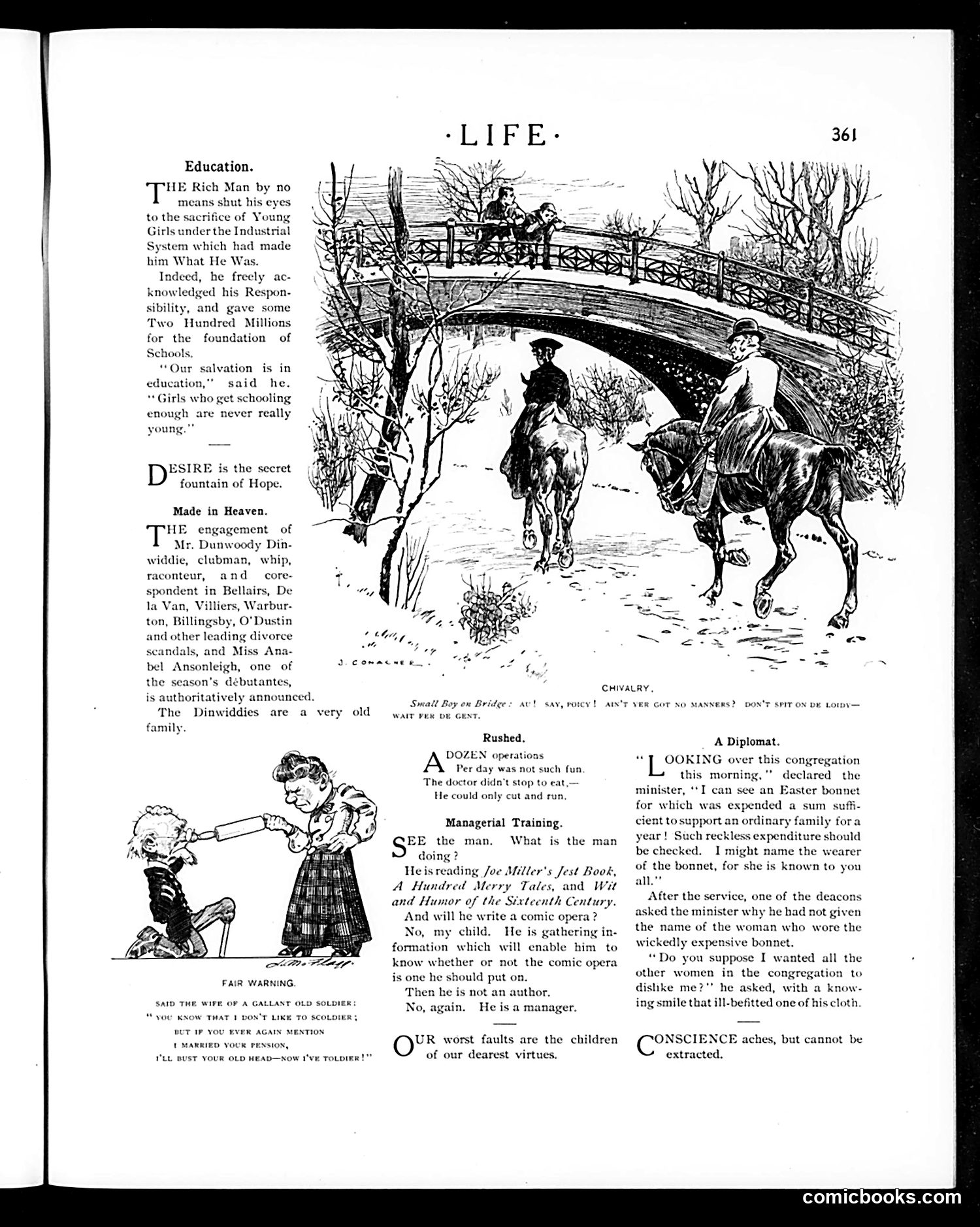
This page contains several brief satirical pieces typical of early Life magazine's format: **"Chivalry"** (top illustration): Shows young boys on horseback beneath a bridge where girls watch. The caption mocks modern manners: "Small boys on bridge: 'Au! say, Rosy! Ain't yer got no manners? Don't spit on de lady!'" The satire targets the decline of gentlemanly behavior among youth. **"Managerial Training"** (middle): A woman questions a man reading *Joe Miller's Jest Book* about writing a comic opera. His response—that he's a "manager," not an author—satirizes how business managers often lack actual expertise in their fields. **"A Diplomat"** (bottom): Mocks church decorum, where a minister lectures about an expensively dressed woman's "Easter bonnet." The satire critiques both conspicuous consumption and clergy's judgment of parishioners' appearances. These reflect turn-of-century concerns about manners, competence, and hypocrisy.
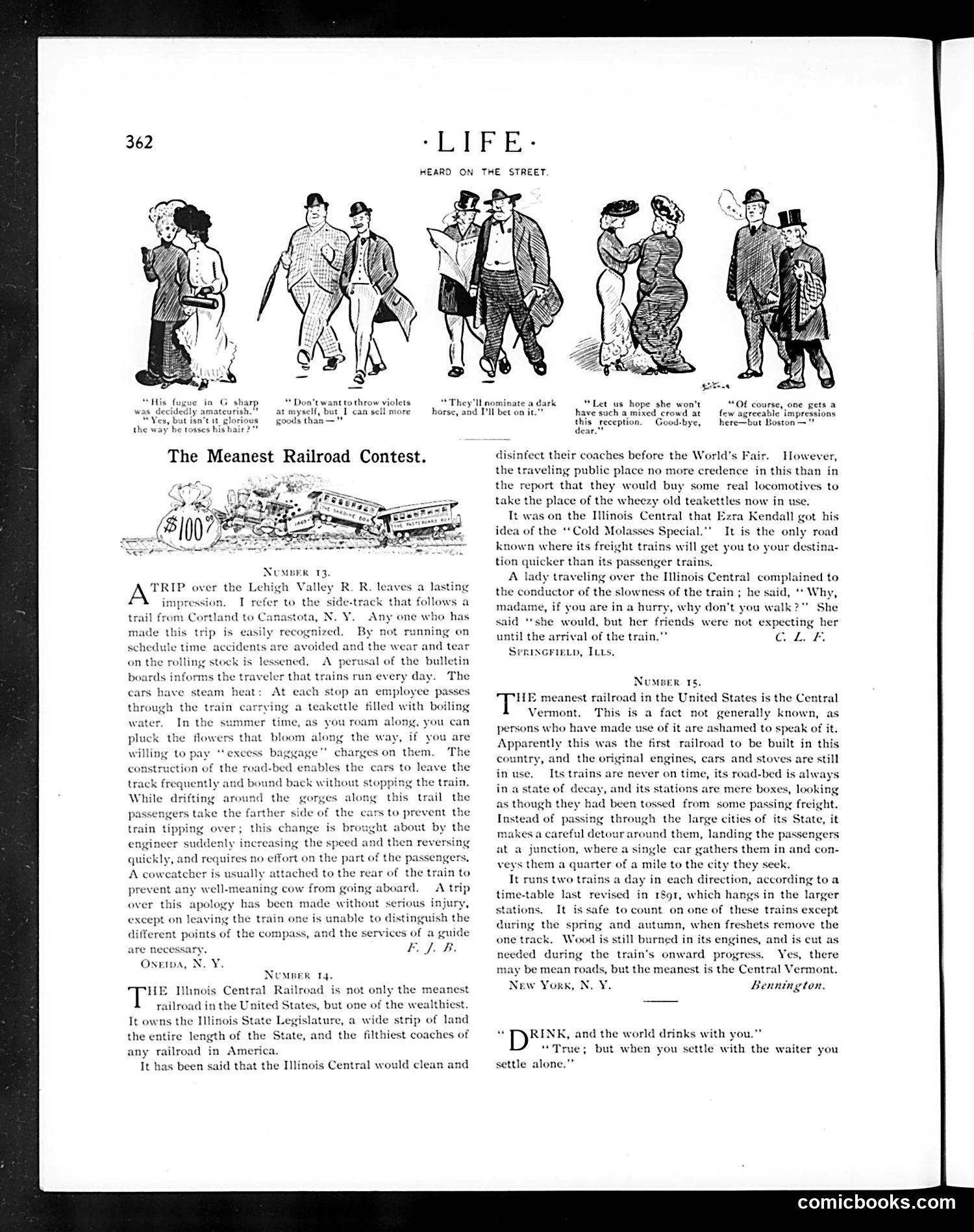
This page contains three sections: a cartoon strip titled "Heard on the Street" showing six vignettes of everyday urban conversations, and two articles about eccentric American railroads. The "Heard on the Street" cartoon captures period humor through overheard dialogue—typical Life magazine social satire poking fun at contemporary manners and relationships. The sketches appear to mock romantic entanglements, social pretension, and courtship rituals of the era. The main articles describe "mean" or poorly-maintained railroads: the Lehigh Valley line (which runs trains on worn tracks) and the Illinois Central (described as the meanest railroad, operating decrepit trains that rarely enter major cities). These pieces blend genuine travel information with humorous complaints about service quality, targeting actual railroad companies' negligence toward passengers.
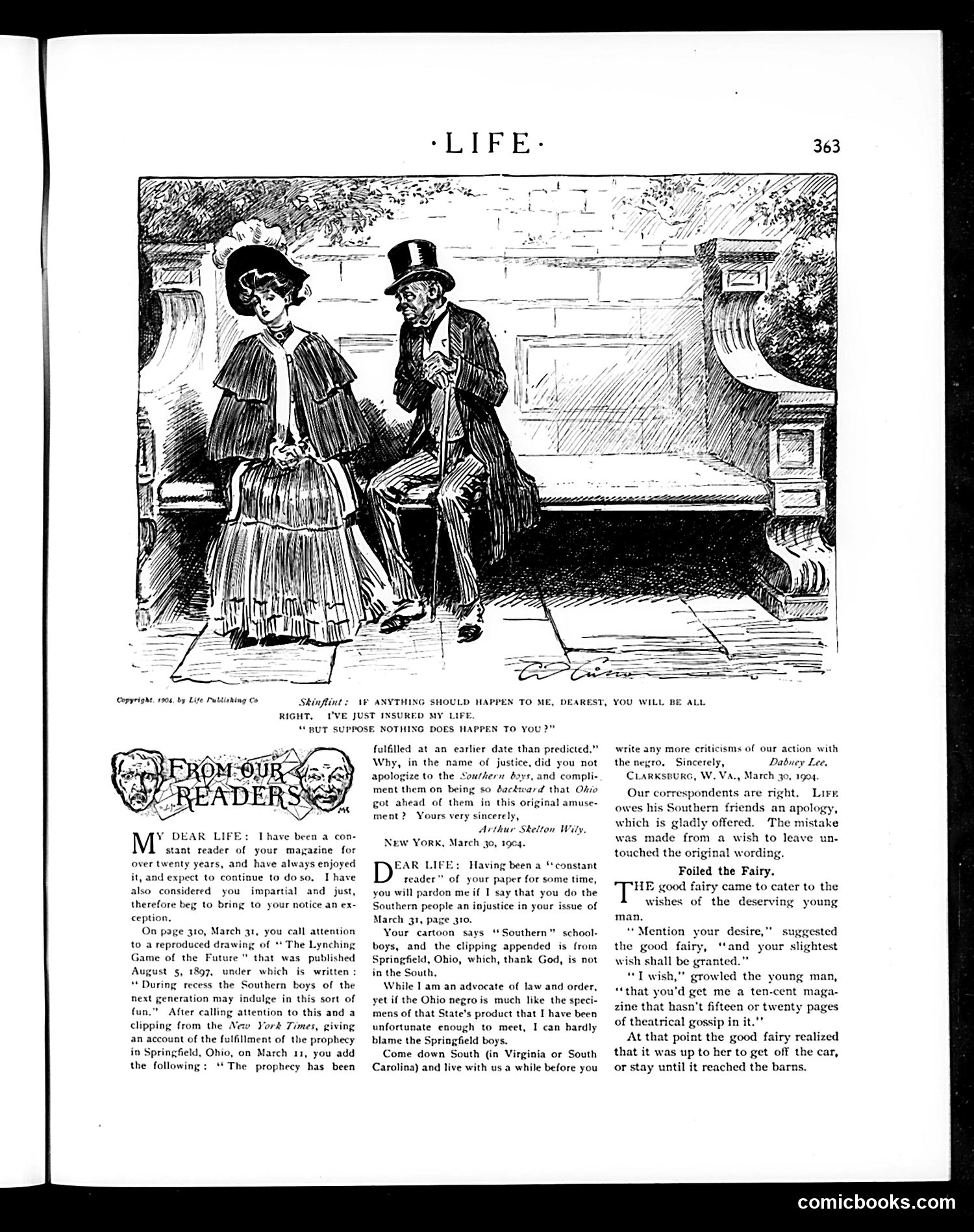
The main cartoon depicts a well-dressed couple in formal early 1900s attire. The man, wearing a top hat, appears to be reassuring the woman about life insurance, saying: "If anything should happen to me, dearest, you will be all right. I've just insured my life. But suppose nothing does happen to you?" This is a **life insurance advertisement disguised as humor**. The joke plays on the irony of insuring against death while remaining anxious about the future anyway. The cartoon satirizes the emerging insurance industry by showing how insurance salesmen used romantic domestic scenarios to sell policies to husbands worried about their wives' security. The "From Our Readers" section below contains letters addressing a previous cartoon about Southern racial attitudes and Ohio prejudice, indicating *Life* magazine's engagement with contemporary social commentary.
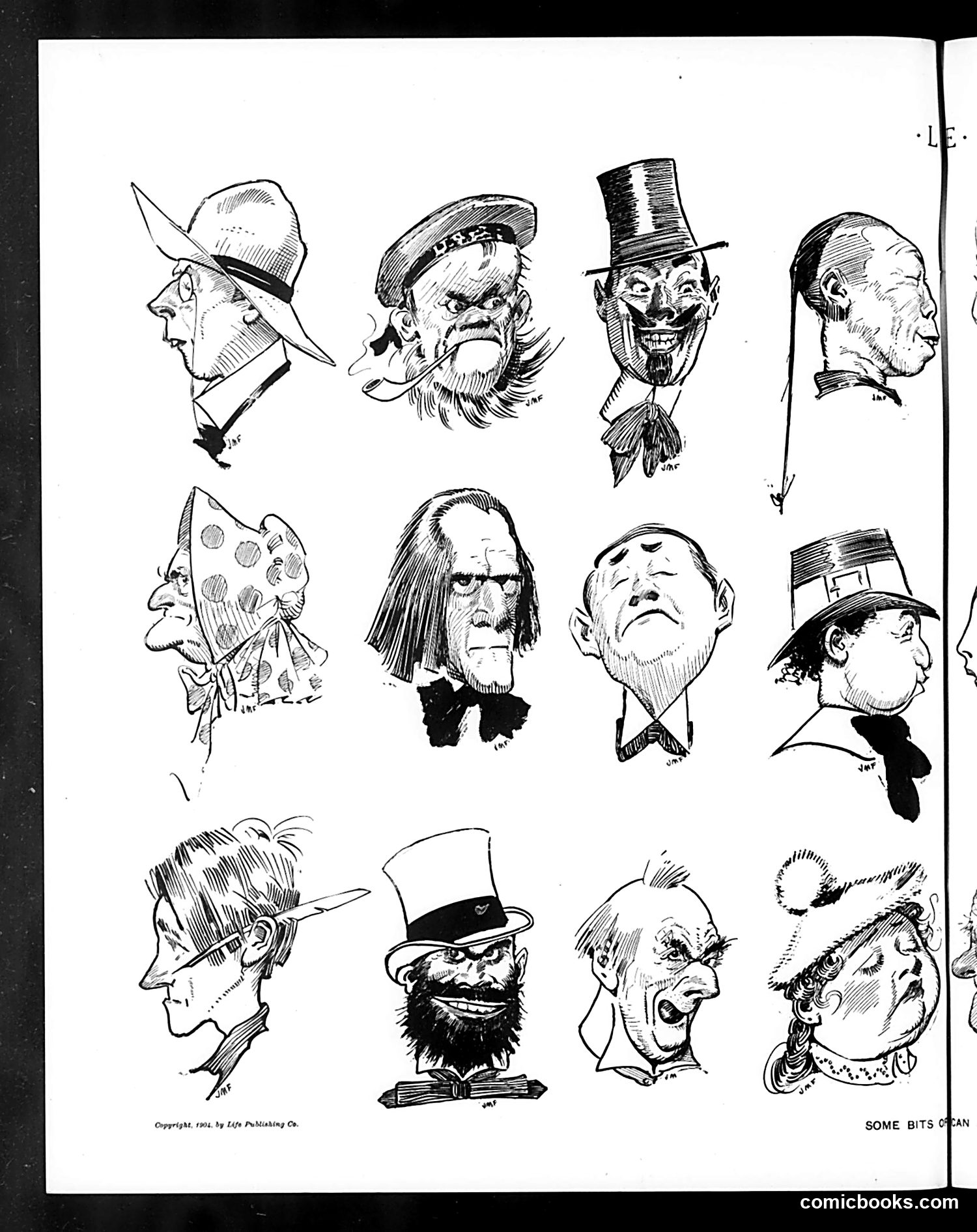
This page presents a collection of caricatured head studies in ink, dated 1902 by Life Publishing Co. The drawings showcase exaggerated facial features—prominent noses, chins, beards, and distinctive headwear—typical of early 20th-century satirical portraiture. The subjects appear to be public figures of the era, identifiable by their characteristic dress (top hats, cowboy hats, formal wear) and physiognomy. However, without clear labels or captions visible in the image, I cannot definitively identify specific individuals. The style suggests these are likely politicians, entertainers, or other notable personalities whom Life's readers would have recognized. The exaggerated features follow contemporary cartooning conventions meant for satirical commentary, though the specific targets remain unclear from the image alone.
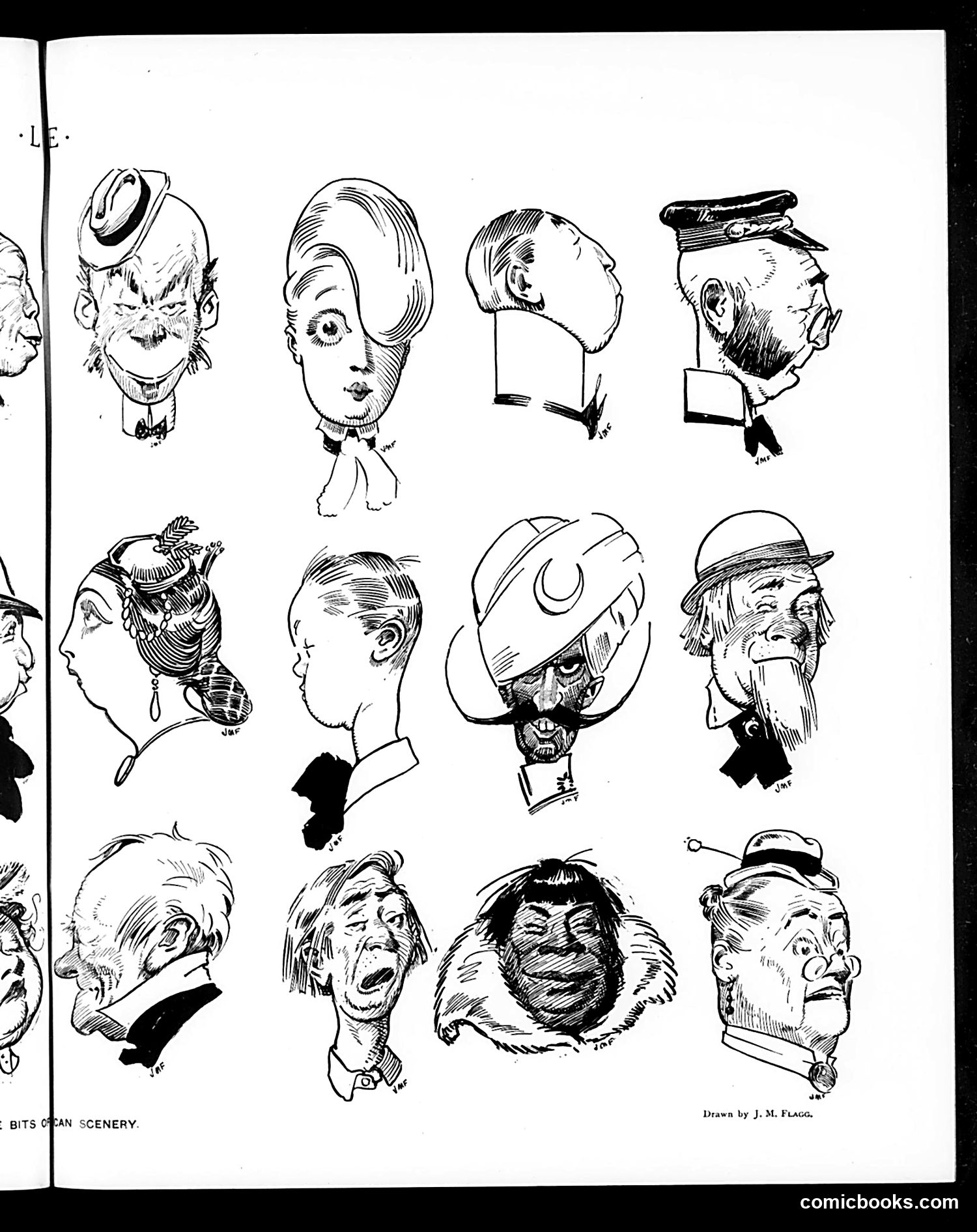
This page displays a series of caricatured head sketches "Drawn by J. M. Flagg," a prominent American cartoonist. The text references "BITS O'CAN SCENERY," suggesting these are character studies or portraits, possibly from theatrical or entertainment contexts. The exaggerated facial features—elongated profiles, prominent noses, distinctive facial hair, and varied headwear (military cap, bowler hat, turban)—are typical of early 20th-century satirical portraiture. The inclusion of formal dress elements (bow ties, military insignia) suggests these may represent public figures or social types of the era. Without accompanying captions identifying the specific individuals or their roles, the exact political or social references remain unclear, though the varied costume details suggest commentary on different social classes or nationalities.
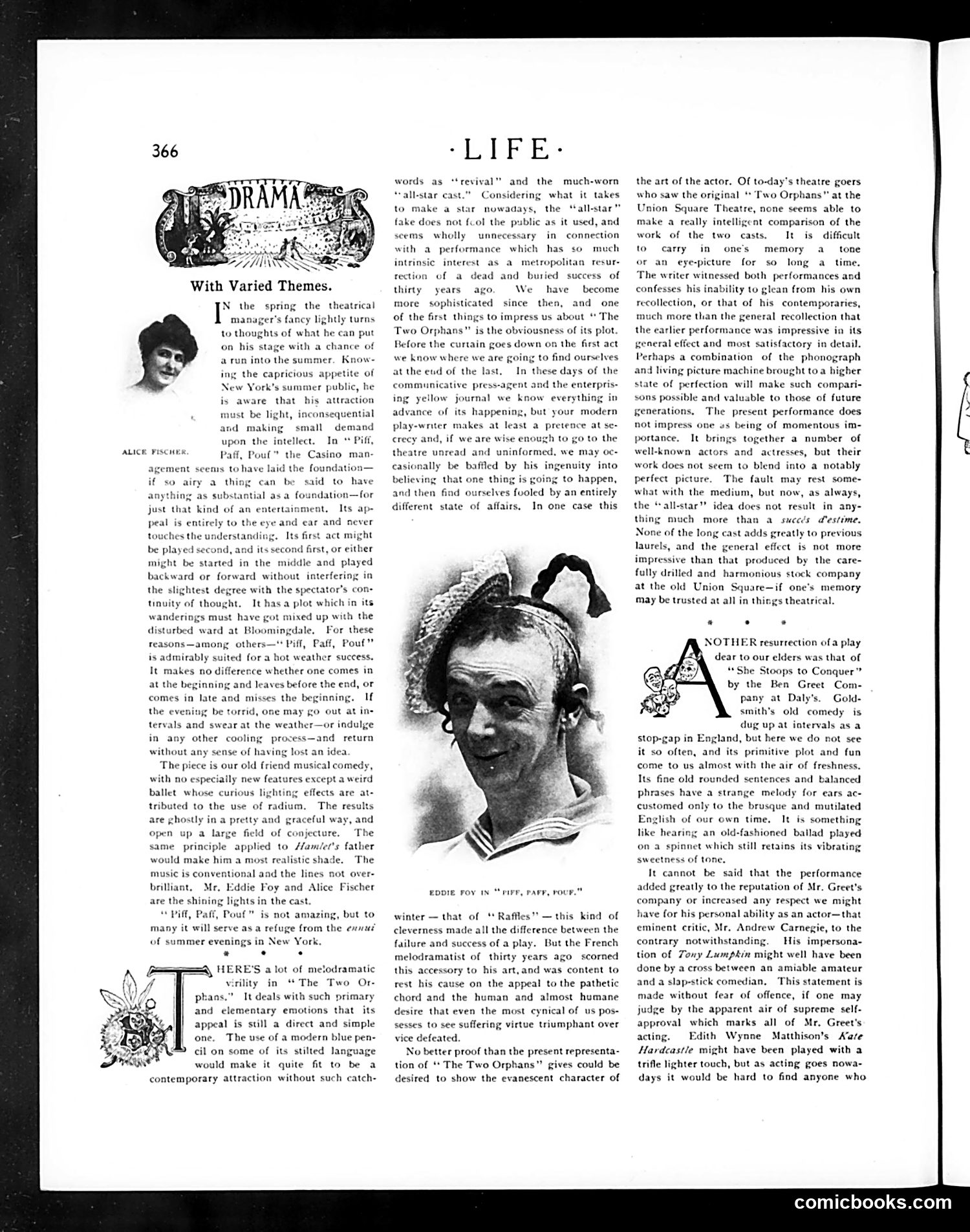
This is a drama criticism page discussing theatrical productions with "varied themes." The main images are photographs of actors—Alice Fisches and Eddie Foy in roles from contemporary plays. The text critiques several theatrical works, including "The Two Orphans" and "She Stoops to Conquer." The author discusses how modern plays often rely on spectacle and star power rather than substantive plot or character development. The piece appears to be a commentary on early 20th-century theater's tendency toward melodrama and star vehicles. The critic expresses preference for well-crafted comedies with strong writing over lavish productions designed primarily to showcase famous actors. The page combines critical analysis with theatrical photography typical of Life's drama coverage during this era.
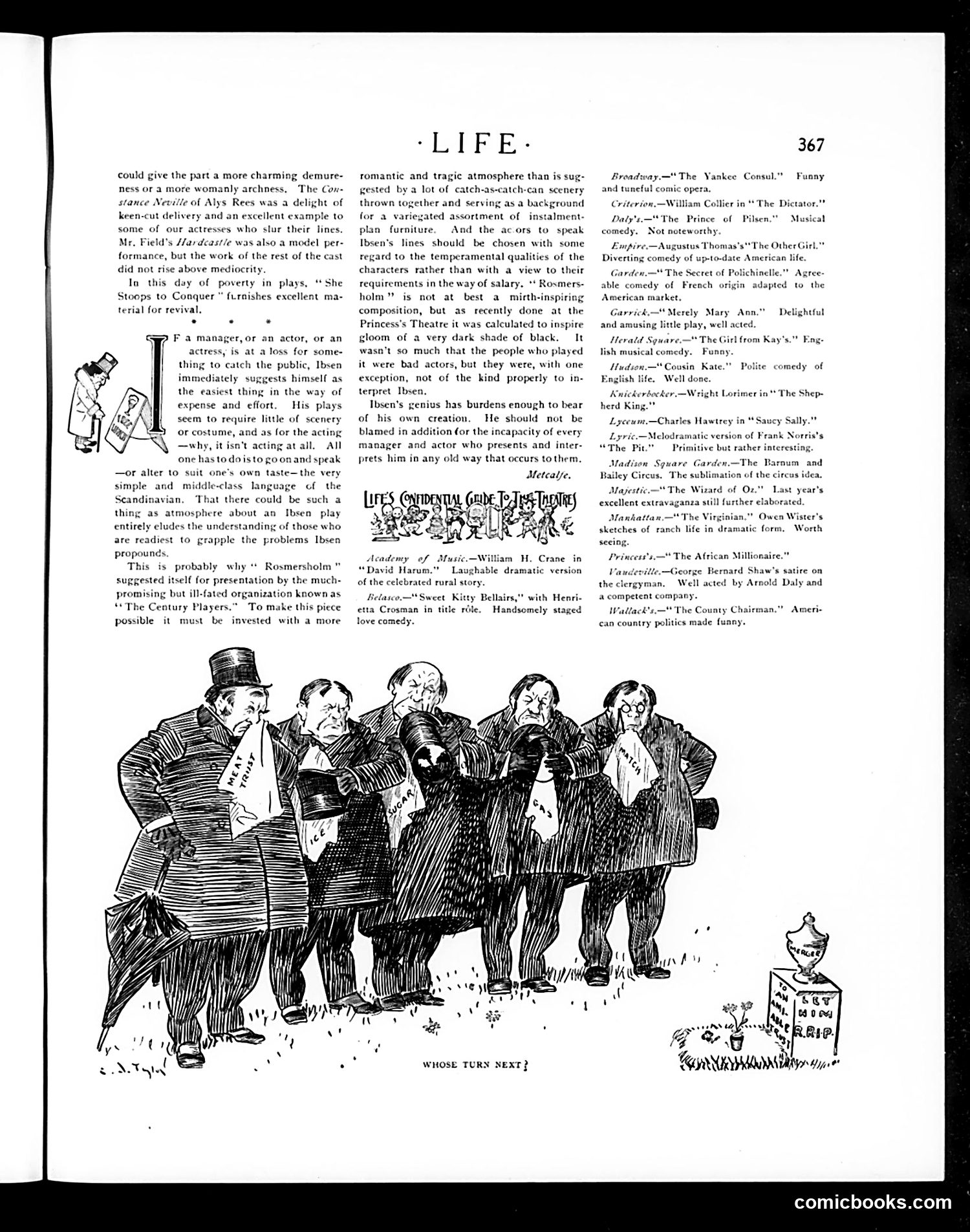
This page from *Life* magazine contains theater reviews and a political cartoon titled "WHOSE TURN NEXT?" The cartoon depicts five figures in formal dress (top hats and coats) standing anxiously together, each holding papers labeled with what appear to be names or positions. They're drawn in a worried, huddled posture. To the right sits a guillotine-like device with a spinning wheel mechanism. The satire references **political turnover or succession anxieties**—likely depicting leaders or public figures nervous about losing their positions or facing political consequences. The guillotine imagery invokes the French Revolution, suggesting fears of dramatic downfall or execution of one's rivals. Without additional context visible on the page, I cannot identify the specific figures or the exact political moment being satirized, though the setup clearly mocks political instability and the precarious nature of holding power during this era.
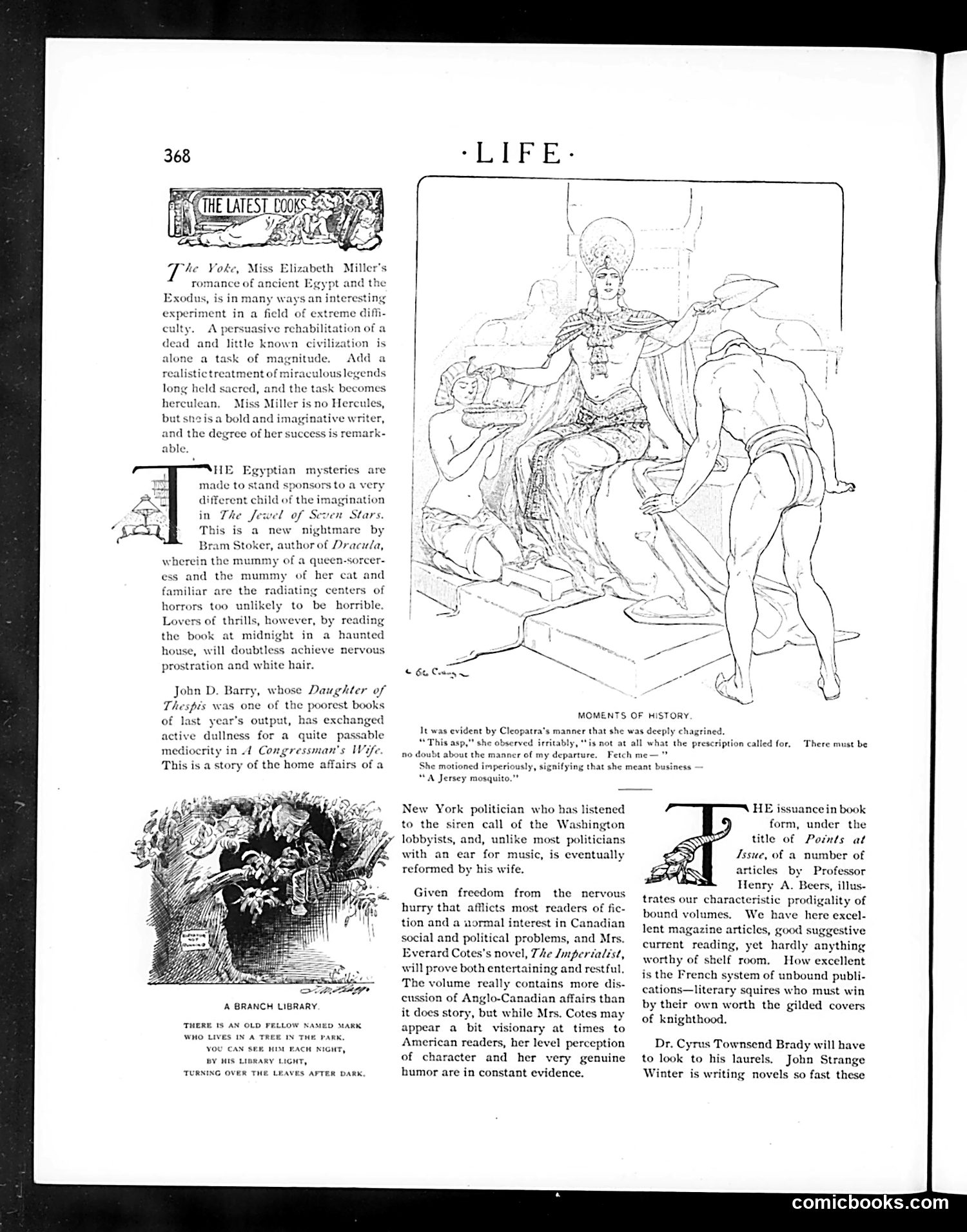
The main cartoon depicts an ancient Egyptian scene with figures in classical dress. The caption references Cleopatra, showing a woman imperiously commanding attendants. The dialogue reveals satire through anachronism: when she asks about "the manner of my departure," an attendant responds with "A Jersey mosquito"—a deliberately modern reference that undercuts the historical setting. The joke targets the pretensions of contemporary historical fiction, particularly Elizabeth Miller's novel *The Yoke* (reviewed above), which attempts to dramatize ancient Egypt. By inserting a mundane New Jersey mosquito into Cleopatra's palace, Life mocks how such romances fail to maintain historical authenticity and plausibility. The satire suggests these novels about "dead and little known civilizations" strain credibility when authors neglect realistic detail—even something as small as what mosquitoes inhabited ancient Egypt.
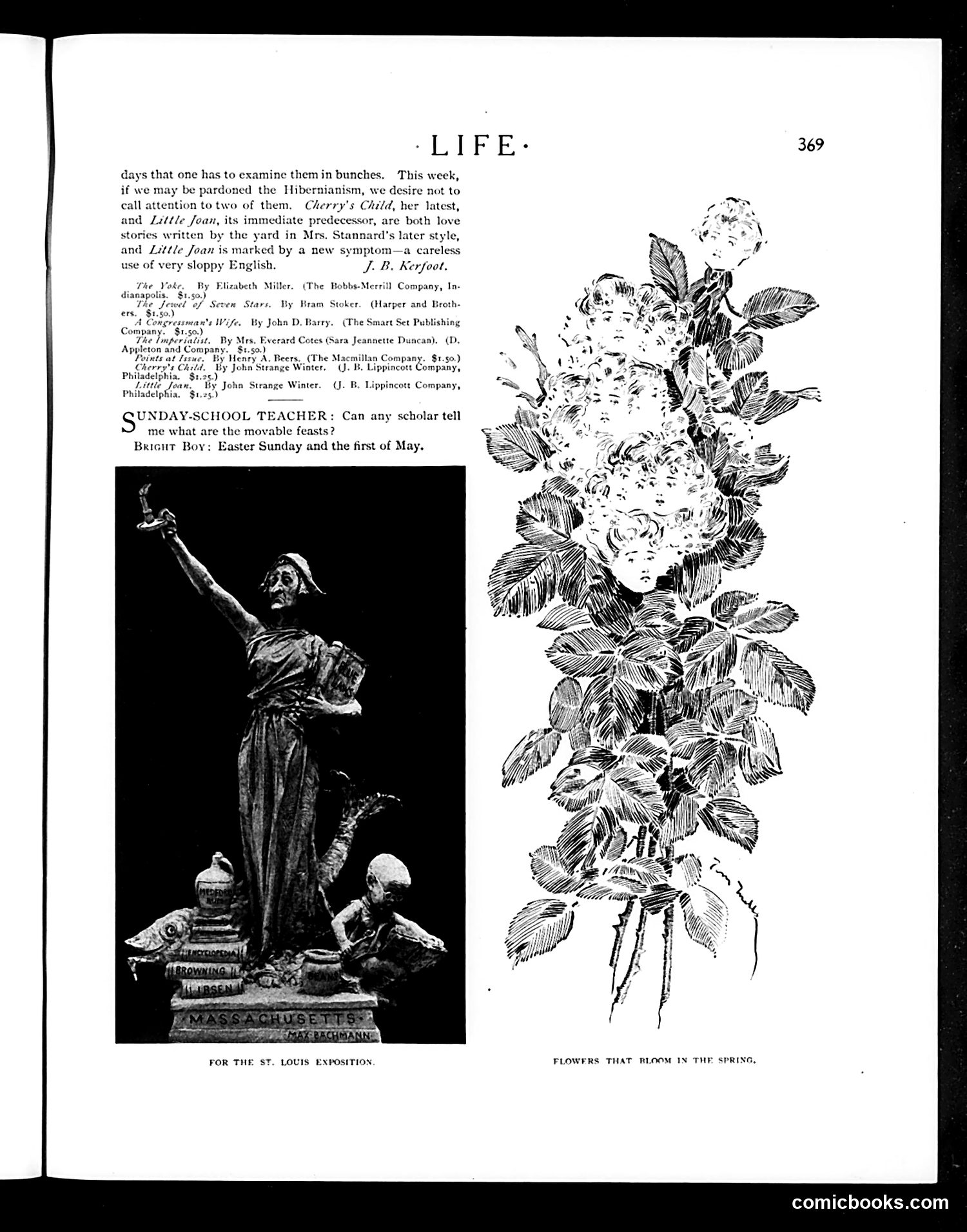
This page contains two distinct elements: **Left side:** A photograph of a sculpture titled "For the St. Louis Exposition." The monument appears to be a commemorative piece featuring a robed female figure with raised arm, flanked by smaller figures, likely representing Massachusetts's contribution to the 1904 St. Louis World's Fair. **Right side:** An illustration of spring flowers in bloom—a straightforward botanical drawing with no apparent satirical content. **Center:** A brief Sunday-school joke where a teacher asks about "movable feasts" (religious holidays with varying dates), and a student provides a literal, humorous answer: "Easter Sunday and the first of May"—treating the term as physical movement rather than calendar flexibility. **Top:** Book reviews of contemporary novels, including works by Elizabeth Miller and Bram Stoker. The page functions primarily as a magazine section mixing cultural commentary, illustrations, and light humor rather than political satire.
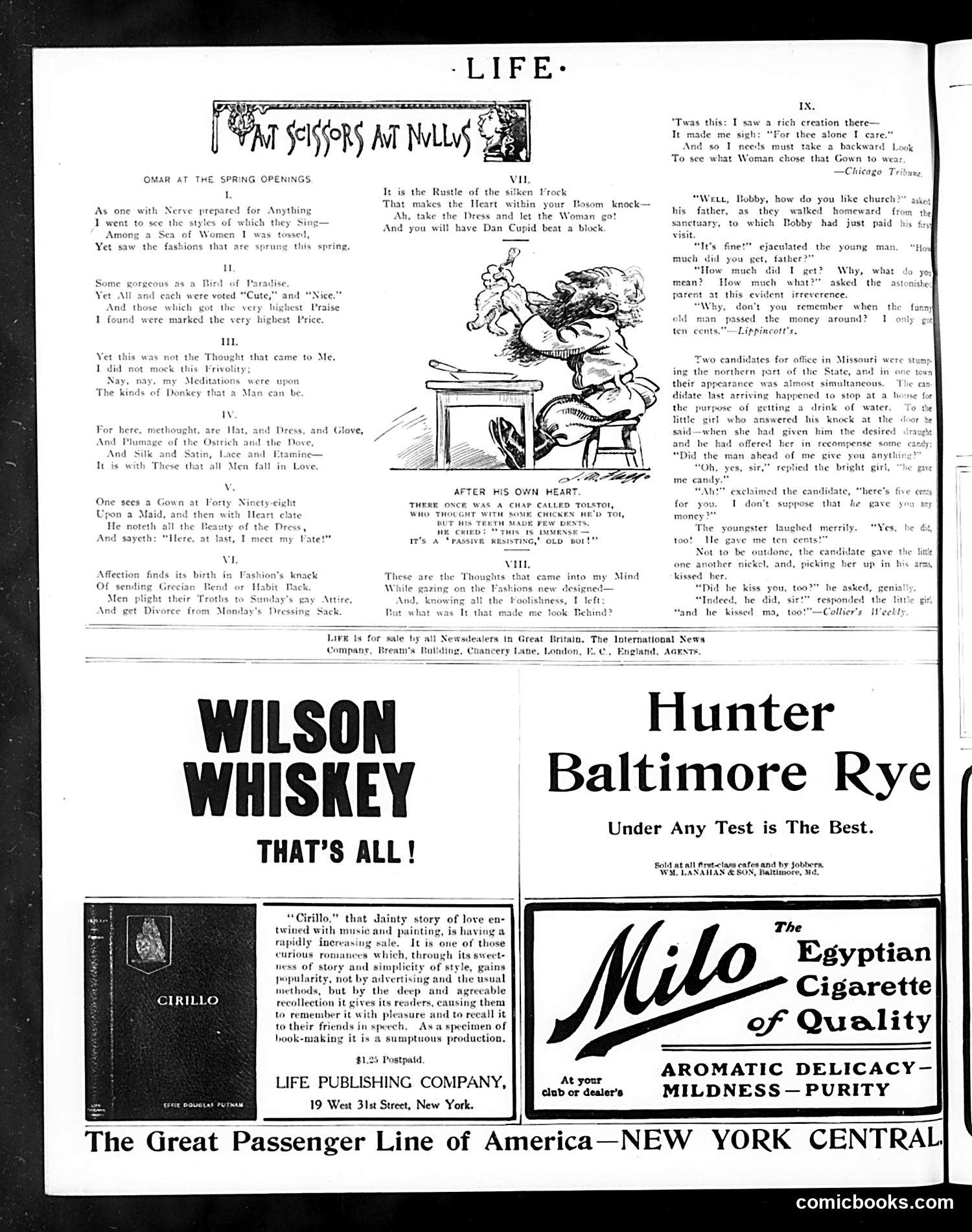
This page from *Life* magazine contains satirical poetry and social commentary alongside period advertisements. ## Main Content: "Scissors at Nullus" The poem mocks spring fashion trends and women's clothing obsession. The central cartoon depicts a man being physically overwhelmed by an enormous dressed woman—satirizing how elaborate spring fashions dominate social interaction. The accompanying verses suggest that fashionable dress, not the woman herself, attracts male attention ("take the Dress and let the Woman go"). The secondary anecdotes mock courtship and family dynamics: a father's stinginess, a young man's naiveté about church attendance, and a candidate's awkward encounter at a farmhouse. These are gentle social satire about American middle-class behavior. ## Advertisements The page includes ads for Wilson Whiskey, Hunter Baltimore Rye, Milo Egyptian Cigarettes, and a Life Publishing Company book promotion for "Cirillo"—typical early 20th-century luxury goods marketing. The satire targets shallow consumerism and fashion-obsessed society, particularly women's apparent prioritization of clothing over substance.
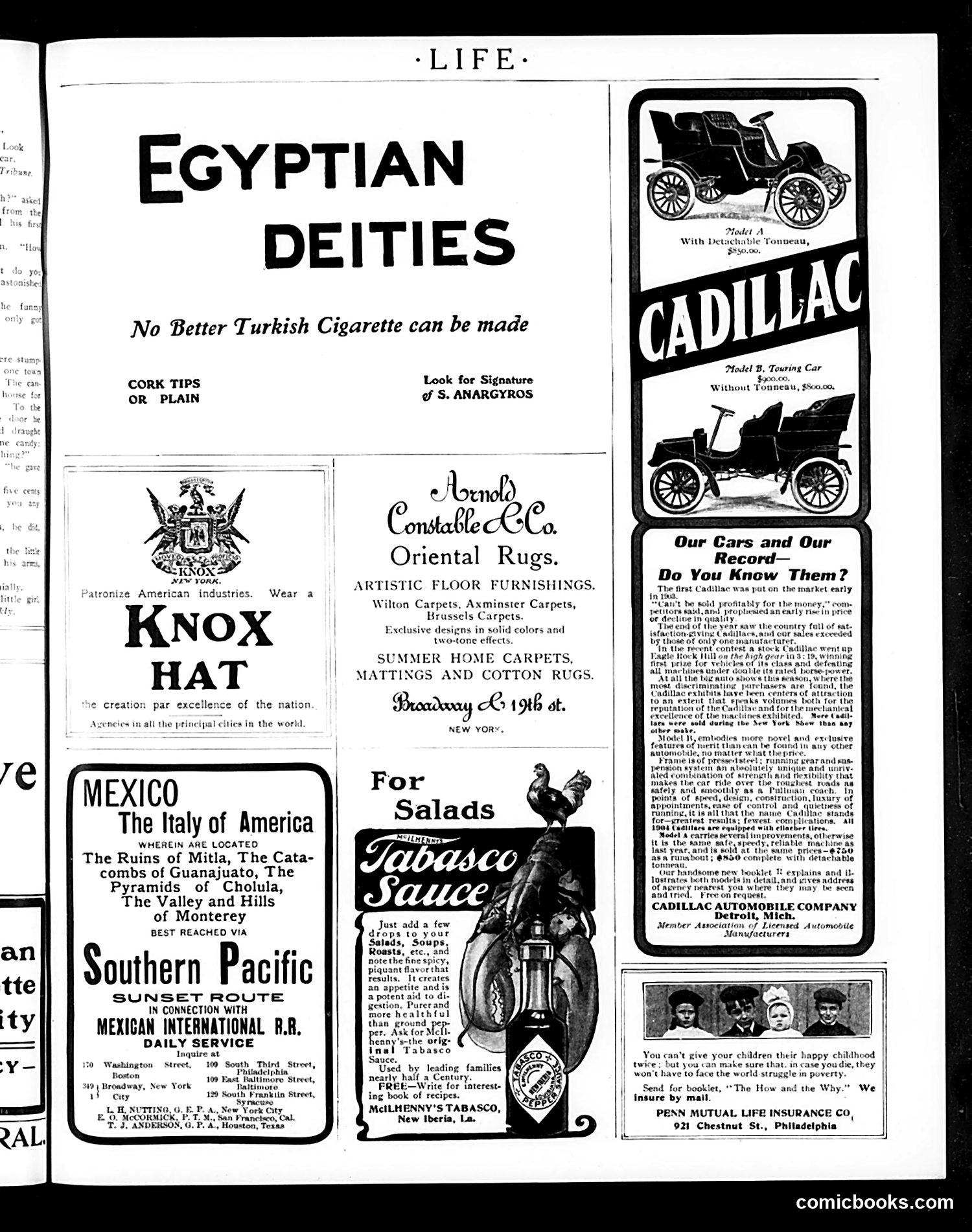
This page is primarily **advertisements**, not satire or political cartoons. The header "Egyptian Deities" is merely a brand name for cigarettes by S. Anargyros—a product marketed with the then-common practice of using exotic foreign imagery to sell goods. The page showcases typical early 1900s advertising: luxury automobiles (Cadillac), Oriental rugs, Turkish cigarettes, Mexican tourism via Southern Pacific Railway, Tabasco sauce, and life insurance. The Knox Hat ad invokes "American Industries" patriotism. One notable element: the **life insurance ad** at bottom uses emotional appeal—promising protection for children if the father dies—reflecting early 20th-century economic anxieties and the nascent life insurance industry's marketing strategy. There is **no visible political cartoon or satire** on this page. It represents straightforward commercial advertising typical of Life magazine during this era, when the publication carried substantial ad revenue alongside editorial content.
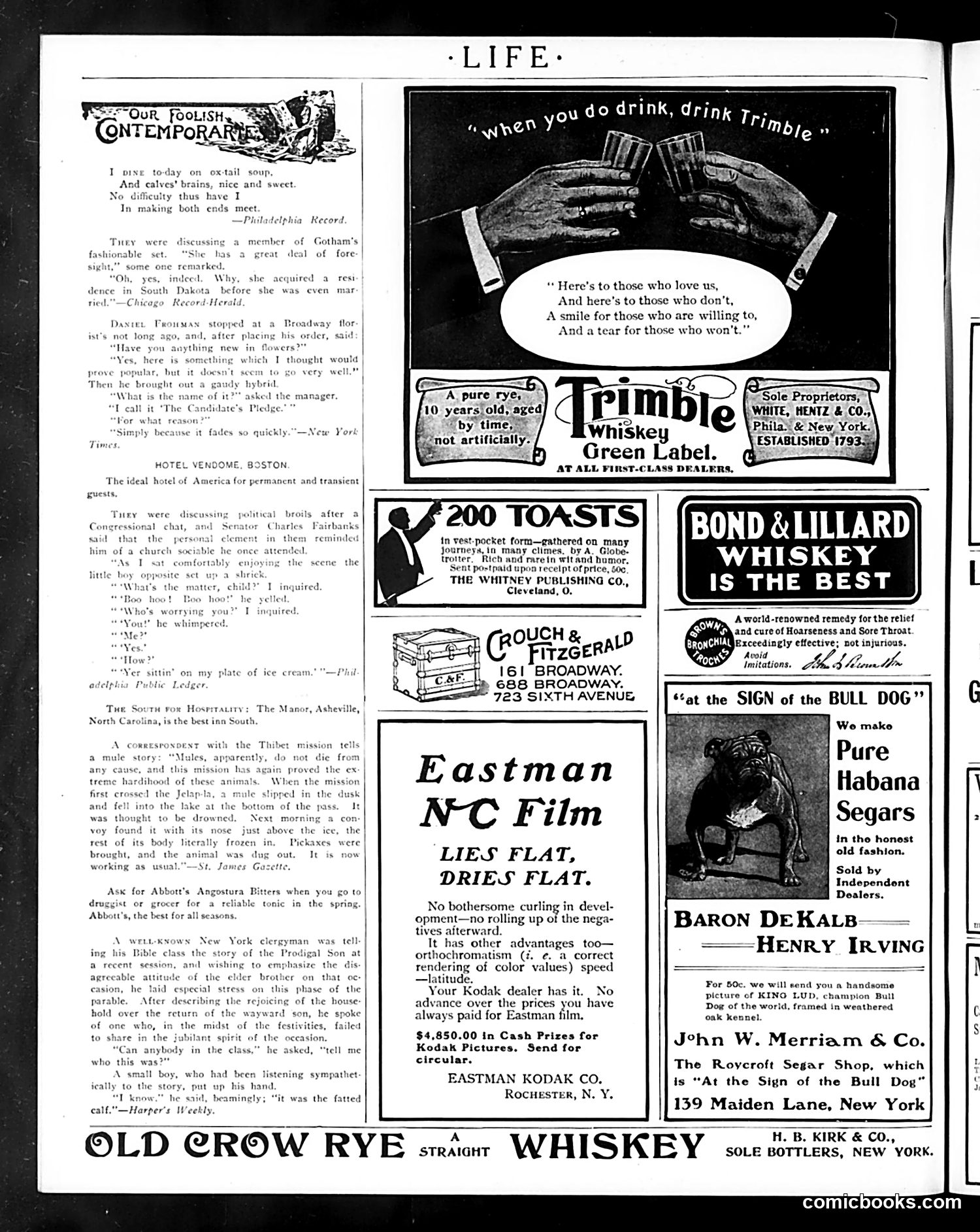
This page is primarily **advertising**, not political satire. The small text sections at the top are humorous anecdotes rather than editorial cartoons. The "Our Foolish Contemporaries" header introduces brief jokes about fashionable society and the church—common Life magazine humor mocking pretension. One anecdote mocks a wealthy woman who acquired a South Dakota residence before marriage; another jokes about a clergyman telling the Prodigal Son parable, with a student misidentifying the "fatted calf" reference. The bulk of the page consists of period advertisements for whiskey (Trimble, Bond & Lillard, Old Crow Rye), Eastman Kodak film, cigars, and other products. The Trimble whiskey ad features a sentimental toast about love and loss—typical early 20th-century advertising sentiment. No identifiable political figures or specific social movements are referenced. This appears to be a standard Life magazine page circa 1910s, mixing light social humor with commercial advertising.
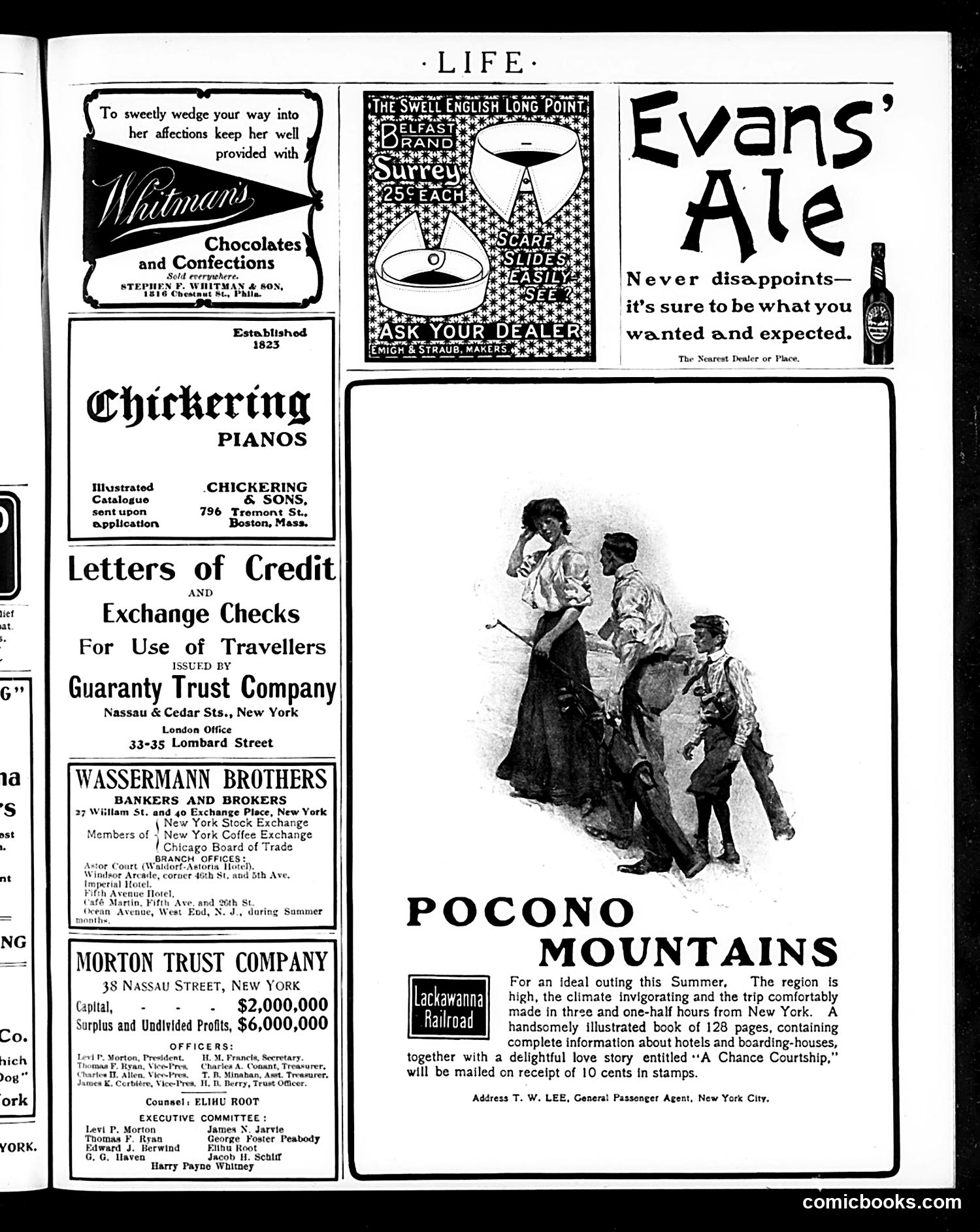
This is primarily an **advertising page**, not a satirical cartoon page. The page contains vintage advertisements for financial services, consumer goods, and travel from the early 20th century. Notable ads include: - **Whitman's Chocolates**: Uses romantic sentiment ("wedge your way into her affections") to market confections—typical of era advertising targeting male gift-givers. - **Chickering Pianos**: Established 1823, positioned as quality merchandise. - **Financial services**: Multiple banking firms (Guaranty Trust, Wassermann Brothers, Morton Trust Company) advertise letters of credit and investment services for travelers and wealthy clients. - **Evans' Ale**: Claims reliability with "Never disappoints." - **Pocono Mountains**: The Lackawanna Railroad advertises a 128-page tourist guide bundled with a romance story ("A Chance Courtship"), reflecting marketing strategies that combined travel promotion with popular fiction. The page illustrates early advertising conventions: appeals to sentimentality, emphasis on established reputation, and bundling of products with entertainment.
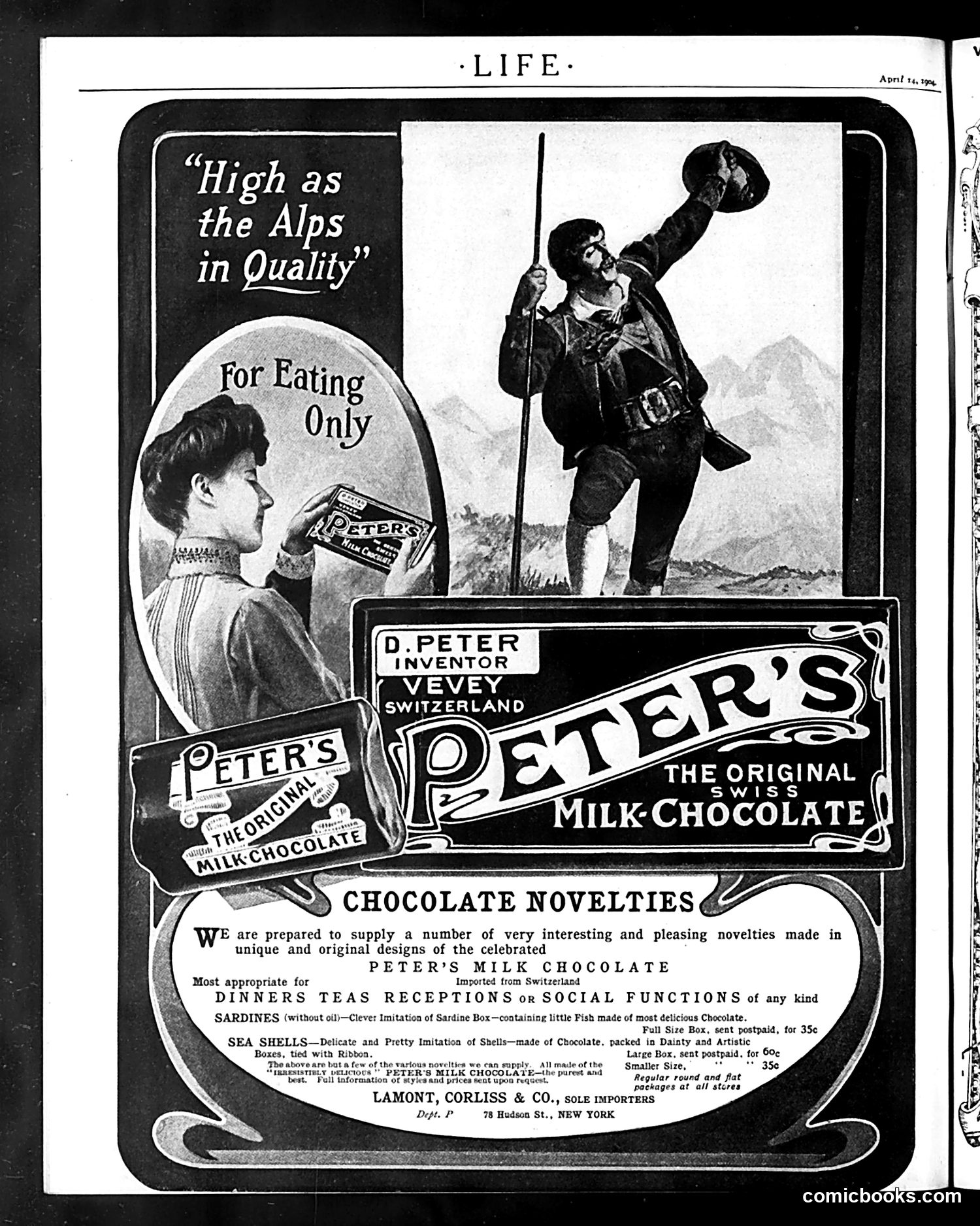
This is a Swiss chocolate advertisement, not political satire. It promotes Peter's brand milk chocolate from Vevey, Switzerland, invented by D. Peter. The imagery contrasts two uses: a woman "eating only" chocolate (left), versus an Alpine mountaineer (right) scaling peaks with chocolate as sustenance. The tagline "High as the Alps in Quality" plays on both the mountainous Swiss landscape and the product's premium positioning. The ad emphasizes novelty chocolate items—sardine-shaped pieces, sea shells, decorative boxes—marketed for "dinners, teas, receptions, or social functions." Pricing ranges from 35¢ to 60¢. This reflects early 1900s luxury marketing: Swiss chocolate was prestigious, imported goods signaled sophistication, and elaborate chocolate novelties were fashionable gifts for middle-class entertaining.