
Life, 1904-04-14 · page 6 of 20
Life — April 14, 1904 — page 6: what you’re looking at
What you’re looking at
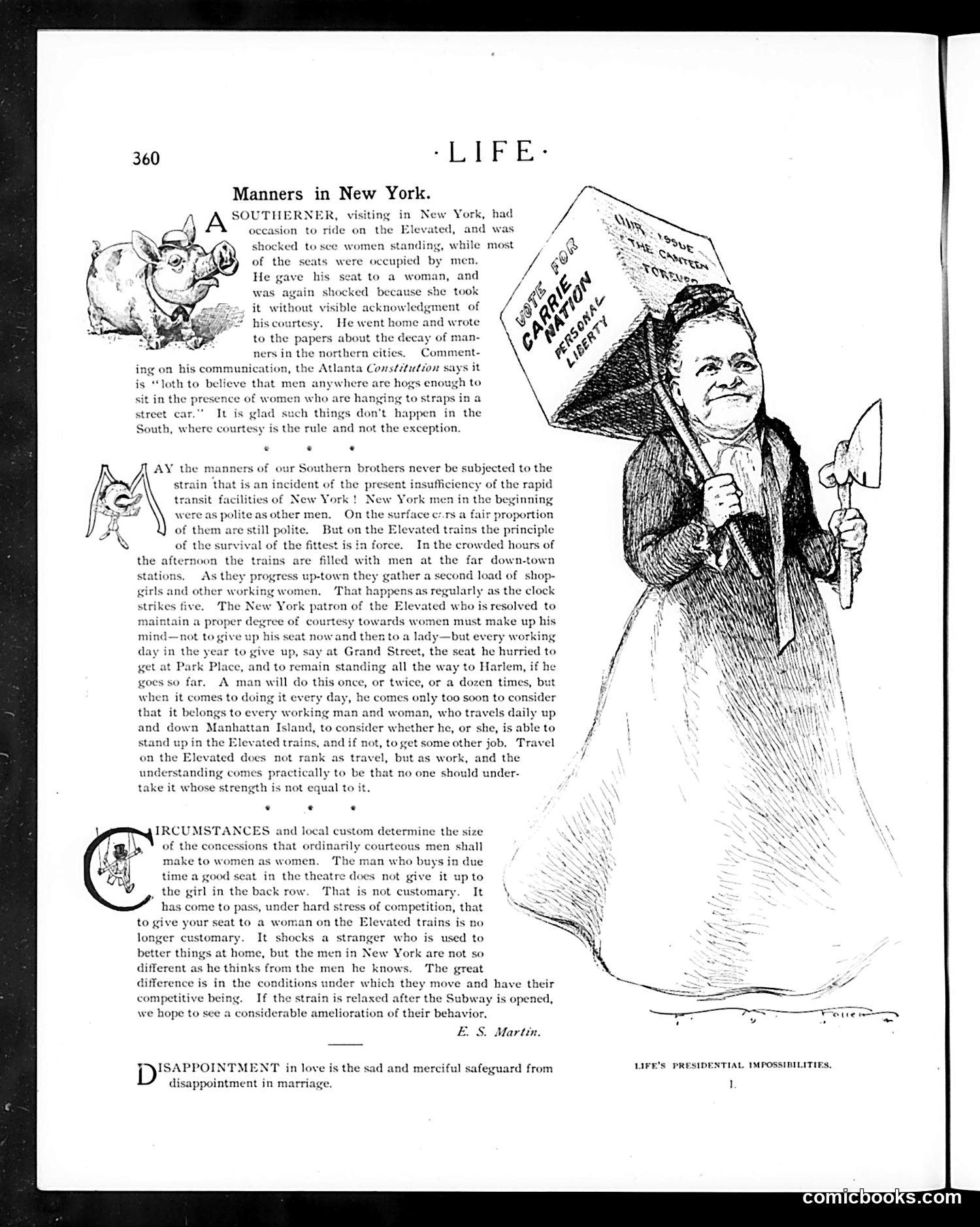
This satirical piece critiques declining courtesy on New York's Elevated trains (the "El"), comparing northern rudeness unfavorably to southern gentility. A visiting Southerner is shocked to witness men refusing seats to women—behavior he considers barbaric. The main cartoon depicts a woman carrying a banner reading "VOTES FOR WOMEN" while holding a flag, likely representing the suffrage movement. The satire suggests an ironic contradiction: women demanding equal rights and voting privileges, yet still expecting men to yield seats to them. The piece argues that crowded urban conditions and competitive commuting have eroded traditional courtesy, and that the "New York patron" must decide whether politeness toward women should continue—especially as women demand equality.
📄 Transcribed text from this page (OCR, searchable)
Machine-transcribed from the original scan — historical spelling and the odd misread are preserved.
‘LIP Be Manners in New York. SOUTHERNER, visiting in New York, had occasion to ride on the Elevated, and was shocked to sce women standing, while most of the seats were occupied by men, t to a woman, and gain shocked because she took it without visible acknowledgment of his courtesy. He went home and wrote to the papers about the decay of man- ners in the northern cities, Comment- on his communication, the Atlanta Constitution says it is loth to believe that men anywhere are hogs enoug’ n the presence of women who are hanging to straps in a street car.” It is glad such things don't happen in the South, where courtesy is the rule and not the exception. AY the manners of our Southern brothers never be subjected to the strain that is an incident of the present insufficiency of the rapid facilities of New York ! New York men in the beginning were as polite as other men. On the surface e:.rs a fair proportion of them are still polite. But on the Elevated t the principle of the survival of the fittest isin force. In the crowded hours of the afternoon the trains filled with men at the far down-town stations, As they progress up-town they gather a second load of shop- girls and other working women, That happens as regularly as the clock strikes five. T) ‘ew York patron of the Elevated who is resolved to maintain a proper degree of courtesy towards women must make up his mind—not to give up his seat now and the iy—but every working in the year to give up, say at Grand Street, the seat he hurried to rk Place, and to remain standing all the way to Harlem, if he goes so far. A man will do this once, or twice, or a dozen times, but when it comes to doin; ay, he comes only too soon to consider that it belongs to every working man and woman, who travels daily up and down M nd, to consider whether he, or she, is able to stand up in the Elevated trains, and if not, to get some other job. Travel on the Elevated does not rank as travel, but as work, and the understanding comes practically to be that no one should under- take it whose strength is not equal to it. . * * IRCUMSTANCES and Ic custom determine the size of the concessions that ordinarily courteous men shall make to women as women. The man who buys in due time a good seat in the theatre does not give it up to the girl in the back row. That is not custom . It has come to pass, under hard stress of competition, that to give your seat to a woman on the vated trains is no longer tomary. It shocks a stranger who is used to better things at home, but the men in New York are not so different as he thinks from the men he knows. The great difference is in the conditions under which they move and have their competitive being. If the strain is relaxed after the Subway is opened, we hope to see a considerable amelioration of their behavior. . Martin. SAPPOINTMENT in love is the sad and merciful s ufeguard from disappointment in marriage. PRESIDENTIAL IMPOSSIBILITIES, 1