
Life, 1904-04-14 · page 12 of 20
Life — April 14, 1904 — page 12: what you’re looking at
What you’re looking at
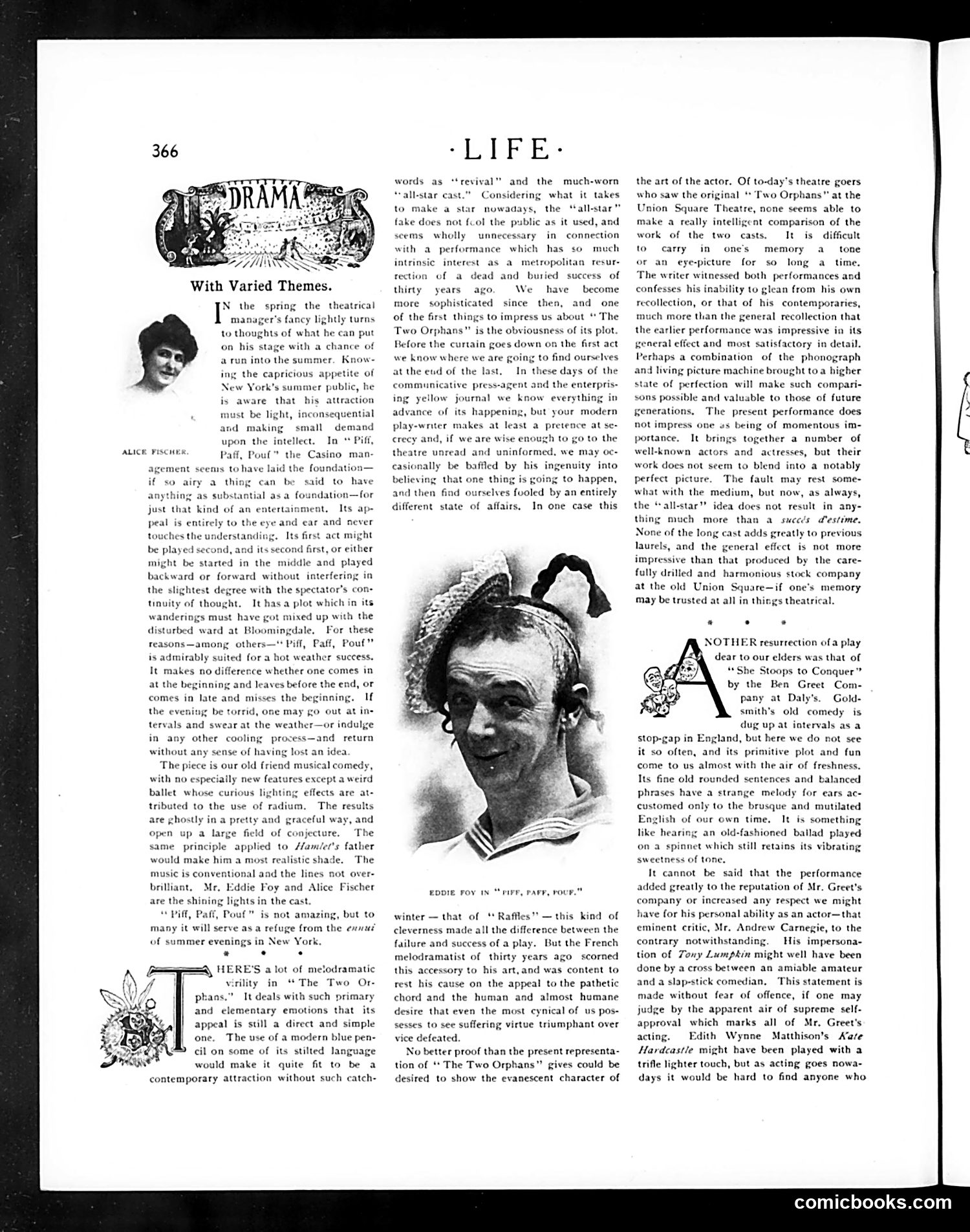
This is a drama criticism page discussing theatrical productions with "varied themes." The main images are photographs of actors—Alice Fisches and Eddie Foy in roles from contemporary plays. The text critiques several theatrical works, including "The Two Orphans" and "She Stoops to Conquer." The author discusses how modern plays often rely on spectacle and star power rather than substantive plot or character development. The piece appears to be a commentary on early 20th-century theater's tendency toward melodrama and star vehicles. The critic expresses preference for well-crafted comedies with strong writing over lavish productions designed primarily to showcase famous actors. The page combines critical analysis with theatrical photography typical of Life's drama coverage during this era.
📄 Transcribed text from this page (OCR, searchable)
Machine-transcribed from the original scan — historical spelling and the odd misread are preserved.
ALICE FISCHER With Varied Themes. N the spring the theatrical l manager's fancy lightly turns to thoughts of what he can put on his stage with a chance of a run into the summer. Know- ing the capricious appetite of w York's summer public, he is aware that his attraction must be light, inconsequential and making small demand upon the intellect. In “ Piff, Paff, Pout the Casino man- agement seems to have laid the founda airy a thing can be said to have as substantial asa foundation—for just that kind of an entertainment, Its ap- peal is entirely to the eye and ear and never hes the understanc ts first act might be played second, and its second first, or either might be started in the middle and played backward or forward without interfering in the slightest degree with the spectator’s con- tinuity of thought. It has a plot which in its wanderings must have got mixed up with the disturbed ward at Bloomingdale, For these reasons—among others—" Piff, Paff, Pout” is admirably suited for a hot weather success. It makes no difference whether one comes in at the beginning and leaves before the end, or comes in late and misses the begin if the evening be torrid, one may go out at ine tervals and swear at the weather—or indulge in any other cooling process—and return without any sense of having lost an idea The piece is our old friend musical comedy, with no especially new features except a weird ballet whose curious lighting effects are at- tributed to the use of radium, The results are ghostly in a pretty and graceful way, and open up a large field of conjecture. The same principle applied to /am/er's father would make him a most realistic shade. The music is conventional and the lines not over- brilliant, Mr, Eddie Foy and Alice Fischer are the shining lights in the cast. “Pit, Paff, Poul” is not amazing, but to many it will serve asa refuge from the ennui of summer evenings in New York. * . . BA HERE'S alot of metodramatic virility in “The Two Or- phans.” It deals with such primary and elementary emotions that its appeal is still a direct and simple one. The use of a modern blue pen- cil on some of its stilted language would make it quite fit to be a contemporary attraction without such catch- ‘LE Ee words as “trevival” and the much-worn ‘all-star cast.” Considering what it takes to make a star nowadays, the “all-star” fake does not {col the public as it used, and seems wholly unnecessary in connection with a performance which has so much intrinsic interest as a metropolitan resur- tection of a dead and buried success of thirty years ago. We have become more sophisticated since then, and one of the first things to impress us about The Two Orphans” is the obviousness of its plot. Before the curtain goes down on the first act we know where we are going to find ourselves at the eud of the last, In these days of th communicative press-agent and the enterpris- ing yellow journal we know everything in advance of its happening, but your modern play-writer makes at least a pretence at se- crecy and, if we are wise enoug >to the theatre unread and uninformed, we may oc- casionally be baffled by his ingenuity into believing that one thing is going to happen, and then find ourselves fooled by an entirely different state of affairs, In one case this EDDIE Foy IN “rIFR, PAFF, FOUR.” winter — that of * Rafiles’” — this kind of cleverness made all the difference between the failure and success of a play. But the French melodramatist of thirty years ago scorned this accessory to his art,and was content to rest his cause on the appeal to the pathetic chord and the human and almost humane desire that even the most cynical of us pos- sesses to see suffering virtue triumphant over vice defeated. No better proof than the present representa- tion of The Two Orphans” gives could be desired to show the evanescent character of the art of the actor, Of to-day’s theatre goers who saw the original ** Two Orphans" at the Union Square Theatre, none seems able to make a really intelligent comparison of the work of the two casts. It is difficult to carry in one’s memory a tone or an eye-picture for so long a time. The writer witnessed both performances and confesses his inability to glean from his own recollection, or that of his contemporaries, much more than the general recollection that the earlier performance was impressive in its general effect and most satisfactory in detail. Perhaps a combination of the phonograph and living picture machine brought toa higher state of perfection will make such compari- sons possible and valuable to those of future generations, The present performance does hot impress one os being of momentous im- portance. It brings together a number of well-known actors and actresses, but their work does not seem to blend into a notably perfect picture. The fault may rest some- what with the medium, but now, as always, Il-star”” idea does not result in any- much more than a succ’s d'estime. None of the long cast adds greatly to previous laurels, and the general effect is not more impressive than that produced by the care- fully drilled and harmonious stock company at the old Union Square—if one’s memory may be trusted at all in things theatrical, NOTHER resurrection ofa play dear to our elders was that of “She Stoops to Conquer” by the Ben Greet Com- pany at Daly's, Gold- smith's old comedy is dug up at intervals as a stop-gap in England, but here we do not see it so often, and its primitive plot and fun come to us almost with the air of freshness. Its fine old rounded sentences and balanced phrases have a strange melody for ears ac- customed only to the brusque and mutilated English of ovr own time, It is something like hearing an old-fashioned ballad played on a spinnet which still retains its vibrating sweetness of tone. It cannot be said that the performance added greatly to the reputation of Mr. Greets company or increased any respect we might have for his personal ability as an actor—that eminent critic, Mr. Andrew Carnegie, to the contrary notwithstanding. His impersona- tion of Tony Lumpkin might well have been done by a cross between an amiable amateur and a slap-stick comedian, This statement is made without fear of offence, if one may judge by the apparent air of supreme self- approval which marks all of Mr, Greet's acting. Edith Wynne Matthison’s A’are Hardcastle might have been played with a trifle lighter touch, but as acting goes nowa- days it would be hard to find anyone who comicbooks.com