
A complete issue · 20 pages · 1903
Life — May 14, 1903
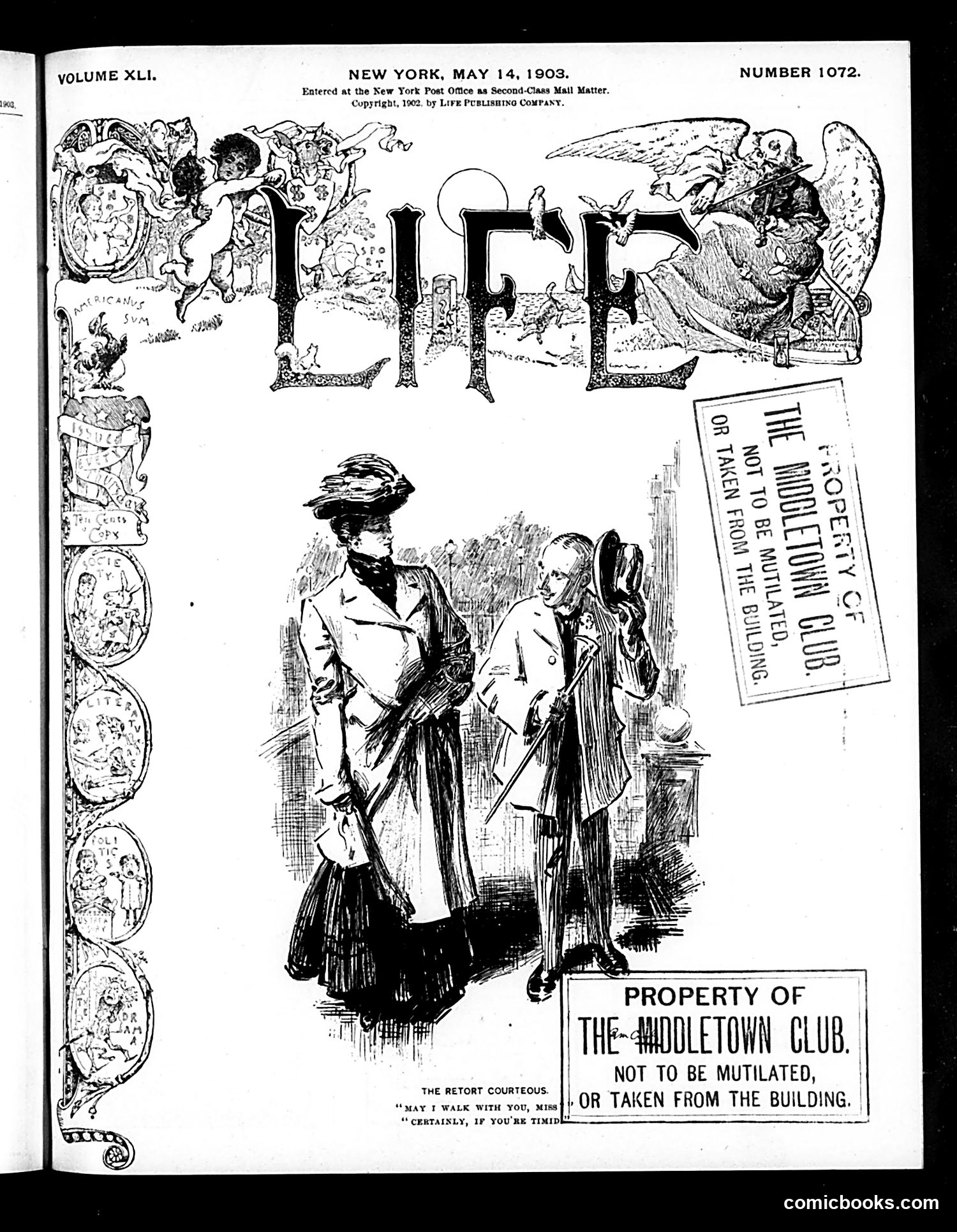
This is the cover of Life magazine's issue #1072. The main illustration depicts two well-dressed women in Edwardian-era clothing with the caption "THE RETORT COURTEOUS: 'MAY I WALK WITH YOU, MISS ___?' 'CERTAINLY, IF YOU'RE TIMID!'" The humor appears to satirize social courtship conventions of the era. The woman's retort—suggesting the man needs to be "timid" to accompany her—mocks overly formal, cautious male behavior in romantic contexts, implying such timidity is necessary for her to accept his company. The decorative left border contains zodiac or astrological symbols, while ornamental header elements frame the "LIFE" masthead. A stamp indicates this was property of "The Middletown Club" and marked "not to be mutilated."
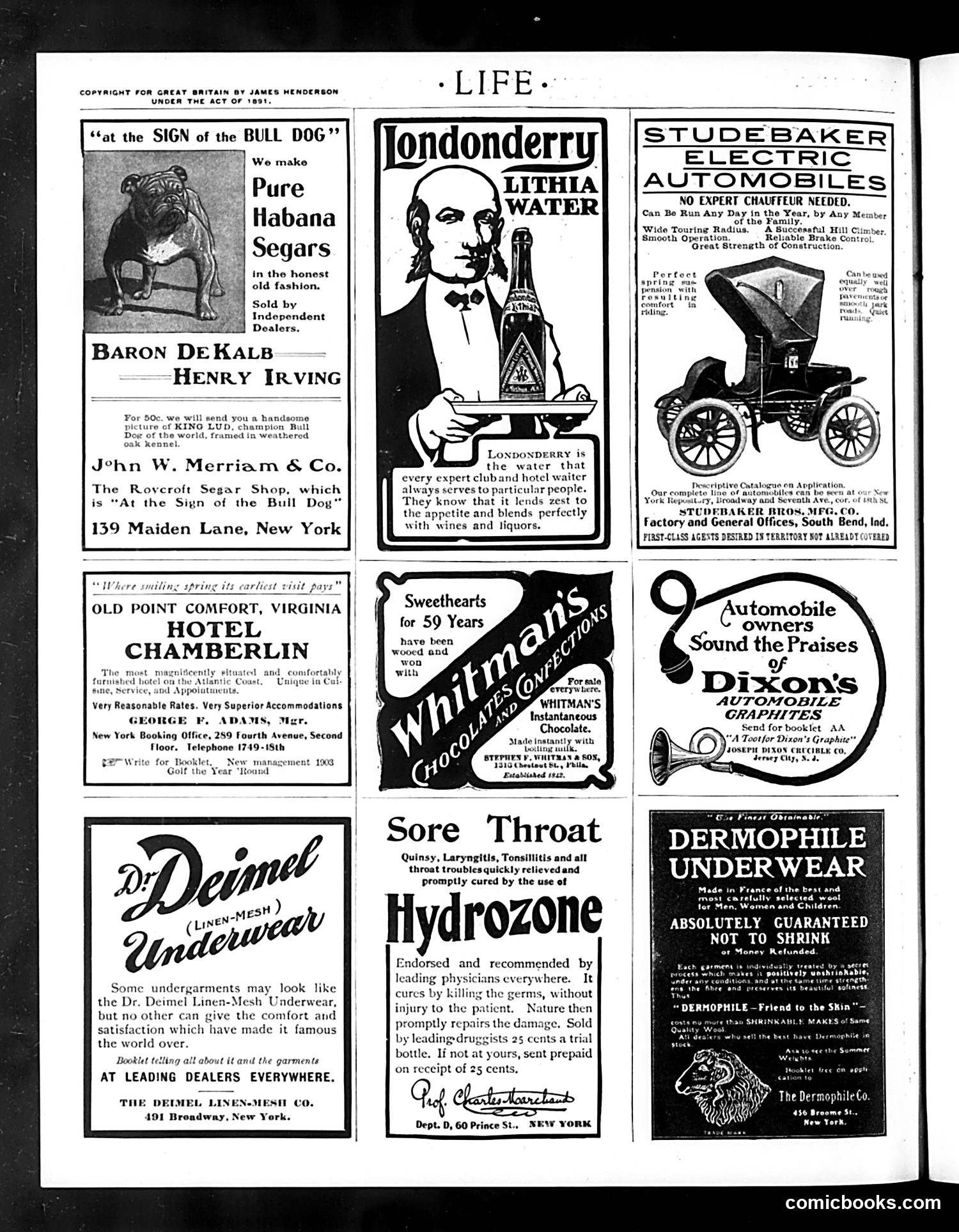
This page is **primarily advertising**, not satire or political commentary. It contains nine distinct advertisements for various products and services: - Cigars and tobacco products - Londonderry Lithia Water (mineral water) - Studebaker electric automobiles - A Virginia hotel - Whitman's chocolates - Dixon automobile supplies - Dr. Deimel linen-mesh underwear - Hydrozone (throat remedy) - Dermophile underwear The ads reflect early 1900s consumer goods and represent typical Life magazine content of this era. There is **no discernible political cartoon or satire** on this page—it's a straightforward commercial section showcasing products marketed to affluent readers through product endorsements and illustrated advertisements.
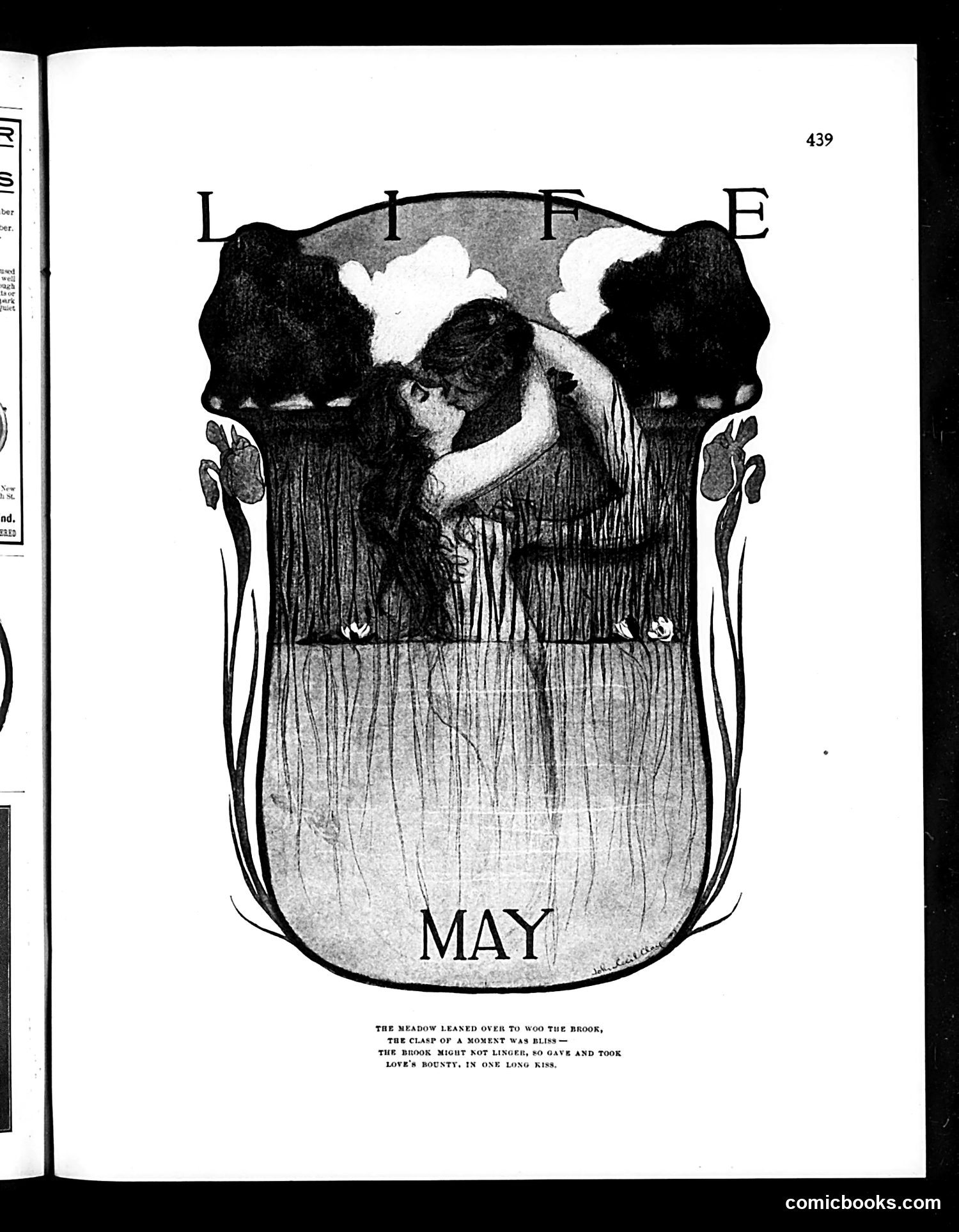
This is a calendar illustration for May featuring an Art Nouveau-style design. Two silhouetted female figures in long dresses lean toward each other against a pastoral background with flowering plants and clouds. The caption below references romantic themes: "The meadow leaned over to woo the brook, / The clasp of a honest was bliss— / The brook might not linger, so gave and took / Love's bounty, in one long kiss." The page appears primarily decorative rather than politically satirical. It exemplifies Life magazine's fin-de-siècle aesthetic sensibility, combining romantic poetry with elegant visual design. The work likely appeals to the magazine's educated, middle-class audience through its sentimental nature imagery and literary references, rather than social commentary or political critique.
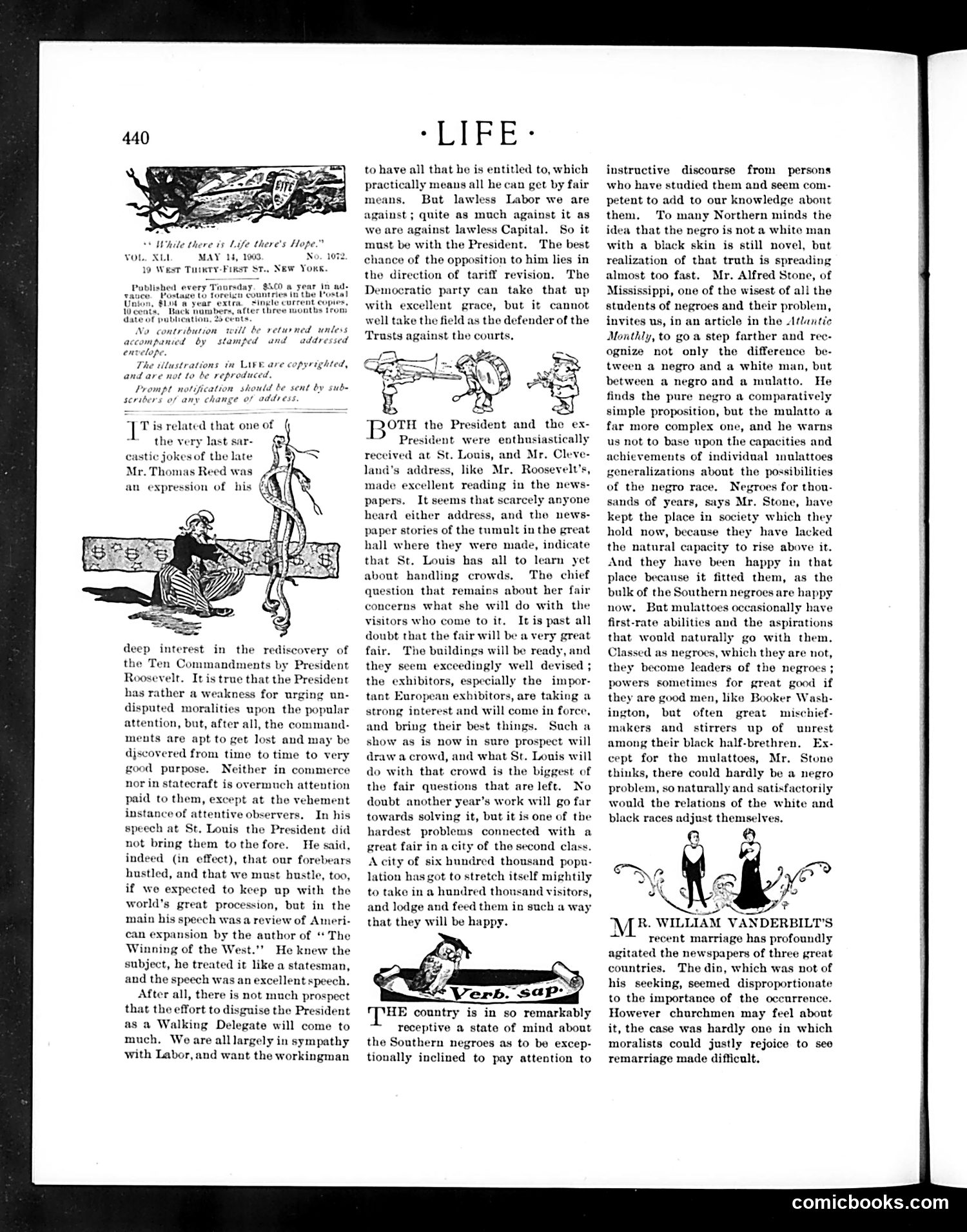
The page discusses President Roosevelt's handling of labor disputes and the upcoming St. Louis World's Fair. The left cartoon depicts a figure (appears to be Roosevelt) as a "Walking Delegate"—a labor union representative—suggesting the President was overstepping by intervening in labor matters. The satire criticizes Roosevelt for being inconsistent: sympathetic to labor unions while opposing "lawless Capital" and trusts, yet the cartoon implies his interventionism is itself problematic. The text notes the President received criticism from both business and labor perspectives at St. Louis. The right section discusses William Vanderbilt's remarriage, treating it as a minor social scandal unworthy of major newspaper attention—satirizing the press's tendency to amplify trivial society news.
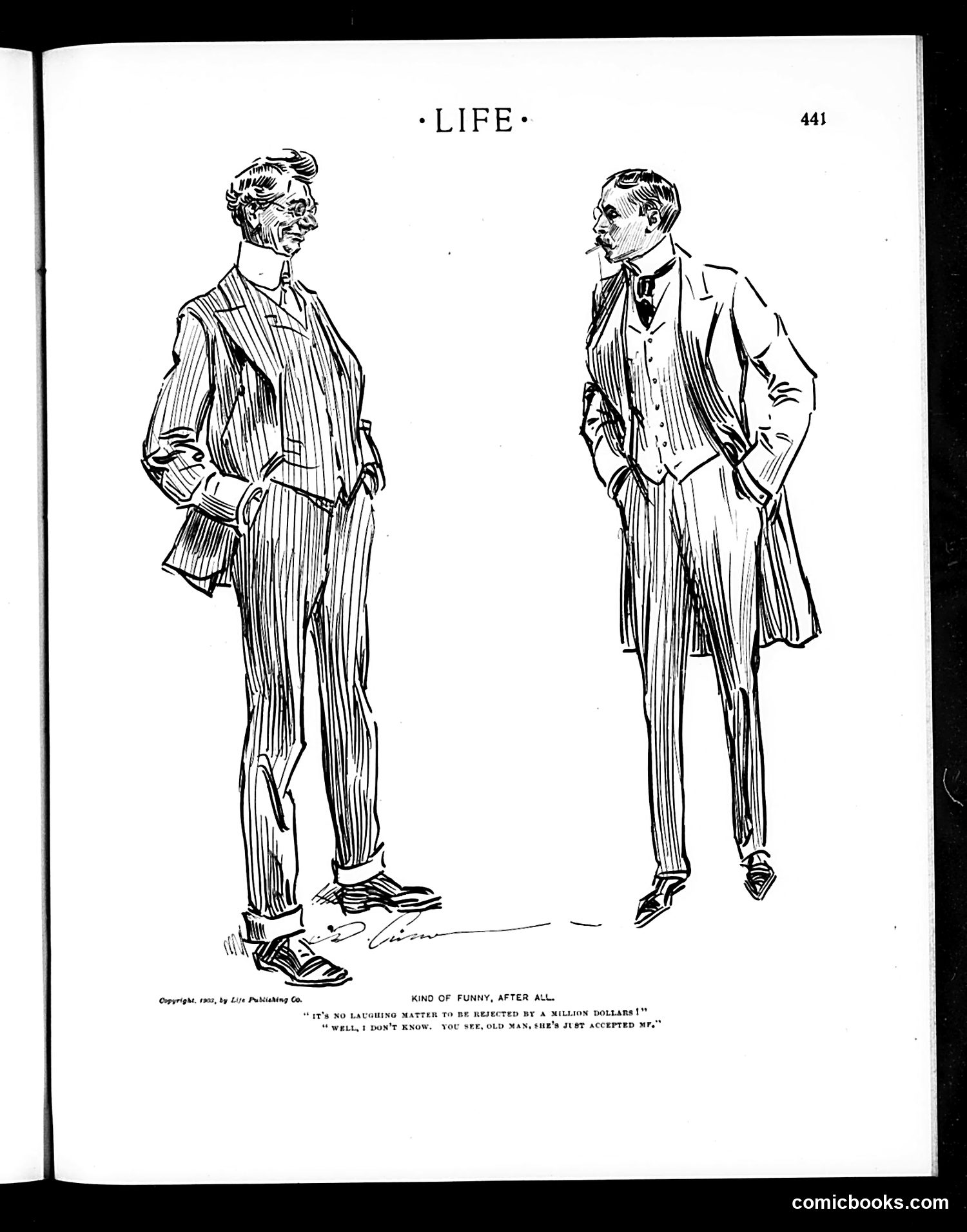
This 1901 Life magazine cartoon, titled "Kind of Funny, After All," depicts two men in conversation. The dialogue reads: "It's no laughing matter to be rejected by a million dollars!" and "Well, I don't know. You see, old man, she's just accepted me." The satire concerns a wealthy woman who rejected a suitor despite his million dollars, then accepted another man—presumably of lesser financial means. The joke inverts typical Gilded Age assumptions: that a woman would naturally accept the richest suitor. Instead, she chose based on personal preference, making the rejected wealthy man's rejection ironically "funny" because money didn't guarantee romantic success. This mocks the era's materialism while celebrating the woman's agency in choosing love over wealth.
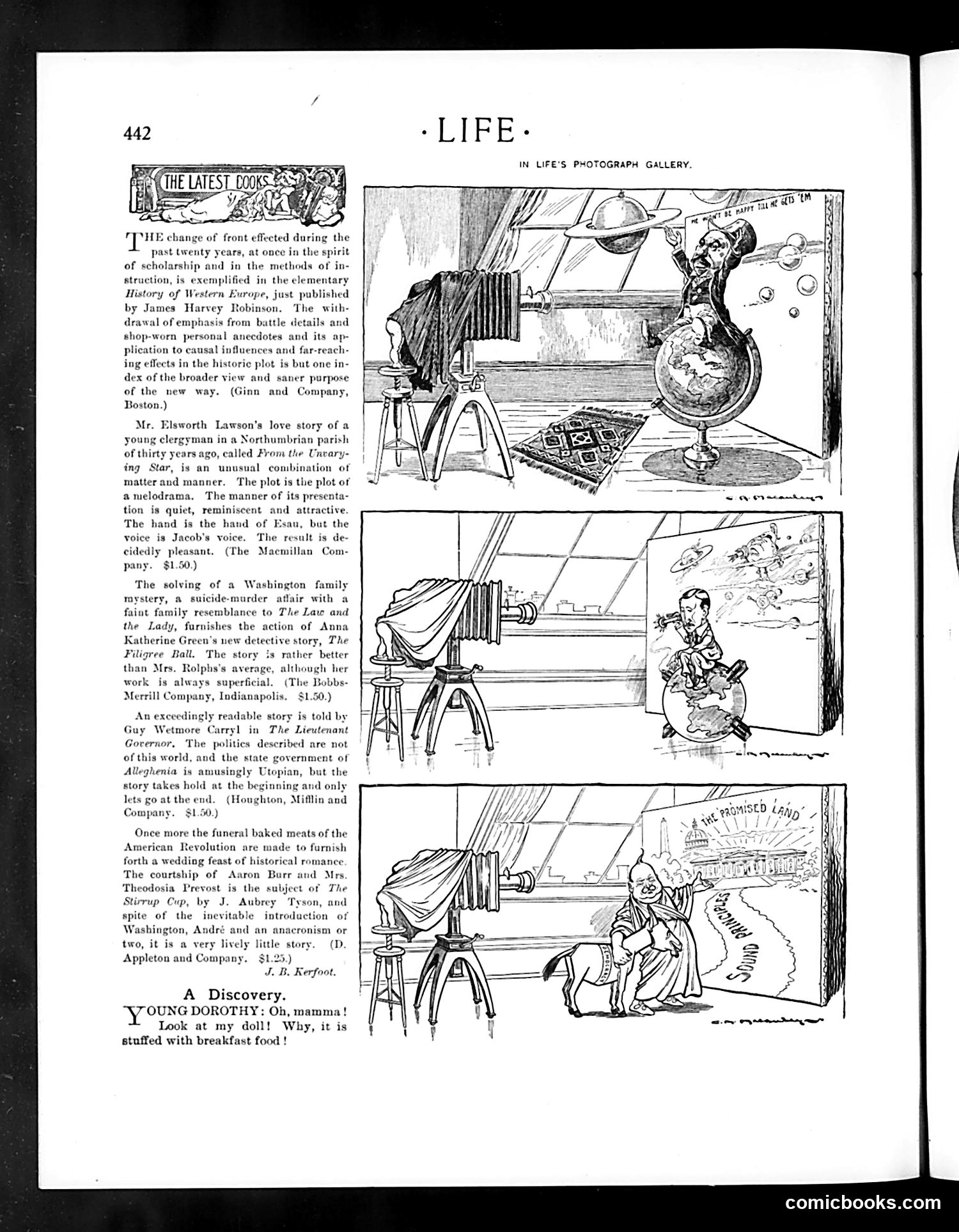
This page reviews new books rather than presenting political satire. The three illustrated panels on the right appear to be whimsical drawings accompanying book reviews, showing figures with globes and maps—likely illustrating stories involving geography or world themes. The text discusses several novels including James Harvey Robinson's *History of Western Europe*, Elsworth Lawson's *From the Unsarring Soil* (a Northumbrian parish love story), and works by Guy Wetmore Carryl and J. Aubrey Tyson involving political utopias and historical fiction about Aaron Burr and Washington. At the bottom, "A Discovery" presents a brief humorous anecdote about a child finding a doll stuffed with breakfast food—a light joke rather than political commentary. This is primarily a literary review section with accompanying illustrations.
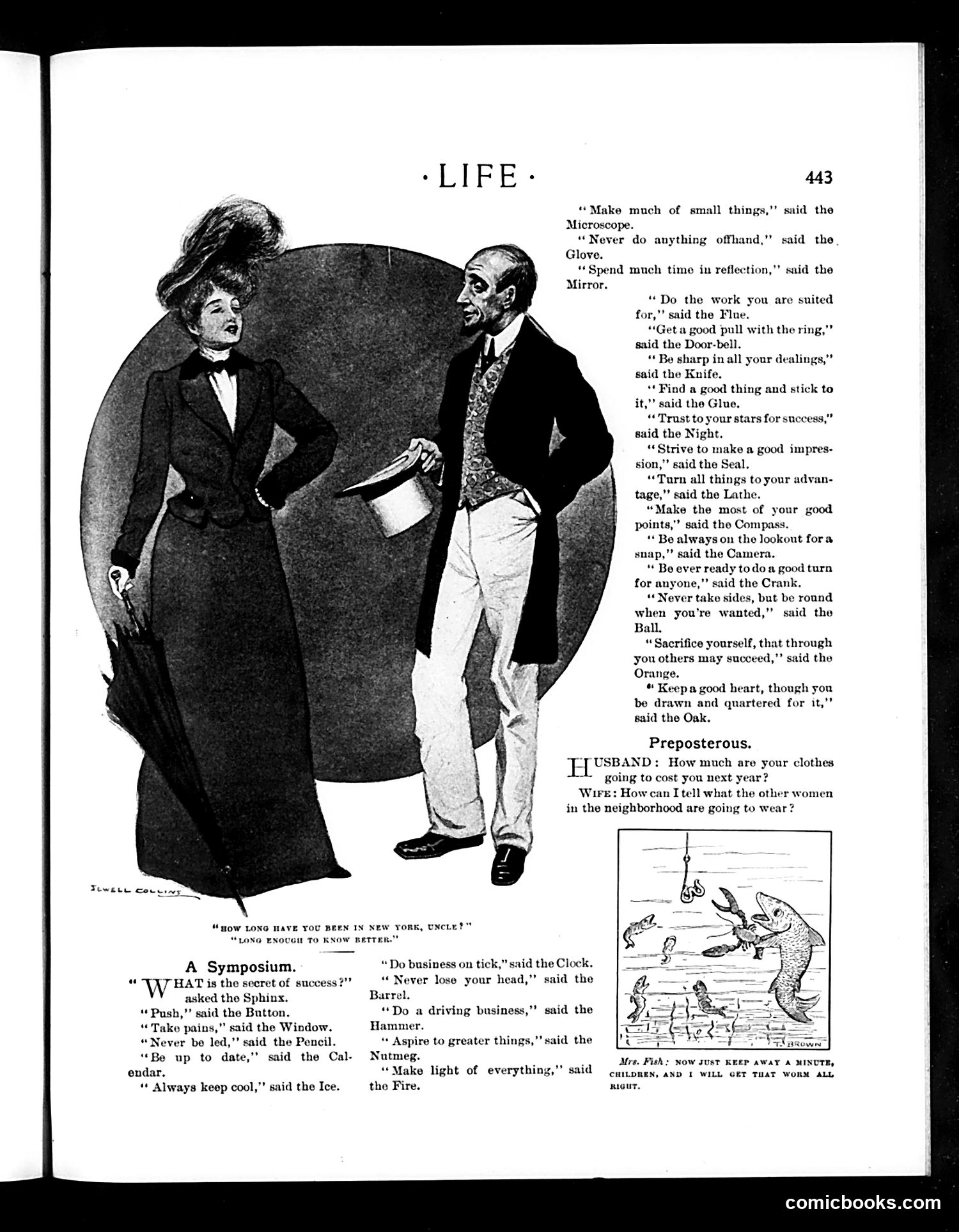
**"A Symposium"** presents anthropomorphic objects offering success advice—a satirical format common to Life magazine. Each item (Button, Window, Pencil, Calendar, Ice, Microscope, Glove, Mirror, Plue, Door-bell, Knife, Glue, Night, Seal, Lathe, Compass, Camera, Crank, Ball, Orange, Oak, Clock, Barrel, Hammer, Nutmeg, Fire) dispenses wisdom, likely mocking self-help literature and fortune-cookie platitudes popular in the era. **"Preposterous"** depicts a marital exchange about clothing costs—husband worried about expenses, wife concerned about fashion competition with neighbors. This satirizes the gender dynamics and consumerism of the period, suggesting women's social status was tied to visible wealth displayed through dress. Both cartoons employ gentle irony rather than sharp political commentary.
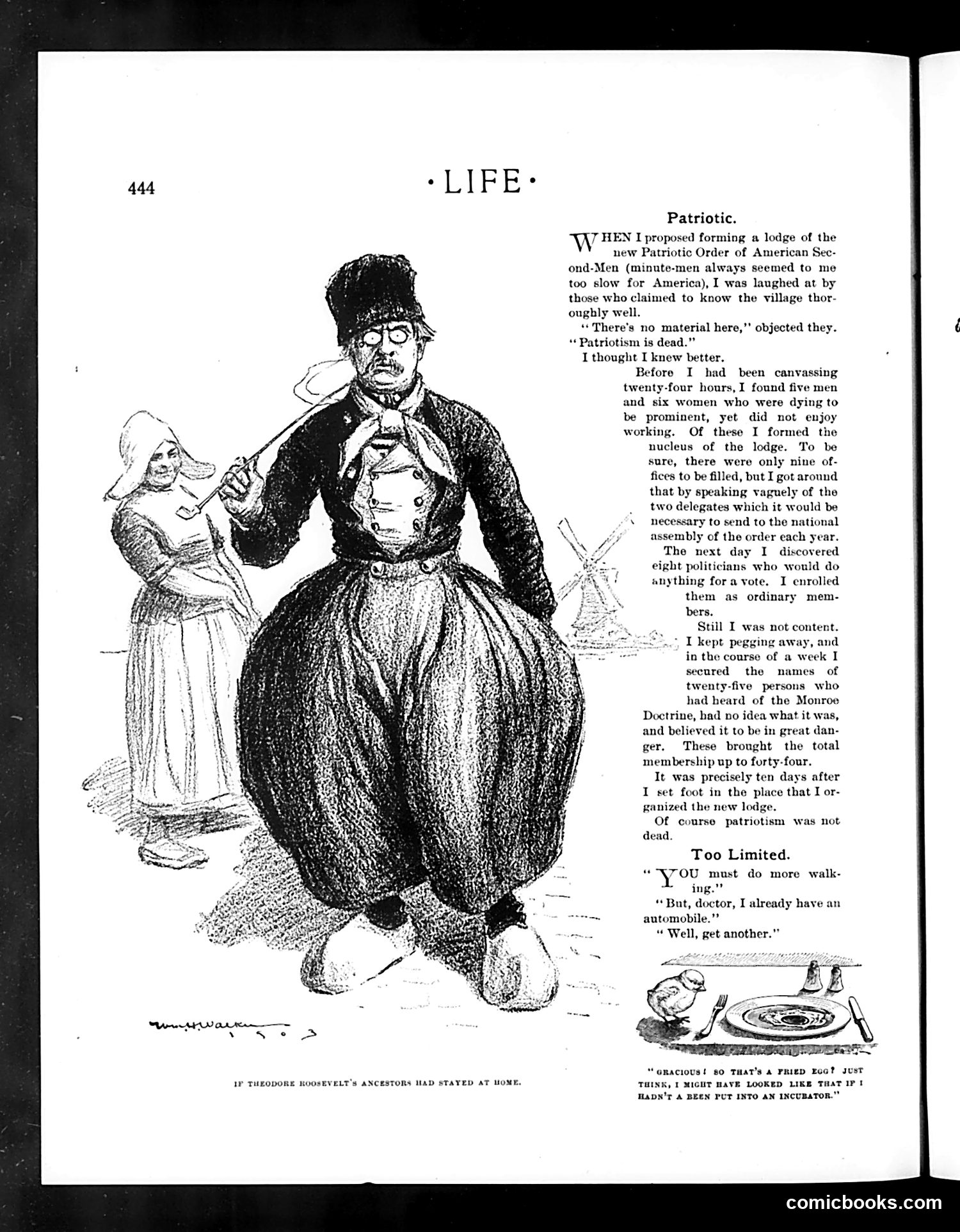
This page contains two satirical pieces mocking American patriotism and medical advice. **"Patriotic"** (left): The cartoon depicts a rotund figure in military dress, likely representing political corruption or self-interest masquerading as patriotism. The narrator describes forming a "Patriotic Order of American Second-Men" but struggling to recruit genuine patriots. Instead, he enrolls politicians, wealthy industrialists, and others motivated by votes rather than principle. The satire suggests that organized patriotism of the era was hollow—a vehicle for self-promotion rather than genuine civic virtue. **"Too Limited"** (right): A brief dialogue where a doctor advises a patient to walk more for health. The patient protests he already owns an automobile, and the doctor sarcastically suggests he buy another. This mocks the emerging automobile culture and resistance to physical exercise among the wealthy. Both pieces critique American materialism and hypocrisy.
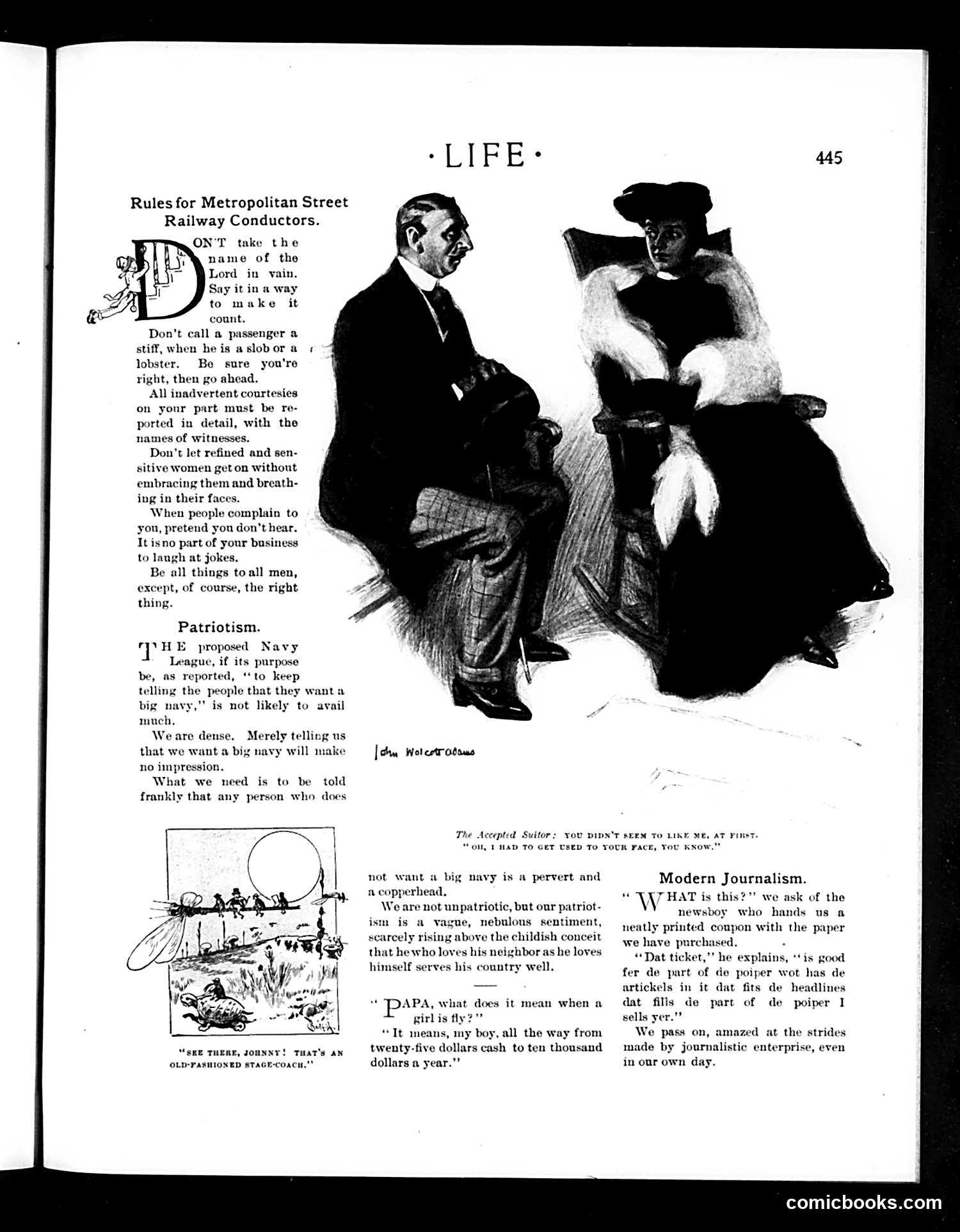
This page contains three distinct pieces of satire: 1. **"Rules for Metropolitan Street Railway Conductors"** — A mock-serious list mocking streetcar conductors' rudeness and poor customer service. It advises them not to call passengers insulting names, to handle complaints professionally, and to treat refined women with respect. The humor lies in the obvious gap between these reasonable suggestions and actual conductor behavior. 2. **"Patriotism"** — Critiques jingoistic naval advocacy, arguing that merely wanting a "big navy" reflects shallow patriotism. The satire targets vague nationalism detached from reasoned policy. 3. **"Modern Journalism"** — Mocks sensationalist newspaper practices, suggesting papers print eye-catching headlines unrelated to actual article content solely to boost sales. All three pieces target institutional incompetence and dishonesty in early 20th-century American life.
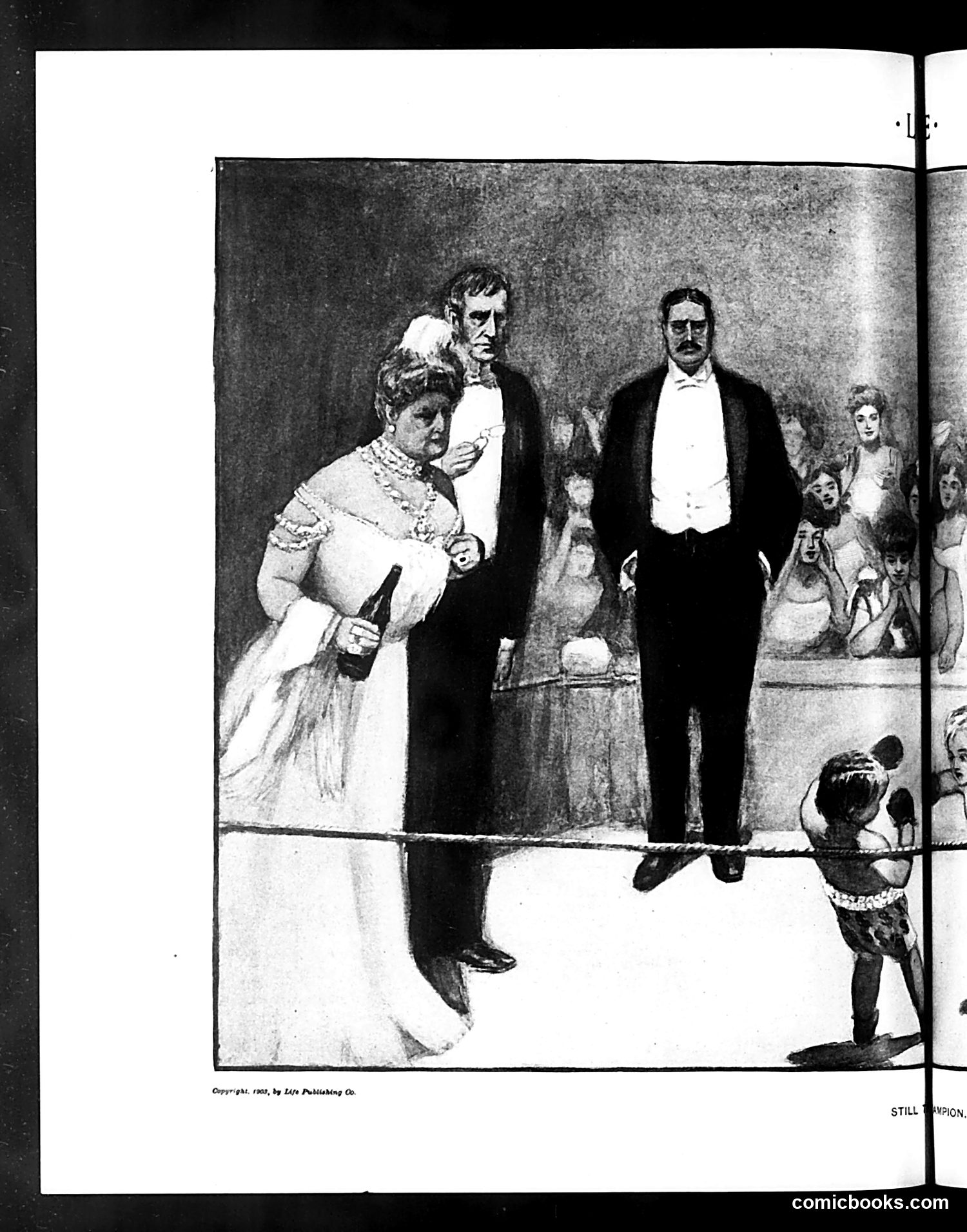
This appears to be a satirical illustration depicting a boxing or wrestling match scene. The image shows a well-dressed woman in an elegant white gown holding what appears to be a weapon or club, positioned alongside formally-dressed men in tuxedos. A small figure (possibly a child or caricatured person) is shown in the boxing ring below. The copyright indicates 1903, and the caption reads "STILL CHAMPION," suggesting this is political satire about power dynamics or competition. However, without clearer identification of the specific figures or additional context from the magazine, I cannot definitively identify which political figures or events are being referenced. The illustration's tone suggests commentary on social hierarchy, gender roles, or political dominance prevalent in early 1900s America, but the exact satirical target remains unclear from the visible information alone.
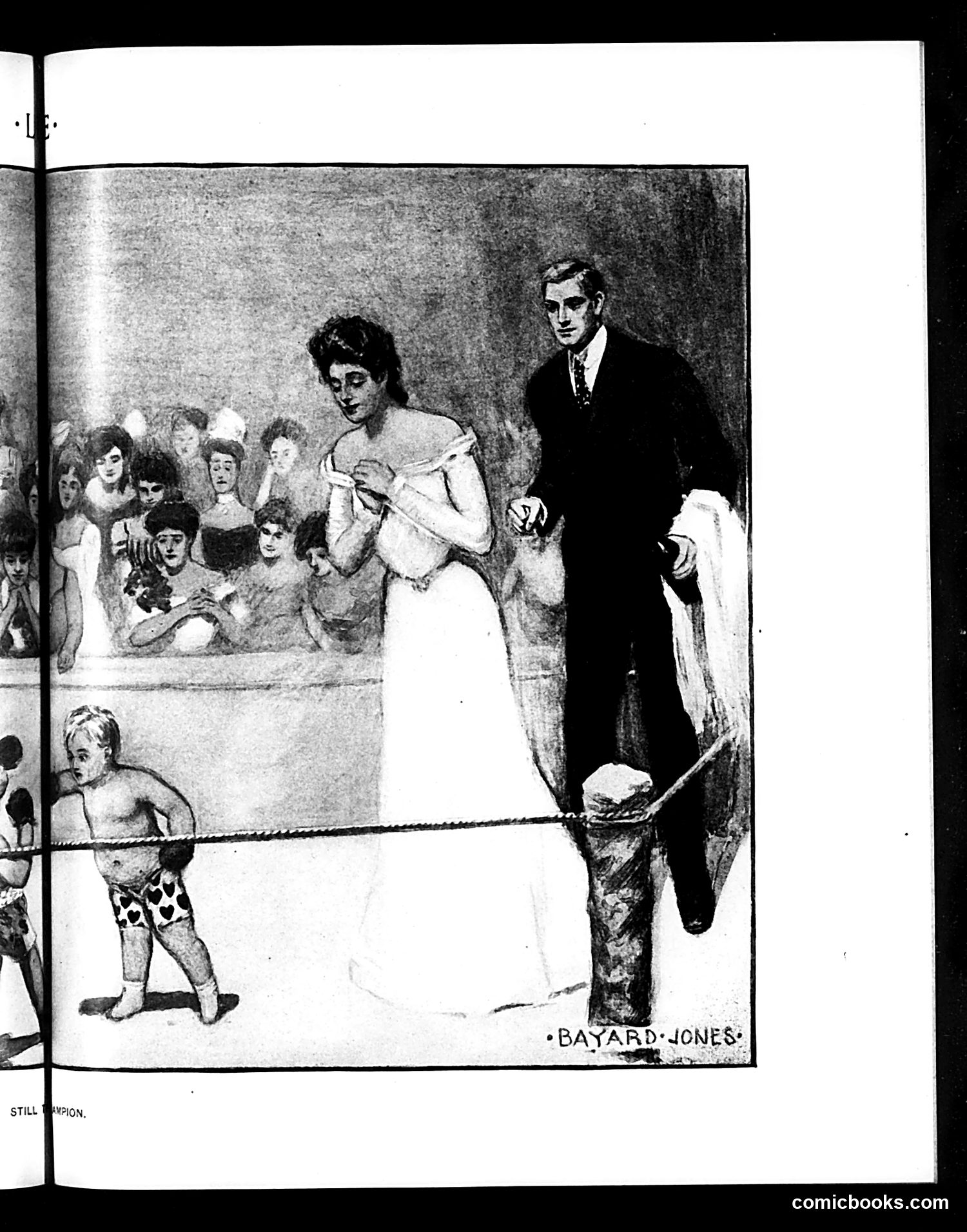
This appears to be a circus or performance scene illustrated by Bayard Jones. The image shows a well-dressed man in formal attire (top hat, suit) and a woman in an elegant off-shoulder gown standing in what appears to be a circus ring, with spectators visible in the background and a young child performer in patterned swimming attire at the bottom. Without additional OCR text or caption information visible on this page, I cannot definitively identify the specific figures or determine what satirical point Life magazine intended. The formal dress of the adults contrasted with the circus setting *suggests* potential satire about high society involvement in entertainment or performance, but the exact social/political commentary remains unclear from the image alone.
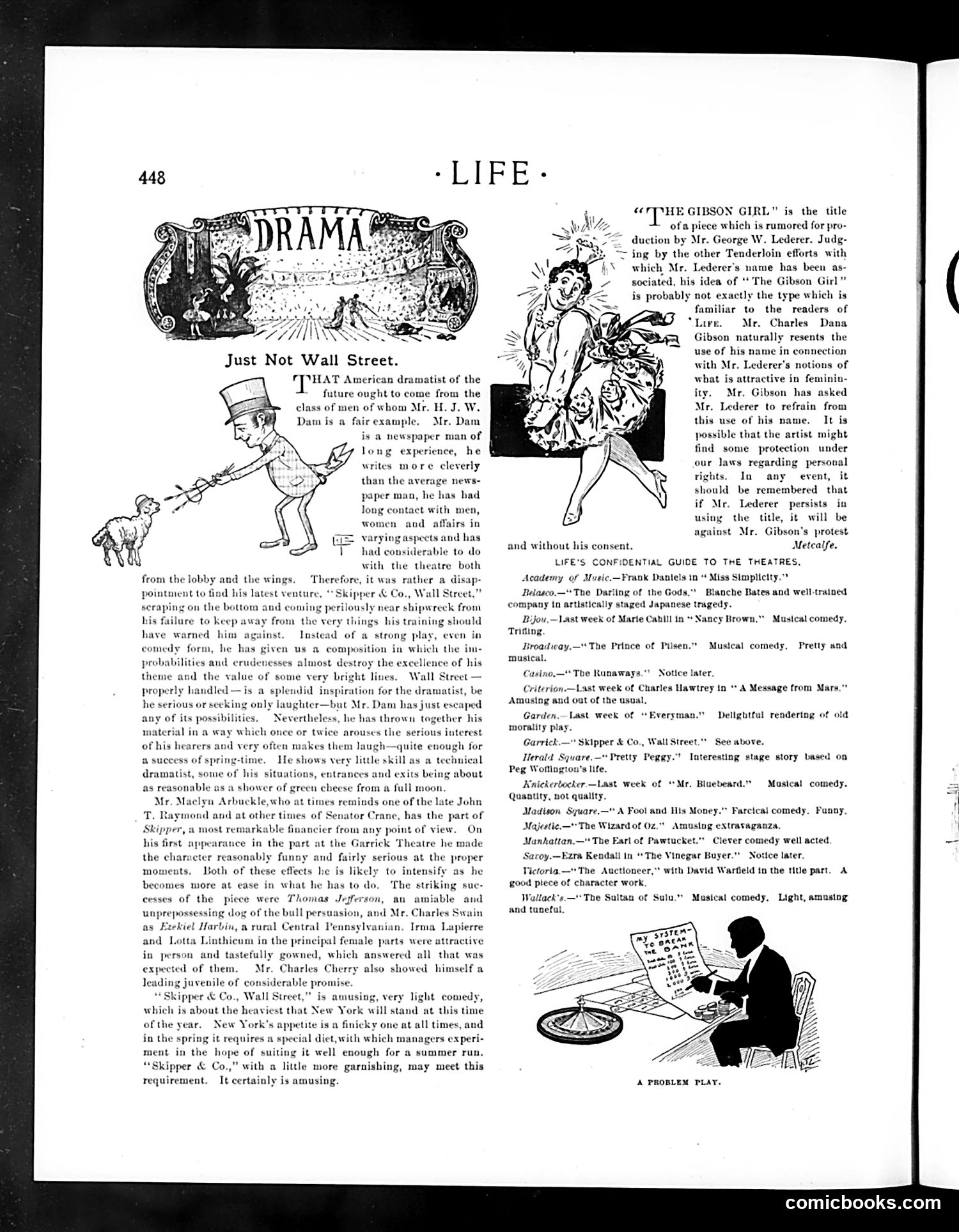
This page discusses theatrical productions and includes a drama section review. The main article, "Just Not Wall Street," critiques a play by H.J. W. Dam about an American dramatist entering theater. The text praises Dam's experience and skill, comparing the work favorably to other recent comedies. The right column addresses a dispute between Charles Dana Gibson (creator of the "Gibson Girl") and producer George W. Lederer over use of Gibson's name for a theatrical production. Life notes potential legal issues regarding personal rights and name usage. The page includes illustrations of theatrical scenes and a cartoon labeled "A Problem Play" showing a man studying theatrical materials—likely satirizing the complexity of theatrical production or playwriting itself.
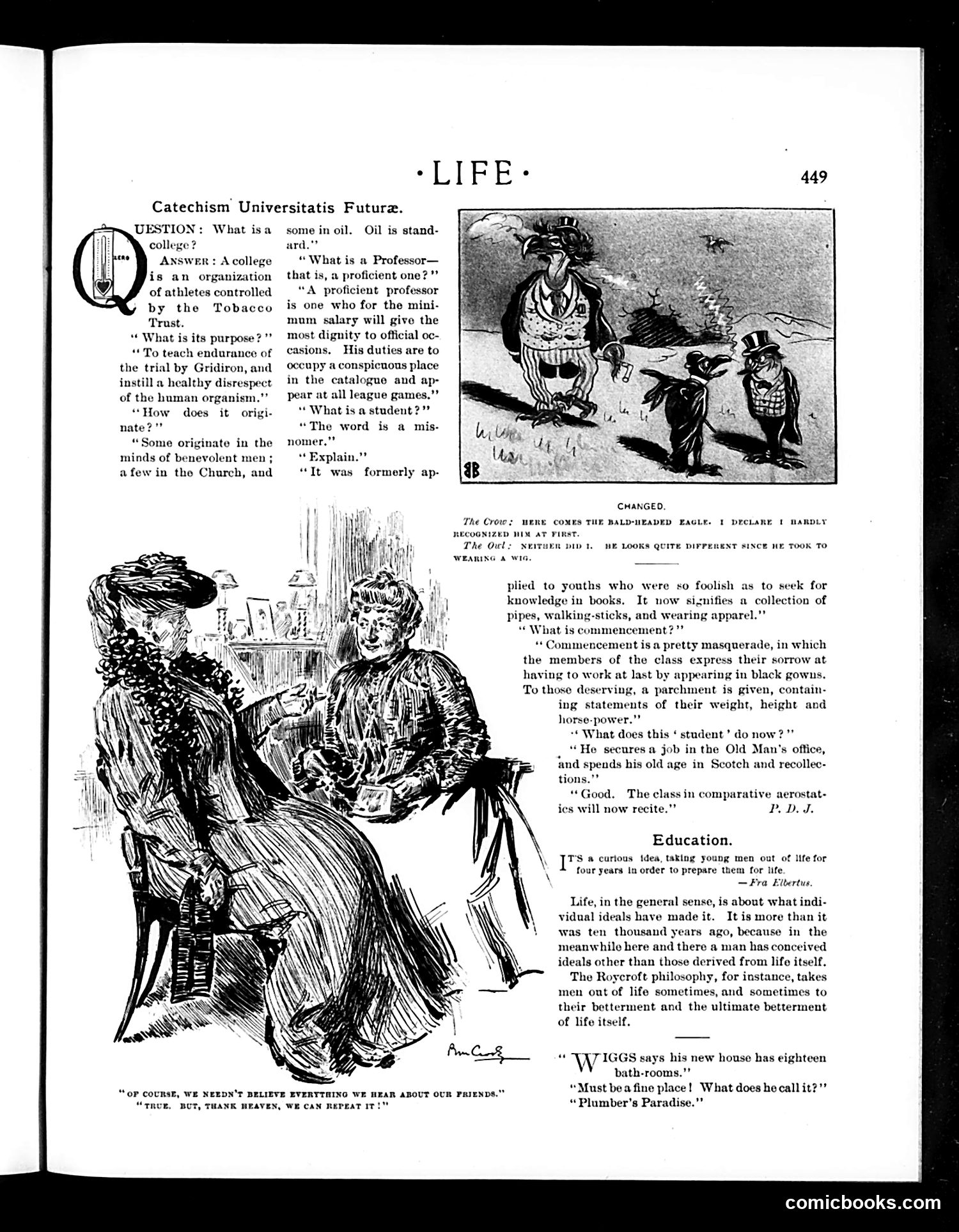
This page satirizes American higher education around the early 1900s through a mock "Catechism" (Q&A format mimicking religious instruction). **Main Satire:** The "Catechism Universitatis Futurae" mocks colleges as commercialized institutions controlled by wealthy industrialists (the "Tobacco Trust"), where: - Athletics dominate over academics - Professors are mere figureheads earning minimum salary - "Students" don't actually study books but collect fashionable accessories - Graduation is performative theater leading to nepotistic office jobs **Supporting Cartoons:** Two smaller pieces critique gossip and superficiality—one about mindlessly repeating rumors about friends, another showing birds unrecognizable after cosmetic changes (wigs), suggesting shallow transformation. **Context:** This reflects Progressive Era skepticism about whether colleges served genuine educational or primarily social/business functions. The satire targets corporate influence on institutions and the gap between educational ideals and commercial reality.
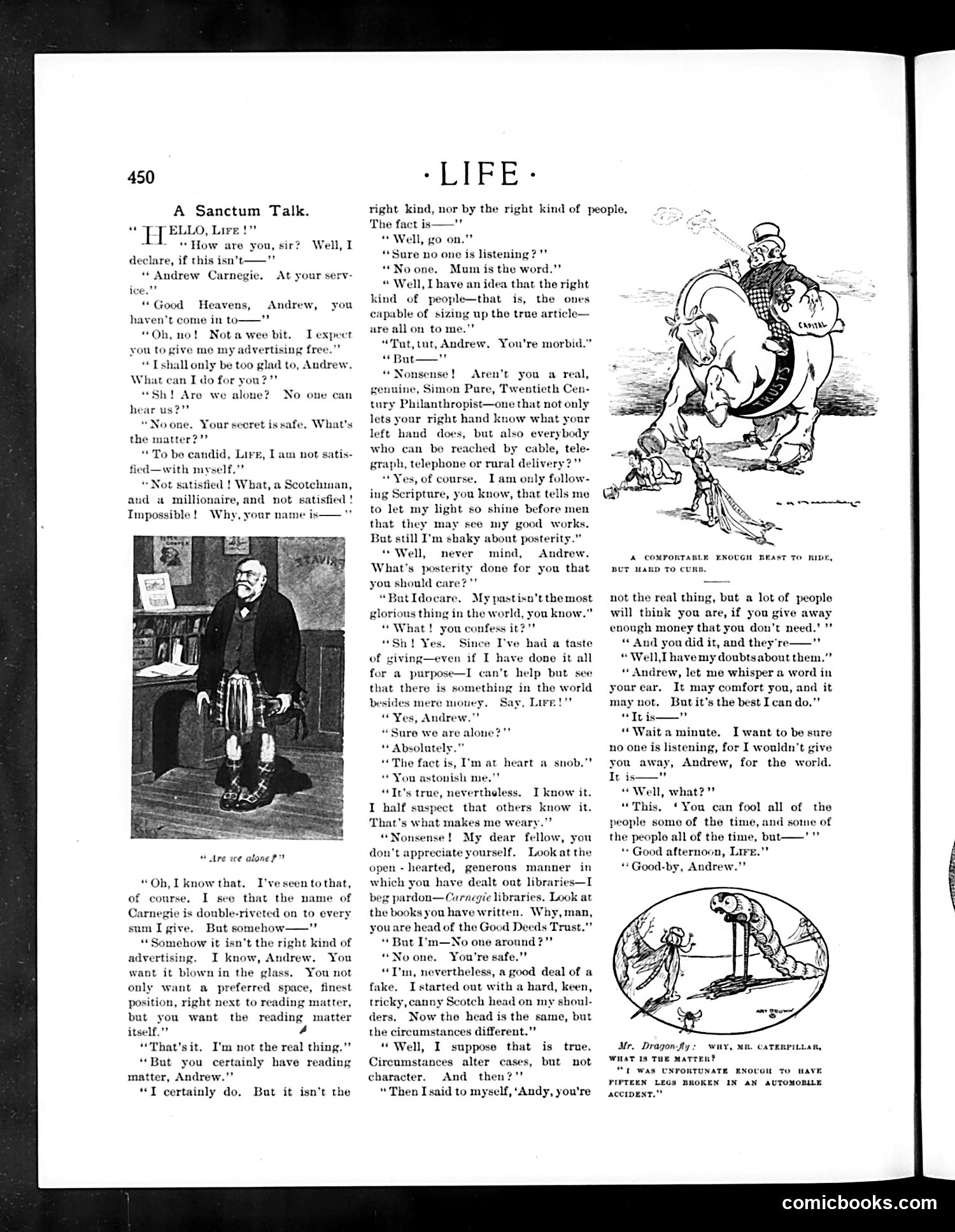
This satirical dialogue depicts **Andrew Carnegie**, the Scottish-American steel magnate and philanthropist, confessing his insecurities to the editor of *Life* magazine in his office ("sanctum"). The satire targets Carnegie's famous public philanthropy—his libraries and charitable giving—as performative rather than genuinely altruistic. Carnegie admits he's "a good deal of a fake" who strategically gave away money he didn't need to manufacture a positive public image. The repeated anxious question "Are we alone?" underscores his hypocrisy: his generous deeds were deliberately publicized, contradicting the Biblical principle about charity done in secret. The cartoon mocks the wealthy industrialist's attempt to buy respectability and moral authority through calculated generosity. The accompanying illustrations show Carnegie as physically unprepossessing—emphasizing that his wealth, not character, earned him prominence. The final caption references Lincoln's aphorism: "You can fool all the people some of the time"—suggesting Carnegie succeeded in fooling the public, if not himself.
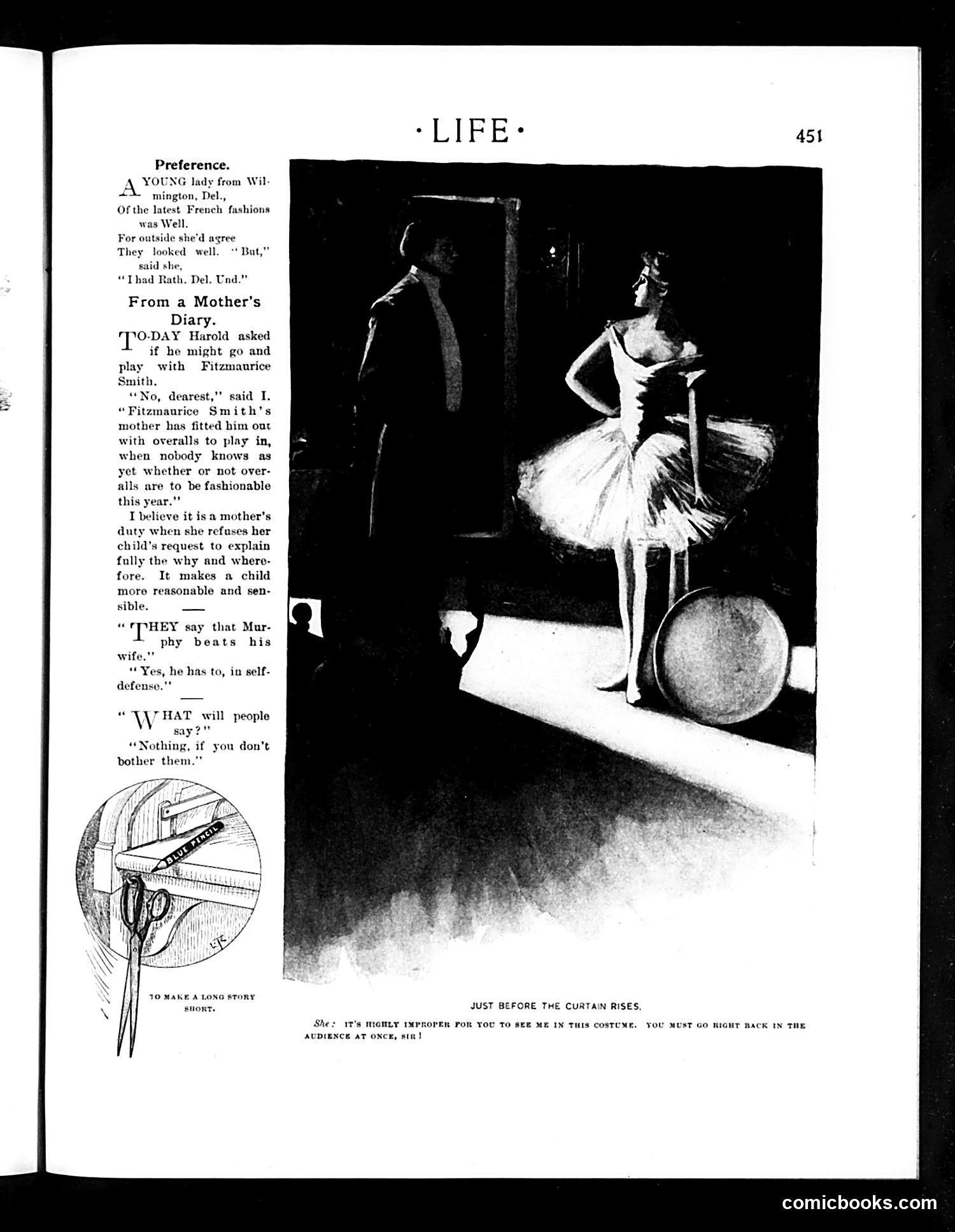
This page contains three separate satirical anecdotes mocking social pretension and fashion anxiety in early 20th-century America. **"Preference"** ridicules a Delaware woman obsessed with French fashions, yet critical of them as "bad" German/Dutch ("Rath. Del. Und.")—suggesting shallow, contradictory snobbery. **"From a Mother's Diary"** satirizes maternal overprotectiveness about social status. A mother refuses her son permission to play with a friend whose mother dressed him in overalls, because overalls' fashionability remains uncertain. The satire mocks how absurdly mothers regulate children based on uncertain social conventions. **The husband-and-wife joke** offers dark humor about domestic violence as mutually necessary ("self-defense"). **"Just Before the Curtain Rises"** depicts theatrical impropriety—an actress insisting a male audience member leave because seeing her in costume before the performance is "improper," though she's about to perform in that costume publicly. It mocks contradictory Victorian modesty conventions. The small cartoon "To Make a Long Story Short" shows a crank telephone, likely illustrating communication mishaps.
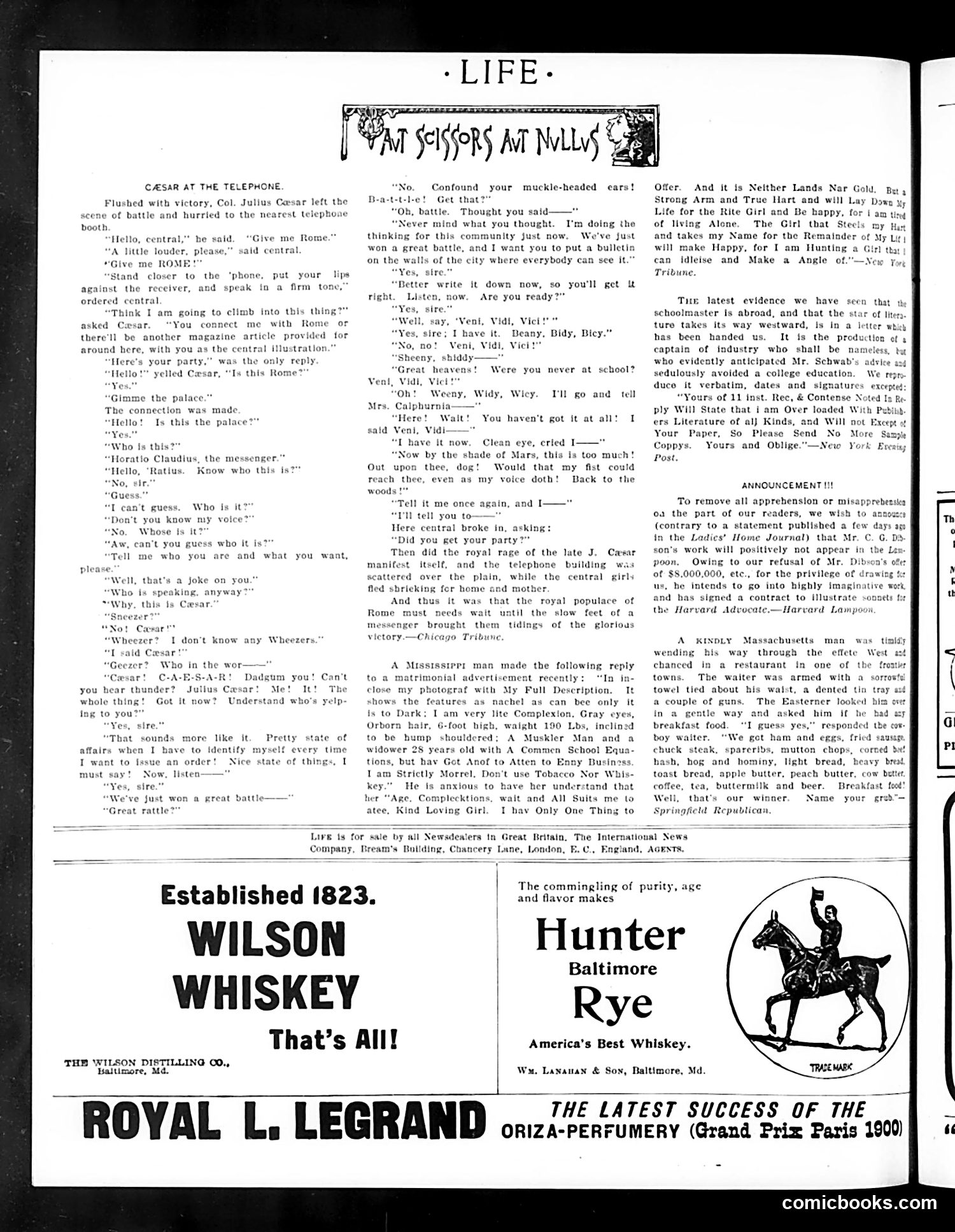
This cartoon mocks the early telephone system's unreliability and the operator's incompetence. Julius Caesar, fresh from military victory, attempts to announce his triumph ("Veni, Vidi, Vici"—"I came, I saw, I conquered") to Rome via telephone. The central operator repeatedly mishears his famous Latin phrase as "Sheeny, Bidy, Bicy" and other garbled versions. Caesar grows increasingly frustrated, unable to communicate even the simplest message through this new technology. The joke satirizes: 1. **New technology's failings** — the telephone as an unreliable novelty 2. **Operator error** — incompetent, poorly-trained telephone operators (often young women called "central girls") 3. **Communication breakdown** — the gap between intent and reception The satire suggests that despite technological progress, human incompetence remains constant—even a triumphant Roman emperor cannot overcome a befuddled telephone operator. This reflects early 20th-century skepticism about whether the telephone would actually improve communication.
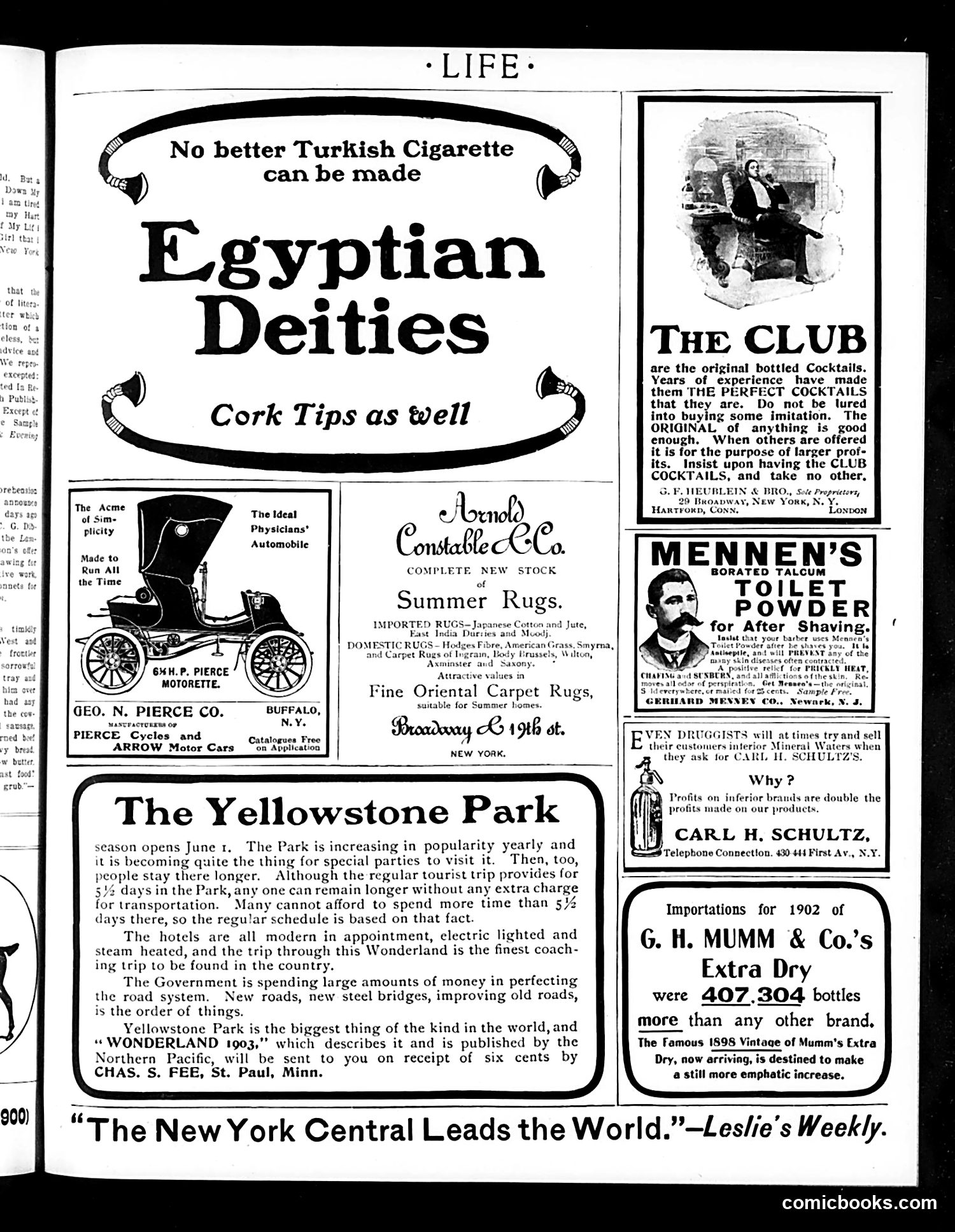
This is primarily an **advertisement page** from Life magazine, containing no political cartoons or satire requiring historical context. The page showcases **turn-of-the-century luxury goods and services**: Egyptian Deities cigarettes, Pierce automobiles, summer rugs, Yellowstone Park tourism, cocktail mixers, talcum powder, and champagne. These ads target wealthy readers. One item warrants note: the Yellowstone Park ad promotes government infrastructure investment (roads, bridges) as a tourist attraction—reflecting early-1900s pride in federal modernization projects. The ads emphasize "original" and "superior" products (Club Cocktails, Mumm champagne, Carl Schultz water), likely responding to proliferating imitations in an unregulated marketplace. The Schultz ad explicitly warns druggists push inferior brands for higher profits—a period concern about commercial dishonesty. The page's concluding tagline, "The New York Central Leads the World," is boosterism for American railroad and industrial achievement, typical of the era.
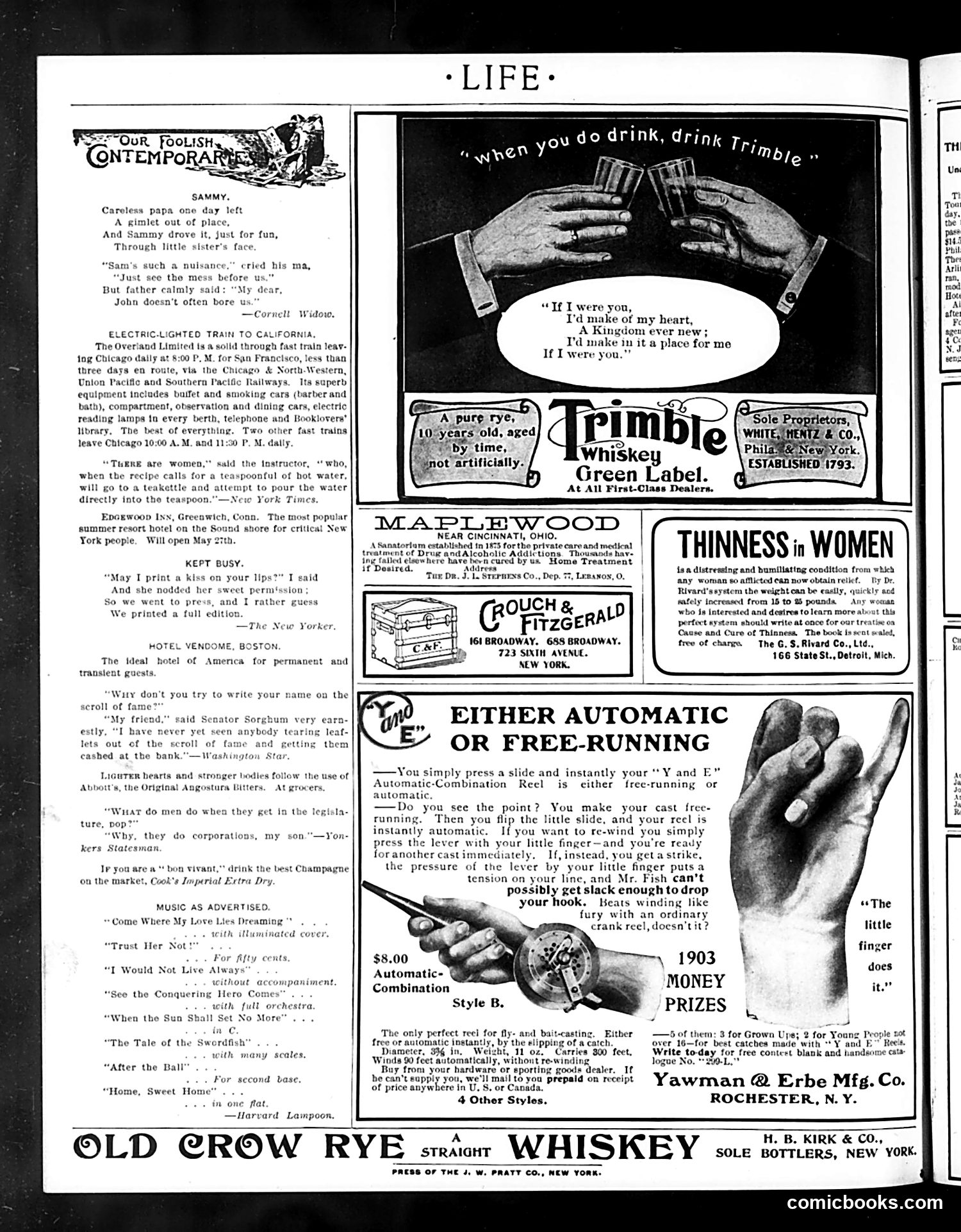
This page from *Life* magazine is primarily **advertising**, with minimal editorial content. The small cartoon at top ("Sammy") is a crude joke about a child driving a gimlet (tool) through his sister's face while father dismisses it as harmless mischief—reflecting early 20th-century attitudes toward child discipline. The bulk of the page consists of period advertisements: Trimble Whiskey, railroad travel, medical treatments for "thinness in women" and other conditions, and notably a fishing reel ("Y and E Automatic-Combination Reel"). There's also an "Old Crow Rye" whiskey ad at bottom. The page reflects era-specific concerns: patent medicines marketed directly to consumers, gender-specific ailments treated as medical conditions, and alcohol advertising presented without regulation. The scattered literary quotes and humor snippets are filler typical of *Life*'s satirical format. Overall, this represents *Life* functioning as a vehicles for advertising revenue rather than serious satire or commentary.
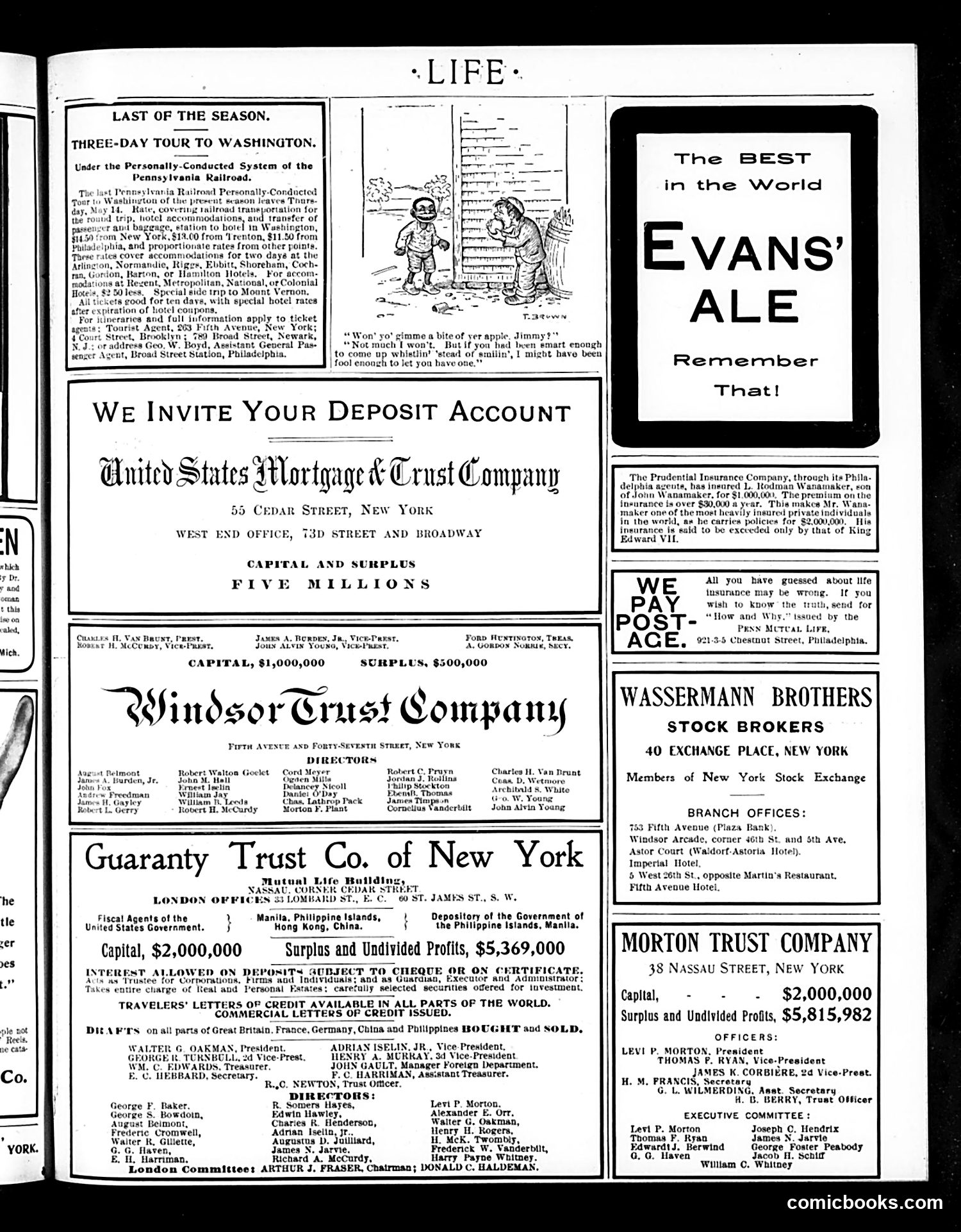
This page is predominantly **advertising** for New York financial institutions and services, with one small cartoon. The sole cartoon—titled "yo gimme a bite of yer apple, Jimmy?"—depicts two children in what appears to be a working-class exchange. The dialogue suggests social commentary on childhood selfishness: one child refuses to share fruit, implying the other child should have been "smart enough" and "fool enough" to behave differently. This reflects *Life*'s era of sometimes condescending humor about children and character. The advertisements below showcase wealth management, trust companies, stock brokers, and life insurance—reflecting the magazine's audience of affluent readers. Notable is the Prudential Insurance ad mentioning L. Rodman Wanamaker's $1,000,000 policy, positioning wealth and security as status symbols. The Evans' Ale advertisement promises "the BEST in the World," typical period marketing. This appears to be a seasonal issue (referenced as "Last of the Season"), likely from early 1900s based on typography and financial institutions listed.
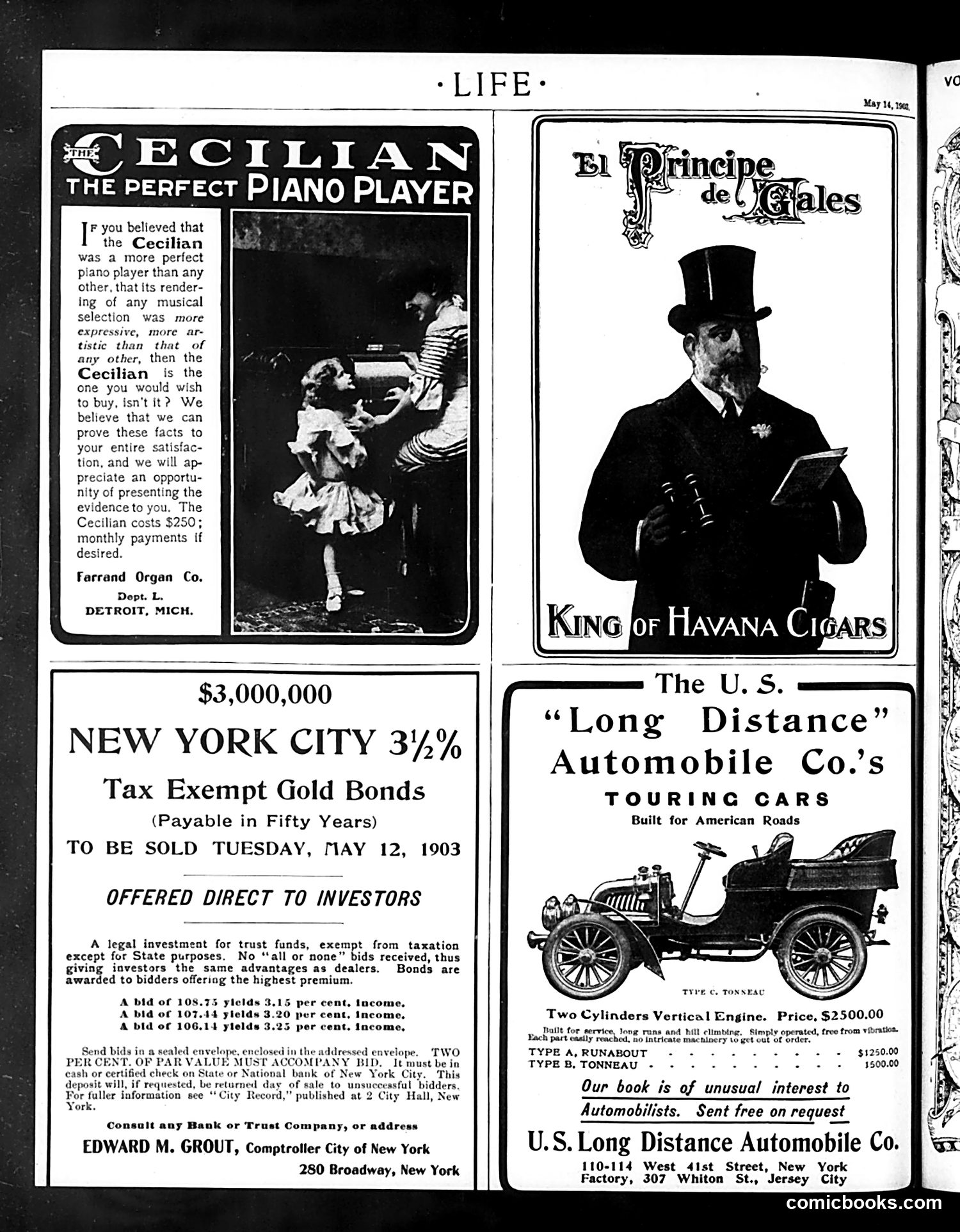
This is primarily an **advertising page**, not a political cartoon. It contains four commercial advertisements typical of the era: 1. **Cecilian Piano Player** — an automated piano device (player piano), marketed as superior to competitors 2. **NYC Municipal Bonds** — a financial investment opportunity for city infrastructure 3. **El Príncipe de Gales Cigars** — Cuban cigars branded with a distinguished gentleman in formal dress 4. **U.S. Long Distance Automobile Company** — early automobiles (touring cars), priced at $1,250-$2,500 **Social context for modern readers:** These ads reflect 1909 consumer culture—mechanical entertainment devices, municipal financing, luxury imported goods, and the nascent automobile industry targeting affluent buyers. The language emphasizes reliability, investment safety, and technological superiority. No satirical content is evident; this represents straightforward early-20th-century advertising in a magazine known for humor elsewhere in its pages.