
Life, 1903-05-14 · page 4 of 20
Life — May 14, 1903 — page 4: what you’re looking at
What you’re looking at
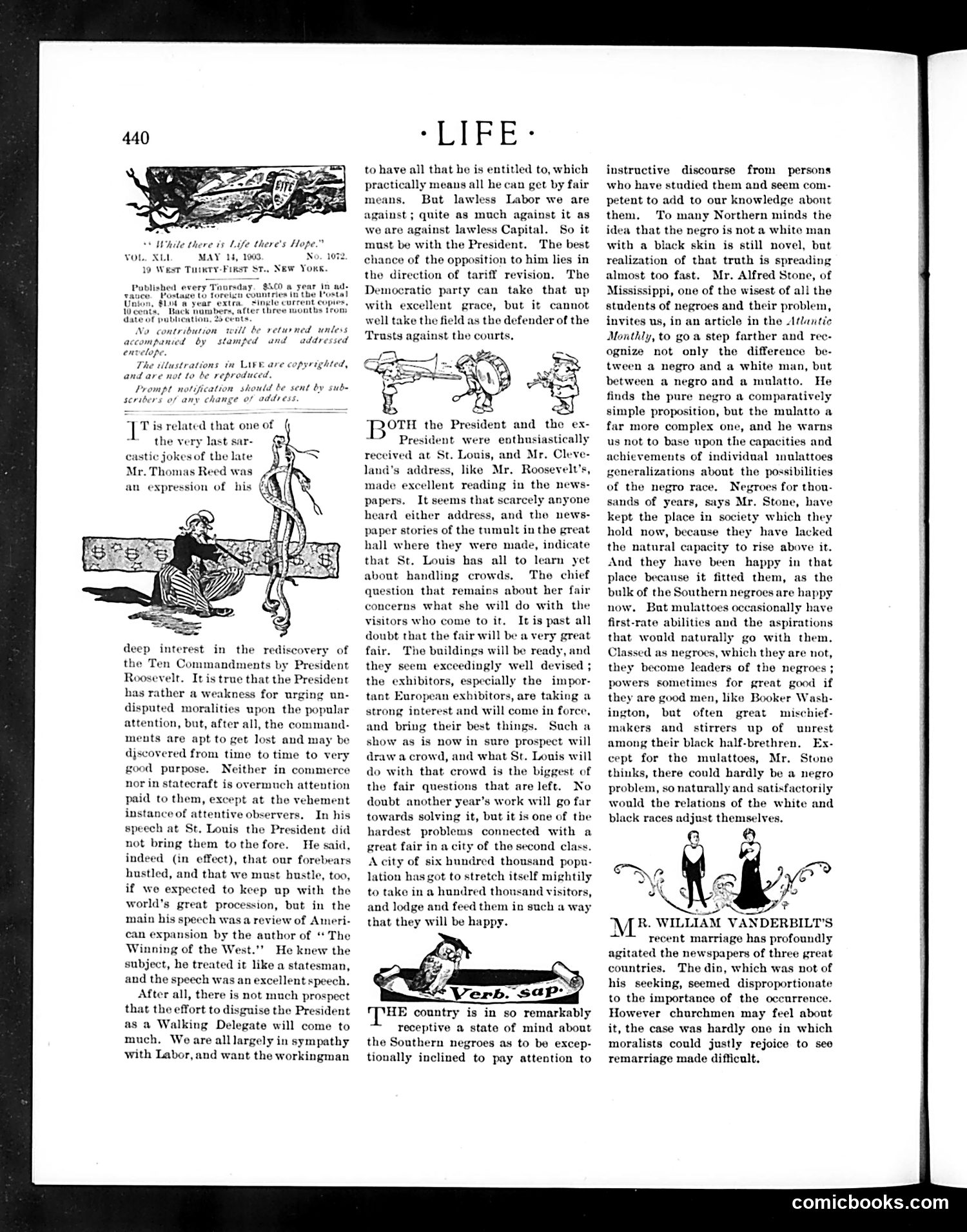
The page discusses President Roosevelt's handling of labor disputes and the upcoming St. Louis World's Fair. The left cartoon depicts a figure (appears to be Roosevelt) as a "Walking Delegate"—a labor union representative—suggesting the President was overstepping by intervening in labor matters. The satire criticizes Roosevelt for being inconsistent: sympathetic to labor unions while opposing "lawless Capital" and trusts, yet the cartoon implies his interventionism is itself problematic. The text notes the President received criticism from both business and labor perspectives at St. Louis. The right section discusses William Vanderbilt's remarriage, treating it as a minor social scandal unworthy of major newspaper attention—satirizing the press's tendency to amplify trivial society news.
📄 Transcribed text from this page (OCR, searchable)
Machine-transcribed from the original scan — historical spelling and the odd misread are preserved.
‘ While there is Life there's Hope.” VoL. XL MAY 14, 1903, 19 West Tutery-FiRst ST, all be returned untess stamped and addressed No contribution ympanied by The tilustrations in LAFE are copyrighted, and are not to be reproduced. Prompt notification should be sent by sub- scribers of any change of address T is related that one of the very last sar- astic jokes of the late Thomas Reed was an expression of his deep interest in the rediscovery of the Ten Commandments by President Roosevelt. It is true that the President has rather a weakness for urging un- disputed moralities upon the popular attention, but, after all, the command- ments are apt to get lost and may be djscovered from time to time to very good purpose. Neither in commerce nor in statecraft is overmuch attention paid to them, except at the vehement instance of attentive observers. In his speech at St. Louis the President did not bring them tothe fore. He said, indeed (in effect), that our forebears hustled, and that we must hustle, too, if we expected to keep up with the world’s great procession, but in the main his speech was a review of Ameri- can expansion by the author of “ The Winning of the West.” He knew the subject, he treated it like a statesman, and the speech was an excellent speech. After all, there is not much prospect that the effort to disguise the President as a Walking Delegate will come to much. We are all largely in sympathy with Labor, and want the workingman to have all that he is entitled to, which practically means all he can get by fair means. But lawless Labor we are against ; quite as much against it as we are against lawless ital. So it must be with the President. The best chance of the opposition to him lies in the direction of tariff revision, The Democratic party can take that up with excellent grace, but it cannot well take the field as the defender of the Trusts against the courts, OTH the Pr President ident and the e enthusiastically ved at St. Louis, and Mr. Cle land's address, like Mr. Roosevelt’: made excellent reading in the new: papers. It seems that scarcely anyone heard either address, and the news- paper stories of the tumult in the great hall where they were made, indicate that St. Louis has all to learn yet The chief about her fair concerns what she will do with the visitors who come to it. It is past all doubt that the fair will be a very great fair. The buildings will be ready, and they seem exceedingly well devised ; the exhibitors, especially the impor- tant European exhibitors, are taking a strong interest and will come in fore and bring their best things. Such show as is now in sure prospect will draw a crowd, and what St. Louis will do with that crowd is the biggest of the fair questions that are left. No doubt another year’s work will go far towards solving it, but it is one of the hardest problems connected with a great fair in a city of the second class. A city of six hundred thor nd popu- lation has got to stretch itself mightily to take in a hundred thonsand visitors, and lodge and feed them in such a way that they will be happy. about handling crowds. question that remain: ‘THE country is in so remarkably receptive a state of mind about the Southern negroes as to be excep- tionally inclined to pay attention to instructive discourse from persons who have studied them and seem com- petent to add to our knowledge abont them, To many Northern minds the idea that the negro is not a white man with a black skin is still novel, but realization of that truth is spreading almost too fast. Mr. Alfred Stone, of Mississippi, one of the wisest of all the students of negroes and their problem, invites us, in an article in the Atlantic Monthly, to goa step farther and rec- ognize not only the difference be- tween a negro and a white man, but between a negro and a mulatto. He finds the pure negro a comparatively simple proposition, but the mulatto a far more complex one, and he warns us not to base upon the capacities and achievements of individual inulattoes generalizations about the possibilities of the negro race. Negroes for thou- sands of years, says Mr. Stone, hav kept the place in society which the hold now, because they have lacked the natural capacity to rise above it. And they have been happy in that place because it fitted them, as the bulk of the Southern negroes are happy now. But mulattoes occasionally have first-rate abilities and the aspirations that would naturally go with them. Classed as negroes, which they are not, they become leaders of the negroes ; powers sometimes for great good if they are good men, like Booker Wash- ington, but often great mischief- makers and stirrers up of unrest among their black half-brethren. cept for the mulattoes, Mr. Stone thinks, there could hardly be a negro problem, so naturally and satisfactorily would the relations of the white and black races ‘o. ‘nan elves. i. as R. we VANDERBILT'S recent marriage has profoundly agitated the newspapers of three great The din, which was not of king, seemed disproportionate to the importance of the occurrence. However churchmen may feel about it, the case was hardly one in which moralists could justly rejoice to see remarriage made difficult. comicbooks.com