
A complete issue · 22 pages · 1903
Life — March 19, 1903
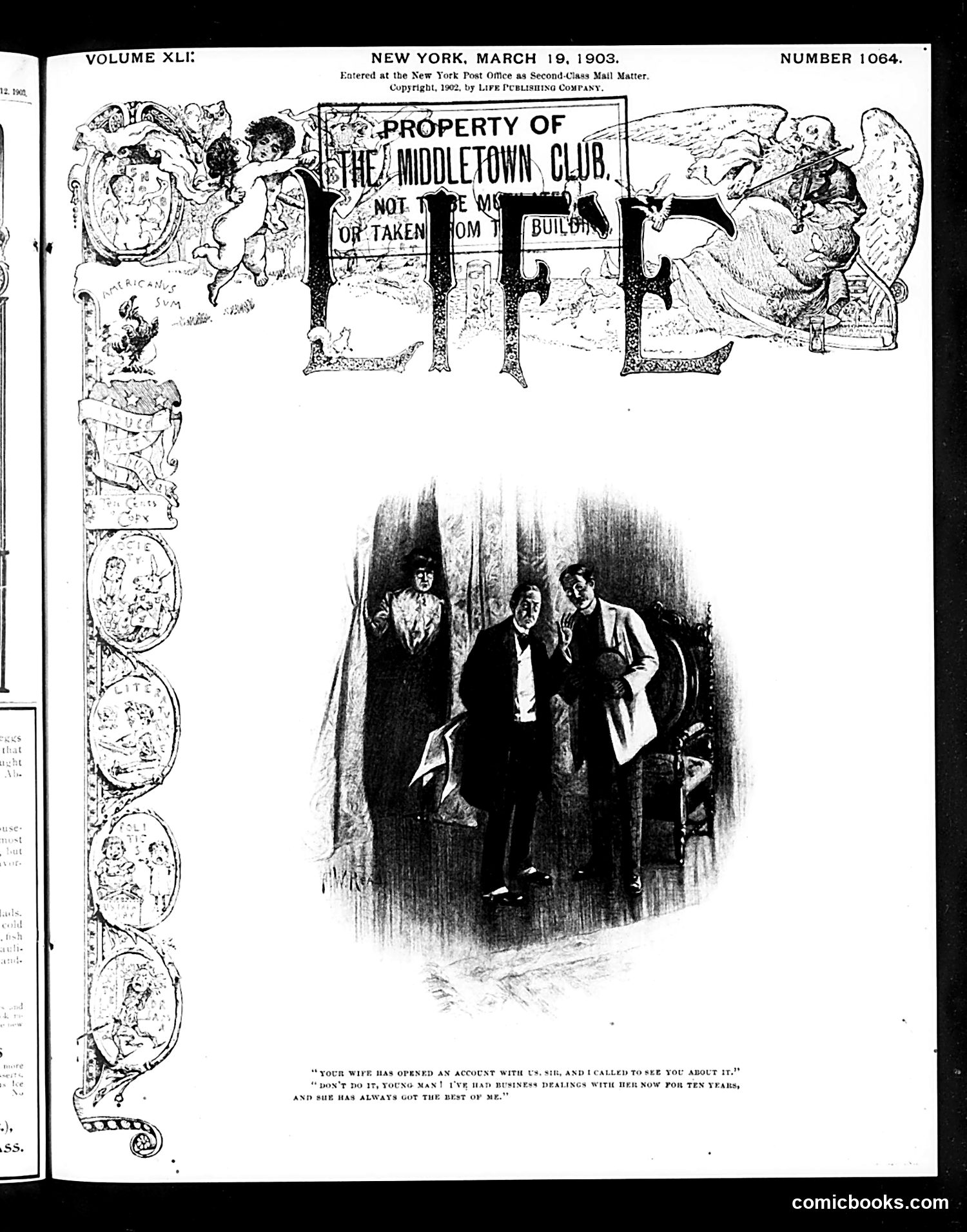
This page features a domestic humor cartoon about marital finances. Three men in formal dress stand together, with the caption quoting one saying his wife has opened an account and he's calling to complain about it—adding that despite ten years of marriage, "she has always got the best of me." The joke reflects early 1900s anxieties about women's financial independence. At this period, married women gaining control over their own money was becoming increasingly common and apparently controversial among some men. The cartoon satirizes husbands who felt threatened or emasculated by wives' economic autonomy, portraying the situation as wives "winning" in marital power dynamics. The ornate decorative borders and cherub illustrations are typical Life magazine design elements of the era.
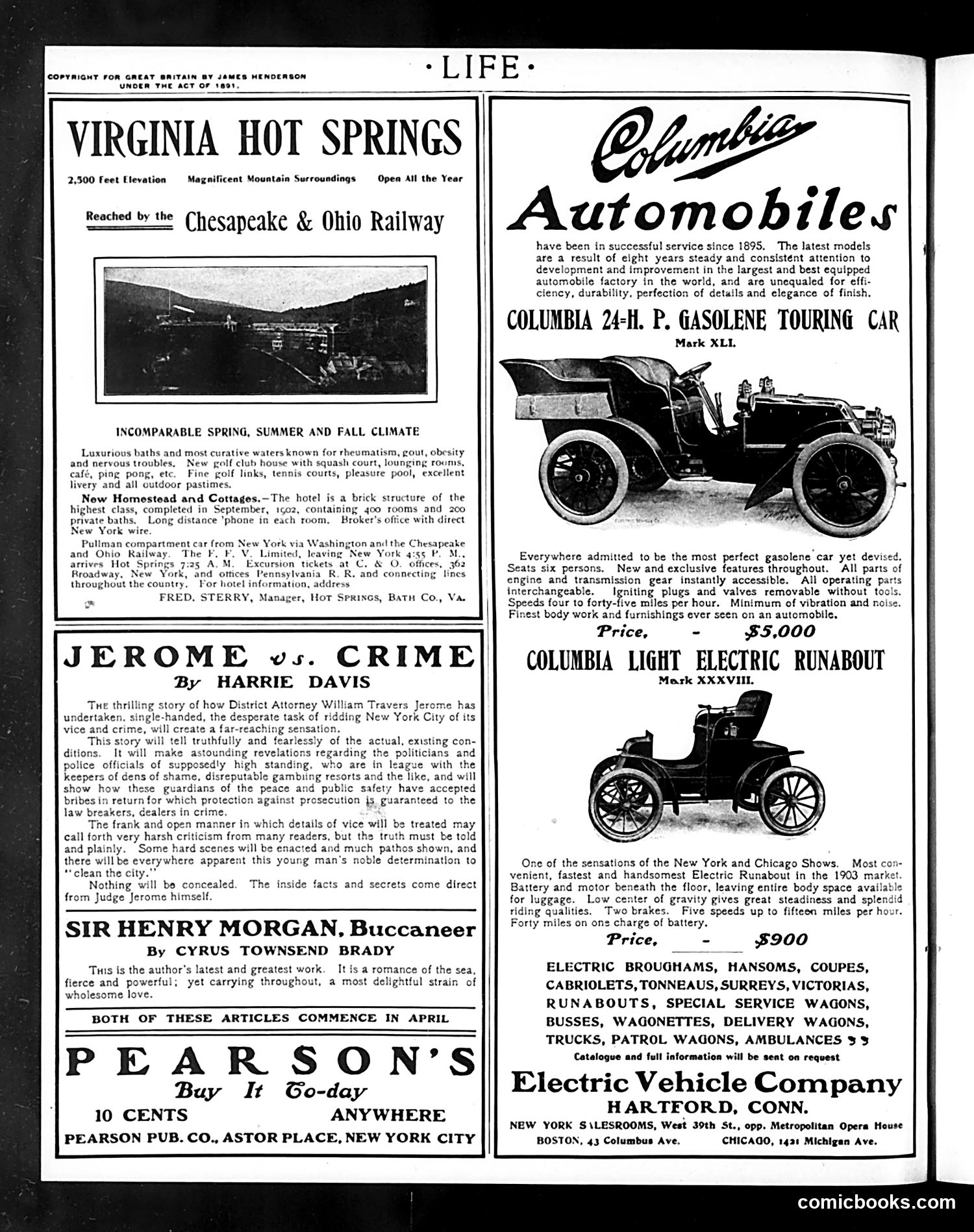
This page is primarily **advertising, not editorial content or satire**. It contains commercial advertisements for: - Virginia Hot Springs resort (accessible by Chesapeake & Ohio Railway) - Columbia automobiles (24-horsepower gasoline touring car and electric runabout models) - Electric Vehicle Company products (broughams, hansoms, coupes, etc.) The page also advertises serialized fiction beginning in April: - "Jerome vs. Crime" by Harrie Davis - "Sir Henry Morgan, Buccaneer" by Cyrus Townsend Brady And promotes Pearson's magazine ("Buy It To-day"). There is **no political cartoon or satire** visible on this page. It represents typical early-1900s Life magazine advertising and literary promotion, reflecting contemporary consumer products and popular fiction interests.
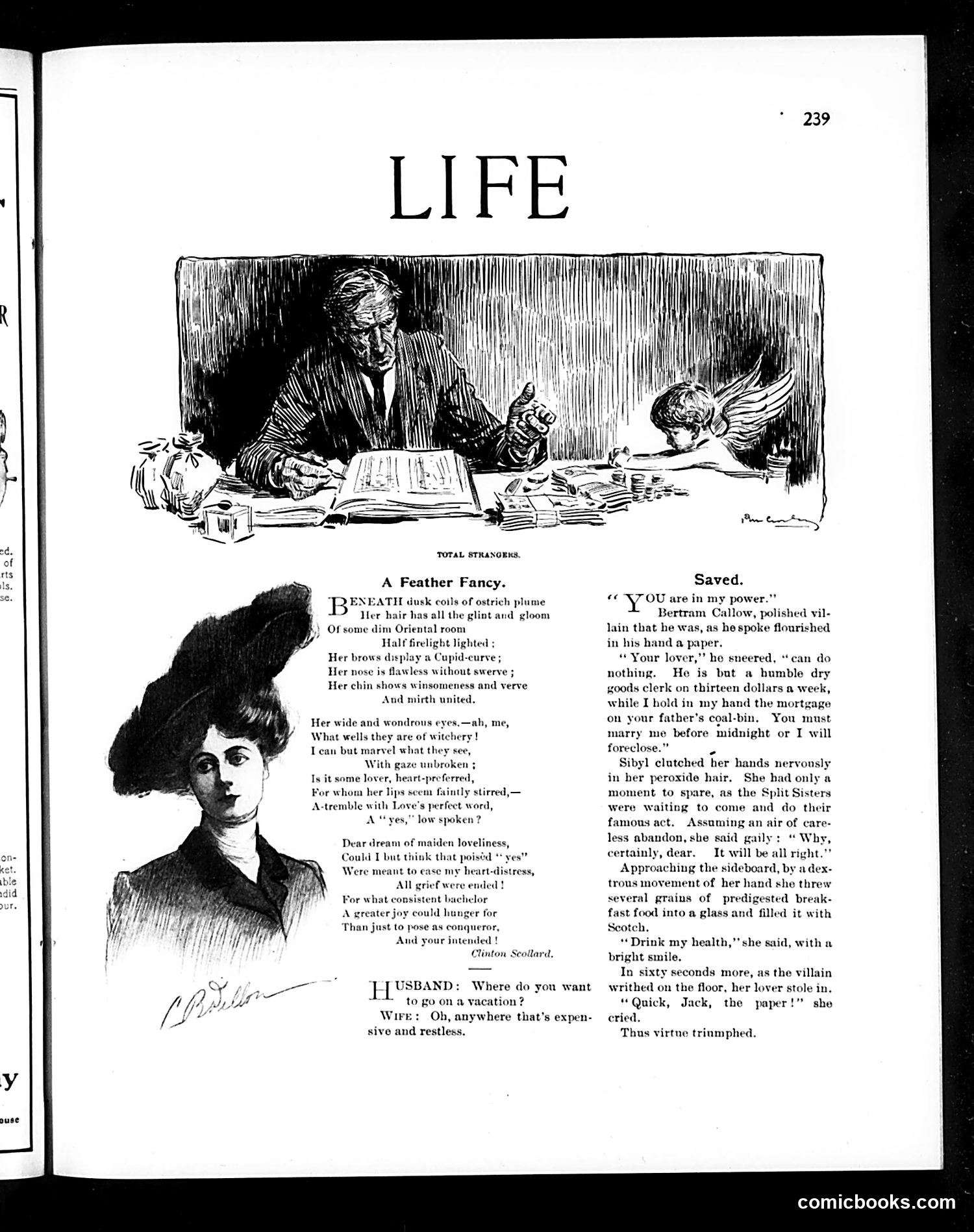
This page contains three unrelated pieces of satirical content: 1. **"Total Strangers"** (top): A sketch showing a man at a desk with papers and money, flanked by cherub figures, likely satirizing greed or financial dealings. 2. **"A Feather Fancy"** (left): A poem by Clinton Scollard accompanying a portrait sketch of a woman wearing an elaborate feathered hat. The verse critiques women's fashion—specifically the ostentatious ostrich plume headdresses fashionable in this era—questioning their appeal and mocking the "yes" they inspire from suitors. 3. **"Saved"** (right): A brief comedic dialogue and story about a woman threatening her reluctant lover with exposure unless he marries her. She ultimately manipulates him through a dramatic gesture, "saving" virtue through coercion rather than genuine reform. The page reflects early 20th-century attitudes toward fashion excess, courtship, and gender dynamics.
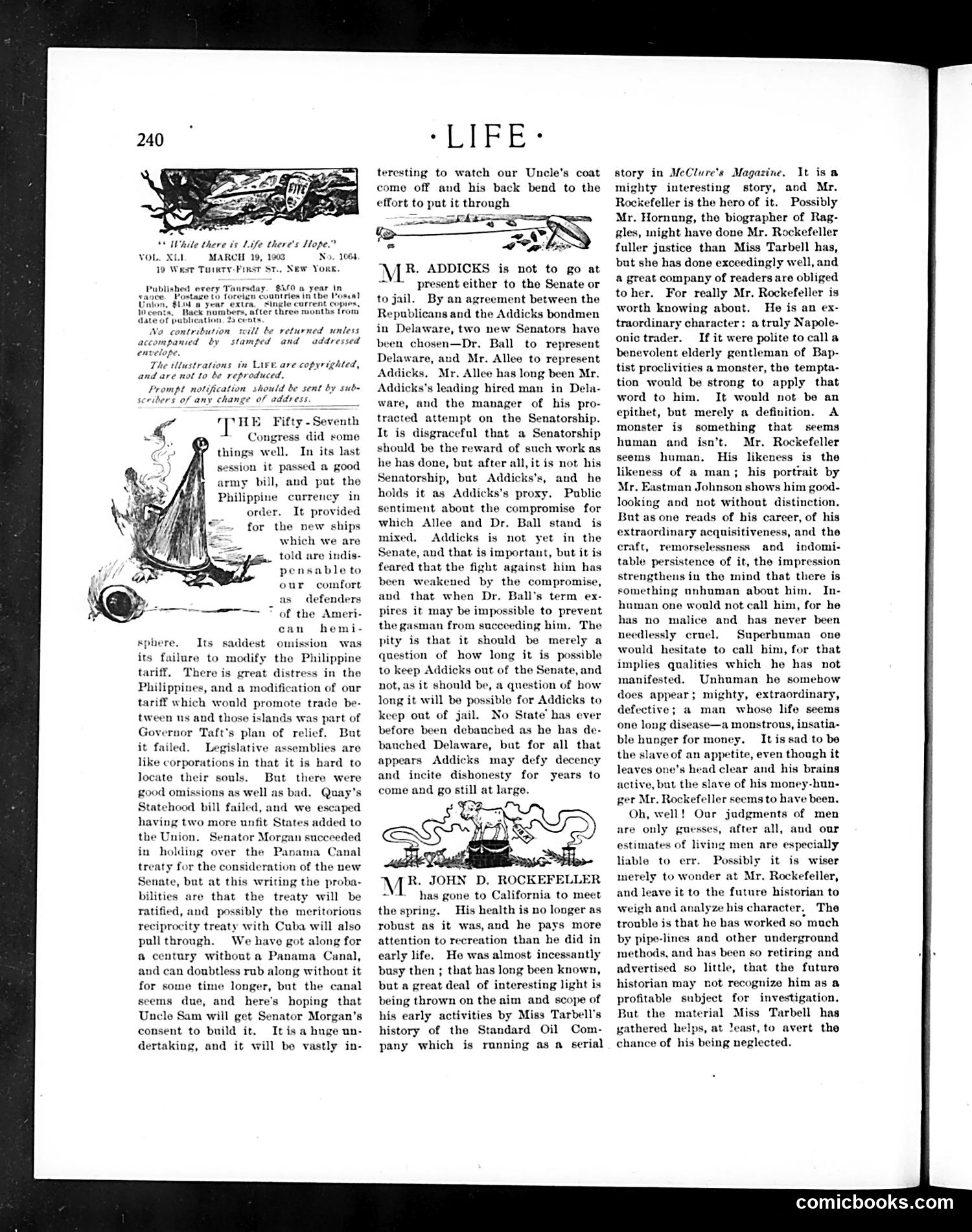
This page contains political commentary rather than cartoons. The main article discusses **Mr. Addicks**, a Delaware politician being considered for Senate appointment. The text criticizes Addicks as unfit for office, suggesting he's essentially a proxy for another senator rather than an independent candidate. The piece also praises **John D. Rockefeller**, noting his departure to California for health reasons. The author argues Rockefeller, despite his enormous wealth and ruthless business methods, possesses admirable personal qualities—calling him "Superhuman" in character and suggesting his public image unfairly conflates his business practices with his humanity. The overall tone critiques both political corruption (Addicks) and wealth-based prejudice (Rockefeller).
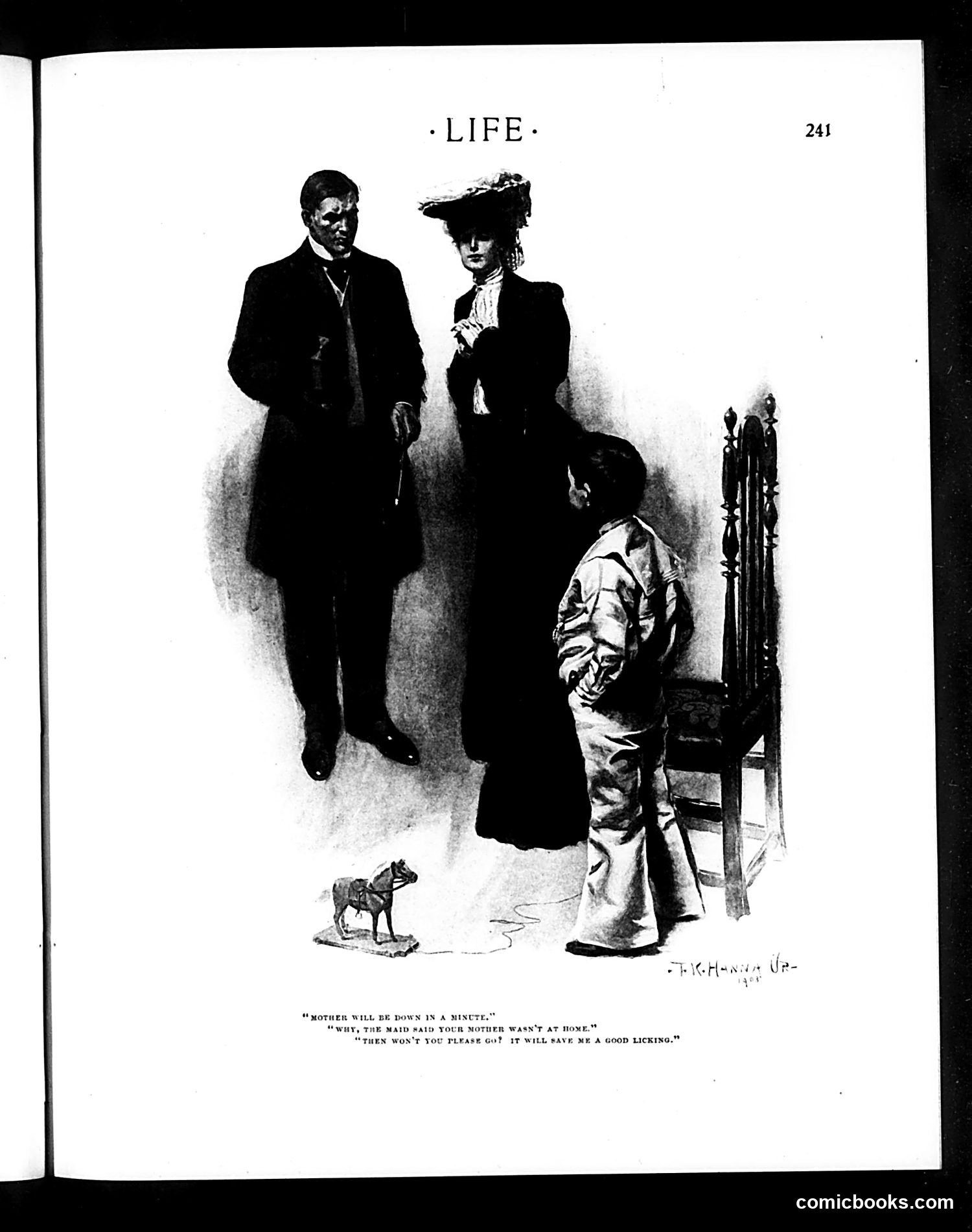
This satirical cartoon depicts a domestic scene involving what appears to be a maid or servant being sent on an errand by well-dressed employers. The caption reads: "Mother will be down in a minute. / 'Why, the maid said your mother wasn't at home.' / 'Then won't you please go? It will save a good licking.'" The humor lies in a social commentary about class dynamics and parental discipline. The child is being sent away to avoid punishment from his mother, while the parents deceive the maid about the mother's availability. The cartoon satirizes both the casual dishonesty of the wealthy toward their servants and the practice of corporal punishment in households. The small dog in the foreground may add to the scene's domestic setting, emphasizing the casual nature of this deceptive household behavior.
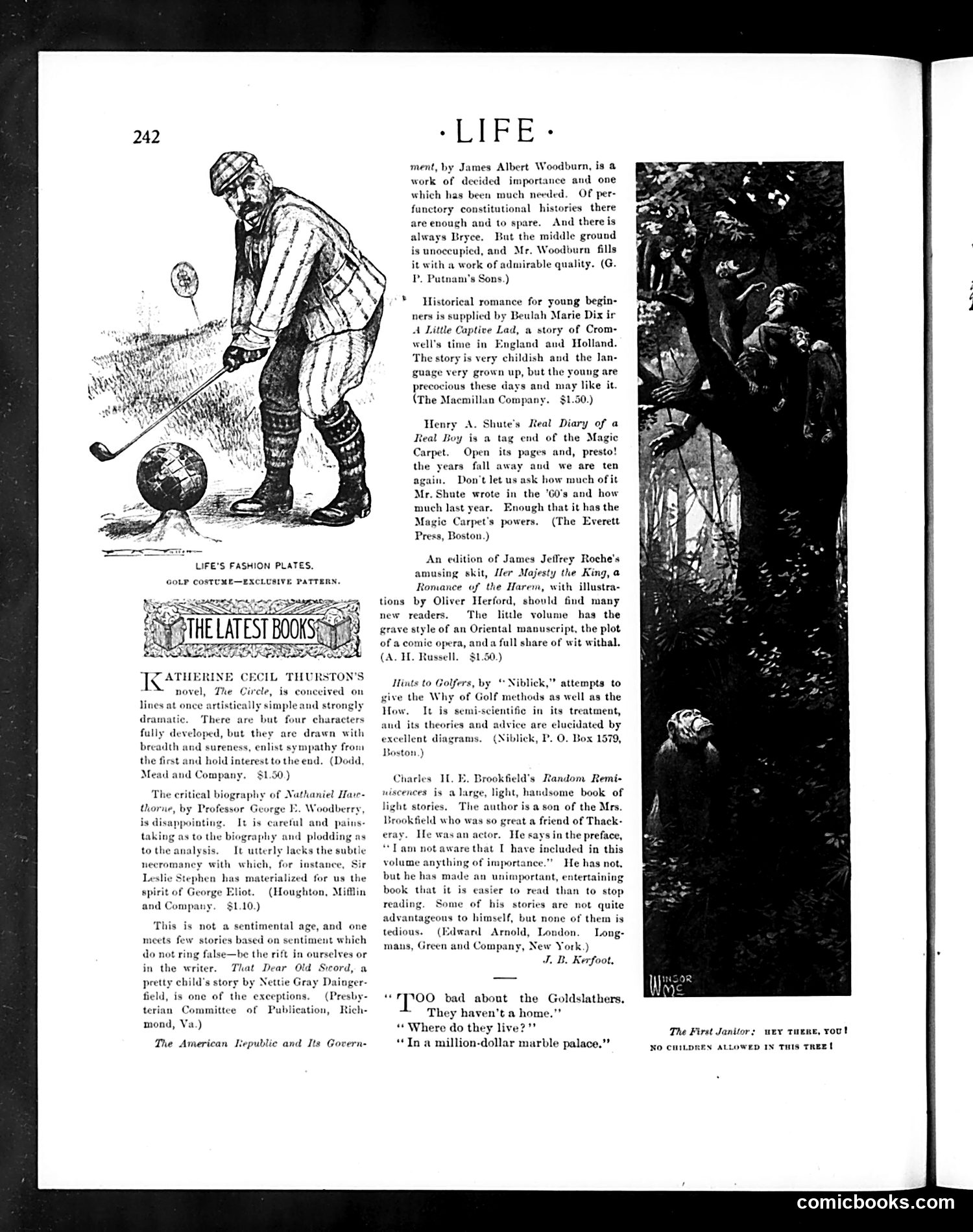
**Main Content:** This page is primarily a book review section titled "The Latest Books," with literary critiques of several works including Katherine Cecil Thurston's novel *The Circle* and James Albert Woodburn's historical text. **Visual Element:** The left side features "Life's Fashion Plates" - a golf-themed illustration showing a golfer mid-swing. This appears to be satirical commentary on golf as a fashionable leisure activity among the wealthy. **Bottom Cartoon:** A brief dialogue joke about the "Goldsathers" living in a "million-dollar marble palace" - likely satirizing the nouveau riche and their ostentatious displays of wealth. The page reflects Life magazine's typical content: literary criticism mixed with social satire targeting upper-class pretensions and consumer culture.
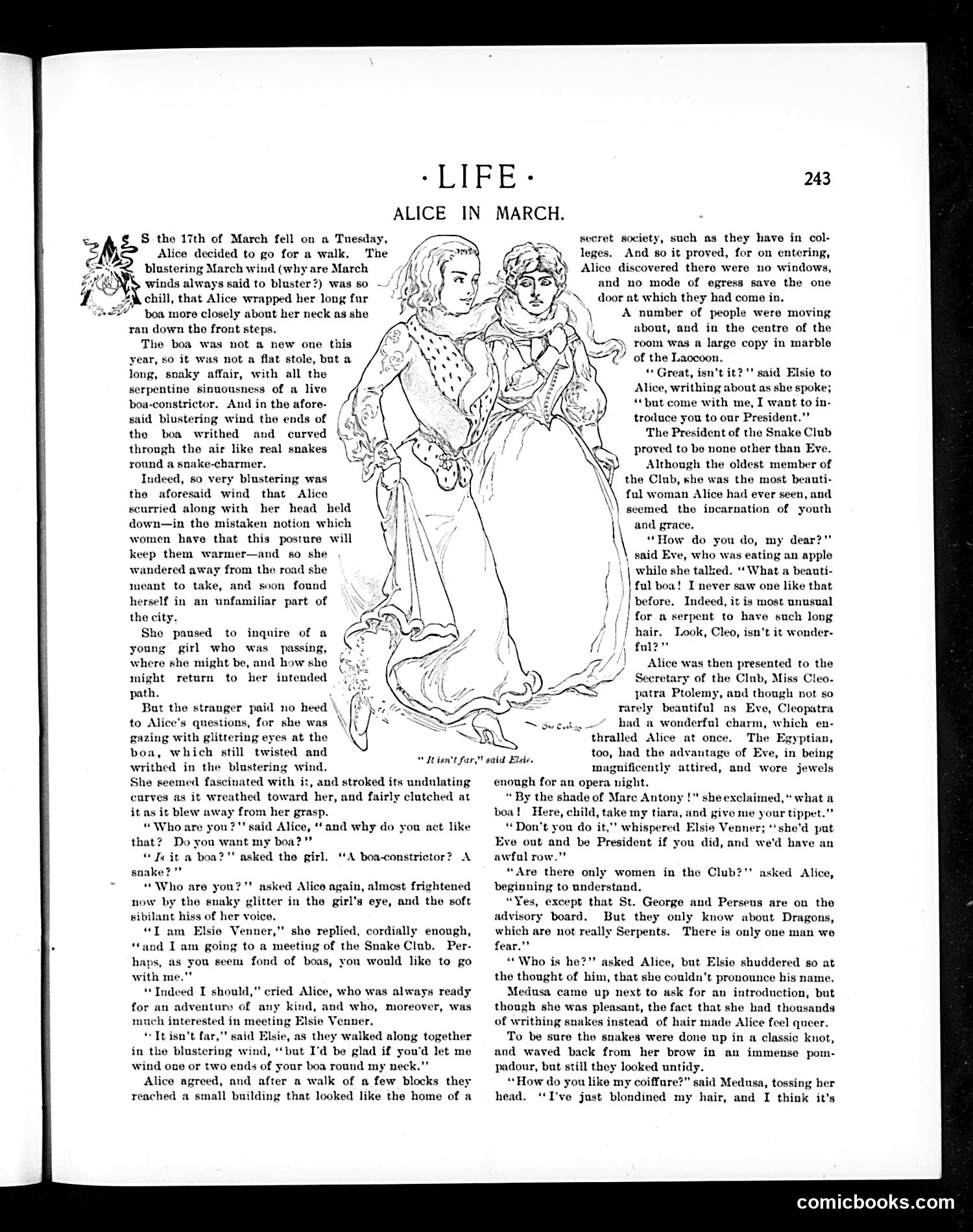
This page from *Life* magazine presents "Alice in March," a serialized fiction story illustrated with a sketch showing two young women. One wears a large decorated hat and coat; the other, identified as "Elsie Venner" in the text, appears to be a serpent-woman with a long, snake-like lower body. The story references a "Snake Club" with a female president named Eve, and includes discussion of serpents, Dragons, St. George, and Perseus—classical and biblical allusions. The satire appears to mock exclusive women's social clubs of the era, using the serpent mythology ironically. The "boa-constrictor" references and snake imagery suggest commentary on the dangers or seductive nature of such exclusive female societies, playing on period anxieties about women's independent social organizations.
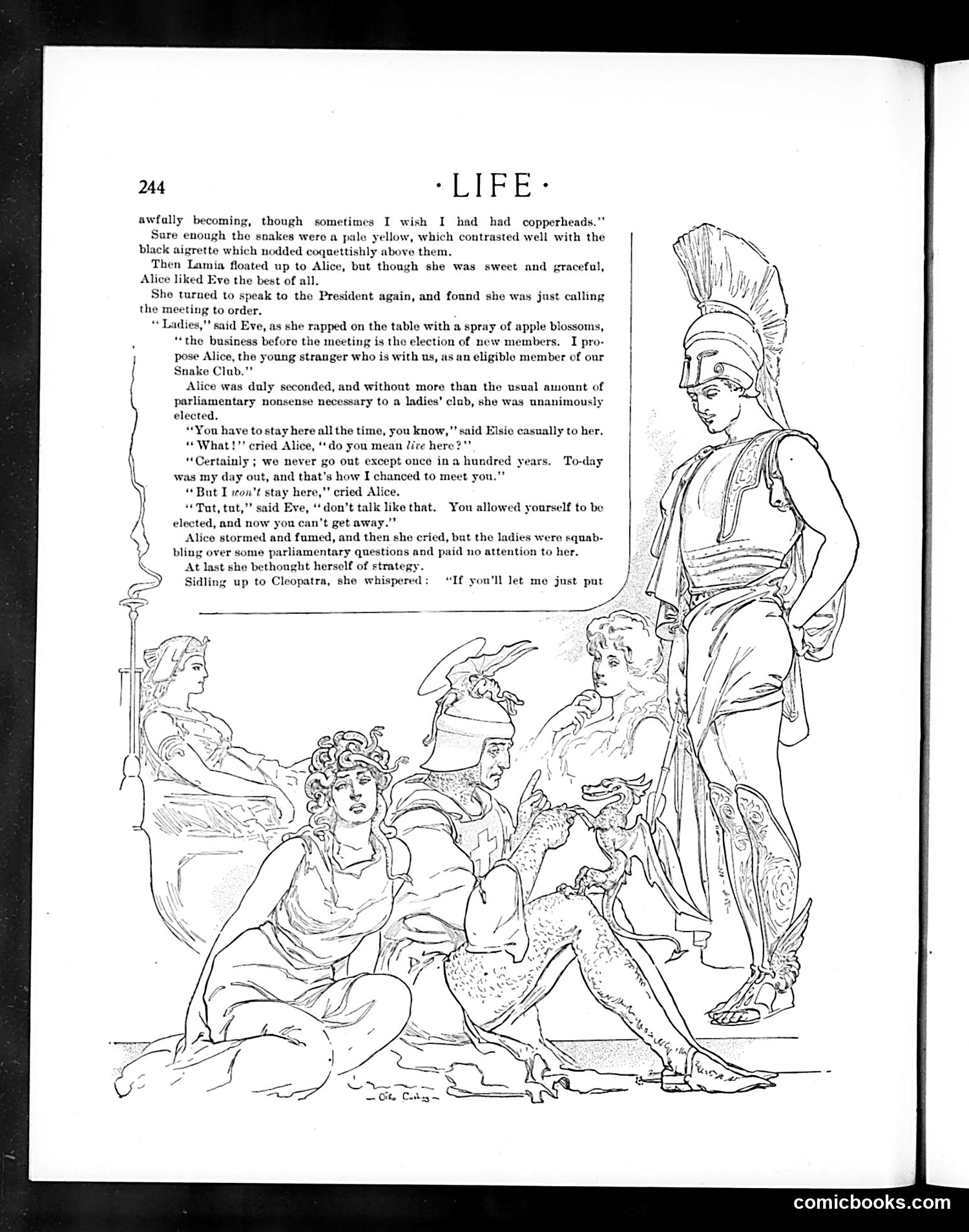
This page depicts a satirical scene of women's club politics. The text describes a "Snake Club" meeting where Alice is being elected as a new member, despite her admission that she only visits once per century. The illustration shows classical female allegorical figures (identifiable by their Greek/Roman styling and attributes) apparently reacting to or mocking this absurd membership situation. The satire targets the pretensions and arbitrary rules of women's social clubs—the contrast between exclusive membership standards and the ease with which someone can join despite minimal participation. The humor relies on depicting serious classical goddesses engaged in petty club bureaucracy, deflating both their dignity and the clubs' self-importance. The "Snake Club" name itself suggests cattiness or backstabbing behavior among members.
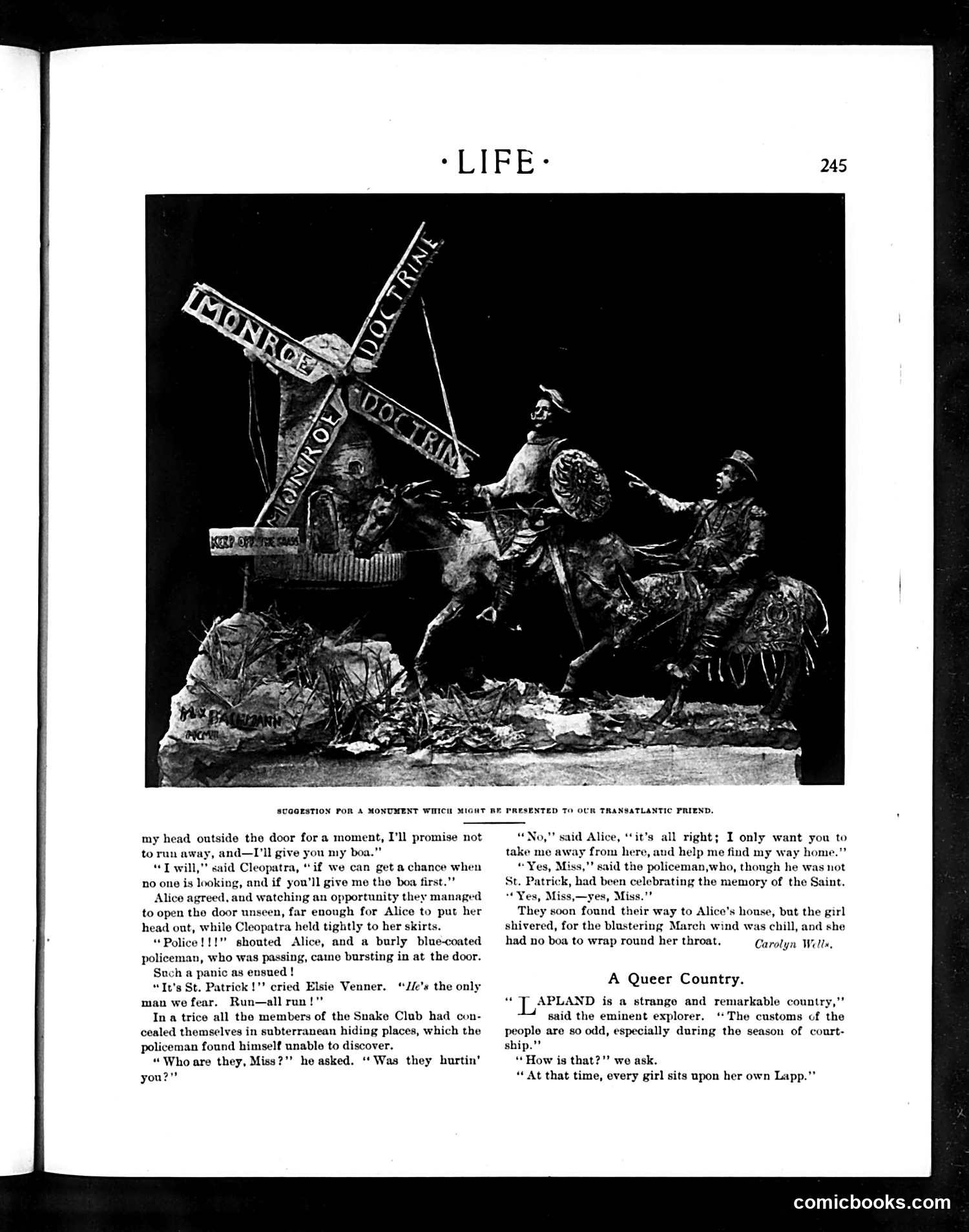
This page features a sculptural monument with labeled arms extending outward, captioned as "SUGGESTION FOR A MONUMENT WHICH MIGHT BE PRESENTED TO OUR TRANSATLANTIC FRIEND." The monument appears to be a satirical jab at a foreign power (likely Britain, given "transatlantic friend"). The extending arms are labeled with terms including "MONROE" and what appears to be references to doctrine or policy positions. The accompanying text discusses the Snake Club members hiding in underground places, with dialogue about searching for culprits. The satire likely critiques British foreign policy or diplomatic overreach regarding American interests—possibly referencing the Monroe Doctrine or trade disputes. The sculptural form mockingly suggests erecting a monument to commemorate a contentious international relationship. Without clearer visibility of all labels, the specific political grievance remains partially unclear.
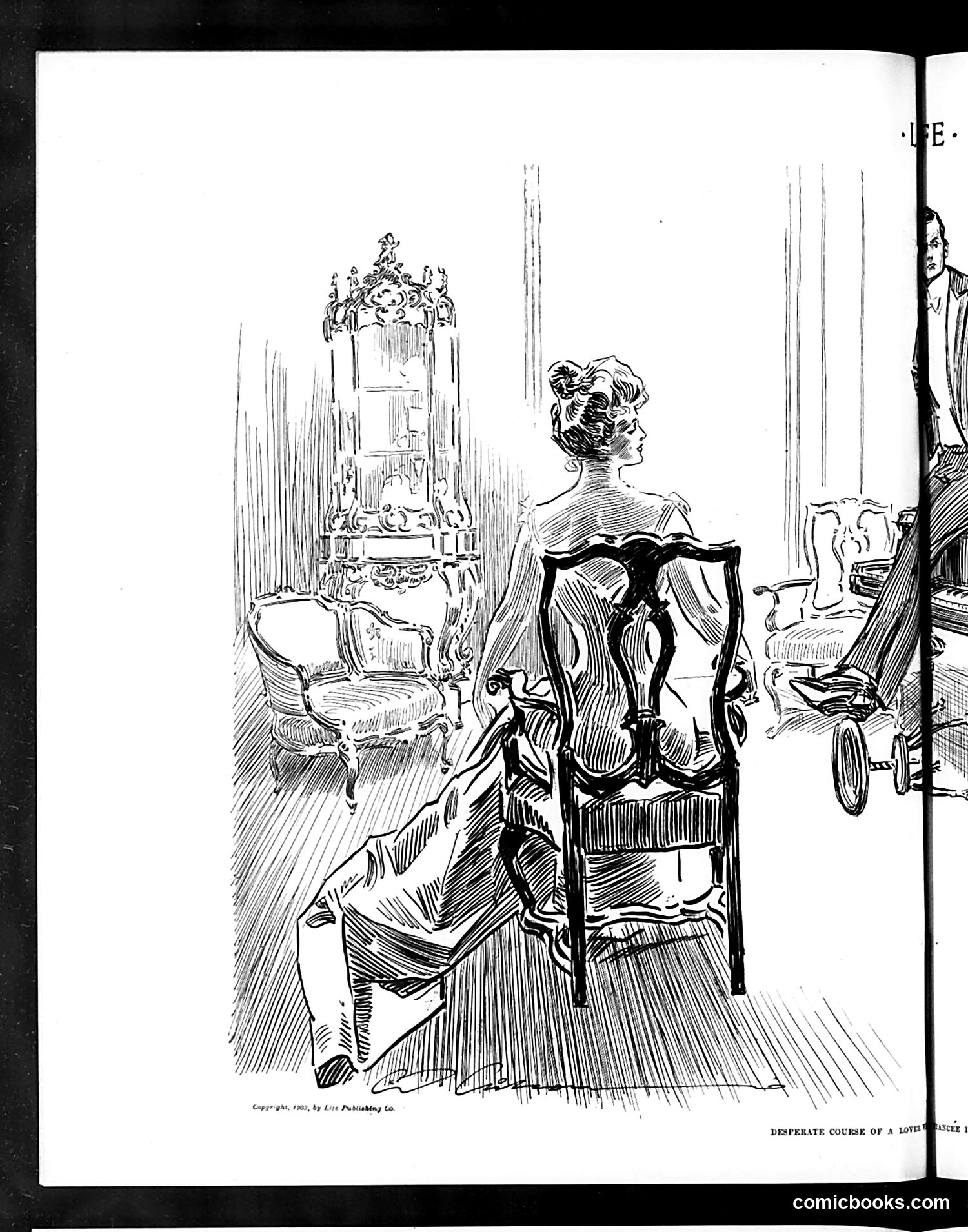
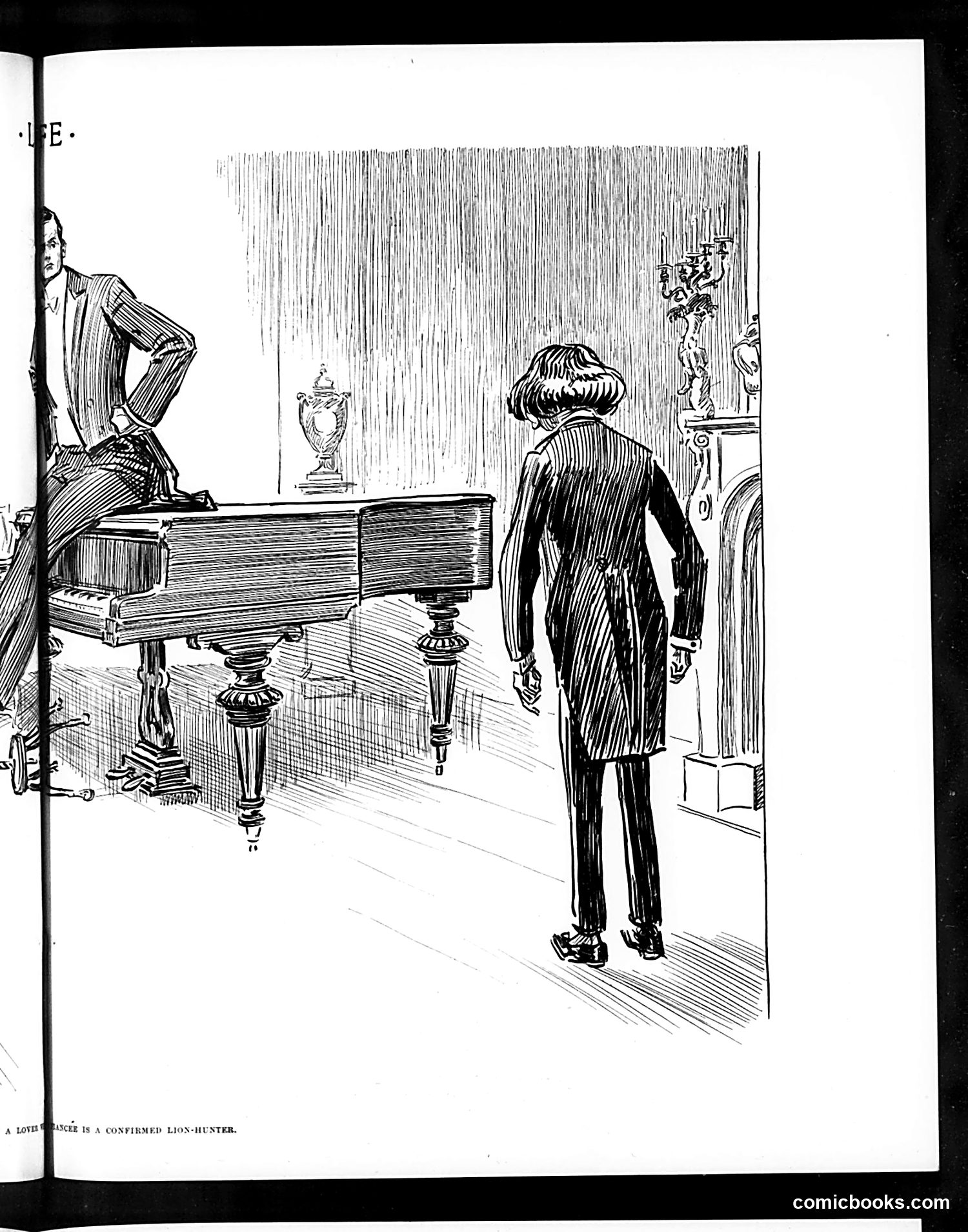
This is a single-panel cartoon with the caption "A LOVER OF MUSIC IS A CONFIRMED LION-HUNTER." The image shows a woman entering what appears to be a wealthy drawing room, where a man sits at a grand piano. The room contains classical decorative elements—an urn on the mantelpiece, statuary, and elegant furnishings typical of upper-class Victorian or Edwardian interiors. The satire plays on the term "lion-hunter"—a period slang term for a woman who pursued famous or socially prominent people. The joke suggests that a woman claiming to be a music lover is actually using that interest as a pretext to socialize with celebrated musicians or composers, thereby "hunting" social lions. It mocks both the pretense of cultural refinement and the social climbing behavior of wealthy women.
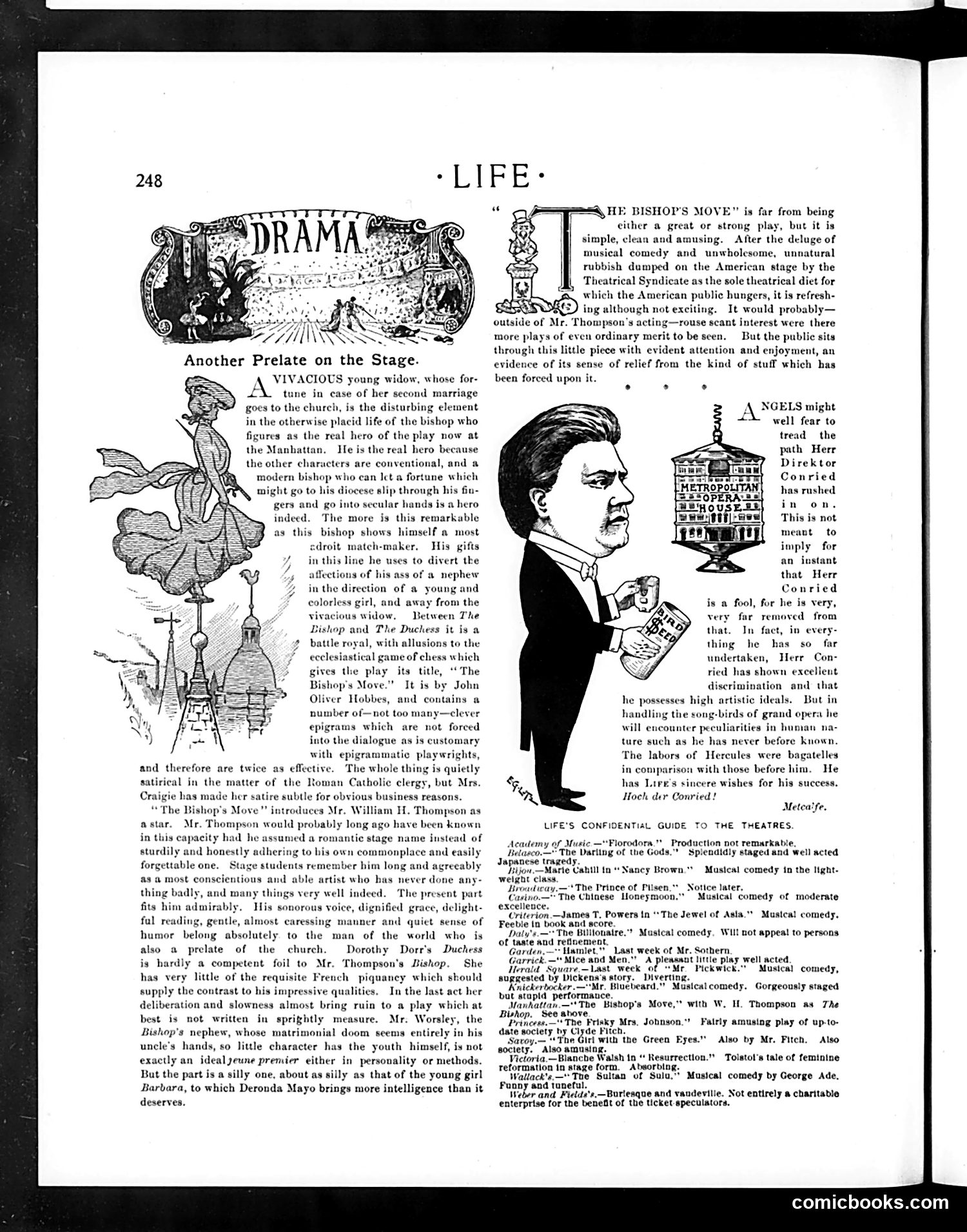
This page reviews theatrical productions. The main drama critique, "Another Prelate on the Stage," discusses "The Bishop's Move" by John Oliver Hobbes, featuring a young widow navigating remarriage while a bishop character attempts to control her fate. The prominent illustration shows a profile portrait of a man labeled as part of "Life's Confidential Guide to the Theatres," appearing to be a theatre critic or personality of the era. The accompanying mermaid illustration is decorative, typical of Life's satirical aesthetic. The text criticizes the play as simple and somewhat unoriginal, though notes it provides "relief from the kind of stuff which has been forced upon" audiences. The page reflects Life magazine's role as a cultural arbiter, reviewing popular theatrical entertainment with satirical commentary on contemporary plays and performers.
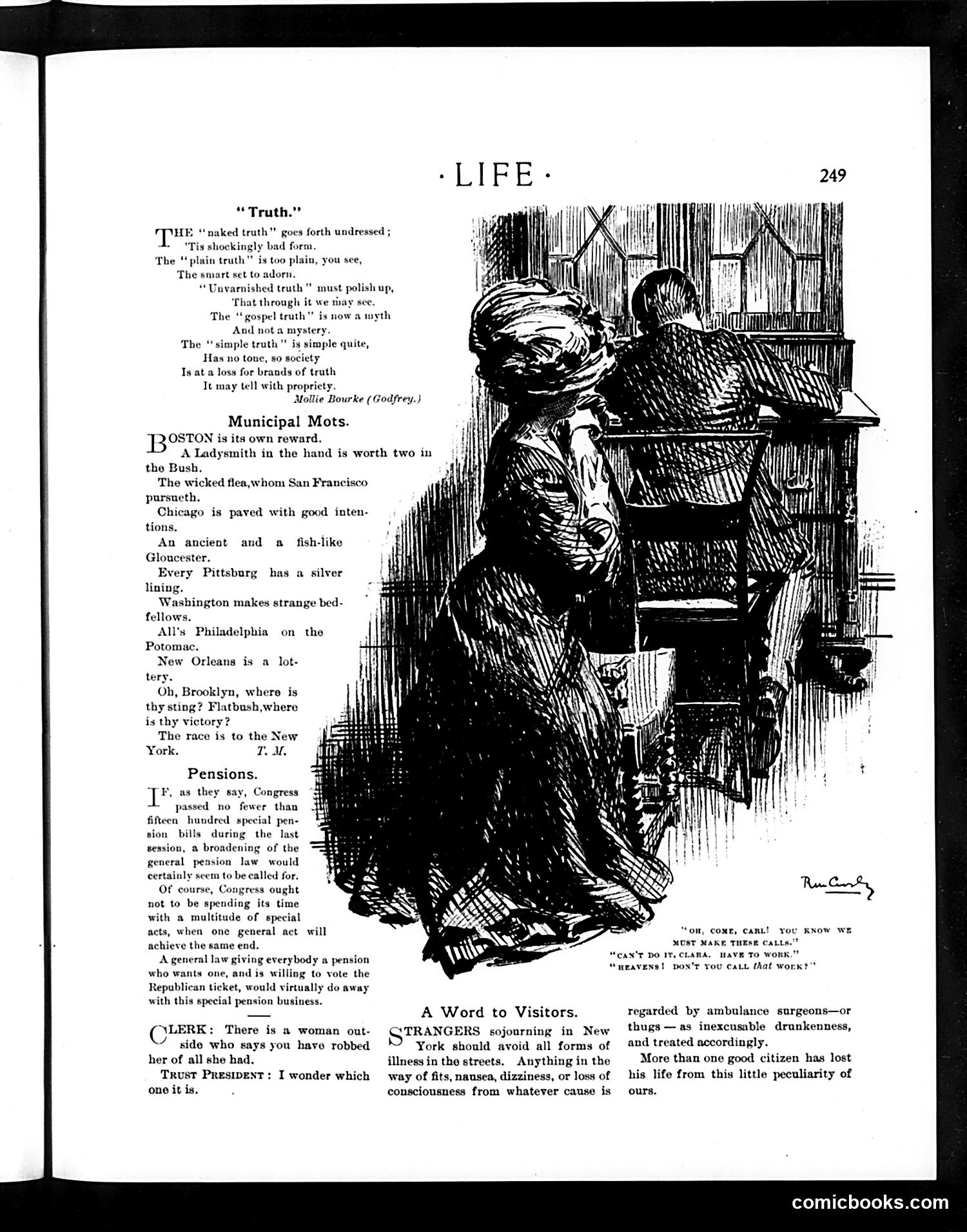
This *Life* magazine page contains three separate satirical pieces: 1. **"Truth"** (poem): Mocks how society demands truth be dressed up—calling "naked truth" improper, requiring "unvarnished truth" to be polished. The satire: high society won't accept plain honesty; it demands truth presented decorously. 2. **"Municipal Mots"**: Puns on American cities, playing on famous phrases ("All's well...," "The race is to the swift"). Unclear without dating, but appears to mock civic characteristics. 3. **Main cartoon** (bottom right): Shows a domestic dispute where a woman says "You know we must make these calls" and the man responds "Can't do it, Clara, have to work," with her replying sarcastically that social visiting isn't "work." The satire targets gender roles and class expectations—a wife's social obligations (visiting friends) versus a husband's paid labor, with the implication that society calls (socializing) were considered women's unpaid "work." 4. **"A Word to Visitors"**: Darkly jokes that New York ambulance drivers treat street illness as drunkenness, costing lives—satire on indifferent urban emergency response.
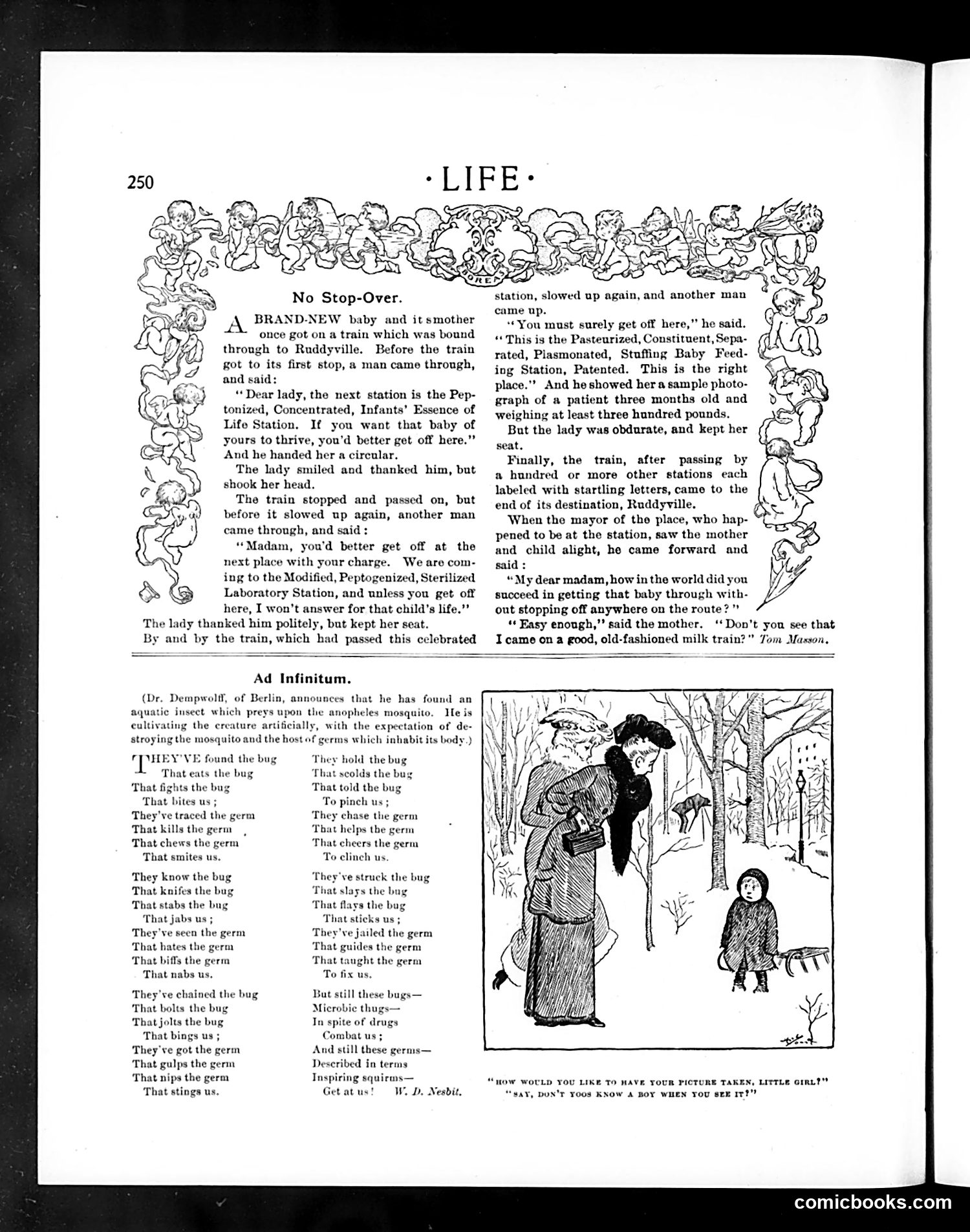
**"No Stop-Over"** satirizes aggressive marketing of infant feeding products in the early 20th century. A mother boards a train with her baby and is repeatedly accosted by salesmen hawking patented, "scientific" baby foods with increasingly absurd names (Peptonized, Modified Peptogenized, Pasteurized, etc.). Each claims her baby will die without their product. She ignores them all and arrives safely, revealing she simply used regular milk. The joke mocks the era's pseudoscientific commercialization of infant care and the anxiety-driven marketing targeting mothers—suggesting such products were unnecessary hype. **"Ad Infinitum"** responds to a Berlin scientist's discovery of an insect that preys on malaria-carrying mosquitoes. The poem humorously catalogs an endless chain of creatures/germs hunting each other in an infinite regression, ultimately concluding the "microbe thugs" resist all efforts anyway. It satirizes the false hope that scientific solutions will definitively solve disease. Both pieces reflect Progressive-era skepticism toward commercial hype and overpromised scientific solutions.
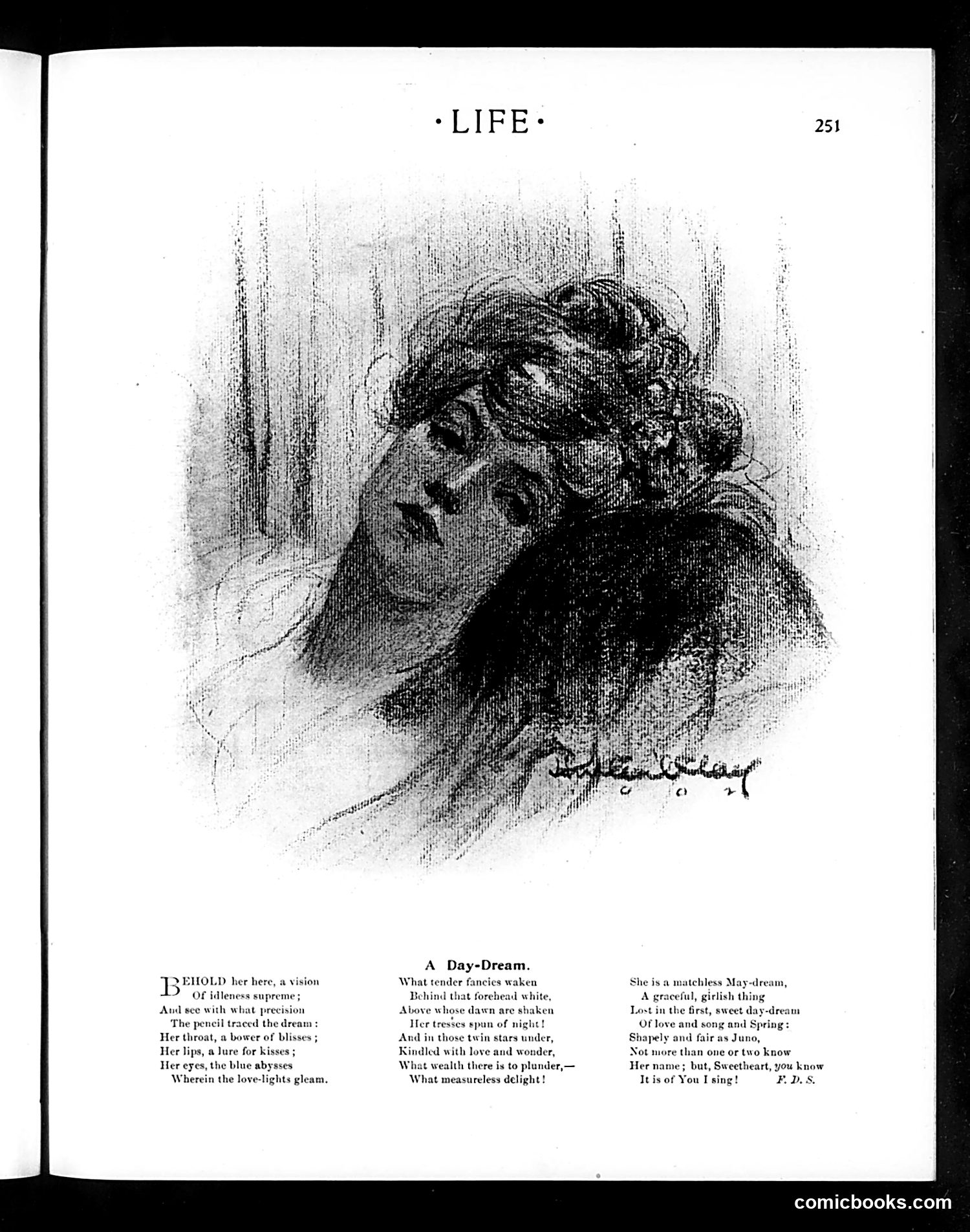
This page features a romantic illustration paired with sentimental poetry—not political satire. The sketch depicts a young woman's head in profile, rendered in a soft, dreamy style typical of late 19th/early 20th-century illustration. The poem "A Day-Dream" (attributed to F.D.S.) is a conventional romantic piece praising an idealized woman: her beauty, her mysterious thoughts, her graceful demeanor. It employs flowery Victorian language ("bower of blisses," "May-dream," comparisons to Juno) and culminates in a personal declaration—the speaker is singing of someone specific to him alone. The content represents typical *Life* magazine aesthetic coverage: romantic illustration with light verse celebrating feminine beauty and courtship. There is no obvious political commentary or satirical intent—this appears to be the magazine's occasional venture into earnest romanticism rather than its usual humorous or critical mode.
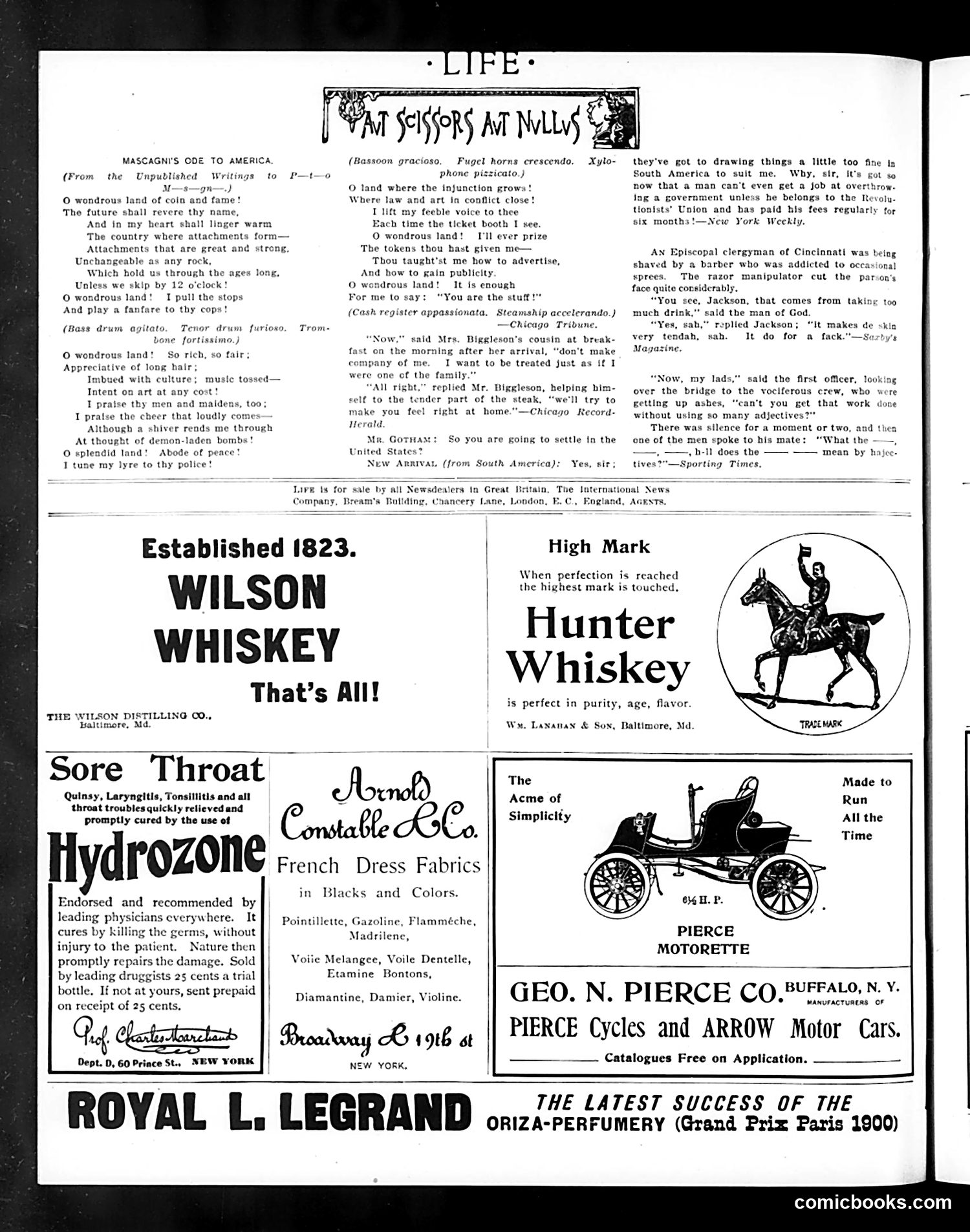
The main text is a satirical poem purporting to be from Italian composer Mascagni's unpublished writings, mocking American materialism and corporate culture. It ironically praises America as a "wondrous land" while actually criticizing its obsession with money, advertising, publicity, and police power. References include ticket booths, cash registers, and attachments (likely debt-related puns). The surrounding short humorous anecdotes mock various American social absurdities: government bureaucracy requiring union membership, a barber's drinking problem, and naval discipline issues. The page is primarily **advertisements** for whiskey, fabric, medicine, and early automobiles—reflecting early 1900s consumer goods. The satire contrasts Life magazine's critique of American commercialism with the irony that the magazine itself profits from advertising these very products.
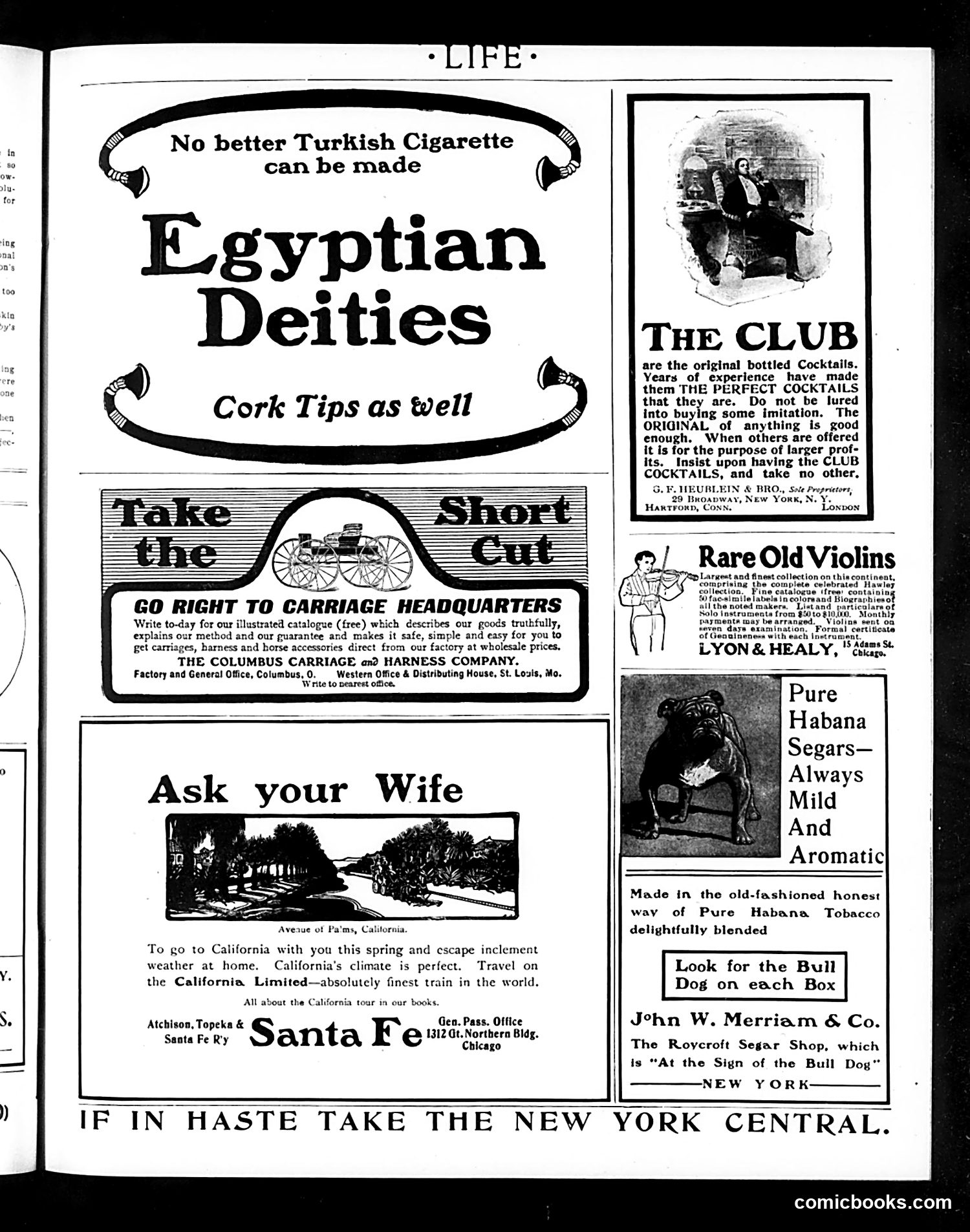
This page consists entirely of **advertisements**, not editorial cartoons or satire. It reflects early 20th-century consumer marketing across luxury and leisure goods. The ads target affluent readers: Turkish cigarettes ("Egyptian Deities"), bottled cocktails ("The Club"), carriages and horse equipment, rare violins, train travel to California, and imported cigars. Each emphasizes quality, originality, and exclusivity—typical positioning for high-end products of the era. Notable for modern readers: the casual mention of "Ask your wife" regarding California travel reflects gender dynamics of the period. References to the "California Limited" train and "New York Central" represent competition between railroad companies for wealthy passengers. The advertisements collectively reveal what Life's audience valued: refined tastes, imported goods, leisure travel, and status symbols. There is no political commentary or satire present on this page—it's a straightforward commercial space reflecting Gilded Age consumer culture.
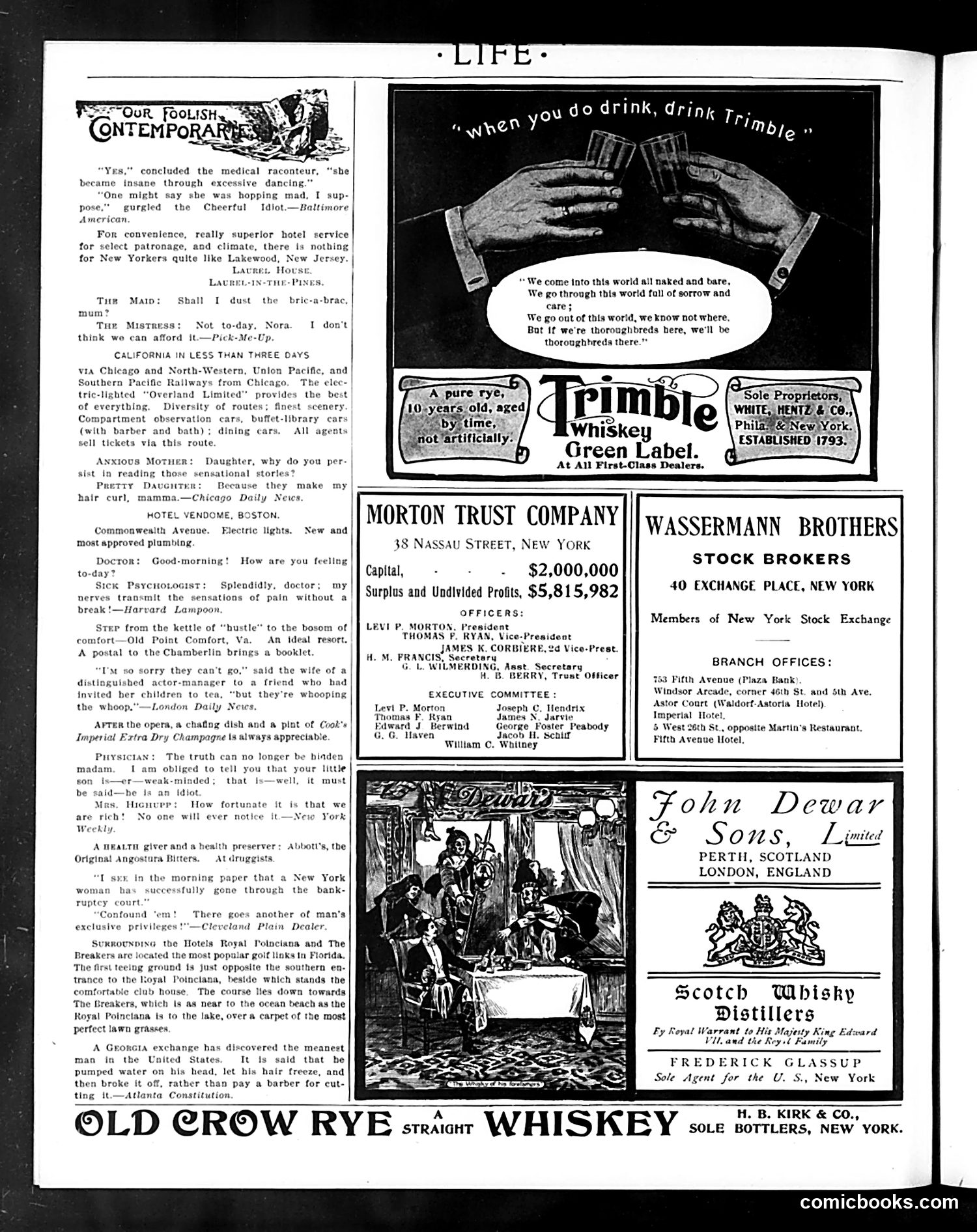
This page is primarily **advertising and humor anecdotes** rather than political satire. The content includes: **Humor Snippets:** Short, satirical jokes about everyday life—a woman dancing herself "insane," servants' wages, nervous doctors, and social awkwardness. These mock contemporary manners and pretension without targeting specific political figures. **The Trimble Whiskey Advertisement:** A philosophical advertisement playing on class anxieties, suggesting whiskey consumption offers escape from earthly sorrows. The imagery of hands toasting reflects the "thoroughbred" aspirations of middle-class drinkers. **Financial/Business Ads:** Morton Trust Company and Wassermann Brothers advertisements emphasize wealth and Wall Street respectability—typical of Life's affluent readership. **Travel Promotions:** Hotels and railroad advertisements target wealthy leisure travelers. The page reflects **Gilded Age attitudes**: materialism, class consciousness, and gentle mockery of social pretension. No specific political events or figures are referenced. The humor targets universal human foibles rather than partisan issues.
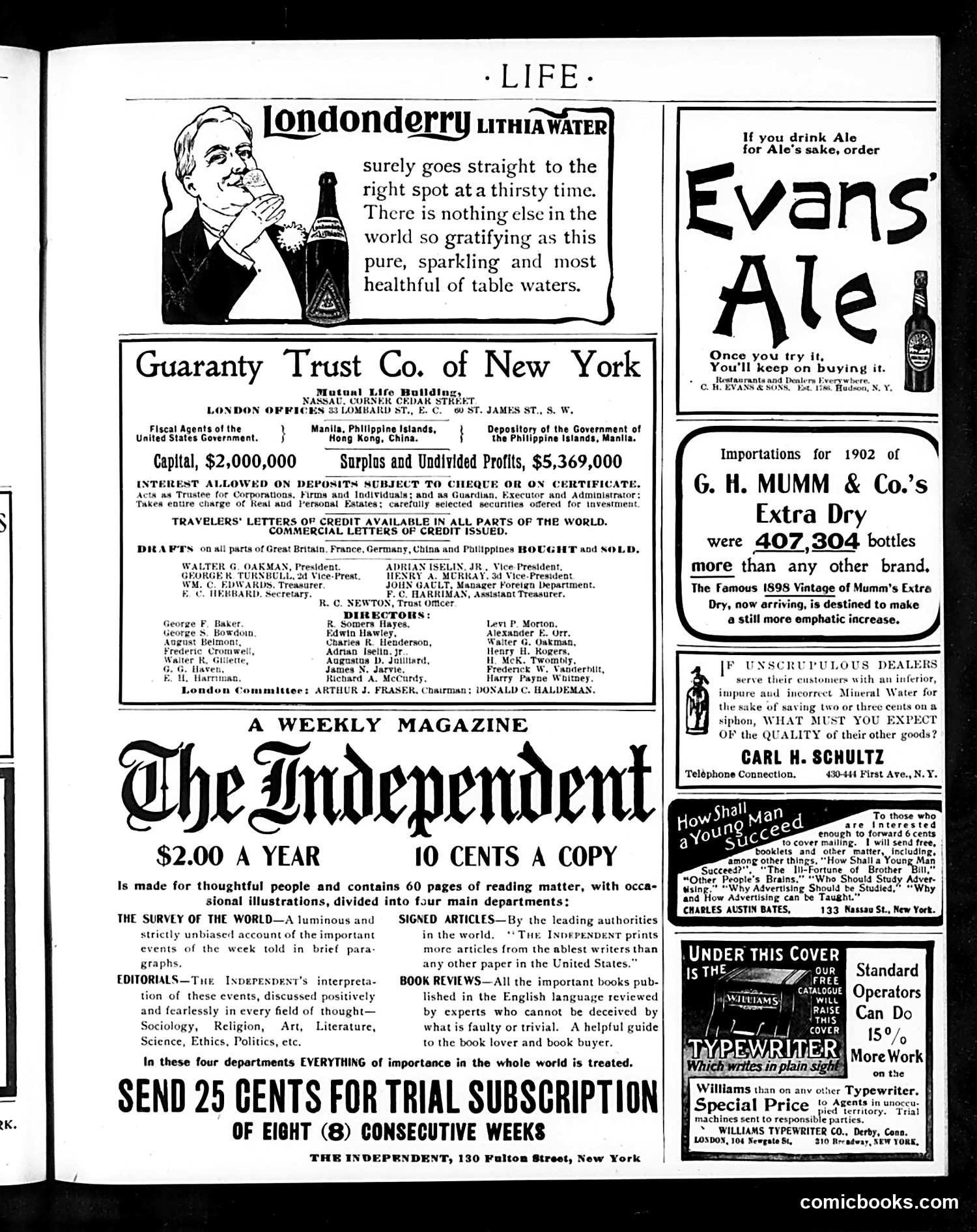
This is primarily a **title/advertising page** from *The Independent*, a weekly magazine ($2.00/year), rather than a satirical cartoon page. The page features **product advertisements** typical of early 1900s publications: - **Londonderry Lithia Water**: advertised with a gentleman's portrait, claiming healthful benefits - **Evans' Ale**: a competitor promoting customer loyalty - **Guaranty Trust Co. of New York**: a financial institution listing capital and services - **G.H. Mumm & Co.'s Extra Dry**: champagne boasting 407,304 bottles imported in 1902—"more than any other brand" - **Williams Typewriter**: promoting "Standard Operators Can Do 50% More Work" - **Carl H. Schultz**: mineral water, with a warning against "unscrupulous dealers" selling inferior products The *Independent* itself is promoted as serving "thoughtful people" with 60 pages covering world news, editorials, and book reviews. **No political satire or caricature is present**—this is straightforward commercial publishing reflecting consumer culture and business confidence of the Edwardian era.
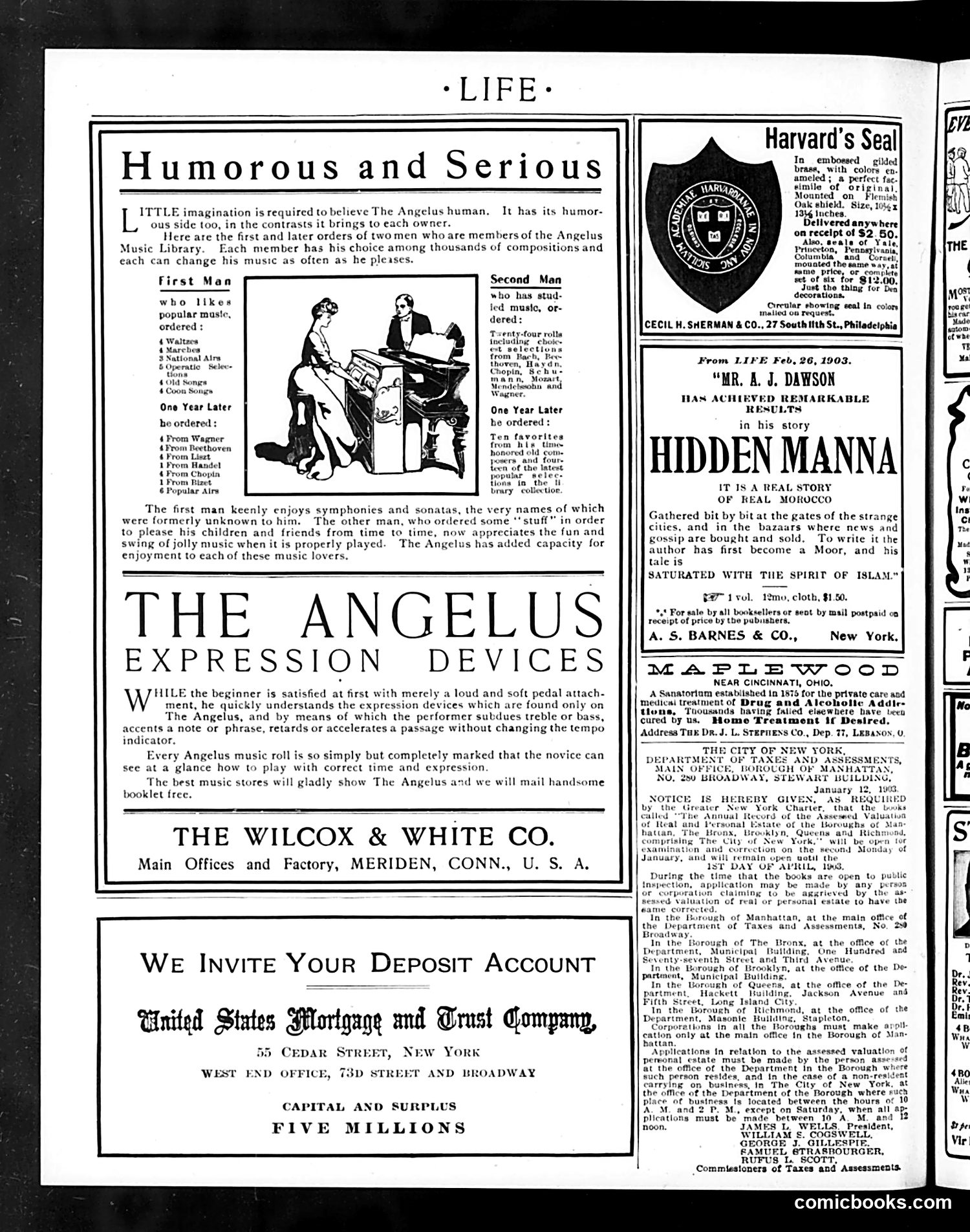
The main content is an advertisement for the **Angelus**, a player piano manufactured by Wilcox & White Co. The "Humorous and Serious" section presents a contrast between two imaginary music-lovers: the "First Man" who orders classical compositions (waltzes, marches, operas), and the "Second Man" who orders popular music and "coon songs" (reflecting 1903 racial attitudes in entertainment). The satire is subtle: both men become culturally improved through the machine. The First Man discovers "fun and swing," while the Second Man graduates from popular "stuff" to appreciating Wagner and classical composers. This suggests the Angelus democratizes musical taste—even unsophisticated buyers can access "serious" culture. The page also includes advertisements for Harvard seals, a book on Morocco, and banking services, typical of LIFE's mixed content. No political figures or specific caricatures appear; this is primarily consumer advertising dressed in gentle social commentary.
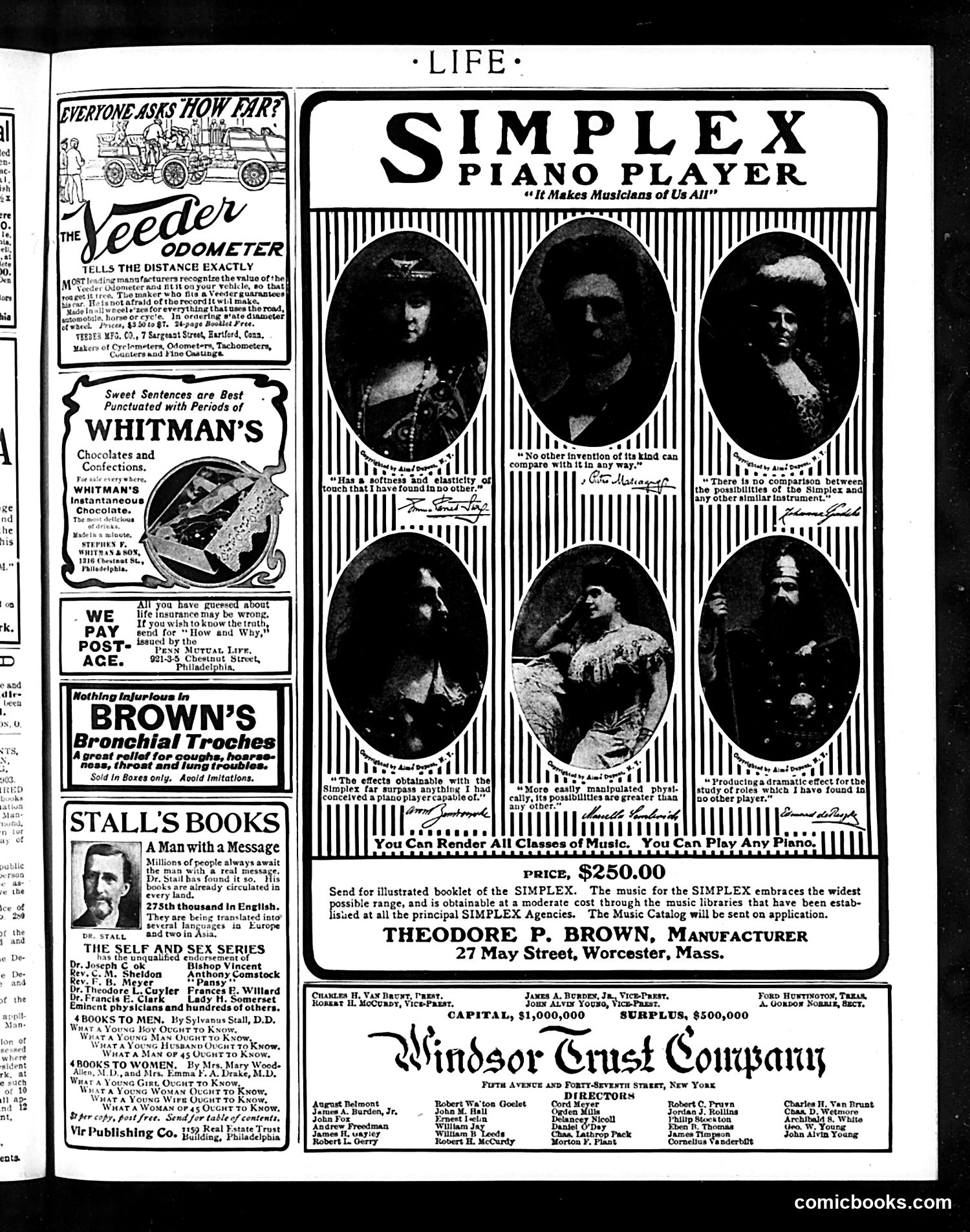
This Life magazine page contains **no political cartoons or satirical content** to analyze. It is dominated by commercial advertisements from the early 20th century, including: - **Simplex Piano Player** (center): A mechanical device ($250) that automated piano playing, marketed with testimonials claiming it made "musicians of us all" - **Stall's Books**: Sex education and self-help volumes - **Various patent medicines and consumer goods**: Whitman's chocolates, Brown's bronchial lozenges, a "Speeder Odometer" The only potentially notable element is the **Simplex ad's implicit class commentary**—it promises to democratize musical skill through technology, reflecting early-20th-century optimism about mechanical solutions to human limitations. However, this is advertising copy, not satire. The page functions as revenue generation for the magazine rather than editorial content.
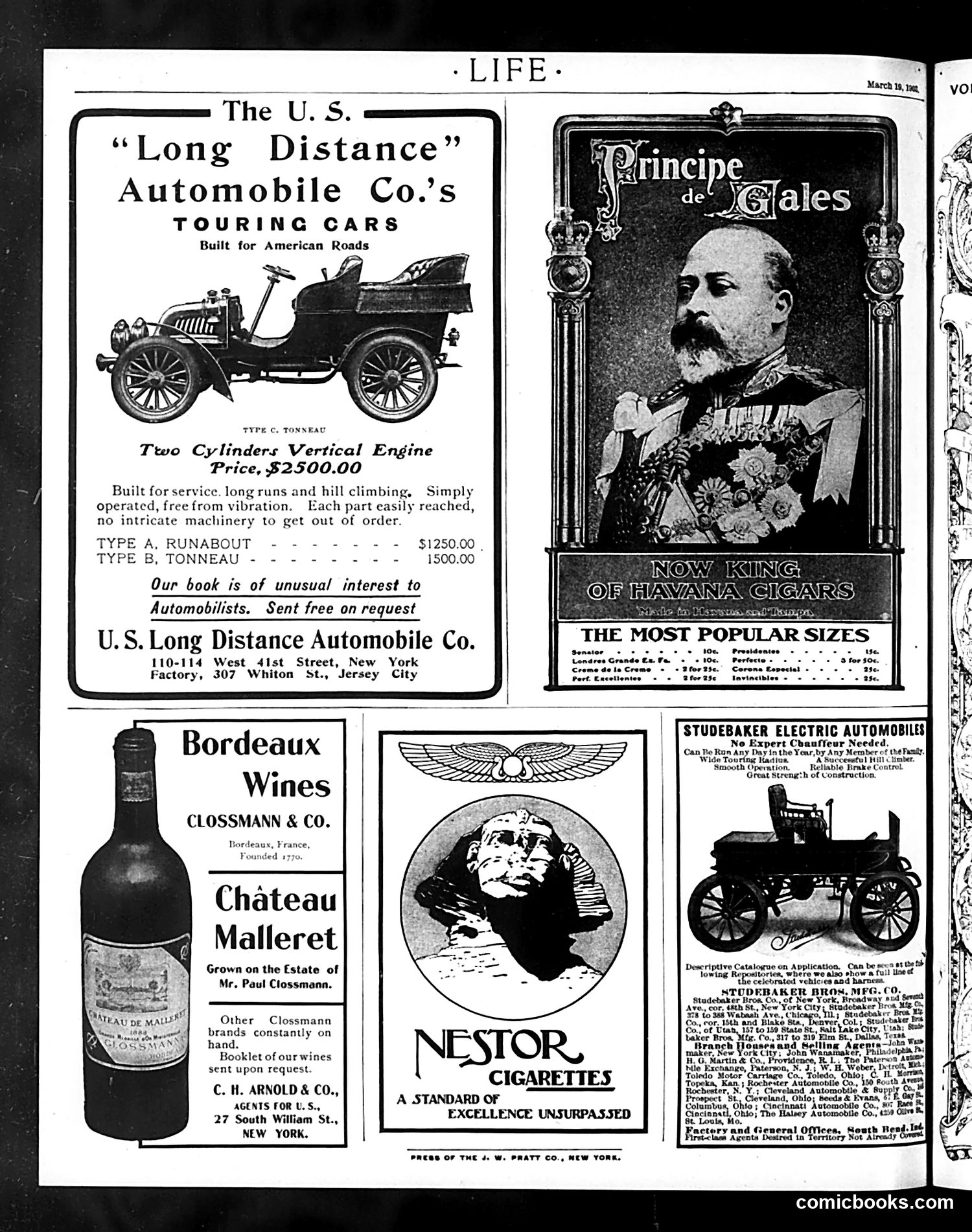
This page is primarily **advertisements**, not satire or political content. It showcases luxury goods marketed to wealthy Americans in the early 1900s. The ads feature: - **U.S. Long Distance Automobile Co.**: Early automobiles priced $1,250-$2,500 (extremely expensive for the era), marketed as reliable touring vehicles for American roads. - **Bordeaux Wines & Château Malleret**: French wines sold through New York agents, appealing to sophisticated consumers. - **Nestor Cigarettes**: Promoted as a "standard of excellence unsurpassed," with Egyptian imagery (the pharaoh profile), reflecting period aesthetic preferences. - **Studebaker Electric Automobiles**: Competing auto technology, emphasizing ease of operation ("No Expert Chauffeur Needed"). - **Príncipe de Gales Cigars**: Featuring what appears to be an Austro-Hungarian royal portrait. The page reflects **Edwardian-era consumer culture**: imported luxuries, emerging automobile industry competition, and aspirational advertising targeting the affluent. No satire is apparent.