
Life, 1903-03-19 · page 4 of 22
Life — March 19, 1903 — page 4: what you’re looking at
What you’re looking at
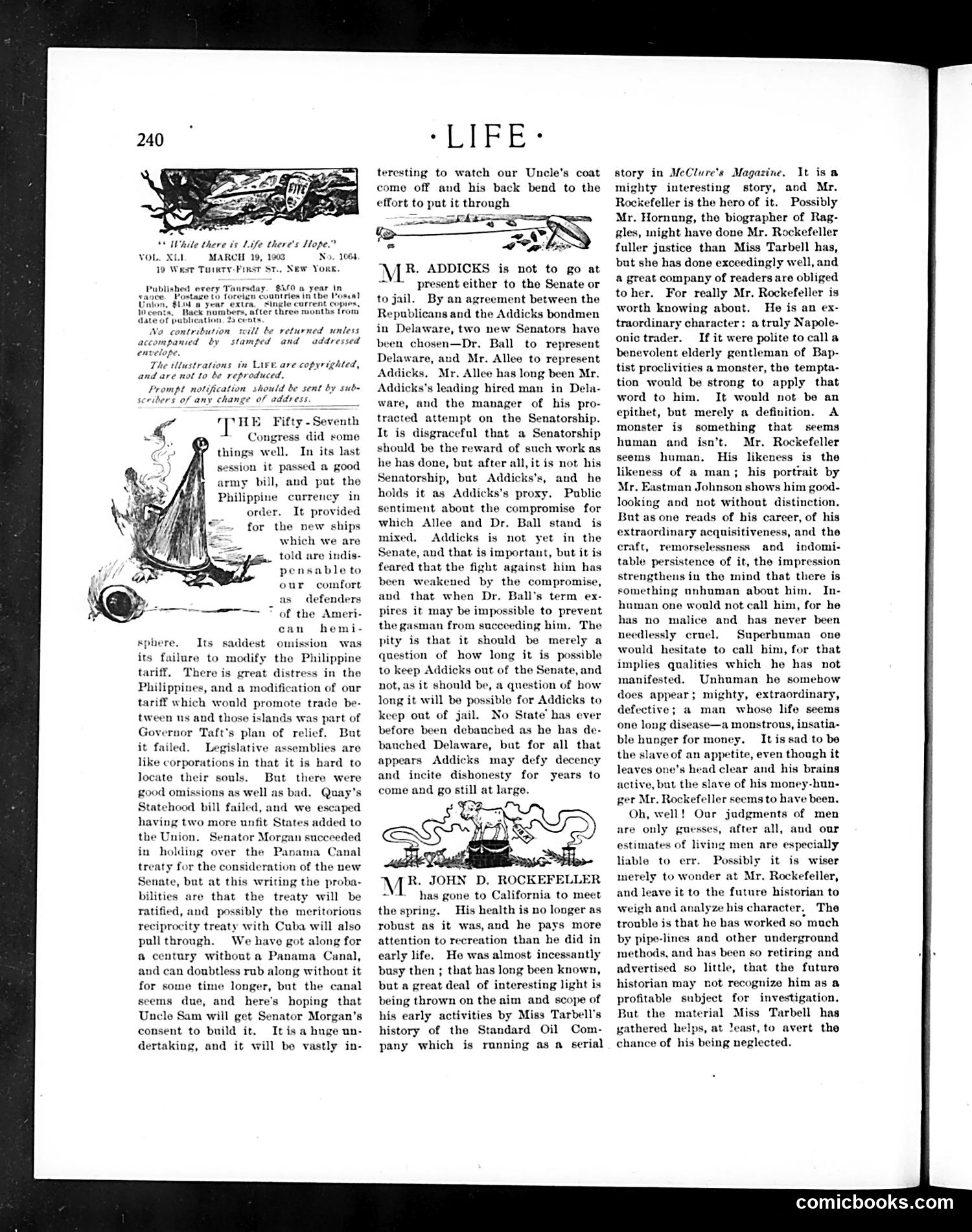
This page contains political commentary rather than cartoons. The main article discusses **Mr. Addicks**, a Delaware politician being considered for Senate appointment. The text criticizes Addicks as unfit for office, suggesting he's essentially a proxy for another senator rather than an independent candidate. The piece also praises **John D. Rockefeller**, noting his departure to California for health reasons. The author argues Rockefeller, despite his enormous wealth and ruthless business methods, possesses admirable personal qualities—calling him "Superhuman" in character and suggesting his public image unfairly conflates his business practices with his humanity. The overall tone critiques both political corruption (Addicks) and wealth-based prejudice (Rockefeller).
📄 Transcribed text from this page (OCR, searchable)
Machine-transcribed from the original scan — historical spelling and the odd misread are preserved.
‘White there is Life there's Hope. MARCH 19, 1003 d >. 1064 19 West Turgty-Finst St.. New AO a year In ries in the Po xt urrent cv abers, after three mouths trom scents, Vo contribution will be returned unless accompanied by stamped and addressed The ttlustrations in Lite are copyrighted, and are not to be reproduced, Prompt notification should be sent by sub scribers of any change of address HE Fifty -Seventh Congress did some things well, In its last session it passed a good army bill, and put the Philippine currency in order. It provided for the new ships which we are sg told are indi: pensable to our comfort as defenders * of the Ameri- can hemi- Its omission was its failure to modify the Philippine tariff, There is great distress in the Philippines, and a modification of our tariff which would promote trade be- tween us and those islands was part of Governor Taft's plan of relief. But it failed. Legislative assemblies are like corporations in that it is hard to locate their souls. But there were good omissions as well as bad. Quay’s Statehood Dill failed, and we escaped having two more unfit States added to the Union. nator Morgan succeeded in holding over the Panama Canal treaty for the consideration of the new Senate, but at this writing the proba- bilities are that the treaty will b ratified, and possibly the meritorions reciprocity treaty with Cuba will also pullthrough. We have got along for ®@ century without a Panama Canal, and can doubtless rub along withont it for some time longer, but the canal seems due, and here's hoping that Uncle Sam will get Senator Morgan's consent to build it. It is a huge un- dertaking, and it will be vastly in- sphere. saddest ‘LIFE* teresting to watch our Uncle’s coat come off and his back bend to the effort to put it through wey e M R. ADDICKS is not to go at ~" present either to the Senate or to jail. By an agreement between the Republicans and the Addicks bondmen in Delaware, two new Senators have been chosen—Dr. Ball to represent Delaware, aud Mr. Allee to represent. Addicks. Mr, Allee has long been Mr. Addicks's leading hired man in Dela- ware, and the manager of his pro- tracted attempt on the Senatorship. It is disgraceful that a Senatorship should be the reward of such work as he has done, but after all, it is not his Senatorship, but Addicks’s, and he holds it as Addicks's proxy. Public sentiment about the compromise for which Allee and Dr. Ball stand is mixed, Addicks is not yet in the Senate, and that is important, but it is feared that the fight against him has been weakened by the compromise, and that when Dr. Ball's term ex- pires it may be impossible to prevent the gasman from succeeding him. The pity is that it should be merely a question of how long it is possible to keep Addicks out of the Senate, and not, as it shonld be, a question of how long it will be possible for Addicks to keep out of jail. No State’ has ever before been debauched as he has de- banched Delaware, but for all that appears Addicks may defy decency and incite dishonesty for years to come and go still at large. M R. JOHN D. ROCKEFELLER ~ has gone to California to meet the spring. His health is no longer as robust as it was,and he pays more attention to recreation than he did in early life. He was almost incessantly busy then ; that has long been known, but a great deal of interesting light is being thrown on the aim and scope of his early activities by Miss Tarbell's history of the Standard Oil Com- pany which is running as a serial story in McClure's Magazine. It isa mighty interesting story, and Mr. Rockefeller is the hero of it. Possibly Mr. Hornung, the biographer of Rag- gles, might have done Mr. Rockefeller fuller justice than Miss Tarbell has, but she has done exceedingly well, and & great company of readers are obliged toher. For really Mr. Rockefeller is worth knowing about. He is an ex- traordinary character: a truly Napole- onic trader. If it were polite to calla benevolent elderly gentleman of Bap- tist proclivities a monster, the tempta- tion would be strong to apply that word to him. It would not be an epithet, but merely a definition. A monster is something that seems human and isn’t. Mr. Rockefeller seems human, His likeness is the likeness of a man; his portrait by Mr. Eastman Johnson shows him good- looking and not without distinction. But as one reads of his career, of his extraordinary acquisitiveness, and the craft, remorselessness and indomi- table persistence of it, the impression strengthens in the mind that there is something onhuman about him. In- human one would not call him, for he has no malice and has never been needlessly cruel. Superbuman one would hesitate to call him, for that implies qualities which he has not manifested. Unhuman he somehow does appear; mighty, extraordinary, defective; a man whose life seems one long disease—a monstrous, insatia- ble hunger for money, It is sad to be ave of an appetite, even though it one's head clear and his brains active, but the slave of his money-hun- ger Mr. Rockefeller seems to have been. Oh, well! Our judgments of men are only guesses, after all, and our estimates of living men are especially liable to err. Possibly it is wiser merely to wonder at Mr. Rockefeller, and leave it to the future historian to weigh and analyze his character. The trouble is that he has worked so’ much by pipe-lines and other underground methods, and has been so retiring and advertised so little, that the future historian may not recognize him as a profitable subject for investigation. But the material Miss Tarbell has gathered helps, at least, to avert the chance of his being neglected. comicbooks.com