
Life, 1903-03-19 · page 12 of 22
Life — March 19, 1903 — page 12: what you’re looking at
What you’re looking at
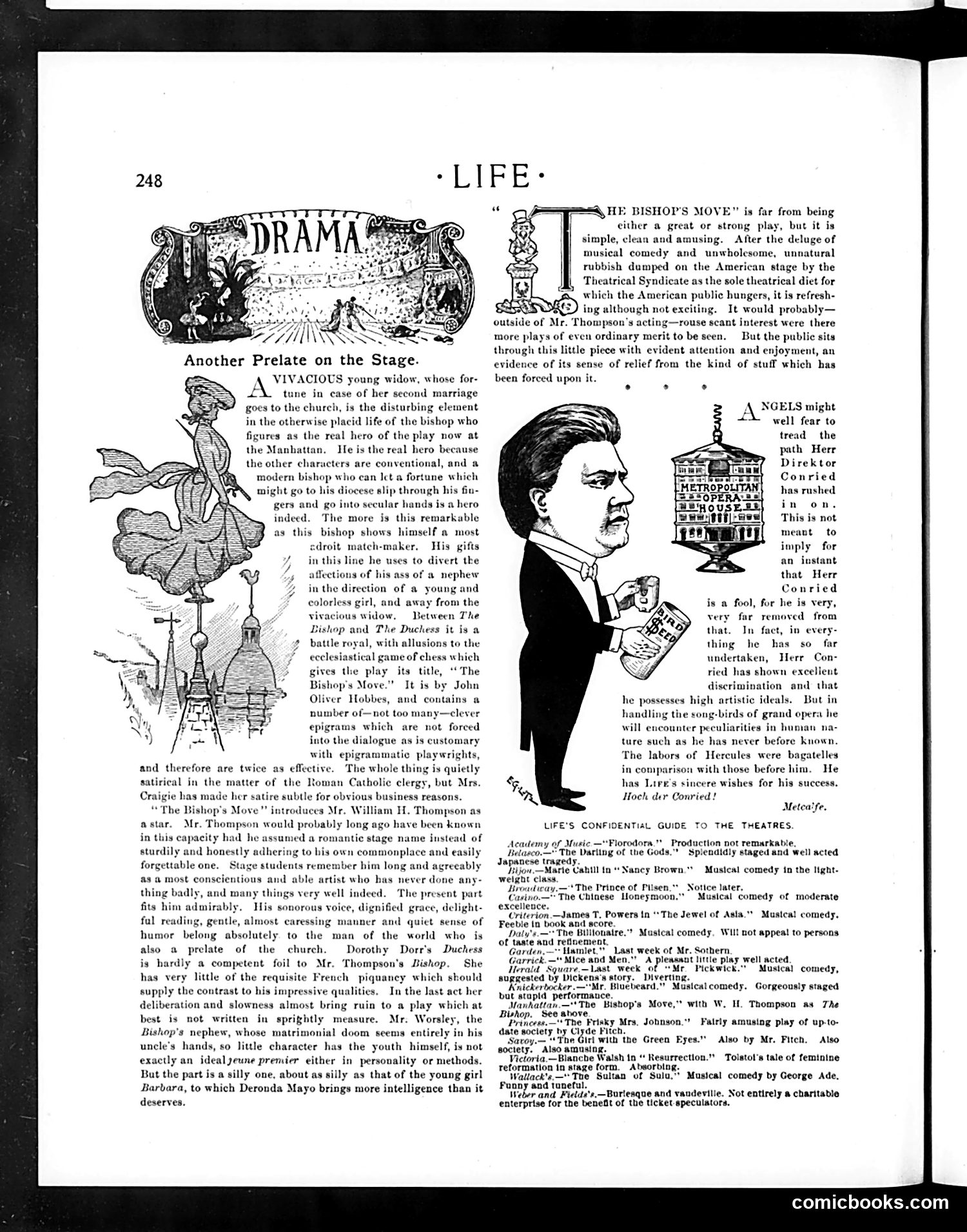
This page reviews theatrical productions. The main drama critique, "Another Prelate on the Stage," discusses "The Bishop's Move" by John Oliver Hobbes, featuring a young widow navigating remarriage while a bishop character attempts to control her fate. The prominent illustration shows a profile portrait of a man labeled as part of "Life's Confidential Guide to the Theatres," appearing to be a theatre critic or personality of the era. The accompanying mermaid illustration is decorative, typical of Life's satirical aesthetic. The text criticizes the play as simple and somewhat unoriginal, though notes it provides "relief from the kind of stuff which has been forced upon" audiences. The page reflects Life magazine's role as a cultural arbiter, reviewing popular theatrical entertainment with satirical commentary on contemporary plays and performers.
📄 Transcribed text from this page (OCR, searchable)
Machine-transcribed from the original scan — historical spelling and the odd misread are preserved.
Another Prelate on the Stage. VIVACIOUS young widow, whose for- A tune in case of her second marriage goes to the church, is the disturbing element in the otherwise placid life of the bishop who figures as the real hero of the play now at the Manhattan, He is the real hero because the other characters are conventional, and a modern bishop who can Ict a fortune which might go to his diocese slip through his fin- gers and go into secular hands is a hero indeed. The more is this remarkable as this bishop shows himself a most zdroit match-maker. His gifts in this line he uses to divert the affections of his ass of a nephew in the direction of a young and colorless girl, and away from the vivacious widow, Between The Bishop and The Duchess it is a battle , with allusions to the ecclesiastical game of chess which gives the play its title, ‘‘ The Bishop's Move.” It is by John Oliver Hobbes, and contains a number of—not too many—clever epigrams which are not forced into the dialogue as is custom with epigi and therefore are twice as effective. satirical in the matter of the mmatie playwrights, The whole thing is quietly Roman Catholic clergy, but Mrs. Craigie has made her satire subtle for obvious business reasons. “The Bishop's Move” introduces Mr. William H. Thompson as astar. Mr. Thompson would probably long ago have been known in this capacity had he assumed a romantic stage name instead of sturdily and honestly adhering to bis own commonplace and easily forgettable one. Stage students remember him long and agreeably asa most conscientious and able artist who bas never done any- thing badly, and many things ve fits him admirably. fal reading 'y well indeed. The present part His sonorous voice, dignified grace, delight- , gentle, almost caressing manner and quiet sense of humor belong absolutely to the man of the world who is also a prelate of the church. Dorothy Dorr's Duchess is hardly a competent foil to Mr. Thompson's Bishop. She has very little of the requisite French piquancy which should supply the contrast to his impressive qualities. In the Jast act her deliberation and slowness almost bring ruin to a play which at best is not written in sprightly measure. Mr. Worsley, the Bishop's nephew, whose matrimonial doom seems entirely in his uncle's hands, so little character has the youth himself, is not exactly an idealyeune premier either in personality or methods. But the part is a silly one, about as silly as that of the young girl Barbara, to which Deronda Mayo brings more intelligence than it deserves. HE BISHOP'S MOVE” is far from being either a great or strong play, but it is simple, clean and amusing. After the deluge of musical comedy and unwholesome, unnatural rubbish dumped on the American stage by the Theatrical Syndicate as the sole theatrical diet for which the American public hungers, it is refresh- ng although not exciting. It would probably— outside of Mr. Thompson's acting—rouse scant interest were there more plays of even ordinary merit to be seen. But the public sits through this little piece with evident attention and enjoyment, an evidence of its sense of relief from the kind of stuff which has been forced upon it. . 3ELS might well fear to tread the path Herr Direktor Conried has rushed in on, This is not meant to imply for an instant Herr Conried is a fool, for he is very, very far removed from that. In fact, in every- thing he has so far undertaken, Herr Con- ried has shown excellent discrimination and that he possesses high artistic ideals. But in handling the song-birds of grand opera he will encounter peculiarities in 1 ture such as he has never befo: The labors of Hercules were b man na- has Lire’s sincere wishes for his success. Hoch der Conried! “nl LIFE'S CONFIDENTIAL GUIDE TO THE THEATRES. Academy of Music —“Florodora.”” Production not remarkable, Belasco." The Variing of the Gods. Splendidly staged and well acted Japanese tragedy. dijon.—Marie Cabill tn + Nancy Brown.” welgnt class. —"The Prince of Piisen. ‘asino.—" The Chinese Honeymoon. excellence. Criterion.—James T, Powers in “The Jewel of Asia.” Musical comedy. Feebie in book and score Daly's.—* The Bulilouatre.* Mustcal comedy, Wil! not appeal to persons of taste and refinement, Garden,—" Hamlet.” Last week of Mr. Sothern Garrick. —" Mice and Men."” A pleasant little play well acted. Herald Square.—Last week of “Mr Pickwick." Musical comedy, suggested by Dickens's story. Diverting. Kuickerbocker.—"Mr. Bluebeard.” Musical comedy. Gorgeously staged but stapid performance. ‘Manhattan.—*The Bishop's Move,” with W, I. Thompson as The Bishop. See above Princess.—""The Frisky Mrs, Johnson." Fairly amusing play of up-to- date society by Ciyde Flich. Savoy.— “The Girl with the Green Eyes."" society. Also amusing. Victoria.—Blanche Walsh tn “ Resurrection.” reformation in stage form. Absorbing. Wallack's—" Tue Sultan of Sulu,” Musical comedy by George Ade. Funny and tuneful. . Weber and Fields's,—Burlesque and vaudevilie. Not entirely a charitable enterprise for the benefit of the ticket speculators, Mastcal comedy tn the light. Notice later, Musical comedy of moderate Also by Mr. Fitch. Also Tolstot's tale of feminine comicbooks.com