
A complete issue · 22 pages · 1903
Life — March 5, 1903
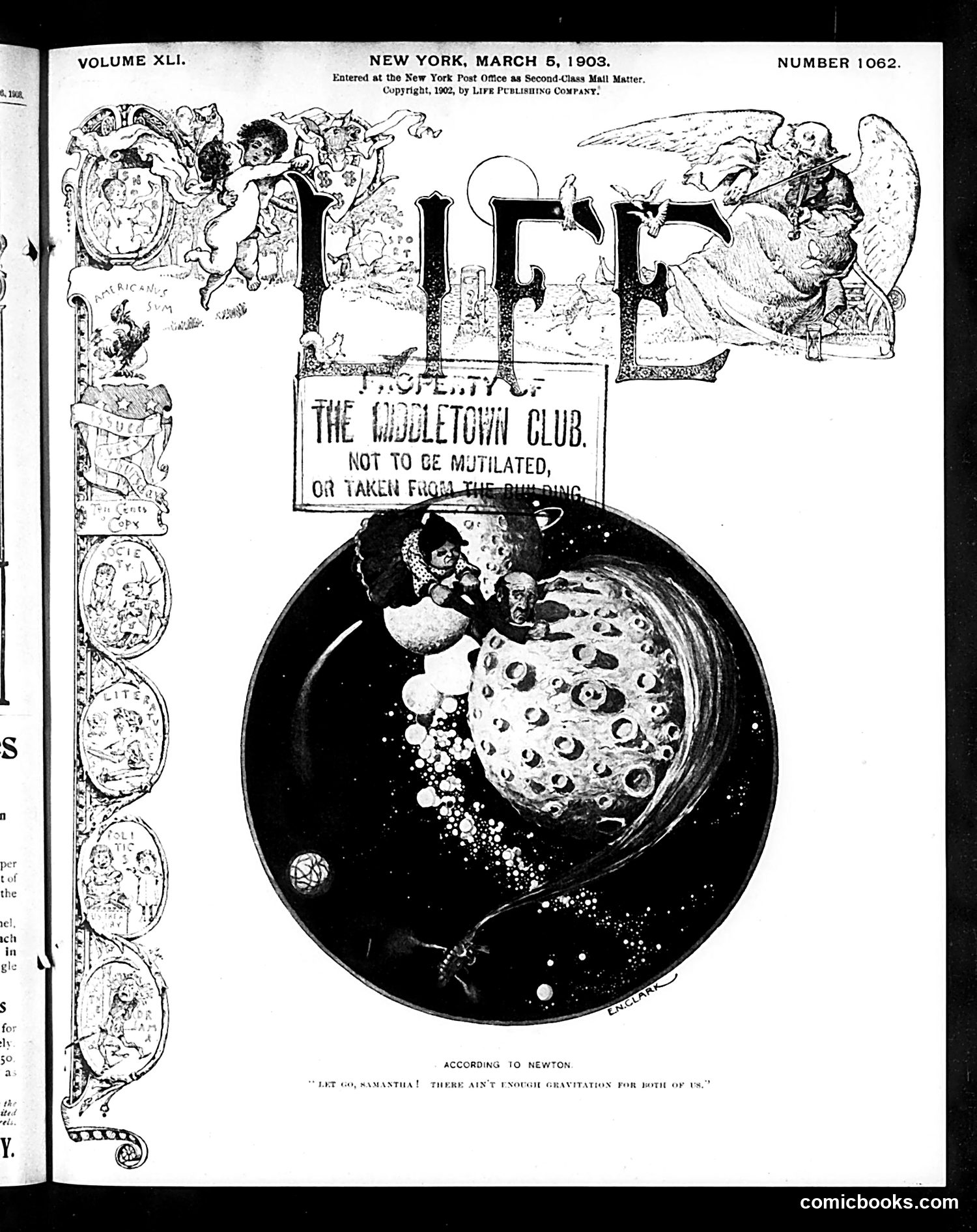
This page features "The Property of the Middletown Club," a satirical illustration about an exclusive social club. The main image depicts figures inside what appears to be a celestial or atomic sphere, with a warning that the property is "not to be mutilated or taken from the building." The bottom caption references Newton, quoting "Let go, Samantha! There ain't enough gravitation for both of us"—a physics joke playing on Newton's law of universal gravitation. The elaborate decorative borders on the left contain smaller circular vignettes, likely depicting club members or activities. The overall satire appears to mock the pretensions and exclusivity of elite Gilded Age social clubs, suggesting their members behave as if operating under different physical laws than ordinary society.
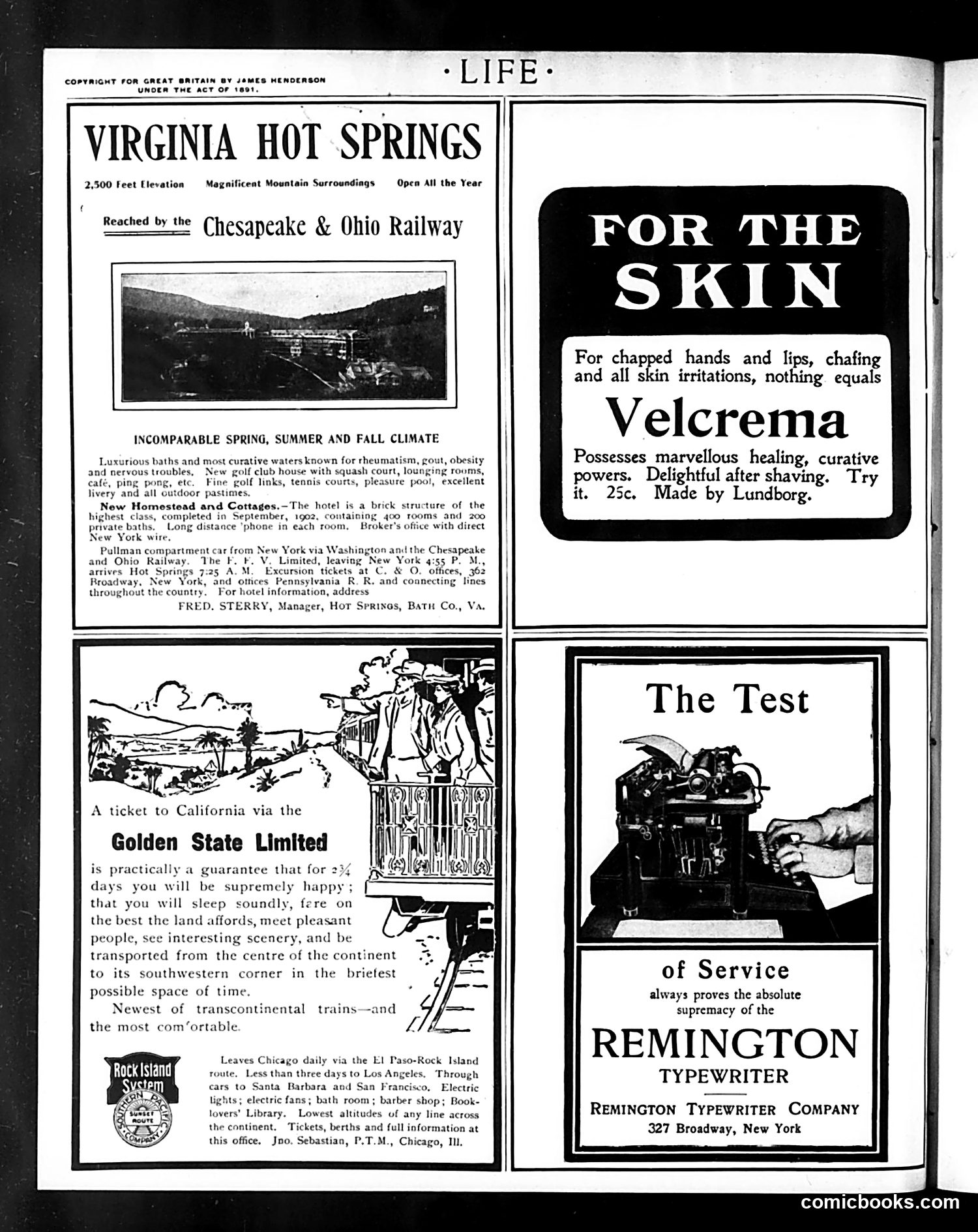
This page consists primarily of **period advertisements**, not satirical cartoons. The content includes: 1. **Virginia Hot Springs resort** advertisement promoting rail travel via Chesapeake & Ohio Railway 2. **Velcrema skin product** ad for treating chapped hands and lips 3. **Golden State Limited train** advertisement highlighting a California route 4. **Remington Typewriter** ad emphasizing service reliability There is **no political satire or social commentary** visible on this page. The imagery is straightforward commercial—scenic mountain photographs, a train illustration, and a typewriter demonstration. This appears to be a standard magazine page from the early 20th century devoted entirely to transportation and consumer product advertising, reflecting the era's emphasis on rail travel and emerging consumer goods marketed to middle-class readers.
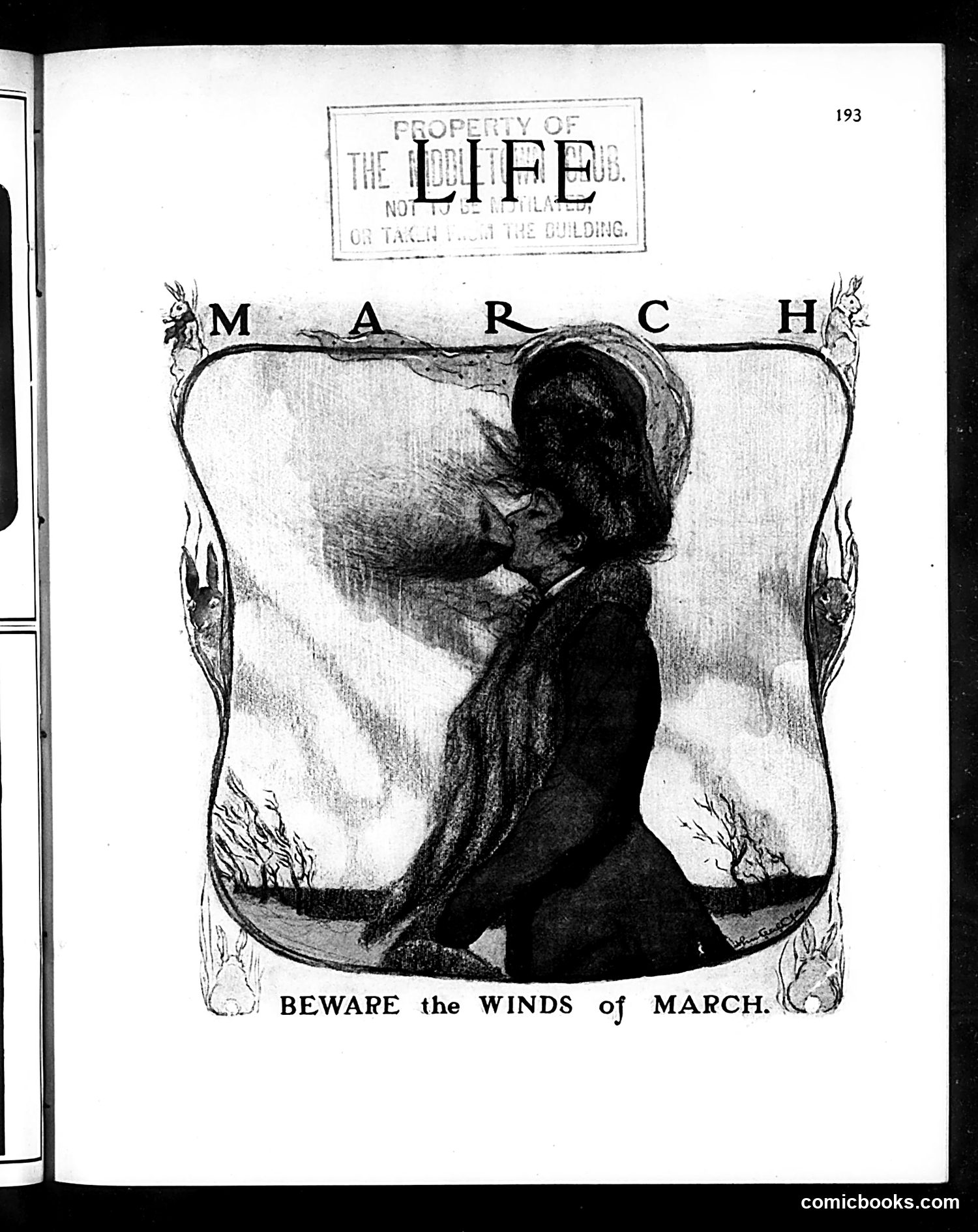
This appears to be a cover or full-page illustration from *Life* magazine's satirical section. The image shows a silhouetted figure being blown by wind, framed decoratively with the letters M-A-R-C-H at the top and ornamental corners featuring cherubs or decorative elements. The caption reads "BEWARE the WINDS of MARCH," likely a metaphorical warning about political or social turbulence expected during March. Without additional context about the specific publication date, the exact reference remains unclear—it could reference anticipated political upheaval, labor unrest, or seasonal/societal changes. The dramatic, wind-swept imagery suggests instability or impending disruption of some kind, typical of *Life* magazine's satirical commentary on contemporary events.
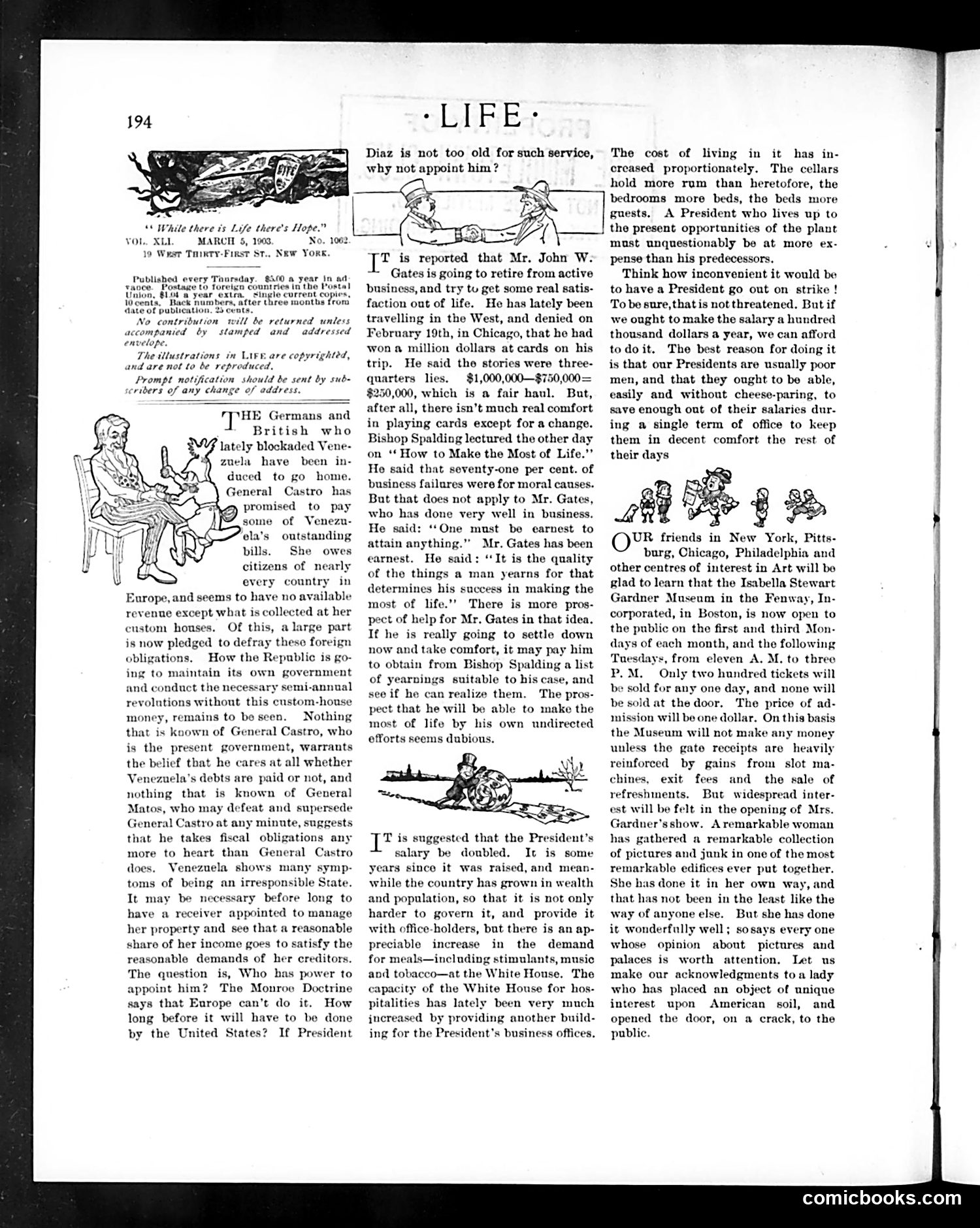
This page contains three distinct pieces of satirical commentary: 1. **"While there is Life there's Hope"** - A brief note about postal rates and currency exchanges. 2. **Venezuelan Government Commentary** - A cartoon showing a rotund figure (General Castro, Venezuela's leader) lounging comfortably. The text critiques Venezuela's debt crisis and Castro's apparent indifference to foreign obligations, suggesting he relies on revolution to avoid fiscal responsibility. 3. **Presidential Salary Debate** - Commentary on proposals to increase the President's salary, arguing it's unnecessary given he already receives comfortable housing and meals. The piece sarcastically suggests if a hundred-dollar salary suffices for common people, the President should manage similarly. 4. **Isabella Stewart Gardner Museum** - A brief note announcing the opening of Gardner's Boston museum to the public, praising her art collection. The page reflects early-20th-century American political cynicism about government spending and foreign affairs.
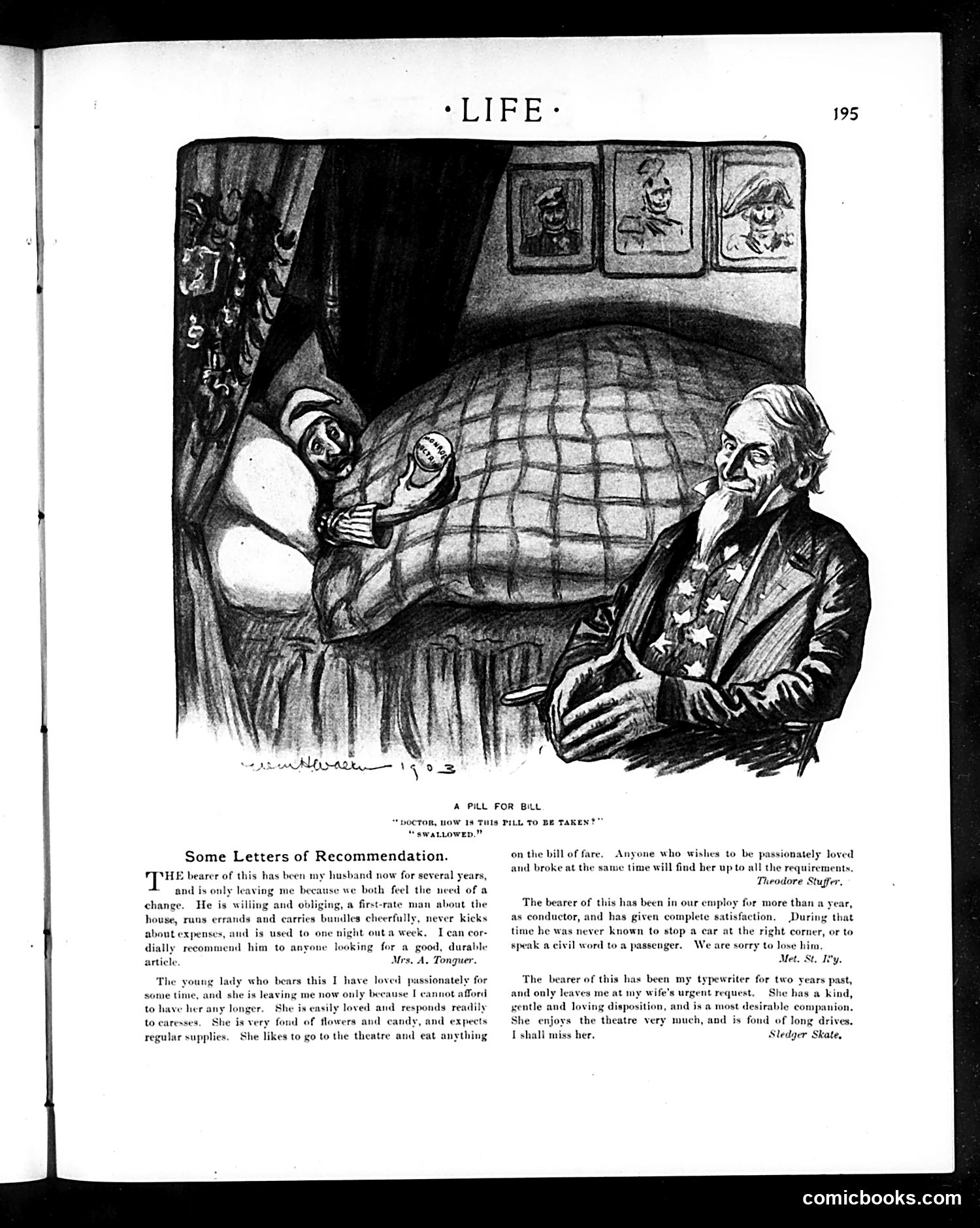
The cartoon depicts a doctor offering medicine to a large, rotund patient labeled "Bill"—likely referring to a legislative bill rather than a person. The doctor asks, "How is this pill to be taken?" with the patient responding, "Swallowed." This is satirical commentary on legislative process. The "pill" represents a proposed law that someone must reluctantly accept or "swallow"—implying the bill is unpalatable but necessary medicine. The cartoonist mocks the difficulty of passing legislation, suggesting it requires forcing something disagreeable through the system. The page's lower section contains testimonial letters praising servants and employees, unrelated to the political cartoon above.
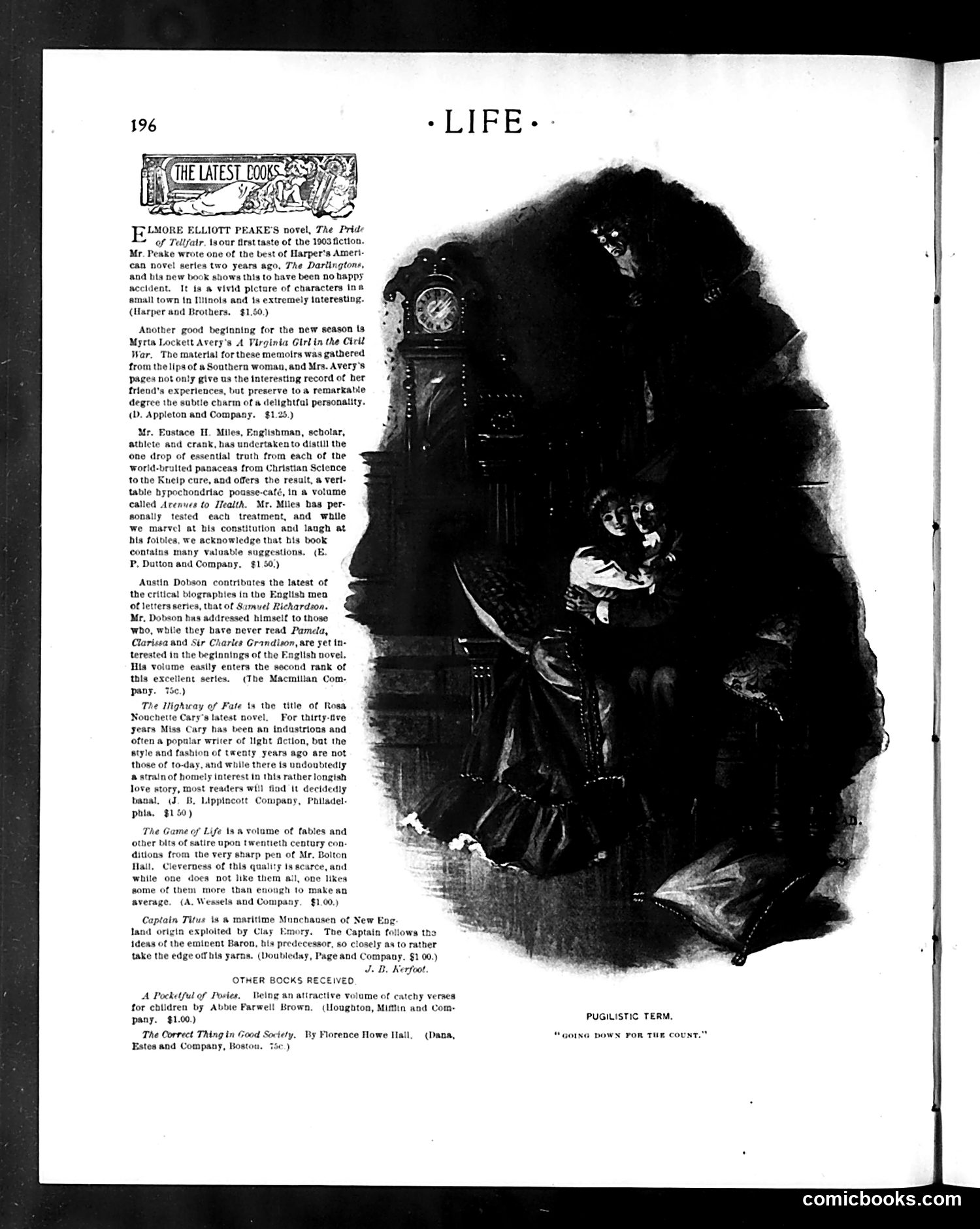
This cartoon illustrates a boxing match metaphor, showing a figure being knocked down and counted out by a referee. The title "Going Down for the Count" suggests political or social defeat. The silhouetted boxer appears to be a caricature, though the specific identity isn't entirely clear from the image alone. The cartoon likely comments on a contemporary political figure or movement experiencing decisive defeat—a common satire device in Life magazine's social commentary. The boxing ring metaphor was frequently used to represent political contests or struggles. Without additional context from the surrounding text or publication date, the exact target remains unclear, but the satirical intent is to mock someone's decisive loss or downfall using the vivid imagery of a knockout.
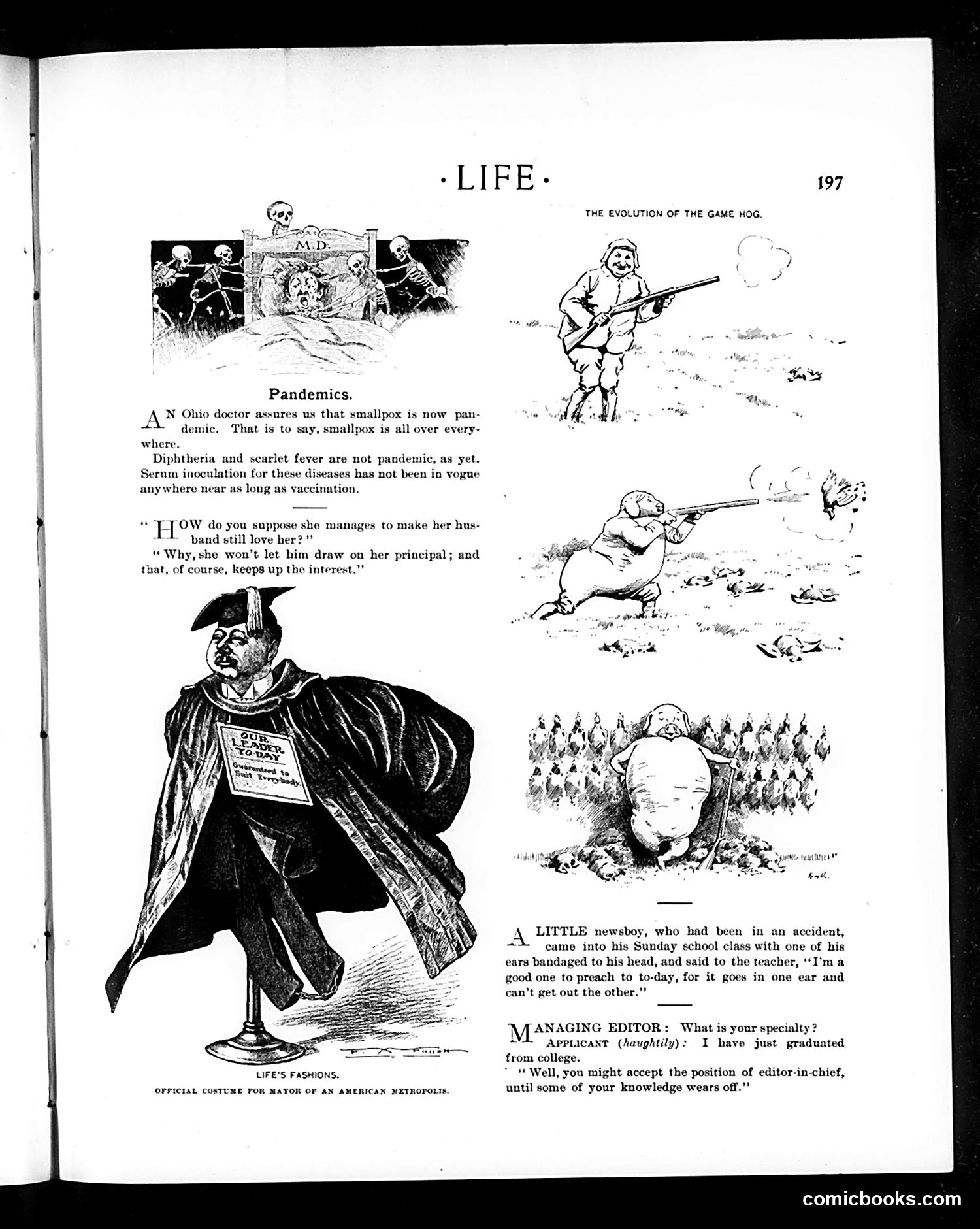
This page contains three distinct satirical pieces: **"Pandemics"** mocks an Ohio doctor's claim that smallpox is now pandemic everywhere. The satire suggests this is an overblown medical pronouncement, contrasting it with diseases like diphtheria and scarlet fever that lack such dramatic claims. **"The Evolution of the Game Hog"** depicts hunting's evolution through three panels showing increasingly rotund hunters shooting game birds, satirizing wealthy sportsmen becoming lazier and more out-of-shape over time. **"Life's Fashions"** shows a caricatured figure in absurdly ornate formal dress, labeled the "official costume for mayor of an American metropolis"—mocking the pretentious ceremonial garb city officials wore. The page includes humorous dialogue snippets about marriage, childhood innocence, and job interviews, typical of *Life* magazine's satirical style.
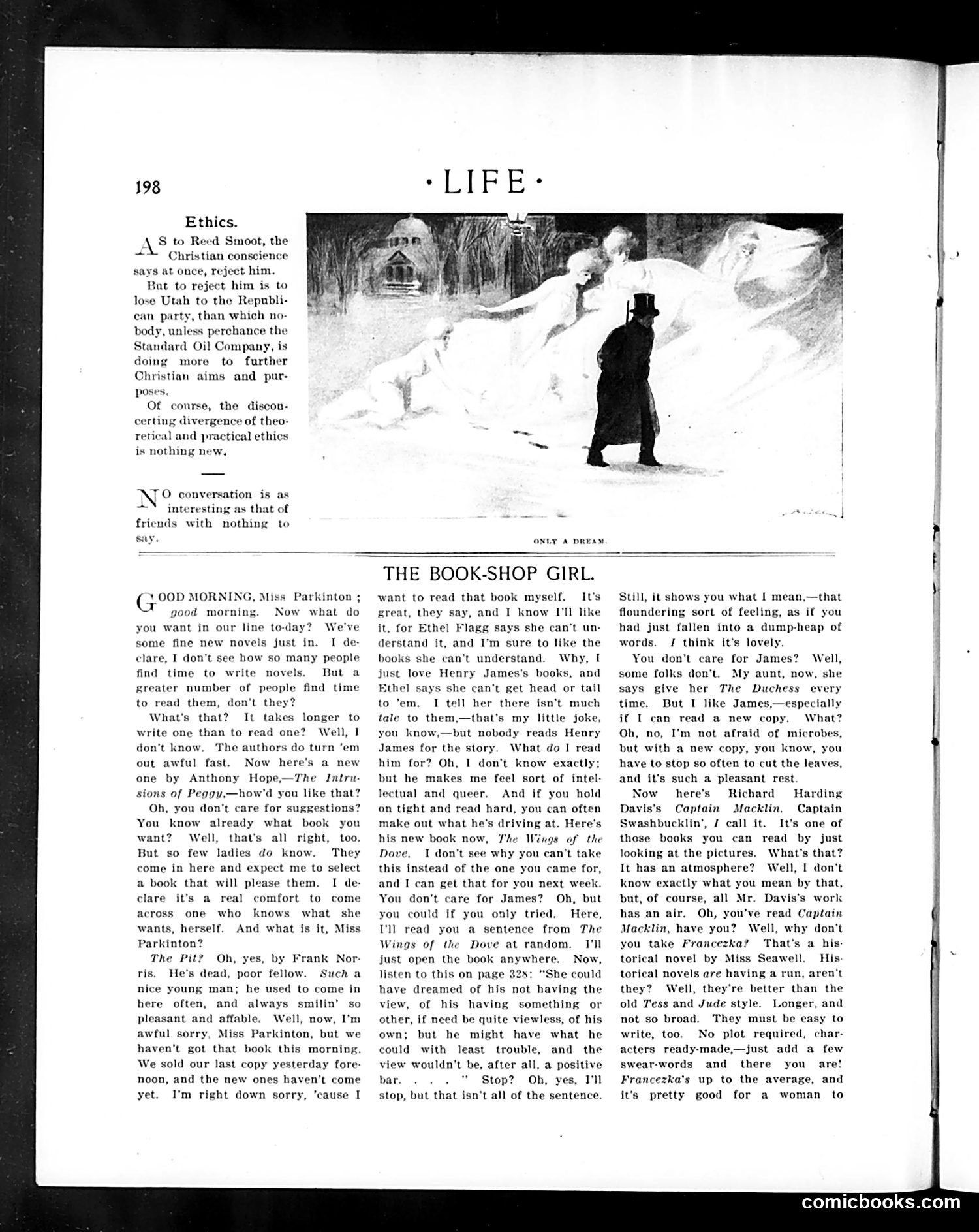
This page from *Life* magazine contains two distinct elements: **"Only a Dream" illustration** (top): Shows a figure in formal attire (top hat and coat) standing in snow, observing what appear to be cherubs or angels in the snowy landscape. The title suggests this is either a satirical commentary on idealistic visions or a commentary on religious/spiritual aspirations versus harsh reality—a common *Life* trope. **"The Book-Shop Girl" (main article)**: A dialogue between a bookshop employee and customer discussing new novels. The text critiques literary taste, referencing Henry James and other authors. It's social satire about reading habits, intellectual pretension, and cultural snobbery—typical *Life* content mocking middle-class affectations and debates over "serious" versus "light" literature. No specific political figures are identifiable; this appears to be general cultural commentary.
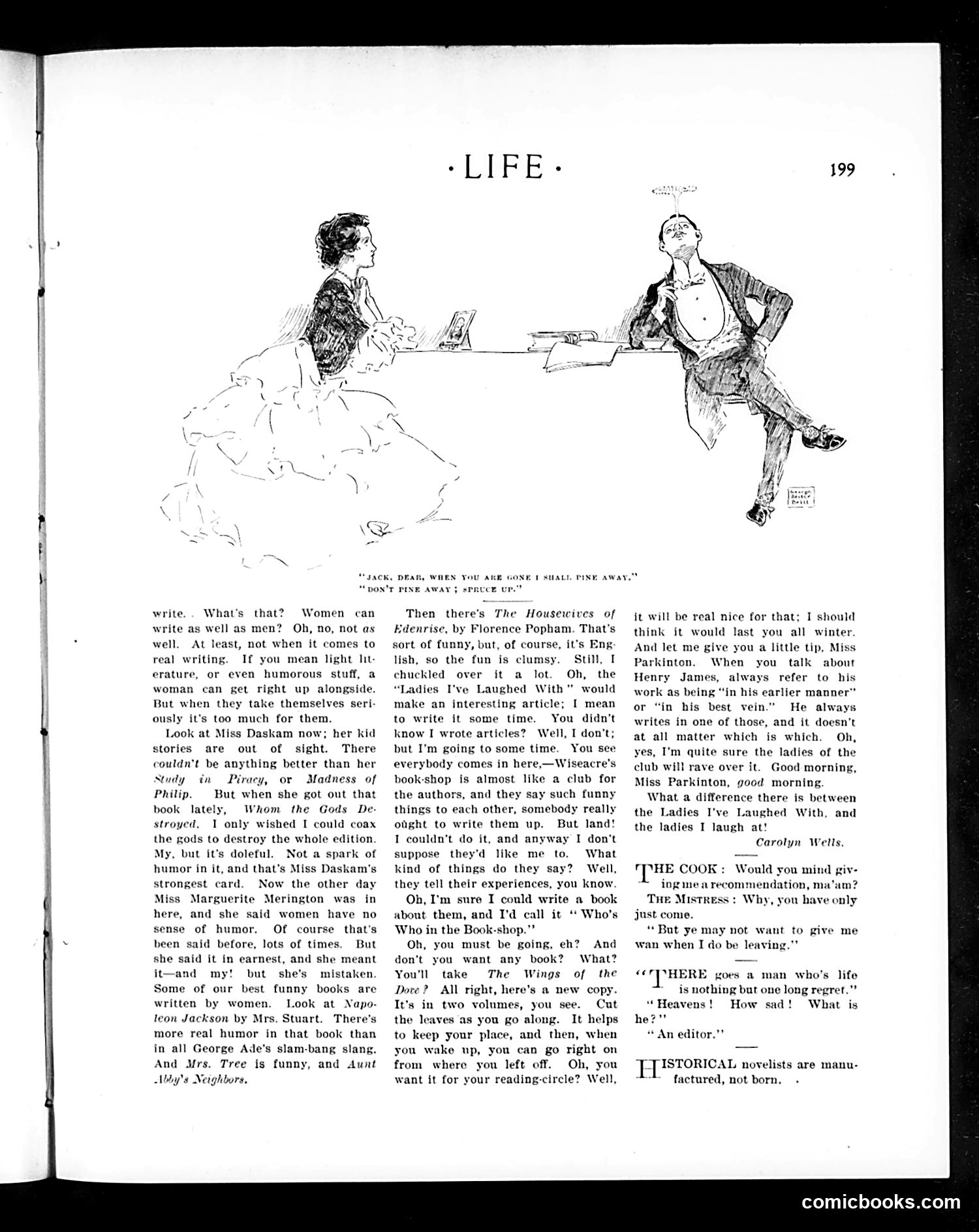
The main illustration depicts a woman at a desk confronting a man in casual pose, with the caption: "Jack, dear, when you are gone I shall pine away." / "Don't pine away; spruce up." This cartoon satirizes gender dynamics in marriage and domesticity. The woman represents the conventional wife who claims emotional dependence on her absent husband, while the man dismissively tells her to "spruce up"—implying she should focus on self-improvement and appearance rather than pining. The satire critiques both the woman's emotional neediness and the man's callous, superficial response. The accompanying text discusses women writers and humor in literature, mentioning works like *The Housewives* and books by Florence Popham, referencing contemporary attitudes about women's intellectual contributions to publishing and satire.
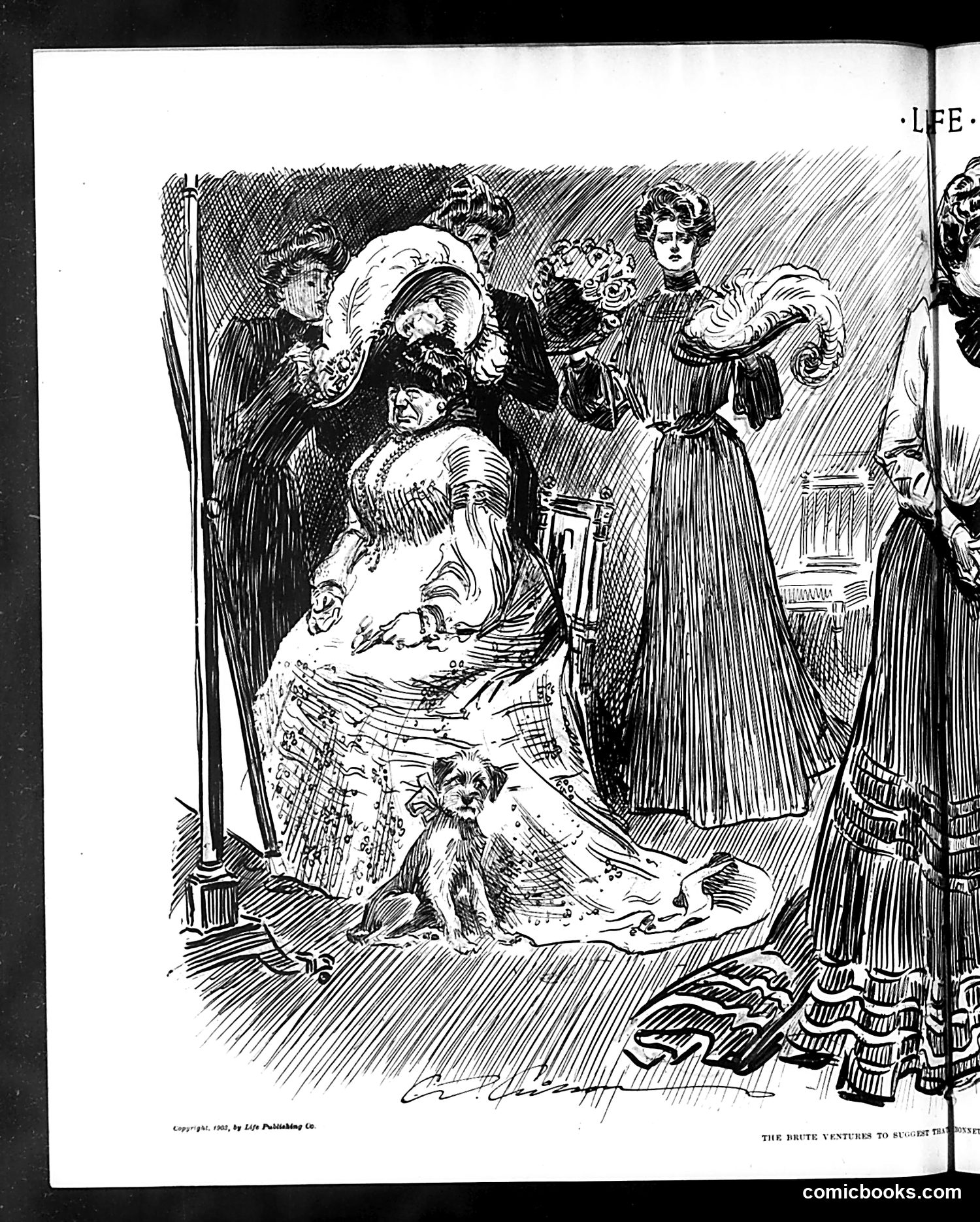
This sketch depicts a wealthy woman in elaborate Edwardian dress—featuring an enormous feathered hat, furs, and jewels—standing uncertainly on ice, accompanied by several attendants. A small dog sits at her feet on the frozen surface. The cartoon satirizes upper-class women's impracticality and fashion excess. The "brute" in the title appears to reference the woman herself, sarcastically suggesting her presumption in attempting outdoor winter activities while dressed in expensive, cumbersome finery designed for drawing rooms rather than athletic pursuits. The attendants watching anxiously suggest concern for her safety given her obvious unsuitability for such exposure. The humor targets early 1900s aristocratic pretension and the disconnect between fashionable appearance and practical necessity.
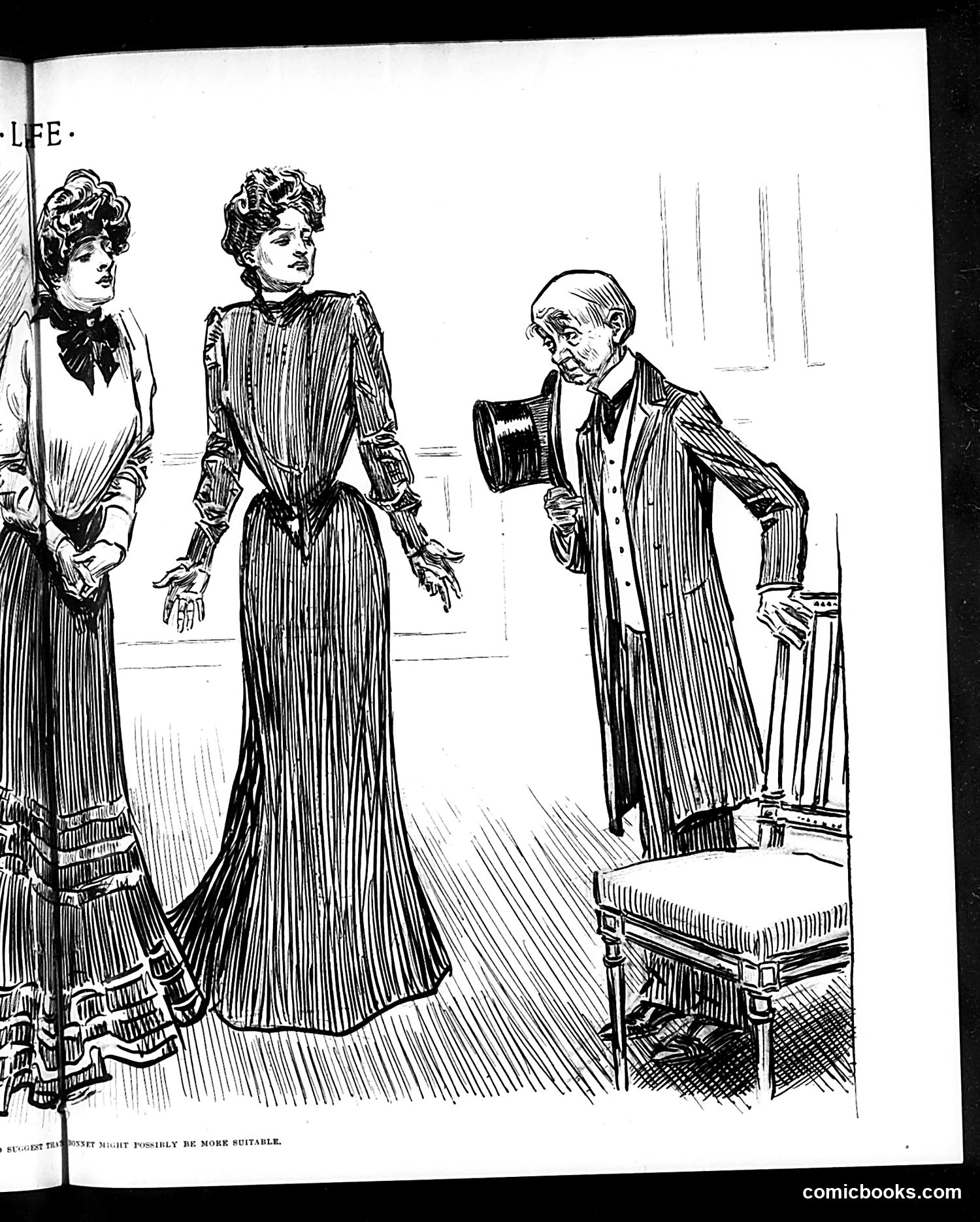
This is a satirical illustration from Life magazine depicting a social interaction scene. The image shows three figures in late Victorian/Edwardian dress: two fashionably dressed women in long gowns on the left, and a bald man in formal evening wear on the right holding a top hat. The caption at the bottom reads: "A BUDGET THE CORSET NIGHT POSSIBLY BE MORE SUITABLE" (likely OCR errors for "A BUDGET THE [something] NIGHT POSSIBLY BE MORE SUITABLE"). The satire appears to mock social pretension and fashion—specifically commenting on the suitability (or unsuitability) of a woman's attire for evening occasions. The man's expression and gesture suggest disapproval or criticism of the women's clothing choices, likely a commentary on rigid Victorian social codes regarding appropriate dress and the absurdity of fashion rules for women.
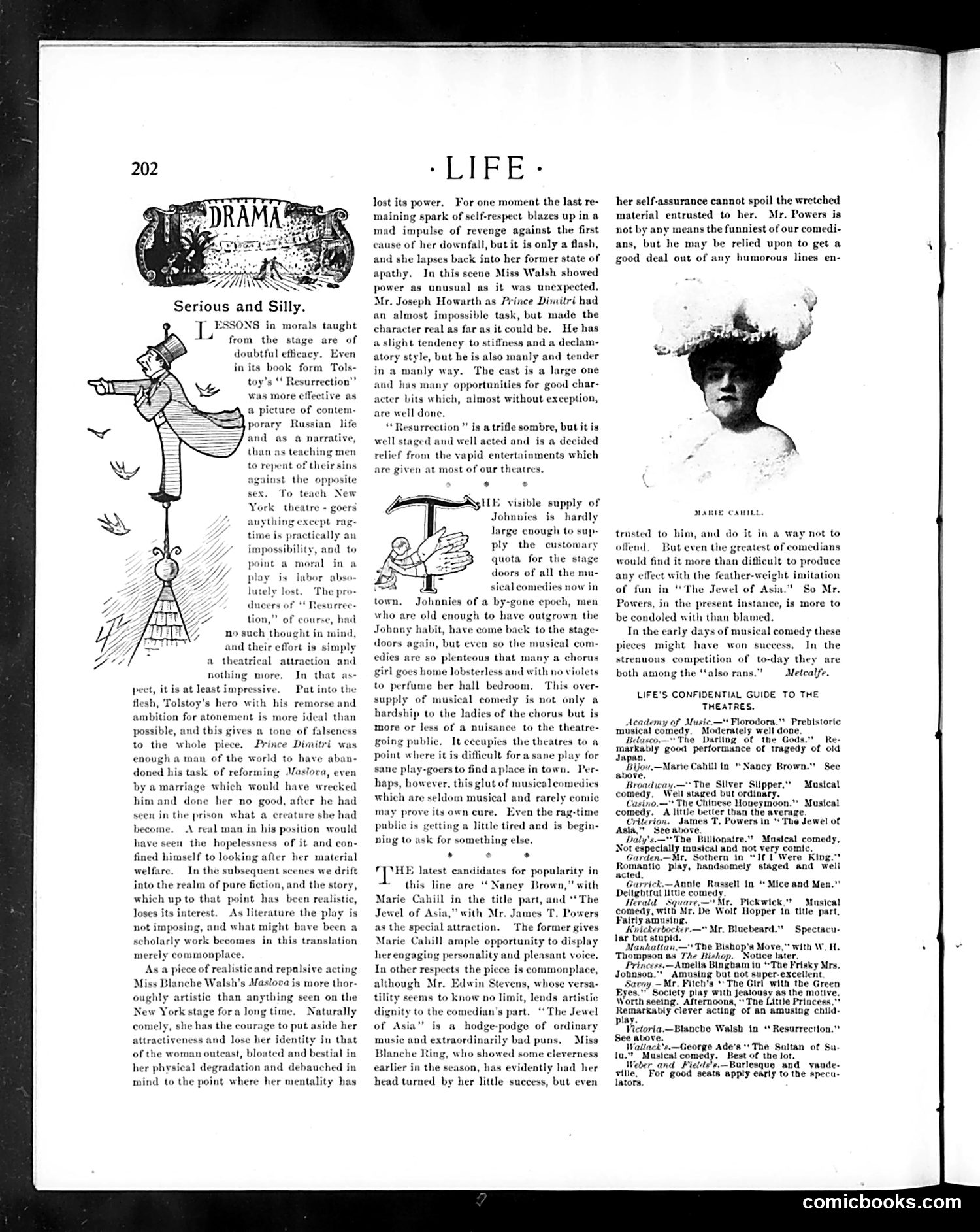
This page contains theatre reviews under the heading "Serious and Silly." The main cartoon depicts a figure in exaggerated Russian-style dress, satirizing contemporary American theatre's fascination with Russian drama and "modern" theatrical aesthetics. The text criticizes New York theatres for programming Russian plays as serious art while simultaneously staging frivolous musical comedies. The reviewer argues this represents an unbalanced approach to entertainment—teaching moral lessons through heavy drama while pandering to audiences with lightweight musicals featuring chorus girls. The reviews discuss specific productions including "Resurrection," "The Jewel of Asia," and "Nancy Brown," with commentary on performers like Marie Cahill and James T. Powers. The satire targets both pretentious artistic programming and the theatre industry's commercial compromises.
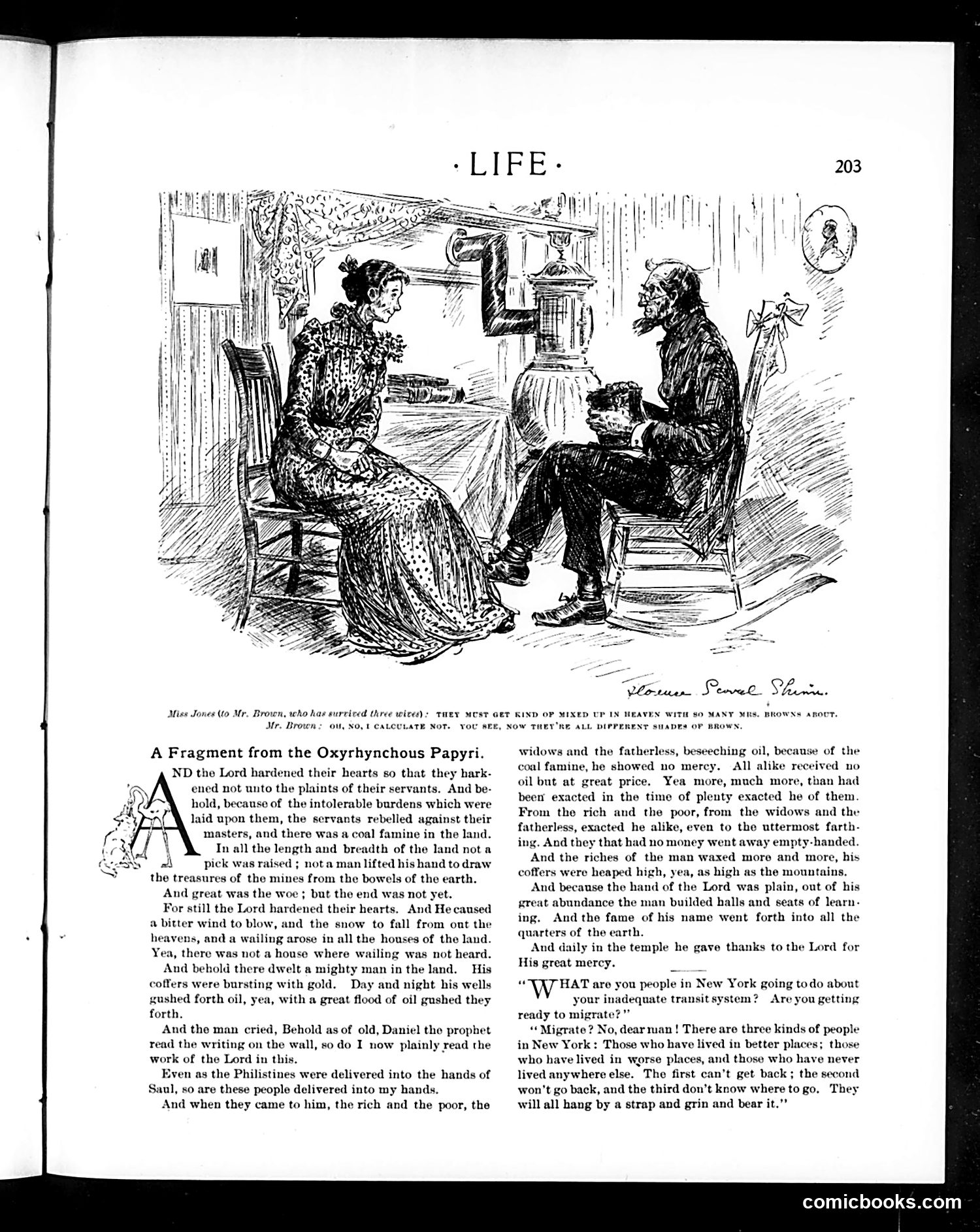
This page contains two distinct satirical pieces: **"A Fragment from the Oxyrhynchous Papyri"** is a mock-biblical text (styled like ancient Egyptian papyrus discoveries) that allegorizes a coal strike and profiteering crisis. It depicts a wealthy man who exploits a fuel shortage, charging exorbitant prices to rich and poor alike while accumulating vast wealth. The satire lies in portraying his greed as divinely sanctioned—he builds monuments to learning while the people suffer, then hypocritically thanks God for "mercy." This appears to critique wartime or postwar profiteering by industrialists during a genuine crisis. **The cartoon below** shows Miss Jones commenting to Mr. Brown (who has outlived three wives) that heaven must be "mixed up" with multiple Mrs. Browns. Brown's response—that they're "all different shades of brown"—is a crude racial joke, appearing to suggest his wives differed by race or complexion. This reflects the casual, offensive racial humor common in early-20th-century American publications. Both pieces satirize exploitation and social inequality of their era.
This comic strip mocks American geography and politics through a father-son dialogue. The father deliberately gives absurd, evasive answers to basic questions: New York is "on the first floor of the Waldorf-Astoria" (a luxury hotel); Washington is "a small hamlet" at Wall Street's foot; the United States occupies the "Morgan belt" (referencing J.P. Morgan's financial dominance). The satire targets: - **Concentrated wealth and power**: Major cities and regions defined by oligarchs (Morgan, Carnegie, Standard Oil, Tammany Hall) - **Political corruption**: States "owned by politicians," cities as collections of mutual "discomfort" - **Class divisions**: Boston elites visit the "United States" as tourists; wealth determines geography - **Urban dysfunction**: Brooklyn reduced to a "polygamous trolley run" The joke's point: American geography has become meaningless because economic power—not civic institutions—now defines the nation's actual structure. A boy memorizing this cynical "lesson" becomes the teacher's star pupil, suggesting this corruption is now the establishment's official curriculum.
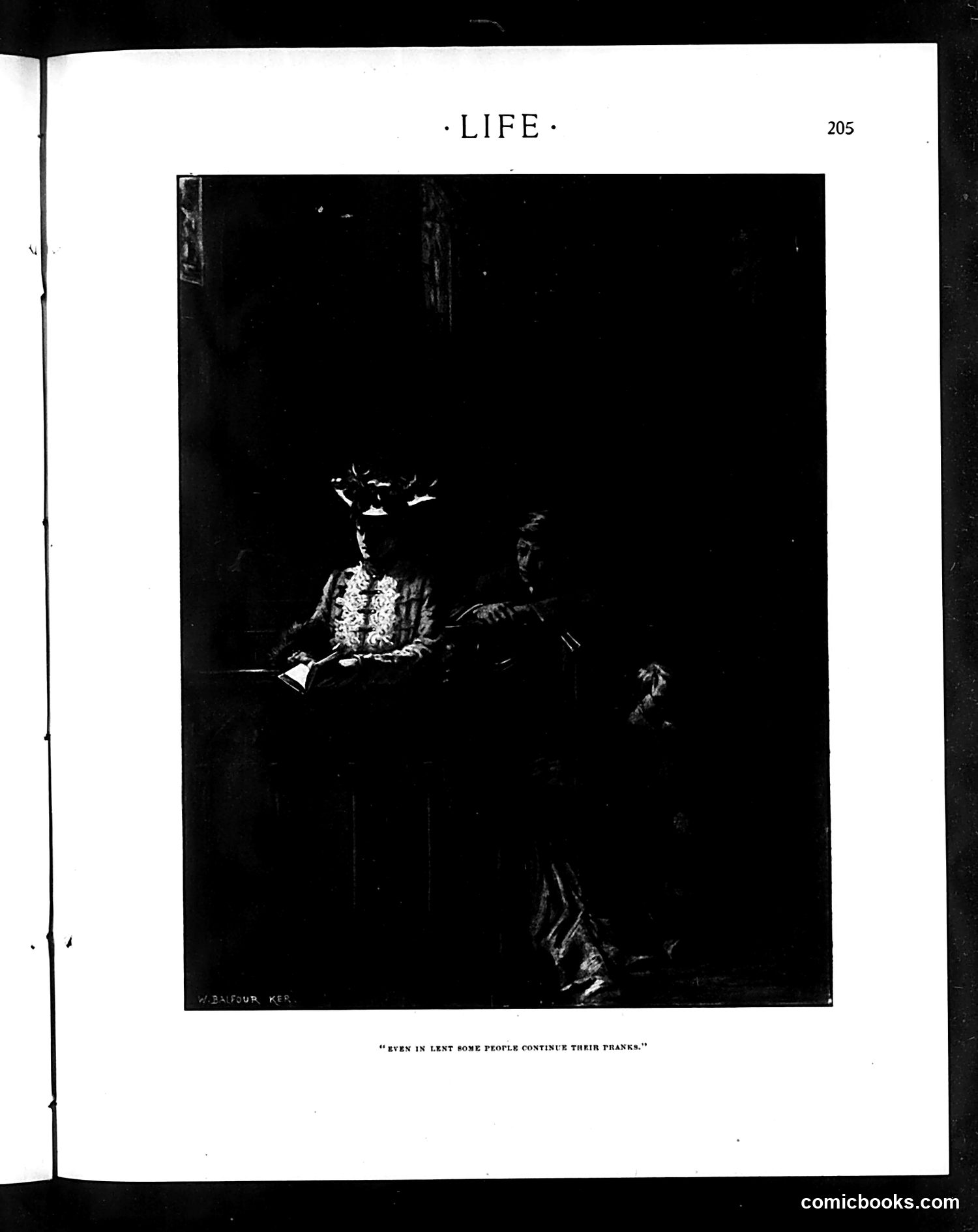
This is a dark illustration accompanying a caption about Lent—the Christian period of fasting and penance. The image shows figures in dim lighting, with one person prominently wearing ornate clothing in the center. The caption's phrase "continue their pranks" suggests mockery of people who ignore Lent's spiritual strictures, possibly engaging in revelry or indulgence when they should be practicing restraint. The satire appears to target those who disregard religious observance, treating a solemn period as an excuse for continued misbehavior or deception. The dramatic shadows and theatrical composition emphasize the hypocrisy being criticized—the contrast between outward propriety (Lent) and hidden misconduct. Without additional context about the magazine's date, specific figures remain unclear, but the joke hinges on social commentary about insincere religious observance.
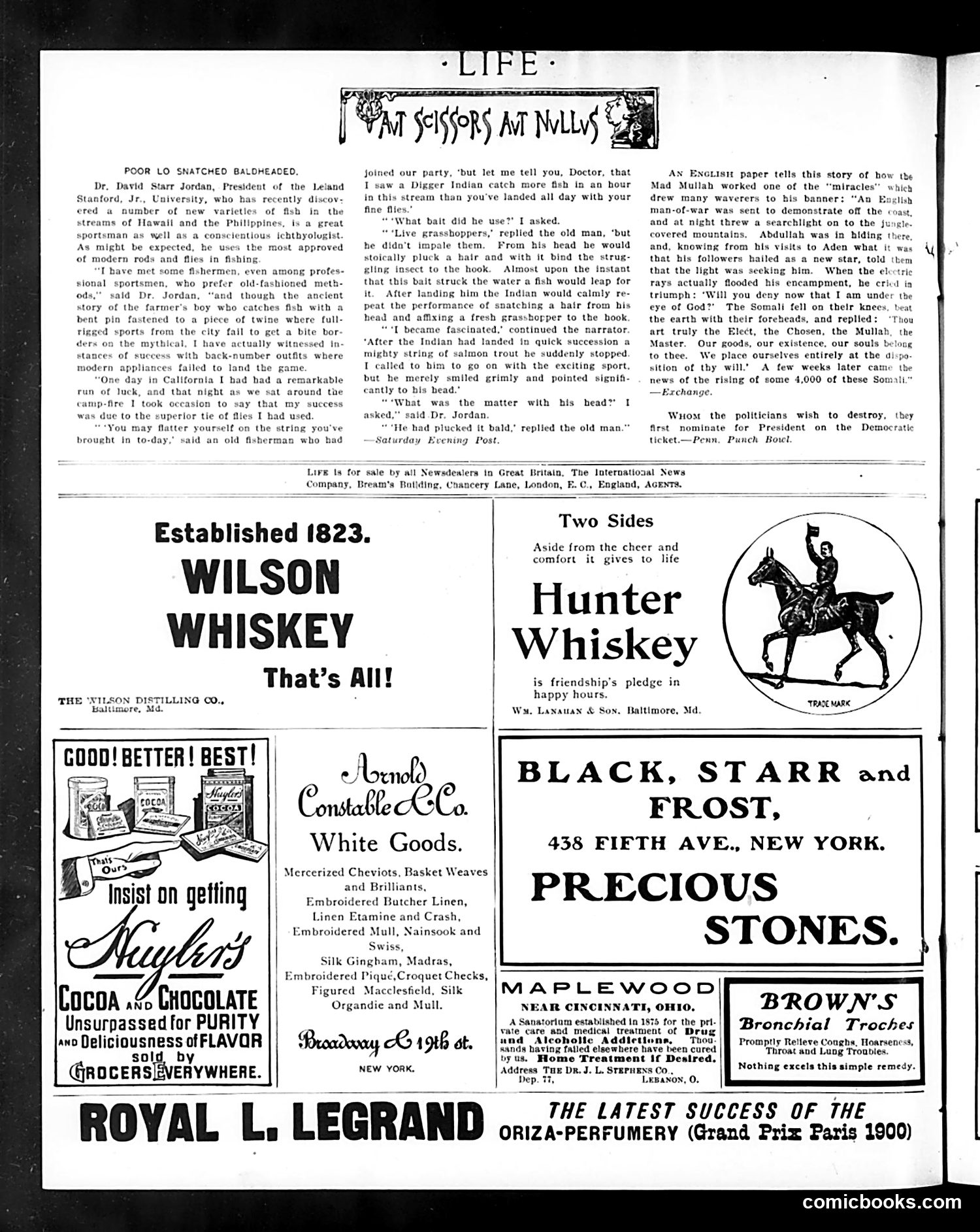
This page from *Life* magazine contains multiple satirical pieces and advertisements rather than a single unified cartoon. **"Poor Lo Snatched Bald-headed"**: This is a humorous fishing anecdote featuring Dr. David Starr Jordan, a real Stanford University president and ichthyologist. The joke hinges on the punchline that a Native American ("Lo," a dated term for Native Americans) out-fishes modern sportsmen by using live grasshoppers attached with a single hair—and ultimately plucks himself bald doing so. The satire mocks modern sportsmen who rely on expensive equipment while missing simpler, more effective methods. **"The Mad Mullah" story**: An unrelated account of how a religious leader in Somalia uses a British searchlight beam as apparent divine evidence ("the eye of God") to recruit 4,000 followers—satirizing religious manipulation and credulity. **The advertisements** (Wilson Whiskey, Hunter Whiskey, Shaylor's Cocoa, etc.) are period commercial notices, not satirical content. The page is primarily a mixed-content editorial page typical of *Life*'s format.
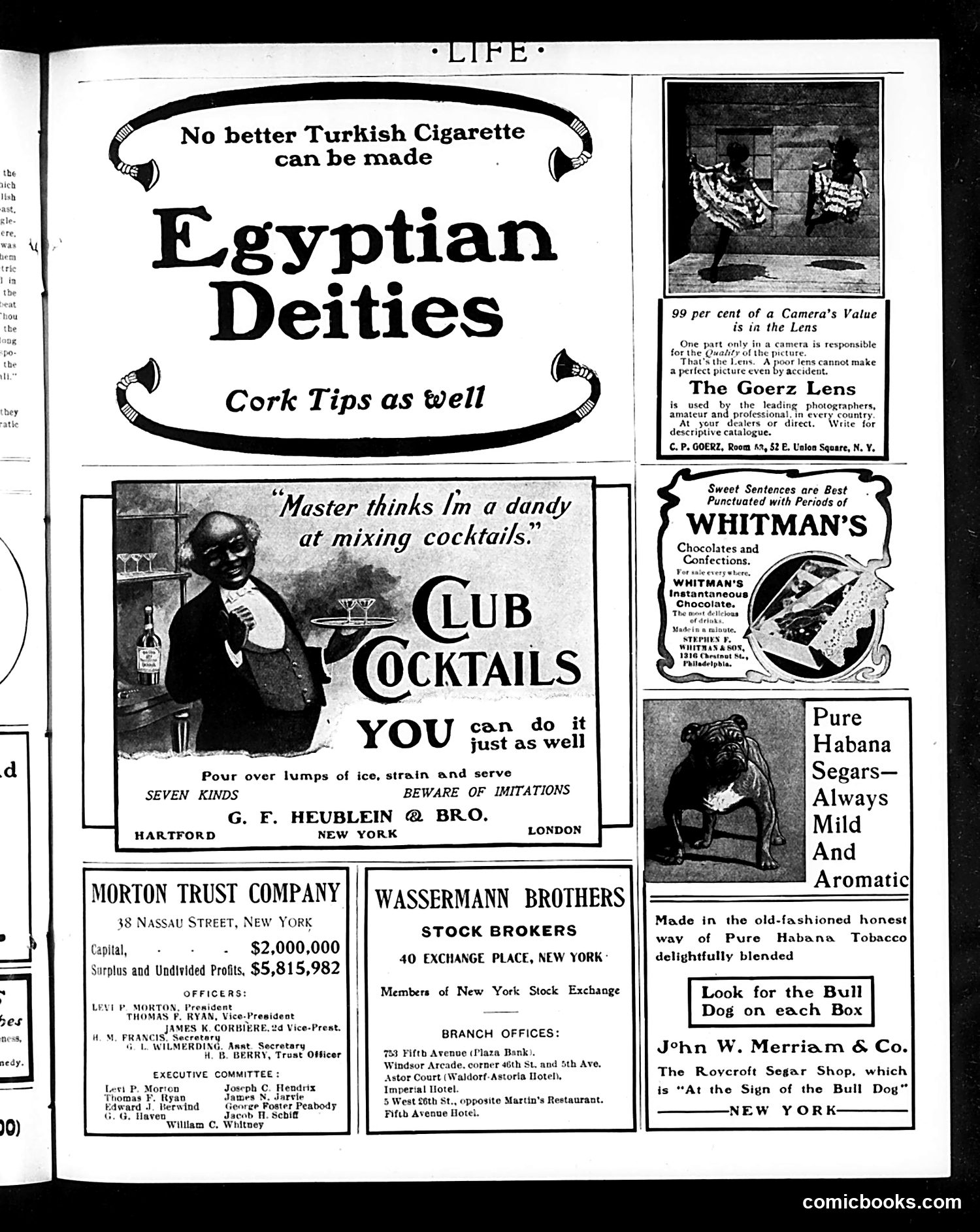
This page is primarily **advertising**, not political satire. It contains product advertisements typical of early 20th-century magazines. The main cartoon depicts a **Black servant** mixing cocktails with the caption "Master thinks I'm a dandy at mixing cocktails." This reflects the period's racist stereotypes and advertising tropes, portraying Black workers through a demeaning caricature common to that era. The surrounding ads promote: - **Egyptian Deities** cigarettes (playing on Orientalist marketing trends) - **Club Cocktails** by Heublein (a real liquor brand) - Camera lenses, chocolates, cigars, and financial services The "99 per cent of a Camera's Value is in the Lens" ad uses humor to suggest only one component matters—comparable advertising logic of the time. For modern readers, the page illustrates how casually racist imagery was integrated into commercial products and publications, and how Orientalism and exoticization sold consumer goods in this period.
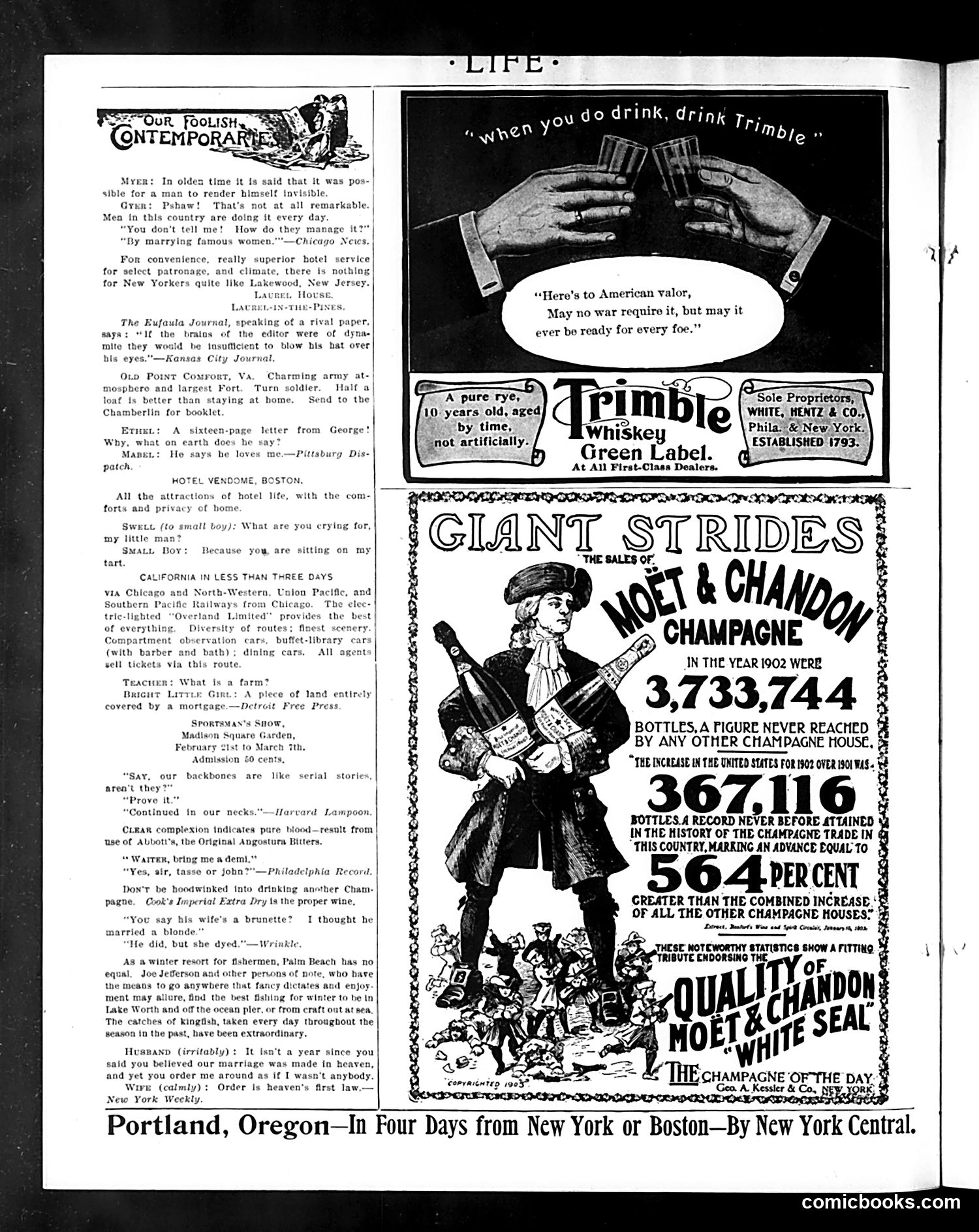
This page is primarily **advertising**, dominated by a large Moët & Chandon champagne advertisement featuring a caricatured figure carrying multiple champagne bottles. The ad emphasizes sales figures (3,733,744 bottles sold in 1902) and market dominance, claiming a 564% increase over competitors—typical bombastic advertising rhetoric of the early 1900s. The left column contains brief satirical vignettes and jokes typical of *Life* magazine's "Our Foolish Contemporaries" section, including wordplay about invisibility and marriage. These are light social commentary with no specific political targets visible. The smaller advertisements promote Trimble Whiskey, hotels, and railroad travel to California and Portland, Oregon. **For modern readers**: This represents pre-prohibition American magazine advertising, when alcohol promotion was standard and unregulated. The content reflects early-1900s upper-class leisure culture and domestic humor conventions that would seem dated today.
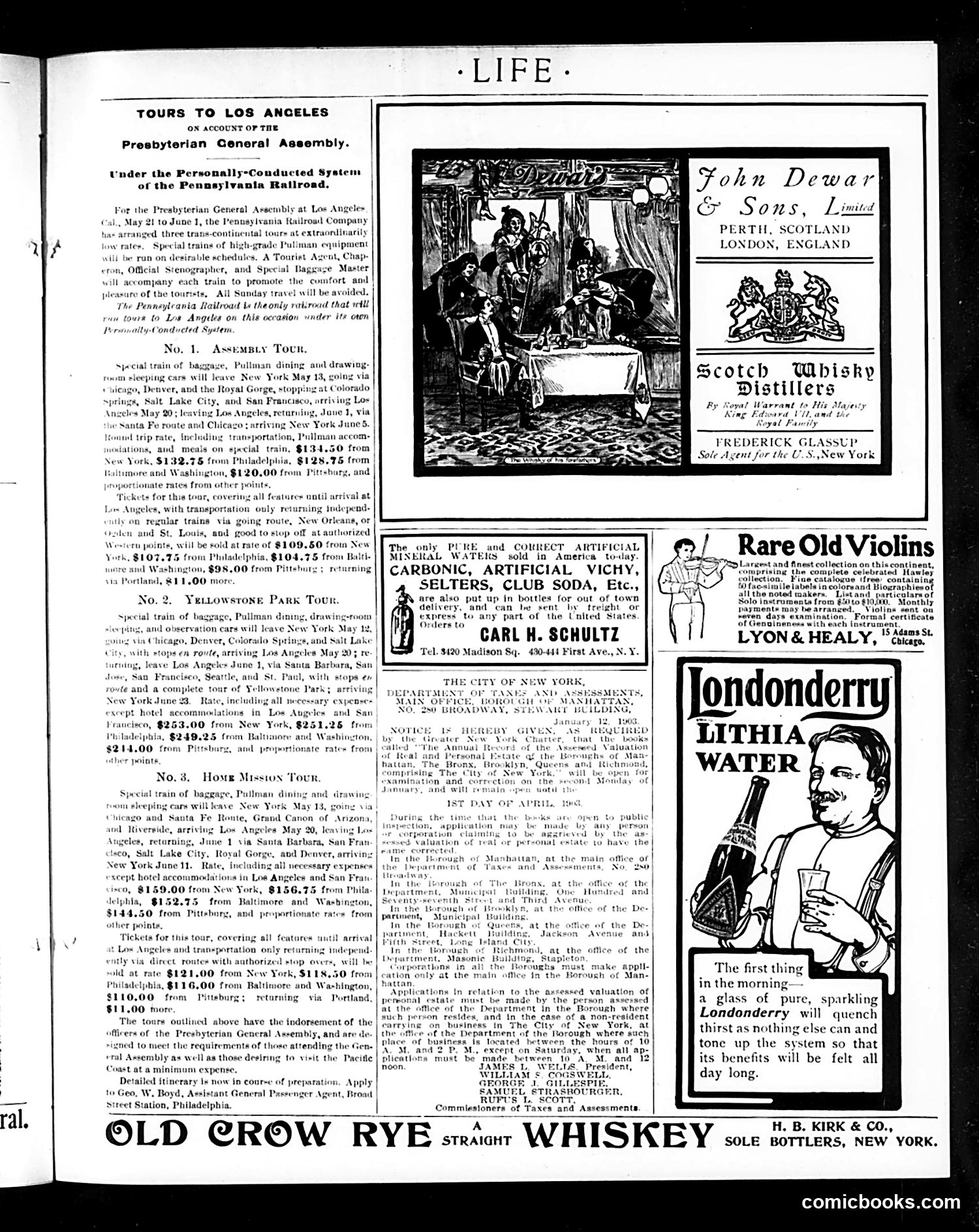
This is primarily **a title/advertisement page** rather than a political cartoon. The page announces three Presbyterian church-sponsored railway tours to Los Angeles (Assemblies, Yellowstone Park, and Home Mission tours), with detailed routes and pricing arranged through the Pennsylvania Railroad. The advertisements surrounding the text include Scotch whisky, artificial mineral water ("Londonderry"), rare violins, whiskey, and other luxury goods—typical *Life* magazine advertiser mix targeting wealthy readers. The **only visual content** is an ornamental woodcut-style illustration (top center) depicting what appears to be a historical or biblical scene, serving as decorative branding for John Dewar & Sons whisky. **No political satire or social commentary appears** on this page. It's fundamentally a travel information and advertising page, reflecting *Life*'s primary business model as a vehicle for affluent consumer goods marketing alongside its satirical editorial content elsewhere in the magazine.
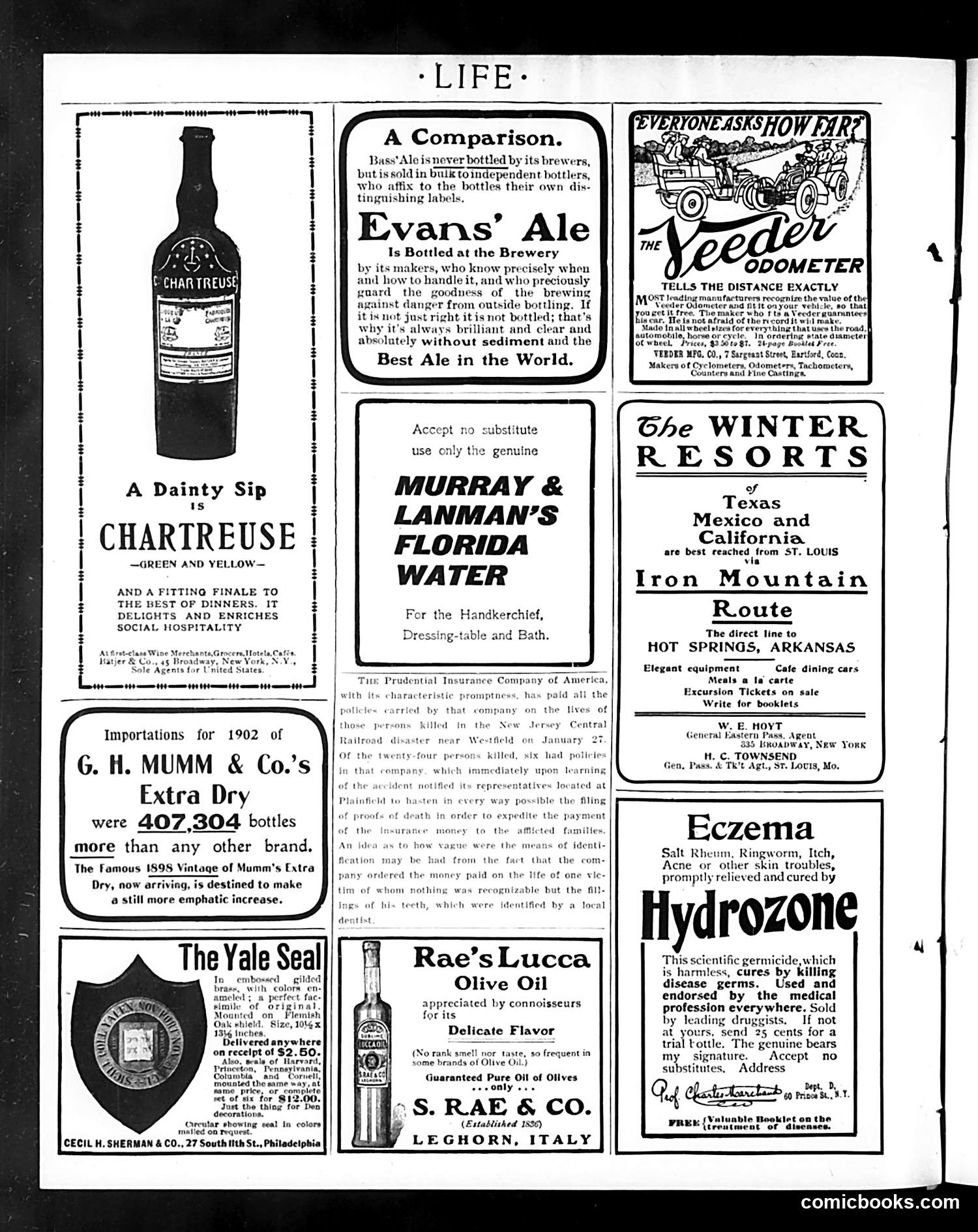
This is primarily an **advertising page** from Life magazine, circa 1902. It contains no political cartoons or satire—rather, it's a collection of product advertisements typical of the era. Notable ads include: - **Chartreuse liqueur** and **G.H. Mumm champagne**: Premium imported beverages marketed to wealthy diners - **Evans' Ale vs. Bass Ale**: A comparative advertisement claiming Evans' superiority because it's bottled at the brewery (quality control angle) - **Murray & Lanman's Florida Water**: A toiletry product - **Rae's Lucca Olive Oil**: Italian import for connoisseurs - **Veeder Odometer**: Early automotive accessory - **Winter resort travel**: Promoting Hot Springs, Arkansas via railroad - **Hydrozone**: A medicinal germicide claiming to cure skin diseases The page reflects **early 1900s consumer culture**—targeting affluent readers with luxury imports, emerging automobile technology, and patent medicines. The Prudential insurance mention documents a contemporary railroad disaster.
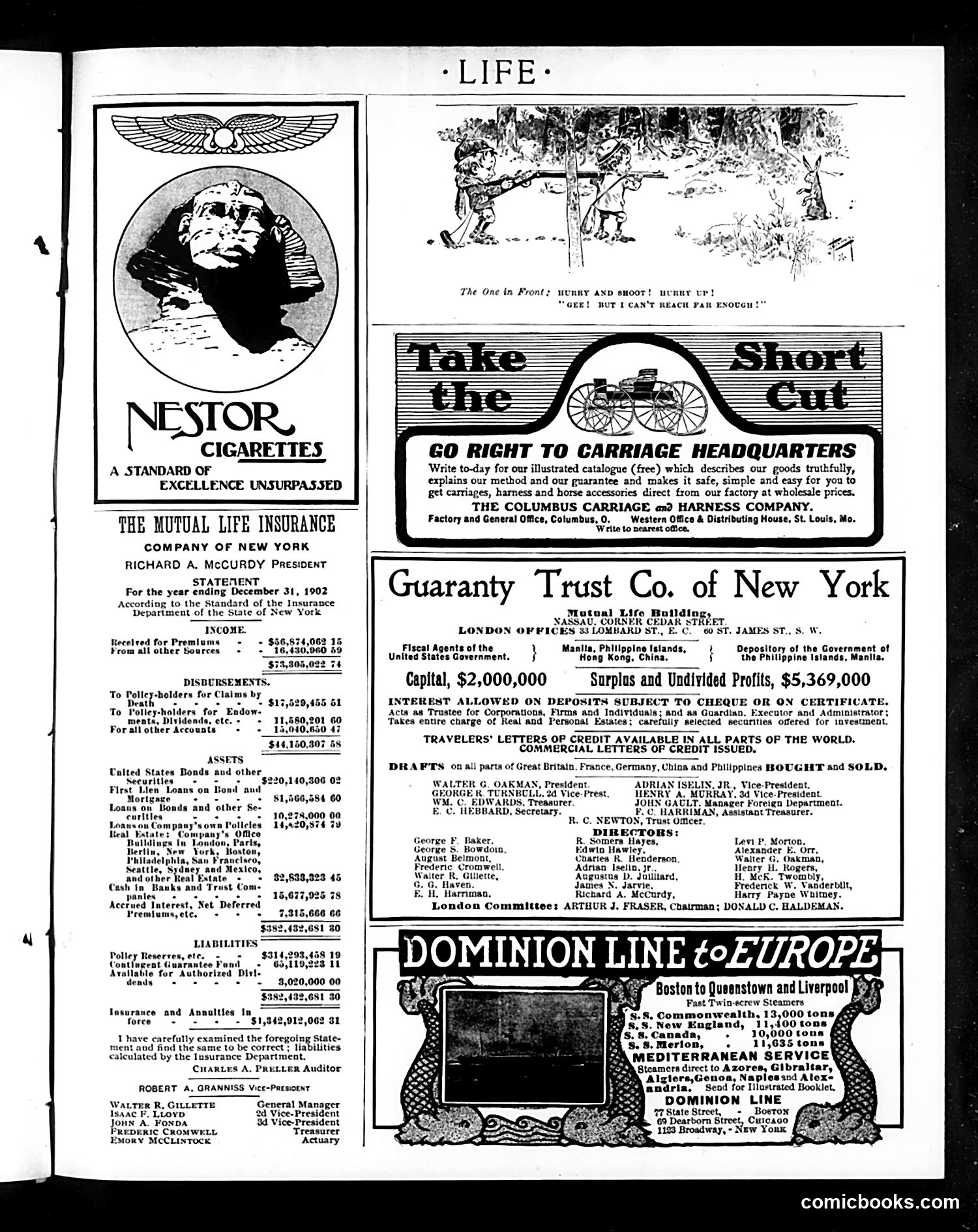
This page is primarily **advertisements and financial statements**, not political satire or editorial content. The top-left features a **Nestor Cigarettes ad** with an eagle emblem claiming "excellence unsurpassed." The bulk of the page contains **financial disclosures**: The Mutual Life Insurance Company of New York's 1902 annual statement, listing assets, liabilities, and company officers. This is formal corporate reporting. Additional advertisements include **carriage sales** (Columbus Carriage & Harness Company), the **Guaranty Trust Co. of New York** (banking services), and the **Dominion Line** (steamship company offering transatlantic passage). The single small illustration at top-right shows children at play with the caption "The One in Front: Hurry and shoot! Hurry up! 'Gee! But I can't reach far enough!'"—a generic comic vignette unrelated to the advertisements below. This is a typical *Life* magazine page mixing editorial humor with paid corporate advertising.
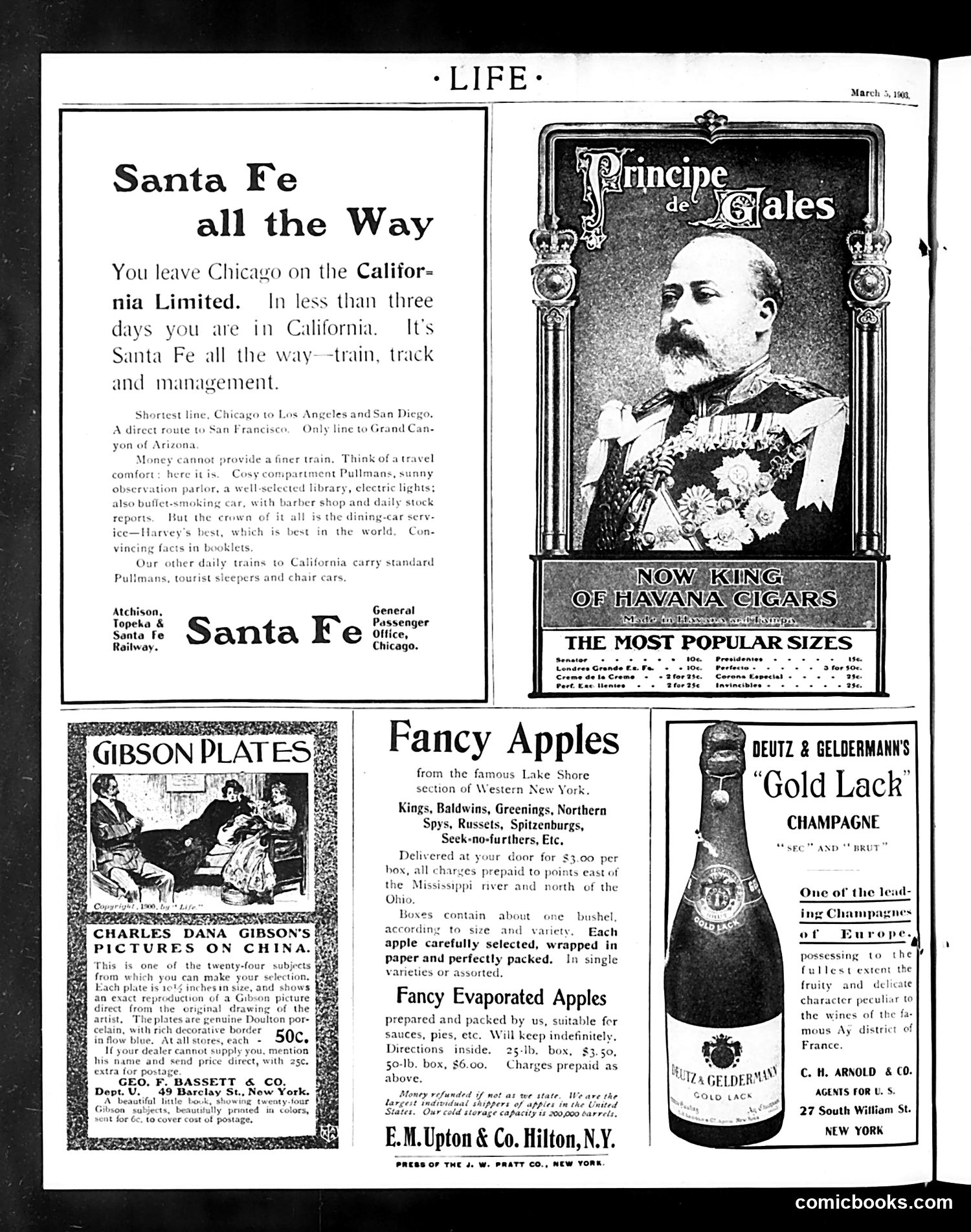
This is primarily an **advertising page** with minimal satirical content. The page features four commercial advertisements: 1. **Santa Fe Railway**: Promotes the "California Limited" train from Chicago to California, emphasizing luxury travel amenities and Harvey House dining service. 2. **Gibson Plates**: Advertises decorative china plates featuring Charles Dana Gibson's illustrations—Gibson was famous for his "Gibson Girl" drawings depicting idealized American women. 3. **Fancy Apples**: E.M. Upton & Co. sells Lake Shore apples from New York, delivered nationwide. 4. **Deutz & Geldermann Champagne**: Marketed as one of Europe's leading champagnes, with an ornate portrait (appears to be a European royal or aristocrat, likely "Príncipe de Gales"—Prince of Wales). The page reflects early 1900s consumer culture targeting middle and upper-class readers—luxury travel, fine dining, imported goods, and artistic home décor. There is **no apparent political satire** on this particular page; it represents standard Life magazine advertising content.