
Life, 1903-03-05 · page 12 of 22
Life — March 5, 1903 — page 12: what you’re looking at
What you’re looking at
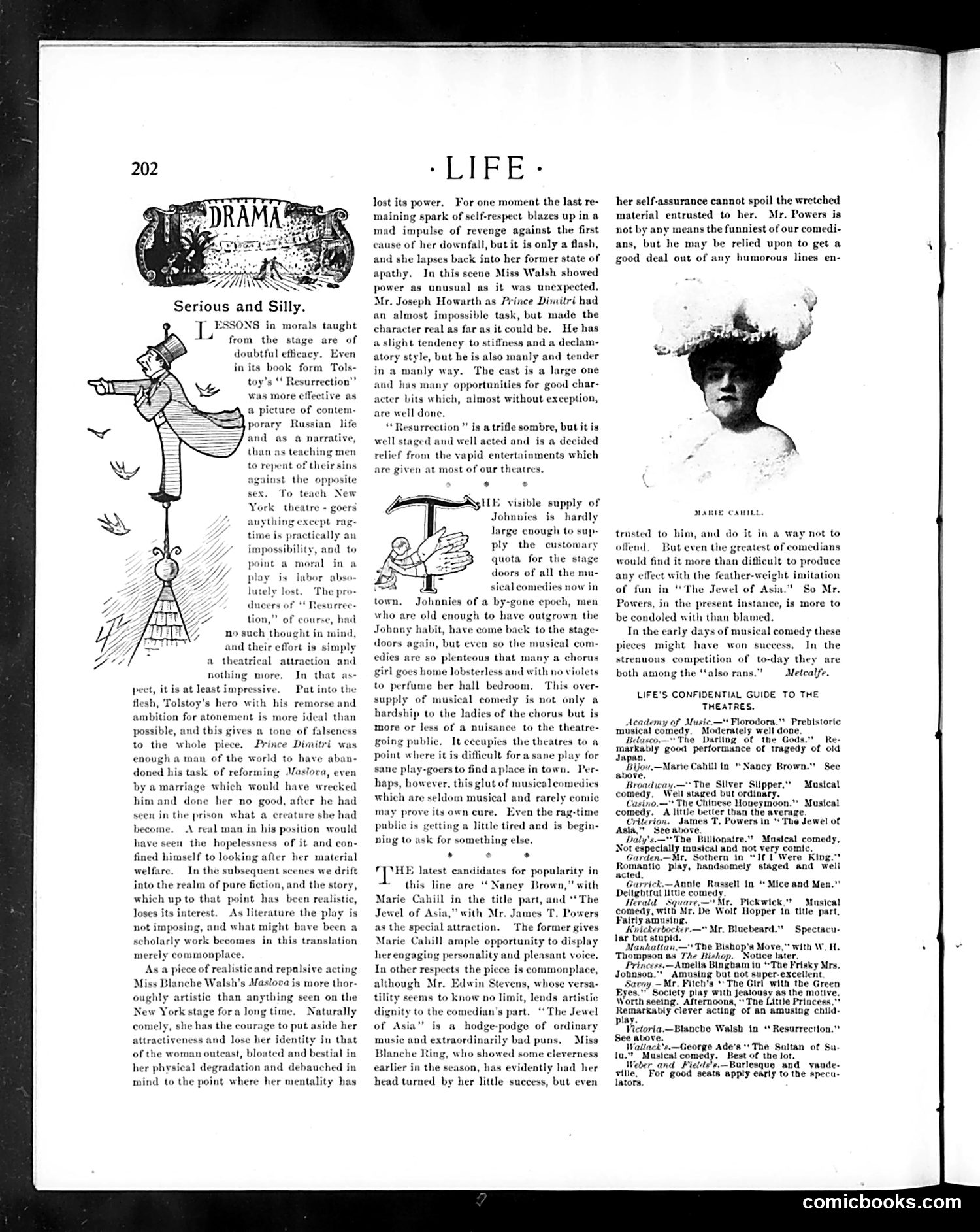
This page contains theatre reviews under the heading "Serious and Silly." The main cartoon depicts a figure in exaggerated Russian-style dress, satirizing contemporary American theatre's fascination with Russian drama and "modern" theatrical aesthetics. The text criticizes New York theatres for programming Russian plays as serious art while simultaneously staging frivolous musical comedies. The reviewer argues this represents an unbalanced approach to entertainment—teaching moral lessons through heavy drama while pandering to audiences with lightweight musicals featuring chorus girls. The reviews discuss specific productions including "Resurrection," "The Jewel of Asia," and "Nancy Brown," with commentary on performers like Marie Cahill and James T. Powers. The satire targets both pretentious artistic programming and the theatre industry's commercial compromises.
📄 Transcribed text from this page (OCR, searchable)
Machine-transcribed from the original scan — historical spelling and the odd misread are preserved.
Serious and Silly. T9088 in morals taught + the sta are of doubtful efficacy. Even in its book form Tols- toy’s ‘* Resurrection" was more effective as a picture of contem- porary life as a narrative, than as teachin from tussian and men to repent of their sins against the opposi sex. To teach New York auything except rag- time is practically an nd to point a moral in a play is theatre = goers impossibility, labor abso- lutely lost. The pro- duc “ Tesurree- tion,” of course, no such thought in mind, and their effort is simply a theatrical attraction and nothing more. In that as- pect, it is at least impressive. Put into the flesh, Tolstoy's hero with his remorse and ambition for atonement is more ideal than possible, and this gives a tone of falseness to the whole piece. ghaman of the world to have aban- doned his task of reforming Maslova, even by a marri; which would have wrecked him and done her no good, after he had seen in the prison what a creature she had A real man in his position would have seen the hopelessness of it and con- fined himself to looking after her material welfare, In the subsequent we drift into the realm of pure fiction, an which upto that point has be loses its interest. As literature the play is not imposing at might have been a scholarly work becomes in this translation merely commonplace. As a piece of realisticand repalsive acting Miss Blanche Walsh's Maslova is more thor- oughly artistic than anything seen on the New York stage fora long time. Naturally comely, she has the courage to put aside her y in that woman outcast, bloated and bestial in ation and debauched in mind to the point where her mentality has had Prince Dimitri was become. 1 realistic, attractiveness and lose her identit of th her physical degra ~LIFE « lost its power. For one moment the last re- maining spark of self-respect blazes up in a mad impulse of revenge against the first cause of her downfall, but it is only a flash, and she lapses back into her former state of apathy. In this scene Miss Walsh showed power as unusual as it was unexpected. Mr. Joseph Howarth as Prince Dimitri had an almost impossible task, but made the character real as far as it could be. He has a slight tendency to stiffness and a declam- atory style, but he is also manly and tender in a manly way, The cast is a large one and has many opportunities for good char- acter bits which, almost without exception, are well done, oR ion” is atrifle sombre, but it is well staged and well acted and is a decided relief from the vapid entertainments whi are given at most of our theatres. Arre Johnnies is large enough to sup- ply the quota for the stage - doors of all the mu- AA sicale town. customary nedies now in Johnnies of a by-gone ¢ who are old enough to have outgrown the Jobnny habit, have come back to the stage- doors again, but even so th edies are so plenteous that many a chorus girl goes home lobsterless and with no violets to perfume her hall bedroom, This over- supply of musical comedy is not only a hardship to the ladies of the chorus but is more or less of a nuisance to the theatre- going publi point where it is difficult forasane play for sane play-goers to find a place in tow haps, however, this glut of musical comedies which are seldom musical and rarely comic ven the rag-time little tired and is begin- h, men musical com- It cecupies the theatres to a Per- may prove its own cure. public is getting g to ask for si ° ° . mething else, HE latest candidates for popularity in this line are ‘'Naney Brown,” with Marie Cahiil in the title part, and The Jewel of Asia,” with Mr. James T. Powers as the special attra The former gives Marie Cahill ample opportunity to display herengaging personality and pleasant voice. In other respects the piece is commonplace, although Mr. Edwin Stevens, whose versa- tility seems to know no limit, lends artisti y to the comedian’s part. “The Jewel tion. is a hodge-podge of ordinary music and extraordinarily bad puns. Miss Blanche Ring, who showed some cleverness earlier evidently had her head turned by her little success, but even 1 the season, her self-assurance cannot spoil the wretched material entrusted to her. Mr. Powers is not by any means the funniest of our comed y be relied upon to get a humorous lines en- ans, but he m good deal out of makin eamine, trusted to him, and do it in a way not to offend. But even the greatest of comedians would find it more than diflicult to produce any effect with the feather-weight imitation of fun in ‘The Jewel of Asia.’ So Mr. Powers, in the present instance, is more to be condoled with than blamed. In the early days of musical comedy these pieces might have won success. In the strenuous competition of to-day they are both among the ‘also ran: ‘Metcalfe. LIFE’S CONFIDENTIAL GUIDE TO THE THEATRES, Academy of Music.— Florodora."* Prebistorte mitsical comedy. Moderately well done. Bdasco.—" The Daring of the Gods." Re- markably good performance of tragedy of old Japan. Bijow,—Marie Cahul in “Nancy Brown." See abov Broadicay.—* The Silver Sitpper.” comedy, Well staged but ordinary. Casino.—* The Chinese Honeymoon.” Musical comedy. A little better than the average. Criterion. James T, Powers in * The Jewel of Asia,” See above. Daly's.—""The Billionaire.” Musical comedy. Not especially musical and not very comic. Garden.—Mt, Sothern in “If 1 Were King." Romantic play, handsomely staged and well acted. Garrick.—Annle Russell in “ Mice and Men.” Delightful litte comedy Herald Square" Mr. Pickwick." Musical comedy, with Mr. De Woit Hopper in title part, Fairly atmusing. Kulekerbocks. lar bat stupid. Manhattan.—* The Bishop's Move," with W. If. Thompson as The Bishop. Notice tater. Princese,—Atella Bingham tu “The Frisky Mrs. Johnson.""” Amusing but not super-excellent ‘Saray — Mr. Fitch's ** The Girl with the Green Fyes."" Society play with Jealousy as the motive. Worth seeing. Afternoons, “The Little Princess,"* Remarkably clever acting of an amusing child- play. Victoria.—Blancbe Walsh tn “Resurrection.” See abovi Wallack's.—George Ade's “The Sultan of Sa- 1a." Musical comedy. Best of the lot. Weber and Fiel/s's.—Burlesque and vaude- fille, " For good seats apply early to the specu- ators. Musical —" Mr, Bluebeard.” Spectacu- comicbooks.com