
Life, 1903-03-05 · page 8 of 22
Life — March 5, 1903 — page 8: what you’re looking at
What you’re looking at
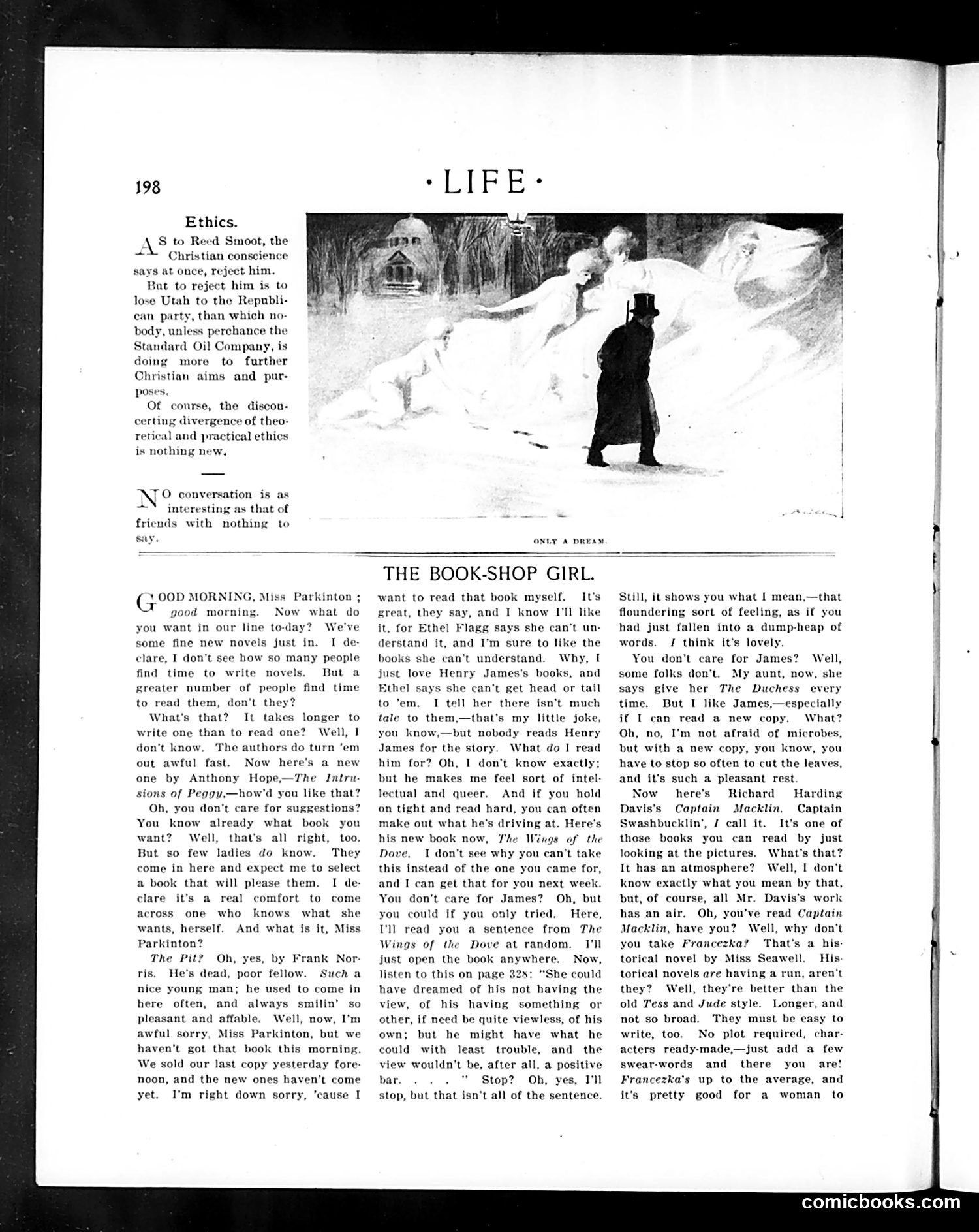
This page from *Life* magazine contains two distinct elements: **"Only a Dream" illustration** (top): Shows a figure in formal attire (top hat and coat) standing in snow, observing what appear to be cherubs or angels in the snowy landscape. The title suggests this is either a satirical commentary on idealistic visions or a commentary on religious/spiritual aspirations versus harsh reality—a common *Life* trope. **"The Book-Shop Girl" (main article)**: A dialogue between a bookshop employee and customer discussing new novels. The text critiques literary taste, referencing Henry James and other authors. It's social satire about reading habits, intellectual pretension, and cultural snobbery—typical *Life* content mocking middle-class affectations and debates over "serious" versus "light" literature. No specific political figures are identifiable; this appears to be general cultural commentary.
📄 Transcribed text from this page (OCR, searchable)
Machine-transcribed from the original scan — historical spelling and the odd misread are preserved.
198 Ethics. A 8 to Reed Smoot, the ~ Christian conscience says at once, reject him. 3ut to reject him is to lose Utah to the Republi- can party, than which no- body, unless perchance the Standard Oil Company, is doing more to further Christian aims and pur- poses. Of course, the discon- certing divergence of theo- retical and practical ethics is nothing new, NO conversation + interesting as that of friends with nothing to say. is as ONLY A DREAM. 1 OOD MORNING, Miss Parkinton ; good morning. Now what do you want in our line to-day? We've some fine new novels just in. I de- clare, I don't see how so many people find time to write novels. But a greater number of people find time to read them, don’t they? What's that? It takes longer to write one than to read one? Well, I don't know. The authors do turn ‘em out awful fast. Now here’s a new one by Anthony Hope,—The Intru- sions of Peggy,—how'd you like that? Oh, you don't care for suggestions? You know already what book you want? Well, that's all right, too. But so few ladies do know. They come in here and expect me to select a book that will please them. I de- clare it’s a real comfort to come ac one who knows what she wants, herself. And what is it, Miss Parkinton? The Pit? Oh, yes, by Frank Nor- ris, He's dead, poor fellow. Such a nice young man; he used to come in here often, and always smilin’ so pleasant and affable. Well, now, I'm awful sorry, M Parkinton, but we haven't got that book this morning. We sold our last copy yesterday fore- noon, and the new ones haven't come yet. I'm right down sorry, ‘cause I THE BOOK-SHOP GIRL. want to read that book myself. It's great, they and I know I'll like it, for Ethel Flagg says she can’t un- derstand it, and I’m sure to like the she can't understand. Why, I just love Henry James's books, and Ethel says she can’t get head or tail to ‘em, I tell her there isn’t much tale to them,—that's my little joke, you know,—but nobody reads Henry James for the story. What do I read him for? Oh, I don't know exactly; but he makes me feel sort of intel- lectual and queer. And if you hold on tight and read hard, you can often make out what he’s driving at. Here's his new book now, The Wings of the Dove. I don’t see why you can’t take this instead of the one you came for, and I can get that for you next week. You don't care for James? Oh, but you could if you only tried, Here, I'll read you a sentence from The Wings of the Dove at random. I'll just open the book anywhere. Now, listen to this on page 3 ‘She could have dreamed of his not having the view, of his having something or other, if need be quite viewless, of his own; but he might have what he could with least trouble, and the view wouldn't be, after all, a positive bar. " Stop? Oh, yes, I'll stop, but that isn’t all of the sentence. books Still, it shows you what | mean,—that floundering sort of feeling, as if you had just fallen into a dump-heap of words. J think it’s lovely. You don't care for James? Well, some folks don't. My aunt, now, she says give her The Duchess ev time. But I like James,—especial if I can read a new copy. What? Oh, no, I'm not afraid of microbes, but with a new copy, you know, you have to stop so often to cut the leave and it’s such a pleasant rest Now here's Richard Davis’s Captain Macklin. Captain Swashbucklin’, / call it. It’s one of those books you can read by just looking at the pictures. What's that? It has an atmosphere? Well, I don't know exactly what you mean by that, but, of course, all Mr. Dav’ work has an air. Oh, you've read Captain Macklin, have you? Well, why don’t you take Francezka? That's a his- torical novel by Miss Seawell. His. torical novels are having a run, aren't they? Well, they're better than the old Tess and Jude style. Longer, and not so broad. They must be easy to write, too. No plot required, char- acters ready-made,—just add a few swear-words and there you are! Francezka’s up to the average, and it's pretty good for a woman to Harding comicbooks.com