
A complete issue · 20 pages · 1903
Life — January 1, 1903
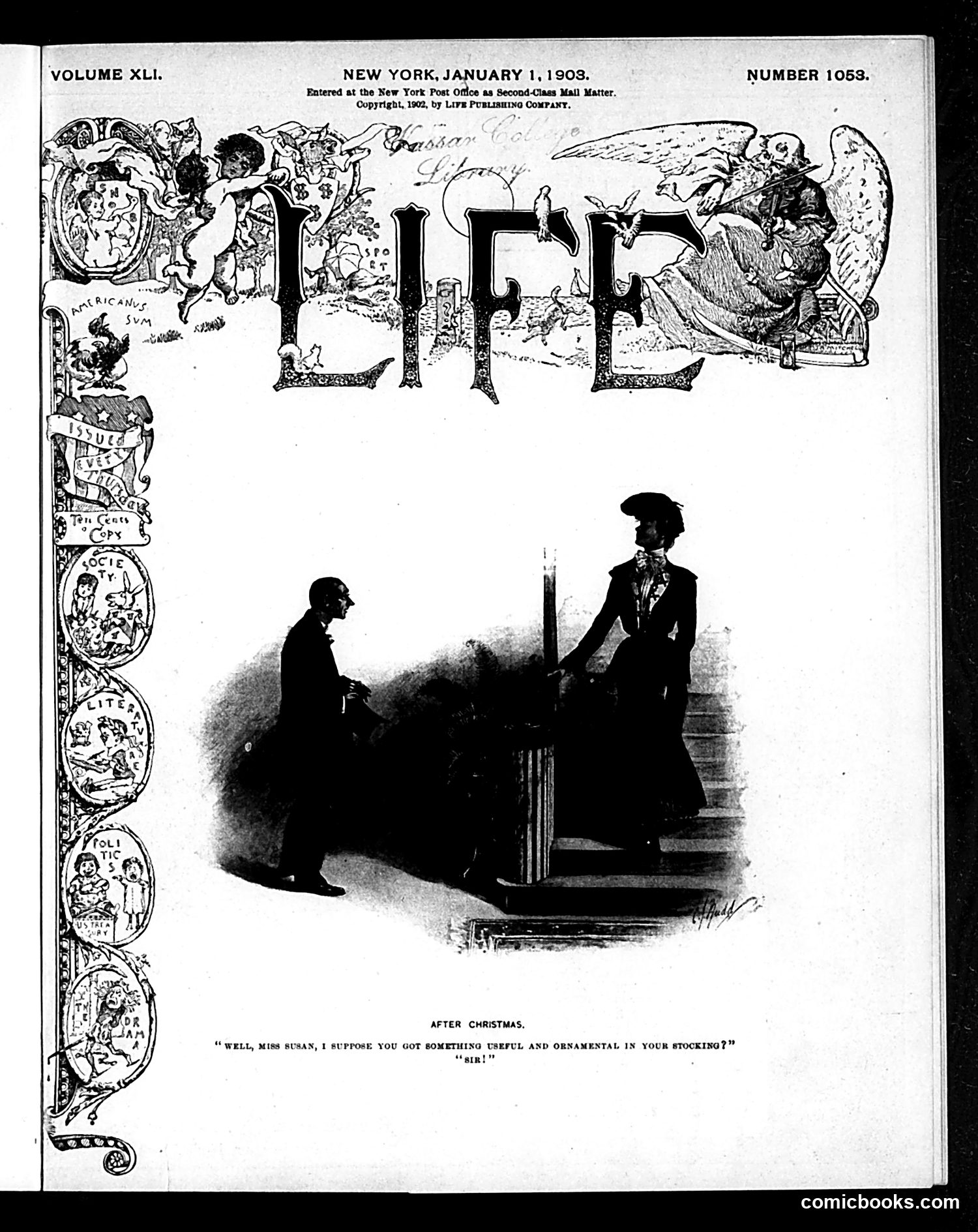
The main cartoon depicts a post-Christmas scene between two silhouetted figures—apparently a gentleman and "Miss Susan" (likely a servant or social inferior). The man's dialogue asks if she received "something useful and ornamental in your stocking," followed by "Sir!" The joke hinges on class-based social expectations: the gentleman appears to be inquiring about Christmas gifts to a female employee or servant in a condescending manner. The "Sir!" response suggests Miss Susan's indignation at either the familiar tone or implication of the question—likely implying impropriety or false assumptions about her relationship to her employer. The satirical point appears to target employer assumptions about servant relationships and post-holiday social awkwardness across class lines.
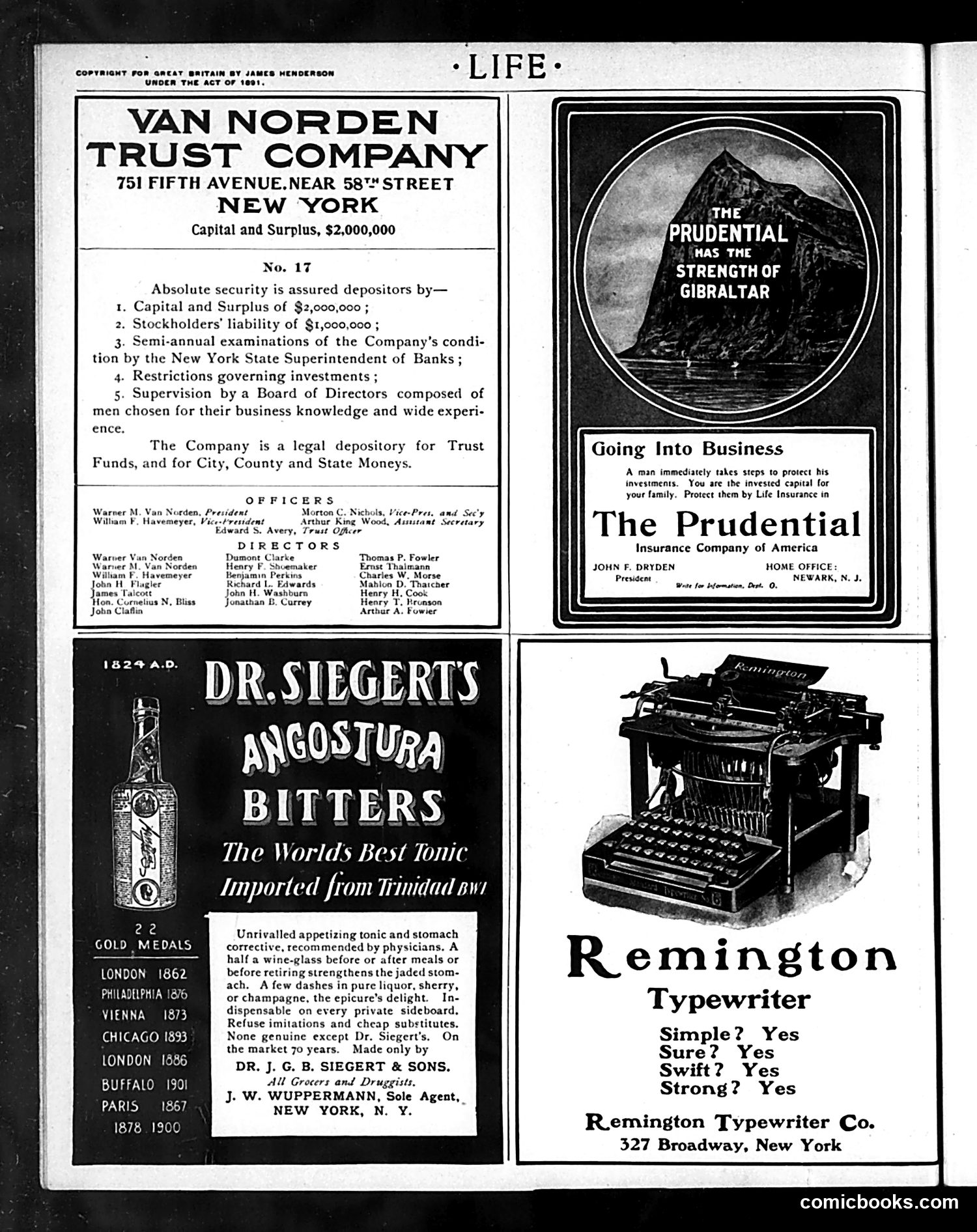
This page is **primarily advertising**, not satirical content. It contains four advertisements: 1. **Van Norden Trust Company** (top left): A financial institution ad emphasizing depositor security through capital reserves and regulatory oversight. 2. **The Prudential Insurance Company** (top right): Features the Rock of Gibraltar metaphor, a famous Prudential symbol representing strength and stability in insurance protection. 3. **Dr. Siegert's Angostura Bitters** (bottom left): A patent medicine/tonic advertised as "the world's best" imported from Trinidad, claiming therapeutic benefits. 4. **Remington Typewriter** (bottom right): Product advertisement emphasizing reliability with simple, positive descriptors. These ads reflect early 20th-century consumer marketing targeting middle-class readers with financial security, health, and business products.
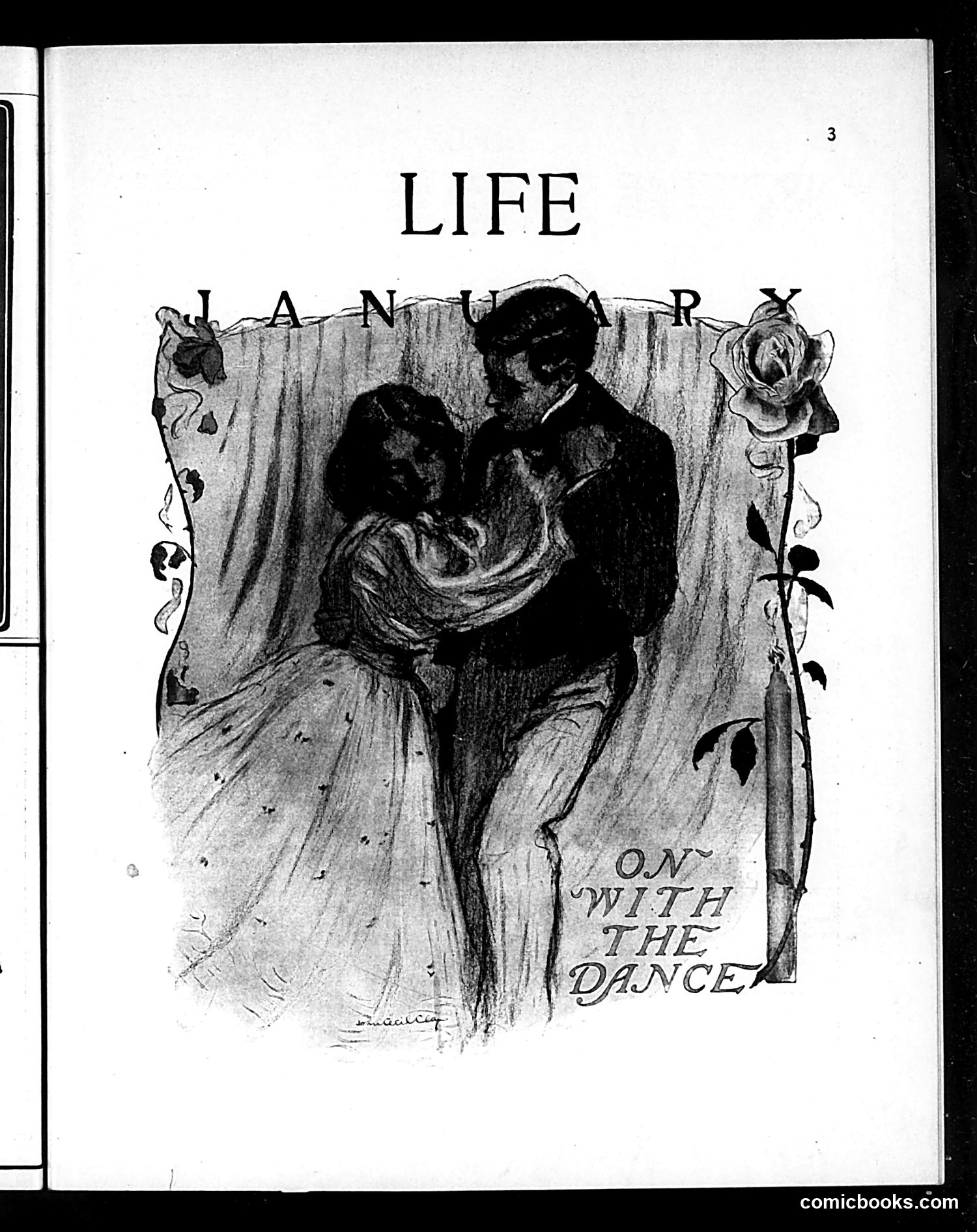
This appears to be a title page or cover illustration from *Life* magazine featuring the heading "LIFE" and decorative text reading "ON WITH THE DANCE." The image shows a couple in an intimate embrace, depicted in a sketchy, romantic illustration style. The woman wears a flowing dress and the man is in formal attire. Decorative floral elements (roses and vines) frame the scene. Without additional context or visible text identifying specific figures, this appears to be a general romantic illustration rather than political satire. The phrase "ON WITH THE DANCE" suggests themes of social life, leisure, or entertainment during what appears to be the early 20th century. The artwork style is typical of *Life*'s aesthetic during this period.
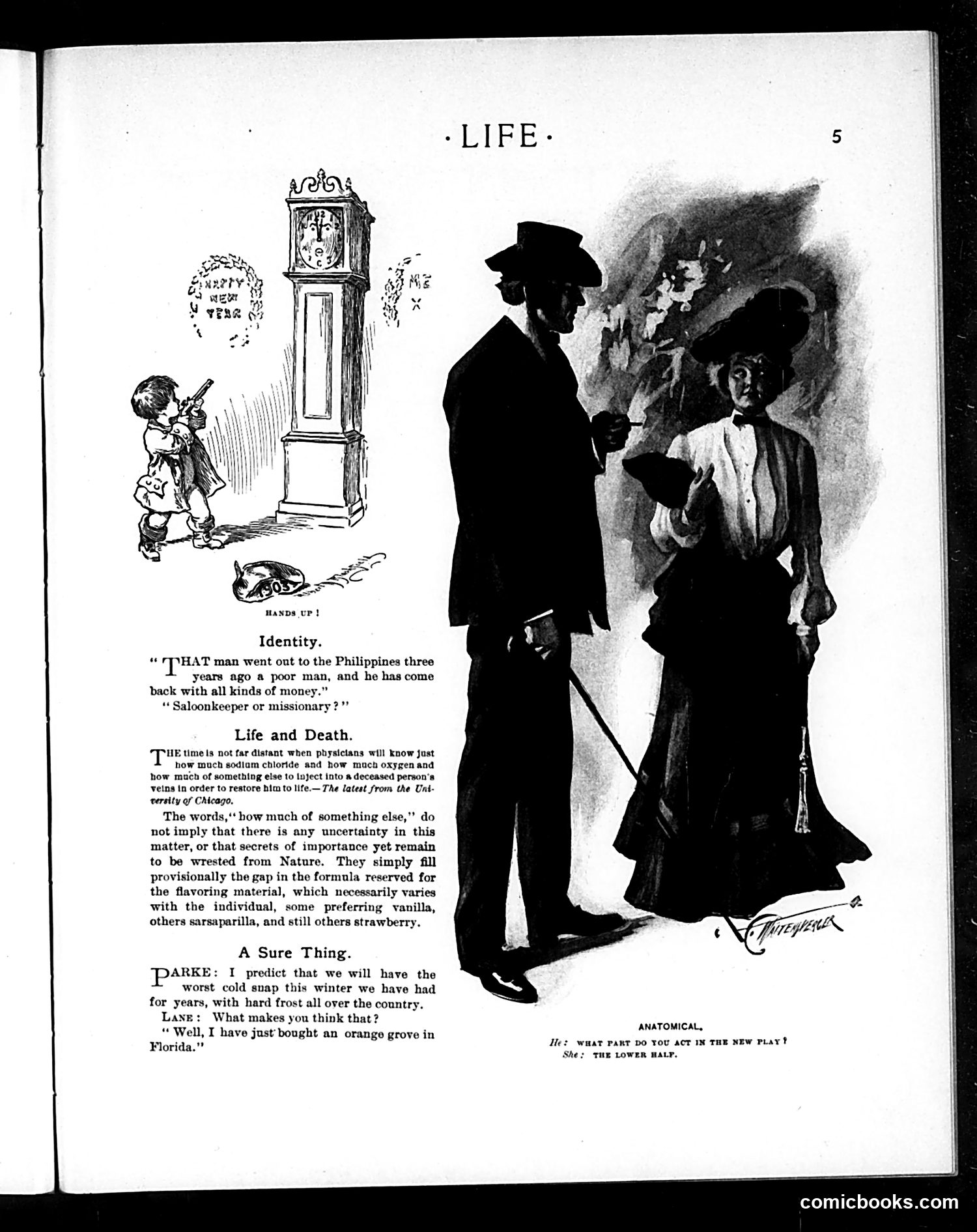
This page contains three separate satirical pieces: 1. **"Identity"**: A sketch mocking a man returned wealthy from the Philippines after three years, asking whether he's a "saloonkeeper or missionary?"—suggesting ambiguity about how colonial fortunes were made. 2. **"Life and Death"**: A scientific commentary on resuscitation techniques, discussing sodium chloride and oxygen injection, with a quote attributed to the "University of Chicago." 3. **"A Sure Thing"**: A dialogue where character "Darke" predicts a harsh winter, and "Lane" counters by having purchased a Florida orange grove—a topical joke about real estate speculation and optimistic financial decisions. 4. **"Anatomical"**: A theatrical reference (lower right) about an actor's role in "the new play." The page satirizes American optimism, colonial ventures, and get-rich-quick schemes typical of early 20th-century Life magazine humor.
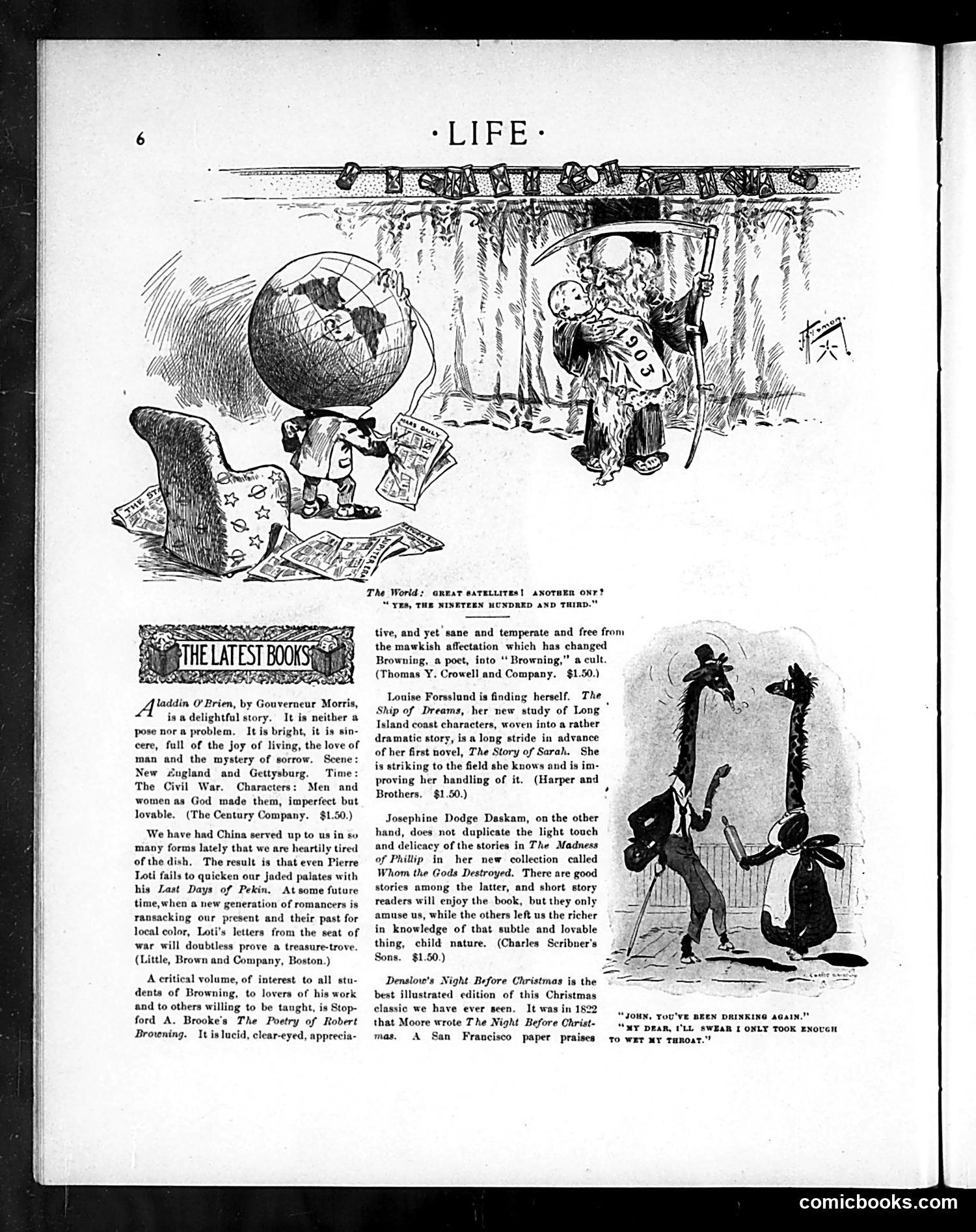
The top cartoon depicts a political allegory about global conflict. A skeletal figure labeled "Death" holds a large globe while a small child representing a nation examines scattered papers. The caption reads: "The World: Great Satellites! Another One? 'Yes, the Nineteen Hundred and Third.'" This appears to satirize early 1900s imperial competition—the "satellites" likely reference competing colonial powers acquiring territories. Death presides over this expansion, suggesting the satirist's dark view that such acquisitions inevitably lead to conflict and suffering. The bottom illustration shows a figure in a doorway with the caption "John, you've been drinking again—My dear, I'll swear I only took enough to wet my throat." This is domestic humor, unrelated to the political cartoon above.
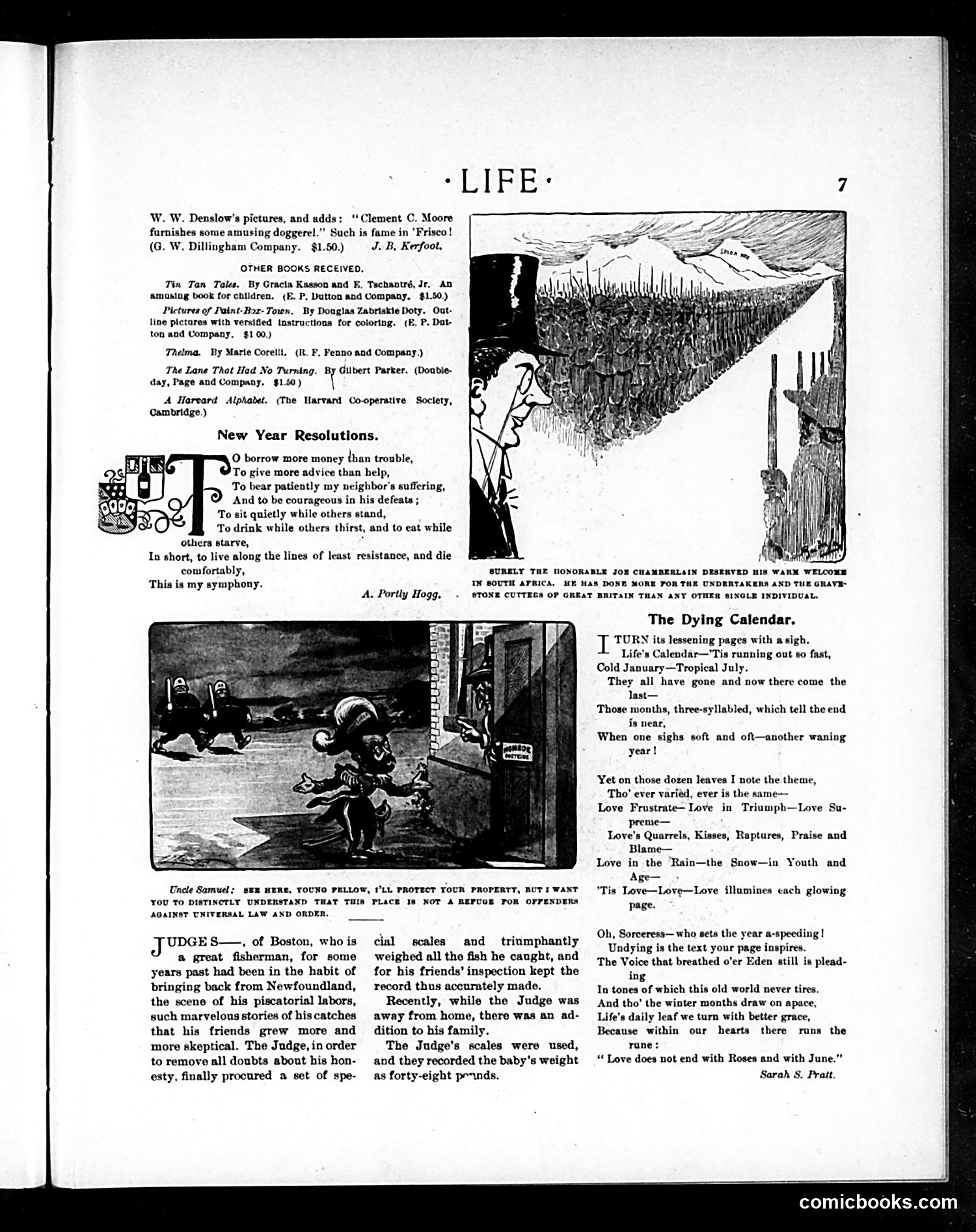
This page from *Life* magazine contains literary reviews, poetry, and satirical commentary rather than political cartoons. **"New Year Resolutions"** by A. Portly Hogg presents mock resolutions about borrowing money, giving alms, bearing neighbors' suffering, and living "along the lines of least resistance"—satirizing how people make insincere New Year's promises they won't keep. **"Uncle Samuel" illustration** depicts a law-enforcement scene with the caption warning that the location is "not a refuge for offenders against universal law and order"—likely commentary on immigration or criminal justice. **"The Dying Calendar"** is a melancholic poem about the year's end, reflecting on time's passage and life's recurring themes of "Love Frustrated—Love in Triumph." The page emphasizes literary and social satire rather than political cartooning, typical of *Life*'s early editorial approach.
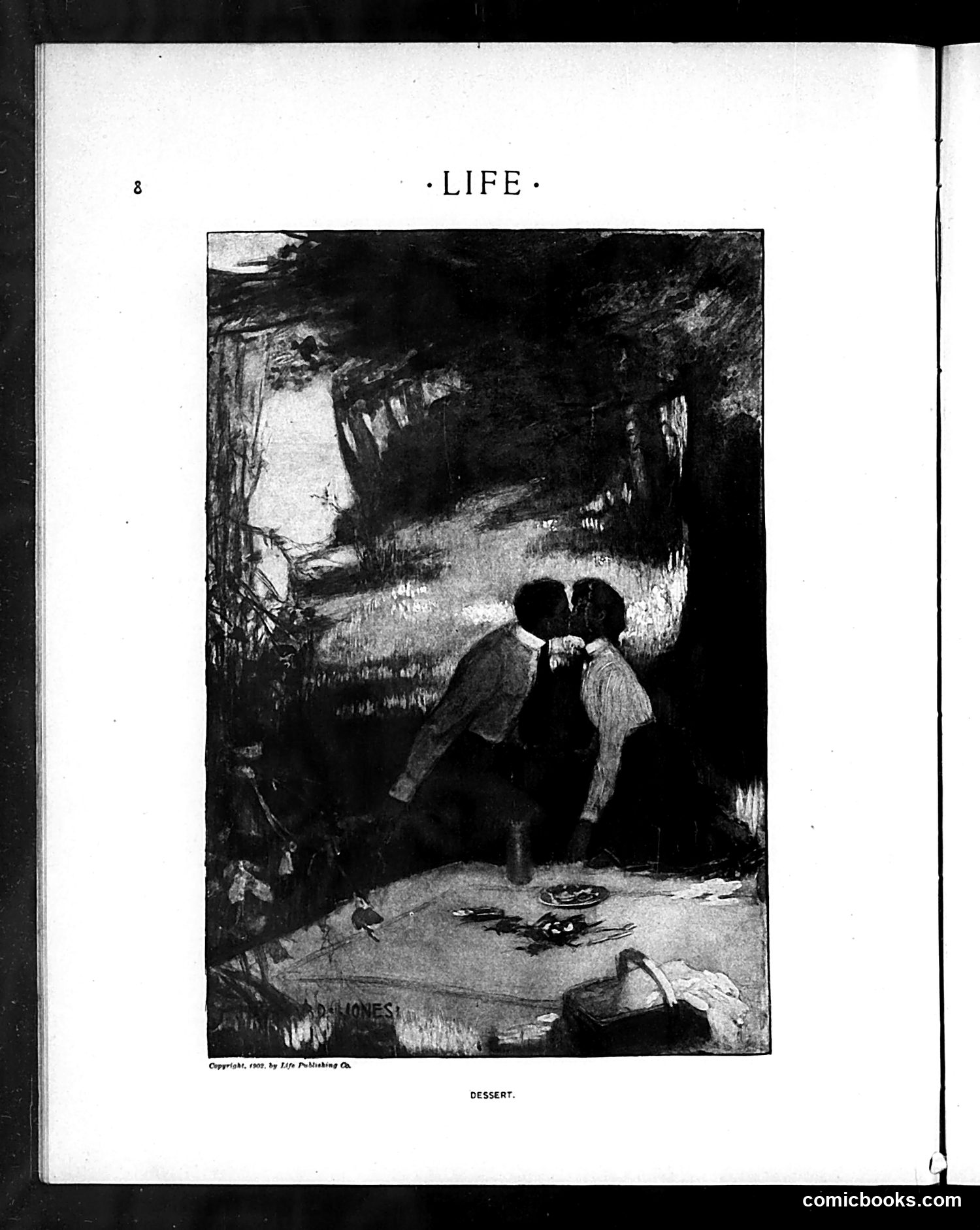
This cartoon depicts two figures in what appears to be a cave or primitive shelter, seated before a meal. Based on the title "Dessert" and the artistic style, this appears to be a satirical commentary on primitive or "caveman" life. The joke likely plays on the contrast between civilized dining customs and prehistoric existence—the figures are about to eat "dessert" in a cave setting, suggesting an ironic juxtaposition of refinement with brutality or primitiveness. Without additional context from the magazine's date or surrounding articles, the specific social or political target remains unclear. However, the cartoon's tone suggests satirical commentary on either human nature, civilization, or possibly contemporary social behavior portrayed through the lens of prehistoric caricature.
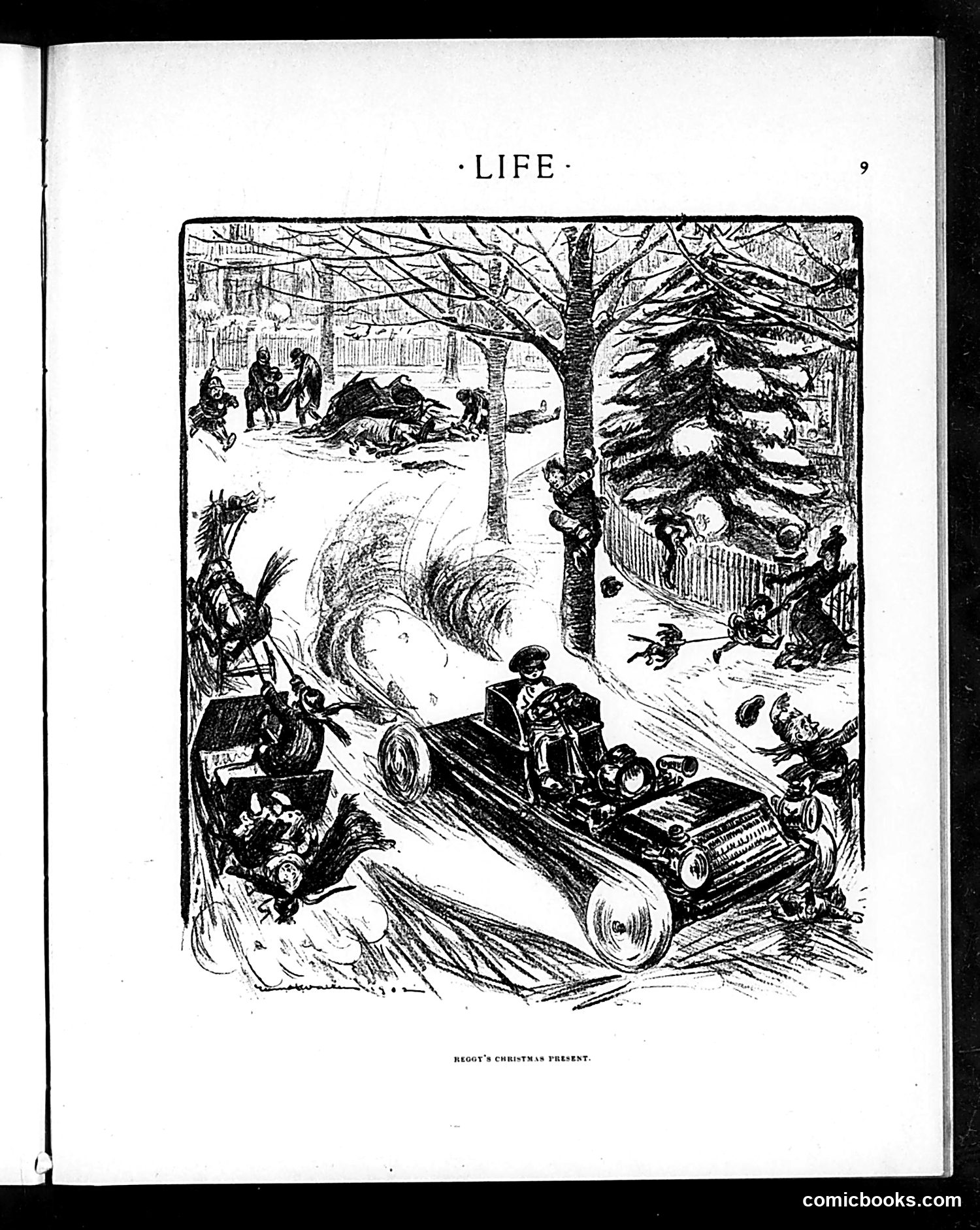
This cartoon depicts a winter scene where children are sledding down a snowy hill. The illustration shows multiple sleds in motion, with figures enjoying winter recreation. In the background, other children and adults are visible in a snowy park or public space with bare trees. The title "Boggy's Christmas Present" suggests this is a holiday-themed illustration, likely humorous commentary on what constitutes an ideal Christmas gift for a child during the period when *Life* magazine was published. The detailed rendering of the sledding scene and the various figures enjoying winter sports reflects satirical observations about holiday traditions and childhood pleasures of the era. Without additional context about "Boggy," the specific satirical point remains unclear from the image alone.
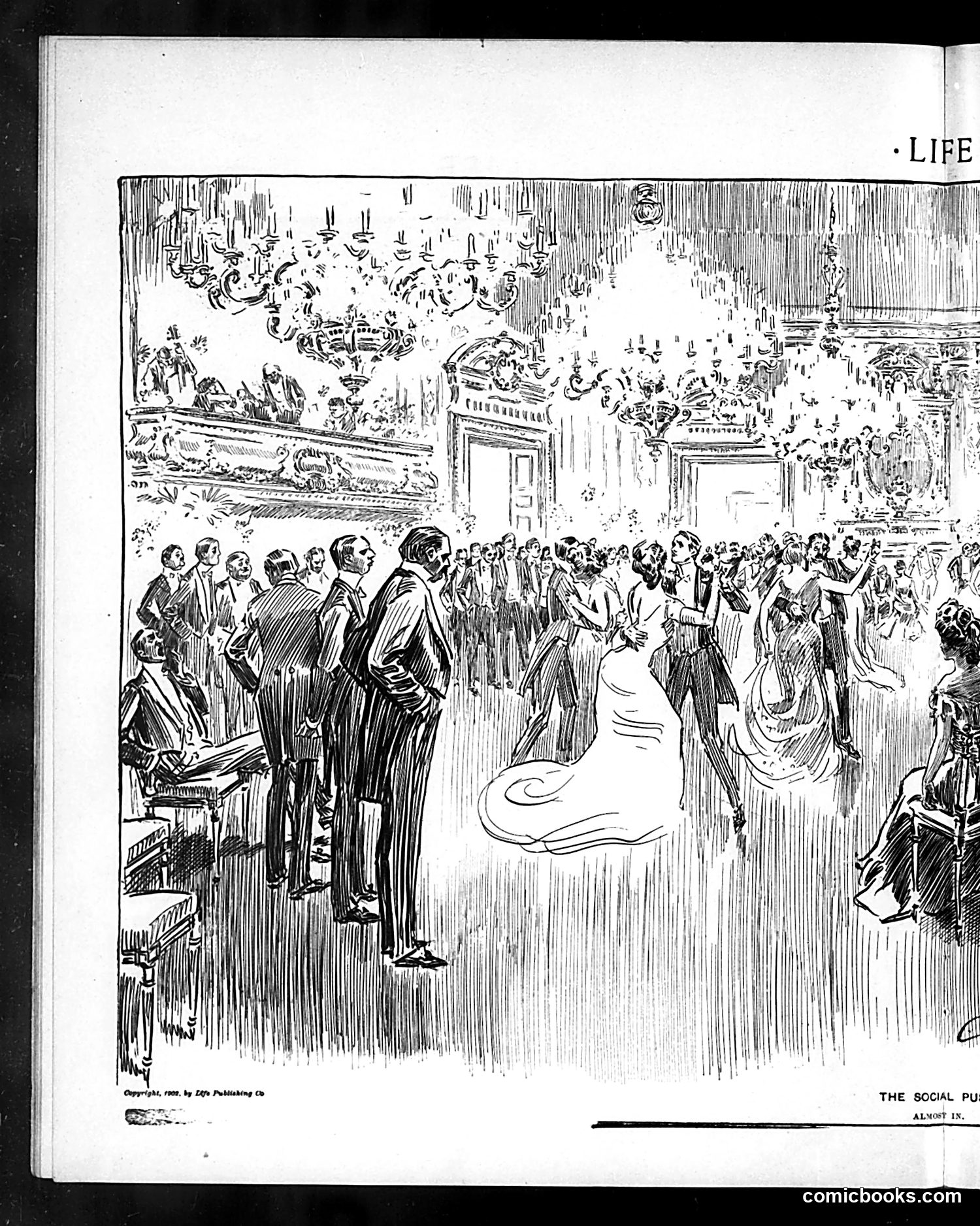
This is a satirical illustration of a formal high-society ball or reception in an ornate, chandelier-filled ballroom. The central figures are several men in formal dress (dark suits) who appear to be the focus of attention, while numerous well-dressed guests mingle around them. The caption reads "THE SOCIAL PU[SHERS]" (text cut off), suggesting satire about social climbing or people seeking status through elite social gatherings. The sketch mocks the pretension of formal society events—the elaborate decorations and crowds of attendees emphasizing the superficiality of upper-class social rituals. The style and composition satirize how certain individuals attempt to gain prominence or influence through fashionable gatherings, a common target of *Life* magazine's social commentary during the Gilded Age era.
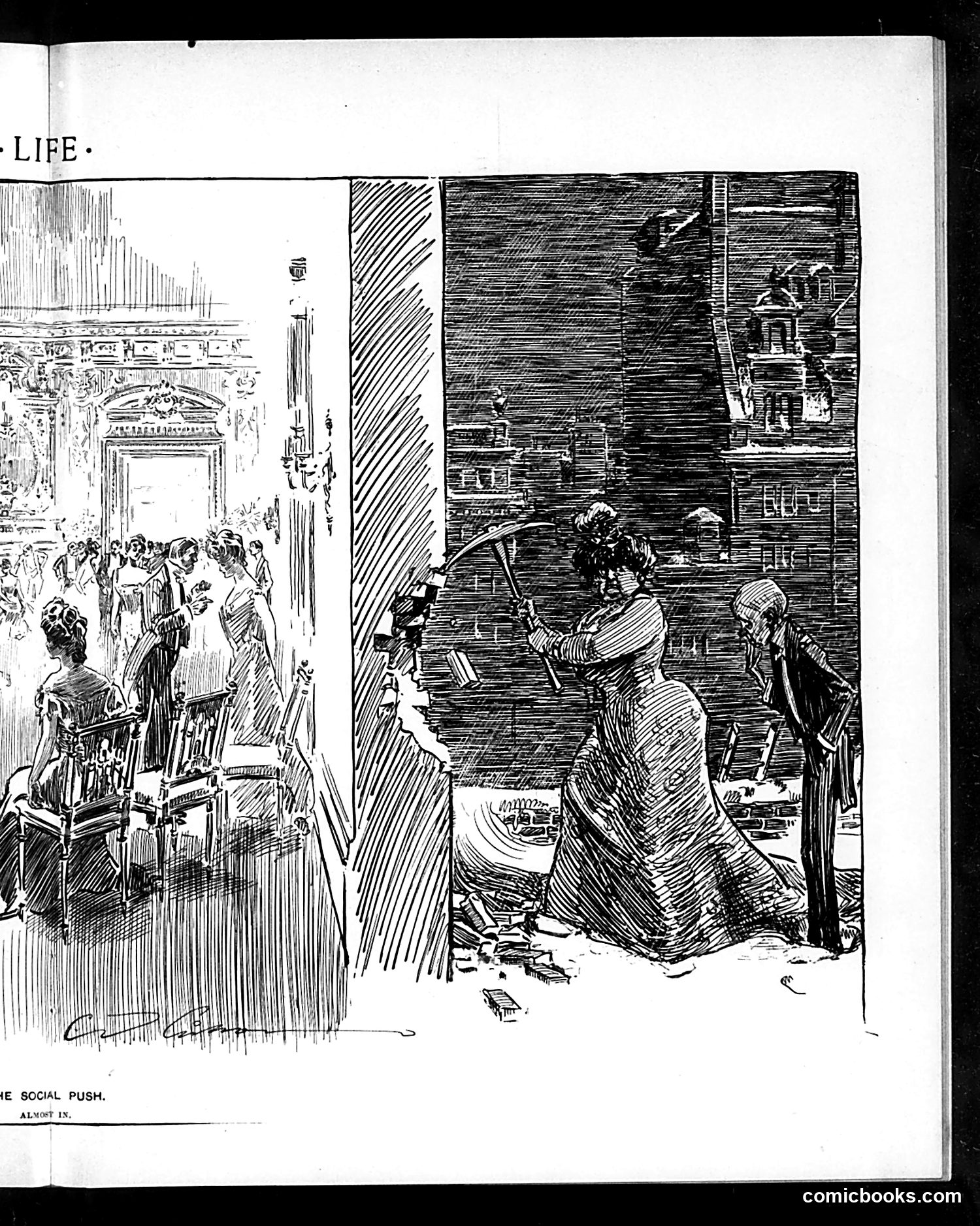
This page contains two separate satirical illustrations addressing **social class and labor conditions**. The **left panel** ("The Social Push") shows well-dressed society women at an ornate interior, depicting upper-class social gatherings. The **right panel** presents a stark contrast: working-class women (appearing to be laborers or domestic workers) engaged in manual labor—one swings an axe or tool while others work amid a deteriorating brick building. The squalid conditions are rendered in heavy, dark crosshatching. The implicit social satire compares the frivolous concerns of wealthy socialites ("the social push") against the genuine hardship of working-class women. This reflects **turn-of-the-century Progressive Era critiques** of inequality and poor labor conditions. The stark visual contrast underscores the magazine's satirical commentary on class disparity in America.
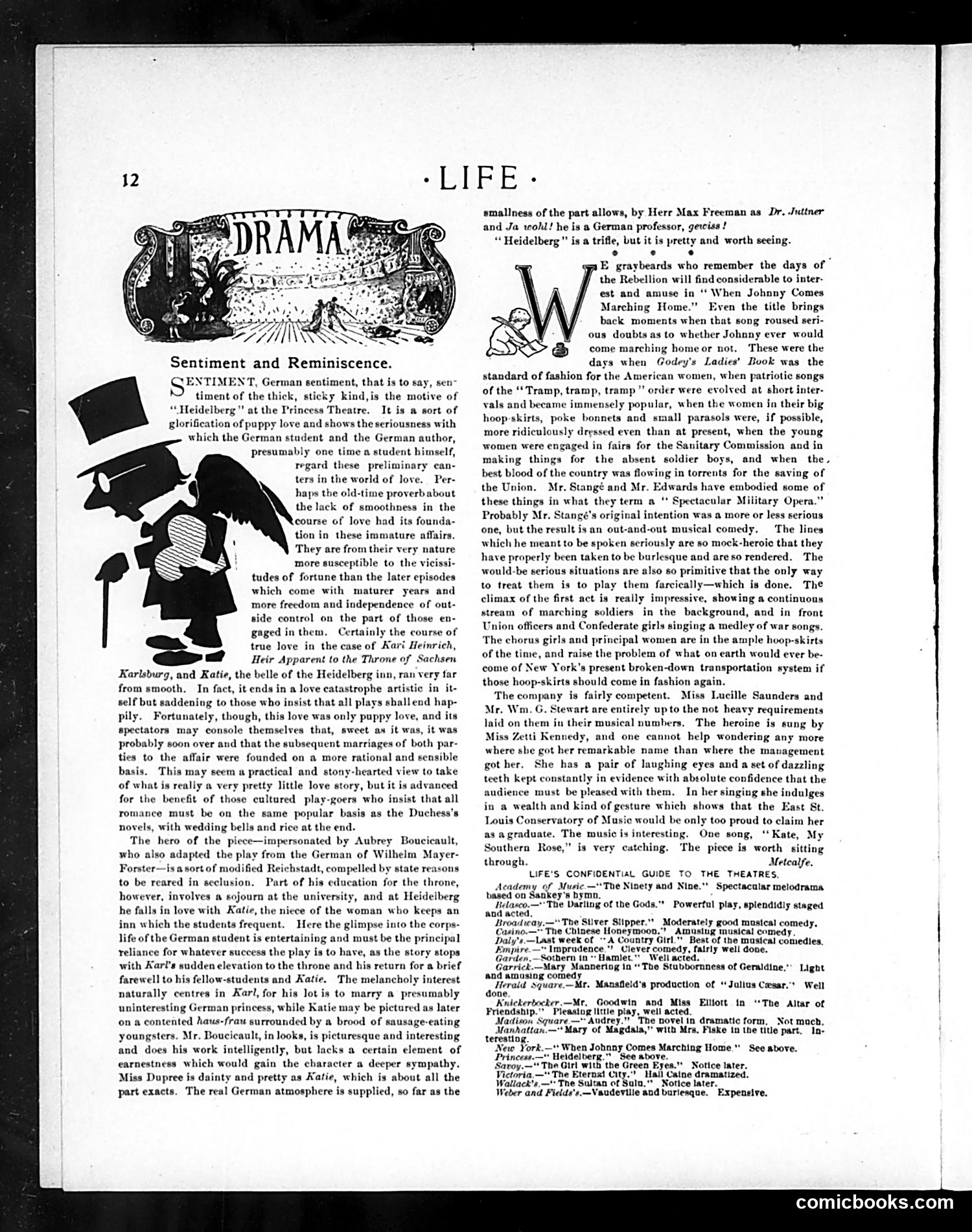
This page features a drama review section titled "Sentiment and Reminiscence." The main illustration shows a silhouetted figure in period costume, likely depicting a character from the theatrical production being discussed. The text reviews a German play called "Heidelberg," praising its romantic sentimentality about student life and love affairs. The reviewer notes the work captures authentic German atmosphere despite some theatrical conventions. The article discusses several theatrical productions and performers, including Miss Lucile Saunders and Miss Zetti Kennedy. It critiques the staging of Civil War scenes with marching soldiers and women singing period songs. The page concludes with "Life's Confidential Guide to the Theatres," listing current Broadway productions with brief critical assessments of their quality and notable performers. This appears to be standard theatrical criticism from the early 20th century American magazine.
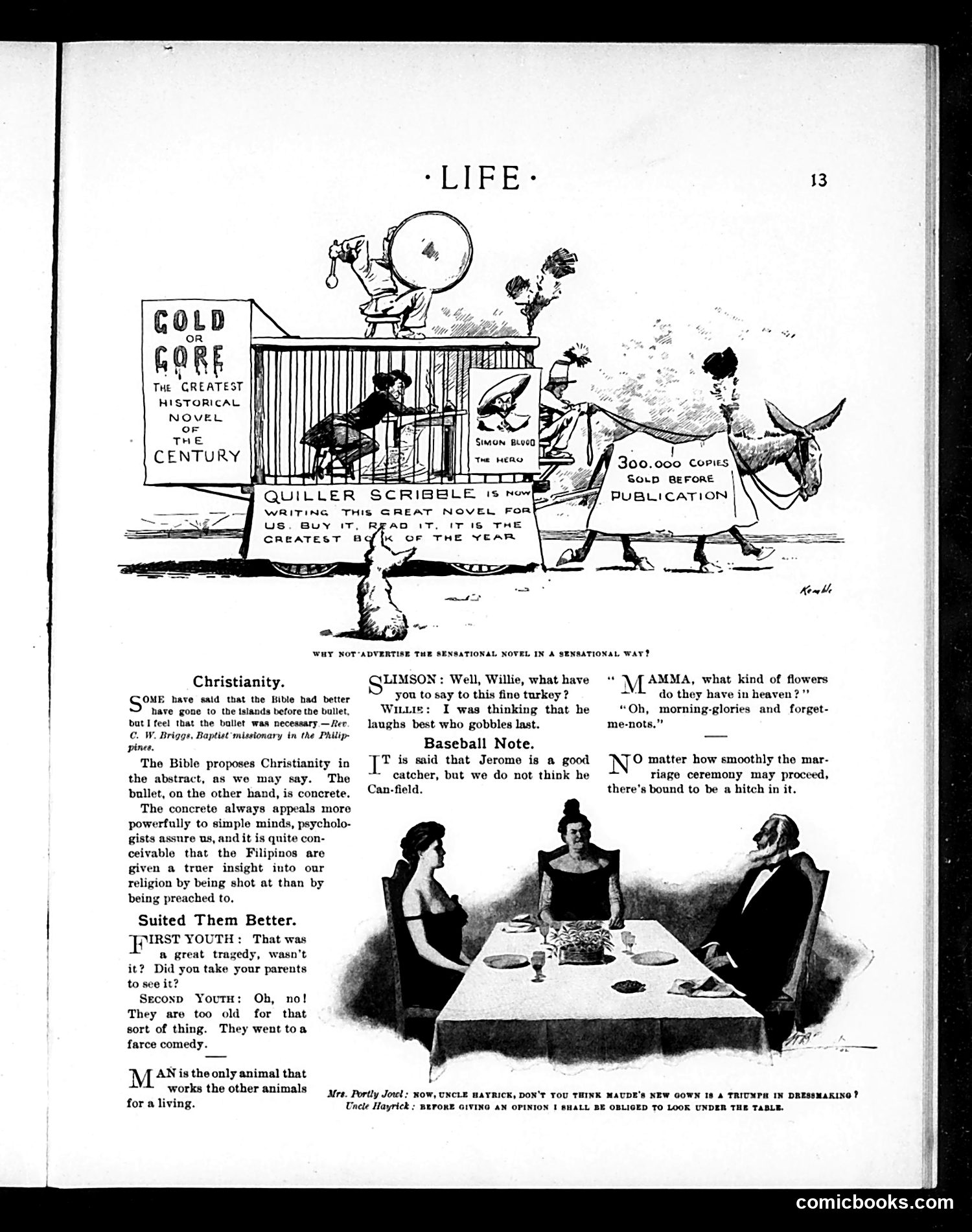
**Top Cartoon:** Mocks sensational book marketing. A circus wagon advertises "Gold or Gore," a supposedly bestselling novel, with exaggerated promotional claims (300,000 copies sold before publication). The satire critiques publishers' over-the-top advertising tactics and readers' appetite for melodramatic fiction—questioning whether such hype-driven promotion is appropriate or honest. **"Christianity" Section:** Commentary on missionary work in the Philippines. The text sardonically suggests that "bullets" (military force) communicate Christianity more effectively to Filipinos than preaching does—dark social satire about American imperialism and the inconsistency between Christian values and violent colonial expansion. **Other Humor Sections:** Include light jokes about baseball, marriage ceremonies, and social propriety (the final cartoon suggests a rustic character won't judge a dress without checking propriety "under the table"—likely a crude reference to women's undergarments). The page represents early 20th-century American satirical humor mixing social commentary with genteel comedy.
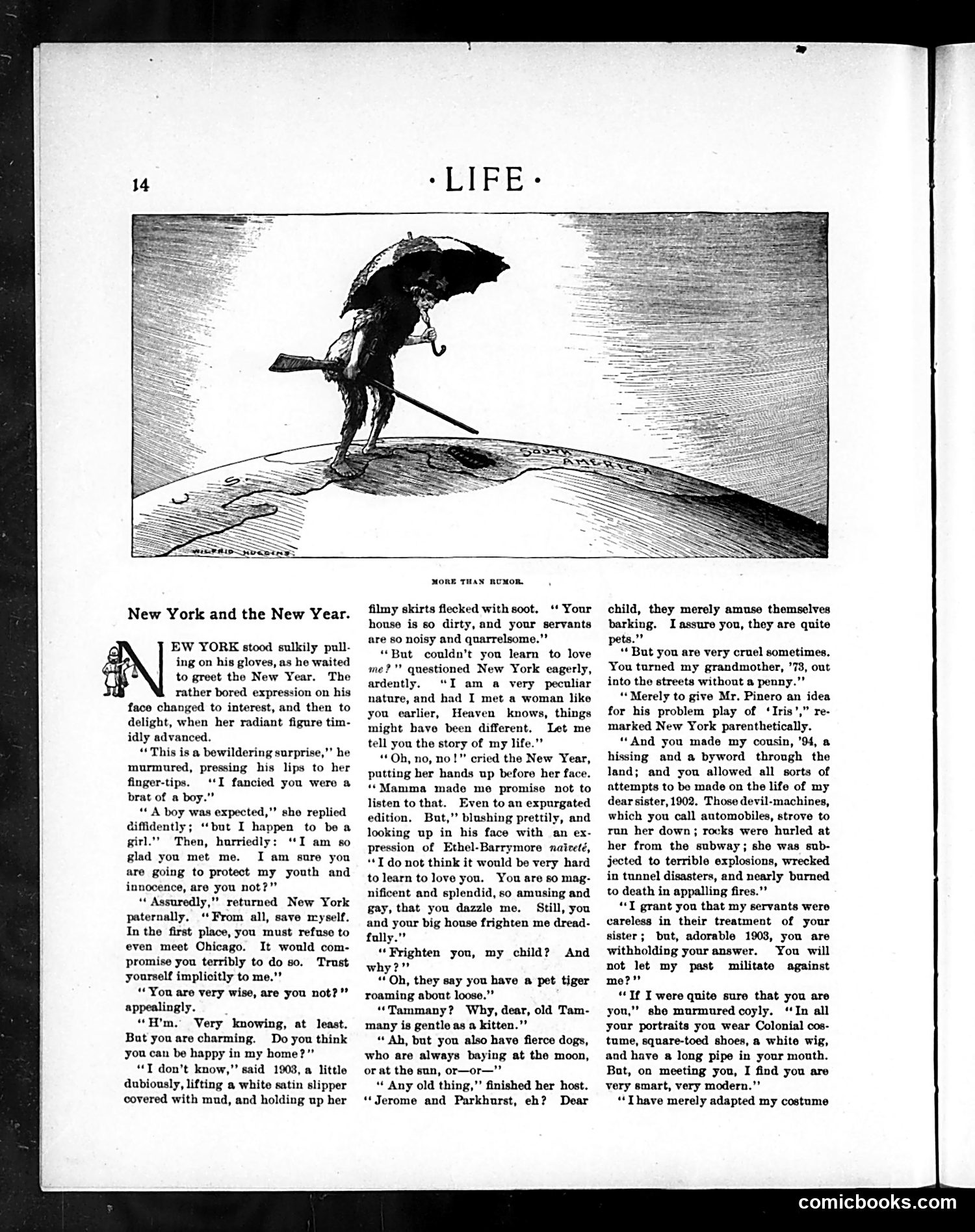
This is a satirical dialogue between personified New York City and the year 1903, depicted as a young woman meeting for the first time. The cartoon mocks New York's corruption and moral failings through romantic banter. **Key References:** - **Tammany**: The notoriously corrupt Democratic political machine controlling NYC - **Jerome and Parkhurst**: Reform figures (likely District Attorney William Travers Jerome and clergyman Charles Parkhurst) attempting to clean up the city - **'73, '94, 1902**: Previous years personified as victims of NYC's exploitation - **Automobiles, explosions, tunnel disasters**: Recent urban tragedies and hazards plaguing the city - **Colonial costume**: NYC's historical identity versus its modern, "smart" appearance **The Satire:** New York seduces 1903 with charm while glossing over his notorious corruption, dangerous infrastructure, and violent history. The "pet tiger" Tammany and "fierce dogs" (reformers) represent forces New York claims to control but clearly doesn't. The joke: New York is morally bankrupt but still attractive to the incoming year.
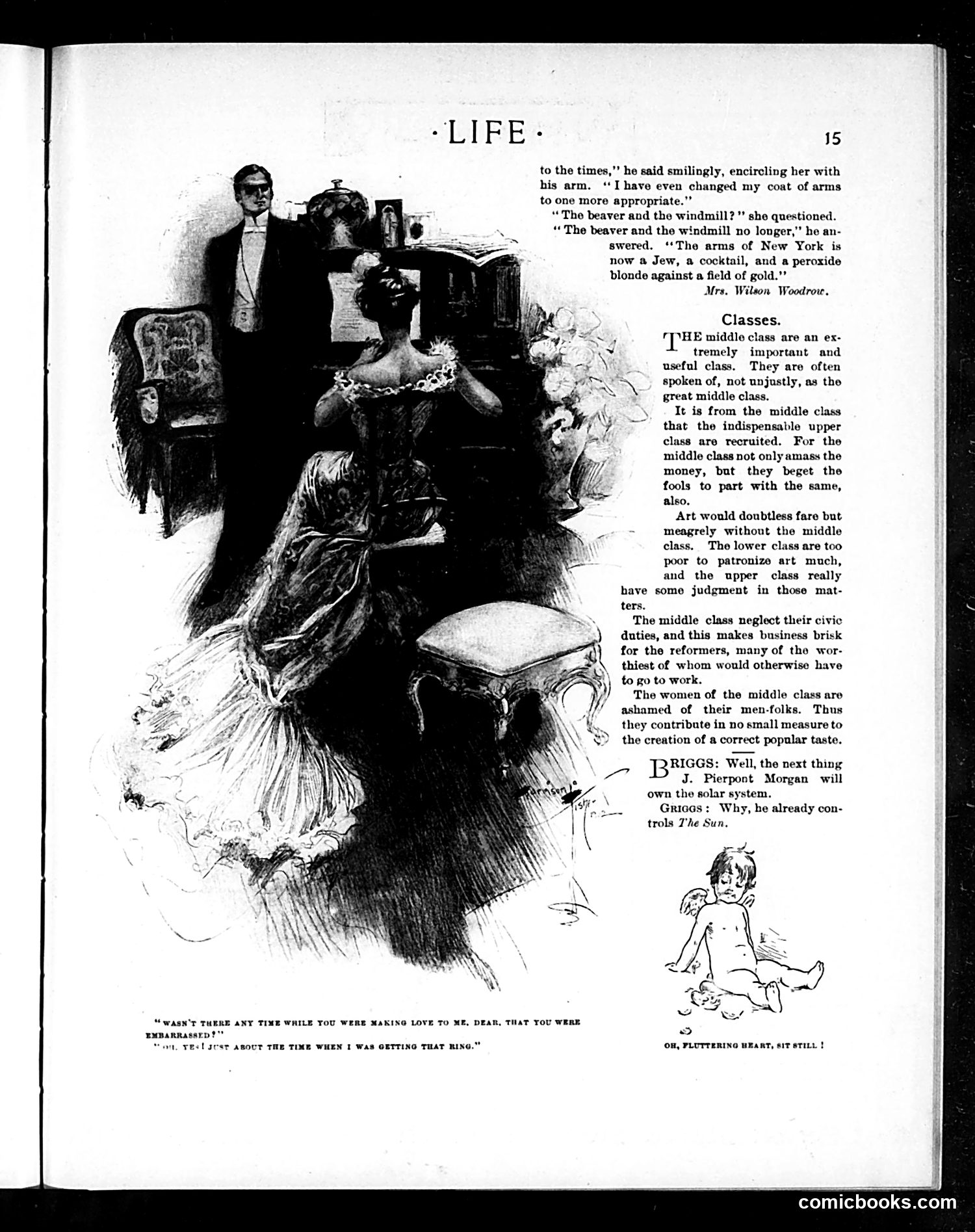
The main cartoon depicts a wealthy couple in an intimate domestic scene. The accompanying dialogue mocks New York's transformed identity: its traditional symbols (the beaver and windmill, referencing colonial Dutch heritage) have been replaced by "a Jew, a cocktail, and a peroxide blonde against a field of gold"—satirizing the city's perceived shift toward Jewish immigration, Prohibition-era drinking culture, and commercialized beauty standards. The "Classes" essay below uses mock-serious sociology to skewer the middle class: they accumulate wealth only to produce foolish heirs who squander it, neglect civic duties (creating work for reformers), and their women are ashamed of their men—yet this shame supposedly elevates public taste. It's caustic social commentary. The final joke about J. Pierpont Morgan owning "the solar system" because he already "controls The Sun" is a pun on the newspaper, mocking the wealthy industrialist's perceived monopolistic power.
This page is primarily **text and advertising** rather than a political cartoon. It contains several humorous anecdotes and jokes typical of Life's satirical format: The main content includes: 1. **Cardiff railway rules** (in verse) — satire on excessive municipal regulation of a new electric railway, mocking overly restrictive by-laws through absurdist humor. 2. **A taciturn Senator anecdote** — jokes about a South Dakota politician's famously brief responses to journalists. 3. **Literary style commentary** — a humorous story about a child's suggestive language regarding candy. 4. **Social observations** — anecdotes about a tailor at a fancy party and General "Phil" Sheridan's story about an Irishman and a mule. The page reflects early 20th-century American humor: gentle social satire, wordplay, and observations about class, politics, and human nature. The **advertisements** (Wilson Whiskey, Esterbrook pens, Chester Crest resort) are period-appropriate. No specific political figures are caricatured; the humor is broadly observational rather than topical.
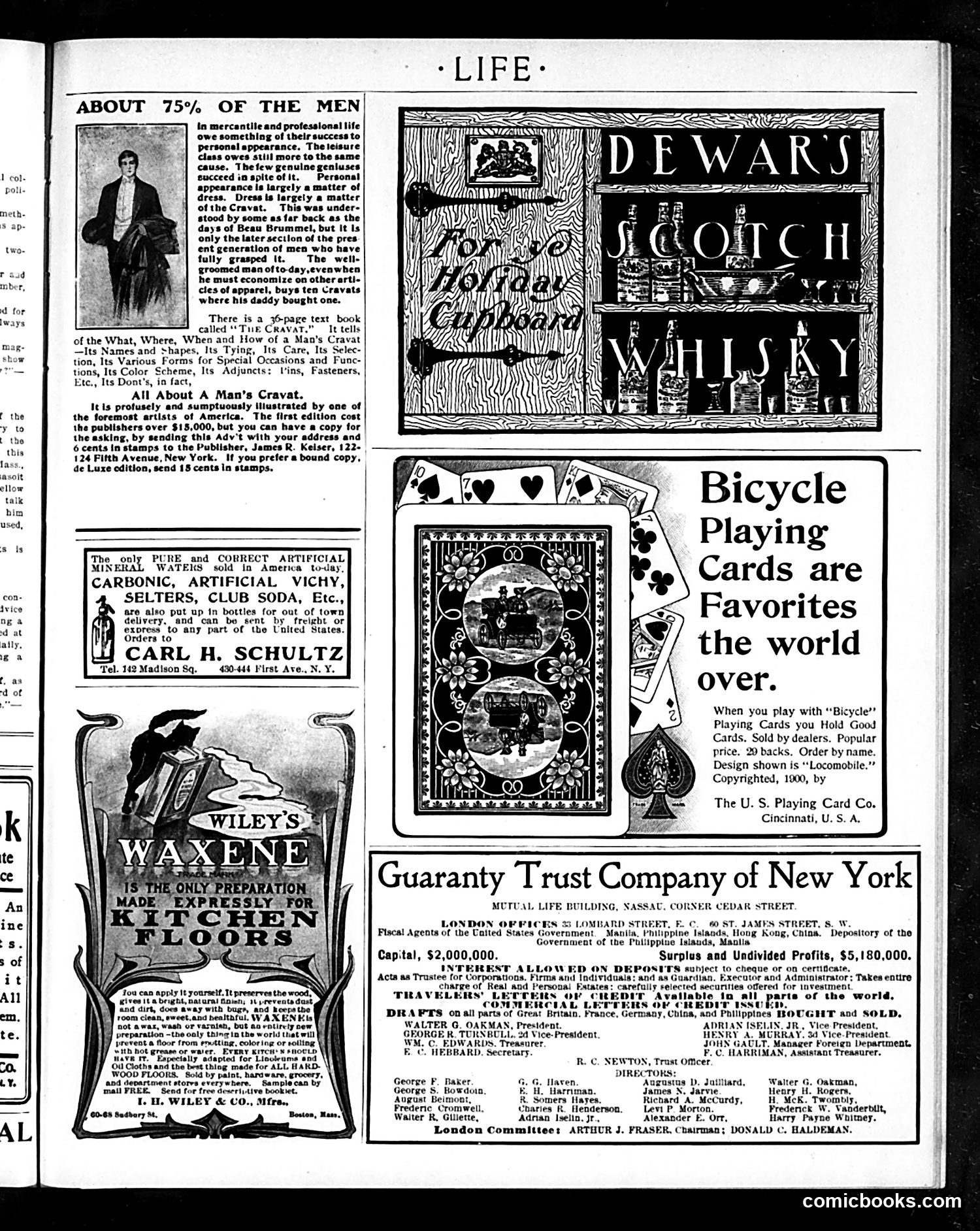
This page is primarily **commercial advertising** disguised as editorial content. The main article promotes "The Cravat"—a 16-page instructional book about men's neckties—by claiming that proper dress (especially cravat selection) determines professional success. The article argues that 75% of successful businessmen and leisure-class men attribute their achievements to personal appearance, making the cravat essential. It claims modern men now buy ten cravats where their fathers bought one, presenting this as evidence of evolving male grooming standards. This reflects early 1900s anxieties about masculine self-presentation and consumer masculinity. The accompanying advertisements for playing cards, floor wax, mineral water, and financial services fill the remainder—typical **turn-of-the-century mass-market magazine content** where advertising and promotional articles blurred together. No satirical intent is apparent.
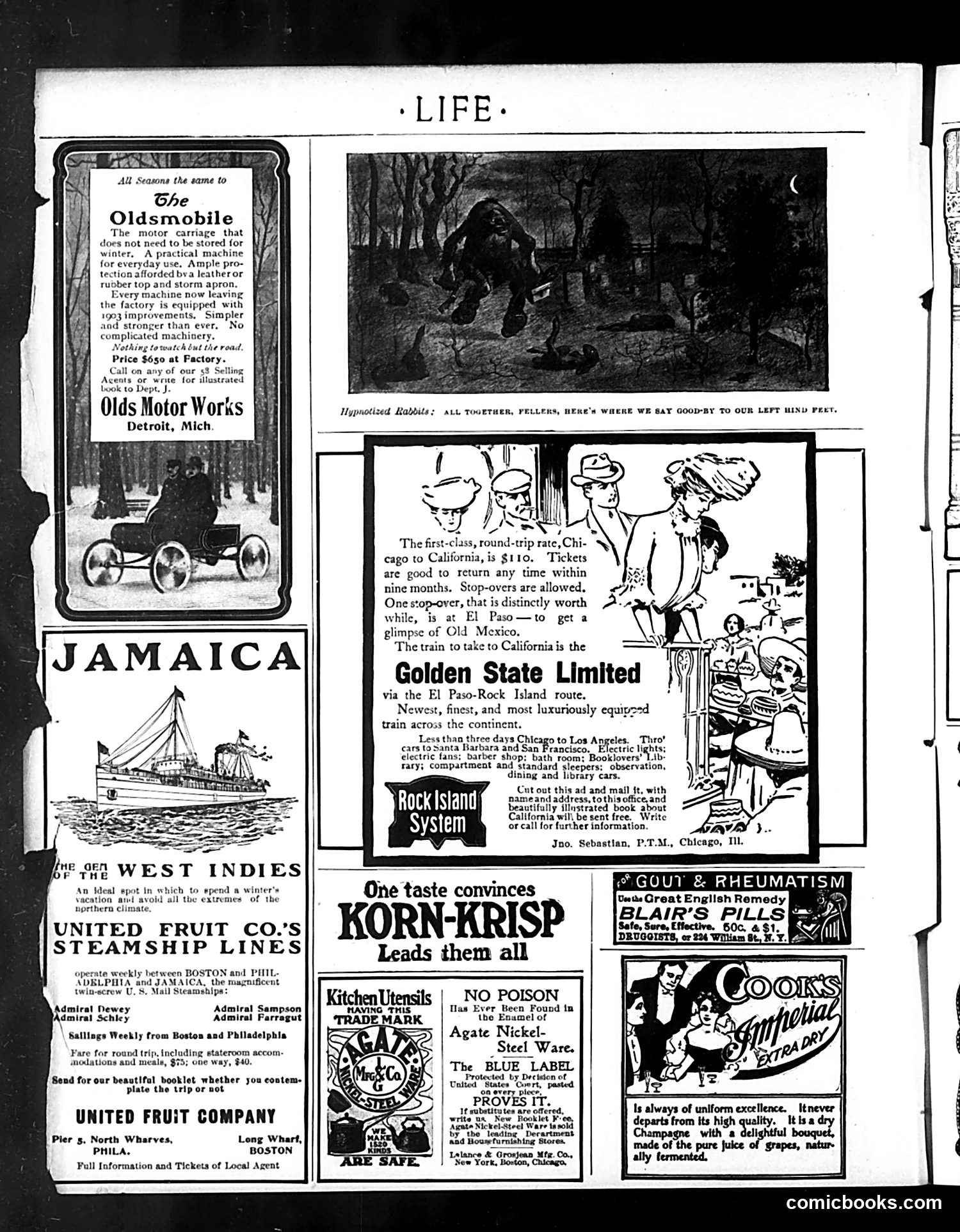
This is primarily an **advertising page**, not a satirical cartoon page. The content consists of early 1900s product and travel advertisements with minimal humor. The main visual element is a photograph labeled "Hypnotised Hobos" showing men saying goodbye, likely illustrating a travel or departure narrative—though the specific context is unclear from the visible text. The advertisements promote: - **Oldsmobile** automobiles (marketed as year-round vehicles, $650) - **Golden State Limited** train service to California via Rock Island route - **United Fruit Company** steamship vacations to Jamaica and the West Indies - Various household products: **Korn-Krisp** cereal, kitchen utensils, and **Cook's Imperial** extract The page reflects turn-of-the-century consumer culture and emerging automobile/travel industries. There is no discernible political satire or social commentary—it's straightforward commercial content typical of Life magazine's revenue model of that era.
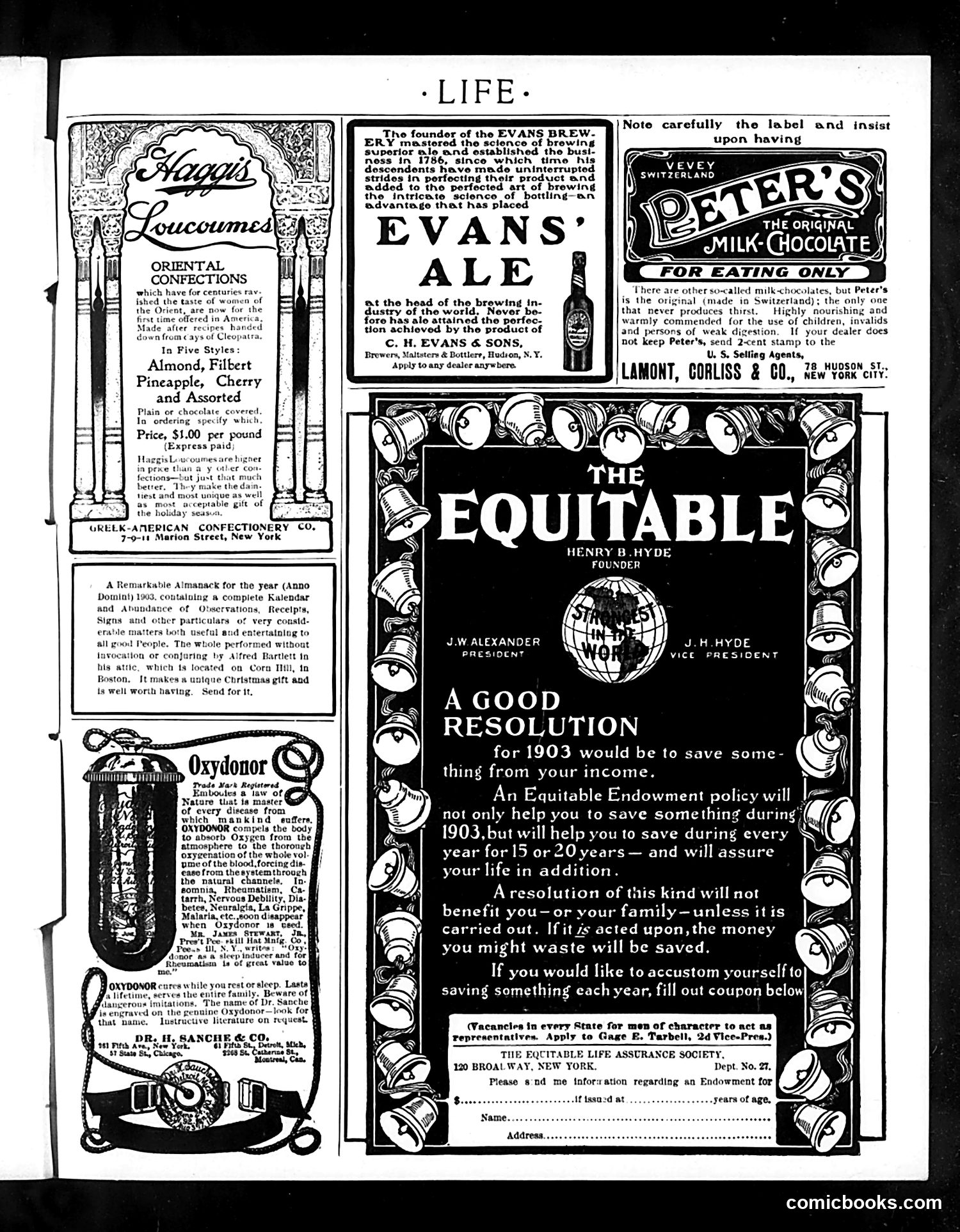
This page is primarily **advertisements**, not editorial content or cartoons. It contains various product promotions typical of early 1900s America: **Key advertisements include:** - **Haggis Loucoumes**: "Oriental confections" marketed as exotic luxuries from the East, appealing to Victorian fascination with the Orient - **Evans' Ale**: A brewery product emphasizing its heritage (founded 1786) and perfection - **Peter's Milk Chocolate**: Swiss chocolate marketed as superior and especially for children and invalids - **Oxydonor**: A patent medicine device claiming to cure numerous diseases through oxygen absorption—a typical turn-of-the-century quack remedy - **Equitable Life Assurance**: An endowment insurance policy promoting financial discipline and savings The page reflects 1903 consumer culture: exotic goods, dubious medical devices, and financial products presented as solutions to modern life. The "Oxydonor" ad is particularly notable as an example of fraudulent health claims common before FDA regulation.
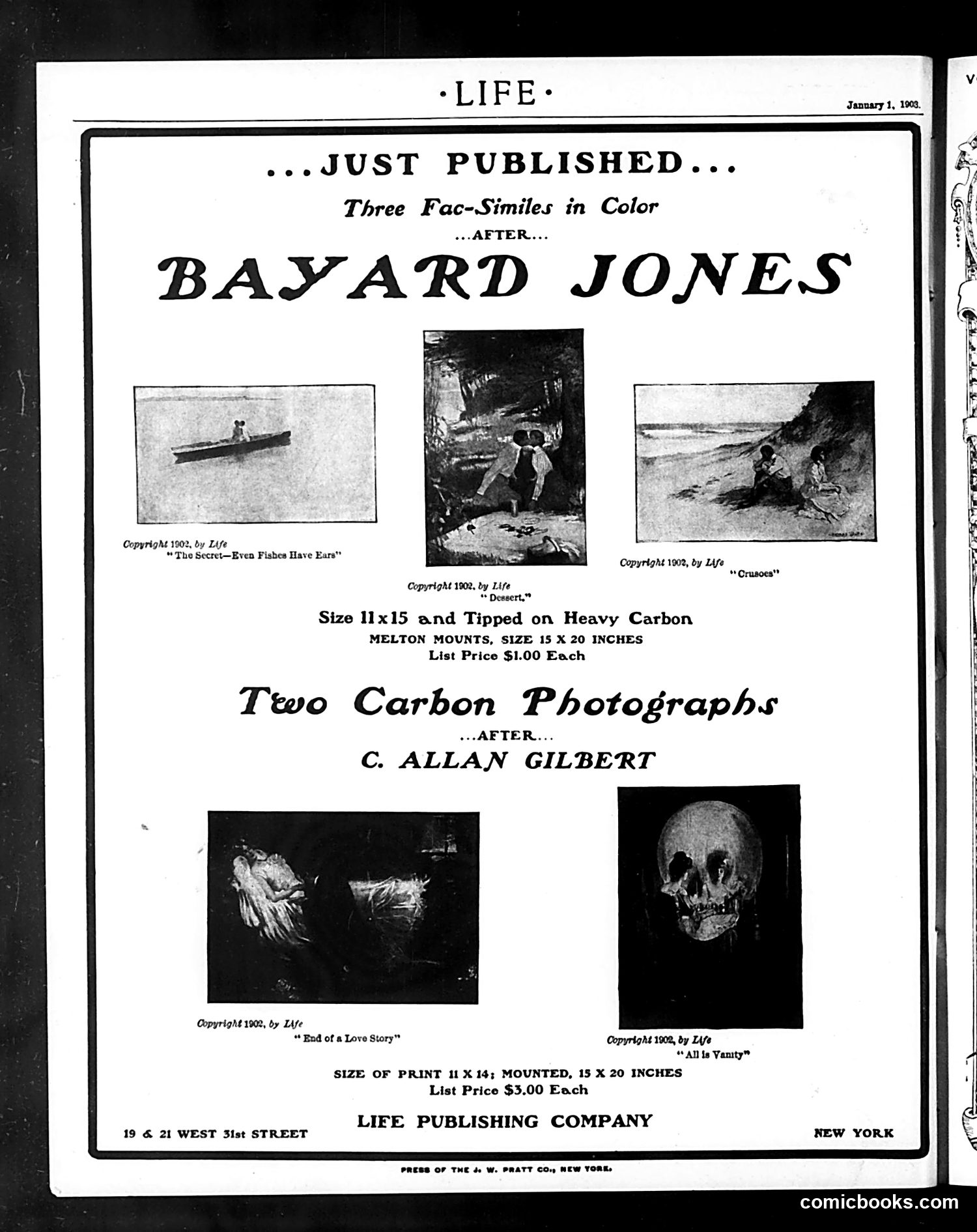
This is a **publishing advertisement**, not editorial content. It announces newly available art prints for sale from Life Publishing Company. The page promotes two artists' works: **Bayard Jones** offers three color facsimiles (reproductions) titled "The Secret—Even Fishes Have Ears," "Crusoes," and "Dessert"—priced at $1.00 each. **C. Allan Gilbert** offers two carbon photographs: "End of a Love Story" and "All is Vanity"—priced at $3.00 each. The images themselves appear to be sentimental or mildly satirical subject matter typical of early 1900s illustration (a boat scene, beach figures, what appears to be a skull). Without clearer visibility of the images or knowledge of these artists' specific works, the precise satirical content remains unclear, though "All is Vanity" suggests memento mori themes common to the period. This is primarily a **commercial advertisement** for art prints, not political satire.