
Life, 1903-01-01 · page 4 of 20
Life — January 1, 1903 — page 4: what you’re looking at
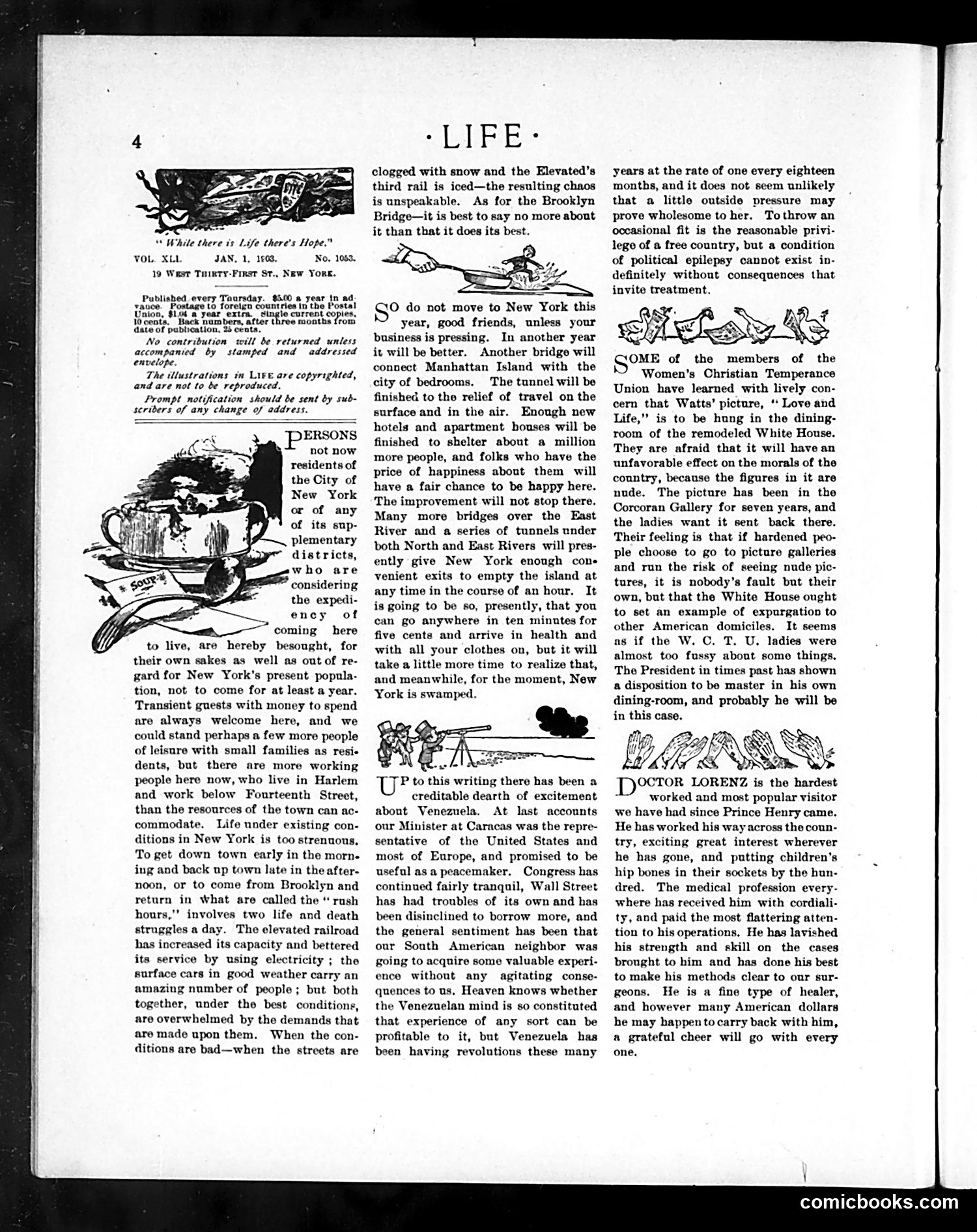
A restored page from Life, 1903-01-01. Page through the whole issue in the reader above.
📄 Transcribed text from this page (OCR, searchable)
Machine-transcribed from the original scan — historical spelling and the odd misread are preserved.
“ While there is Life there's Hope.” VOL. XLL JAN, 1, 1903. No. 1053. 19 West Tuixty-Fiest St., NEw YORE. Published every Toursday. $5.00 a year tn ad vauce. Postage to foreign countries in the tal Union, $1.4 a year extra. Songie corrent jpn Weents. Back nambers, after three months from date of publication, 25 cents, No contribution will be returned unless accompanied by stamped and addressed envelope. The illustrations in Lie are copyrighted, and are not to be reproduced. Prompt notification should be sent by sub- scribers of any change of address. ‘PERSONS not now residents of the City of New York or of any of its sup- plementary districts, who are considering the expedi- _ enecy of _ * coming here to live, are hereby besonght, for their own sakes as well as out of re- gard for New York’s present popula- tion, not to come for at least a year. Transient guests with money to spend are always welcome here, and we could stand perhaps a few more people of leisure with small families as resi- dents, but there are more working people here now, who live in Harlem and work below Fourteenth Street, than the resources of the town can ac- commodate. Life under existing con- ditions in New York is too strenuous, To get down town early in the morn. ing and back up town late in the after- noon, or to come from Brooklyn and return in What are called the “ rash hours,”’ involves two life and death struggles a day. The elevated railroad has increased its capacity and bettered its service by using electricity ; the surface cars in good weather carry an amazing number of people; but both together, under the best conditions, are overwhelmed by the demands that are made upon them. When the con- ditions are bad—when the streets are EB clogged with snow and the Elevated’s third rail is iced—the resulting chaos is unspeakable. As for the Brooklyn Bridge—it is best to say no more about it than that it does its best. Yy. O do not move to New York this year, good friends, unless your business is pressing. In another year it will be better. Another bridge will connect Manhattan Island with the city of bedrooms. The tunnel will be finished to the relief of travel on the surface and in the air. Enough new hotels and apartment houses will be finished to shelter about a million more people, and folks who have the price of happiness about them will have a fair chance to be happy here. The improvement will not stop there. Many more bridges over the East River and a series of tunnels under both North and East Rivers will pres- ently give New York enough cone venient exits to empty the island at any time in the course of an hour. It is going to be so, presently, that you can go anywhere in ten minutes for five cents and arrive in health and with all your clothes on, but it will take a little more time to realize that, and meanwhile, for the moment, New York is swamped. UP to this writing there has been a creditable dearth of excitement about Venezuela. At last accounts our Minister at Caracas was the repre- sentative of the United States and most of Europe, and promised to be useful as a peacemaker. Congress has continued fairly tranquil, Wall Street has had troubles of its own and has been disinclined to borrow more, and the general sentiment has been that our Sonth American neighbor was going to acquire some valuable experi- ence without any agitating conse- quences to us, Heaven knows whether the Venezuelan mind is so constituted that experience of any sort can be profitable to it, but Venezuela has been having revolutions these many years at the rate of one every eighteen months, and it does not seem unlikely that a little outside pressure may prove wholesome to her. To throw an cocasional fit is the reasonable privi- lege of a free country, but a condition of political epilepsy cannot exist in- definitely without consequences that invite treatment. Hickey NS OME of the members of the Women’s Christian Temperance Union have learned with lively con- cern that Watts’ picture, ‘* Love and Life,” is to be hung in the dining- room of the remodeled White House. They are afraid that it will have an unfavorable effect on the morals of the country, because the figures in it are nude. The picture has been in the Corcoran Gallery for seven years, and the ladies want it sent back there. Their feeling is that if hardened peo- ple choose to go to picture galleries and run the risk of seeing nude pic- tures, it is nobody’s fault but their own, but that the White House ought to set an example of expurgation to other American domiciles. It seems as if the W. C. T. U. ladies were almost too fussy about some things. The President in times past has shown a disposition to be master in his own dining-room, and probably he will be BABY. OCTOR LORENZ is the hardest worked and most popular visitor we have had since Prince Henry came. He has worked his way across the coun- try, exciting great interest wherever he has gone, and putting children’s hip bones in their sockets by the hun- dred. The medical profession every- where has received him with cordiali- ty, and paid the most flattering atten- tion to his operations. He has lavished his strength and skill on the cases brought to him and has done his best to make his methods clear to our sur- geons. He is a fine type of healer, and however many American dollars he may happen to carry back with him, a grateful cheer will go with every one. comicbooks.com