
Life, 1903-01-01 · page 12 of 20
Life — January 1, 1903 — page 12: what you’re looking at
What you’re looking at
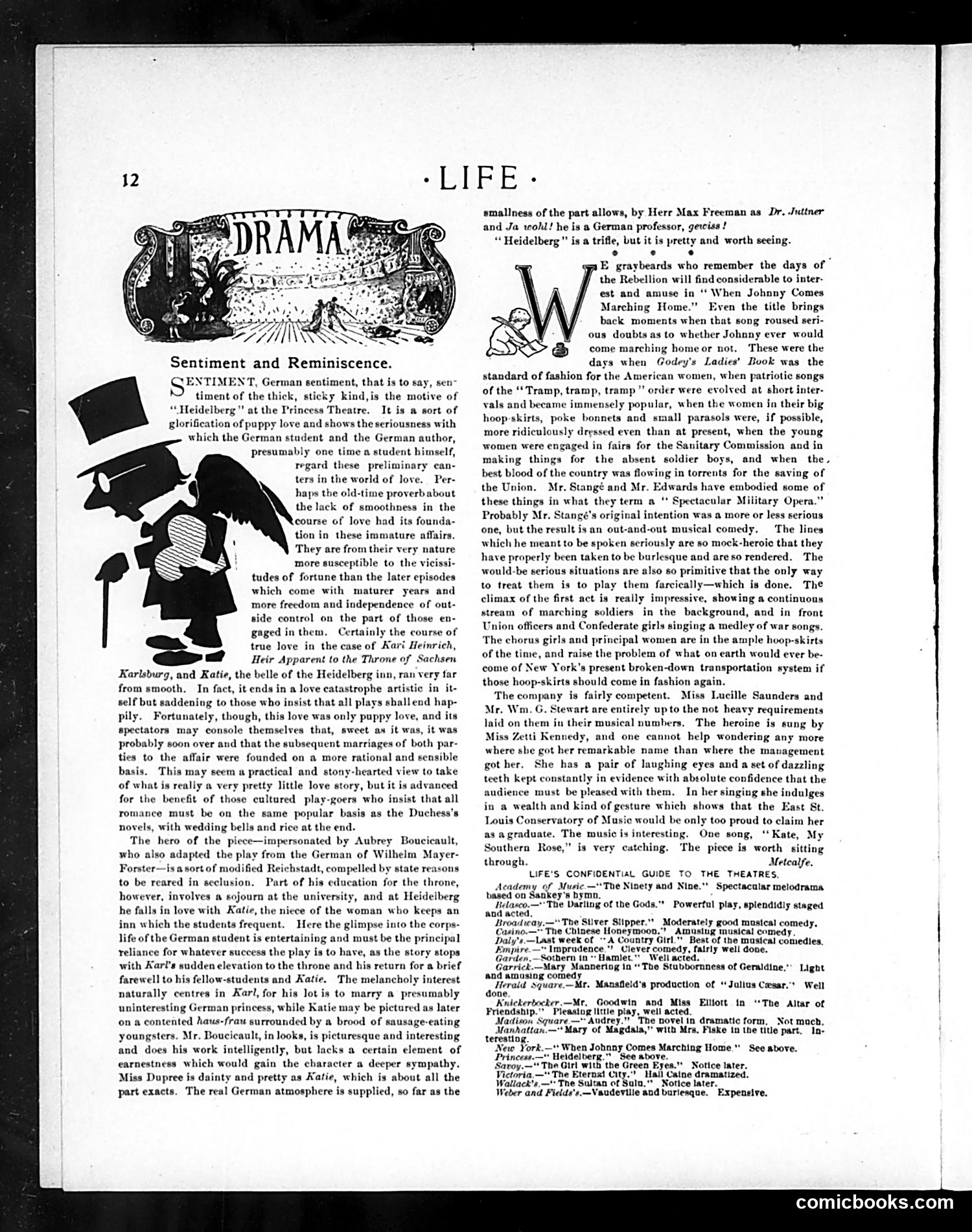
This page features a drama review section titled "Sentiment and Reminiscence." The main illustration shows a silhouetted figure in period costume, likely depicting a character from the theatrical production being discussed. The text reviews a German play called "Heidelberg," praising its romantic sentimentality about student life and love affairs. The reviewer notes the work captures authentic German atmosphere despite some theatrical conventions. The article discusses several theatrical productions and performers, including Miss Lucile Saunders and Miss Zetti Kennedy. It critiques the staging of Civil War scenes with marching soldiers and women singing period songs. The page concludes with "Life's Confidential Guide to the Theatres," listing current Broadway productions with brief critical assessments of their quality and notable performers. This appears to be standard theatrical criticism from the early 20th century American magazine.
📄 Transcribed text from this page (OCR, searchable)
Machine-transcribed from the original scan — historical spelling and the odd misread are preserved.
: At Ay V7 HWE Sentiment and Reminiscence. ~ ENTIMENT, German sentiment, that is to say, sen- timent of the thick, sticky kind,is the motive of “Heidelberg” at the Princess Theatre. It is a sort of glorification of puppy love and shows the seriousness with which the German student and the German author, presumably one time a student himself, regard these preliminary can- ters in the world of love. Per- haps the old-time proverb about the lack of smoothness in the course of love had its founda- tion in these immature affairs. ‘They are from their very nature more susceptible to the vicissi- tudes of fortune than the later episodes which come with maturer years and more freedom and independence of out- side control on the part of those en- gaged in them. Certainly the course of true love in the case of Kari Heinrich, Heir Apparent to the Throne of Sachsen Karlsburg, and Katie, the belle of the Heidelberg inn, ran very far from smooth. In fact, it ends in a love catastrophe artistic in it- self but saddening to those who insist that all plays shall end hap- pily. Fortunately, though, this love was only puppy love, and its spectators may console themselves that, sweet as it was, it was probably soon over and that the subsequent marriages of both par- ties to the affair were founded on a more rational and sensible basis. This may seem a practical and stony-hearted view to take of what is really a very pretty little love story, but it is advanced for the benefit of those cultured play-goers who insist that all romance must be on the same popular basis as the Duchess’s novels, with wedding bells and rice at the end. The hero of the piece—impersonated by Aubrey Boucicault, who also adapted the play from the German of Wilhelm Ma Forster—isasortof modified Reichstadt, compelled by state reasons to be reared in seclusion. Part of his education for the throne, however, involves a sojourn at the university, and at Heidelberg he falls in love with Katie, the niece of the woman who keeps an inn which the students frequent. Here the glimpse into the corps- life of the German student is entertaining and must be the principal reliance for whatever success the play is to have, as the story stops with Karl's sudden elevation to the throne and his return for a brief farewell to his fellow-students and Katie, The melancholy interest naturally centres in Karl, for his lot is to marry a presumably uninteresting German princess, while Katie may be pictured as later on a contented haus-frau surrounded by a brood of sausage-eating youngsters. Mr. Boucicault, in looks, is picturesque and interesting and does his work intelligently, but lacks a certain element of earnestness which would gain the character a deeper sympathy. Miss Dupree is dainty and pretty as Katie, which is about all the part exacts. The real German atmosphere is supplied, so far as the ETRE : smallness of the part allows, by Herr Max Freeman as Dr. «Juttner and Ja wohl! he is a German professor, gewiss ! “Heidelberg” is a trifle, but it is pretty and worth seeing. ° . E graybeards who remember the days of the Rebellion will find considerable to inter- est and amuse in “ When Johnny Comes Marching Home.” Even the title brings Seo back moments when that song roused seri- N ous doubts as to whether Johnny ever would RSL ® come marching home or not. ‘These were the days when Godry'’s Ladies’ Book was the standard of fashion for the American women, when patriotic songs of the ‘Tramp, tramp, tramp” order were evolved at short inter- vals and became immensely popular, when the women in their big hoop-skirts, poke bonnets and staall parasols were, if possible, more ridiculously dressed even than at present, when the young women were engaged in fairs for the Sanitary Commission and in making things for the absent soldier boys, and when the, best blood of the country was flowing in torrents for the saving of the Union. Mr. Stangé and Mr. Edwards have embodied some of these things in what they term a ‘ Spectacular Military Opera.” Probably Mr. Stangé's original intention was a more or less serious one, but the result is an out-and-out musical comedy. The lines which he meant to be spoken seriously are so mock-heroic that they have properly been taken to be burlesque and are so rendered. The would-be serious situations are also so primitive that the only way to treat them is to play them farcically—which is done. The climax of the first act is really impressive, showing a continuous stream of marching soldiers in the background, and in front Union officers and Confederate girls singing a medley of war songs. The chorus girls and principal women are in the ample hoop-skirts of the time, and raise the problem of what on earth would ever be- come of New York's present broken-down transportation system if those hoop-skirts should come in fashion again. ‘The company is fairly competent. Miss Lucille Saunders and Mr. Wm. G, Stewart are entirely up to the not heavy requirements laid on them iu their musical numbers, The heroine is sung by Miss Zetti Kennedy, and one cannot help wondering any more where she got her remarkable name than where the management got her, She has a pair of laughing eyes and a set of dazzling teeth kept constantly in evidence with absolute confidence that the audience must be pleased with them, In her singing she indulges in a wealth and kind of gesture which shows that the East St. Louis Conservatory of Music would be only too proud to claim her as agraduate, The music is interesting. One song, ‘Kate, My Southern Rose,” is very catching. The piece is worth sitt through. Metcalfe. LIFE'S CONFIDENTIAL GUIDE TO THE THEATRES. Academy of Music —"The Ninety and Nine.’ Spectacular melodrama based on Sankey’s bymn. Relasco.—"" The Darling of the Gods." Powertul play, splendidly staged and acted. Broadway.—*The Siiver Slipper." Moderately good musical comedy, Casin he Chinese Honeymoon.” Amuslug musical comedy. Daly's.—Last week of “A Country Girl.” Best of the masical comedies. fi) Empire.— \mpradence.’ Clever comedy, fairly well done. Garden.—Sothern in “Hamlet. _ Well acted. Garrick.—Mary Mannering in “The Stabbornness of Geraldine.” Light and amasing comedy qdlgratd Square—Mr. Manafield's production of “Jallus Cesar. Well lone. Knickertocker.—Mr, Goodwin and Miss Elliott tn “The Altar of Friendship.” Pieastog little play, well acted. Madison Square —" Audrey.”” ‘The novel in dramatic form, Not mach. ‘Manhattan.—" Mary of Magdala,” with Mra, Fiske in the tite part, In- teresting. New York.—* When Johnny Comes Marching Home." See above. Princess.—" Heidelberg.” See above. ‘Saroy.—" The Girl with the Green Eyes."" Notice tater. Victoria. —* The Eternxt City.” Hall Caine dramatized. Watlack's,—'* The Sultan of Sula." Notice later. Weber and Fields'e.. ‘audeville and burlesque. Expensive. comicbooks.com