
Life, 1903-01-01 · page 6 of 20
Life — January 1, 1903 — page 6: what you’re looking at
What you’re looking at
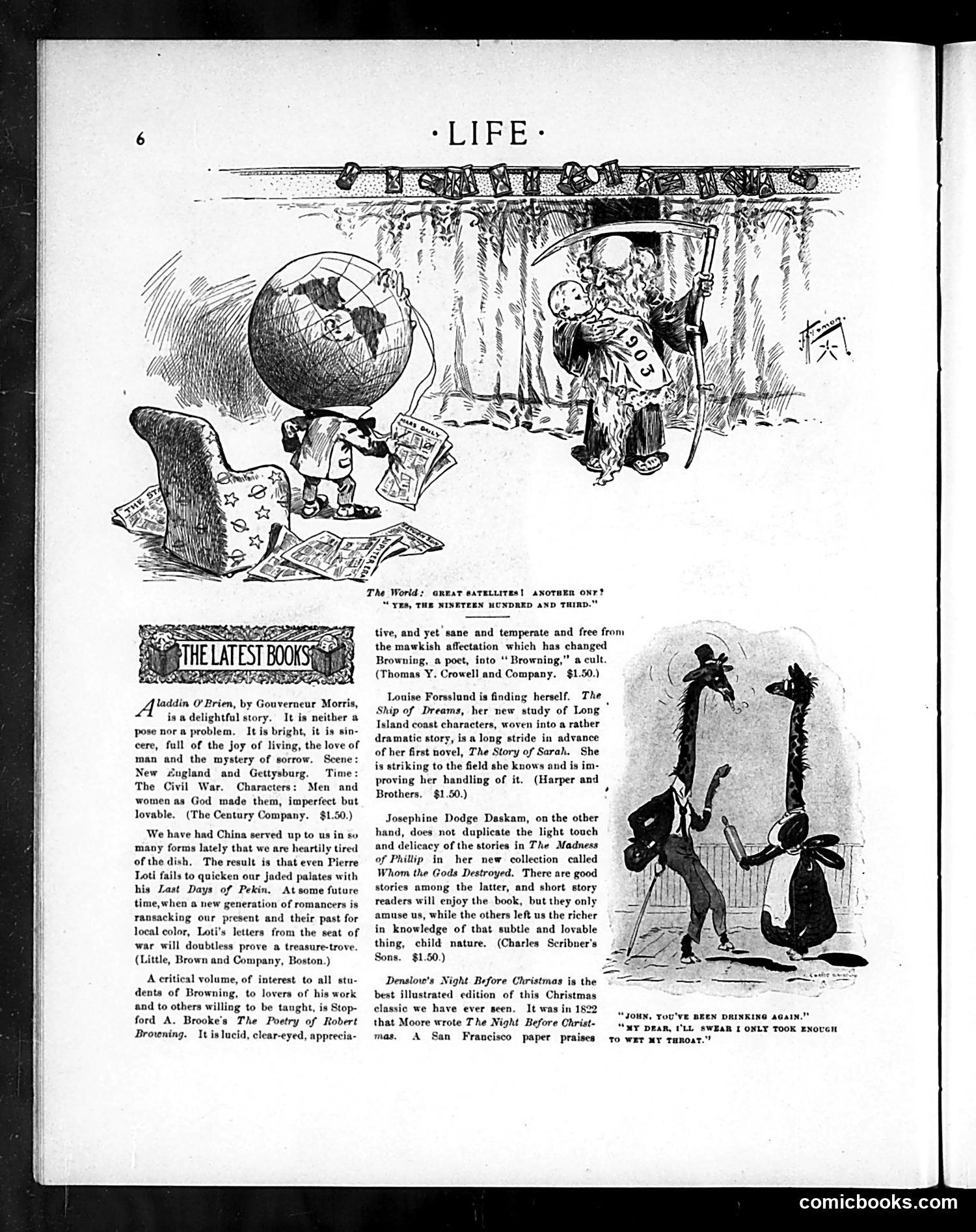
The top cartoon depicts a political allegory about global conflict. A skeletal figure labeled "Death" holds a large globe while a small child representing a nation examines scattered papers. The caption reads: "The World: Great Satellites! Another One? 'Yes, the Nineteen Hundred and Third.'" This appears to satirize early 1900s imperial competition—the "satellites" likely reference competing colonial powers acquiring territories. Death presides over this expansion, suggesting the satirist's dark view that such acquisitions inevitably lead to conflict and suffering. The bottom illustration shows a figure in a doorway with the caption "John, you've been drinking again—My dear, I'll swear I only took enough to wet my throat." This is domestic humor, unrelated to the political cartoon above.
📄 Transcribed text from this page (OCR, searchable)
Machine-transcribed from the original scan — historical spelling and the odd misread are preserved.
laddin O Brien, by Gouverneur Morris, is adelightfal story. It is neither a pose nora problem. It is bright, it is sin- cere, full of the joy of living, the love of man and the mystery of sorrow. Scene: New England and Gettysburg. Time: The Civil War. Characters: Men and women as God made them, imperfect but lovable. (The Century Company. $1.50.) We have had China served up to us in so many forms lately that we are heartily tired of the dish. The result is that even Pierre Loti fails to quicken our jaded palates with his Last Days of Pekin. At some future time, when a new generation of romancers is ransacking our present and their past for local color, Loti’s letters from the seat of war will doubtless prove a treasure-trove. (Little, Brown and Company, Boston.) A critical volume, of interest to all stu- dents of Browning, to lovers of his work and to others willing to be taught, is Stop- ford A. Brooke's The Poetry of Robert Browning. It is lucid, clear-eyed, apprecia- Mp “ee: rls The World: oneat eatetuites! axotaEn onr? “YES, THE NINETEEN HUNDRED AND THIRD.” tive, and yet sane and temperate and free from the mawkish affectation which has changed Browning, poet, into “ Browning,” a cult. (Thomas Y. Crowell and Company. $1.50.) Louise Forsslund is finding herself. The Ship of Dreams, her new study of Long Island coast characters, woven into a rather dramatic story, is a long stride in advance of her first novel, The Story of Sarah. She is striking to the field she knows and is im- proving her handling of it. Brothers. $1.50.) Josephine Dodge Daskam, on the other hand, does not duplicate the light touch and delicacy of the stories in The Madness of Phillip in her new collection called Whom the Gods Destroyed. There are good stories among the latter, and short story readers will enjoy the book, but they only amuse us, while the others left us the richer in knowledge of that subtle and lovable thing, child nature. (Charles Scribner's Sons. $1.50.) Denslow's Night Before Christmas is the best illustrated edition of this Christmas classic we have ever seen. It was in 1822 that Moore wrote The Night Before Ohrist- mas. A San Francisco paper praises (Harper and , “JOHN, YOU'VE BEEN DRINKING Again.” “MY DEAR, ULL SWEAR I ONLY TOOK zNOvGH To wet MY TuRoaT.”’ comicbooks.com