
A complete issue · 26 pages · 1902
Life — November 27, 1902
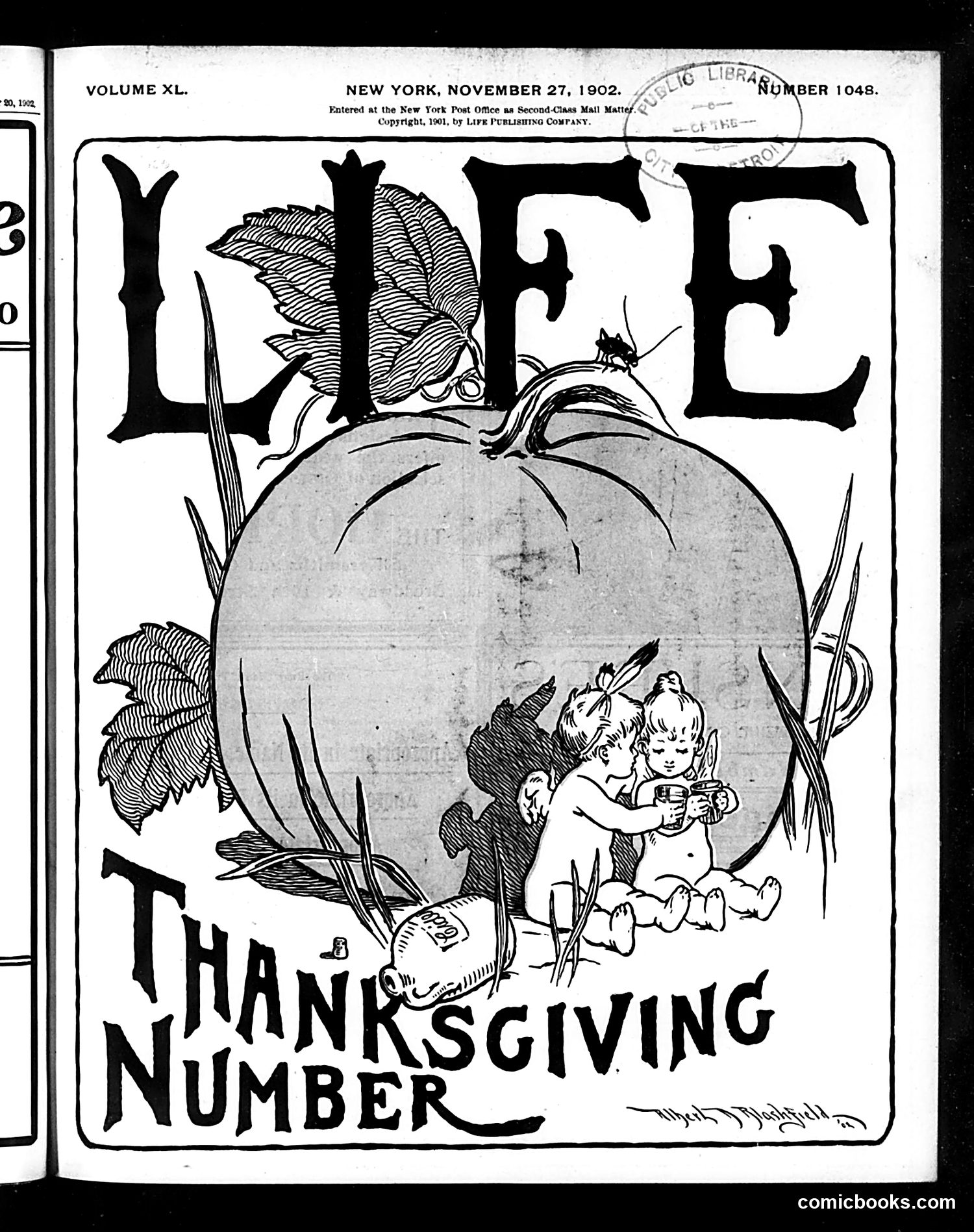
This is the cover of Life magazine's Thanksgiving issue. The central image depicts a large pumpkin with two cherubs or putti (classical child figures) sitting beside it in a pastoral setting with corn stalks. The pumpkin is a traditional symbol of American harvest and Thanksgiving abundance. The cover is primarily decorative and seasonal rather than political satire. The cherubs and harvest imagery represent themes of bounty, innocence, and American prosperity during the early 1900s. The ornate typography spelling "LIFE" and "THANKSGIVING NUMBER" emphasizes this is a special holiday edition intended to celebrate the harvest season. No specific political figures or controversial references are apparent—this appears to be straightforward holiday-themed cover art for the magazine.
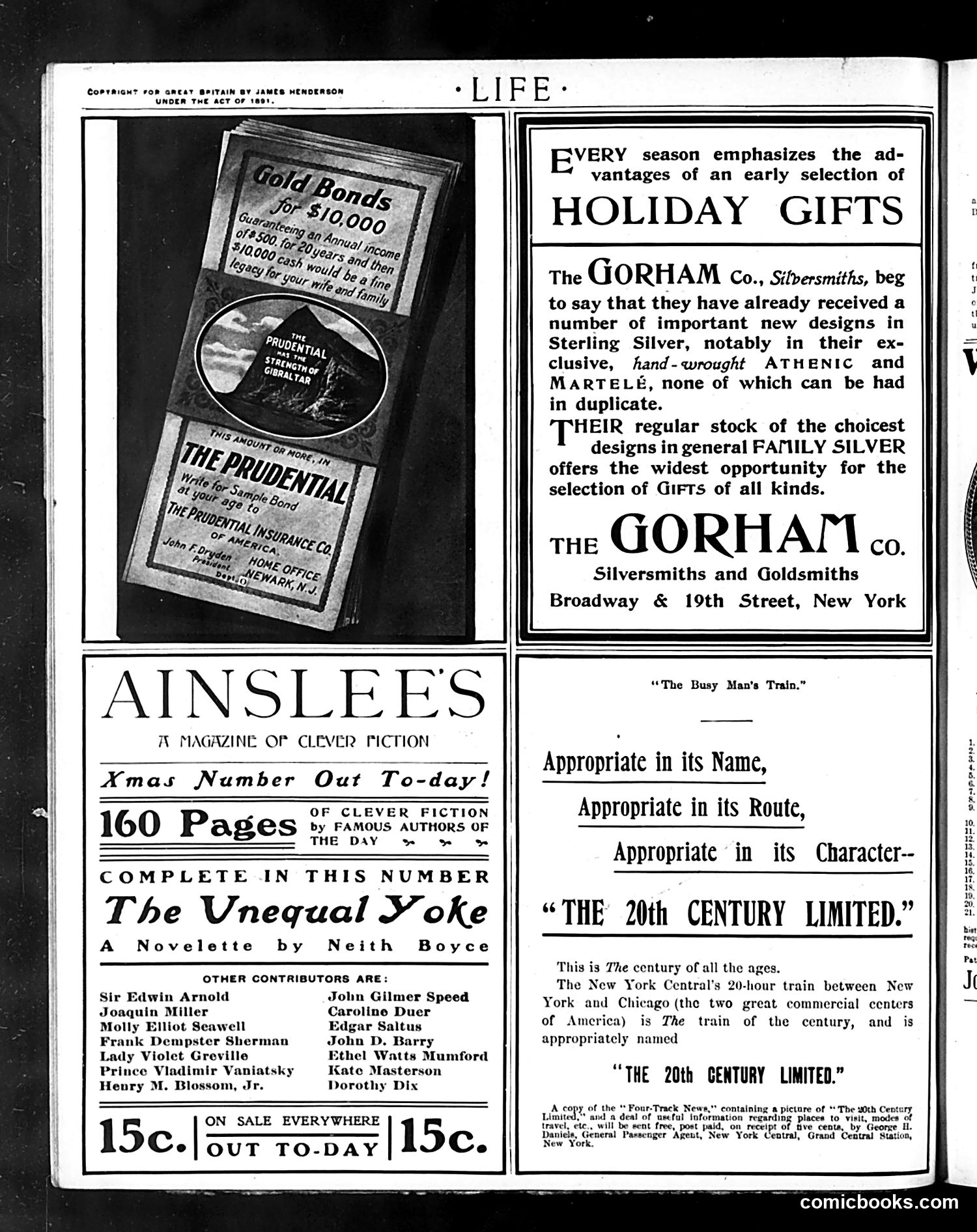
This page is primarily **advertising and magazine promotion** rather than political satire or cartooning. The top left shows a **Prudential Insurance advertisement** featuring Gold Bonds ($1,000 denomination) with their logo. This is straightforward commercial promotion. The right side advertises **The Gorham Co.**, luxury silversmiths and goldsmiths on Broadway in New York, promoting sterling silver and gift items for the holiday season. The lower left promotes **Ainslee's Magazine**, advertising their Christmas issue containing 160 pages and a novelette titled "The Unequal Yoke" by Neith Boyce, priced at 15 cents. The lower right advertises the **20th Century Limited train**, New York Central's famous passenger train between New York and Chicago, calling it "the train of the century." There is **no political cartoon or satire present** on this page.
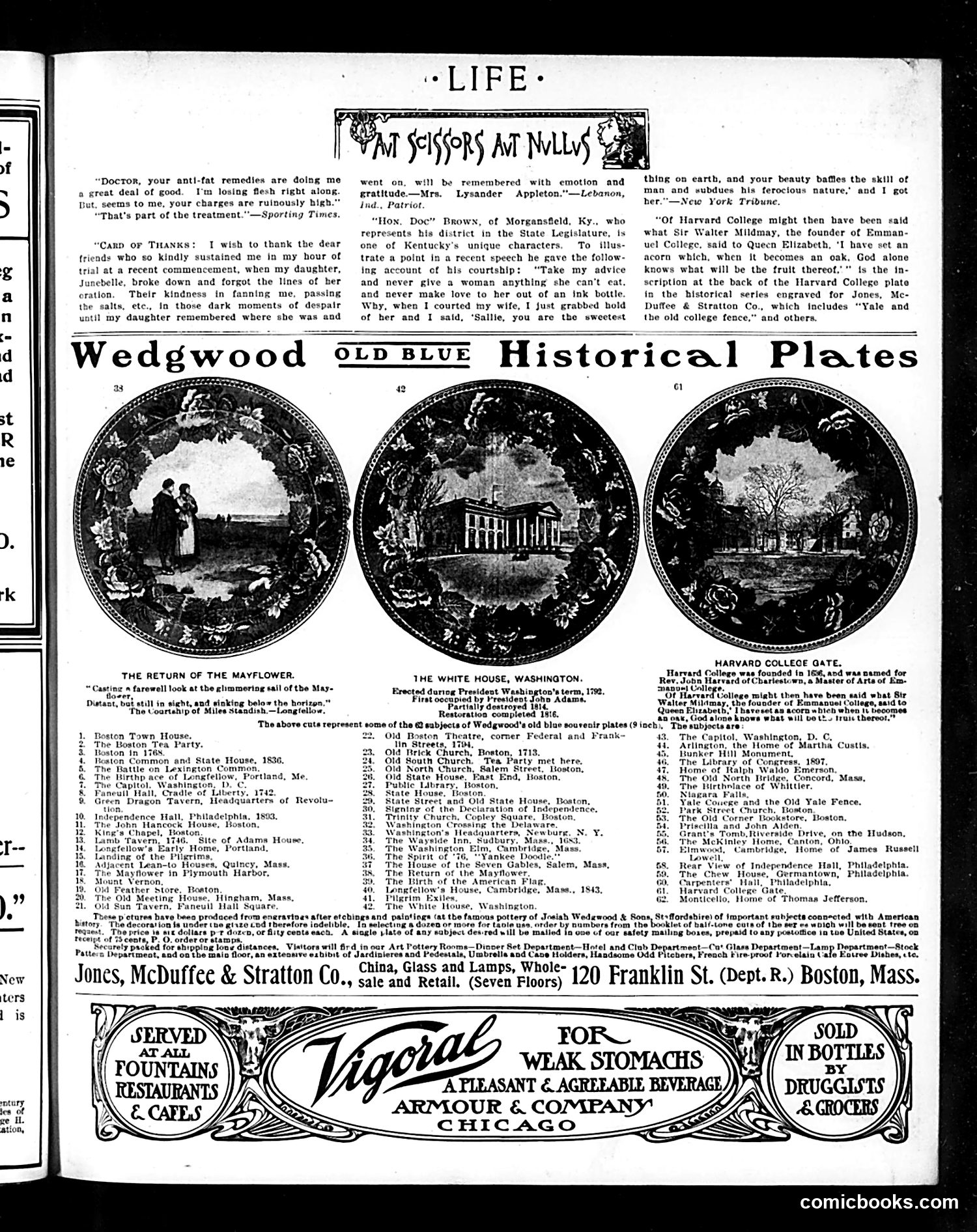
This page is primarily **advertising and historical content**, not political satire. The main feature is "Wedgwood Old Blue Historical Plates," displaying three decorative porcelain plates with scenic designs (The Return of the Mayflower, The White House Washington, and Harvard College Gate). The upper portion contains brief personal notices—a doctor responding to criticism about anti-fat remedies, and someone thanking friends for support during a trial. These appear to be reader submissions rather than satirical content. The bottom half is dominated by a large advertisement for **Vigoral**, a stomach tonic made by Armour & Company in Chicago, promising relief for "weak stomachs" and marketed through fountains, restaurants, and drugstores. There is **no discernible political cartoon** on this page.
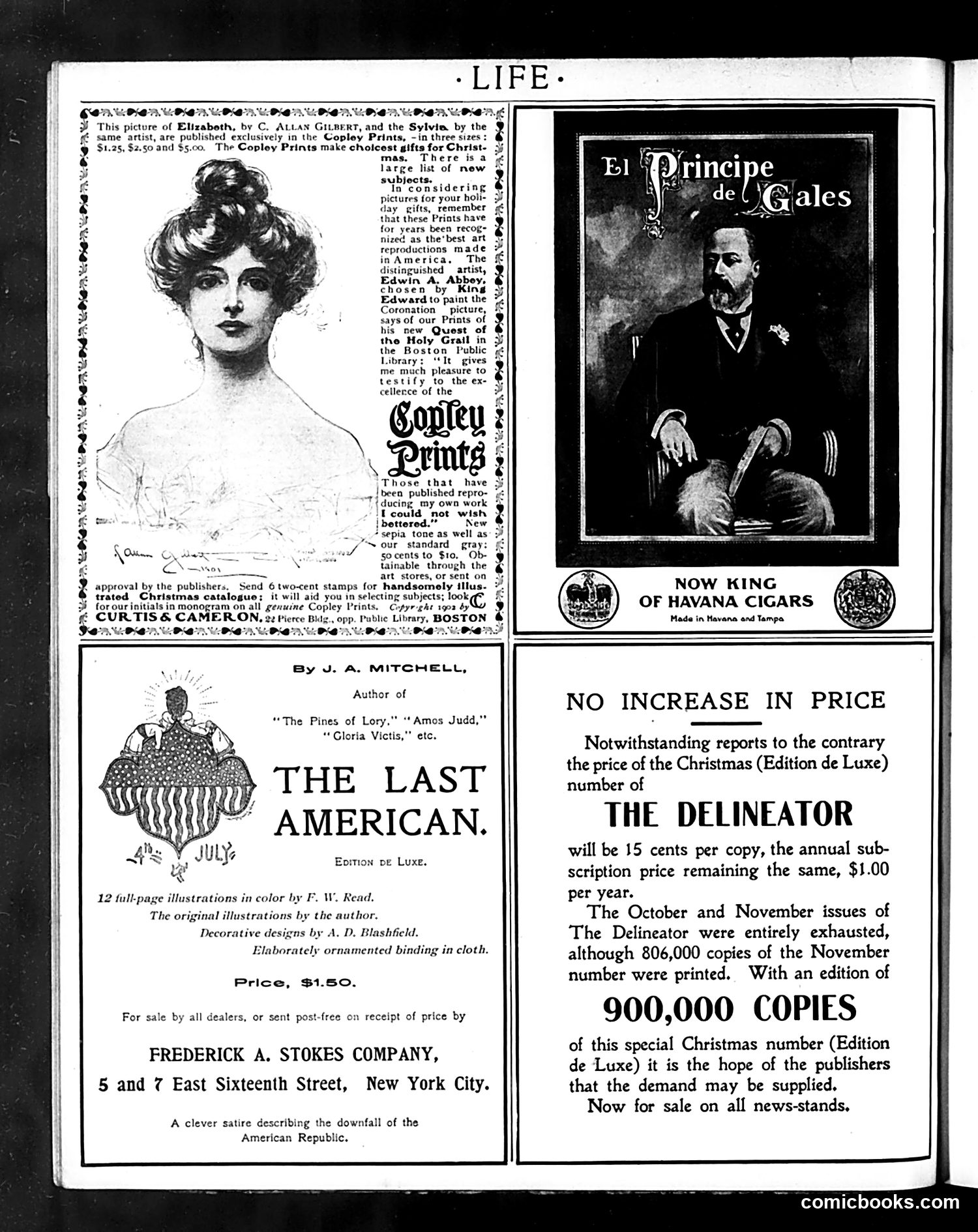
This page is primarily **advertising**, not editorial content or satire. The left side advertises **Copley Prints** (art reproductions) and **"The Last American"** by J.A. Mitchell—a satirical novel described as "a clever satire describing the downfall of the American Republic." The right side promotes **El Príncipe de Gales** (Prince of Wales) cigars and announces that **The Delineator** magazine's Christmas luxury edition will cost 15 cents, with 900,000 copies printed. The only potentially satirical element is Mitchell's book title itself, which appears to be social/political commentary on American decline, though the actual content isn't shown here. The rest is straightforward commercial advertising typical of Life magazine's revenue model.
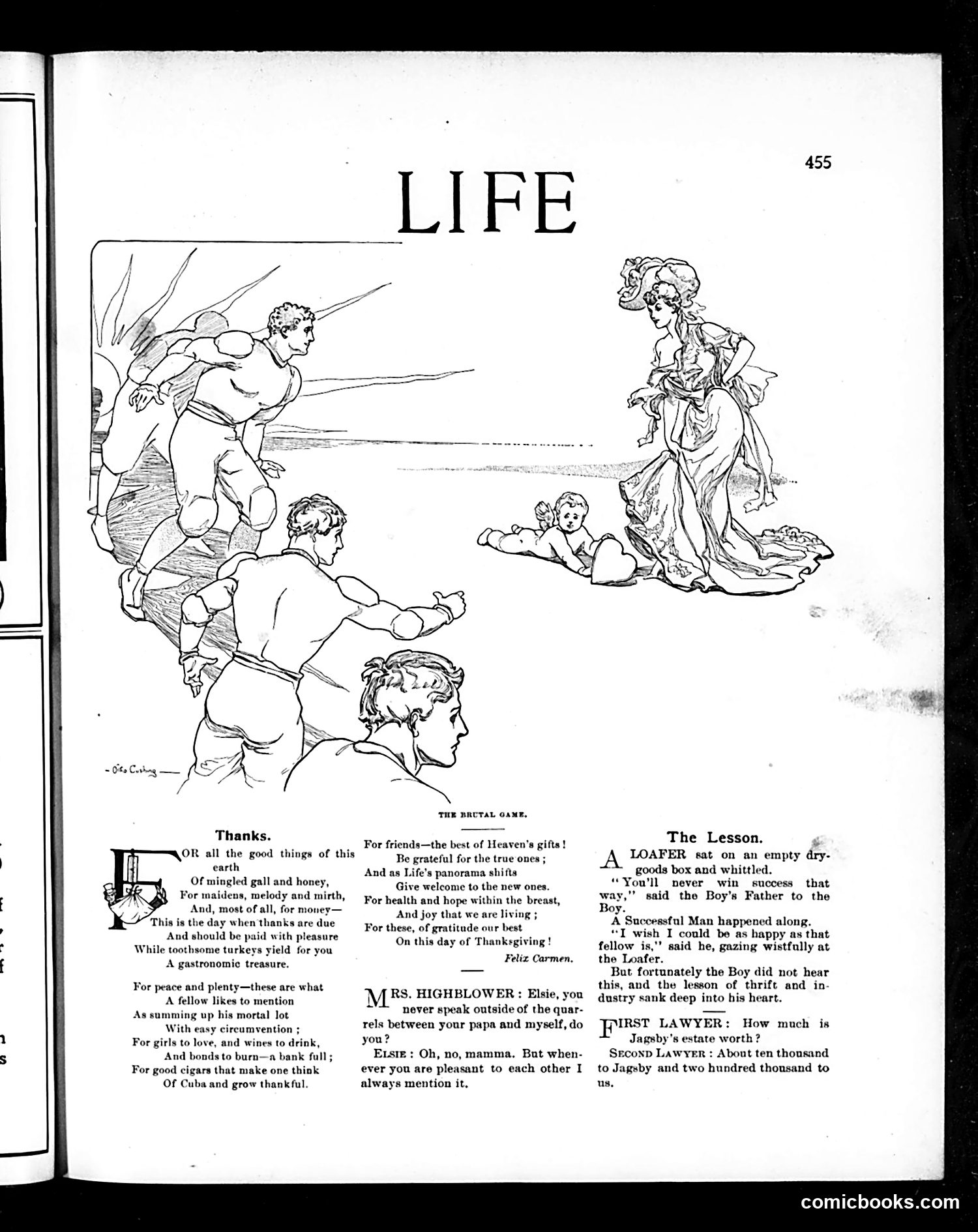
This page contains two distinct pieces: **"The Brutal Game"** (top illustration): Shows cherubs/putti engaged in what appears to be a violent or rough physical contest. The satire likely critiques some contemporary sport or competitive activity as unnecessarily brutal, using the ironic contrast of innocent baby figures to highlight the violence involved. **"The Lesson"** (right side): A dialogue between a Boy and his Father about a Loafer with an empty dry-goods box, contrasting poverty with aspiration. The Father uses this encounter to teach about thrift and industry—a moral lesson common to Gilded Age satire about work ethic and social class. **Other content**: Thanksgiving-themed verses and a brief exchange between Mrs. Highblower and Elsie about discretion in discussing family finances. The page reflects turn-of-century American values emphasizing morality, industriousness, and class distinctions.
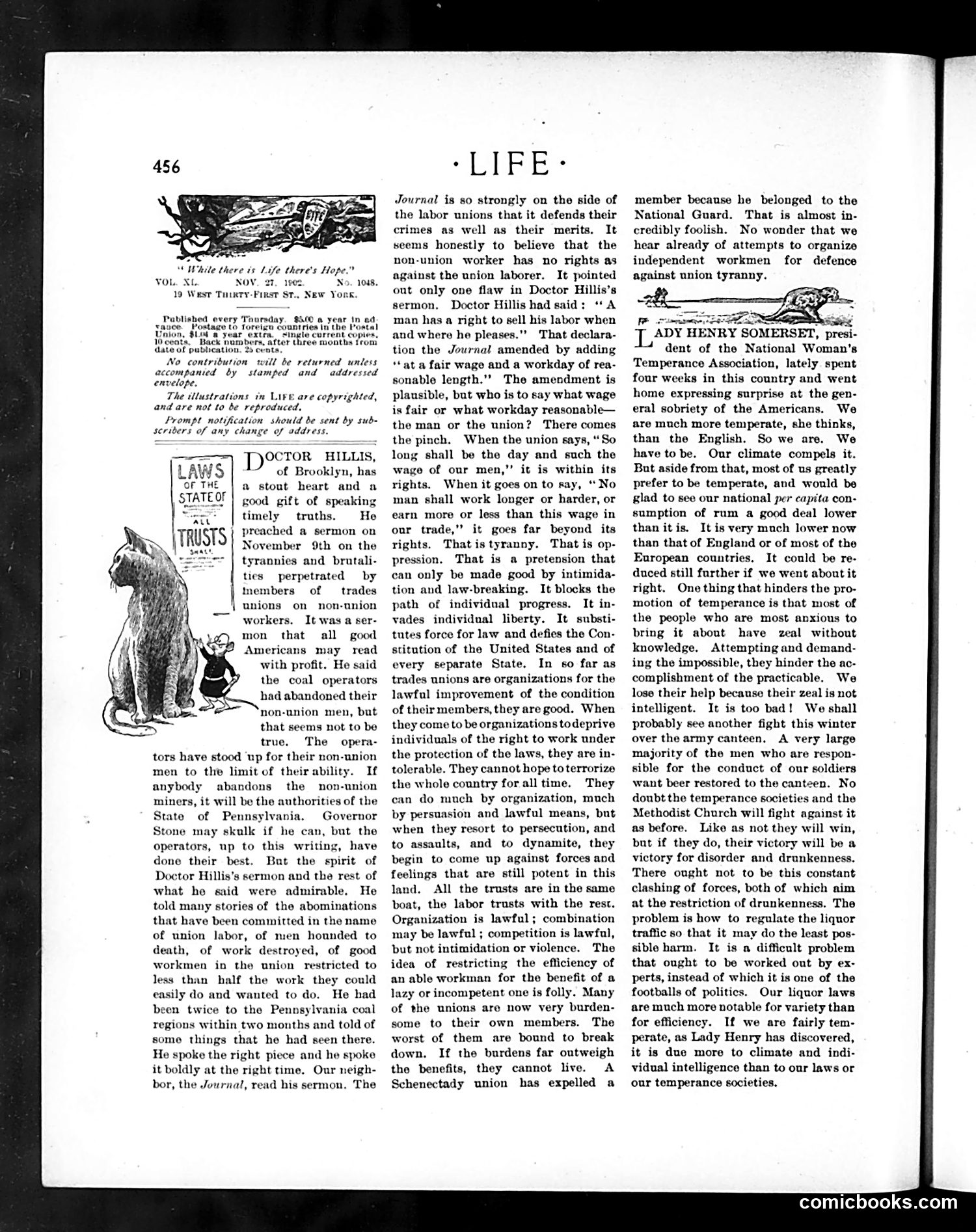
The cartoon depicts a large, aggressive dog labeled "TRUSTS" attacking a smaller figure representing a worker or laborer. The accompanying article discusses Doctor Hillis's sermon criticizing labor unions while defending industrial trusts. The satire is pointed: while Hillis condemned unions as lawless and violent organizations threatening American liberty, the cartoon visually inverts this argument—depicting trusts (monopolistic corporations) as the actual aggressive force attacking workers. The dog metaphor suggests trusts operate without restraint or law, despite Hillis's claims that unions represent the real lawlessness. This reflects Progressive Era anxieties about unchecked corporate power versus labor organizing, suggesting the magazine sided with worker protections against monopolistic business practices.
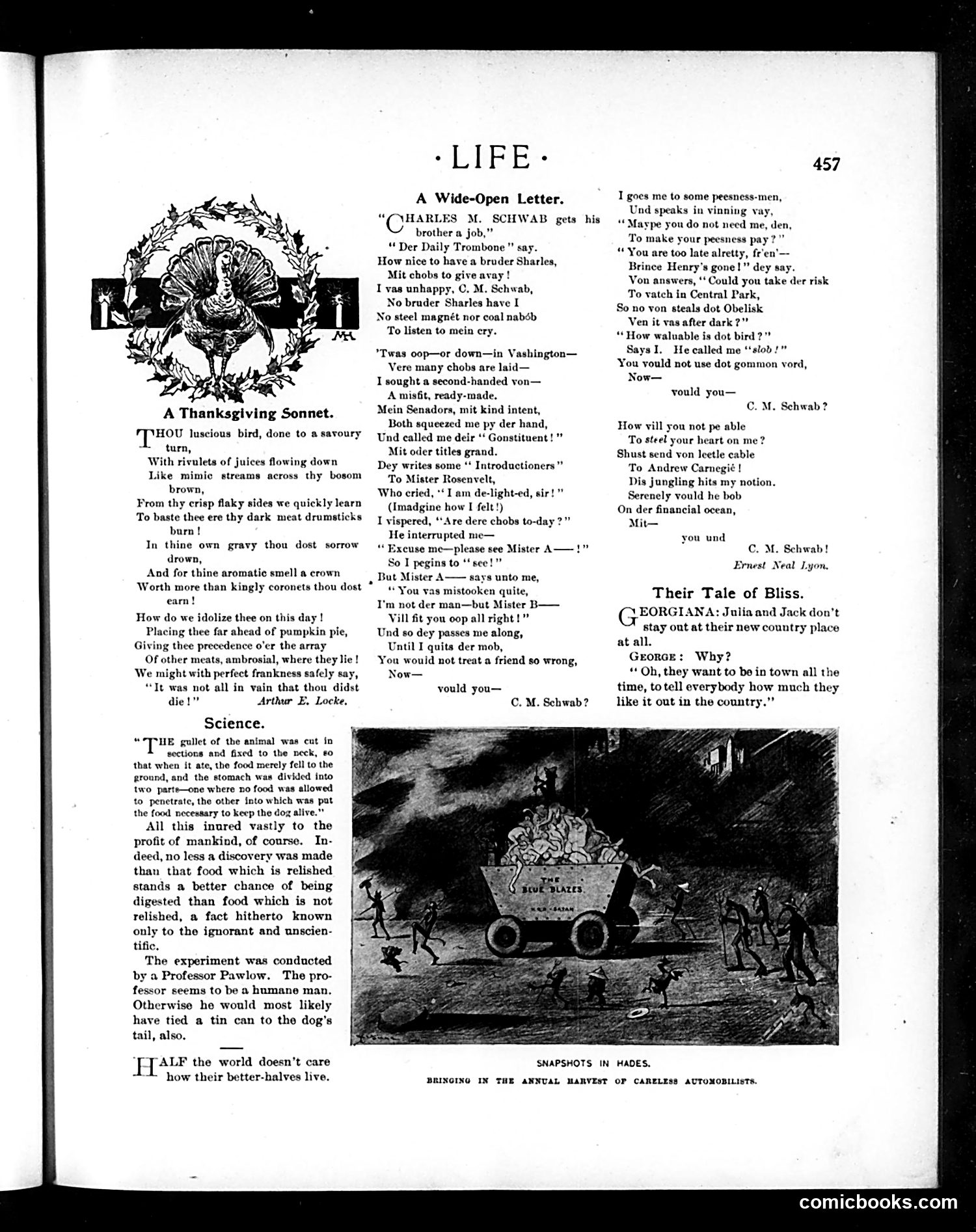
This page contains three distinct literary/humorous pieces rather than political cartoons: 1. **"A Wide-Open Letter"** — A satirical poem by C.M. Schwab addressing Charles Schwab's brother getting a job at "Der Daily Trombone." It mocks pretentious newspaper writing and self-important "Introductioners." 2. **"A Thanksgiving Sonnet"** — A traditional sonnet about turkey dinner, credited to Arthur E. Locke. 3. **"Science"** — A brief article describing an animal digestive experiment by "Professor Pawlow," humorously noting the professor's humane nature. 4. **"Their Tale of Bliss"** — A brief dialogue about country vs. city living preferences. The bottom photograph shows "Snapshots in Hades: Bringing in the Annual Harvest of Careless Automobilists" — a satirical caption suggesting automobile accidents are deadly and commonplace. The page is primarily literary satire rather than visual political commentary.
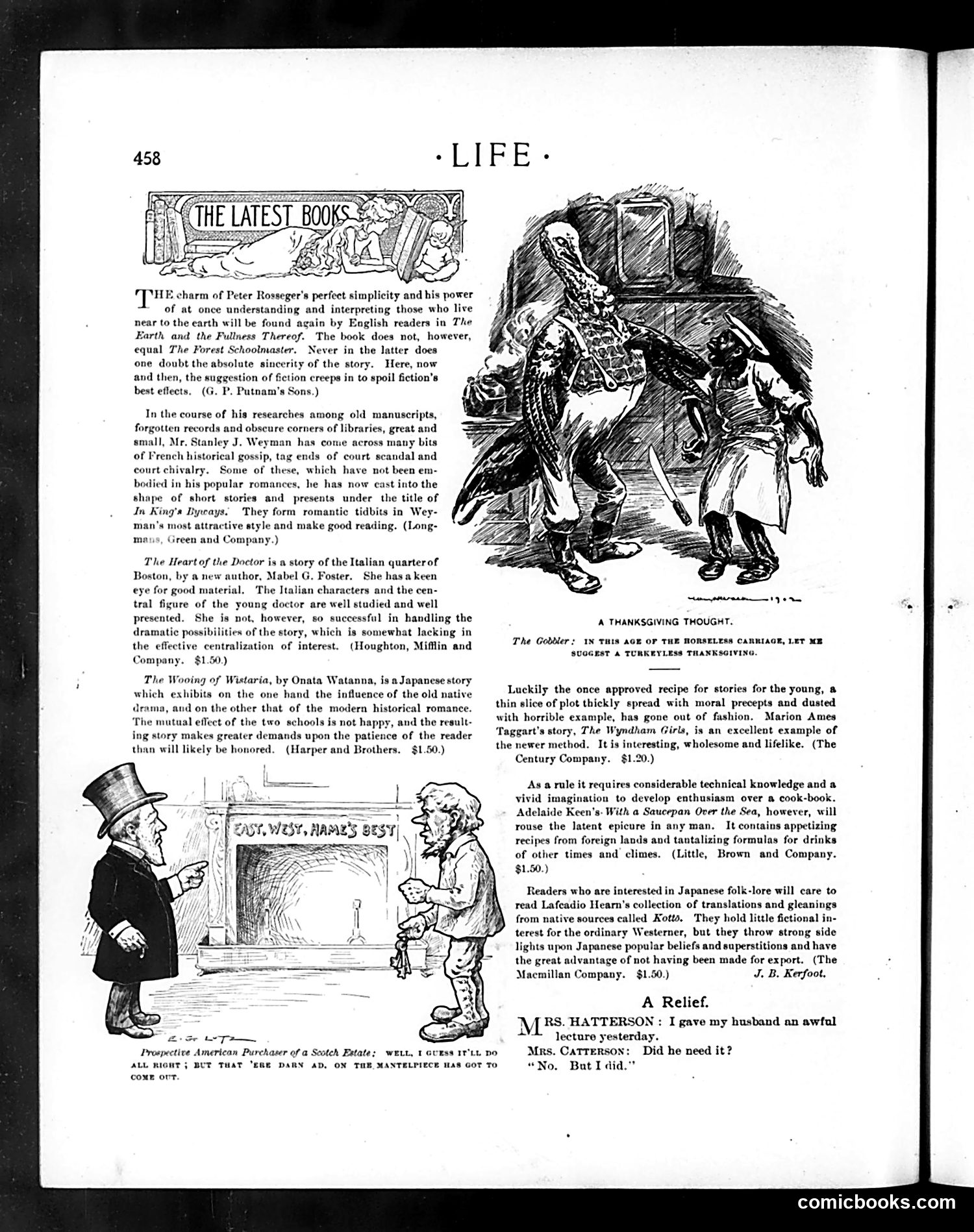
This cartoon satirizes the American purchasing of Scottish estates. The well-dressed man (labeled "Prospective American Purchaser of a Scotch Estate") expresses satisfaction that an ornate mantelpiece advertised as part of the property sale will be removed before delivery. The joke targets wealthy American industrialists of the period who bought European country estates as status symbols, often sight-unseen or with misleading representations. The cartoon mocks both the Americans' eager gullibility and the cunning of sellers who would strip valuable fixtures from properties after the sale was agreed upon. The humor relies on the viewer recognizing this as a common scam of the era, where transatlantic real estate deals frequently disappointed naive American buyers.
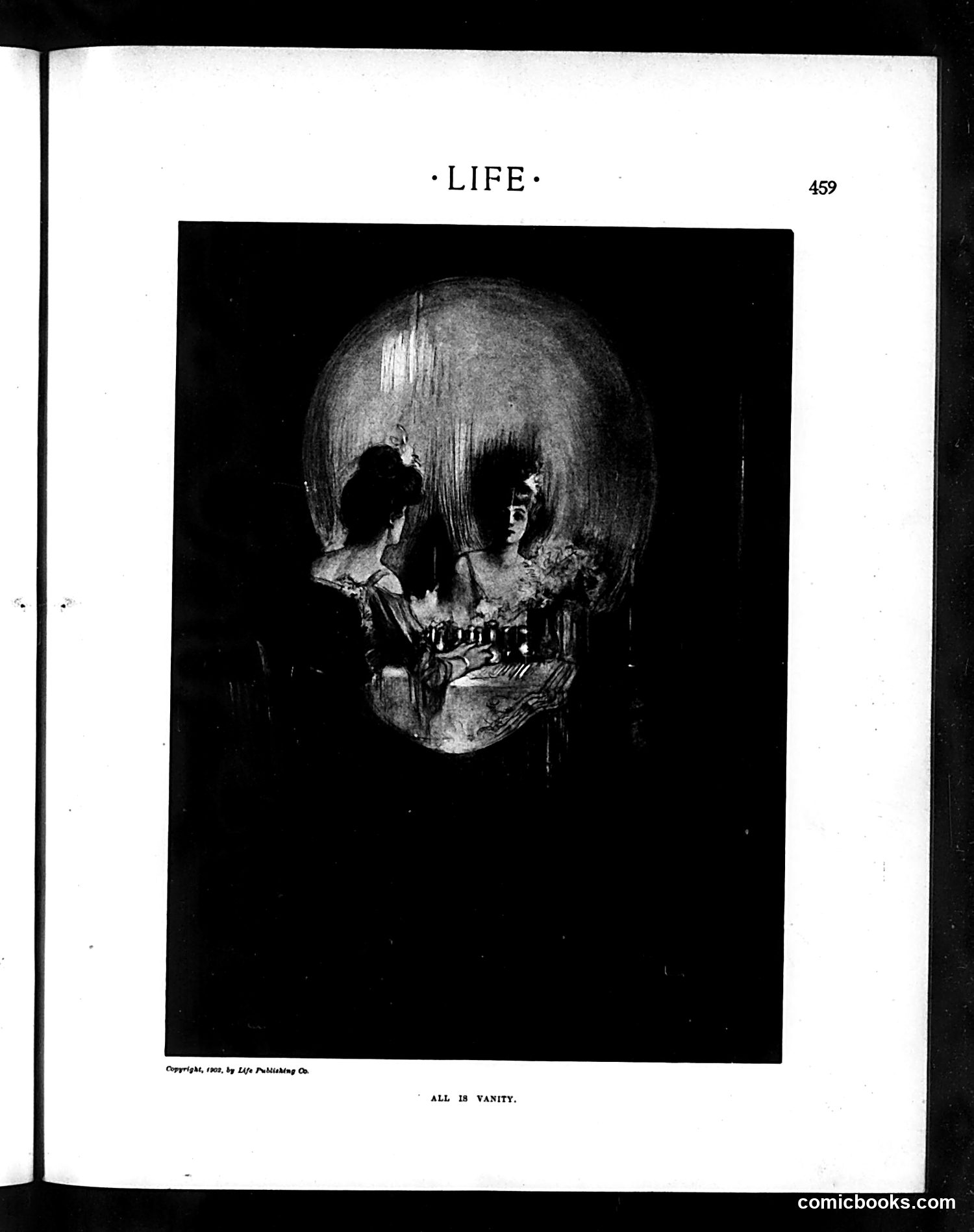
This is a memento mori artwork titled "ALL IS VANITY" showing a skull that appears to be composed of two human figures—a woman at her vanity mirror on the left and a man on the right. The skull's eye sockets are formed by the empty spaces where their faces meet or turn away from each other. The piece is a visual pun on the classical "vanity skull" motif. It satirizes human vanity and mortality by literally constructing a death's-head from two people absorbed in personal appearance and self-regard. The woman's elaborate hairstyle forms part of the skull's cranium, reinforcing the commentary on superficial concerns with beauty. The copyright indicates this appeared in Life magazine around 1902, making it an early example of Life's sophisticated visual satire about social follies and human nature.
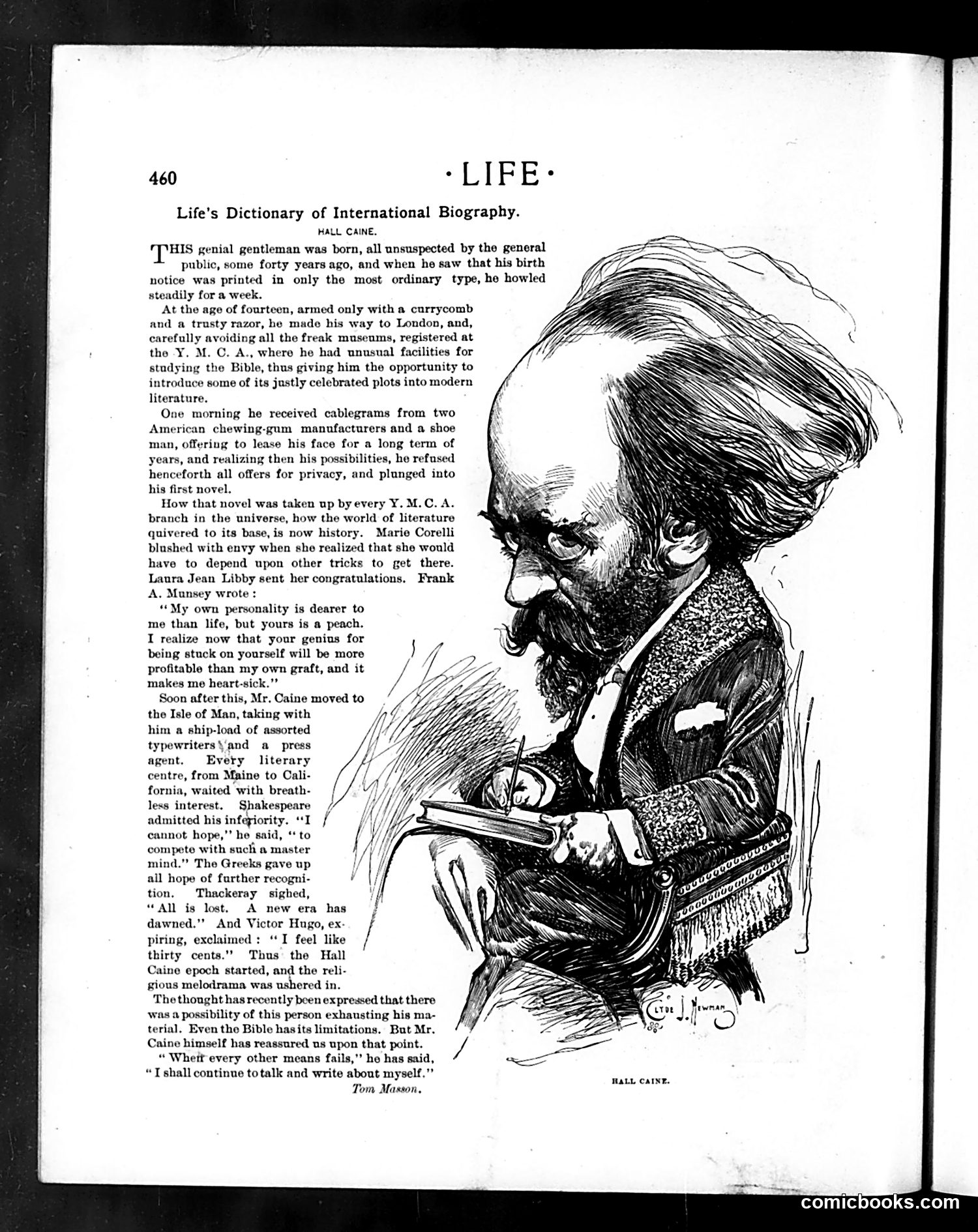
This is a biographical entry for **Hall Caine**, a prolific Victorian/Edwardian writer, from Life's Dictionary of International Biography. The text is satirical, mocking Caine's self-promotion and productivity. The satire focuses on: - Caine's **relentless self-advertising** (birth announcement printed in "ordinary type" disappointingly him) - His **prolific output** across multiple genres and media - His **shameless self-promotion** through various publishing channels - Critical dismissals from literary figures like Frank A. Munsey and Victor Hugo (quoted dismissively) The portrait shows Caine as a bearded, intense figure clutching papers—visually emphasizing his obsessive writing habits. The humor lies in presenting Caine as simultaneously ambitious yet artistically overlooked, despite his commercial success. This reflects Life magazine's tendency to deflate the pretensions of celebrities through irreverent biographical sketches.
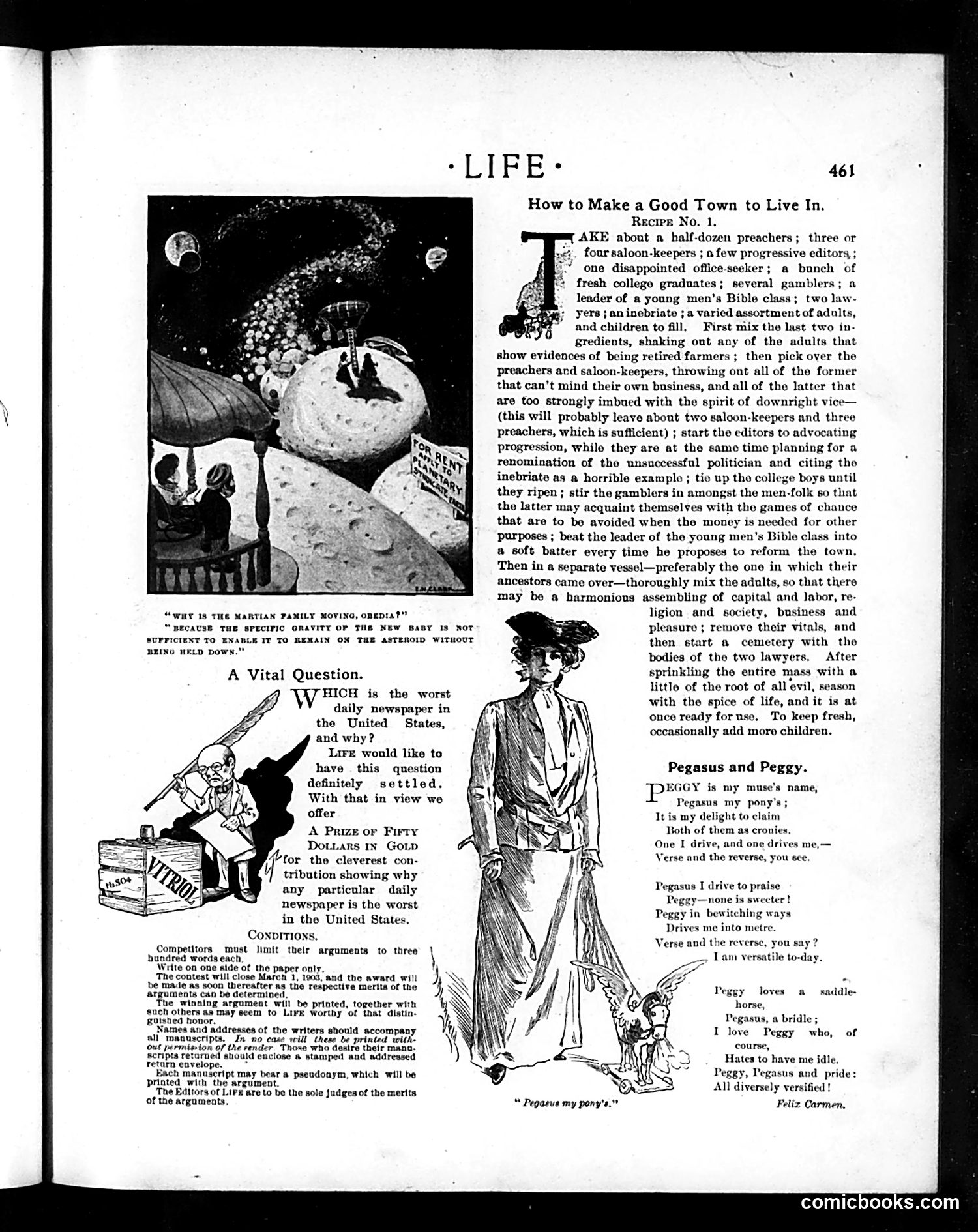
This page contains satirical content about American civic life. The main article "How to Make a Good Town to Live In" is a mock recipe that sarcastically prescribes removing all the town's most problematic elements—preachers, saloon-keepers, corrupt editors, gamblers, and inebriates—then starting fresh with a cemetery for "the bodies of the two lawyers." It's biting social commentary on widespread corruption and moral decay in American towns. "A Vital Question" below contests which daily newspaper is worst in the United States, offering "$50 in Gold" to whoever can prove one paper superior. It mocks American journalism's generally poor quality. The illustration shows a woman with a small dog, labeled "Pegasus my pony's," accompanying verses about her pets. This appears lighter satirical verse content.
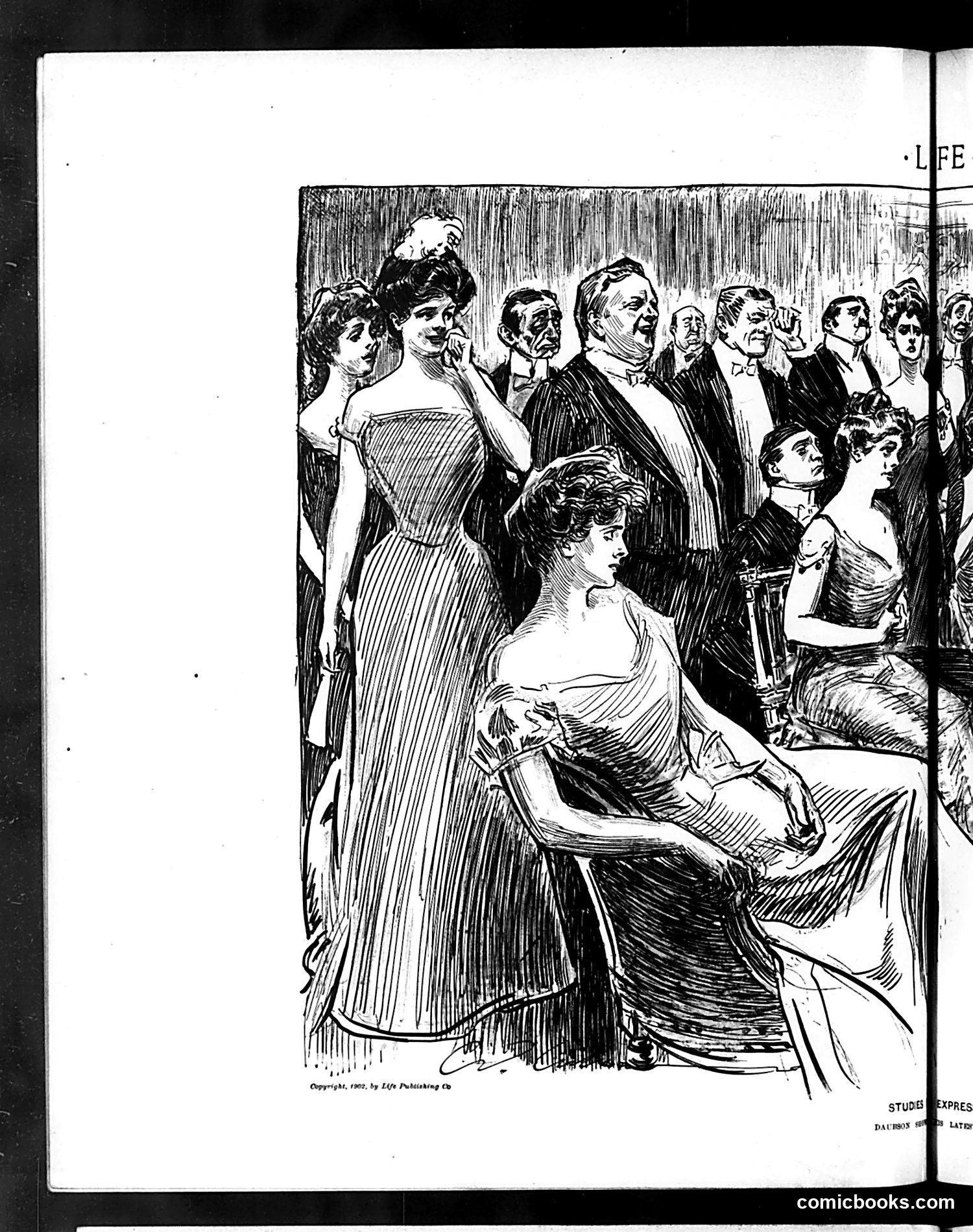
This is a pen-and-ink illustration depicting a formal social gathering—likely a high-society event or reception. The scene shows well-dressed men in evening wear and women in fashionable gowns mingling in what appears to be an elegant interior space. The satire appears to target upper-class social conventions and etiquette of the period. The detailed rendering of clothing and poses suggests commentary on social posturing or artificial formality. The central seated woman draws particular attention, creating a focal point that may indicate social hierarchy or status-consciousness among the attendees. Without additional text or caption visible on this page, the specific satirical target remains unclear, though the formal dress and crowded composition suggest critique of Gilded Age or Progressive Era elite society gatherings.
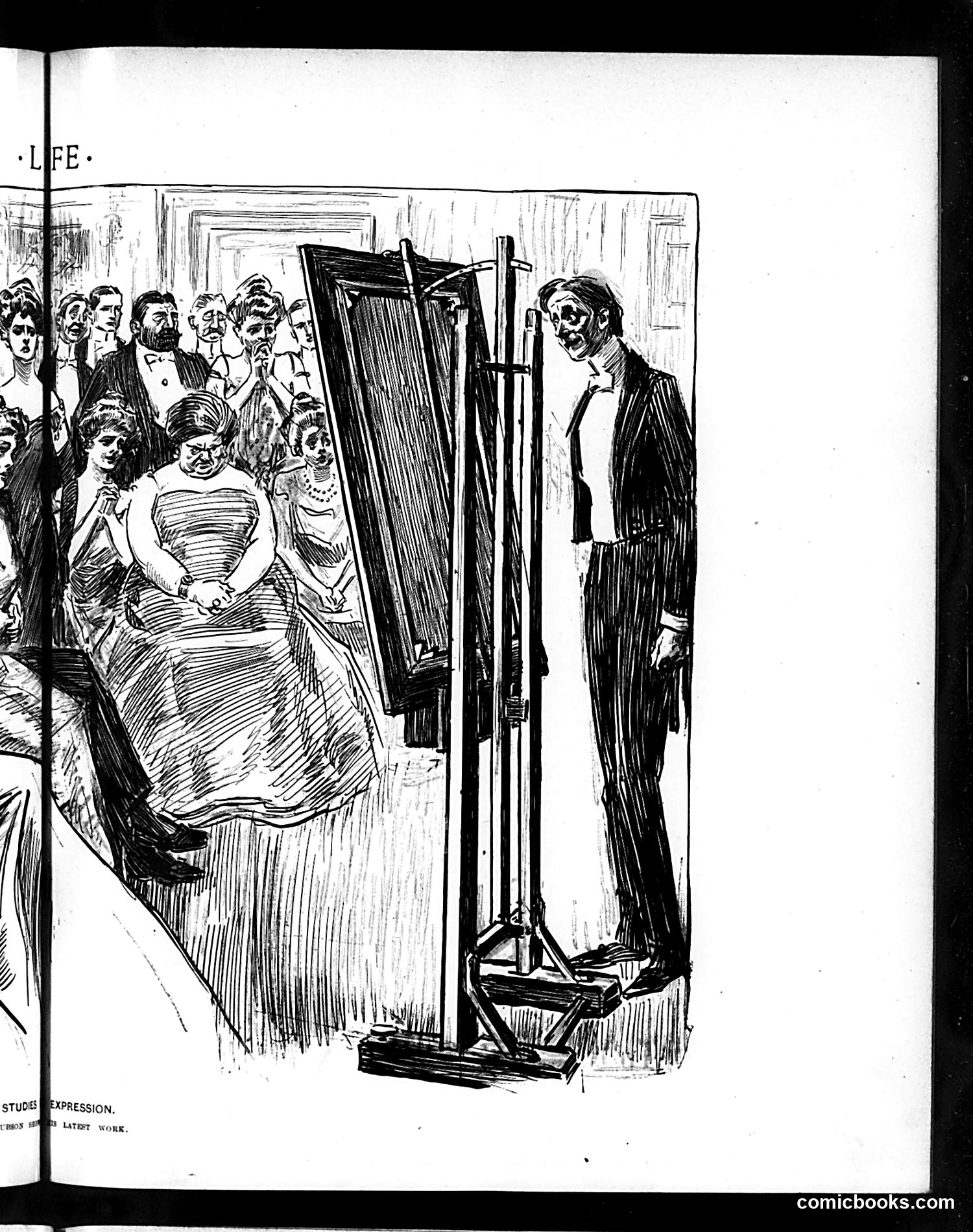
This appears to be a satirical Life magazine cartoon depicting an art studio scene. A well-dressed man stands before an easel displaying what appears to be a portrait or artistic work, while a woman sits posed and a group of well-dressed onlookers observe from behind. The caption references "STUDENT EXPRESSION" and "LATEST WORK," suggesting satire about artistic pretension or the art world's self-seriousness. The cartoon likely mocks either: - Pretentious artistic circles and their affected appreciation of student work - The gap between artistic ambition and actual talent - Social posturing in bohemian or artistic communities The formal dress of the observers and the theatrical setup indicate mockery of how seriously the art establishment takes itself. Without additional context about the specific date or artist, the precise target remains somewhat unclear, though the general satire on artistic pomposity is evident.
This page contains theater criticism of productions featuring two famous actors: **Eleonora Duse** (the renowned Italian actress) and **Martin Harvey** (English actor). **The Duse critique** laments her artistic decline. The reviewer notes she was once a magnificent, understated performer who captivated American audiences. Now, "peroxided and painted," she appears in inferior plays—specifically works by D'Annunzio, whom the critic dismisses as morbid and "degenerate." The satire suggests she's compromised her talent for commercial ventures that draw only the "merely curious." **The Harvey section** praises his acting abilities but criticizes his managers for not properly launching him with stronger supporting material and company members. The small cartoon at bottom-right appears to show a humorous domestic scene (text is illegible at this resolution) unrelated to the theater reviews above. The page exemplifies *Life*'s role as arbiter of cultural taste, using satire to critique artistic decline and commercialism in American theater circa 1893.
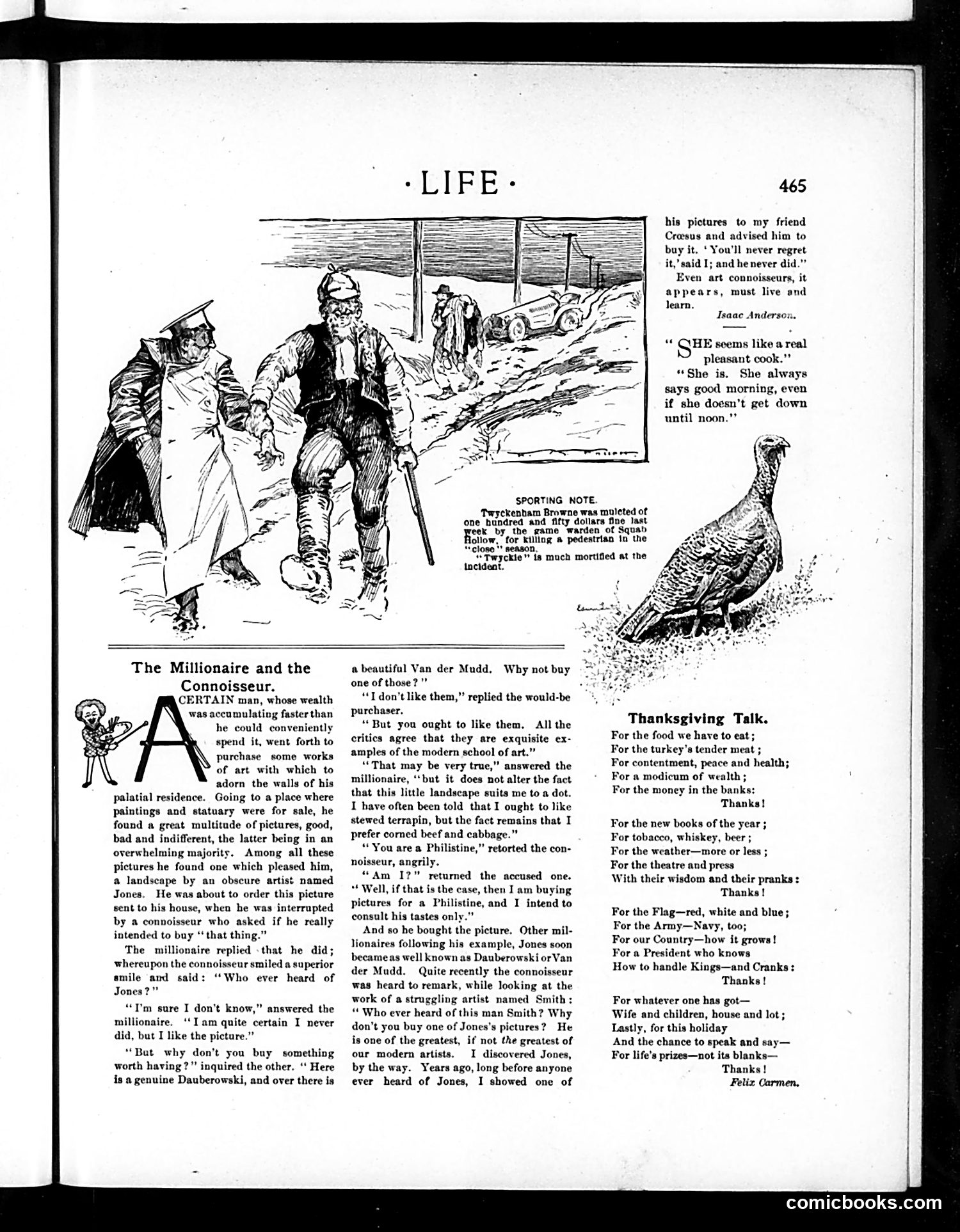
This satirical story mocks art world snobbery. A wealthy man buys a landscape by obscure artist "Jones" because he genuinely likes it. A self-important connoisseur ridicules his choice, insisting he should purchase famous names like "Dauberowski" or "Van der Mudd" instead—what critics approve of, not what suits personal taste. The millionaire refuses, comparing it to being told he *should* like stewed terrapin when he prefers corned beef and cabbage: taste cannot be dictated. Years later, Jones becomes famous. The same connoisseur now claims credit for "discovering" him, conveniently forgetting he'd dismissed the artist initially. **The satire targets:** pretentious art critics who value reputation over merit, and their tendency to retroactively claim prescience. It defends individual judgment against expert gatekeeping—a democratic sentiment typical of *Life* magazine's humor.
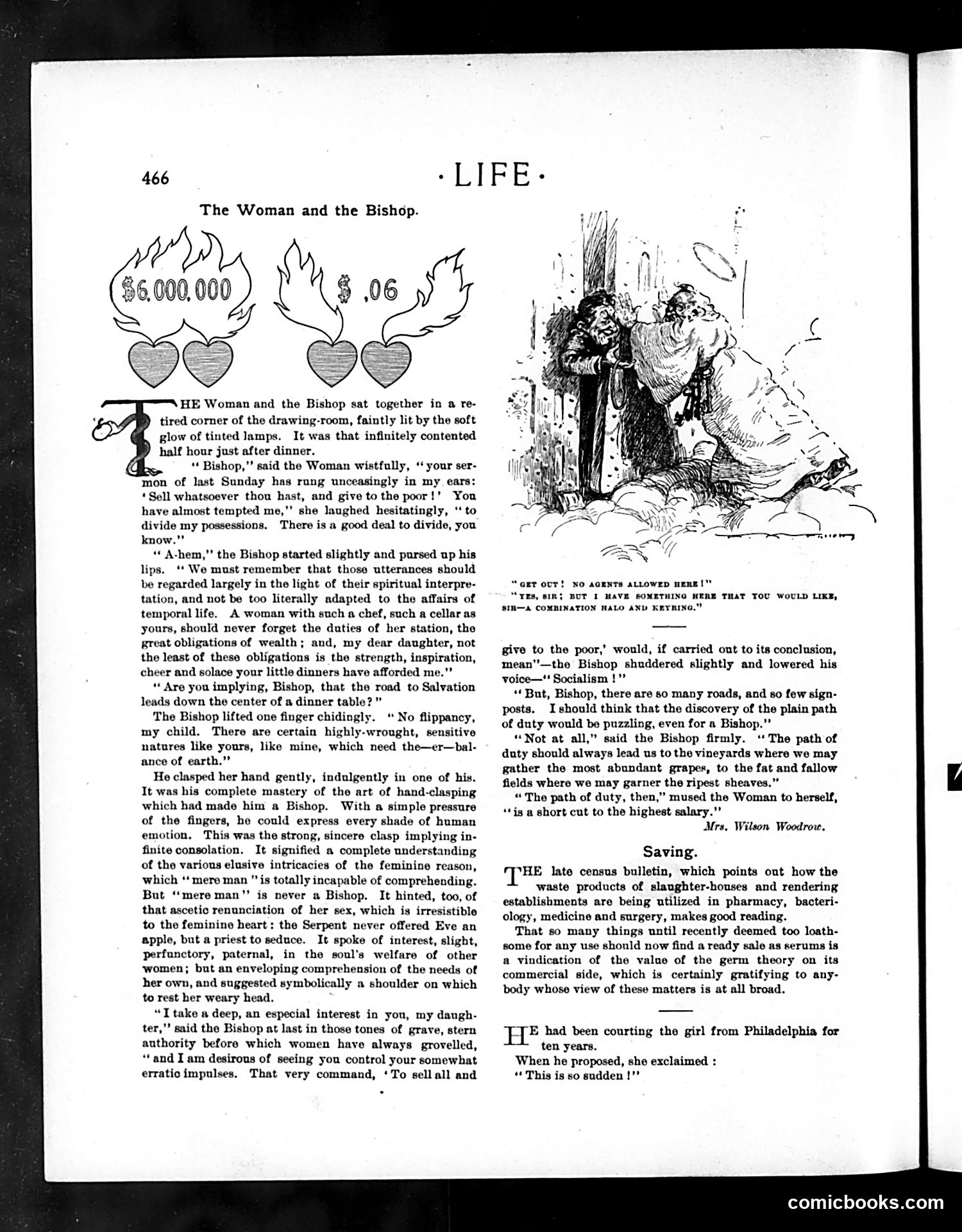
This satirical story mocks clerical hypocrisy. A wealthy woman quotes the Bishop's own sermon urging the poor to "sell all and give to the poor," suggesting she might do so. The Bishop hastily reinterprets his religious teaching as "spiritual" rather than literal—conveniently exempting the wealthy from actual sacrifice. The satire targets how clergy rationalize away Jesus's radical economic demands when applied to their comfortable donors. The Bishop's flowery language about "balance" and "spiritual interpretation" masks naked self-interest: he depends on her lavish dinners and patronage. His manipulative hand-clasping and paternal authority over women further expose his duplicity. The final punchline—his warning that literal charity would mean "Socialism"—crystallizes the critique: religious leaders used faith to discourage redistribution while serving wealthy congregants' interests.
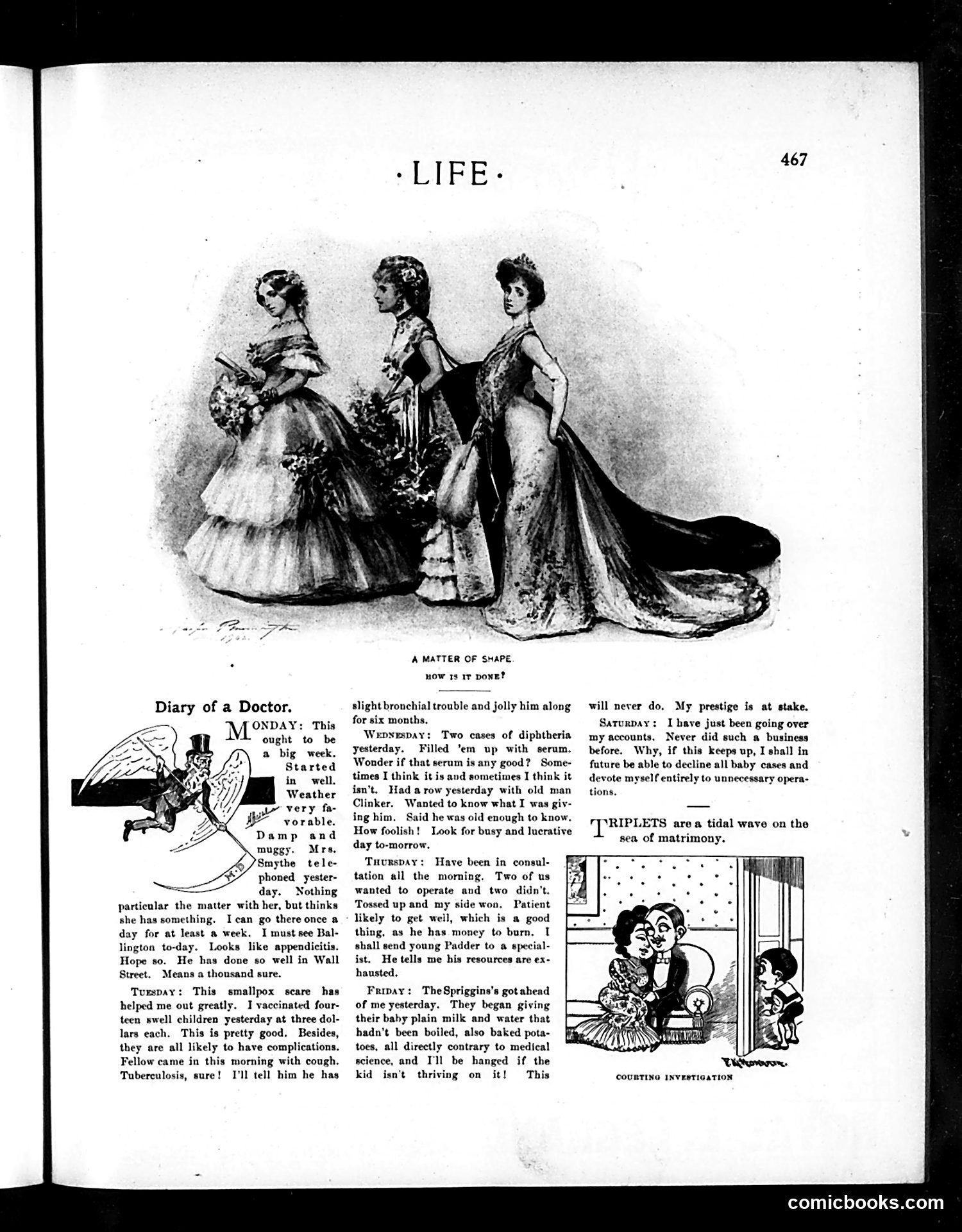
This page satirizes unethical medical practices of the era. The doctor's diary reveals cynicism about patient care: he prescribes unnecessary treatments, hopes patients develop complications (ensuring repeat visits), admits uncertainty about serum effectiveness, and performs surgery based on a coin toss rather than medical need. He charges wealthy patients more and deliberately misleads them with false diagnoses. The satire exposes how doctors prioritize profit over health—vaccinating children expecting complications, treating minor coughs as tuberculosis, and performing unnecessary operations. The final irony: when a patient ignores his advice and their child thrives, he's outraged because it threatens his prestige and income model. The accompanying illustration about "triplets" and the "courting investigation" cartoon appear unrelated filler. This was a common critique of American medicine's commercialization during this period.
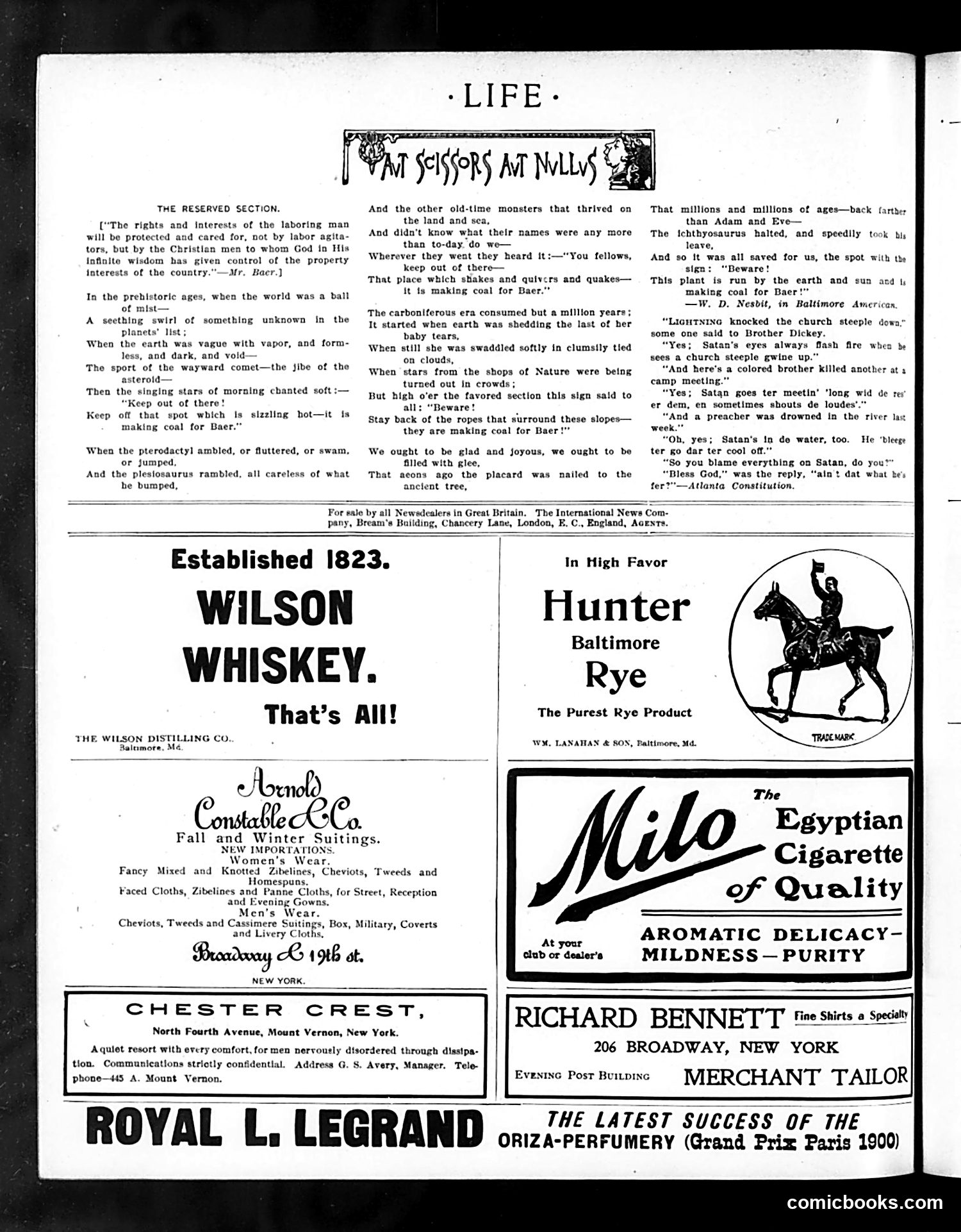
This page contains two distinct satirical pieces amid advertisements: **"The Reserved Section"** is a scathing poem mocking industrialist Mark Baer (or a figure representing coal/mining magnates). It sardonically suggests that since the Earth's formation—from prehistoric times through the carboniferous era—nature itself has reserved coal deposits exclusively "for Baer." The satire targets capitalists' claims that workers should trust "Christian men" who control property, suggesting such men act as though nature itself ordained their ownership. The poem ridicules this arrogant entitlement. **The second piece** appears to be a humorous dialect exchange mocking someone who attributes all misfortunes—a church collapse, murders, drowning—to Satan's interference. The joke likely critiques superstitious thinking or fatalism among certain communities. The page is primarily **advertisements** (whiskey, clothing, cigars, tailors) typical of early 1900s Life magazine, which mixed serious satire with commercial notices.
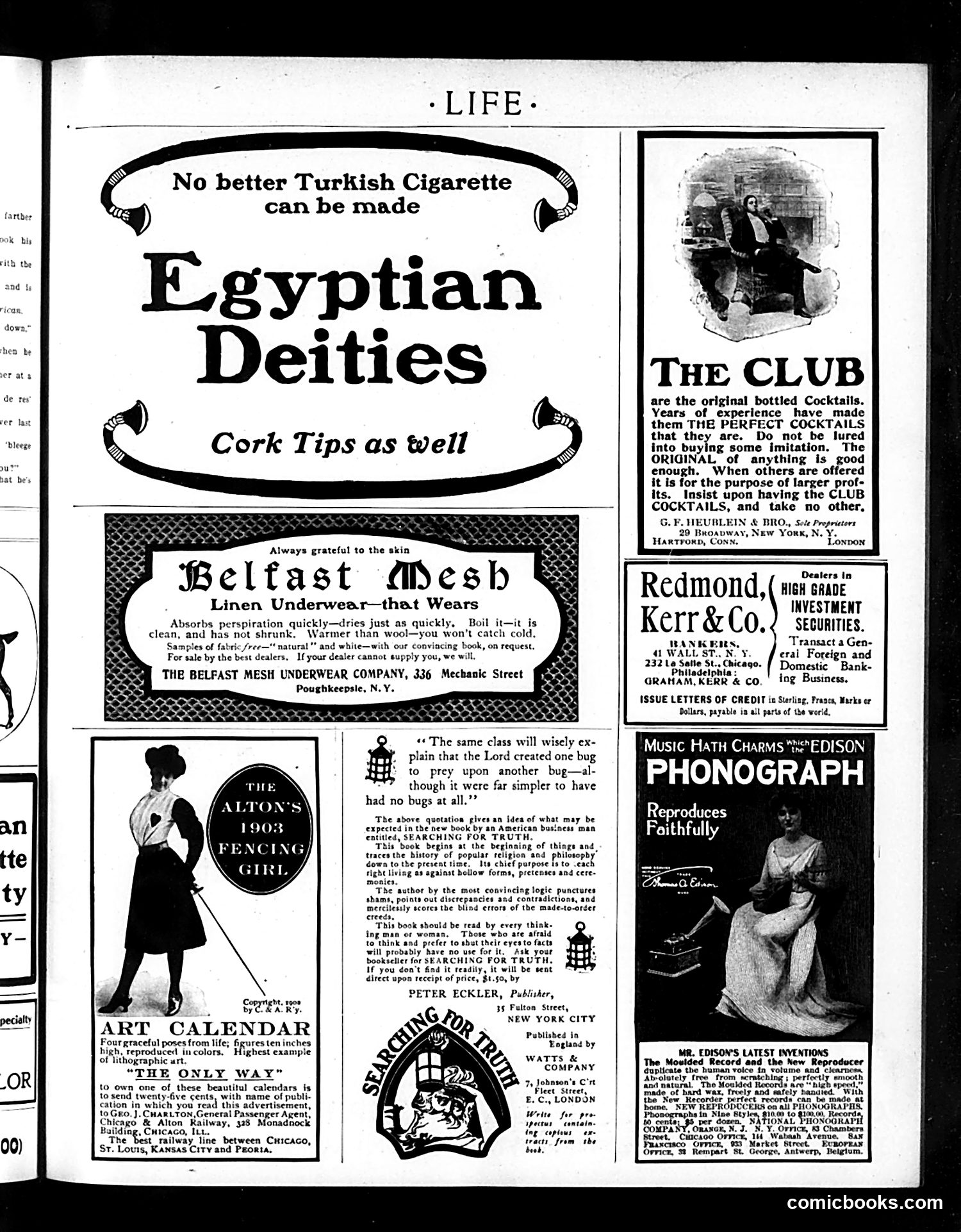
This is primarily an **advertising page**, not a satirical cartoon. The page contains multiple commercial advertisements typical of early 1900s American magazines. The largest ad promotes **Egyptian Deities cigarettes**, emphasizing their superiority as "Turkish cigarettes" with cork tips—a common marketing claim of the era when Turkish and Egyptian tobacco products were fashionable luxuries. Other notable ads include: - **Belfast Mesh underwear** (emphasizing durability and warmth) - **The Club bottled cocktails** (positioned as the "original" against imitations) - **Redmond, Kerr & Co.** (investment securities) - **Edison Phonograph** (emphasizing faithful sound reproduction) - **Art Calendar** and **"Searching for Truth" book** (cultural products) There's a small embedded quote about God creating bugs—seemingly promoting the philosophical book—but no coherent satirical cartoon or political message dominates the page. This appears to be a standard advertising section where Life monetized space by selling ads to various manufacturers and publishers.
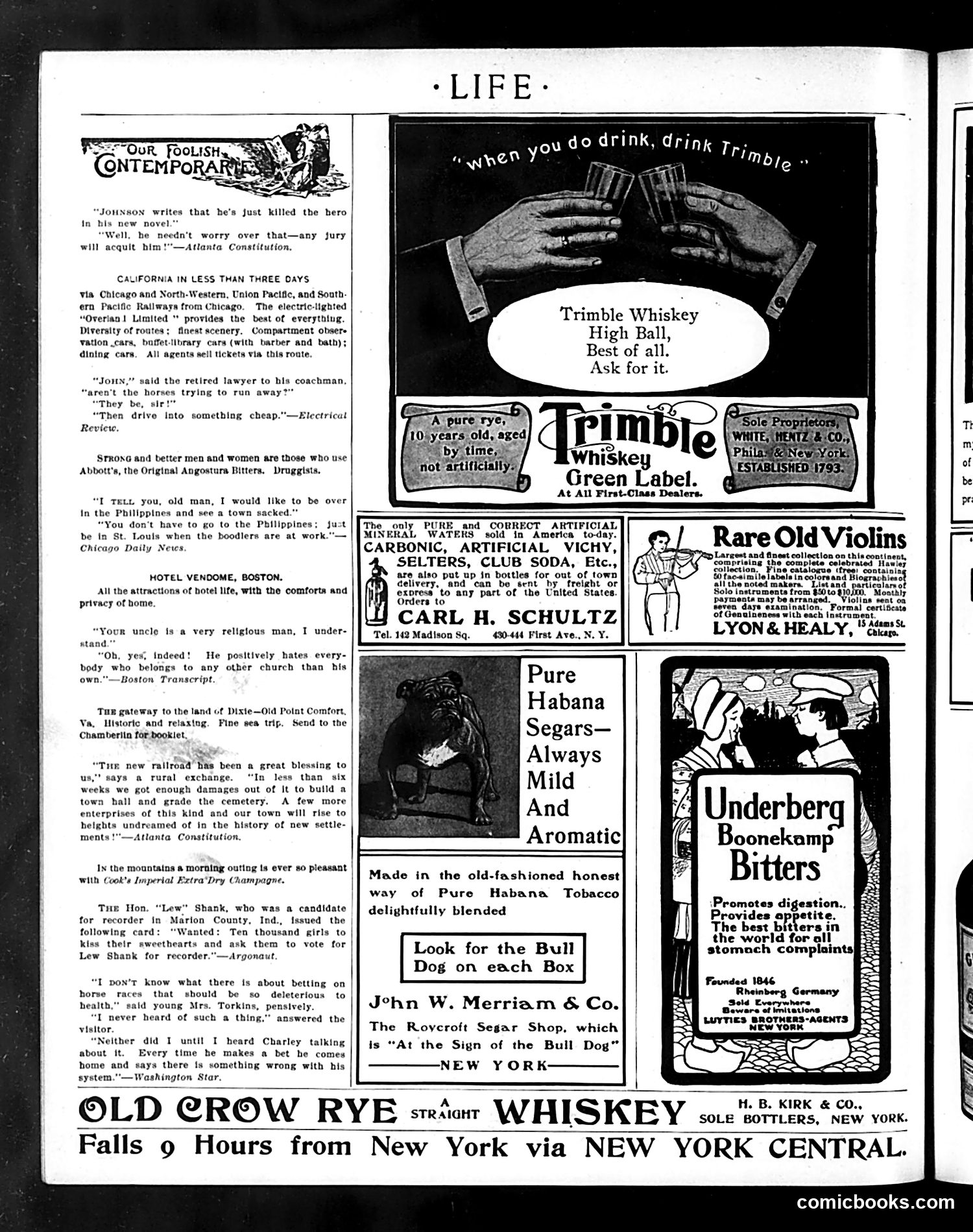
This is primarily an **advertising page** with humor snippets rather than political cartoons. The page showcases the magazine's satirical format: short, joke-like observations on contemporary American life mixed with product advertisements. The humor targets include: - **Literary criticism**: A quip that a novelist needn't worry about killing his hero—"any jury will acquit him," suggesting readers themselves commit violence casually. - **Urban corruption**: A joke about St. Louis "boodlers" (corrupt politicians/gangsters) causing damage, paralleling damage from the Philippines war, implying domestic corruption rivals foreign violence. - **Rural opportunism**: A town profiting from railroad accidents to fund civic improvements. - **Political desperation**: A candidate for recorder asking young women to vote for him via kisses. The **advertisements dominate**—whiskeys (Trimble, Old Crow), bitters, cigars, mineral waters, and violins. These reflect Gilded Age consumer culture. The page's satiric thrust is gentle mockery of American materialism, corruption, and social pretension rather than sharp political critique.
This page is primarily **advertising**, not political satire. It features: **Top section:** Book advertisements for four novels by popular authors (Corelli, Jerome, Fowler, Barr), all priced at $1.50, published by Dodd, Mead & Co. **Left column:** Alcohol advertisements—Martell's Three Star Brandy and John Hopkins & Co. Scotch Whiskies ("Glen Garry" and "Navy Liqueur"), marketed to bars and restaurants. **Large right section:** A White Steam Carriage advertisement emphasizing reliability, citing a 500-mile endurance contest from New York to Boston where White vehicles performed without breakdown. This appears to be early automotive marketing (appears to be circa 1900s based on vehicle design), promoting steam-powered automobiles as dependable transportation. The page reflects turn-of-the-century consumer culture: literature, spirits, and emerging automobile technology were all premium products marketed to affluent readers.
This page is primarily **advertising and publishing promotions**, not political satire. The main content includes: **Key Advertisement**: Leslie's Popular Monthly magazine offers a "Best Offer of the Year"—free November and December issues plus a 1903 College Girl Calendar to new subscribers paying $1.00 annually. **Featured Content**: The page promotes "The Misdemeanors of Nancy," described as "the most entertaining story of the year" (illustrated by Stanlawe), published by Doubleday, Page & Company for $1.50. **Other Advertisements**: Morton Trust Company, Dixon's American Pencils, Black Starr and Frost (precious stones), and Wassermann Brothers (stock brokers) occupy the remaining space. **Context for Modern Readers**: This represents typical early-1900s magazine promotion strategies—bundling free premiums with subscriptions and cross-promoting serialized fiction to drive readership. The "College Girl Calendar" suggests the era's emerging focus on young women as consumers.
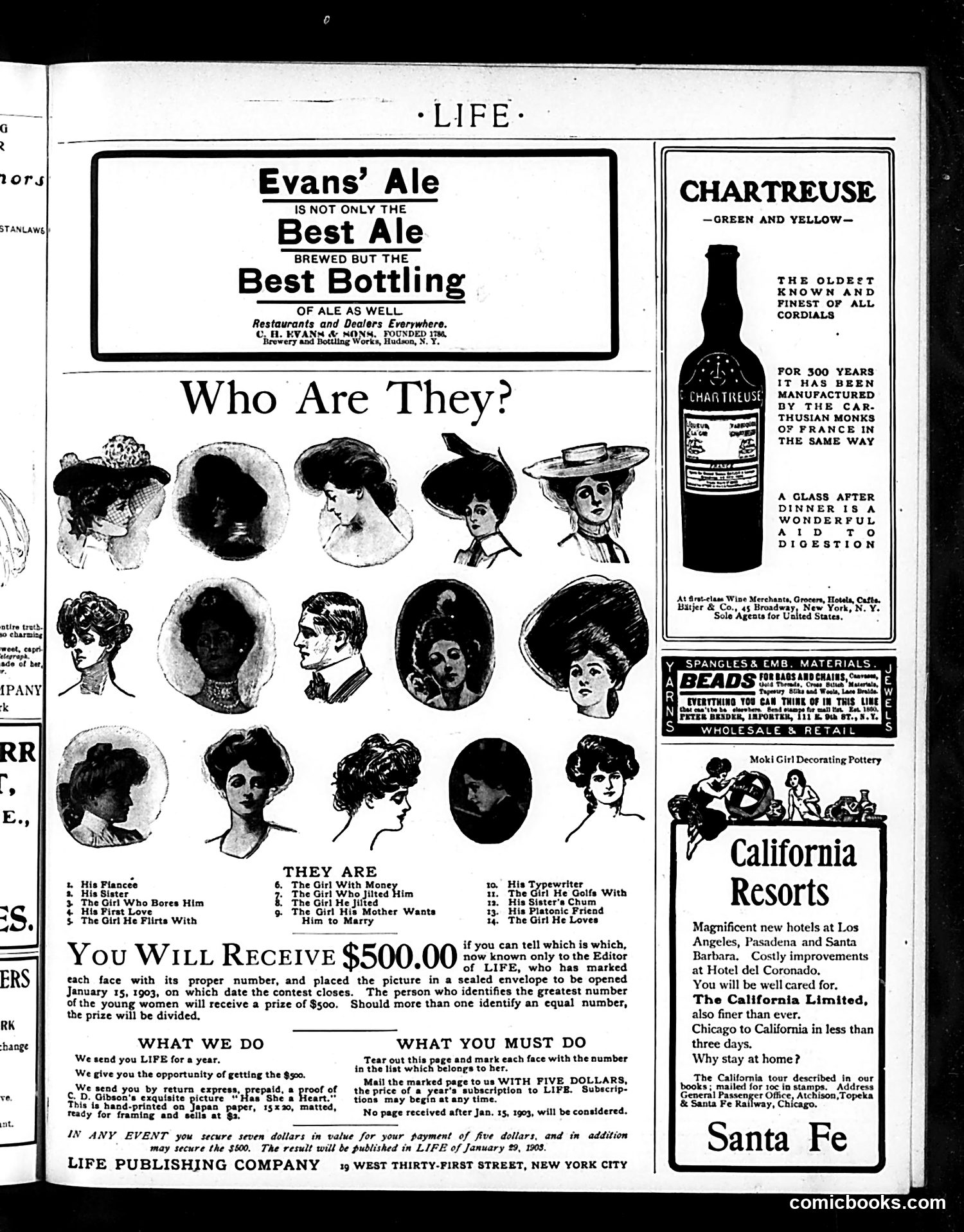
This page is primarily a **contest advertisement** rather than political satire. Life magazine is running a puzzle offering a **$500 prize** to readers who can correctly identify 14 illustrated female faces matched to relationship categories (e.g., "His Fiancée," "The Girl Who Bores Him," "His Platonic Friend"). The satire lies in the **premise itself**: the joke mocks men's romantic confusion and duplicity. The categories reveal a cynical view of male behavior—men simultaneously maintain multiple romantic interests (fiancées, ex-girlfriends, girls they've jilted, girls their mothers approve of, etc.). The humor works because early 1900s readers would recognize the type—the man juggling various female relationships without clear commitment. This was a common theme in Life's satirical content. The page also carries standard period advertisements (Evans' Ale, Chartreuse liqueur, California resorts) unrelated to the contest satire itself.
This page is primarily **advertising**, not satirical content. It contains five commercial advertisements from the early 1900s: 1. **Burrowes Pool/Billiard Tables** - home recreation equipment ($15-$45) 2. **S.H.&M. Skirt Protector** - a practical device to prevent wear on women's drop skirts 3. **Londonderry Lithia Water** - a mineral water advertised as a morning health tonic 4. **Siede's Furs and Fashion** - luxury Parisian clothing and fur coats for wealthy clientele 5. **Brighton Silk Garter** - men's hosiery accessory The ads reflect **Edwardian-era consumer culture**: home entertainment for the middle class, protective devices for women's elaborate clothing, health tonics (common in this period), and luxury fashion for the affluent. No political satire is present on this page—it's a straightforward commercial section of the magazine.
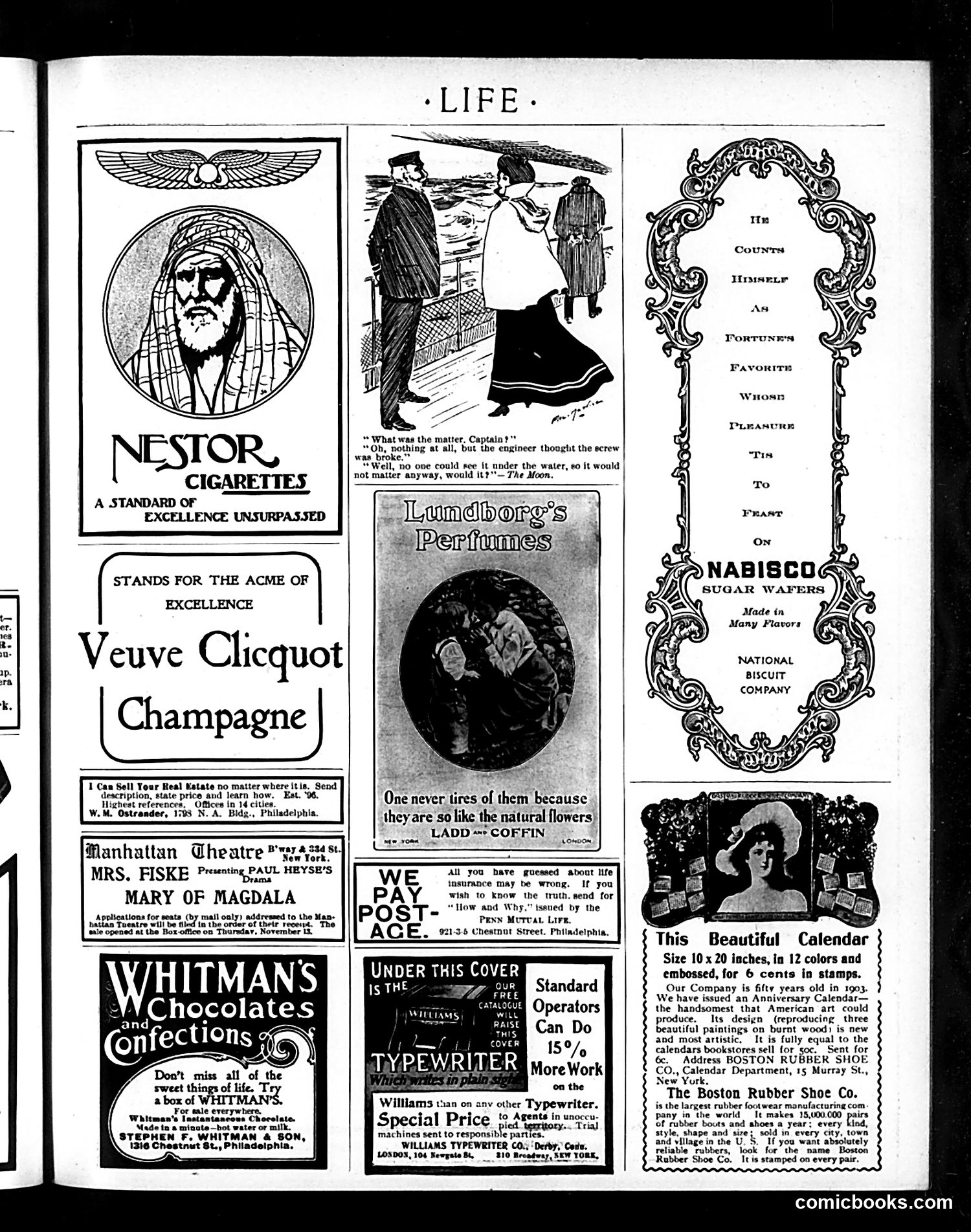
This is primarily an **advertising page** from Life magazine, circa 1903 (based on the Boston Rubber Shoe Company's 50th anniversary reference). The only editorial content is a **single captioned cartoon** (top center) depicting two men discussing a ship's screw: one reassures the captain that since no one can see the broken part underwater, it doesn't matter anyway. This is gentle, absurdist humor about willful ignorance—the joke being that hidden problems remain problems. The remainder of the page consists of advertisements for luxury goods and services typical of the era: Nestor Cigarettes, Veuve Clicquot Champagne, Lundborg's Perfumes, Nabisco Sugar Wafers, Whitman's Chocolates, Williams Typewriters, and various other products. There's also a theater advertisement for "Mary of Magdala." The ads employ period-typical appeals to sophistication and quality. The page itself is not satirical—it's a commercial product designed to fund the magazine through paid advertising.
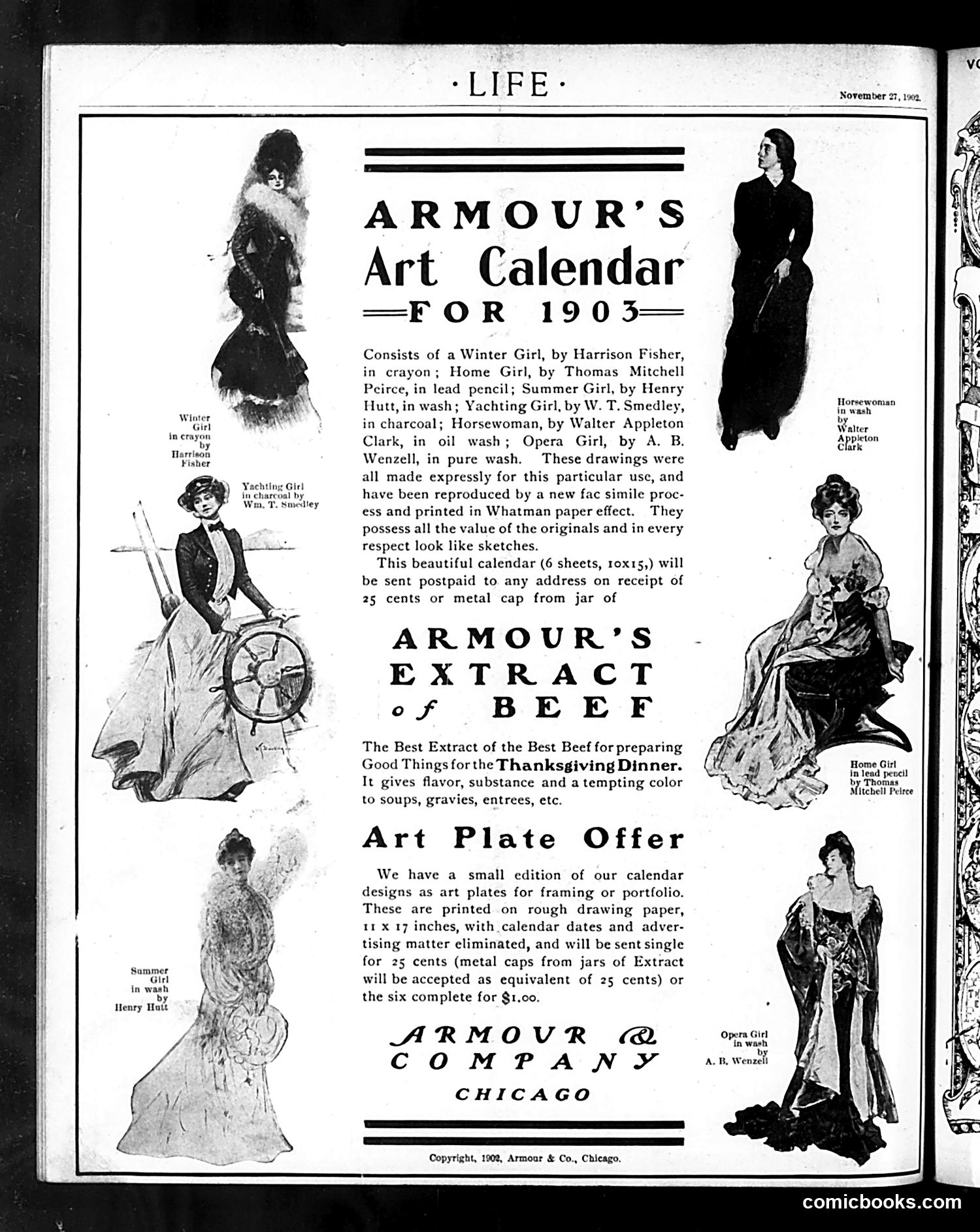
This is a full-page advertisement, not political satire. Armour & Company, a major Chicago meatpacking firm, promoted their 1903 calendar featuring six illustrated "girl" portraits by prominent commercial artists of the era (Harrison Fisher, Henry Hutt, W.T. Smedley, Walter Appleton Clark, A.B. Wenzell, and Thomas Mitchell Peirce). The gimmick: consumers could obtain the calendar by sending 25 cents or a metal jar cap from Armour's Extract of Beef. The ad emphasizes the calendar's artistic legitimacy—drawn "expressly" for this use and reproduced via new printing techniques on quality paper. This exemplifies early 1900s advertising strategy: linking consumer products to high-art imagery and attractive imagery to drive brand loyalty. The "girl" motifs (Winter Girl, Yachting Girl, Opera Girl, etc.) appealed to middle-class aspirations while making beef extract seem fashionable and refined.