
Life, 1902-11-27 · page 6 of 26
Life — November 27, 1902 — page 6: what you’re looking at
What you’re looking at
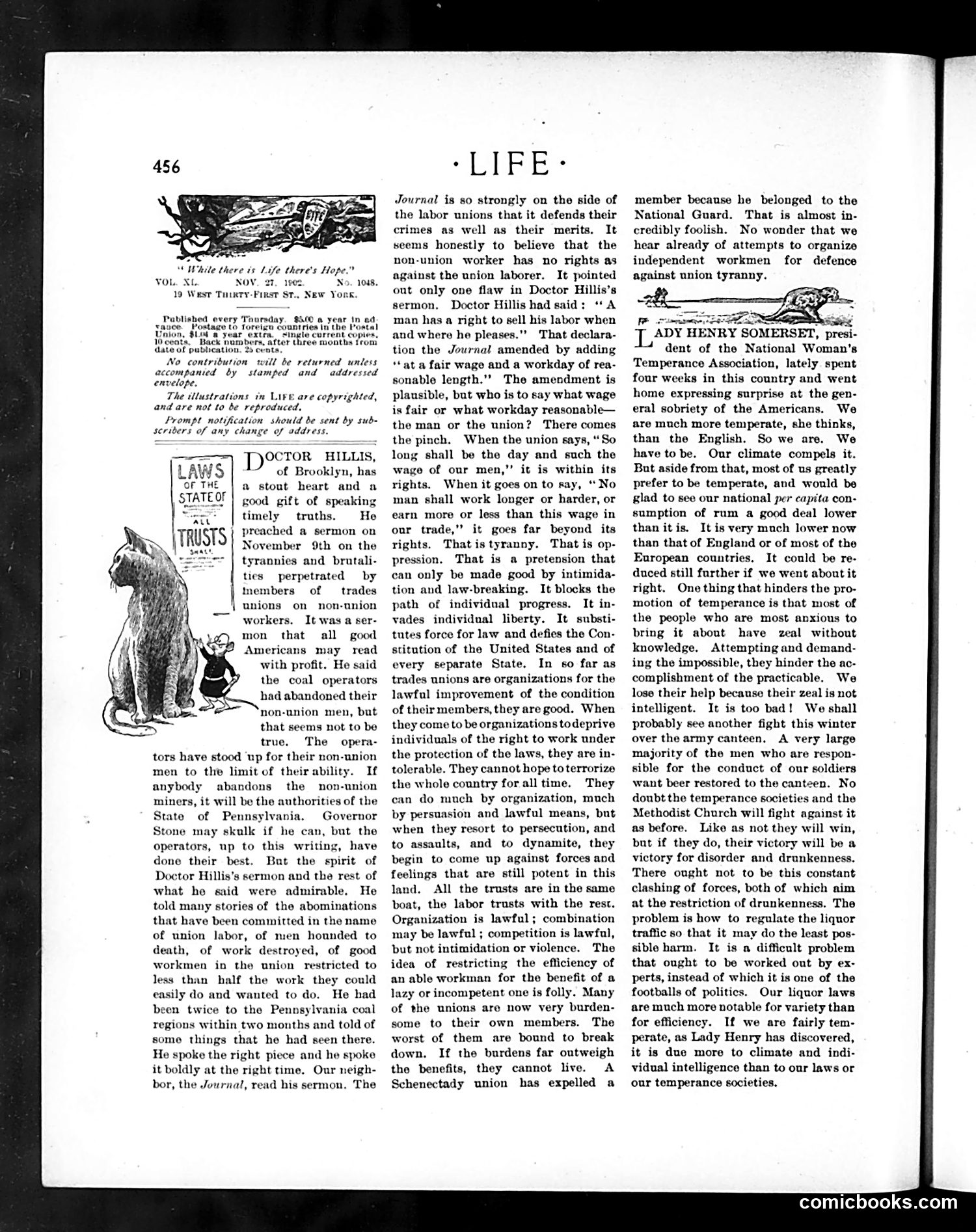
The cartoon depicts a large, aggressive dog labeled "TRUSTS" attacking a smaller figure representing a worker or laborer. The accompanying article discusses Doctor Hillis's sermon criticizing labor unions while defending industrial trusts. The satire is pointed: while Hillis condemned unions as lawless and violent organizations threatening American liberty, the cartoon visually inverts this argument—depicting trusts (monopolistic corporations) as the actual aggressive force attacking workers. The dog metaphor suggests trusts operate without restraint or law, despite Hillis's claims that unions represent the real lawlessness. This reflects Progressive Era anxieties about unchecked corporate power versus labor organizing, suggesting the magazine sided with worker protections against monopolistic business practices.
📄 Transcribed text from this page (OCR, searchable)
Machine-transcribed from the original scan — historical spelling and the odd misread are preserved.
While there is Life there's Hope.” Vou. X NOV. 27, 1802. N 19 West Tuixty-Finst St.. New York. raday. $00 a y ign countries In t , $Lod a fa. single corre y Weeats. Back after three months trom date of publication, 25 cents, No contribution will be returned uniess accompanied by stamped and addressed envelope. The illustrations in LIFE are copyrighted, and are not to be reproduced, Prompt notification should be sent by sub- scribers of any change of address. Pablished every Ta e Postage = L OCTOR HILLIS, LAWS of Brooklyn, has a stout heart and a good gift of speaking timely truths. He } preached a sermon on November 9th on the tyrannies and brutali- ties perpetrated by members of trades unions on non-union workers. It was a ser- mon that all good Americans may read with profit. He said the coal operators had abandoned their non-union men, but that seems not to be true. The opera- tors have stood ‘up for their non-union men to the limit of their ability. If anybody abandons the non-union miners, it will be the authorities of the State of Pennsylvania, Governor Stone may skulk if he can, but the operators, up to this writing, have done their best. But the spirit of Doctor Hillis’s sermon and the rest of what he said were admirable. He told many stories of the abominations that have been committed in the name of union labor, of men hounded to death, of work destroyed, of good workmen in the union restricted to less than half the work they could easily do and wanted to do. He had been twice to the Pennsylvania coal regions within two months and told of some things that he had seen there. He spoke the right piece and he spoke it boldly at the right time. Our neigh- bor, the Journal, read his sermon. The ~ LIIRIE * Journal is so strongly on the side of the labor unions that it defends their crimes as well as their merits. It seems honestly to believe that the non-union worker has no rights as against the union laborer. It pointed out only one flaw in Doctor Hillis’s sermon. Doctor Hillis had said: “A man has a right to sell his labor when and where he pleases." That declara- tion the Journal amended by adding ‘*ata fair wage and a workday of rea- sonable length.’? The amendment is plausible, but who is to say what wage is fair or what workday reasonable— the man or the union? There comes the pinch. When the union says, “So long shall be the day and such the wage of our men,” it is within its rights, When it goes on to say, “No man shall work longer or harder, or earn more or less than this wage in our trade,” it goes far beyond its rights. Thatis tyranny. That is op- pression. That is a pretension that can only be made good by intimida- tion and law-breaking. It blocks the path of individual progress. It in- vades individual liberty, It substi- tutes force for law and defies the Con- stitution of the United States and of every separate State. In so far as trades unions are organizations for the lawful improvement of the condition of their members, they are good. When they come to be organizations todeprive individuals of the right to work under the protection of the laws, they are in- tolerable. They cannot hope to terrorize the whole country for alltime. They can do much by organization, much by persuasion and lawful means, but when they resort to persecution, and to assaults, and to dynamite, they begin to come up against forces and feelings that are still potent in this land. All the trusts are in the same boat, the labor trusts with the rest. Organization is lawful; combination may be lawful ; competition is lawfal, but not intimidation or violence. The idea of restricting the efficiency of an able workman for the benefit of a lazy or incompetent one is folly. Many of the unions are now very burden- some to their own members. The worst of them are bound to break down. If the burdens far outweigh the benefits, they cannot live. A Schenectady union has expelled a member because he belonged to the National Guard. That is almost in- credibly foolish. No wonder that we hear already of attempts to organize independent workmen for defence against union tyranny. one aS d ert HENRY SOMERSET, presi- dent of the National Woman's Temperance Association, lately spent four weeks in this country and went home expressing surprise at the gen- eral sobriety of the Americans. We are much more temperate, she thinks, than the English. So we are. We have to be. Our climate compels it. But aside from that, most of us greatly prefer to be temperate, and would be glad to see our national per capita con- sumption of rum a good deal lower than itis. It is very mach lower now than that of England or of most of the European countries. It could be re- duced still farther if we went about it right. One thing that hinders the pro- motion of temperance is that most of the people who are most anxious to bring it about have zeal without knowledge. Attempting and demand- ing the impossible, they hinder the ac- complishment of the practicable. We lose their help because their zeal is not intelligent. It is too bad! We shall probably see another fight this winter over the army canteen. A very large majority of the men who are respon- sible for the conduct of our soldiers want beer restored to the canteen. No doubt the temperance societies and the Methodist Church will fight against it as before. Like as not they will win, but if they do, their victory will be a victory for disorder and drunkenness. There onght not to be this constant clashing of forces, both of which aim at the restriction of drunkenness. The problem is how to regulate the liquor traffic so that it may do the least pos- sible harm. It is a difficult problem that ought to be worked out by ex- perts, instead of which it is one of the footballs of politics. Our liquor laws are much more notable for variety than for efficiency. If we are fairly tem- perate, as Lady Henry has discovered, it is due more to climate and indi- vidual intelligence than to our laws or our temperance societies. comicbooks.com