
Life, 1902-11-27 · page 14 of 26
Life — November 27, 1902 — page 14: what you’re looking at
What you’re looking at
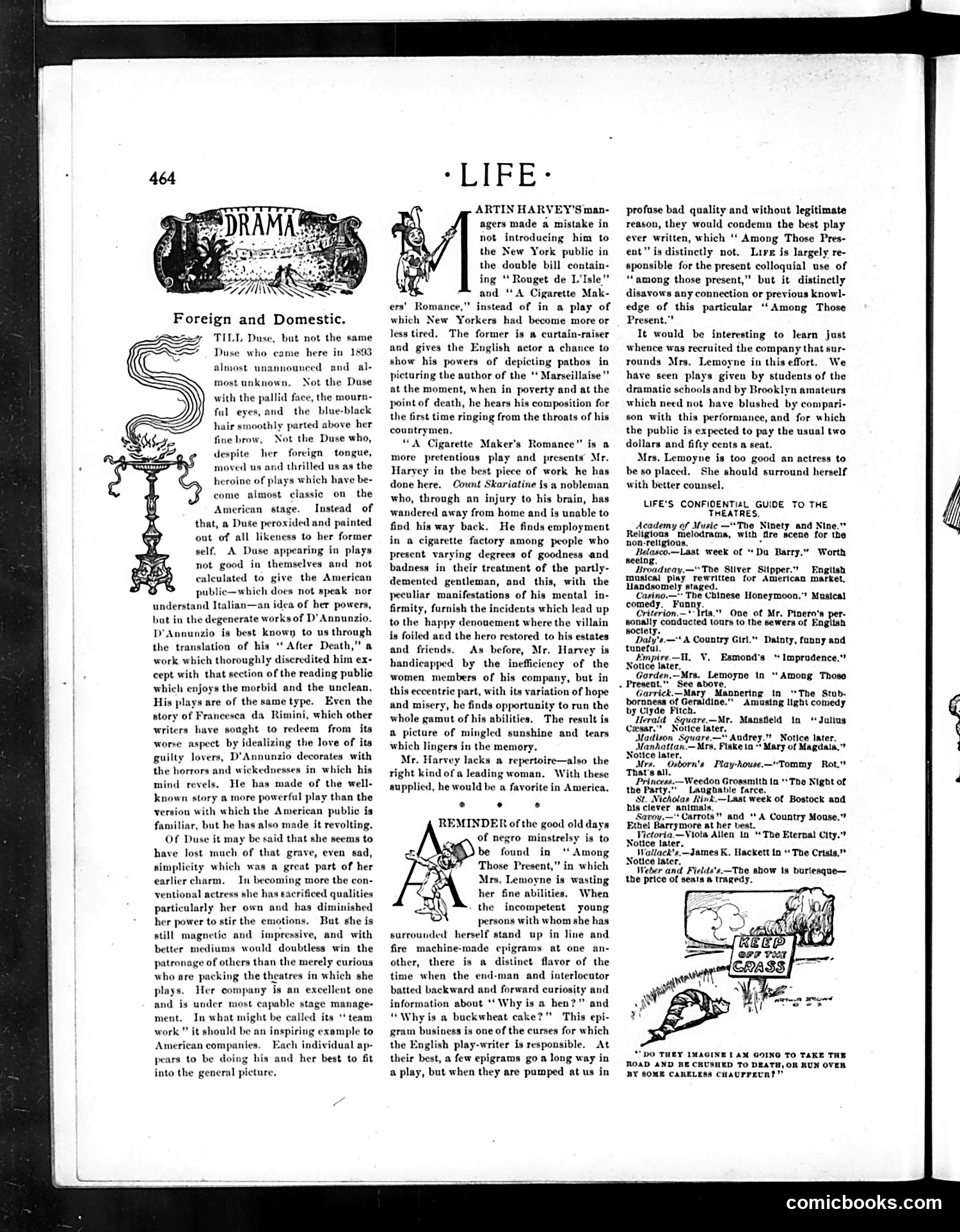
This page contains theater criticism of productions featuring two famous actors: **Eleonora Duse** (the renowned Italian actress) and **Martin Harvey** (English actor). **The Duse critique** laments her artistic decline. The reviewer notes she was once a magnificent, understated performer who captivated American audiences. Now, "peroxided and painted," she appears in inferior plays—specifically works by D'Annunzio, whom the critic dismisses as morbid and "degenerate." The satire suggests she's compromised her talent for commercial ventures that draw only the "merely curious." **The Harvey section** praises his acting abilities but criticizes his managers for not properly launching him with stronger supporting material and company members. The small cartoon at bottom-right appears to show a humorous domestic scene (text is illegible at this resolution) unrelated to the theater reviews above. The page exemplifies *Life*'s role as arbiter of cultural taste, using satire to critique artistic decline and commercialism in American theater circa 1893.
📄 Transcribed text from this page (OCR, searchable)
Machine-transcribed from the original scan — historical spelling and the odd misread are preserved.
Foreign and Domestic. Sx4y TILT Duse, but not the same in 1893 almost unannounced and al- most unknown, Not the Duse with the pallid face, the mourn- ful eyes, and the blue-black hair smoothly parted above her fine brow, Not the Duse who, despite her foreign tongue, moved us and thrilled us as the heroine of plays which have be- come almost classic on the American stage. Instead of that, a Duse peroxided and painted out of all likeness to her former If. A Duse appearing in plays not good in themselves and not calculated to give the American public—which does not speak nor understand Italian—an idea of her powers, but in the degenerate works of D' Annunzio, D'Annunzio is best known to us through the translation of his ‘‘ After Death,” a work which thoroughly discredited him ex- cept with that section of the reading public which enjoys the morbid and the unclean. His plays are of the same type. Even the story of Francesca da Rimini, which other writers have sought to redeem from its worse aspect by idealizing the love of its guilty lovers, D'Annunzio decorates with the horrors and wickednesses in which his mind revels, He has made of the well- known story a more powerful play than the version with which the American public is fami but he has also made it revolting. Of Duse it may be said that she seems to have lost much of that grave, even sad, simplicity which was a great part of her earlier charm. In becoming more the con- ventional actress she has sacrificed qualities particularly her own and has diminished her power to stir the emotions, But she is still magnetic and impressive, and with better mediums would doubtless win the patronage of others than the merely curious who are packing the theatres in which she plays. Her company is an excellent one and is under most capable stage manage- ment. In what might be called its ‘team work” it should be an inspiring example to American companies. Each individual ap- pears to be doing his and her best to fit into the general picture, Duse who came her “LIFE ARTIN HARVEY'S man- agers made a mistake in not introducing him to the New York public in the double bill contain- ing “ Rouget de L’Isle”” and “A Cigarette Mak- ers’ Romance,” instead of in a play of which New Yorkers had become more or less tired. The former is a curtain-raiser and gives the English actor a chance to show his powers of depicting pathos in picturing the author of the ‘ Marseillaise” at the moment, when in poverty and at the point of death, he hears his composition for the first time ringing from the throats of his countrymen. “A Cigarette Maker's Romance” is a more pretentious play and presents’ Mr. Haryey in the best piece of work he has done here. Count Skariatine is a nobleman who, through an injury to his brain, has wandered away from home and is unable to find his way back. He finds employment in a cigarette factory among people who present varying degrees of goodness and badness in their treatment of the partly- demented gentleman, and this, with the peculiar manifestations of his mental in- firmity, furnish the incidents which lead up tothe happy denouement where the villain is foiled and the hero restored to his estates and friends. As before, Mr. Harvey is handicapped by the inefficiency of the women members of his company, but in this eccentric part, with its variation of hope and misery, he finds opportunity to run the whole gamut of his abilities. The result is a picture of mingled sunshine and tears which lingers in the memory. Mr. Harvey lacks a repertoire—also the right kind of a leading woman. With these supplied, he would be a favorite in America, e . ° REMINDER of the good old days of negro minstrelsy is to be found in “ Among Those Present,” in which Mrs. Lemoyne is wasting her fine abilities. When the incompetent young persons with whom she has surrounded herself stand up in line and fire machine-made epigrams at one an- other, there is a distinct flavor of the time when the end-man and interlocutor batted backward and forward curiosity and information about ‘‘ Why is a hen?” and “Why is a buckwheat cake?" This epi- gram business is one of the curses for which the English play-writer is responsible. At their best, a few epigrams goa long way in a play, but when they are pumped at us in « Present. profuse bad quality and without legitimate reason, they would condemn the best play ever written, which “ Among Those Pres- ent” is distinctly not. Lire is largely re- sponsible for the present colloquial use of “among those present,” but it distinctly disavows any connection or previous knowl- edge of this particular “Among Those Present.” It would be interesting to learn just whence was recruited the company that sur- rounds Mrs. Lemoyne in this effort. We have seen plays given by students of the dramatic schools and by Brooklyn amateurs which need not have blushed by compari- son with this performance, and for which the public is expected to pay the usual two dollars and fifty cents a seat. Mrs. Lemoyne is too good an actress to be so placed. She should surround herself with better counsel, LIFE'S CONFIDENTIAL GUIDE THEATRES. Academy of Music —“The Ninety and Nin Religious “melodrama, with fire scene for the non-religious, g Belasco.—Last week of “Da Barry. Worth seeing. Broadway.—"The Sliver Sitpper.” Engitsh musical play rewritten for American market. Handsomely staged. Casino.— The Chinese Honeymoon.”’ Musical comedy.” Funny Criterion.—*"Irta.” One of Mr. Pinero's per- sonally conducted tours to the sewers of Engitsh soctety. Daty's.—' A Country Giri.” Dainty, fanny and tuneful. Empire—UW, V, Esmond's “Impradence."* Notice later, Garden. TO THE ‘Mrs. Lemoyne in “Among Those See above, Garrick.—Mary Mannering in “The Stub- bornness of Geraldine." Amasing light comedy by Clyde Fitch. Herald Square—Mr. Mansfeld tn Cwesar.* Notice later. Madison Square—" Audrey." Notice later. Manhattan.— Mrs, Fiske tn * Mary of Magdala,”* Notice later, Cstorn's Playhouse —Tommy Rot.” Weedon Grossmith tn “The Night of Laughable farce. St, Nicholas Rink.—Last week of Bostock and his clever animals. Savoy.—"* Carrots” and ‘A Country Mouse."* Ethel Barrymore at her vest. Victoria —Viola Allen Ln The Eternal City."” Notice later. Wallack"s,—James K. Hackett in “The Crista,”* Notice later, Weber and Fields's.—The show 18 buresque— the price of seats a tragedy. “Jalias “Do THEY IMAGINE TAM GOING TO TAKE THE ROAD AND BE CRUSHED TO DEATH, OR RUN OVER BY SOME CARELESS CHaAUrrEUR?” comicbooks.com