
Life, 1902-11-27 · page 8 of 26
Life — November 27, 1902 — page 8: what you’re looking at
What you’re looking at
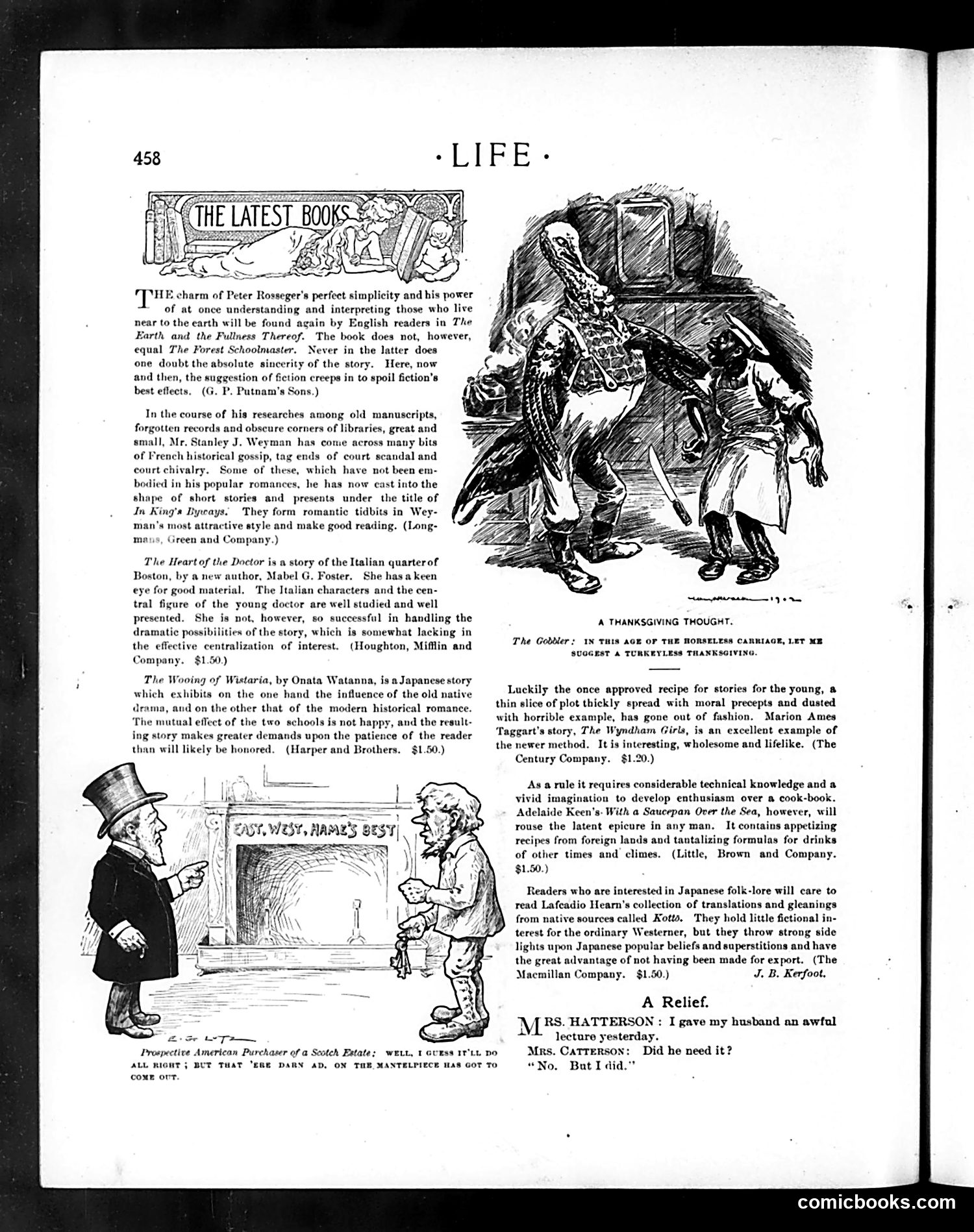
This cartoon satirizes the American purchasing of Scottish estates. The well-dressed man (labeled "Prospective American Purchaser of a Scotch Estate") expresses satisfaction that an ornate mantelpiece advertised as part of the property sale will be removed before delivery. The joke targets wealthy American industrialists of the period who bought European country estates as status symbols, often sight-unseen or with misleading representations. The cartoon mocks both the Americans' eager gullibility and the cunning of sellers who would strip valuable fixtures from properties after the sale was agreed upon. The humor relies on the viewer recognizing this as a common scam of the era, where transatlantic real estate deals frequently disappointed naive American buyers.
📄 Transcribed text from this page (OCR, searchable)
Machine-transcribed from the original scan — historical spelling and the odd misread are preserved.
HE charm of Peter Rosseger's perfect simplicity and his power of at once understanding and interpreting those who live near to the earth will be found again by English readers in The Earth and the Fullness Thereof. The book does not, however, equal The Forest Schoolmaster. Never in the latter does one doubt the absolute sincerity of the story. Here, now and then, the suggestion of fiction creeps in to spoil fiction’s best eflects. (G. P. Putnam's Sons.) In the course of his researches among old manuscripts, forgotten records and obscure corners of libraries, great and small, Mr, Stanley J, Weyman has come across many bits of French historical gossip, tag ends of court scandal and court chivalry. Some of these, which have not been em- bodied in his popular romances, he has now cast into the shape of short stories and presents under the title of In King's Byways. They form romantic tidbits in Wey- man’s most attractive style and make good reading. (Long- mans, Green and Company.) The Heart of the Doctor is a story of the Italian quarter of Boston, by a new author, Mabel G. Foster. She has a keen eye for good material, The Italian characters and the cen- tral figure of the young doctor are well studied and well presented. She is not, however, so successful in handling the dramatic possibilities of the story, which is somewhat lacking in the effective centralization of interest. (Houghton, Mifflin and Company. $1.50.) The Wooing of Wistaria, by Onata Watanna, is a Japanese story which exhibits on the one hand the influence of the old native na, and on the other that of the modern historical romance. ‘The mutual effect of the two schools is not happy, and the result- ing story makes greater demands upon the patience of the reader than will likely be honored. (Harper and Brothers. $1.50.) Prospective American Purchaser of a Scotch Estate; wut, 1 GUESS ITLL po j BUT THAT ‘ERE DARN AD, ON THE MANTELPIECE mAs GoT TO ALL RIG! cour ov. eae a A THANKSGIVING THOUGHT. The Gobbler: 18 THIS AGE OF THE MORSELESS CARRIAGE, LET ME SUGGEST A TURKEYLESS THANKSGIVING. Luckily the once approved recipe for stories for the young, thin slice of plot thickly spread with moral precepts and dusted with horrible example, has gone out of fashion, Marion Ames Taggart's story, The Wyndham Girls, is an excellent example of the newer method. It is interesting, wholesome and lifelike. (The Century Company. $1.20.) Asa rule it requires considerable technical knowledge and a vivid imagination to develop enthusiasm over a cook-book. Adelaide Keen's: With a Saucepan Over the Sea, however, will rouse the latent epicure in any man. It contains appetizing recipes from foreign lands and tantalizing formulas for drinks of other times and’ climes. (Little, Brown and Company. $1.50.) Readers who are interested in Japanese folk-lore will care to read Lafcadio Hearn’s collection of translations and gleanings from native sources called Kotts. They hold little fictional in- terest for the ordinary Westerner, but they throw strong side lights upon Japanese popular beliefs and superstitions and have the great advantage of not having been made for export. (The Macmillan Company. $1.50.) J. B. Kerfoot. A Relief. RS. HATTERSON : I gave my husband an awful lecture yesterday. Mrs. CaTTERso: Did he need it? “No. But I did. comicbooks.com