
A complete issue · 20 pages · 1902
Life — July 17, 1902
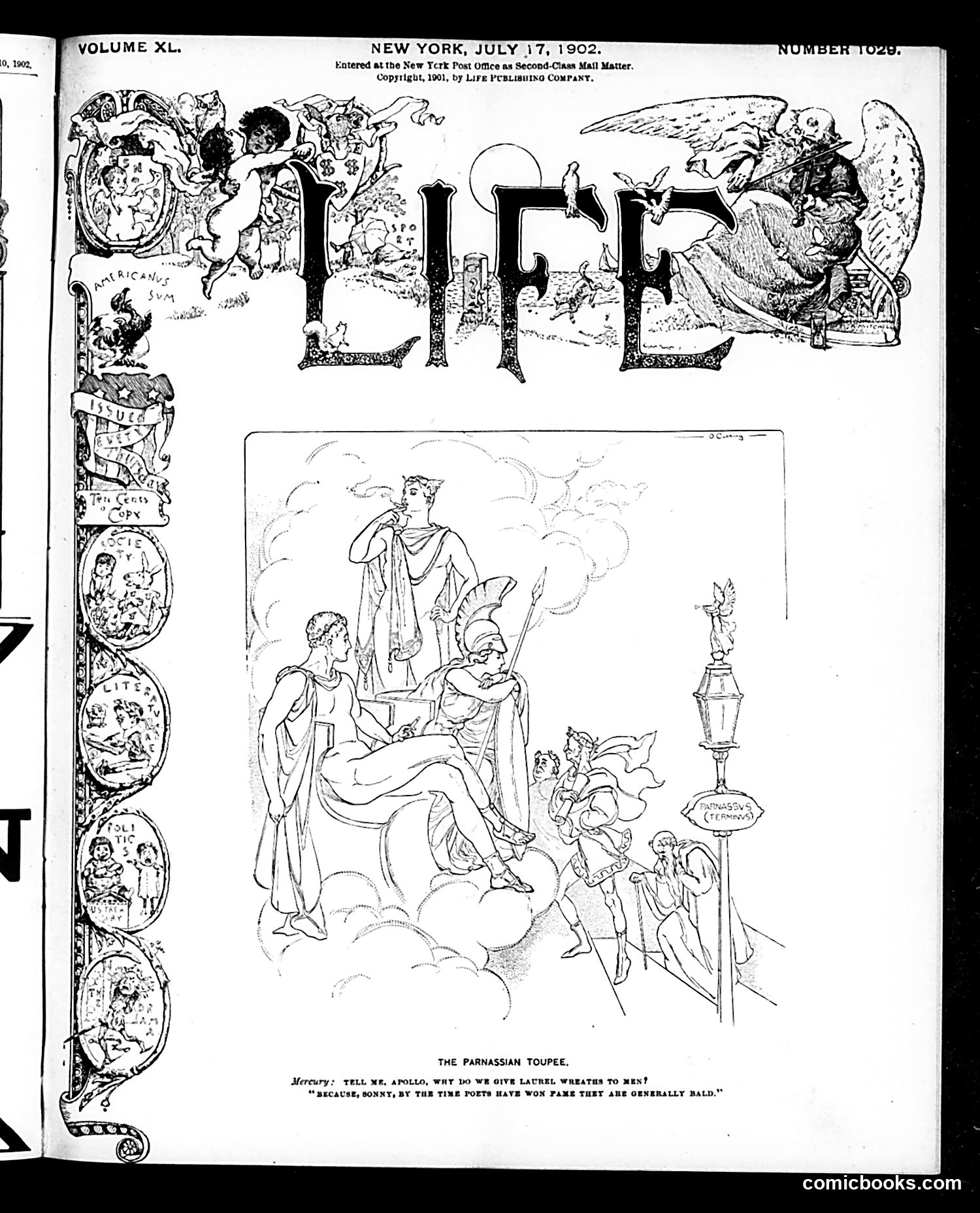
This cartoon depicts a classical scene set on Mount Parnassus (the mythological home of the Muses and Apollo). Mercury addresses Apollo with a pointed joke: "Tell me, Apollo, why do we give Laurel wreaths to men? Because, Dons, by the time poets have fame they are generally bald." The satire mocks bald male poets and writers of the era—suggesting that by the time a poet achieves sufficient fame to receive laurels (symbolic of poetic achievement), baldness has typically set in. The reference to a "toupee" in the title indicates the cartoon may be satirizing a specific contemporary poet, though the figure is unclear from the image alone. It's a humorous jab at the physical toll of aging combined with poetic ambition.
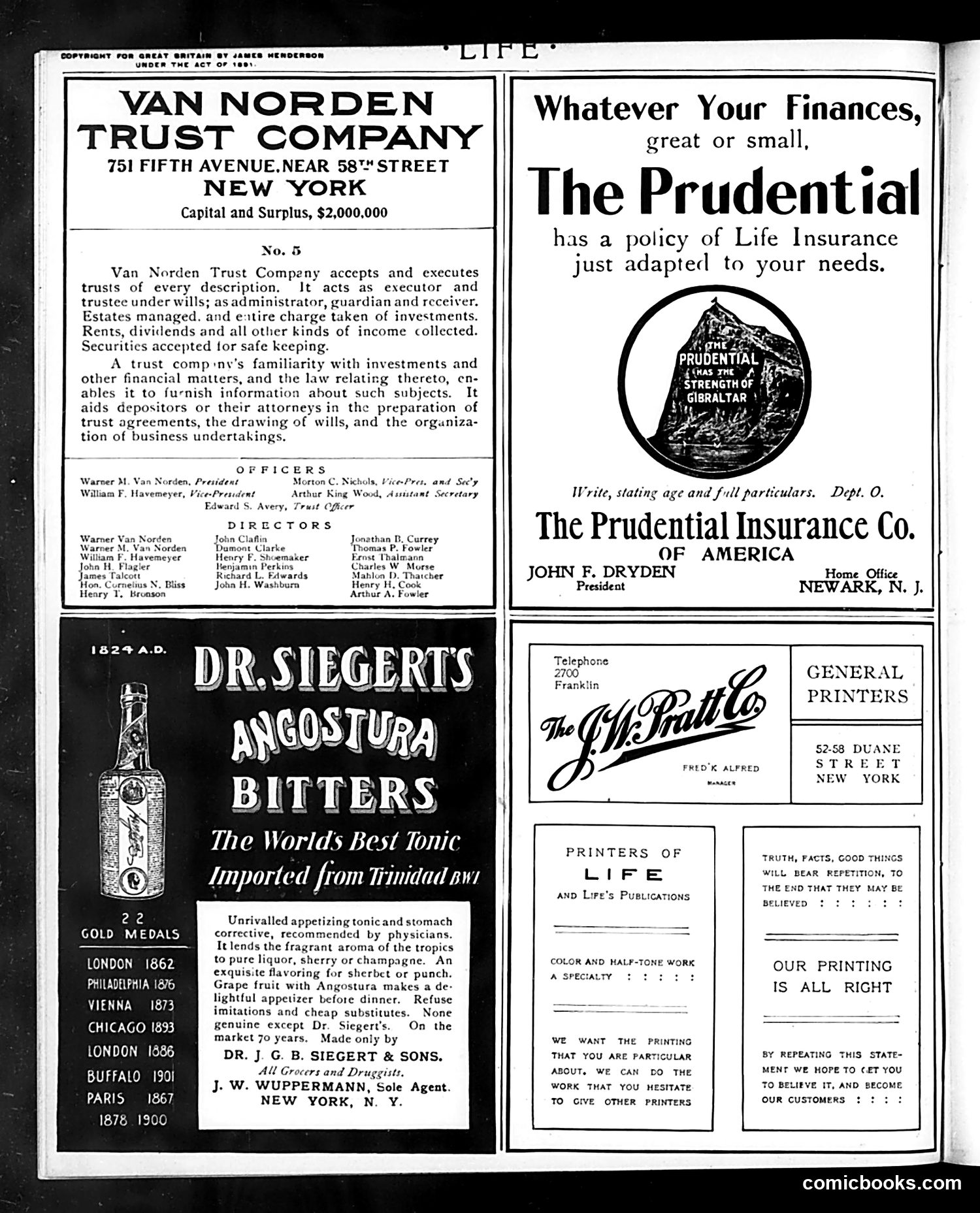
This page consists primarily of **advertisements rather than editorial cartoons**. The content includes: 1. **Van Norden Trust Company** (top left): A financial services advertisement describing trust and estate management services. 2. **Prudential Insurance** (top right): Life insurance advertisement featuring their iconic Rock of Gibraltar logo, symbolizing strength and stability. 3. **Dr. Siegert's Angostura Bitters** (bottom left): A patent medicine advertisement claiming it's "The World's Best Tonic," imported from Trinidad, listing multiple gold medals from international competitions. 4. **The O. Paulette and General Printers** (right side): Printing service advertisements emphasizing quality work. There are no political cartoons, caricatures, or satirical commentary visible on this page. It's a standard early-20th-century magazine advertising section.
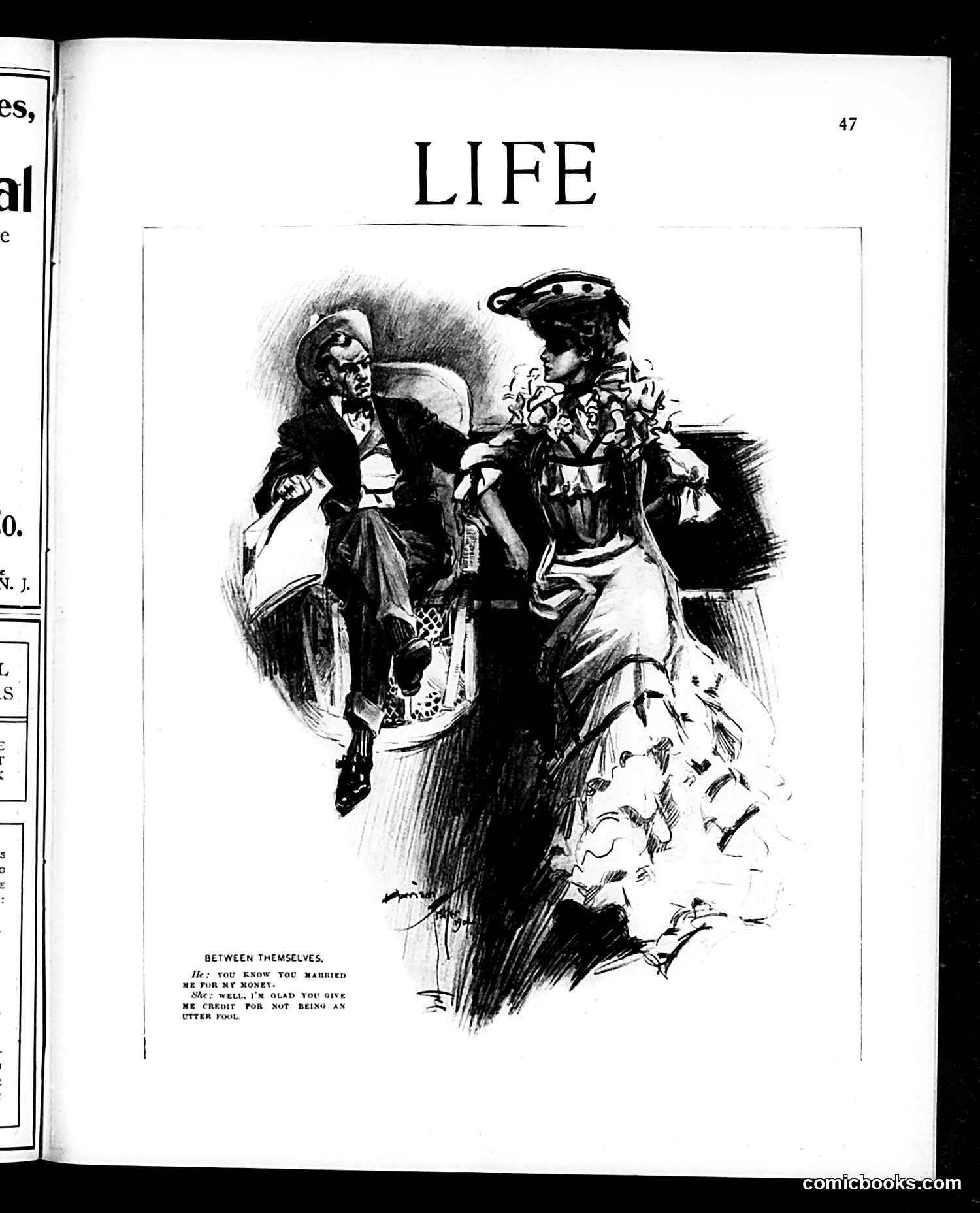
This cartoon appears in Life magazine's satirical section. The caption reads: "Between Themselves. / He: You know you married me for my money. / She: Well, I'm glad you give me credit for not being an utter fool." The sketch depicts two figures in conversation—a man in formal attire on the left and a woman in fashionable dress on the right. The satire targets marriage dynamics and financial motivations in relationships among the wealthy or upper class. The woman's retort is a cutting joke: she admits marrying for money but insults her husband's intelligence for stating the obvious, implying he's foolish for both believing she married him for love and for having the audacity to call her out on it. The humor lies in the woman's sharp wit turning the accusation back on him.
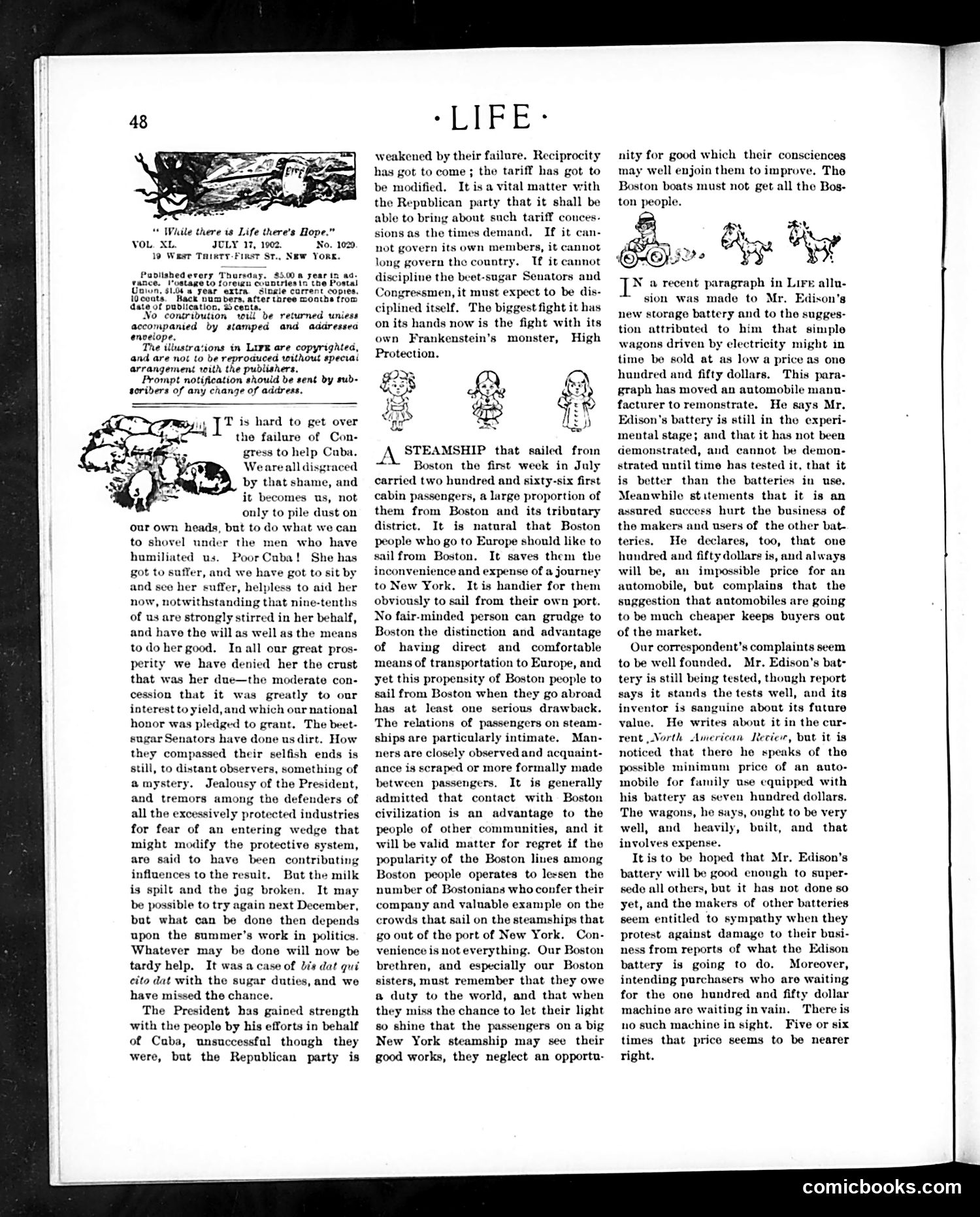
The page contains two distinct political commentaries: **Left cartoon**: Depicts Cuba as a suffering woman ("Poor Cuba!") being neglected. The text criticizes American failure to help Cuba after the Spanish-American War, arguing that the U.S. has abandoned its moral responsibility to the island. **Right section**: Discusses a Boston steamship carrying passengers to Europe, using it as a vehicle to critique Boston elites' tendency to travel abroad rather than invest locally. The passage sarcastically notes their preference for European travel while neglecting Boston's own development and opportunities. Both pieces employ **satirical social criticism**—attacking American neglect of Cuba and Boston's self-interested wealthy class who prioritize European leisure over civic responsibility. The tone suggests disappointment in American ethical and civic commitments circa 1902.
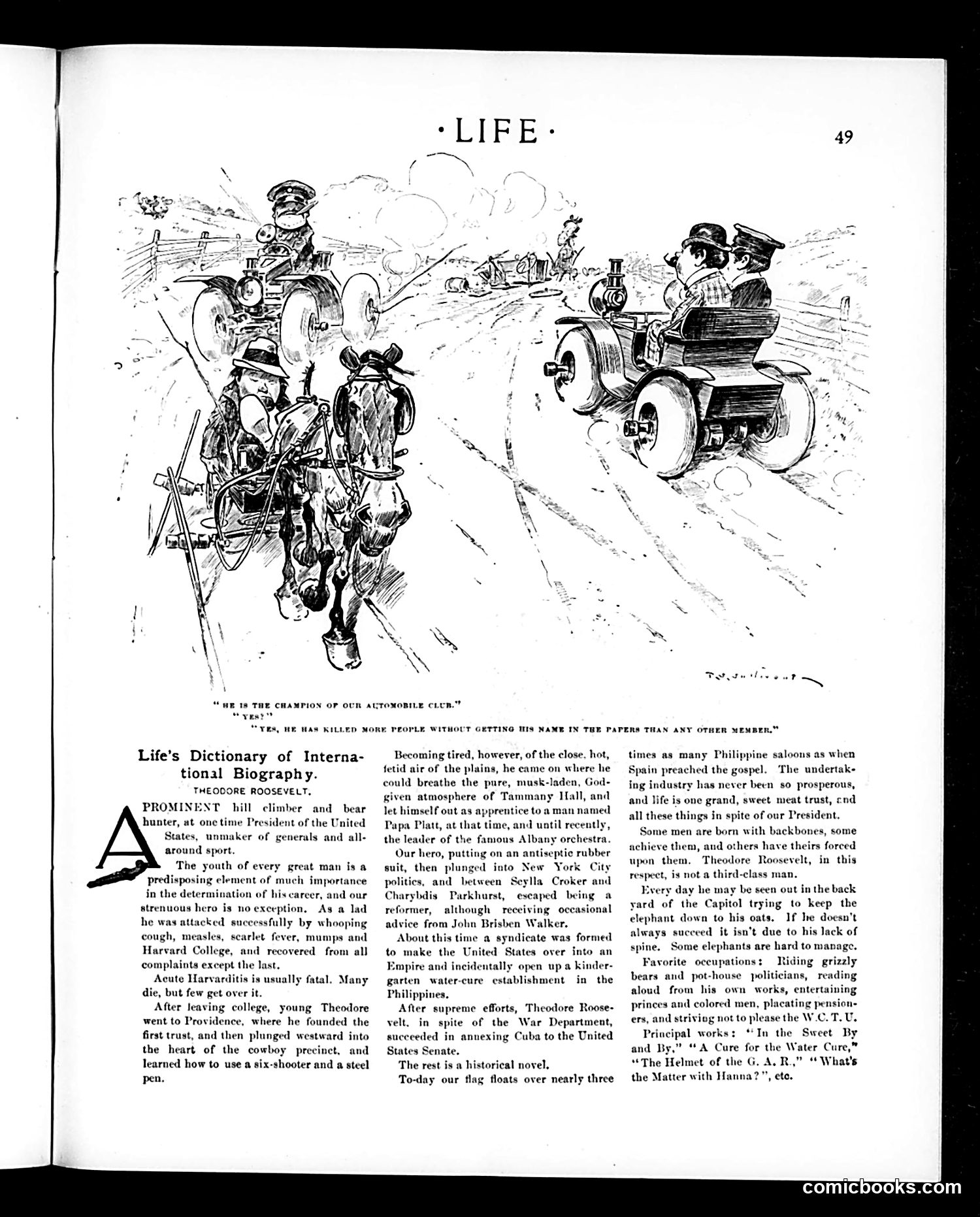
This page contains a satirical cartoon and biographical entry about **Theodore Roosevelt**. The illustration shows two early automobiles racing on a country road—one driven by a military officer, the other by two men in hats. The caption jokes: "He is the champion of our automobile club" / "Yes, he has killed more people without getting his name in the papers than any other member." The satire references Roosevelt's reckless driving habits and the automobile deaths he caused without legal consequences—a critique of how wealth and status shielded him from accountability. The biographical text below celebrates his various roles: hunter, President, and general. This mocks the gap between his public heroic image and his actual dangerous behavior.
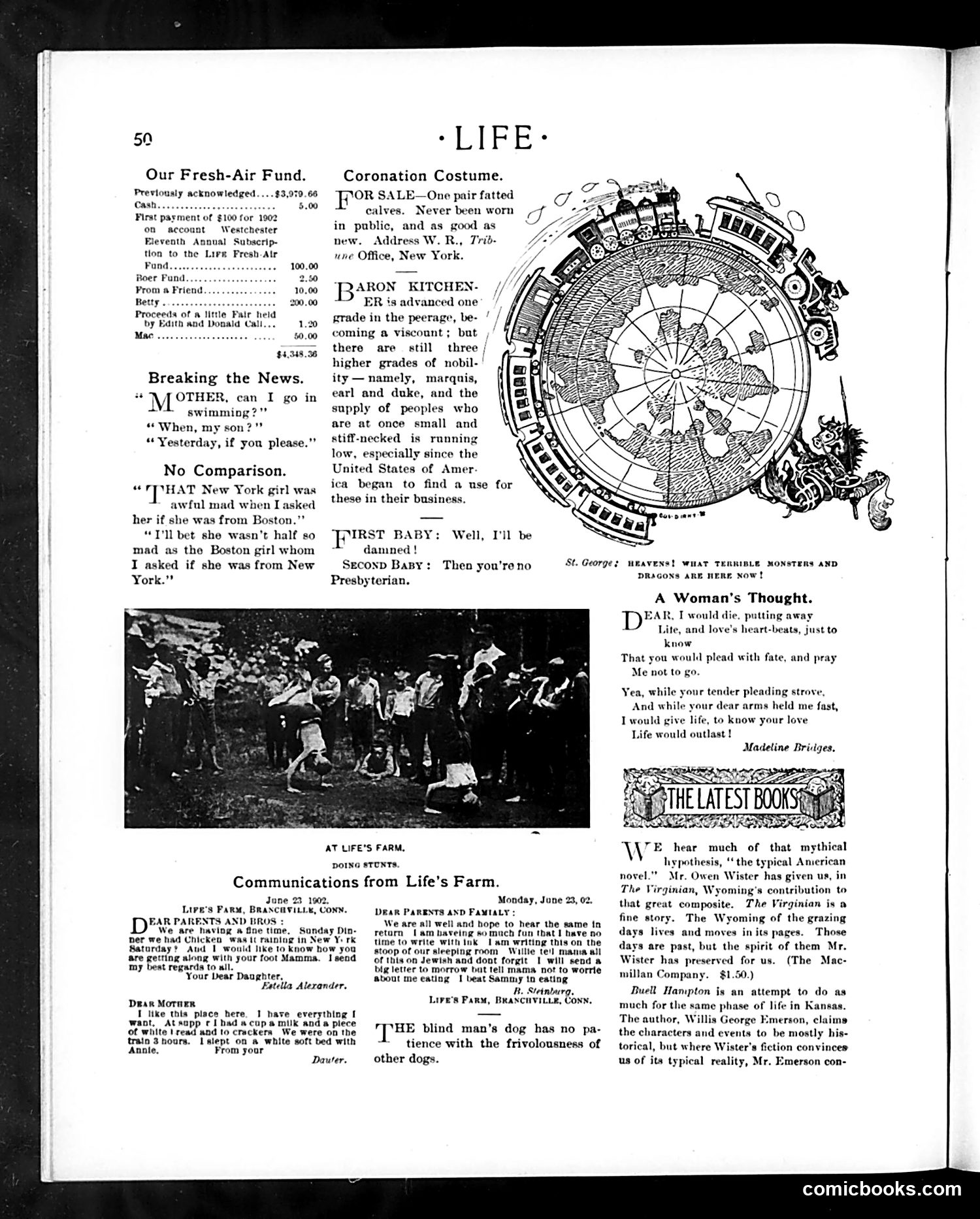
This page contains several unrelated humor pieces and advertisements rather than a cohesive political cartoon. The main visual element is a circular map labeled "ST. GEORGE'S HEAVENS! WHAT TERRIBLE MONSTERS AND DRAGONS ARE HERE NOW!" — a satirical reimagining of a geographic location with fantastical creatures, though the specific reference is unclear without additional context. The text sections include jokes ("Breaking the News," "No Comparison") and "Communications from Life's Farm," a regular advice column featuring humorous letters from readers about rural life. "A Woman's Thought" presents romantic poetry by Madeline Bridges. "The Latest Books" reviews recent publications including *The Virginian* by Owen Wister, offering literary commentary typical of early 1900s magazine content. The page functions primarily as miscellaneous entertainment rather than political satire.
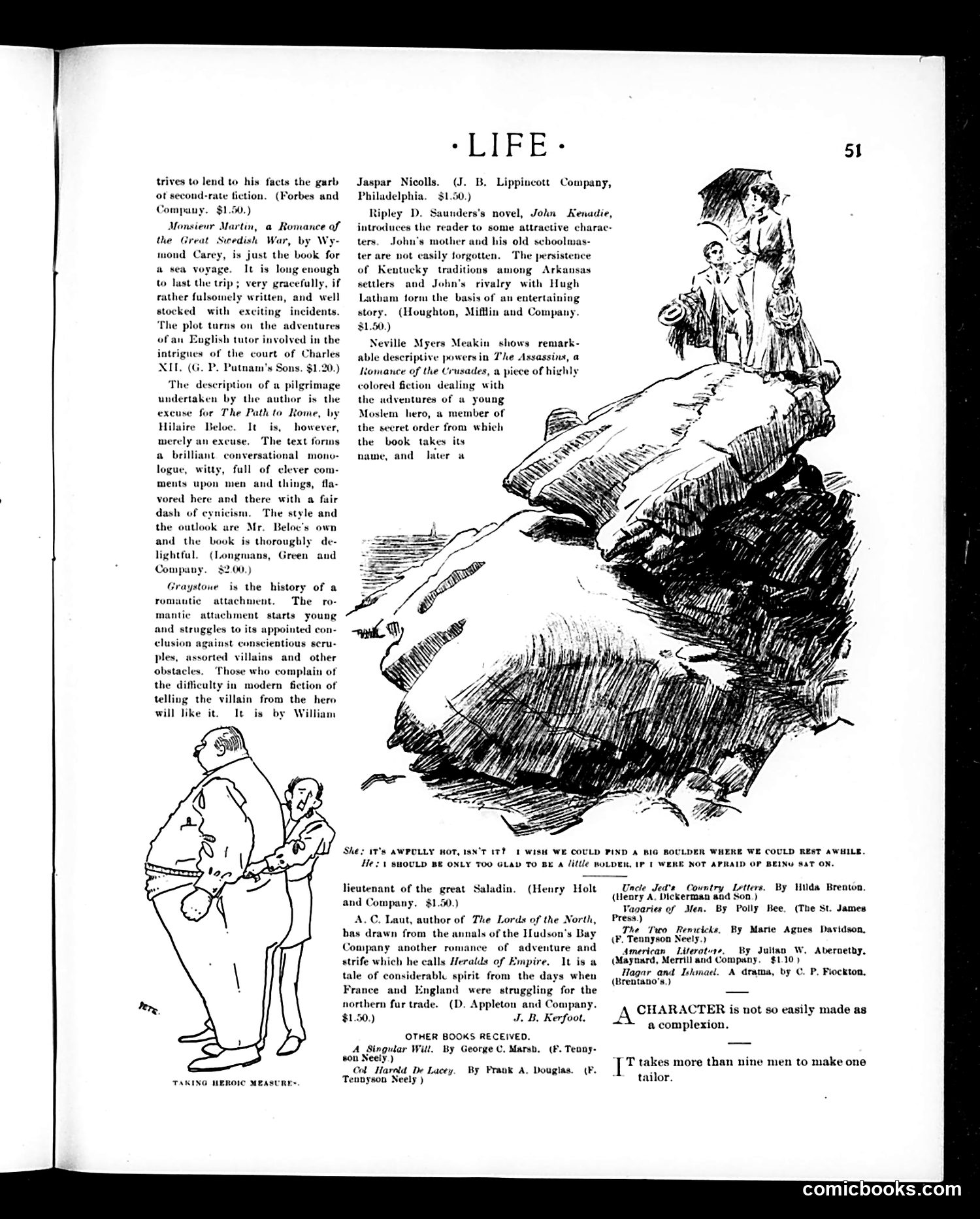
This page contains two cartoon illustrations satirizing contemporary social situations, with accompanying book reviews. The **upper cartoon** depicts what appears to be tourists or travelers on a rocky outcrop, with the caption addressing discomfort during travel ("it's awfully hot, isn't it?"). The satire targets the impracticality of outdoor leisure activities. The **lower cartoon**, labeled "TAKING HEROIC MEASURE," shows two figures in an exaggerated physical interaction, likely mocking masculine posturing or one-upmanship in social situations. Both cartoons employ caricature and visual humor typical of Life's satirical approach. The page's primary content is book reviews of contemporary fiction, with illustrations scattered among literary critiques of novels about adventure, romance, and historical narratives popular in this era.
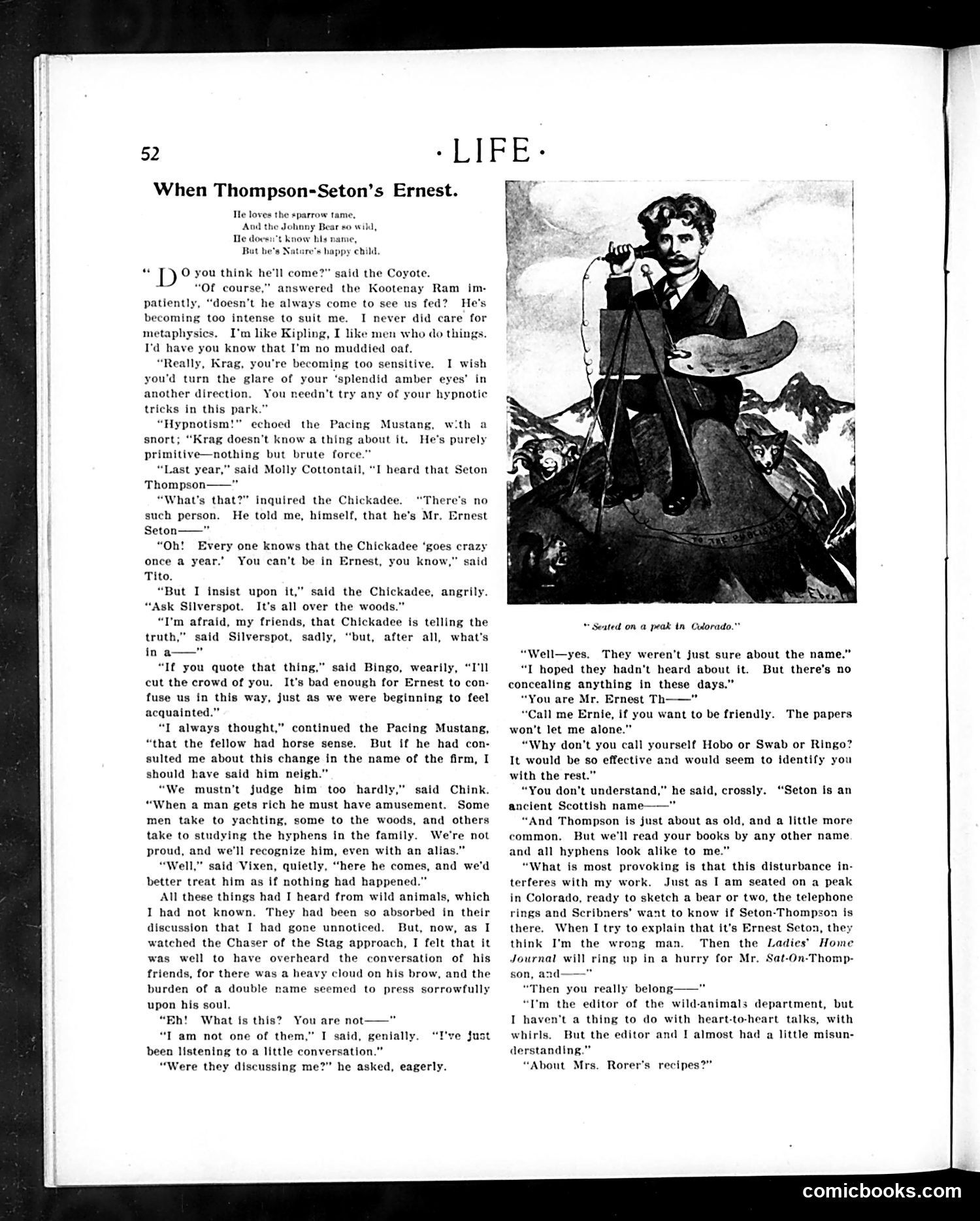
This page satirizes the identity confusion surrounding **Ernest Thompson Seton**, a prominent naturalist and writer. The illustration shows a man seated on a peak in Colorado, and the dialogue reveals the joke: various animals (the Coyote, Kootenay Ram, Pacing Mustang, Chickadee) are debating whether "Ernest Thompson-Seton" actually exists as a real person or is merely a fictional character created by "Thompson." The satire centers on Seton's dual reputation as both a wildlife author and illustrator who anthropomorphized animals in his popular stories. The confusion about his name—whether he's "Ernest Seton" or "Thompson-Seton"—mirrors the blurred line between his real identity and his literary creations. The piece mocks how Seton's fame made him almost mythical.
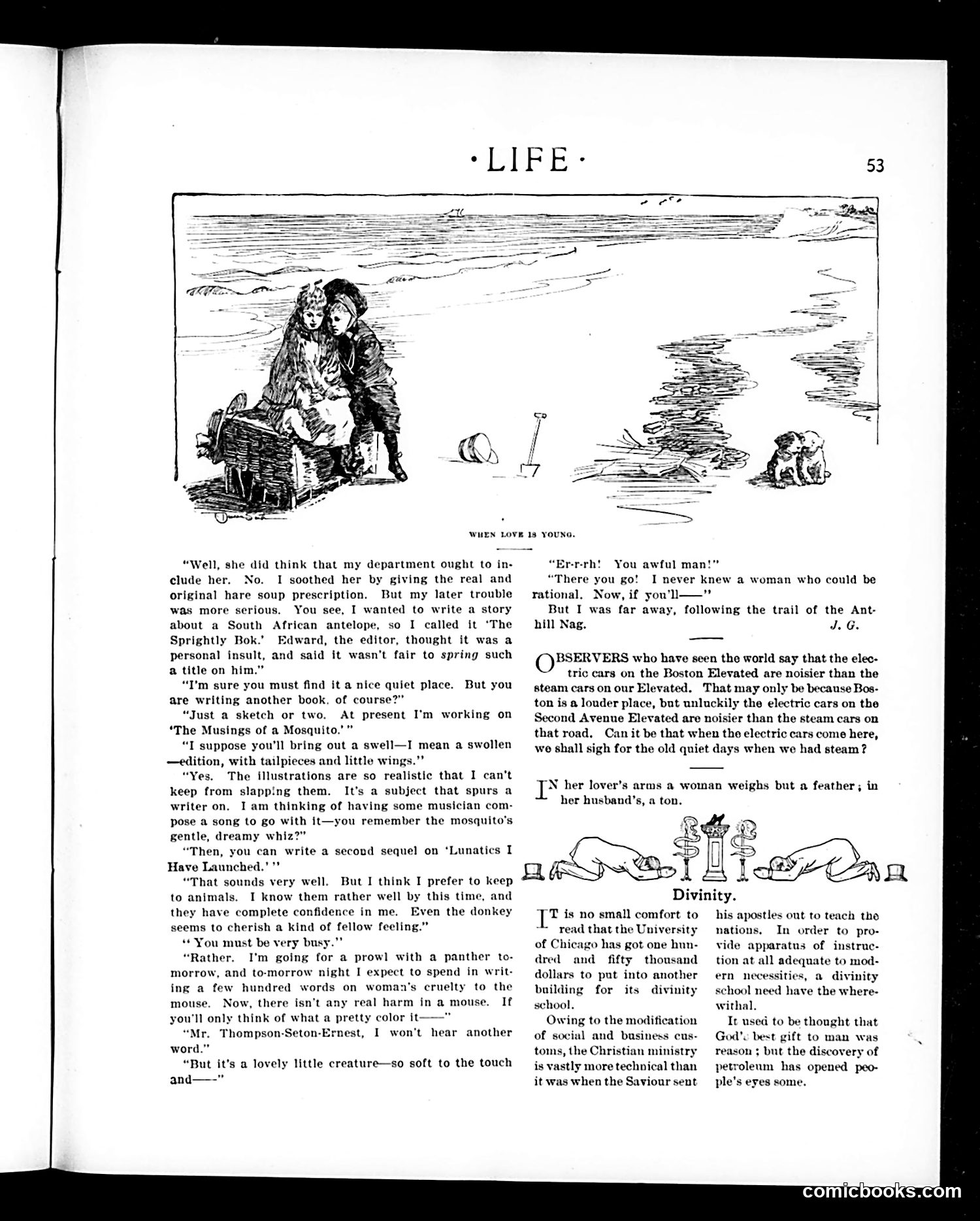
This page contains a dialogue between two writers discussing their work, accompanied by a small illustration titled "When Love is Young" showing a couple on a beach. The main content is a conversation about writing projects: one writer mentions a story about a South African antelope called "The Springbok's Bok," while another discusses "The Misings of a Mosquito"—a sequel to "Lunatics I Have Launched." The humor derives from the absurdity of these animal-focused literary works and the writers' pretentious justifications for them. Below is a separate satirical piece titled "Divinity" discussing the University of Chicago's investment in a new divinity school building, suggesting that petroleum discovery has become more spiritually valuable than traditional Christian ministry. The satire targets both literary pretension and the era's commercialism versus religious commitment.
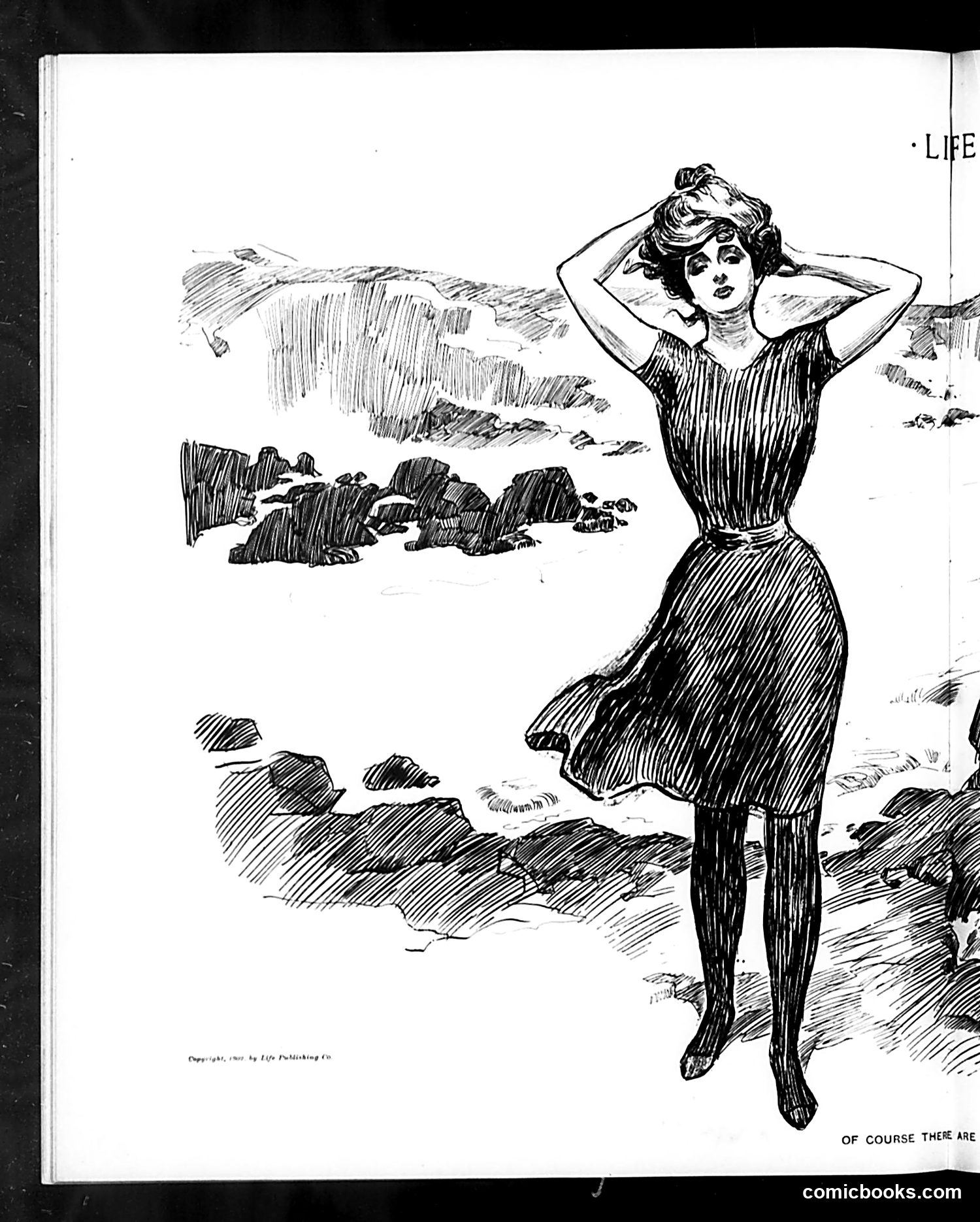
This page from *Life* magazine features a single illustration of a fashionably dressed woman standing on a rocky beach, with her hands behind her head in a relaxed pose. She wears a short, belted dress typical of early 20th-century women's fashion. The visible text fragments—"LIFE" (masthead), "OF COURSE THERE ARE" (partial caption at bottom)—suggest this is part of a larger article or satirical piece, though the complete context is cut off. The incomplete caption makes the specific satirical point unclear, but the image likely comments on contemporary women's fashion, leisure, or social attitudes of the era. Without the full text, the precise target of satire cannot be definitively identified.
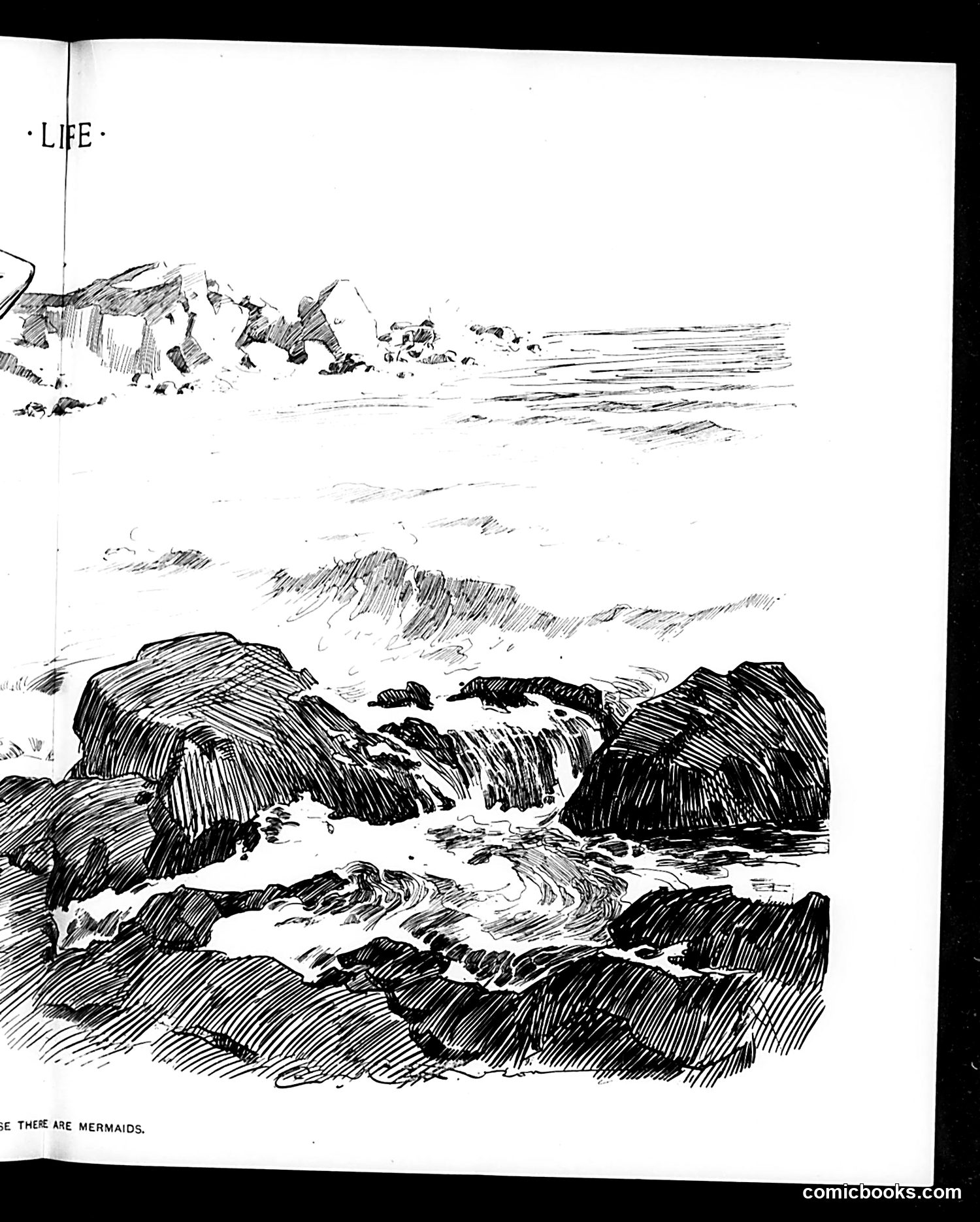
This page from *Life* magazine features a coastal landscape sketch labeled "LIFE" at the top. The detailed pen-and-ink drawing depicts rocky shores with boulders, waves, and what appears to be debris or wreckage scattered in the background near the waterline. The partial text visible at the bottom reads "SE THERE ARE MERMAIDS" (likely "...THESE ARE MERMAIDS"), suggesting this is part of a caption or joke about mermaids. Given the wreckage visible in the upper portion and the mermaid reference, this appears to be satirizing a common sailor's tale or romantic myth—possibly mocking the fantasy of mermaids amid actual maritime disaster or mundane reality. The specific satirical point remains unclear without the complete caption.
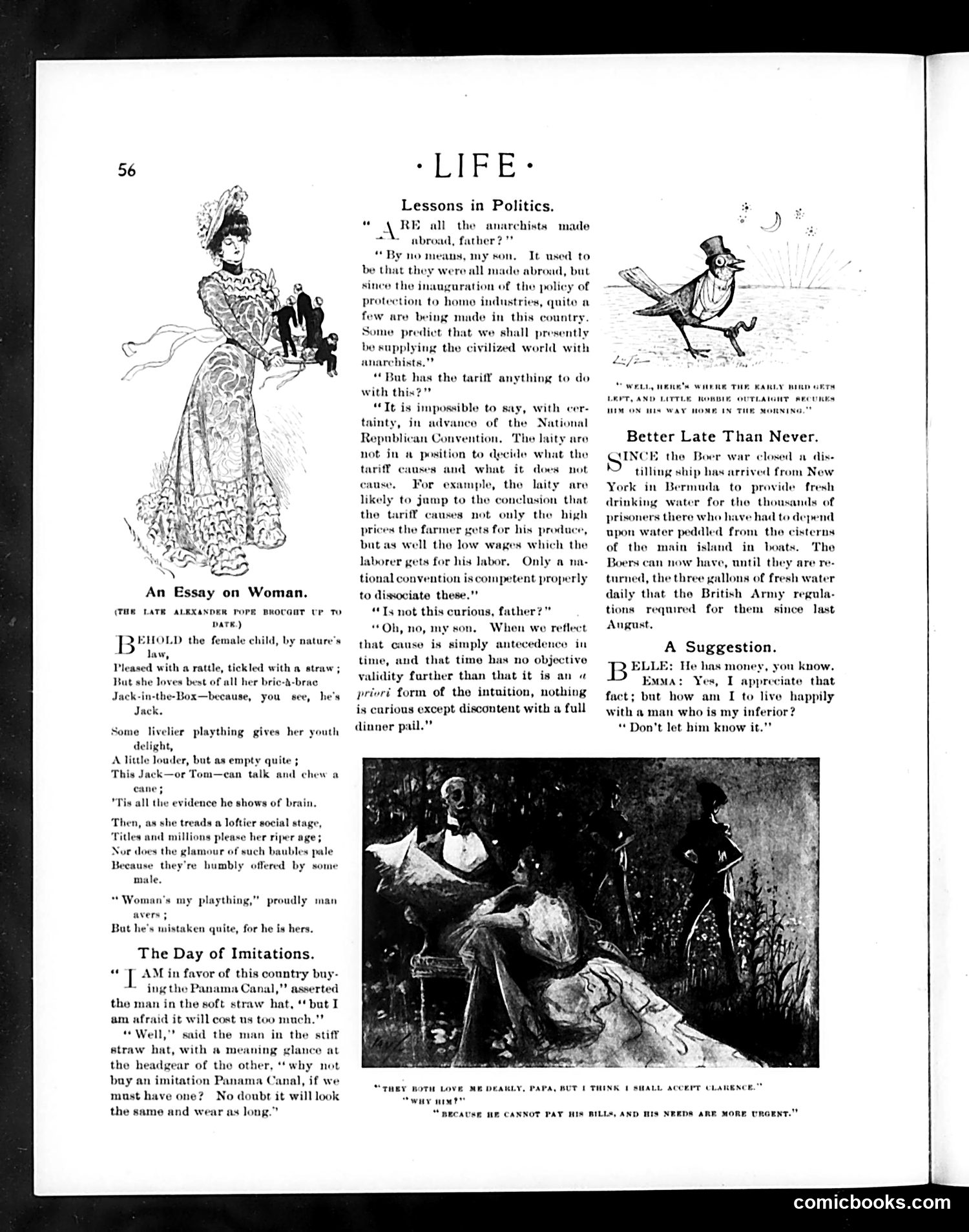
This page contains satirical dialogue on American tariffs and protectionism. A father and son debate whether tariffs benefit domestic workers or create problems. The father argues tariffs cause high prices and low wages, while the son counters that tariffs protect American industries—a reference to the actual "tariff debate" that dominated late 19th/early 20th-century American politics. The accompanying sketches mock various social pretensions: "An Essay on Woman" ridicules fashionable ladies, while "The Day of Imitations" satirizes a man boasting about the Panama Canal, suggesting Americans uncritically imitate foreign engineering projects. The photographs below appear to illustrate domestic or social scenes, though their specific reference is unclear from visible text alone.
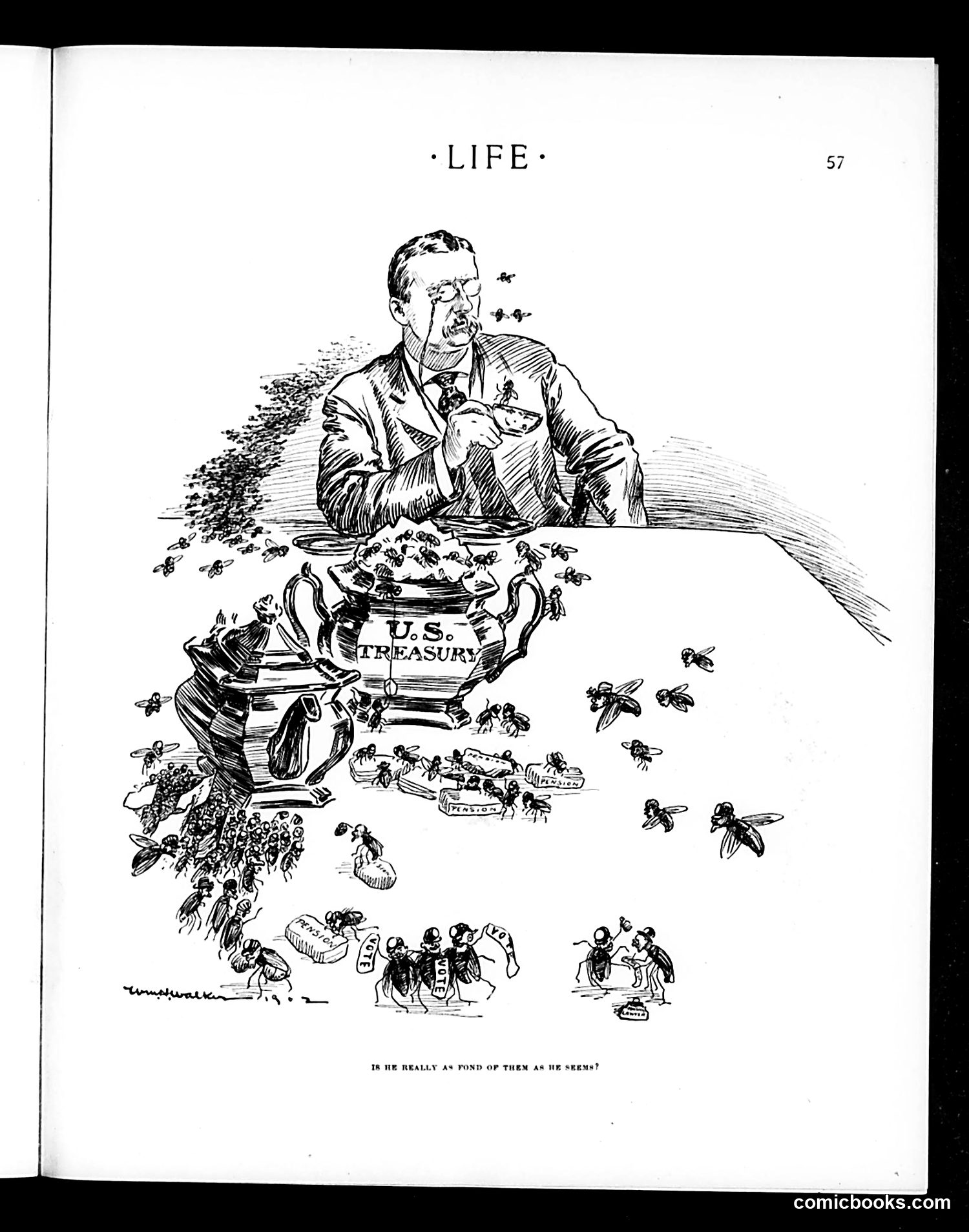
This Life magazine cartoon depicts a man at a desk labeled "U.S. TREASURY" pouring money that transforms into flies or insects. The figure appears to be a government official or politician, shown dispensing funds that scatter and escape his control. The caption reads: "IS HE REALLY AS FOND OF THEM AS HE SEEMS?" The satire criticizes wasteful government spending or corruption—suggesting that money allocated from the Treasury is being squandered, lost, or diverted rather than properly used. The insects represent the dissipation of public funds. The cartoon implies the official claims to care about the nation's finances ("fond of them") while actually allowing money to leak away uncontrollably. This appears to be turn-of-the-century American political critique of fiscal mismanagement.
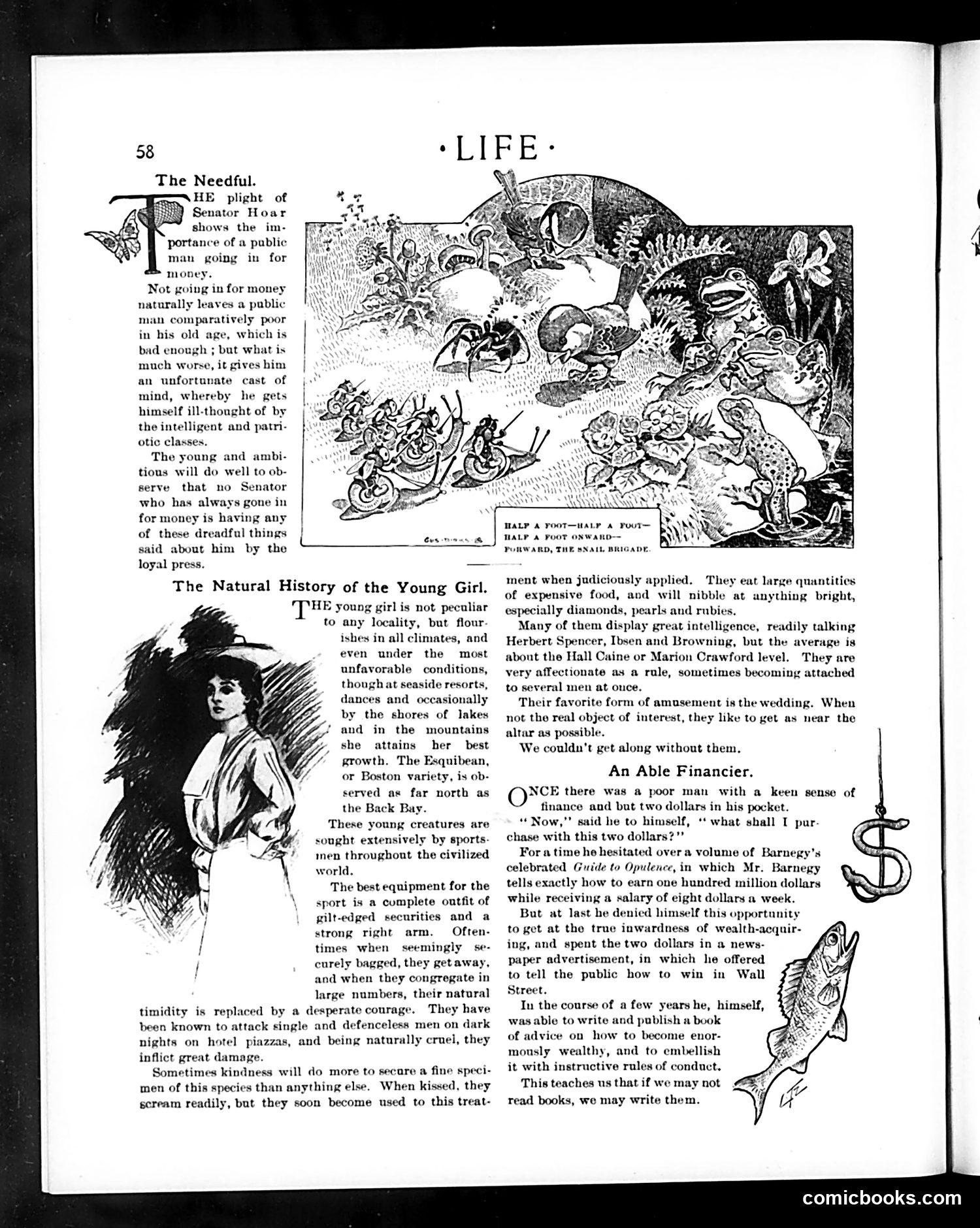
This page contains three satirical pieces mocking American social hypocrisy and financial culture: **"The Needful"** attacks Senator George Hoar, criticizing him for *not* pursuing wealth. Life's satire inverts conventional morality: the "loyal press" praises wealthy senators while condemning Hoar's apparent poverty as disreputable—implying that American society judges politicians by greed rather than integrity. **"Natural History of the Young Girl"** uses pseudo-scientific language to mock wealthy young women as hunted "specimens." The satire targets their materialism (they're attracted to "gilt-edged securities" and expensive jewels), their intellectual pretensions (name-dropping philosophers), and their marriage-hunting behavior. The top illustration depicts an absurdist scene with insects/creatures, emphasizing their triviality. **"An Able Financier"** satirizes financial charlatans. A poor man spends his last dollars on newspaper ads promising wealth secrets, then uses that success to sell books offering the same empty advice—a cycle of con artistry parasitizing the gullible. Overall, Life critiques wealth obsession, female materialism, and financial fraud as defining features of the era.
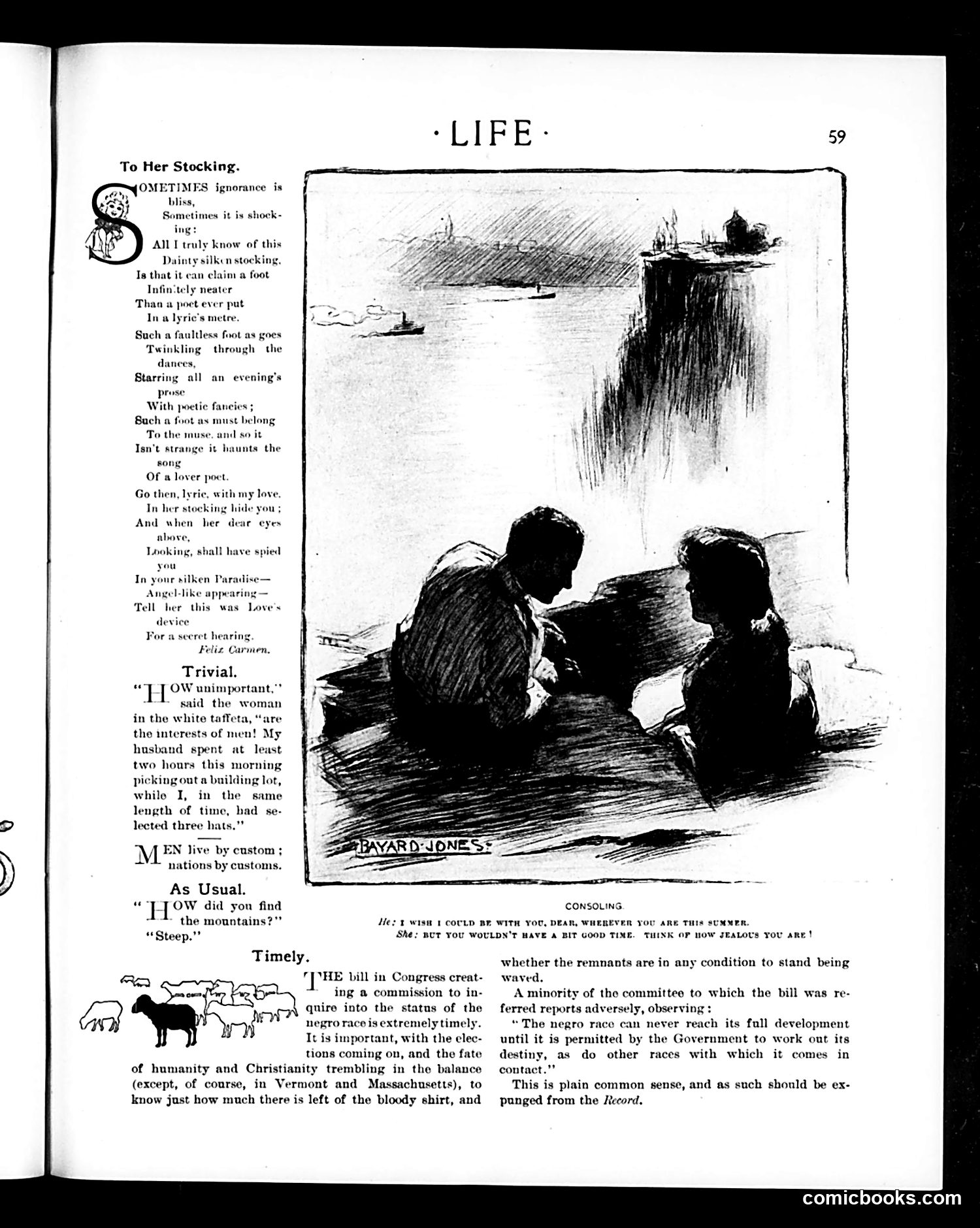
This page contains several brief satirical pieces typical of 1890s-era American humor: **"To Her Stocking"** is a romantic poem mocking sentimental Victorian verse about women's hosiery—poking fun at how poets romanticize trivial feminine accessories. **"Trivial"** satirizes gender relations: a woman dismisses her husband's serious business decision (selecting property) as unimportant compared to her afternoon hat-shopping, inverting typical gender hierarchies for comic effect. **"Timely"** criticizes Congress's commission investigating "the negro race" as politically motivated—timed for elections—rather than genuinely seeking solutions. The "bloody shirt" reference alludes to post-Civil War Republican campaign tactics. The minority report quoted advocates for Black self-determination, which Life sarcastically suggests should be "expunged" (removed) from official records. **"Consoling"** depicts a couple's romantic difficulty: he wishes to be with her; she predicts he'd be miserable because of his jealousy. The Bayard Jones illustration depicts two figures in conversation by water—likely related to the "Consoling" piece.
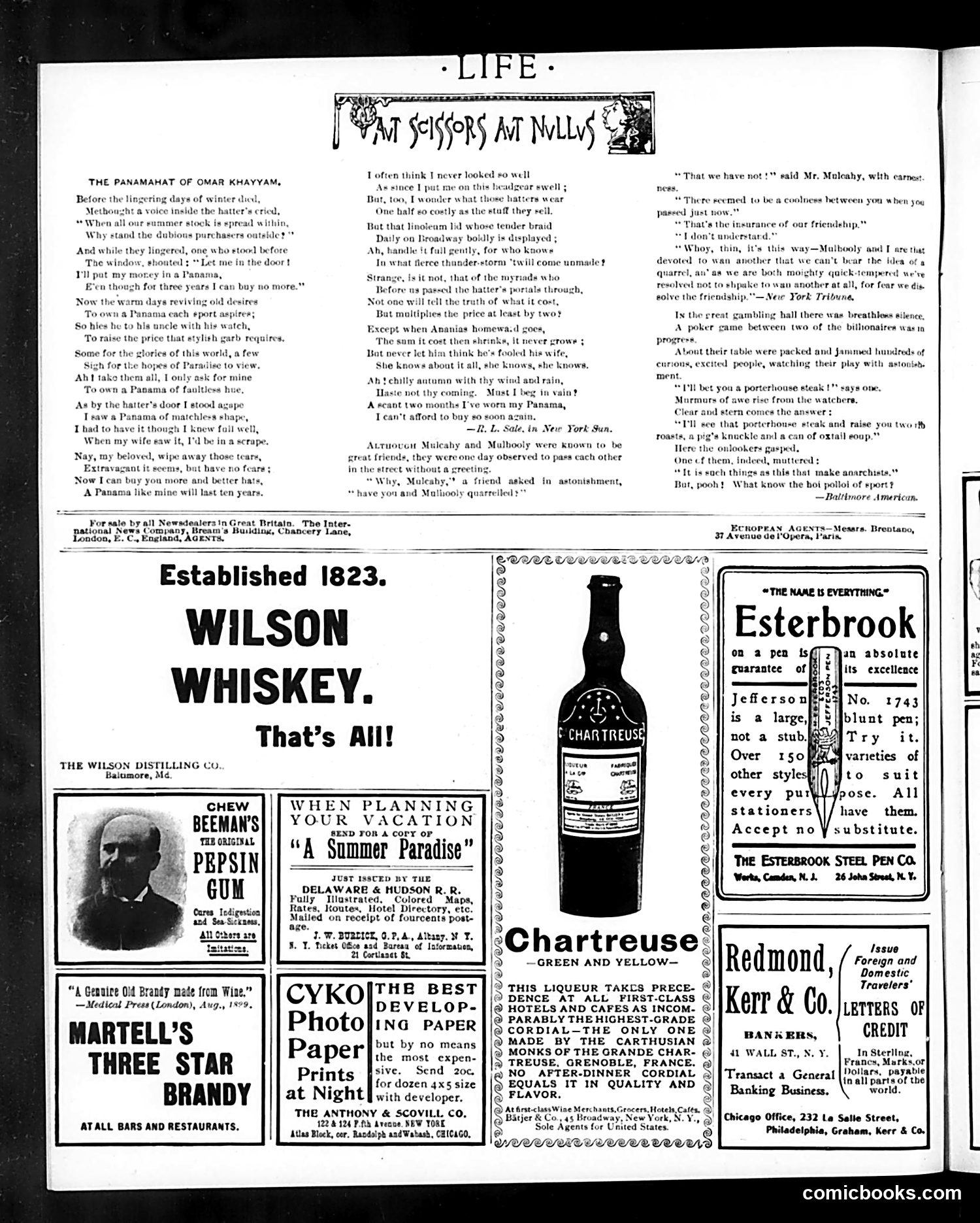
This page is primarily **advertising**, with one notable satirical poem at the top. ## "The Panama Hat of Omar Khayyam" This is a humorous poem parodying Omar Khayyam's famous verses. It follows a man's obsession with acquiring an expensive Panama hat, using the Persian poet's style to mock American consumer desire and marital tension. The joke: a man pawns his watch to buy a fashionable hat, fears his wife's reaction, then justifies the extravagance by claiming it will last ten years—a tongue-in-cheek commentary on materialism and self-deception. The remaining content is **period advertisements** (circa 1900s) for Wilson Whiskey, Beeman's Pepsin Gum, Martell's Brandy, and other products—typical commercial clutter with no satirical intent. There are also two brief anecdotes in the margins about social situations (one involving "Moloahy" and friendship, another about wealthy men gambling with expensive foods), but these are minor filler pieces without clear satirical point.
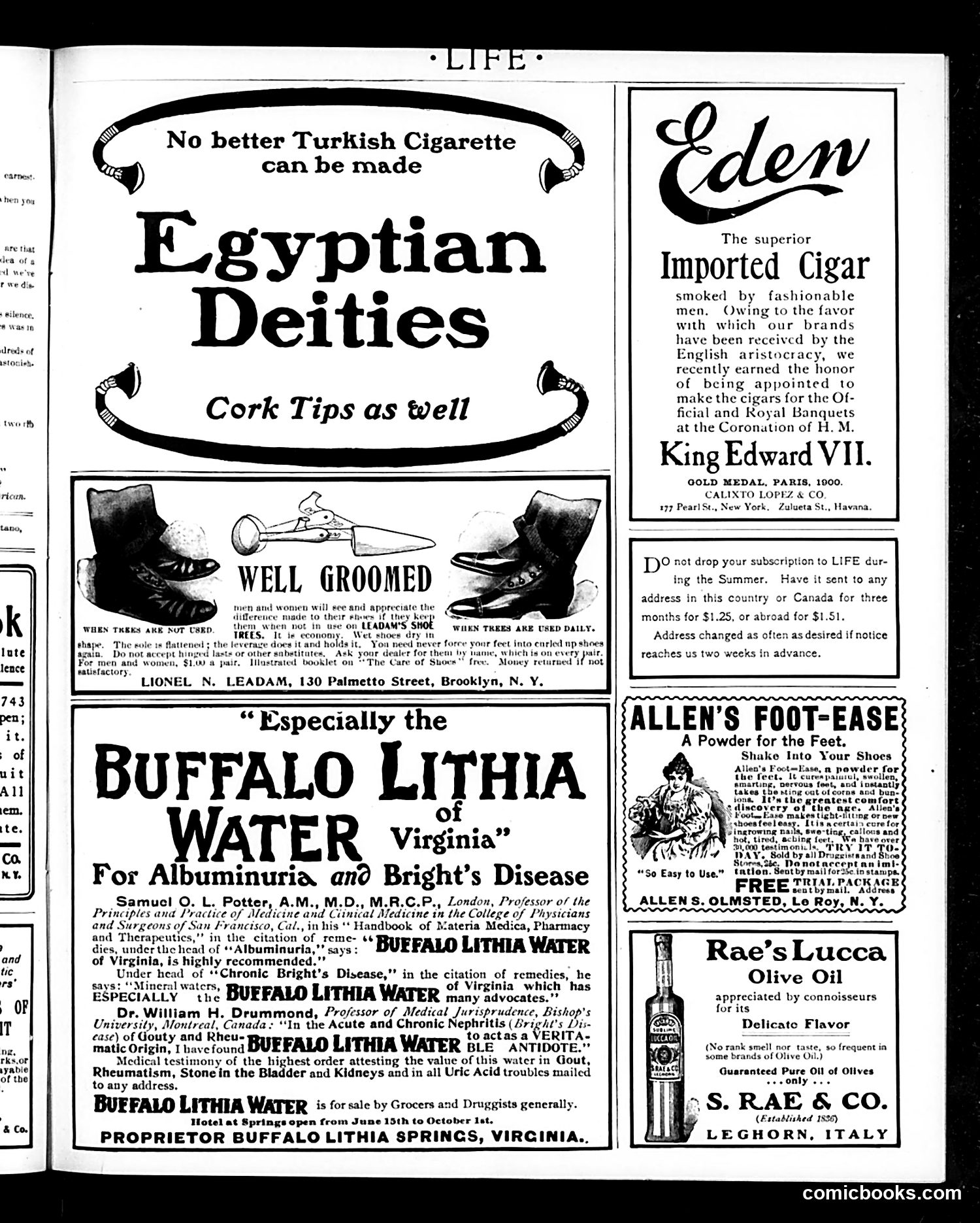
This page is primarily **advertisements**, not satire or political cartoons. However, the ads reveal period attitudes worth noting: The "Egyptian Deities" cigarette ad uses pseudo-exotic branding common to early 1900s marketing—associating foreign products with glamour and sophistication. Similarly, the "Eden" cigar prominently references **King Edward VII's coronation** (1902), leveraging royal endorsement as a status marker for fashionable consumption. The **Leadam shoe ad** features images of well-groomed feet and shoes, emphasizing personal grooming standards for "men and women"—reflecting Edwardian class consciousness about appearance. Most striking is the **Buffalo Lithia Water** ad, which cites medical authorities endorsing the mineral water for serious kidney diseases (Bright's Disease, albuminuria). This reflects pre-FDA era patent medicine marketing, where mineral waters and tonics made unregulated medical claims backed by selective doctor testimonials. The remaining ads (Allen's Foot-Ease powder, Rae's olive oil) follow similar patterns: appeals to health, refinement, and imported status.
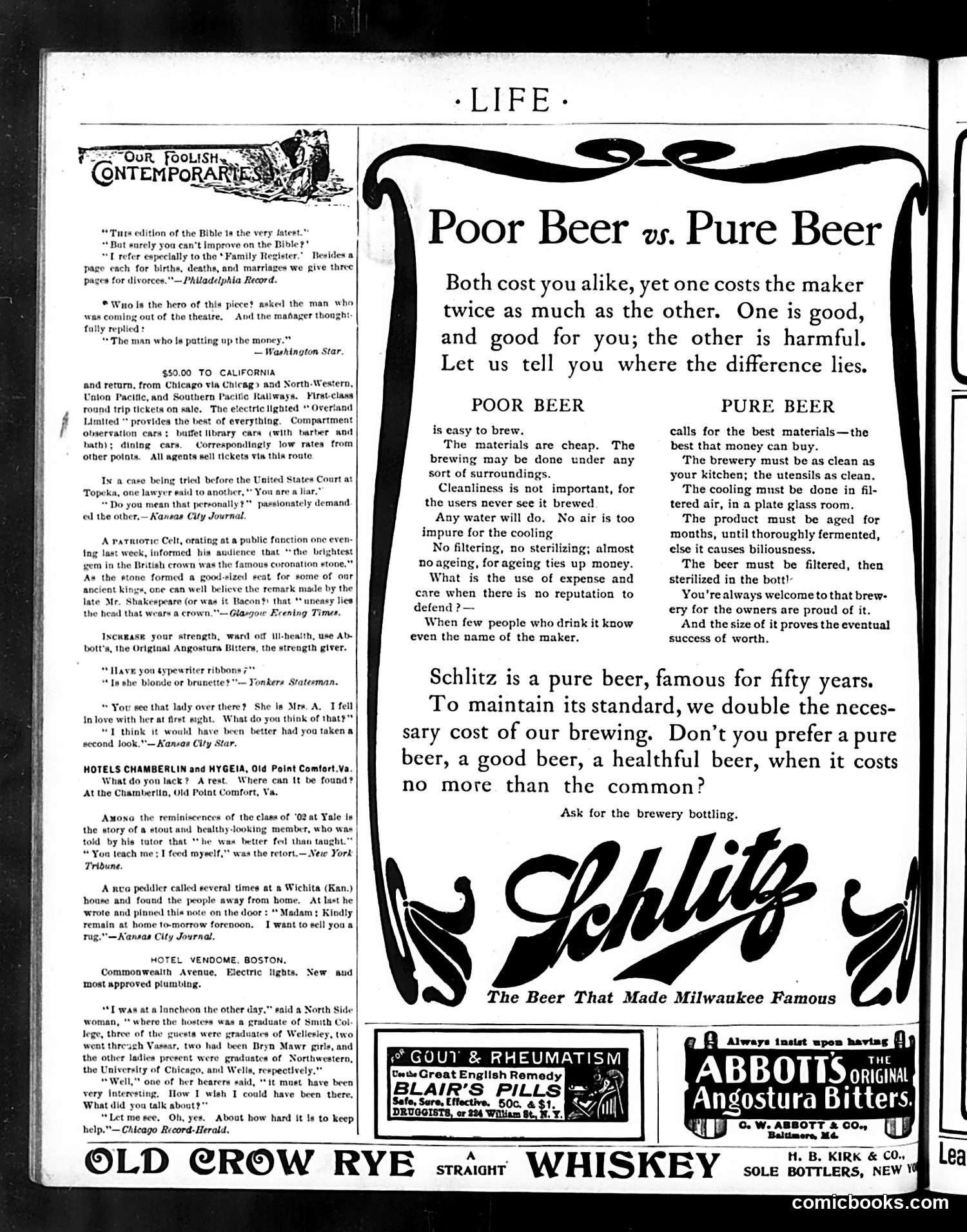
This page is primarily **advertising and light humor content**, not political satire. The main feature is a **Schlitz beer advertisement** comparing "Poor Beer" versus "Pure Beer"—arguing that Schlitz costs no more than inferior brands despite doubling brewing expenses for quality control, cleanliness, filtration, and sterilization. The left column contains **miscellaneous short jokes and quips** typical of Life magazine's humor format, including: - Critiques of modern Bible editions and divorce - Theater/money jokes - Legal arguments and misunderstandings - Observations about college-educated women caring only about household help The humor is gentle social commentary rather than sharp satire—poking fun at contemporary absurdities (Bible "improvements," materialistic theater patrons, educated women's priorities) without targeting specific political figures or events. The page also includes advertisements for hotels, whiskey, and patent medicines—standard period advertising.
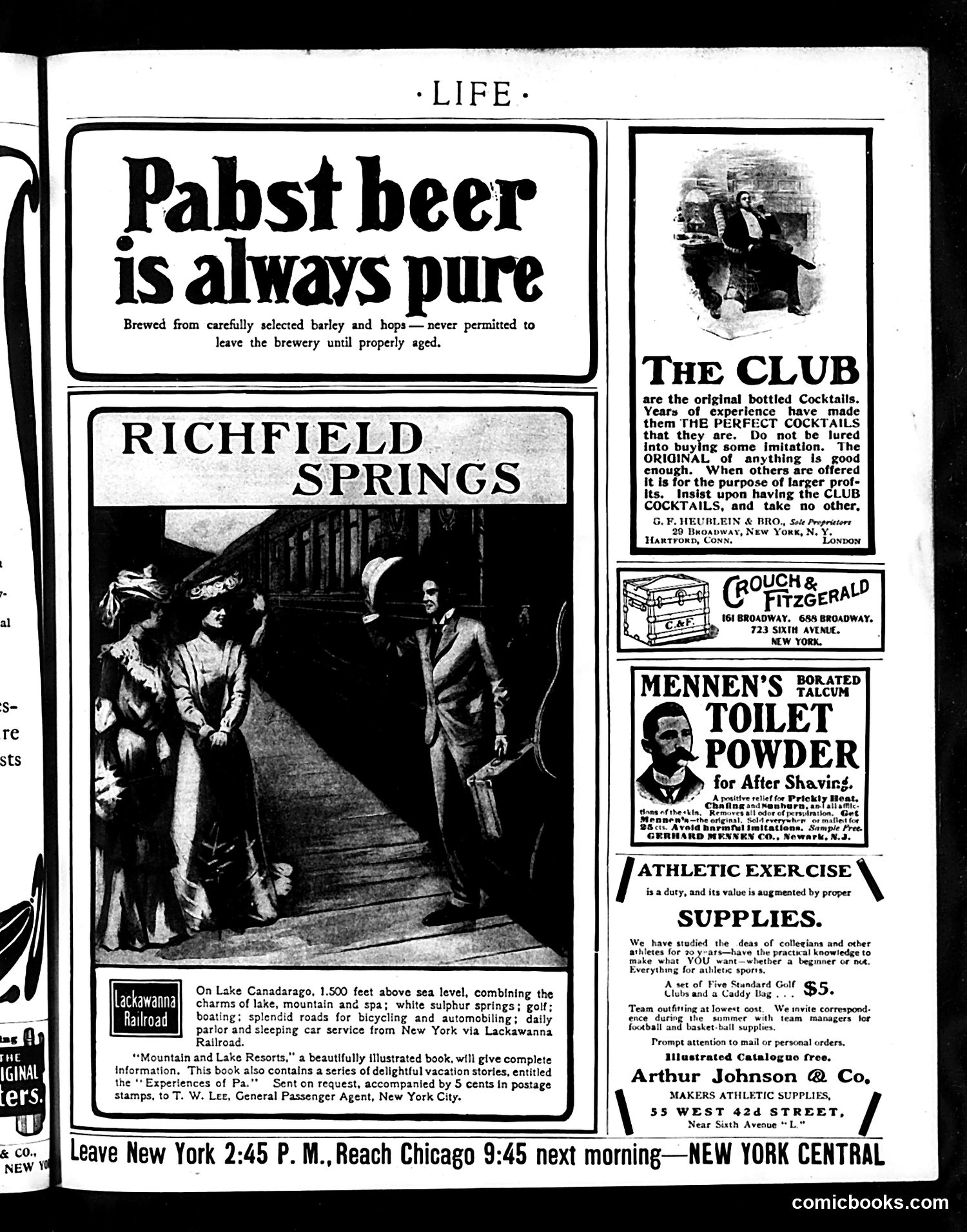
This is primarily an **advertising page** rather than editorial content or satire. It contains multiple commercial advertisements typical of early 20th-century magazines. The main visual element is a "Richfield Springs" resort advertisement featuring an illustration of well-dressed people at what appears to be a spa or resort destination, promoting the location as a vacation spot with golf, boating, and rail service from New York. The page includes various product ads: Pabst Beer (emphasizing purity and aging), The Club brand cocktails (marketed as "original" bottled cocktails), Mennen's talcum powder, Crouch & Fitzgerald luggage, and Arthur Johnson athletic supplies. There is **no identifiable political cartoon or satire** on this page. The advertisements reflect early 1900s consumer culture and leisure activities marketed to affluent readers—resort vacations, branded alcoholic beverages, grooming products, and sporting equipment. The page serves as a revenue source for the magazine rather than editorial commentary.
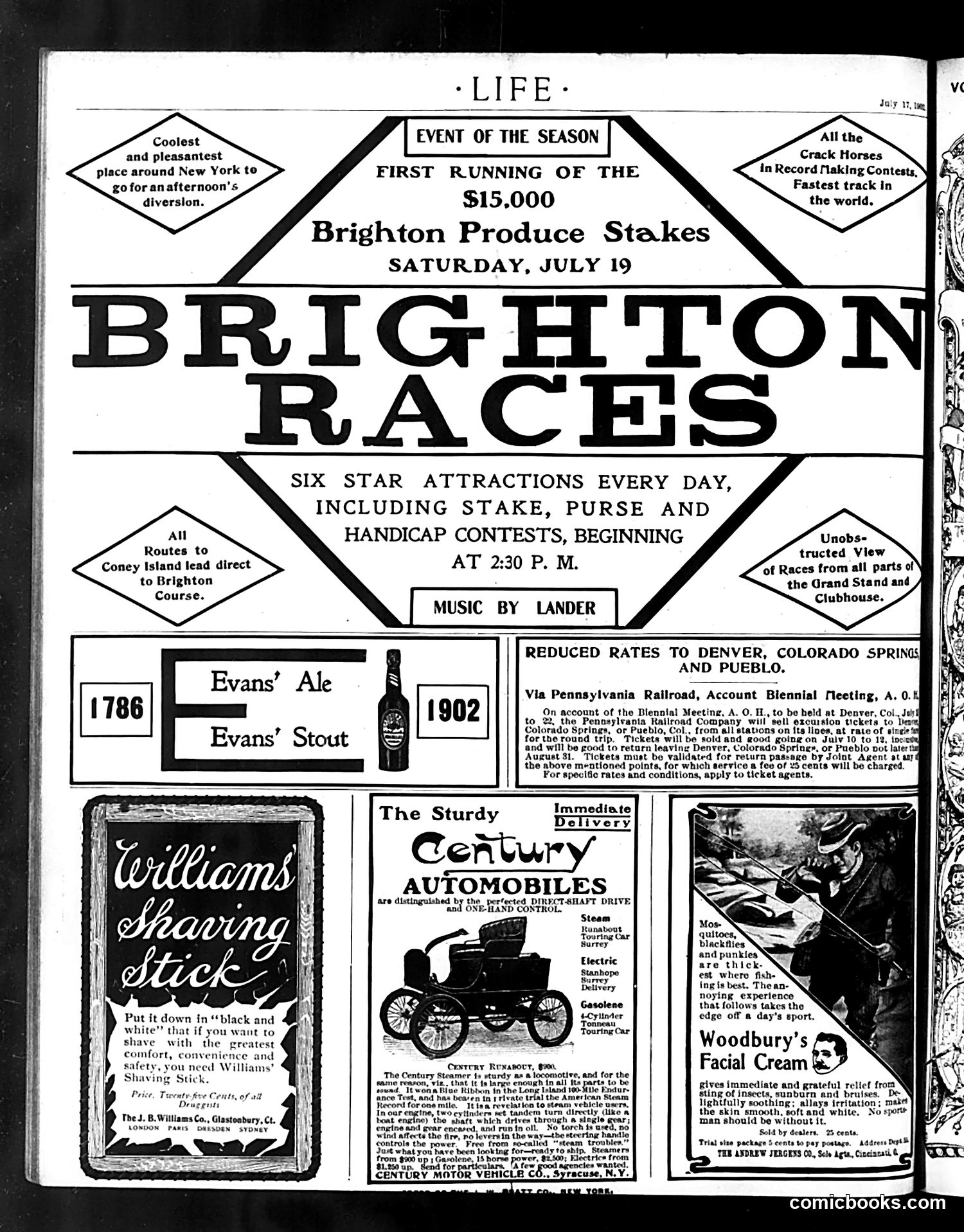
This page is primarily **advertising**, not satire or political commentary. It announces the Brighton Races (a horse-racing event featuring the $15,000 Brighton Produce Stakes on Saturday, July 19) as a leisure destination for New Yorkers. The advertisements showcase period technology and consumer goods: - **Evans' Ale and Stout** (1786-1902): A beverage company advertising longevity - **Williams' Shaving Stick**: A grooming product emphasizing comfort and safety - **Century Motor Vehicle Co.**: Promoting early automobiles with "direct-shaft drive" and "one-hand control" — innovations highlighting how modern these vehicles were - **Woodbury's Facial Cream**: A beauty product offering relief from sunburn and irritation The railroad notice advertises reduced fares to Denver and Colorado Springs for a fraternal organization's meeting (A.O.H. — likely Ancient Order of Hibernians). The overall tone reflects turn-of-the-century American optimism about modern conveniences, leisure activities, and commercial progress.