
Life, 1902-07-17 · page 4 of 20
Life — July 17, 1902 — page 4: what you’re looking at
What you’re looking at
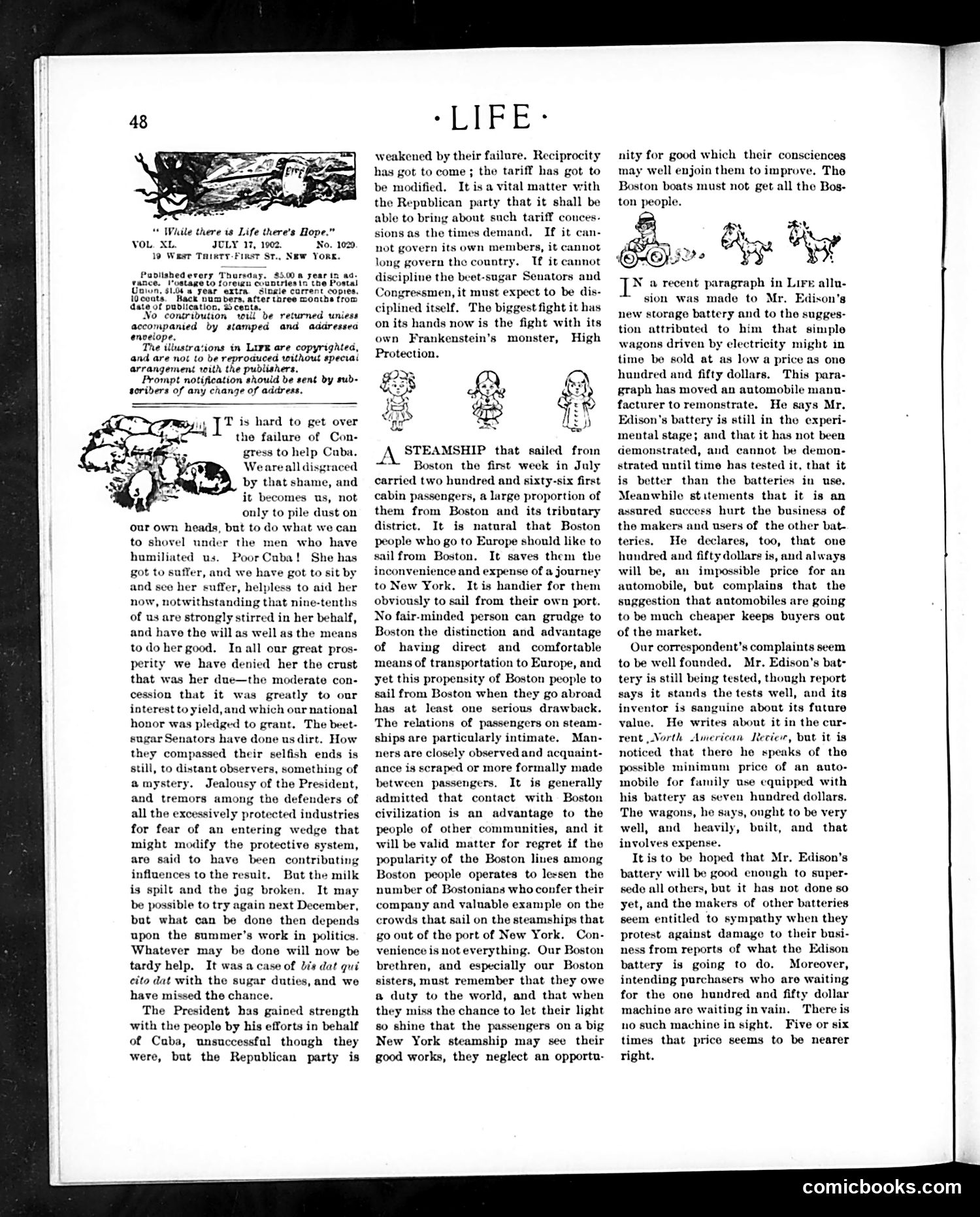
The page contains two distinct political commentaries: **Left cartoon**: Depicts Cuba as a suffering woman ("Poor Cuba!") being neglected. The text criticizes American failure to help Cuba after the Spanish-American War, arguing that the U.S. has abandoned its moral responsibility to the island. **Right section**: Discusses a Boston steamship carrying passengers to Europe, using it as a vehicle to critique Boston elites' tendency to travel abroad rather than invest locally. The passage sarcastically notes their preference for European travel while neglecting Boston's own development and opportunities. Both pieces employ **satirical social criticism**—attacking American neglect of Cuba and Boston's self-interested wealthy class who prioritize European leisure over civic responsibility. The tone suggests disappointment in American ethical and civic commitments circa 1902.
📄 Transcribed text from this page (OCR, searchable)
Machine-transcribed from the original scan — historical spelling and the odd misread are preserved.
“ While there is Life there's Hope.” VOL. XL. 19 Waser Taixty-First Sr. Papiishedevery Thursday. $5.00 0 year tn ad- vance. Mostage to foreign countries in (00 F Coron, 1.068 year extra. single carrent cop ats. “Rack numbers, after taree months from of publication, a cente, No contribution twill be returned uniess accompanied by stamped and addressea envelope. The illustrations in LxrE are copyrighted, and are not to be reproduced without speciai arrangement with the publishers. Prompt notification should be sent by sub- soriders of any change of address, is hard to get over the failure of Con- gress to help Cuba, Weare alldisgraced by that shame, and it becomes us, not only to pile dust on our own heads, but to do what we can to shovel under the men who have humiliated us. PoorCuba! She has got to suffer, and we have got to sit by and see her suffer, helpless to aid her now, notwithstanding that nine-tenths of us are strongly stirred in her behalf, and have the will as well as the means todo her good. In all our great pros- perity we have denied her the crust that was her due—the moderate con- cession that it was greatly to our interest to yield, and which our national honor was pledged to grant. The beet- sugar Senators have done us dirt. How they compassed their selfish ends is still, to distant observers, something of amystery. Jealousy of the President, and tremors among the defenders of all the excessively protected industries for fear of an entering wedge that might modify the protective system, are said to have been contributing influences to the result. But the milk is spilt and the jag broken, It may be possible to try again next December, but what can be done then depends upon the summer’s work in politics. Whatever may be done will now be tardy help. It was a case of Dis dat qui cito dat with the sugar duties, and we have missed the chance. The President has gained strength with the people by his efforts in behalf of Caba, unsuccessful though they were, but the Republican party is i i LIPE weakened by their failure. Reciprocity has got to come ; the tariff has got to be modified. It is a vital matter with the Republican party that it shall be able to bring about such tariff conces- sions as the times demand, If it can- not govern its own members, it cannot long govern the country. Tf it cannot discipline the beet-sugar Senators and Congressmen, it must expect to be dis- ciplined itself. The biggest fight it has on its hands now is the fight with its own Frankenstein's monster, High Protection. = 235 : S Ne cans aps ‘or STEAMSHIP that sailed froin Boston the first week in July carried two hundred and sixty-six first cabin passengers, a large proportion of them from Boston and its tributary district. It is natural that Boston people who go to Europe should like to sailfrom Boston. It saves them the inconvenience and expense of a journey to New York. It is handier for them obviously to sail from their own port. No fair-minded person can grudge to Boston the distinction and advantage of having direct and comfortable means of transportation to Europe, and yet this propensity of Boston people to sail from Boston when they go abroad has at least one serious drawback. The relations of passengers on steam- ships are particularly intimate. Man- ners are closely observed and acquaint- ance is scraped or more formally made between passengers. It is generally admitted that contact with Boston civilization is an advantage to the people of other communities, and it will be valid matter for regret if the popularity of the Boston lines among Boston people operates to lessen the number of Bostonians who confer their company and valuable example on the crowds that sail on the steamships that go out of the port of New York. Con- venience is noteverything. Our Boston brethren, and especially our Boston sisters, must remember that they owe ® duty to the world, and that when they miss the chance to let their light so shine that the passengers on a big New York steamship may see their good works, they neglect an opportu- nity for good which their consciences may well enjoin them to improve. The Boston boats must not get all the Bos- ton eo” ox: ne Ane a recent paragraph in Lire allu- i sion was made to Mr. Edison's new storage battery and to the sugges- tion attributed to him that simplo wagons driven by electricity might in time be sold at as low a price as one hundred and fifty dollars. This para- graph has moved an automobile manu- facturer to remonstrate. He says Mr. Edison's battery is still in the experi- mental stage; and that it has not been demonstrated, and cannot be demon- strated until time has tested it, that it is better than the batteries in use, Meanwhile stitements that it is an assured success hurt the business of the makers and users of the other bat- teries. He declares, too, that one hundred and fifty dollars is, and always will be, an impossible price for an automobile, but complains that the suggestion that automobiles are going to be much cheaper keeps buyers out of the market. Our correspondent’s complaints seem to be well founded. Mr. Edison's bat- tery is still being tested, though report says it stands the tests well, and its inventor is sanguine about its future value. He writes about it in the cur- rent North American Review, but it is noticed that there he speaks of the possible minimum price of an auto- mobile for family use equipped with his battery as seven hundred dollars. The wagons, he says, ought to be very well, and heavily, built, and that involves expense. It is to be hoped that Mr. Edison’s battery will be good enongh to super- sede all others, but it has not done so yet, and the makers of other batteries seem entitled to sympathy when they protest against damage to their busi- ness from reports of what the Edison battery is going to do, Moreover, intending purchasers who are waiting for the one hundred and fifty dollar machine are waiting invain. There is no such machine in sight. Five or six times that price seems to be nearer right. comicbooks.com