
A complete issue · 20 pages · 1902
Life — May 29, 1902
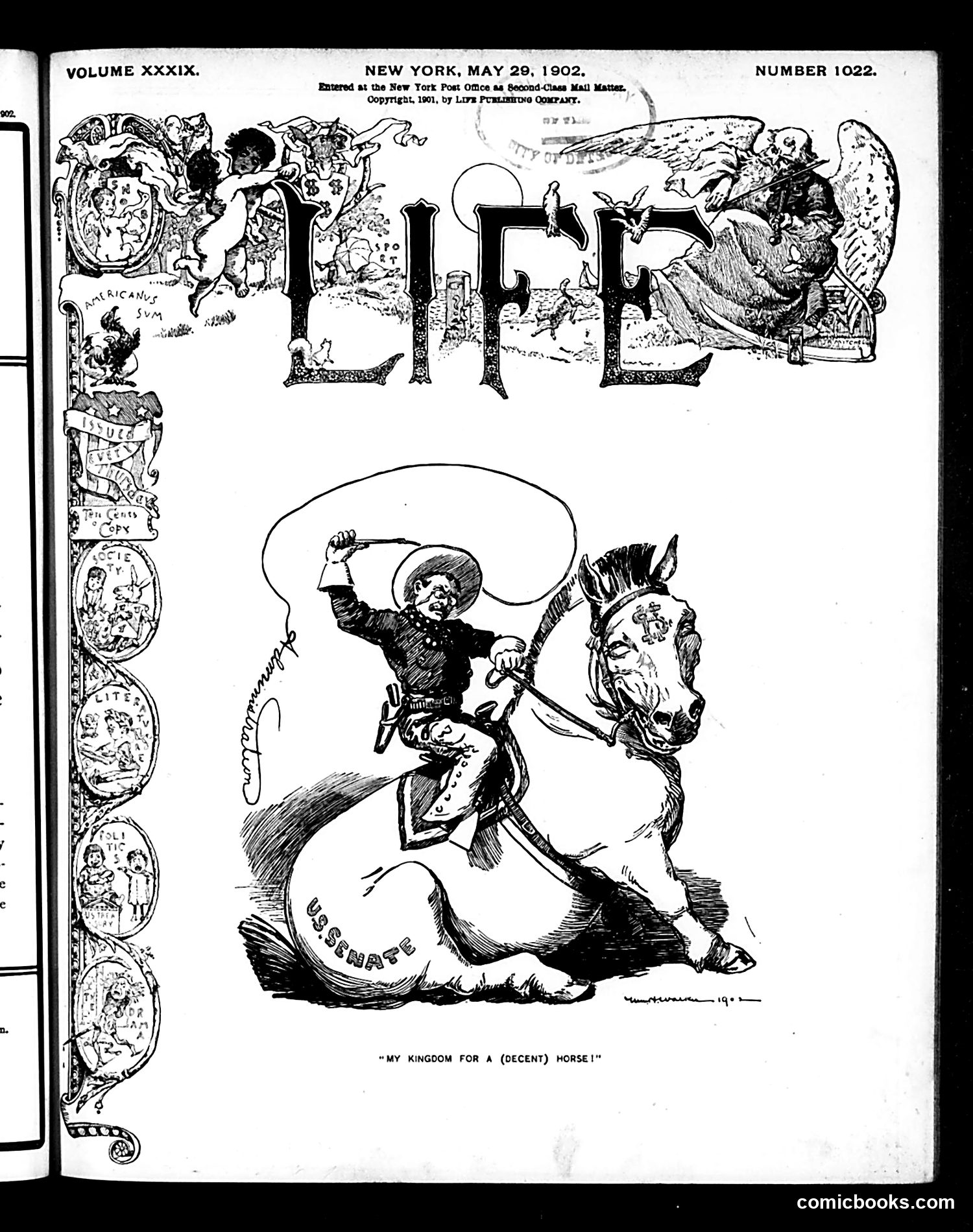
The main cartoon depicts a cowboy on a horse labeled "DESPAIR," wielding a lasso. The caption reads: "MY KINGDOM FOR A (DECENT) HORSE!" This is a political satire referencing Richard III's famous line "A horse, a kingdom for a horse!" The cartoon appears to critique someone's (likely a political figure's) poor choice or "despair" over inadequate resources or options. The cowboy imagery suggests an American political context—possibly commentary on Western expansion, Republican politics, or a specific leader's position. The decorative left border contains small comic vignettes typical of Life's satirical style. Without identifying the specific figure caricatured as the cowboy, the core joke plays on the classic Shakespeare reference to mock someone desperately regretting their situation or mount.
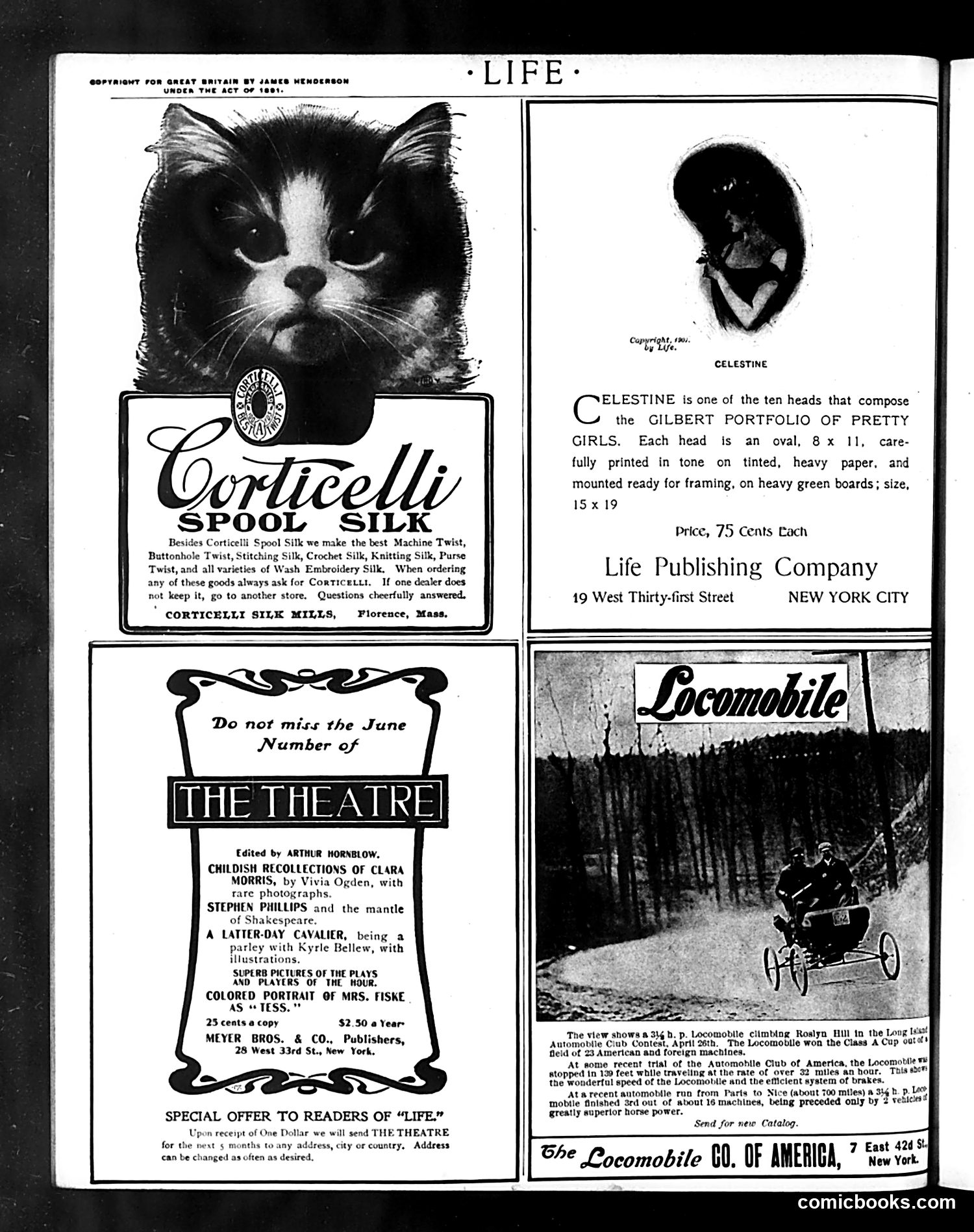
This page is **primarily advertising**, not political satire. The top-left features a **Corticelli Spool Silk advertisement** using an anthropomorphized cat's face as its mascot—a common early 20th-century marketing approach with no political content. The top-right advertises the **"Gilbert Portfolio of Pretty Girls"**—specifically a portrait print titled "Celestine" sold by Life Publishing Company for 75 cents. The bottom-left promotes the **June issue of "The Theatre"** magazine, listing articles about theatrical figures and offering a special subscription deal. The bottom-right showcases a **Locomobile automobile advertisement**, highlighting the vehicle's racing achievements and speed capabilities. **No political cartoons or satire appear on this page.** It represents typical early 1900s Life magazine content: lighthearted illustrations mixed with commercial advertisements.
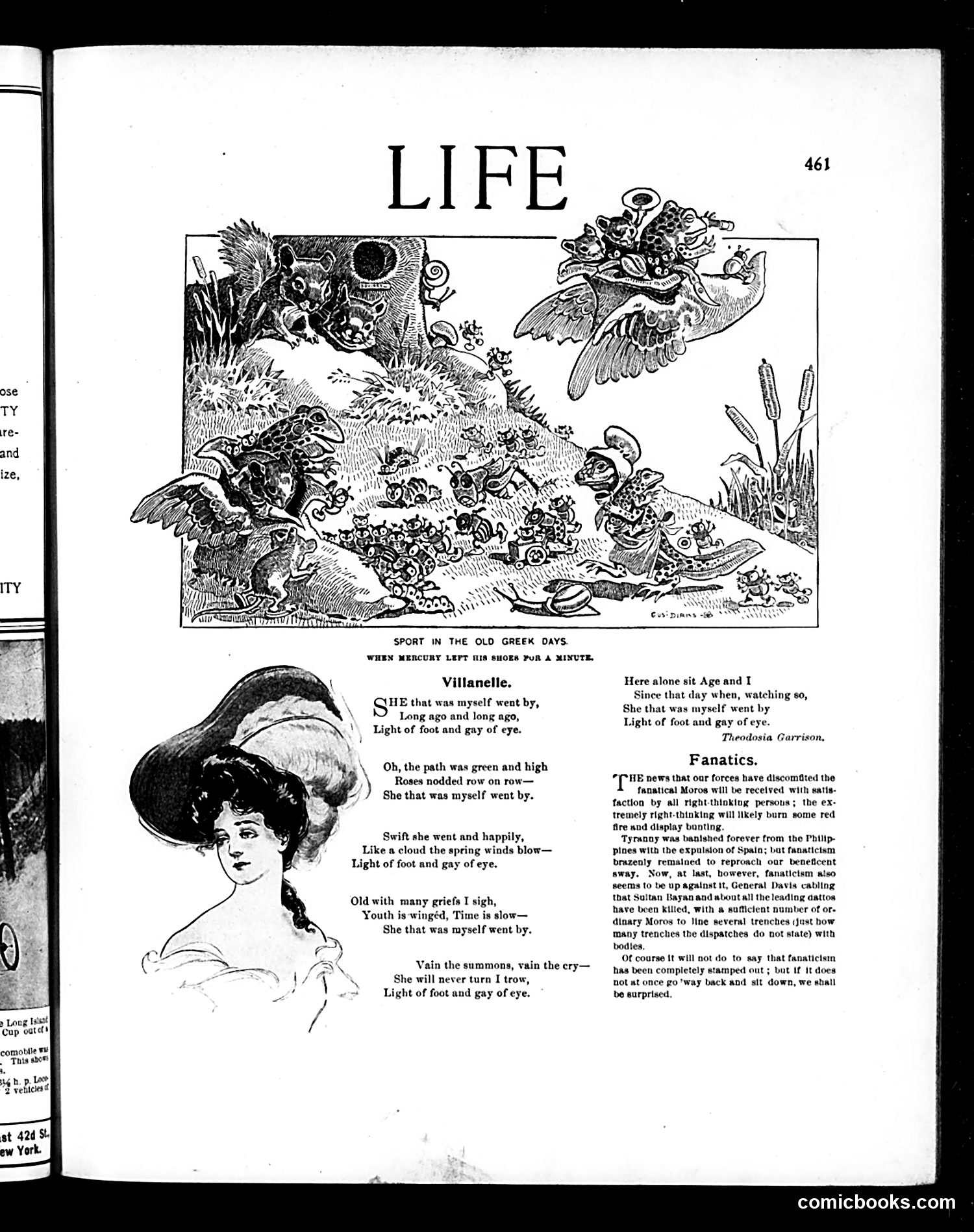
**The Main Cartoon** depicts classical Greek mythological figures in a whimsical scene, captioned "Sport in the Old Greek Days—When Mercury Left his Shoes for a Minute." This is a humorous visual pun: Mercury's winged shoes (talaria) are absent, so the gods and creatures are engaged in absurd activities instead of their usual divine pursuits. **The Poems Below** include "Villanelle" by Thodosia Garrison about a woman's nostalgic memories, and "Fanatics," which discusses fanatical Moors and references General Davis's military campaigns (likely colonial-era conflicts). The accompanying portrait sketch shows a woman's face. The page primarily features literary content rather than political satire, mixing classical humor with period poetry and social commentary.
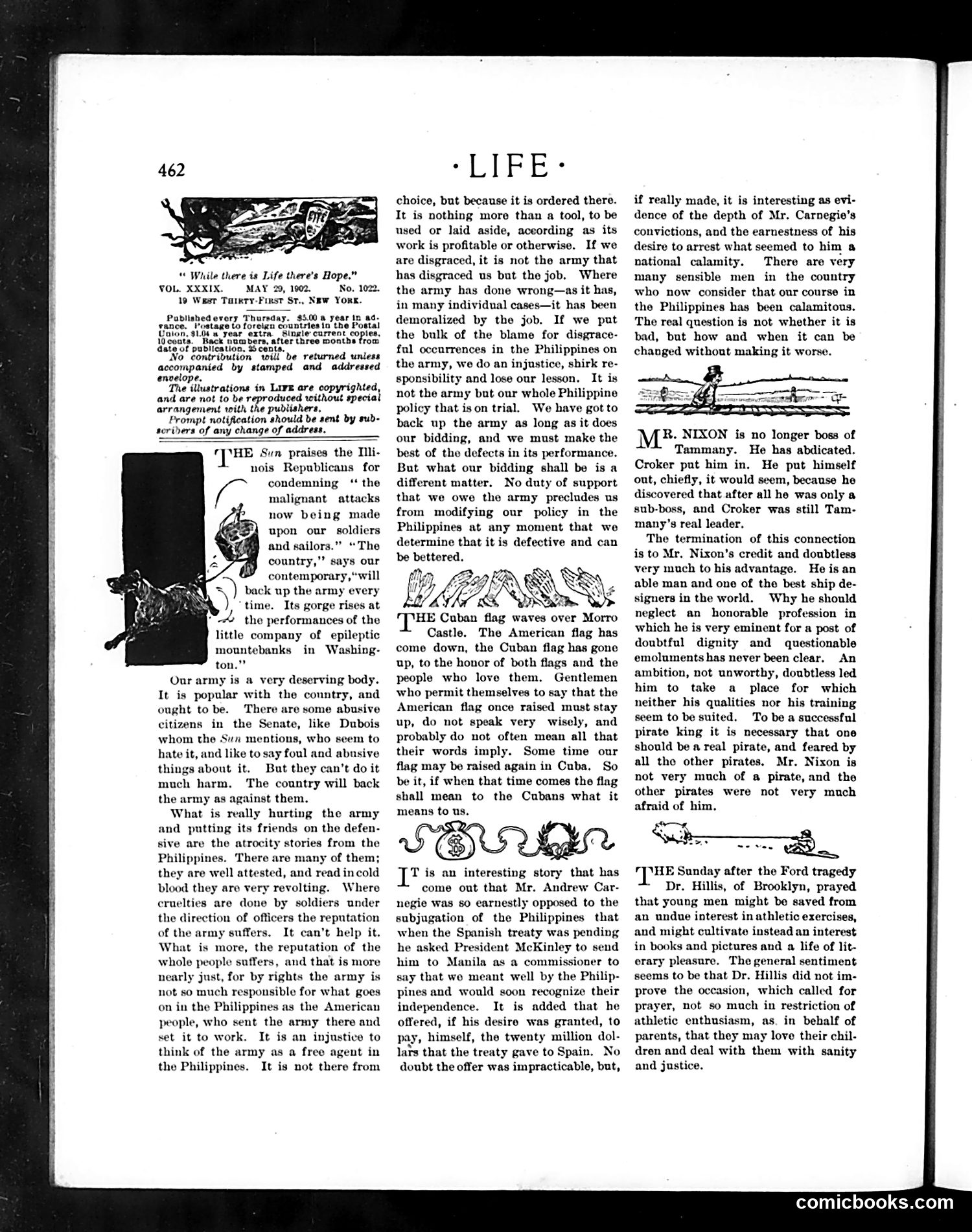
This page contains editorial commentary on U.S. military policy in the Philippines during the ongoing Philippine-American War. The text defends the American army against criticism regarding conduct in the Philippines, arguing that policy failures shouldn't discredit soldiers. There is a small illustration showing what appears to be a naval or military figure, though details are unclear in reproduction. The editorial also discusses Mr. Nixon (appears to be a ship captain or naval officer) losing authority to someone named Croker, suggesting political/administrative changes in colonial administration. A separate item mentions the Cuban flag and American flag at Morro Castle, celebrating American military presence in Cuba following the Spanish-American War. The content reflects early-1900s American imperialism debates and military administration of newly-acquired territories.
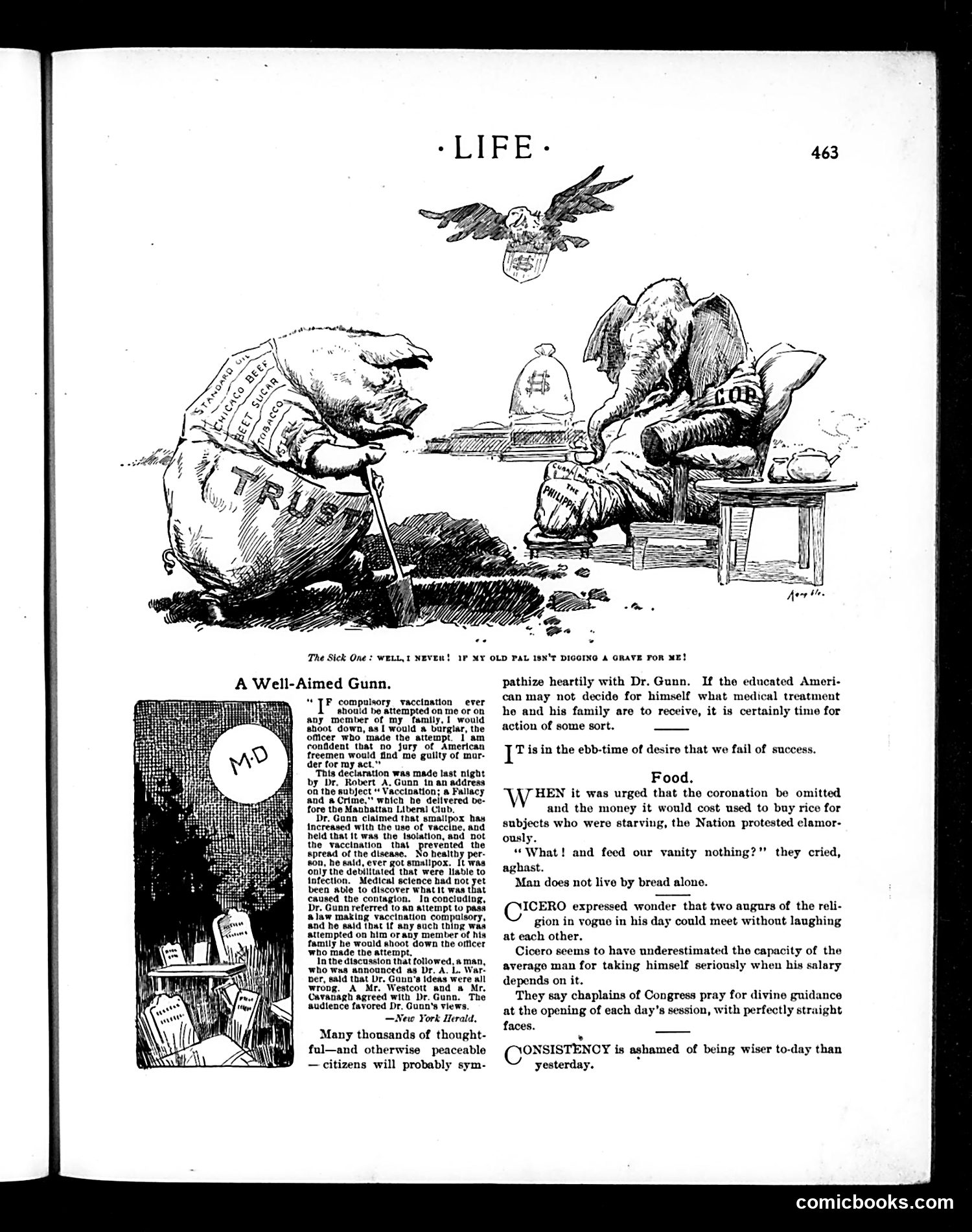
**Top Cartoon:** "A Well-Aimed Gunn" depicts two figures in conversation—one labeled "TRUTH" confronting what appears to be a medical or political authority figure. The accompanying text discusses Dr. Gunn's declaration that vaccination caused no harm, countered by claims that analogs actually increased disease transmission. This satirizes a contemporary medical debate (likely early 1900s based on style) about vaccine safety and expert credibility. **Lower Section:** Contains commentary on food shortages and religious hypocrisy during wartime or economic crisis. References to starving subjects, the coronation being omitted for cost reasons, and Cicero's observations about rival religions meeting suggest satirizing government priorities and aristocratic indifference to suffering masses. The page overall critiques institutional authority figures and social inequality.
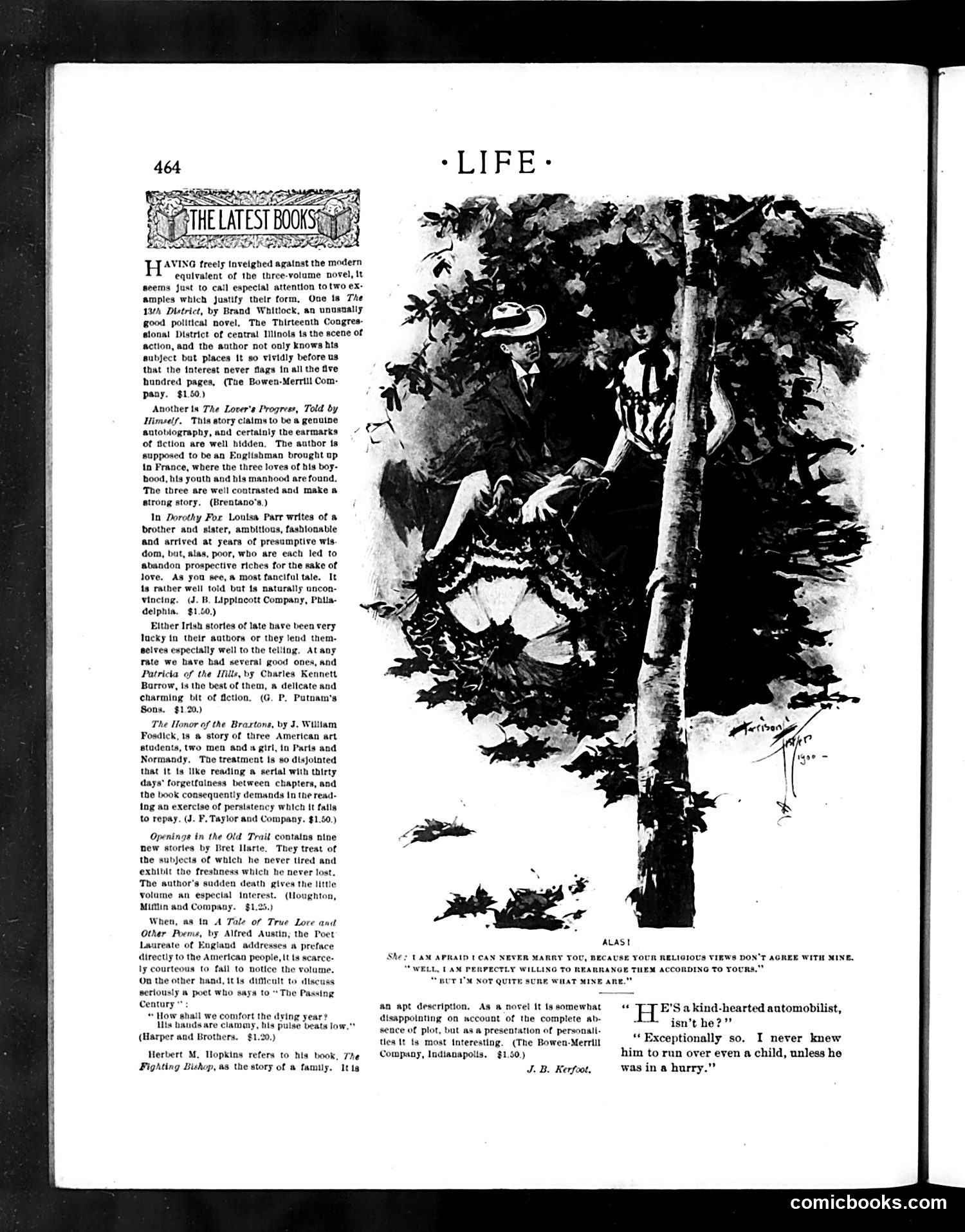
This page primarily consists of book reviews under "The Latest Books" section, not political satire. The large illustration on the right depicts a man in a hat and suit surrounded by ivy or climbing vines, drawn in a sketchy style signed by the artist. Below the illustration is a dialogue snippet: a woman expresses surprise at a "kind-hearted automobilst" who won't hit her, saying she never knew him to run over anyone unless in a hurry. This appears to be satirizing reckless automobile drivers of the era—a common early 20th-century concern about dangerous driving habits. The page reviews several novels including works by Brad Whitlock, Louisa Parr, and Charles Kennett Burrow, with prices listed. The content reflects period literary criticism rather than political commentary.
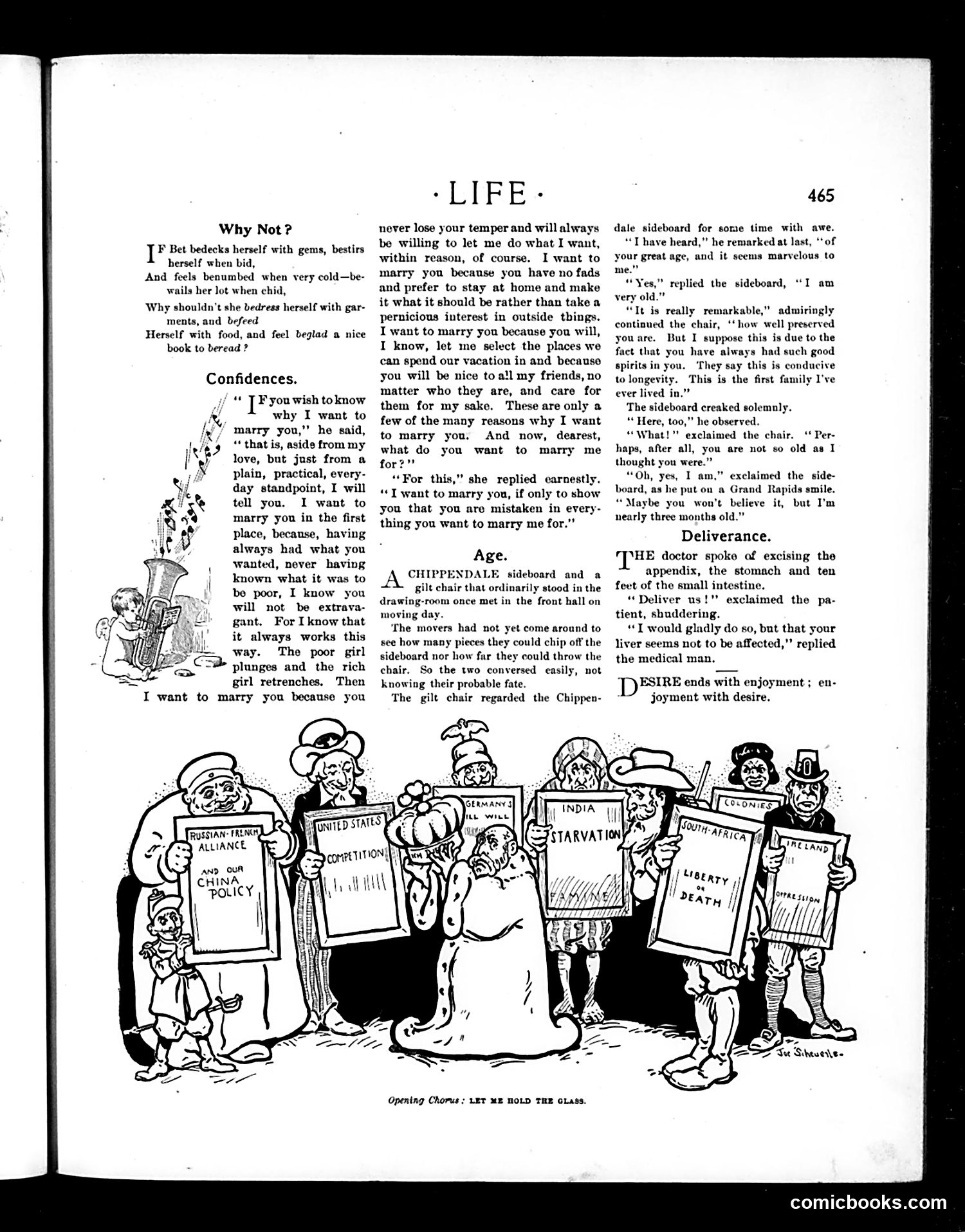
This satirical cartoon depicts various nations as caricatured figures holding signs representing their concerns during what appears to be the World War I era. Visible nations include the Indian-French Alliance, United States, Germany, India, Starvation, South Africa, and Ireland. The cartoon's title, "Let Us Hold the Glass," suggests these nations are toasting or unified around a central figure (likely representing a major power or conflict). The signs reference wartime issues: China Policy, Competition, Starvation, Liberty or Death, and others. The satire critiques how different nations—allies and enemies alike—are preoccupied with their own agendas and survival concerns rather than unified purpose. The cartoon mocks the competing interests within the war effort and international relationships of the period.
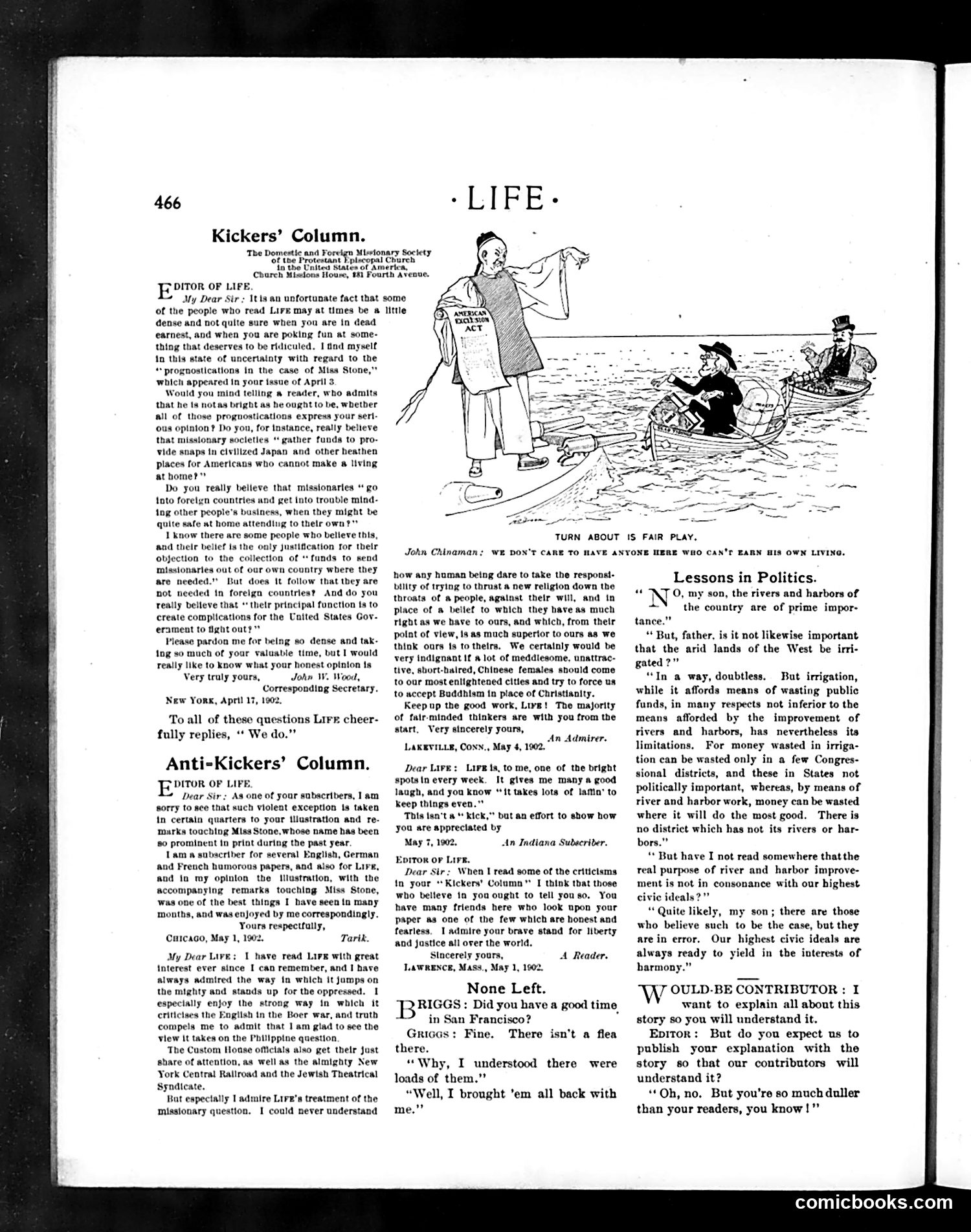
The main cartoon depicts a figure labeled "American Duty" standing on a beach, apparently expelling or removing another figure into the water. Two men in boats observe. The caption reads: "TURN ABOUT IS FAIR PLAY. We don't care to have anyone here who can't earn his own living." This satirizes late-19th/early-20th century American immigration debates. "American Duty" personifies nativist sentiment opposing immigration. The cartoon suggests xenophobic policy—that foreigners unable to immediately earn money should be expelled. The "turn about" phrase likely references reciprocal treatment, implying America should do to outsiders what other nations supposedly do to Americans. This reflects the period's restrictive immigration attitudes, before major legislative restrictions like the 1924 National Origins Act.
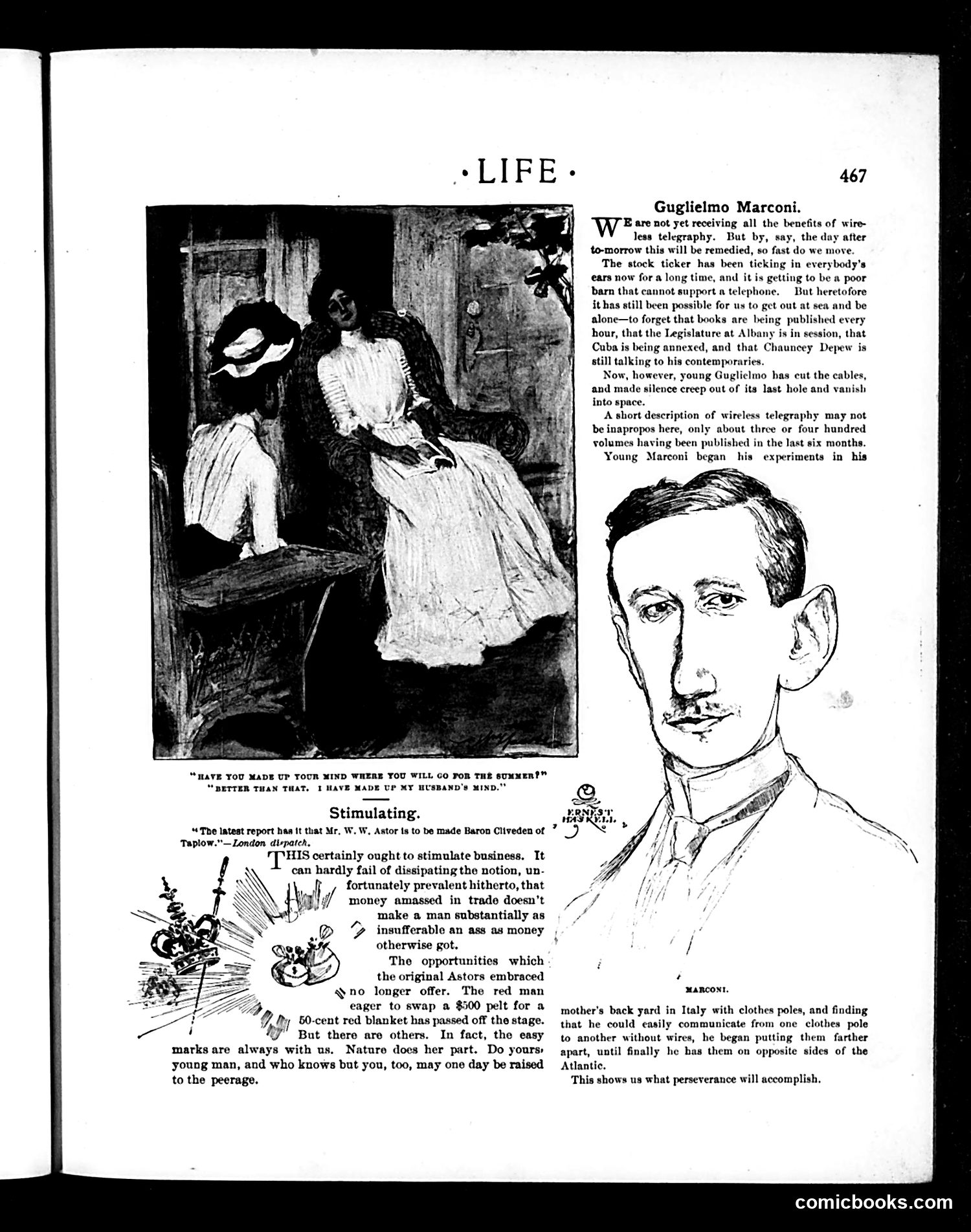
This page features a biographical article about **Guglielmo Marconi**, the inventor of wireless telegraphy. The portrait on the right shows Marconi himself. The main illustration depicts two women in conversation, with a caption about making plans for summer—a lighthearted domestic scene unrelated to the biography. Below is a satirical section titled "Stimulating" that jokes about business stimulus through a reference to W.W. Astor (a wealthy businessman). The cartoon shows theatrical performers, satirizing how easy money from trade stimulates business ambitions, suggesting that anyone with financial backing might aspire to theatrical success—a commentary on how wealth rather than talent sometimes drives careers. The page essentially contrasts Marconi's genuine innovation with society's tendency to reward wealthy amateurs.
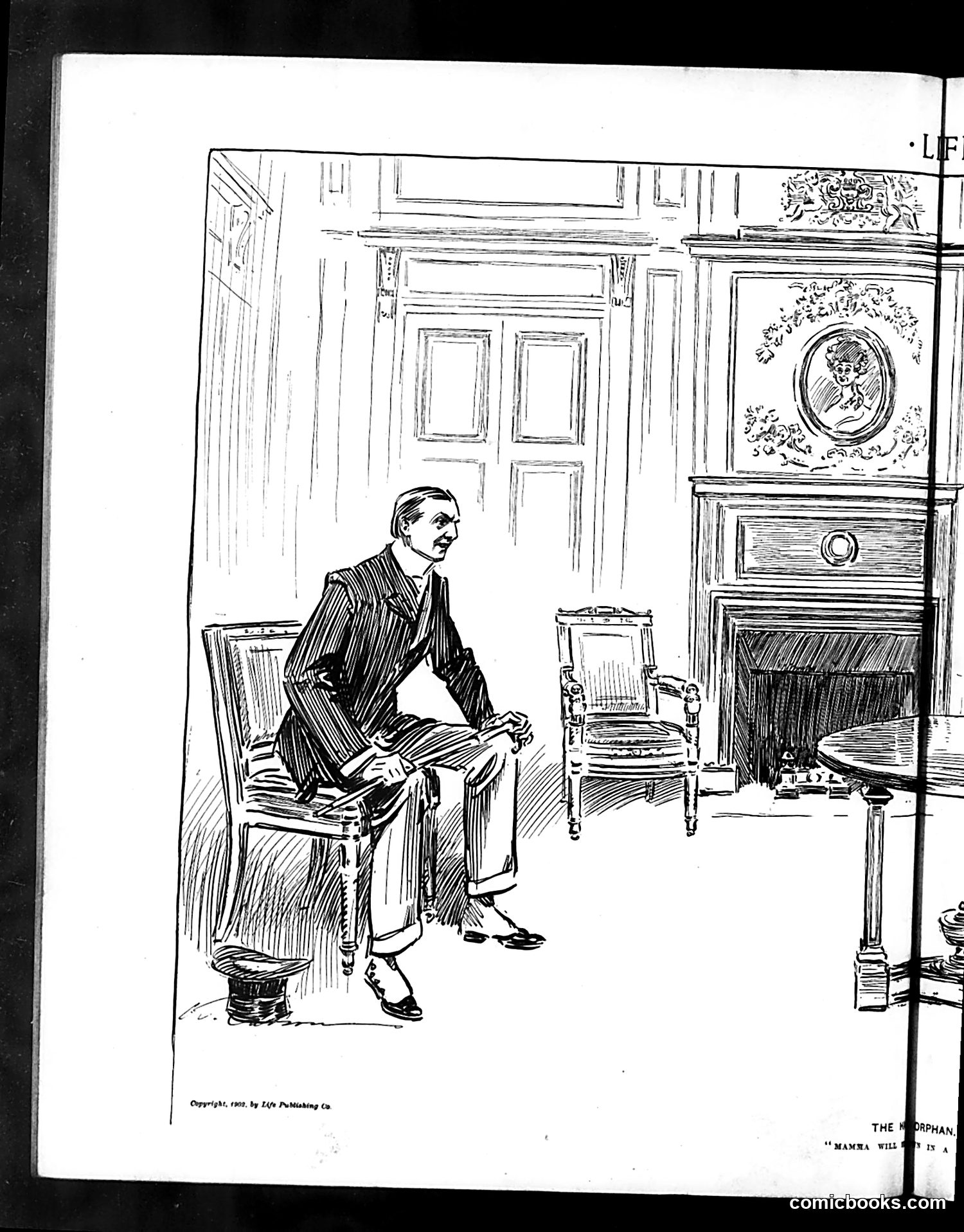
This is a black and white illustration showing a well-dressed man in pinstriped suit sitting alone in an ornate parlor. The room features elaborate furnishings typical of wealthy early 20th-century interiors—decorative wall panels, framed oval portrait, cushioned furniture, and a fireplace. The partial text visible at bottom reads "THE ORPHAN" and "MAMMA WILL BE IN A," suggesting this is part of a serialized story or comic feature rather than a political cartoon. The image appears to be from Life magazine's literary or dramatic illustration section. Without the complete caption and text, the specific narrative context and satirical point remain unclear, though the composition emphasizes the character's isolation within luxury, possibly suggesting themes about wealth, loneliness, or social circumstance.
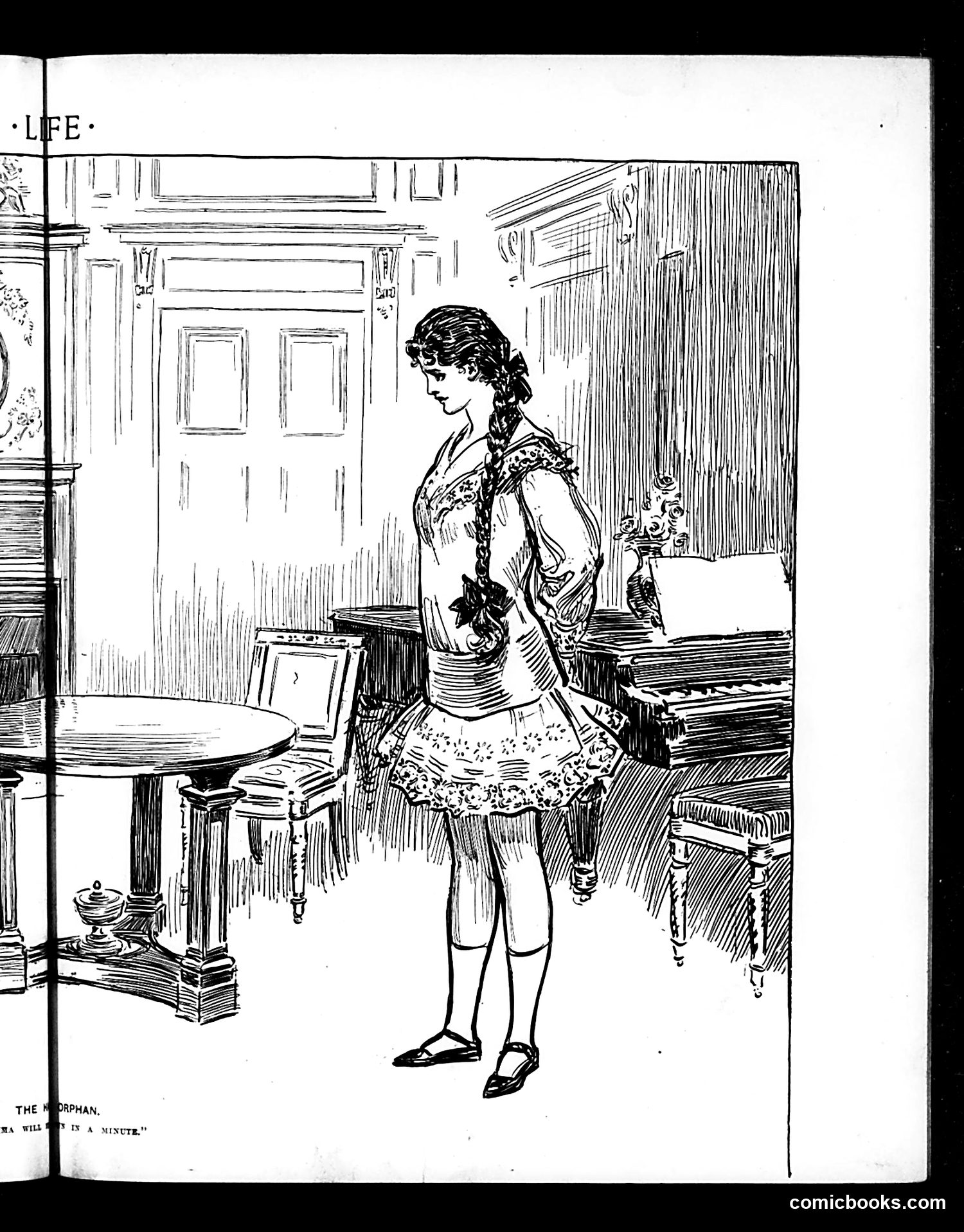
This is a page from *Life* magazine labeled simply "LIFE" at the top. The illustration shows a woman in early 20th-century dress standing in an interior room with furniture and curtains. She wears a decorative dress with a bow and braided hair. The OCR text at bottom appears fragmentary: "THE ORPHAN" and "A WILL BE IS A MINUTE," which seems incomplete or corrupted. Without clearer text or caption, the specific satirical point is unclear. The image may reference a serialized story or satirical commentary on women's fashion, domestic life, or a contemporary social situation, but I cannot confidently identify the specific figure, event, or joke intended without more legible context. The style is consistent with early 1900s magazine illustration.
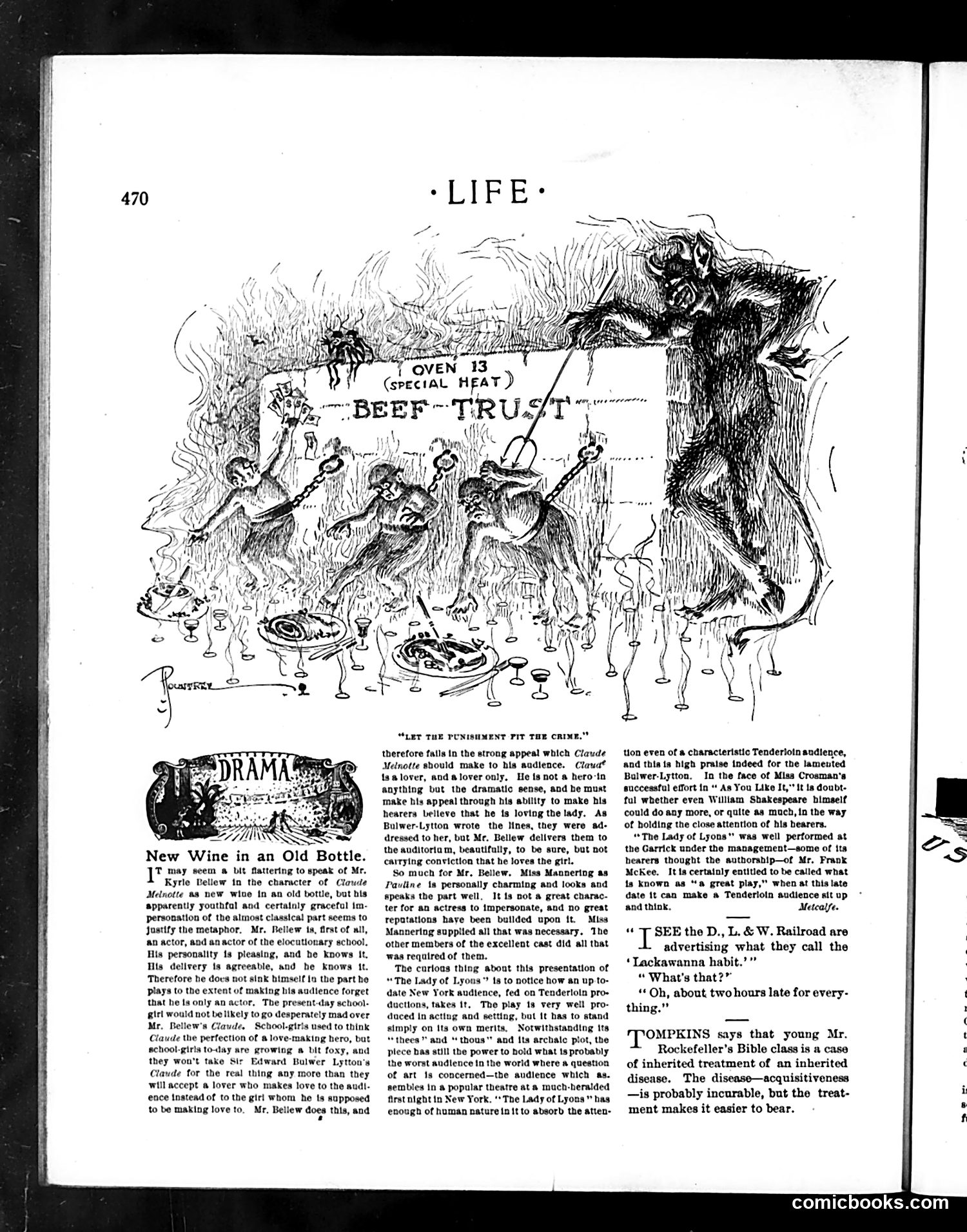
This is a satirical cartoon titled "Oven 13 (Special Heat): Beef Trust." Small human figures labeled as politicians or business figures are depicted inside a giant oven, being roasted or cooked. The imagery references the **beef trust**—the monopolistic practices of major American meatpacking companies in the early 20th century. The cartoon satirizes how these corporations controlled prices and competition, "cooking" their competitors or political enemies through anti-competitive practices. The figures appear distressed, suggesting they are victims of the trust's power. The accompanying drama column discusses theatrical productions, unrelated to the cartoon's political message about industrial monopolies and trust-busting concerns of the Progressive Era.
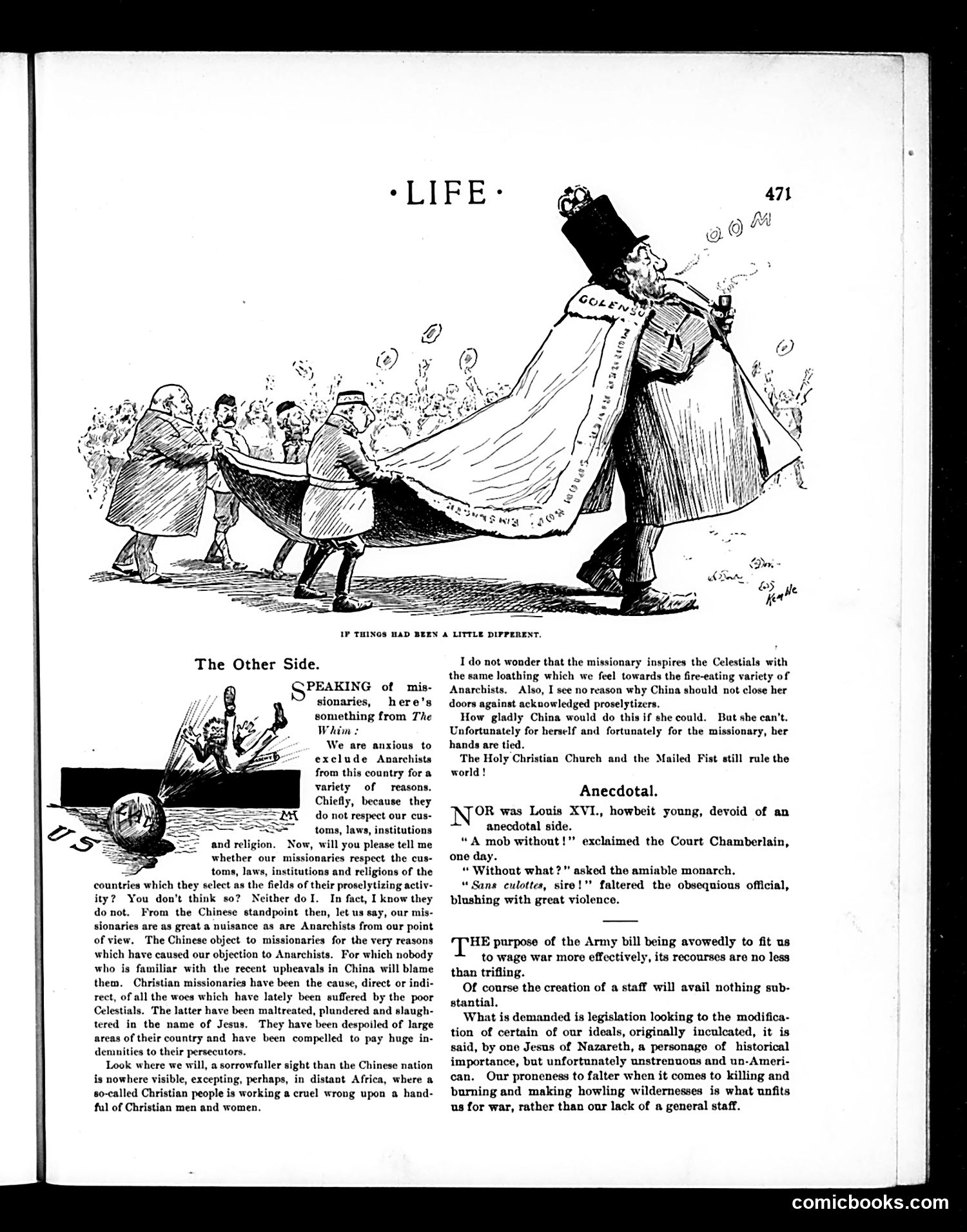
This page contains two distinct satirical pieces critiquing American hypocrisy and militarism. **"The Other Side"** uses a cartoon showing a large figure (representing Western imperialism/Christianity) being pulled by smaller figures, captioned "IF THINGS HAD BEEN A LITTLE DIFFERENT." The accompanying text argues that America excludes Anarchists for disrespecting customs and laws—yet American missionaries do exactly this in China, causing suffering, exploitation, and land seizure. The satire: China has equal reason to exclude missionaries, but cannot due to Western military power ("The Mailed Fist"). **The Louis XVI anecdote** is a brief joke about the French king misunderstanding "sans culottes" (literally "without breeches," but the name of French revolutionaries). **The Army Bill commentary** sarcastically critiques American military weakness, claiming it stems not from lacking staff but from Christian values of mercy—implying Jesus's teachings make Americans unfit for ruthless warfare. The satire mocks both Christian pacifism and aggressive militarism simultaneously.
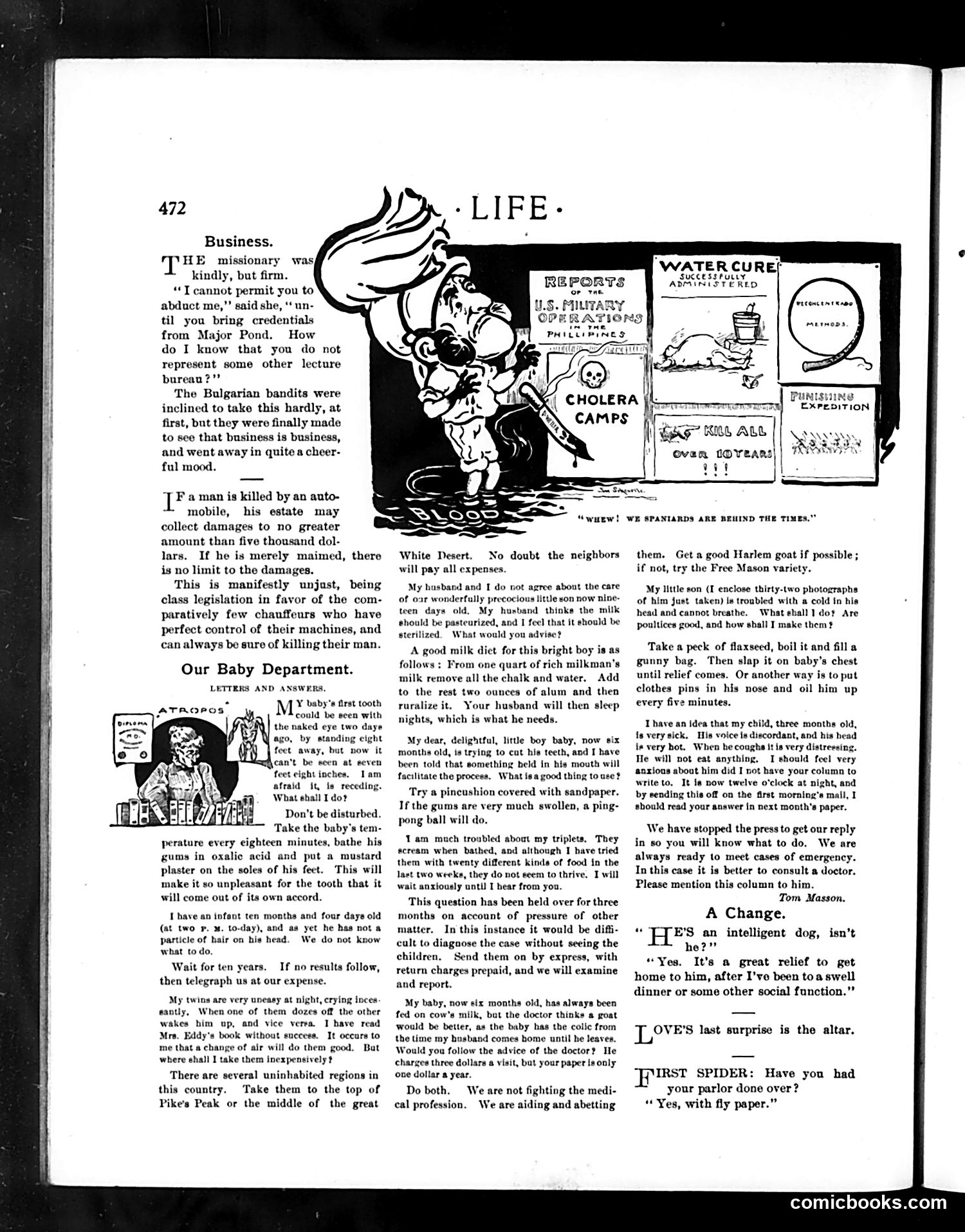
This page combines satirical business commentary with absurdist advice humor. **The Cartoon:** The main illustration depicts a missionary resisting Bulgarian bandits who attempt to kidnap her. The joke satirizes American business culture: even criminals must follow proper procedure. She demands credentials from "Major Pond" (a real lecture bureau manager), treating abduction as a breach of contract rather than a crime. The caption "Whew! We Spaniards are behind the times" suggests European backwardness compared to American commercialism. **The "Baby Department":** The advice column is pure parody—intentionally ridiculous medical "treatments" (oxalic acid baths, mustard plasters on feet, sandpaper pincushions for teething). It mocks both overzealous new parents seeking expert advice and the era's dubious medical practices. The deadpan, authoritative tone makes absurd suggestions sound serious. The cartoon critiques American obsession with business propriety; the advice column ridicules pseudoscientific parenting advice.
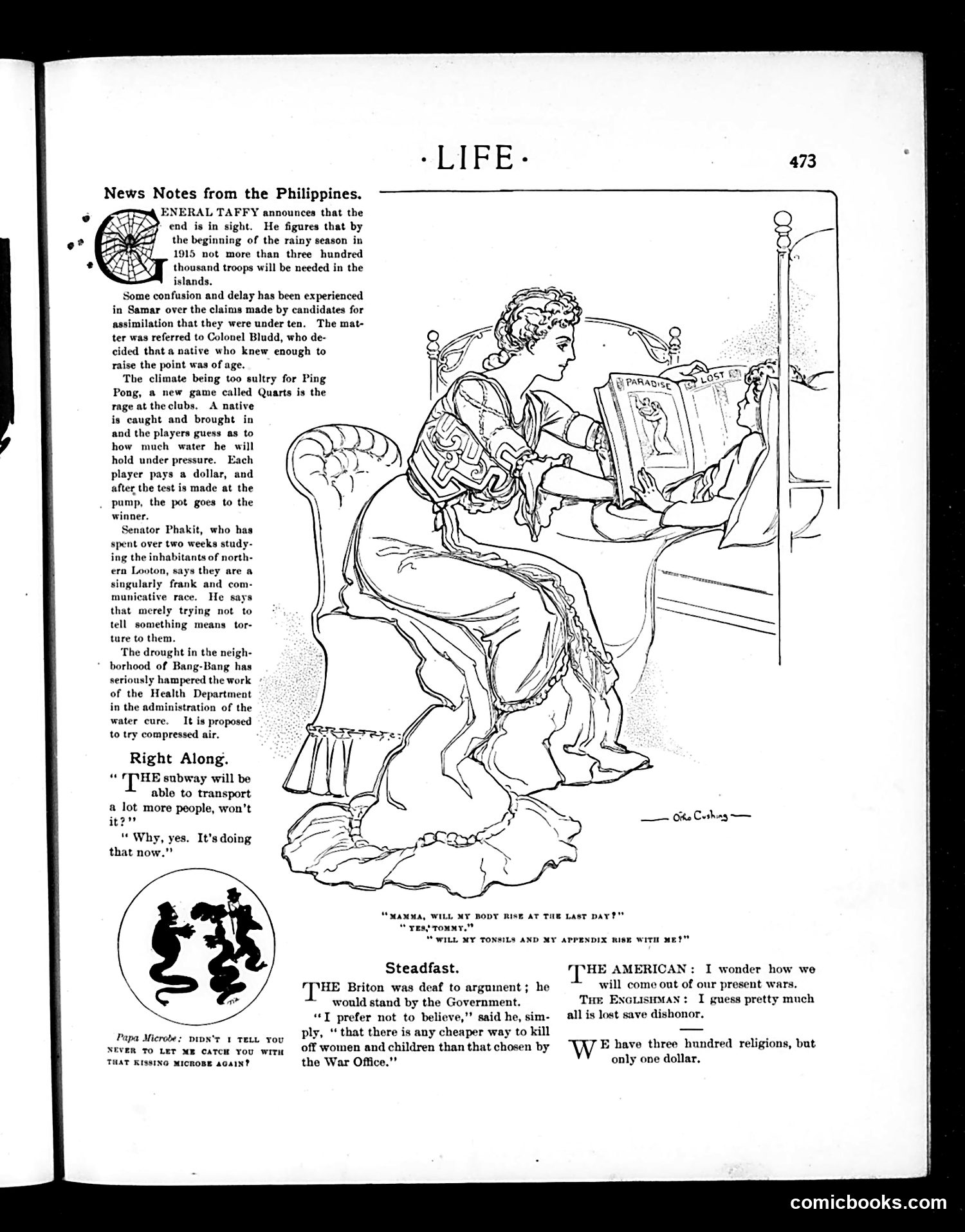
This page satirizes American imperialism in the Philippines during the early 1900s colonial period. The main cartoon depicts a robust woman (representing America or "civilization") sitting with a native Filipino, reading propaganda about the colonial enterprise—a jab at how the U.S. justified occupation. The "News Notes" mock the brutal Philippine-American War (1899-1902, though text references extending to 1915). References to "assimilation," "Colonel Bludd," and the grotesque "water cure" game describe actual torture methods used by American forces. "General Taffy" likely satirizes optimistic military assessments of ending the conflict. The shorter jokes ("Steadfast," "Right Along") contrast British and American perspectives on warfare, with cynical commentary on the human and moral costs of colonialism. The cartoon ridicules how American institutions presented colonial conquest as benevolent "civilization" while ignoring documented violence against Filipino civilians.
This page contains primarily **advertisements and humorous anecdotes** rather than political cartoons. The main text pieces include: 1. **"Address to John Bull"** — A poem from *The London Globe* suggesting British decline ("your swiftly falling star") compared to American ascendancy (U.S.), reflecting late 19th/early 20th-century anxieties about Britain's waning imperial power. 2. **Roosevelt anecdote** — A lighthearted story about President Theodore Roosevelt's wit: when an officer's wife requests a warship named after her, Roosevelt agrees but names it "The Vixen"—a clever insult disguised as compliance. 3. **"Uncle Tom's Cabin" advertisement** — Noting this 19th-century play still draws multigenerational audiences despite its age. 4. **"Every Child Her Own Solomon"** — A humorous domestic dispute where a girl proves ownership of a lost dog through a series of trick-performance tests. The page is primarily **advertising-driven** (whiskey, cigarettes, tailoring services, perfume) with satirical commentary on contemporary social issues embedded in short narratives rather than visual cartoons.
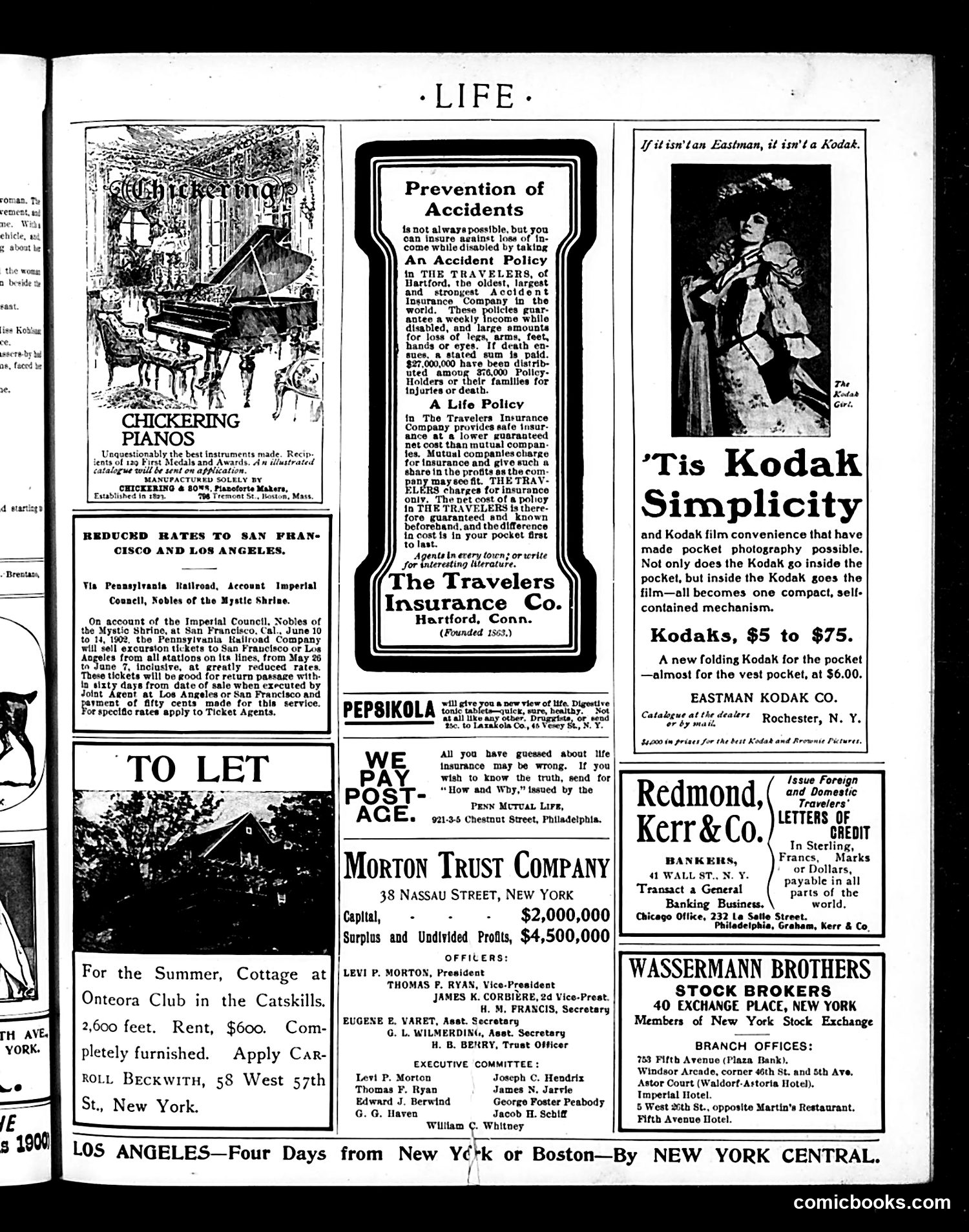
This page is primarily **advertising with minimal cartoons or political satire**. The top-left contains an illustrated advertisement for Chickering Pianos showing an elegant interior scene with a woman at a piano. This is straightforward commercial promotion, not satire. The upper-right features a Kodak camera advertisement with an illustration labeled "If it isn't an Eastman, it isn't a Kodak"—a branded slogan, not satirical commentary. The remaining content consists entirely of business advertisements: insurance companies (The Travelers, Pawn Mutual Life), real estate listings, banking services (Morton Trust Company, Redmond Kerr & Co., Wassermann Brothers), and travel notices. **This is not a satirical page**—it's a commercial advertising section from Life magazine, typical of early 1900s publications that subsidized content through paid advertisements. No political figures, cartoons, or satirical commentary appear here.
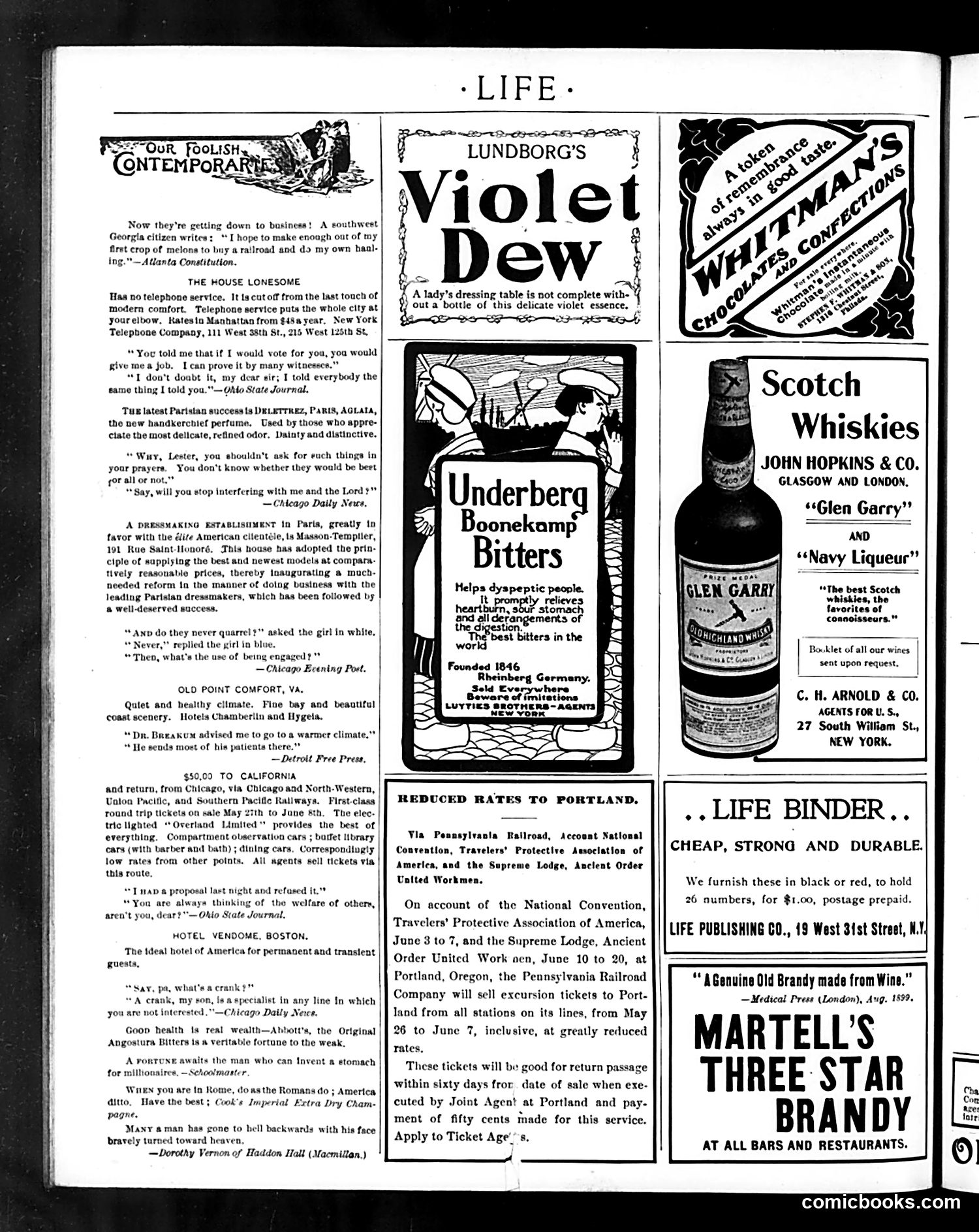
This page is primarily **advertisements and brief satirical vignettes**—typical of Life's format as a humor/satire magazine of the early 20th century. The satirical bits mock **American optimism and political hypocrisy**. A Georgia farmer boasts of buying a railroad from melon profits (mocking rural overconfidence). A politician admits he promised jobs to everyone who voted for him (corrupt patronage). A man complains God won't answer prayers for luxuries—his friend jokes he shouldn't interfere between a man and the Lord (poking fun at materialistic prayer). The cartoon labeled "Our Foolish Contemporaries" collects these quips—typical of Life's format satirizing everyday American absurdities and political corruption. The remaining space is filled with **period advertisements**: Lundborg's Violet Dew perfume, Underberg Bitters (digestive aid), Scotch whisky, and travel/hotel services. These ads reflect early 1900s consumer culture and patent remedies. No major political figures or events are referenced—this is **social satire targeting ordinary hypocrisy and commercial culture**.
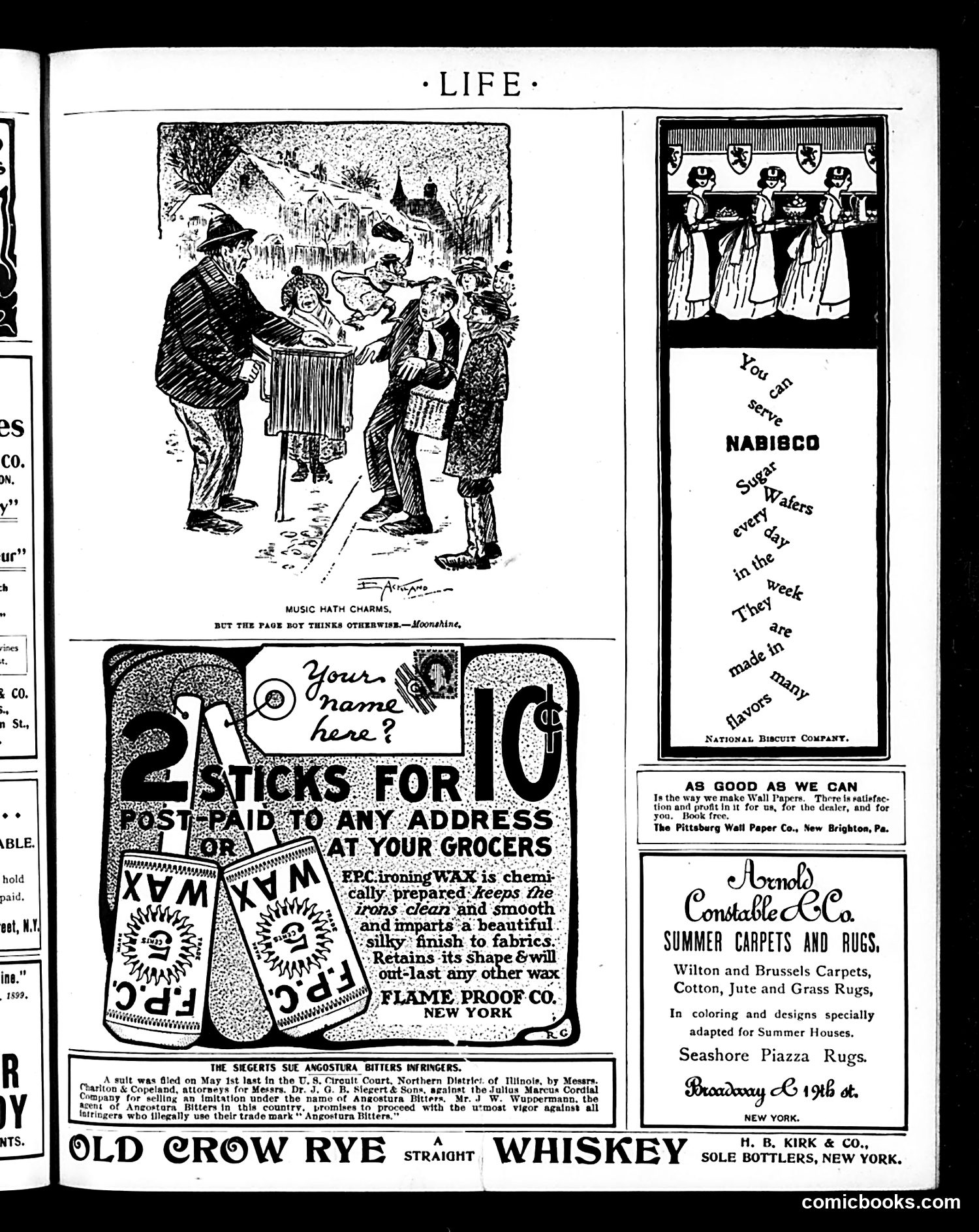
The cartoon depicts a street musician or organ-grinder performing for a gathered crowd in what appears to be a European town setting. The caption jokes that while music is traditionally said to "soothe the savage beast," a **pageboy** (a young hotel or household servant) thinks otherwise—implying the boy finds the music annoying or objectionable rather than charming. The humor lies in this reversal of the common saying: instead of music's universal appeal, even a mere servant boy rejects it. The satire gently mocks either the quality of street musicians' performances or perhaps the pretensions of those who assume everyone appreciates music. The page is primarily **advertising**—for wall paper, carpets, biscuits, wax products, and whiskey—with this single cartoon as the main editorial content. This was typical for *Life* magazine during this era.
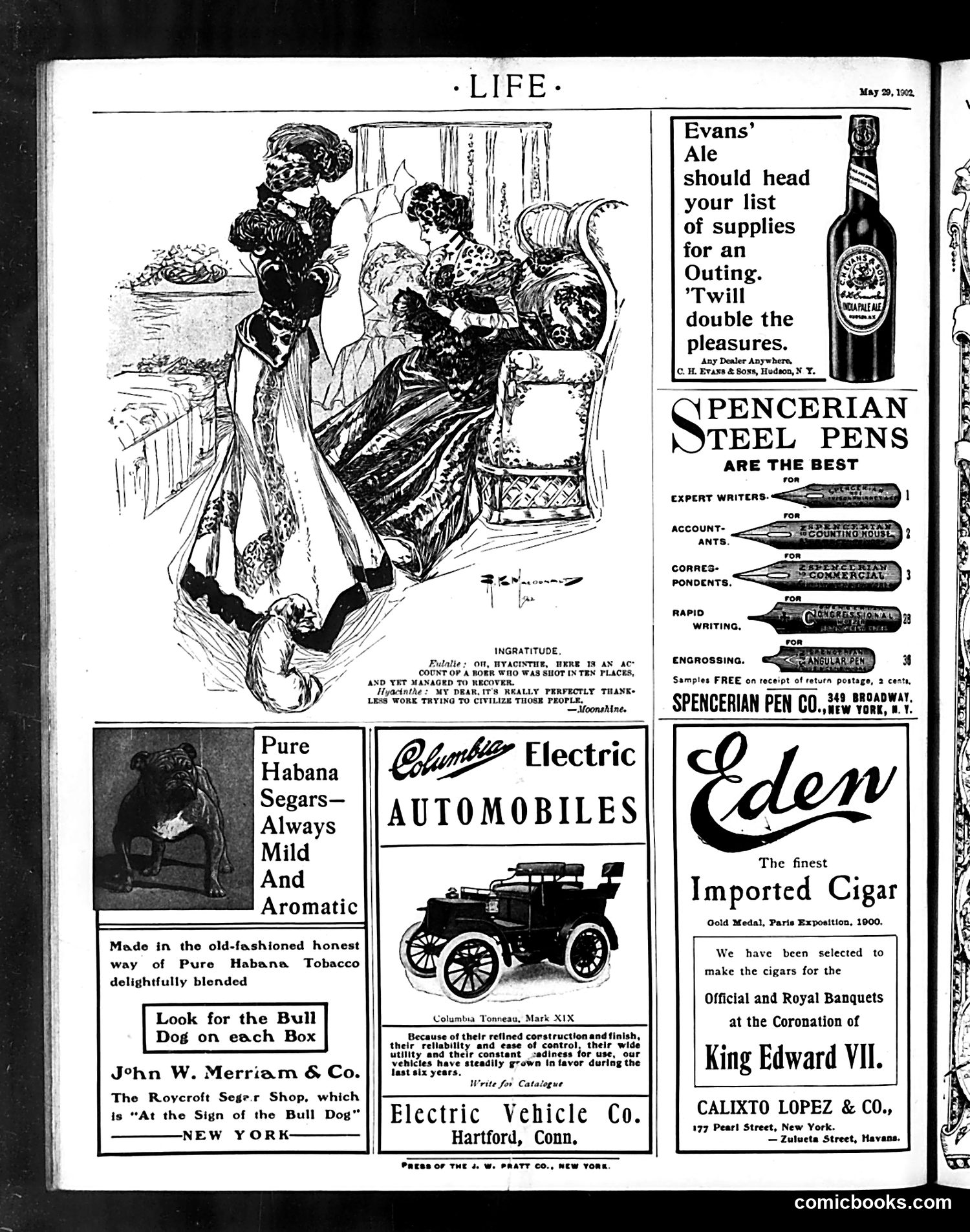
This satirical cartoon mocks ingratitude through a brief dialogue between two society women, Eulalie and Hyacinth. Eulalie recounts a remarkable story: a Boer soldier who was shot ten times yet recovered. Hyacinth's response—calling it "perfectly thankless work"—delivers the joke's punchline by misunderstanding the anecdote. She interprets the Boer's survival as ungrateful behavior rather than recognizing it as a medical marvel. The cartoon likely references the recent Boer War (1899-1902), making the "Boer" reference timely for 1902 readers. The humor operates on two levels: the absurdity of the scenario itself, and the woman's twisted logic in framing miraculous survival as discourteous. It's a gentle satire of upper-class obliviousness and conversational mishaps among society women. The page is primarily advertisements (ale, steel pens, automobiles, cigars) with this single cartoon as editorial content.