
Life, 1902-05-29 · page 6 of 20
Life — May 29, 1902 — page 6: what you’re looking at
What you’re looking at
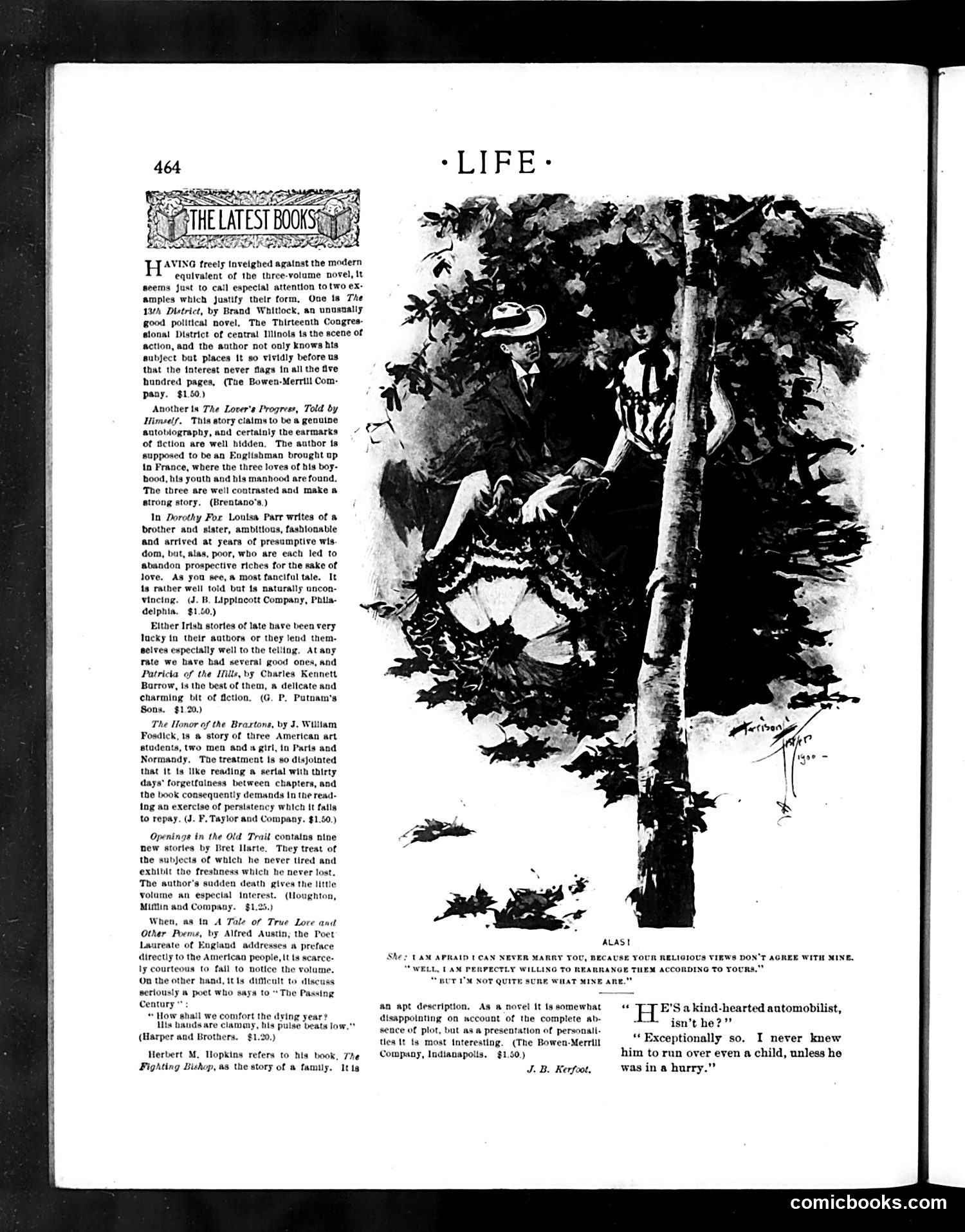
This page primarily consists of book reviews under "The Latest Books" section, not political satire. The large illustration on the right depicts a man in a hat and suit surrounded by ivy or climbing vines, drawn in a sketchy style signed by the artist. Below the illustration is a dialogue snippet: a woman expresses surprise at a "kind-hearted automobilst" who won't hit her, saying she never knew him to run over anyone unless in a hurry. This appears to be satirizing reckless automobile drivers of the era—a common early 20th-century concern about dangerous driving habits. The page reviews several novels including works by Brad Whitlock, Louisa Parr, and Charles Kennett Burrow, with prices listed. The content reflects period literary criticism rather than political commentary.
📄 Transcribed text from this page (OCR, searchable)
Machine-transcribed from the original scan — historical spelling and the odd misread are preserved.
SEIS FANG treeis tnveighed against the modern equivalent of the three-volume novel, It seems just to cail especial attention totwo ex- amples which Justify their form, One 18 The 13th District, by Brand Whitiock, an unosually good political novel, The Thirteenth Congres: sional District of central Iilinols ts the scene of action, and the author not only knows hts subject but places It so vividly before us that the interest never fags in all the five hundred pages, (The Bowen-Merrill Com- pany. $1.50) Another ts The Lover's Progress, Told by Himself. This story claims to be a genuine autoblography, and certainly the earmarks of fiction are well hidden. The author is supposed to be an Englishman brought up in France, where the three loves of his boy- bood, his youth and his manhood are found. The three are well contrasted and make & strong story. (Brentano's) In Dorothy For Loutsa Parr writes of a brother and sister, ambitious, fashionable and arrived at years of presumptive wis. dom, but, alas, poor, who are each led to ‘Abandon prospective riches for the sake of Jove. AS you see, & most fanciful tale. It 1s rather well told but 1s naturally uncon- vincing. (J. B. Lippincott Company, Phila- delpnia. $1.60.) Either Irish stortes of late have been very Jacky in their authors or they lend them. selves expectally well to the telling. Atany rate we bave bad several good ones, and Patricia of the Ills, by Charles Kennett Barrow, is tho best of them, a delicate and charming bit of fiction. (G. P. Putnam's Sons, $1.20.) The Honor of the Braxtons, by J. Wiliam Fosdick, 18 @ story of three American art students, two men and a girl, in Parts and Normandy. The treatment 1s #0 disjointed that it ts like reading @ sertal with thirty days’ forgetfalness between chapters, and the book consequently demands In the read- ing an exercise of persistency which It falls to repay. (J. F, Taylor and Company. $1.60.) Openings in the Old Trait contains nine new stories by Bret Marte. They treat of the subjects of which he never tired and exhinlt the freshness which he never los! The author's sudden death gives the Itt volume an especial interest. (Houghton, Miflin and Company. $1.25.) When, as tn A Tale of True Lore and Other Poems, by Alfred Austin, the Poet Laureate of England addresses a preface directly to the American people, It {8 scarce- ly courteous to fail to notice the volume. On the other hand, 1tls dificult to discuss seriously a poet who says to“ The Passing Century: * How shail we comfort the dying year? Als hands are clammy, his pulse beats low."* (Harper and Brothers. $1.20.) Herbert M. Hopkins refers to his book, The Fighting Bishop, as the story of @ family. It is ALAS She: TAM APRAID [CAN NEVER MARRY YOU, BECAUSE YOUR RELIGIOUS VIEWS DON'T AGREE WITH MINE. “WELL, FAM PERPECTLY WILLING TO REARRANGE THEM ACCORDING To YOURS." * BUT I'M NOT QUITE SURE WHAT MINE ARE.” An apt description. As a novel {t ts somewhat disappointing on sccount of the complete ab- sence of plot, but as. presentation of personali- tles {t {8 most Interesting. (The Bowen-Merrlil Company, Indianapolis. $1.50.) J.B. Kerfoot, ‘¢ H. E'S akind-hearted automobilist, ~ isn’t he?” “Exceptionally so. I never knew him to run over even a child, unless he was in a hurry.” comicbooks.com