
Life, 1902-05-29 · page 8 of 20
Life — May 29, 1902 — page 8: what you’re looking at
What you’re looking at
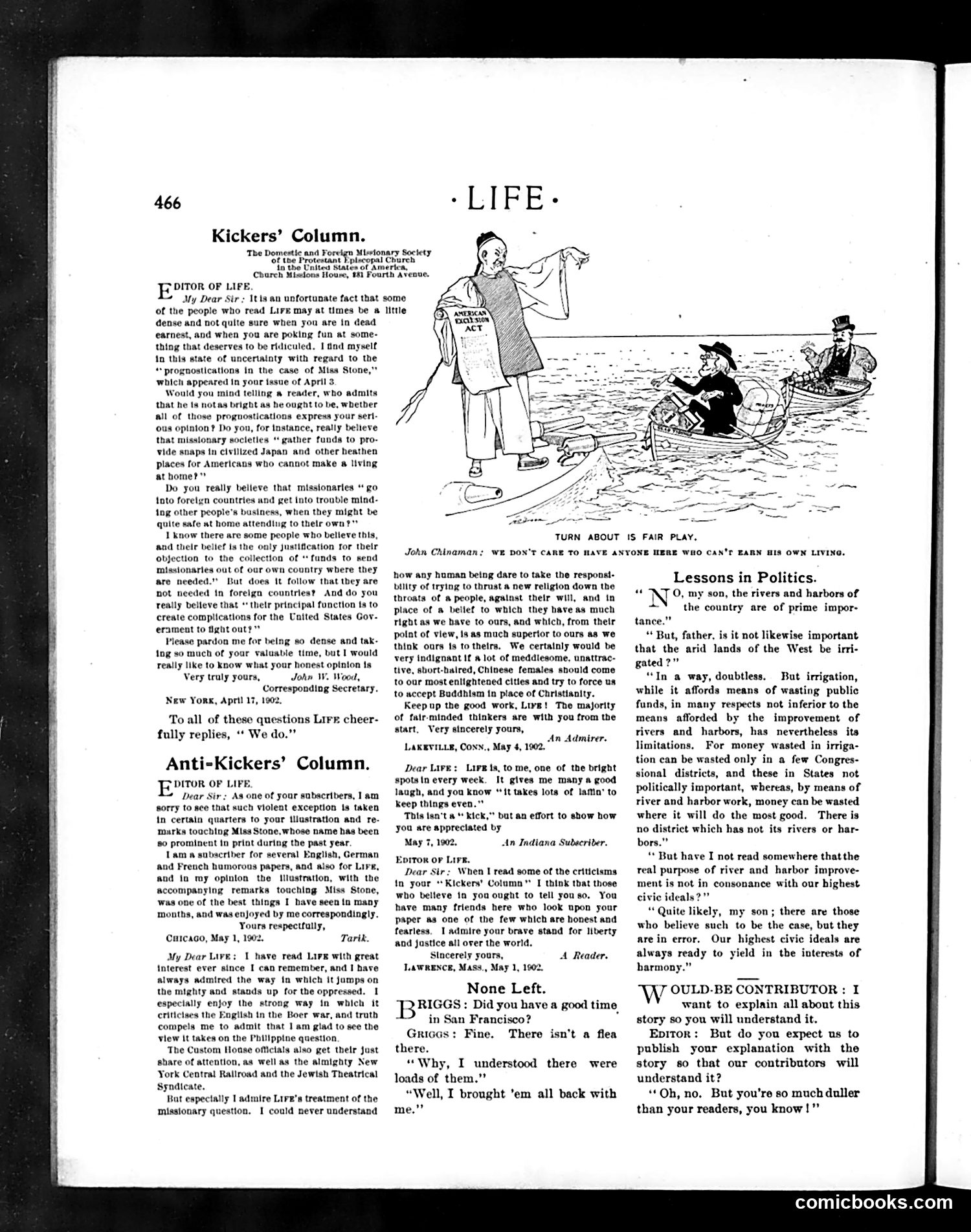
The main cartoon depicts a figure labeled "American Duty" standing on a beach, apparently expelling or removing another figure into the water. Two men in boats observe. The caption reads: "TURN ABOUT IS FAIR PLAY. We don't care to have anyone here who can't earn his own living." This satirizes late-19th/early-20th century American immigration debates. "American Duty" personifies nativist sentiment opposing immigration. The cartoon suggests xenophobic policy—that foreigners unable to immediately earn money should be expelled. The "turn about" phrase likely references reciprocal treatment, implying America should do to outsiders what other nations supposedly do to Americans. This reflects the period's restrictive immigration attitudes, before major legislative restrictions like the 1924 National Origins Act.
📄 Transcribed text from this page (OCR, searchable)
Machine-transcribed from the original scan — historical spelling and the odd misread are preserved.
Kickers’ Column. The Domestic and Forel ‘Of tbe Protestan Missionary Soctety piscopal Chureh tn the United States of America, Church Mizdons House, #41 Fourth Avenue. DITOR OF LIFE. My Dear Sir : \tts an unfortunate fact that some of the people who read Lire may at times be a litte dense and not quite sure when you are in dead earnest, and when you are poking fun at some- thing that deserves to be ridiculed. I find myself tn this state of uncertainty with regard to the © prognostications in the case of Miss Stone,” which appeared In your issue of April 3 Would you mind telling ® reader, who admits that he {4 notas bright as he ought to be, whether All of those prognostications express your sert- ous opinton? Do you, for Instance, really belteve that missionary socteties ‘gather funds to pro- vide snaps in civilized Japan and other heathen places for Americans who cannot make a living at home?” Do you really believe that missionartes “go tnto foretgn countries und get into trouble mind- ing other people's business, when they might be quite safe wt home attending to thelr own?” 1 know there are some people who believe this, ‘and thelr beltef 1s the only justification for thelr ‘objection to the collection of “funds to send missionaries out of our own country where they are needed.” But does It follow that they are not needed tn foreign countries? And do you really belleve that “thelr principal fonction ts to create complications for the United States Gov- erament to fight out?” Picase pardon me for being so dense and tak- Ing #0 much of your valuable time, but I would really like to know what your honest optnton ts Very truly yours, John W. Wood, Corresponding Secretary. New York, April 17, 1902. To all of these questions Lire cheer- fully replies, ‘* We do.” Anti-Kickers’ Column. Eton oF Live. Dear Sir; As one of your subscribers, I am sorry to sce that such violent exception Is taken in certain quarters to your tllustration and re- marks touching Misa Stone, whose name has been 80 prominent in print during the past year. Tama subscriber for several English, German and French humorous papers, and also for Lire, and in my opinton the Illustration, with the accompanying remarks touching Miss Stone, was one of the best things I bave seen tn many months, and was enjoyed by me correspondingly. Yours respectfally, Cucago, May 1, 1902. Tarik. My Dear Live: 1 have read Lire with great interest ever since I can remember, and I have always admired the way in which it jamps on the mighty and stands up for the oppressed. 1 especially enjoy the strong way in which it criticises the Engilsh tn the Boer war, and trath compels me to admit that 1am giad to see the view It takes on the Phillppine question The Custom Honse officials also get thelr Jost share of attention, as well as the almighty New York Central Railroad and the Jewish Theatrical Syndicate. But espectally I admire Live's treatment of the missionary question, I could never understand TURN ABOUT IS FAIR PLAY, John Chinaman: how any haman betng dare to take the responsi- bility of trying to thrust @ new religion down the throats of @ people, against thelr will, and in place of a bellef to which they have as much Tight as we have to ours, and which, from their polnt of view, 1s. as much supertor to ours as we think ours Is to theirs, We certainly would be ‘very indignant If a lot of meddlesome, unattrac- ve, short-haired, Chinese females should come to our most enlightened cities and try to force us to accept Buddhism in place of Christianity. Keep up the good work, Livg! The majority of fair-minded thinkers are with you from the start, Very sincerely yours, An Admirer. LAKRVILLE, CONN., May 4, 1902, Duar Live: Live is, to me, one of the bright spotsin every week. It gives me many a good laugh, and you know “it takes lots of latin’ to keep things even." This tan't a+ kick,” but an effort to show how you are appreciated by May 7, 1902, -An Indiana Subscriber. Eprrox oF Lire. Dear Sir: When I read some of the criticisms, tn your * Kickers’ Column” I think that those who belfeve in you ought to tell youso. You have many friends here who look upon your Paper as one of the few which are honest and fearless, I admire your brave stand for liberty and jastice all over the world, Slncerely yours, Lawrence, Mass,, May 1, 1902, None Left. | RIGGS : Did you have a good time in San Francisco? Griccs: Fine. There isn’t a flea ther “Why, I understood there were loads of them.” “Well, I brought ’em all back with me.”” A Reader. WE DON'T CARE TO HAVE ANYONE HERE WHO CAN'T EARN HIS OWN LIVING. Lessons in Politics. “ XT, my son, the rivers and harbors of + the country are of prime impor- tance.” “But, father, is it not likewise important that the arid lands of the West be irri- gated?” “In a way, doubtless. But irrigation, while it affords means of wasting public funds, in many respects not inferior to the means afforded by the improvement of rivers and harbors, has nevertheless its limitations. For money wasted in irriga- tion can be wasted only in a few Congres- sional districts, and these in States not politically important, whereas, by means of river and harbor work, money can be wasted where it will do the most good. There is no district which has not its rivers or ha bors.” ‘* But have I not read somewhere thatthe real purpose of river and harbor improve- ment is not in consonance with our highest civic ideals?” “ Quite likely, my son; there are those who believe such to be the case, but they arein error, Our highest civic ideals are always ready to yield in the interests of harmony.” WwW OULD-BE CONTRIBUTOR : want to explain all about this story so you will understand it. Epitor: But do you expect us to publish your explanation with the story so that our contributors will understand it? “Oh, no. But you're so much duller than your readers, you know!” comicbooks.com