
Life, 1902-05-29 · page 12 of 20
Life — May 29, 1902 — page 12: what you’re looking at
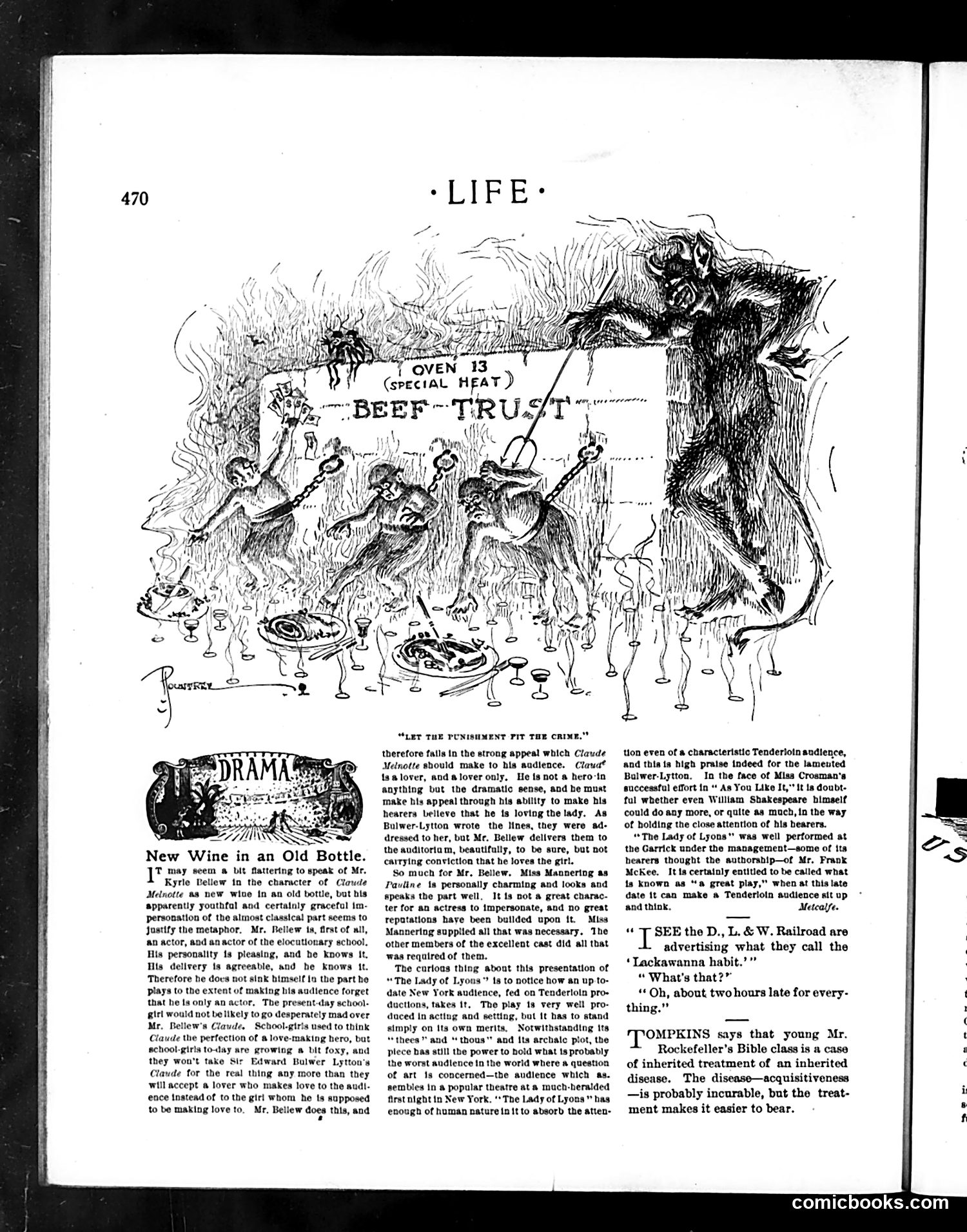
What you’re looking at
This is a satirical cartoon titled "Oven 13 (Special Heat): Beef Trust." Small human figures labeled as politicians or business figures are depicted inside a giant oven, being roasted or cooked. The imagery references the **beef trust**—the monopolistic practices of major American meatpacking companies in the early 20th century. The cartoon satirizes how these corporations controlled prices and competition, "cooking" their competitors or political enemies through anti-competitive practices. The figures appear distressed, suggesting they are victims of the trust's power. The accompanying drama column discusses theatrical productions, unrelated to the cartoon's political message about industrial monopolies and trust-busting concerns of the Progressive Era.
📄 Transcribed text from this page (OCR, searchable)
Machine-transcribed from the original scan — historical spelling and the odd misread are preserved.
fi Wy \ NTR Bottle. I" may seem @ Dit flattering to speak of Mr, Kyrie Vellew in the character of Claude Meinotte a3 Dew wine In an old bottle, but bis Spparently youthfal and certainly graceful im- personation of the almost classical part seems to Jastify the metaphor. Mr. Rellew is, first of all, ‘an actor, and an actor of the elocutlonary school, His personality is pleasing, and he knows It, His delivery is agreeable, and he knows tt. Therefore he docs not sink himself in the part he plays to the extent of making his audience forget that he fs only an actor, The present-day school- girl would not be likely to go desperately mad over Mr. Bellew's Claude. School-gtris used to think Claude the perfection of @ love-making hero, bat school-girls to-day are growing # bit foxy, and they won't take Sir Edward Bulwer Lytton’s Claude for the real thing any more than they ‘will accept @ lover who makes love to the audi- ence instead of to the girl whom he ts supposed to be making love to. Mr. Bellew does this, and : VO “LET THE PUNISHMENT PIT THE CRIME." therefore falls in the strong appeal which Claude Melnotte should make to bis audience. Claua* {sa lover, andalover only, He ts not a hero-tn anything but the dramatic sense, and be must make bls appeal through his ability to make his hearers belleve that he {s loving the lady. As Bulwer-Lytton wrote the lines, they were ad- dressed to her, but Mr. Bellew delivers them to the anditoriam, beautifully, to be sure, but not carrying conviction that he loves the girl. So much for Mr, Bellew, Miss Mannering as Pauline 1s personally charming and looks and speaks the part well, It 1s not a great charac. ter for an actress to impersonate, and no great repatations haye been bullded upon it, Miss Mannering supplied all that was necessary. he other members of the excellent cast did all that was required of them, The curloas thing about this presentation of “The Lady of Lyons” 18 to notice how an up-to- date New York audience, fed on Tenderloln pro- ductions, takes {t, The play 18 very well pro- duced In acting and setting, but {t has to stand simply on {ts own merits, Notwithstanding tts “thes” and thous” and {ts archate plot, the plece bas still the power to hold what ts probably the worst andlence in the world where a question of art is concerned—the audience which as. sembies In a popular theatre ats much-heralded first night in New York. "The Lady of Lyons” has enough of human nature init to absorb the atten- tion even of characteristic Tenderloin audience, and thiais high praise indeed for the lamented Bulwer-Lytton. In the face of Miss Crosman‘s successful effort in “ As You Like It,"*it is doubt- ful whether even William Shakespeare bimself could do any more, or quite as much, in the way of holding the close attention of his bearers. “The Lady of Lyons” was well performed at the Garrick under the management—some of its hearers thought the authorahip—of Mr. Frank McKee. It is certainly entitled to be called what 1s Known as “a great play,” when at this late date {t can make @ Tenderloin audience alt up and think. Metcalfe. “7 SEE the D., L. & W. Railroad are advertising what they call the ‘Lackawanna habit.’ “ What's that?” “Oh, about two hours late for every- thing.” '(OMPKINS says that young Mr. Rockefeller’s Bible class is a case of inherited treatment of an inherited disease. The disease—acquisitiveness —is probably incurable, but the treat- ment makes it easier to bear. comicbooks.com