
A complete issue · 20 pages · 1902
Life — March 20, 1902
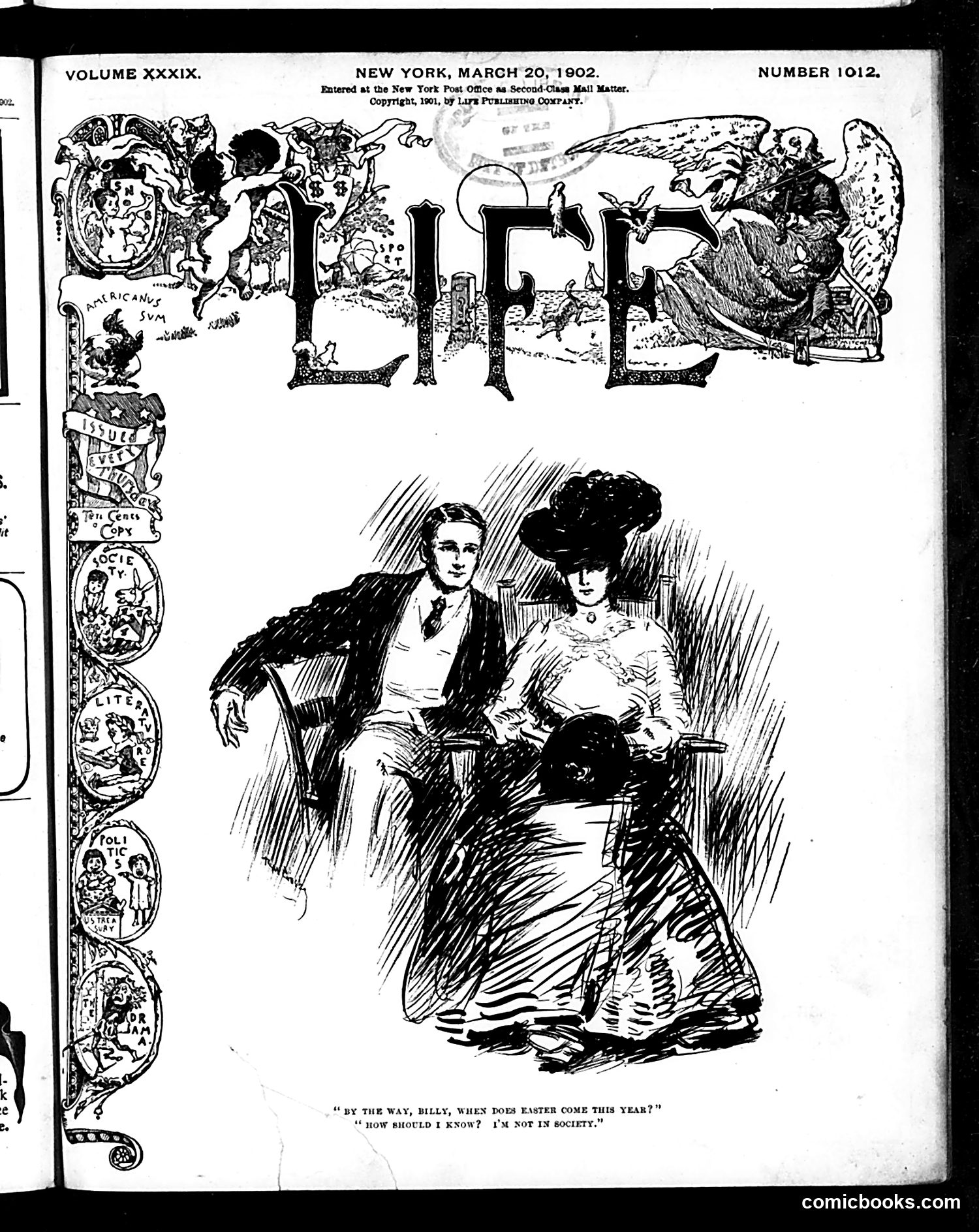
This is the cover of *Life* magazine from 1902. The main illustration shows a domestic scene with a man and woman seated, and a woman in a large hat standing before them. The caption reads: "By the way, Billy, when does Easter come this year?" / "How should I know? I'm not in society." The joke satirizes the social divisions of the era. The woman's elaborate hat and fashionable dress mark her as part of "society"—the upper-class social set. The implication is that only society people track Easter's date, while ordinary men like "Billy" remain unaware. This mocks both the pretensions of the wealthy elite and the apparent uselessness of their knowledge. The ornamental left border contains various small vignettes typical of *Life's* decorative style.
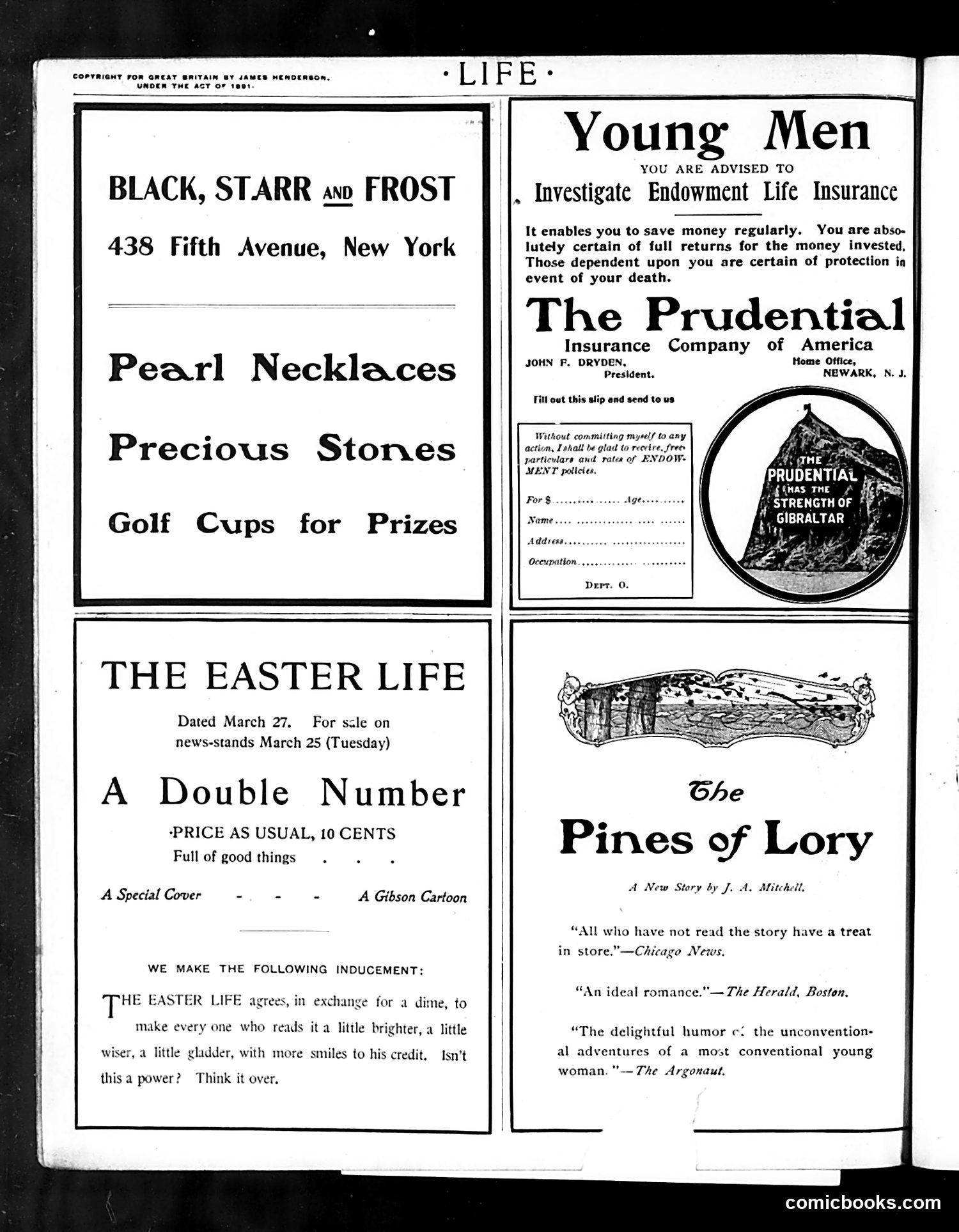
This page is primarily **advertising**, not political commentary or satire. The top left advertises **Black, Starr and Frost**, a New York jeweler offering pearl necklaces, precious stones, and golf trophies as prizes. The top right promotes **Prudential Insurance's endowment life insurance** for young men, featuring the company's trademark Rock of Gibraltar logo. The bottom left announces **The Easter Life**, a double-issue magazine dated March 27, offering a Gibson Cartoon cover and promising "good things" at the usual 10-cent price. The bottom right advertises **"The Pines of Lory,"** a new story by J.A. Mitchell, with positive reviews from contemporary newspapers. All content serves commercial purposes typical of early 20th-century magazine publishing.
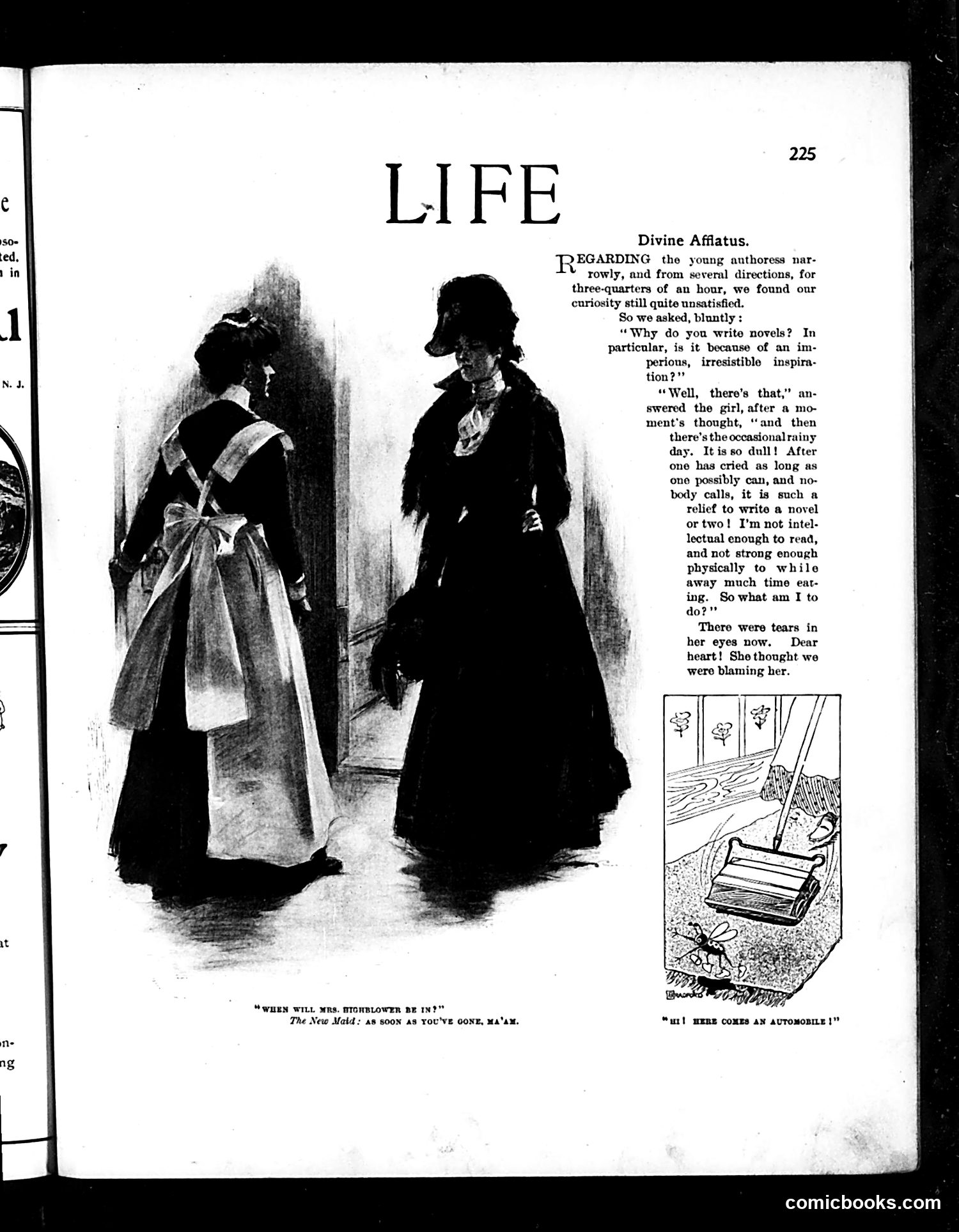
This page contains two illustrations satirizing early 20th-century women's experiences. **Left illustration:** Shows two women in conversation, titled "When will Mrs. Highlander be in?" with a subtitle referencing "The New Maid." The satire appears to target domestic service and the challenges of household management—likely mocking either the pretentiousness of wealthy households or the difficulties servants faced. **Right illustration:** Titled "Here comes an automobile!" depicts a woman using a lawn roller or similar tool while reacting to an approaching car. This satirizes the novelty and disruption caused by automobiles in residential neighborhoods, capturing early automotive-era anxieties about safety and changing urban/suburban life. The adjacent text discusses a young authoress struggling to find inspiration while dealing with writer's block, touching on gender and creative pursuits.
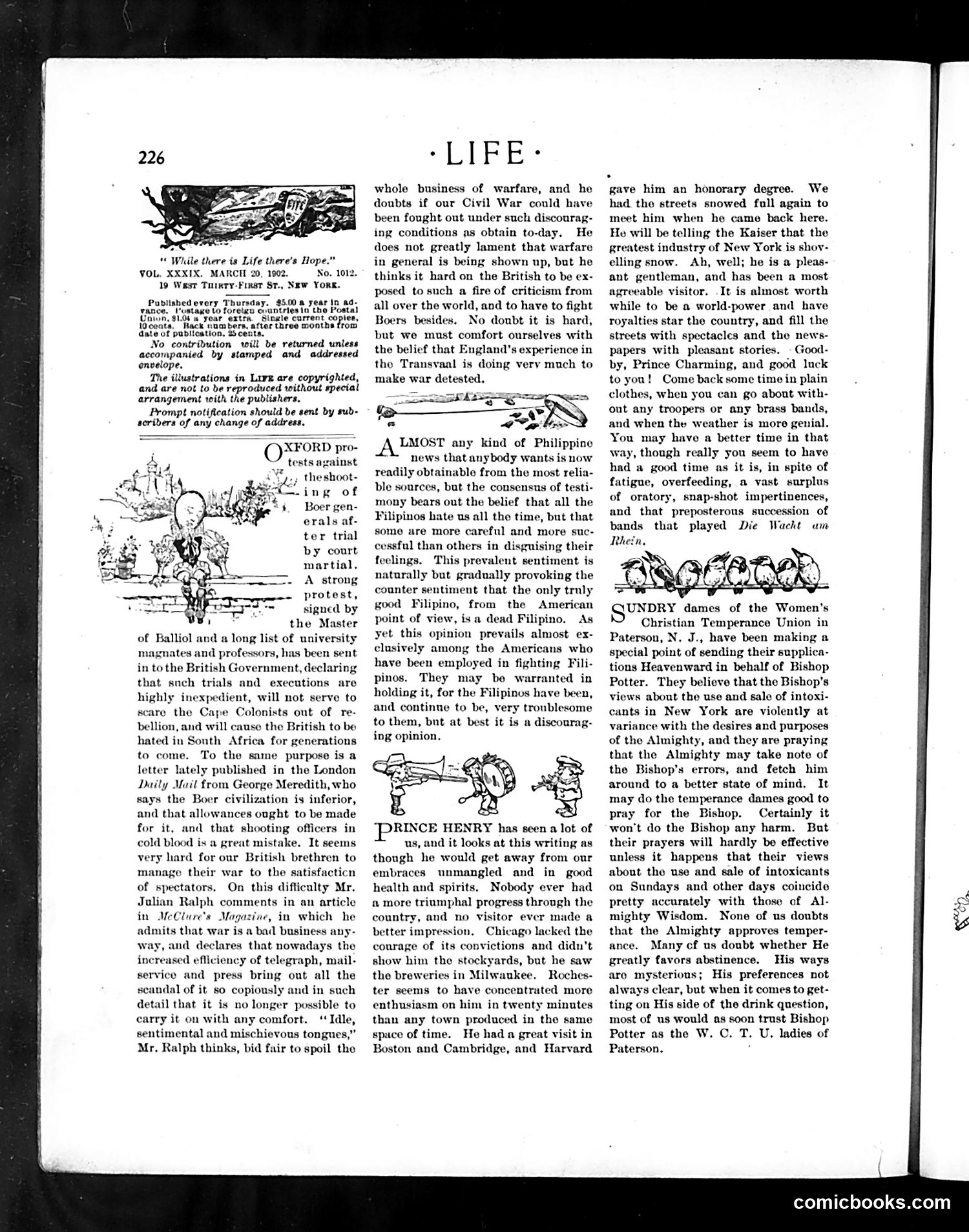
This page contains two main sections: editorial commentary and satirical illustrations about early 1900s British-Philippine relations. The text discusses the Philippines and British military conduct during the Boer War (referenced as "Transvaal"), arguing that England's experience there provides lessons for current conflicts. There's criticism of Filipino sentiment toward Americans and debate about war's necessity. The small cartoon illustrations appear to mock military figures and colonial administration, though specific identities are unclear from the image quality. One illustration seems to depict officers or officials in a satirical manner typical of Life's style. A final section addresses the Women's Christian Temperance Union's criticism of Bishop Potter regarding alcohol sales in New York, suggesting tension between temperance advocates and church leadership on moral regulation. The overall tone is skeptical toward military policy and institutional hypocrisy.
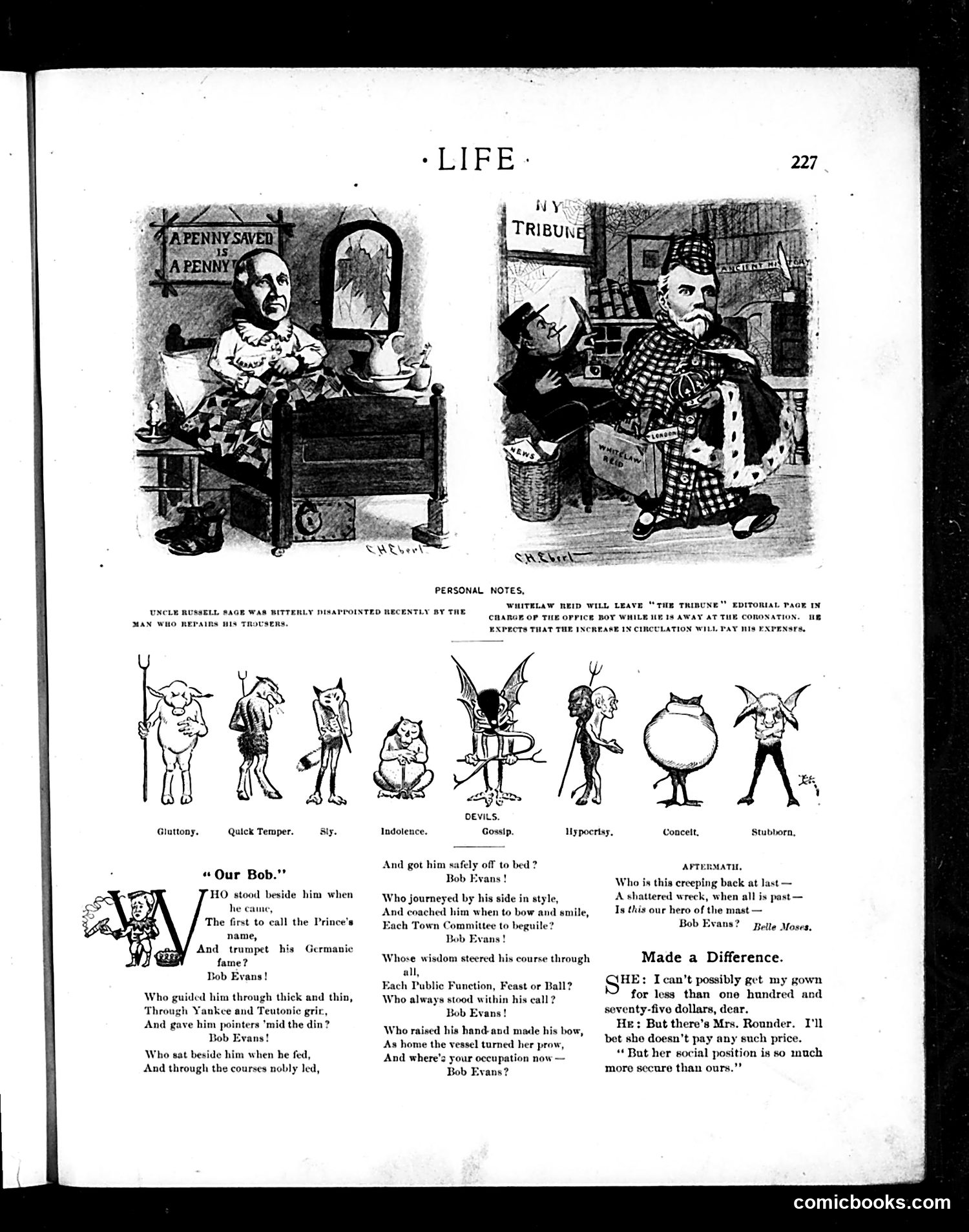
The page contains two editorial cartoons and satirical commentary about political figures. **Top Left Cartoon:** Shows a man labeled "A PENNY SAVED / A PENNY" at a desk with a large glass container, satirizing someone's frugality or penny-pinching approach to finances. **Top Right Cartoon:** Depicts a figure at "MY TRIBUNE" (likely referencing a newspaper), with another character behind him, suggesting editorial control or backstage political maneuvering. **Middle Section:** A row of eight devil/demon characters labeled with character traits (Gluttony, Quick Temper, Sly, Indolence, Gossip, Hypocrisy, Conceit, Stubborn) — a morality lesson in cartoon form. **Bottom:** Poem titled "Our Bob" and another titled "Made a Difference" appear to reference a political figure named Bob Evans, though his specific identity isn't clear from this page alone. The overall tone is sharply satirical toward political and social figures of the era.
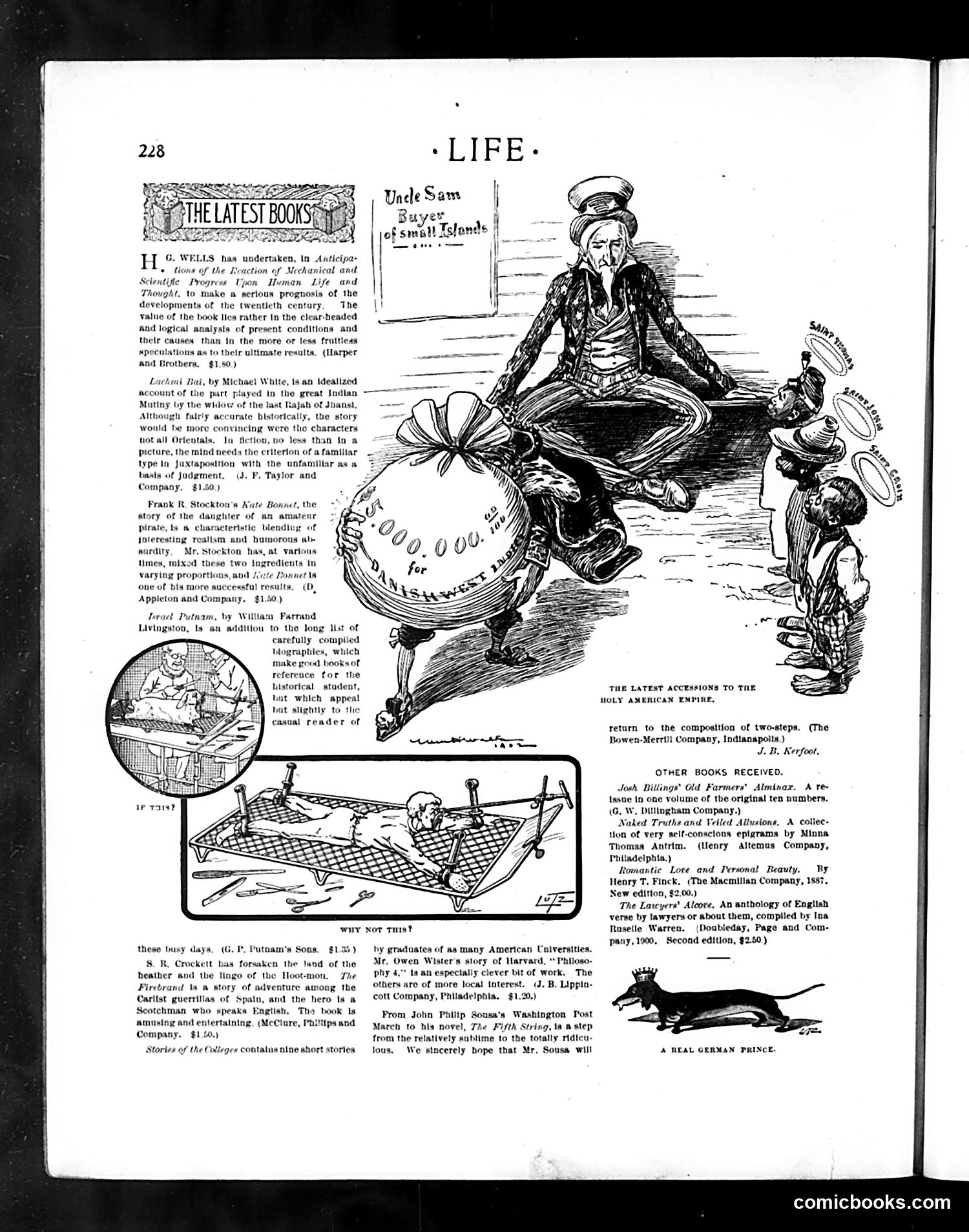
The central cartoon depicts **Uncle Sam** (identifiable by his characteristic hat and goatee) distributing money labeled "$3,000,000,000" to several figures representing **small island nations**, captioned "THE LATEST ACCESSIONS TO THE HOLY AMERICAN EMPIRE." This satirizes U.S. **imperial expansion** in the late 19th/early 20th century, likely referencing territorial acquisitions like Hawaii, Puerto Rico, and the Philippines following the Spanish-American War. The artist critiques America's economic involvement with newly acquired territories as exploitative rather than benevolent, mocking the paternalistic language of "empire" and suggesting financial transactions mask colonial acquisition. The accompanying reviews of books about political/social topics reinforce the page's focus on contemporary American expansion and ideology.
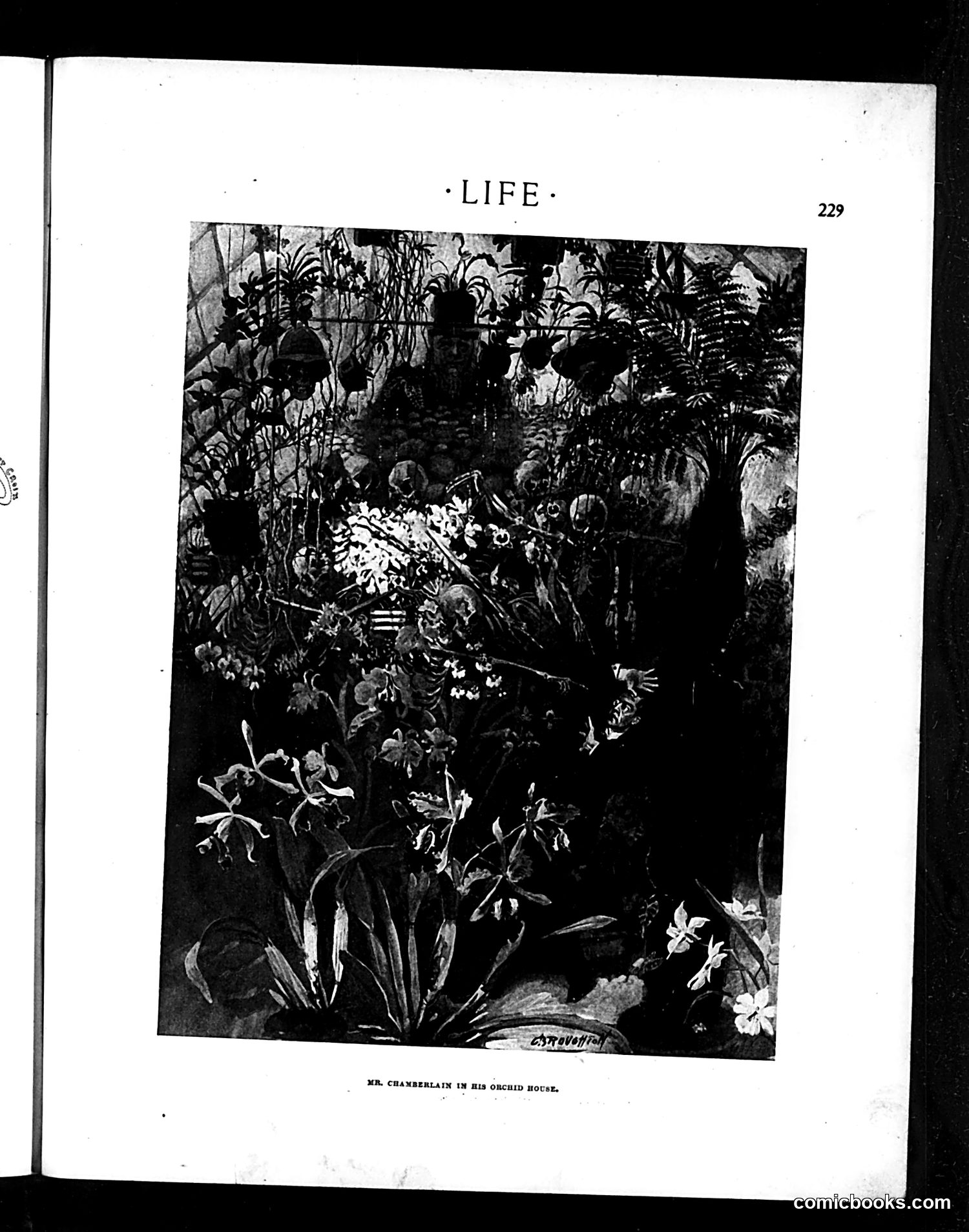
This page from *Life* magazine (page 229) features an illustration titled "MR. CHAMBERLAIN IN HIS ORCHID HOUSE." The image depicts a man surrounded by exotic orchids and lush tropical plants in what appears to be a greenhouse setting. The caption identifies the subject as "Mr. Chamberlain," likely referring to a prominent political figure of the era. The satire appears to compare Chamberlain to a delicate orchid—suggesting he is fragile, artificially cultivated, or requiring special protected conditions to survive. This type of comparison was common in political satire to mock politicians as out-of-touch or overly refined. Without additional context about which Chamberlain or the specific historical moment, the precise political critique remains unclear, though the tone is clearly mocking.
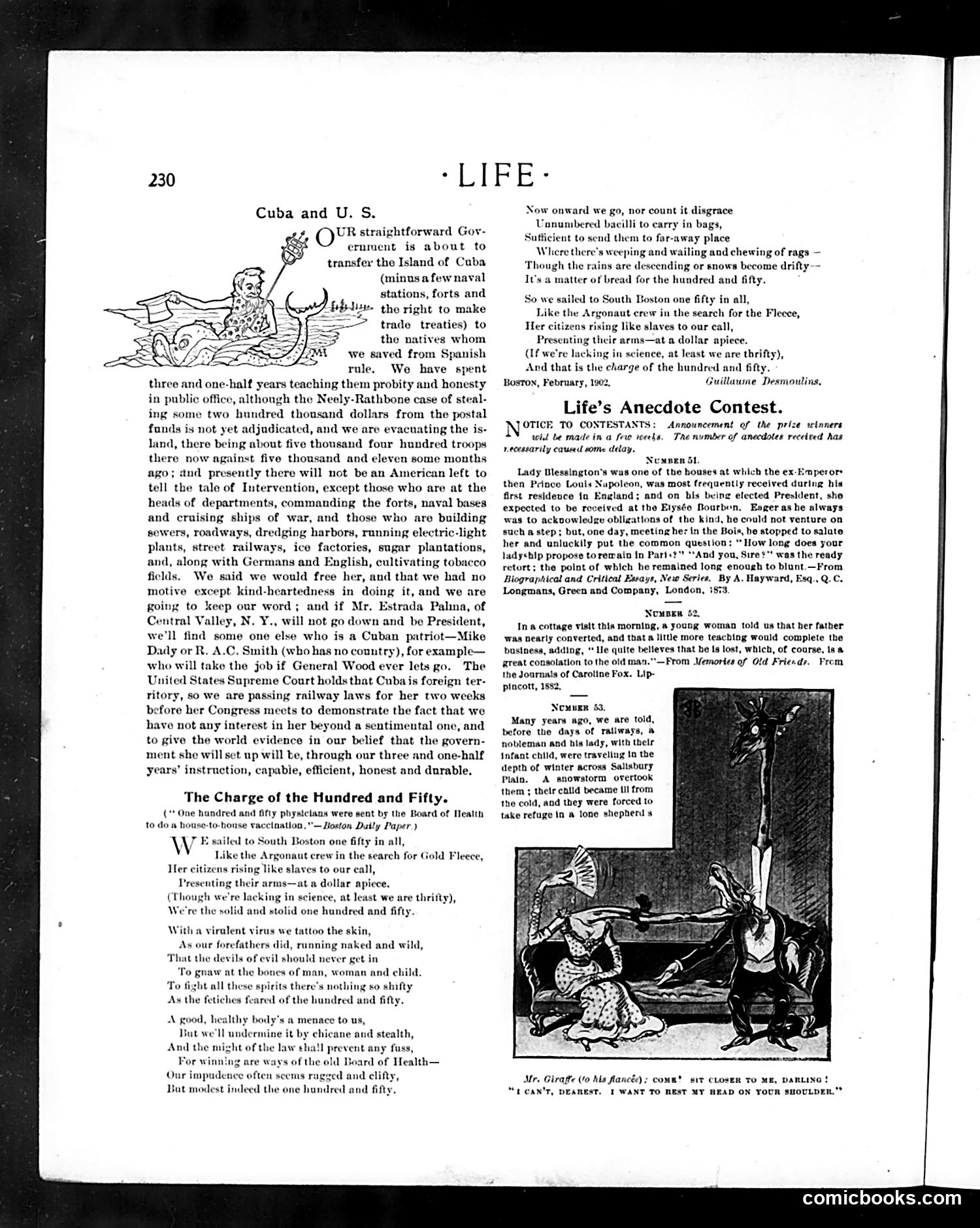
This page contains satirical commentary on American involvement in Cuba. The main article criticizes U.S. plans to take control of Cuba from Spain, arguing the government is acting from self-interest rather than noble motives. The author sarcastically lists upcoming American administrators (Estrada Palma, Mike Daly, R.A.C. Smith) who will govern the island. "The Charge of the Hundred and Fifty" is a satirical poem mocking the Board of Health's plan to send 150 physicians to Cuba for vaccinations—depicted as militaristic and grandiose ("Like the Argonaut crew in search for Gold Fleece"). The illustration shows a figure offering comfort to someone in distress, accompanying "Life's Anecdote Contest" with humorous domestic vignettes. The overall tone expresses skepticism about American imperial intentions in Cuba.
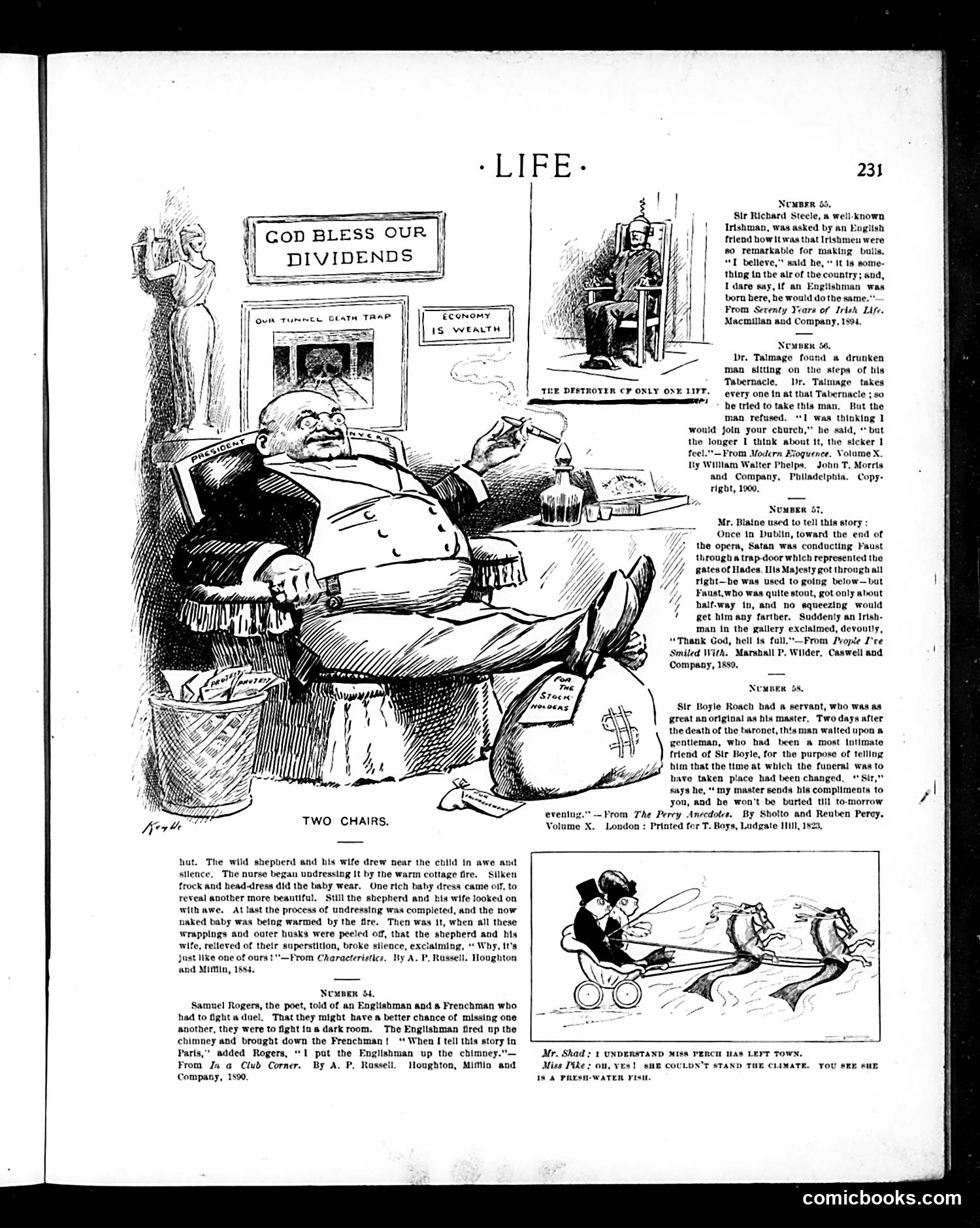
This 1894 *Life* magazine cartoon satirizes wealth inequality and economic disparity. The large central figure—a wealthy, well-fed man relaxing luxuriously in an armchair—represents the privileged class enjoying "dividends" and "economy is wealth." Meanwhile, the smaller figure visible on the right sits uncomfortably upright in a rigid chair labeled "THE DESTROYER OF ONLY ONE LIFE," suggesting the working poor endure harsh conditions while the wealthy live in comfort. The signs reading "GOD BLESS OUR DIVIDENDS" and "OUR TUNNEL DEATH TRAP" juxtapose the rich man's blessings against industrial workers' dangerous labor and death. The satire critiques how capitalists prosper from workers' suffering and exploitation, a common Progressive Era theme addressing labor abuses and class conflict in industrial America.
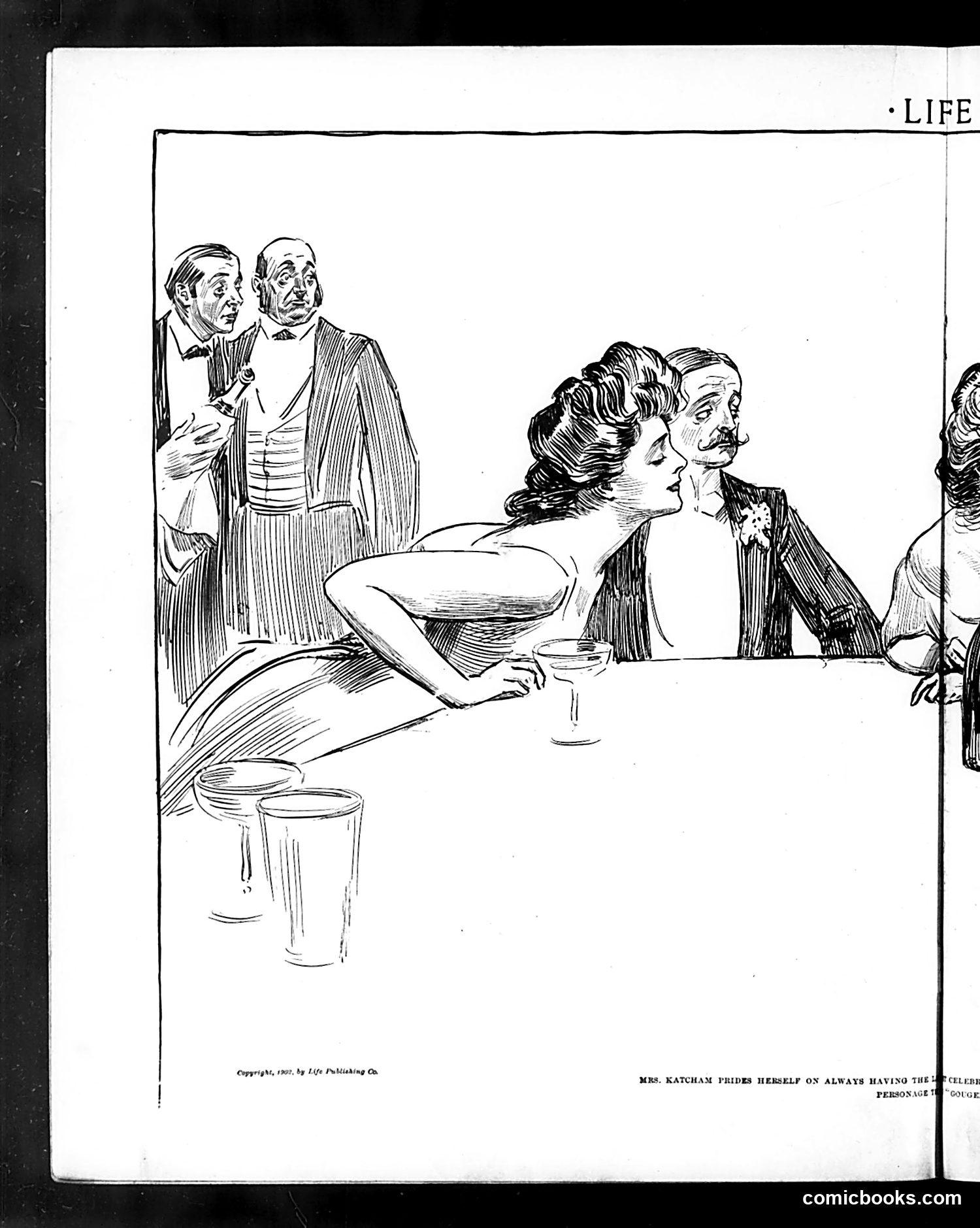
This Life magazine cartoon satirizes a woman identified in the caption as "Mrs. Ketcham" who "prides herself on always having the liveliest person at her parties." The scene depicts a formal dinner party where the woman reclines provocatively at the table while formally-dressed male guests stand awkwardly nearby. The satire mocks upper-class social pretension: Mrs. Ketcham apparently believes her own scandalous or attention-seeking behavior makes her gatherings entertaining, when in fact her guests appear uncomfortable and unimpressed. The joke criticizes women who confuse impropriety with sophistication, suggesting her attempts to be "lively" and modern actually create awkward social situations rather than genuine wit or charm.
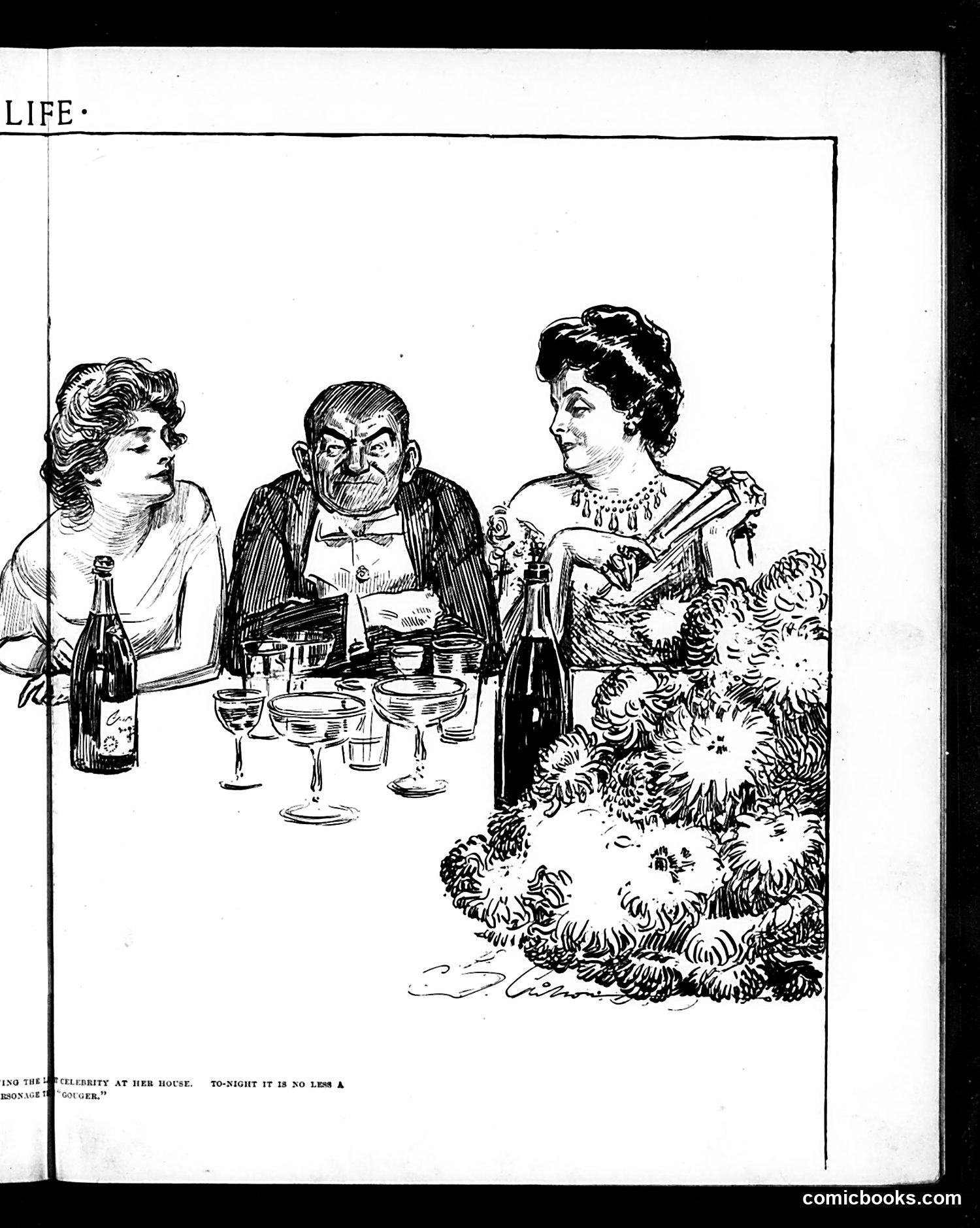
This is a satirical cartoon from Life magazine showing three figures at what appears to be a social gathering with flowers, wine bottles, and glasses on a table. The visible text references "celebrity at her house" and mentions "TO-NIGHT IT IS NO LESS A.../'COUGAR.'" (the OCR is incomplete). The cartoon depicts a social scene with caricatured figures—a woman on the left, a man in the center (drawn with exaggerated, unflattering features wearing formal attire with a bow tie), and another woman on the right holding what appears to be a fan or document. The crude rendering of the central male figure suggests this is mocking satire, likely commenting on social pretension or an affair involving a public personality. Without complete text or clearer historical context, I cannot definitively identify the specific figures or the complete satirical point intended.
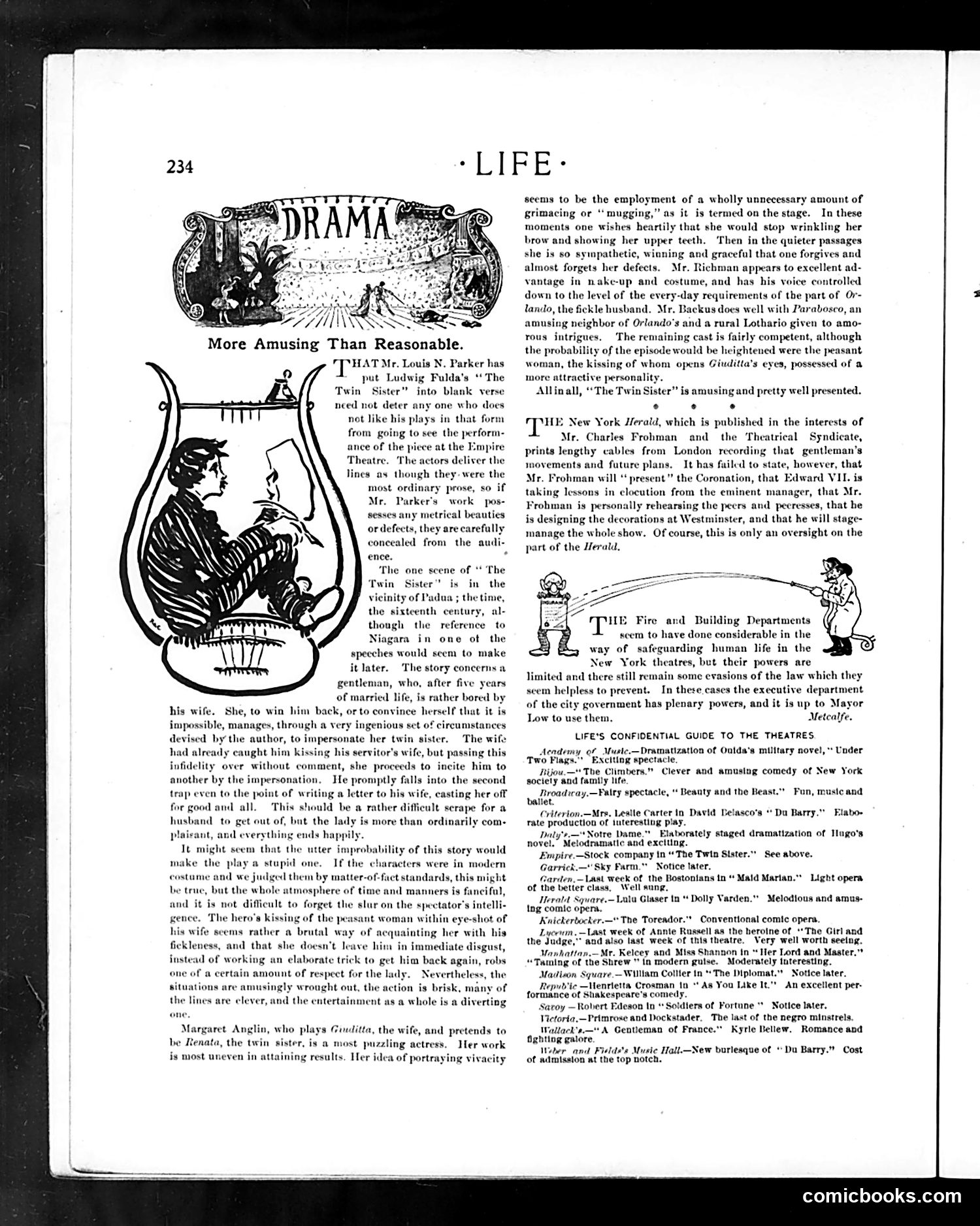
This drama critique reviews a theatrical production of "The Twin Sister," adapted by Louis N. Parker from Ludwig Fulda's play. The cartoon illustrates the central plot: a wife attempts to convince her husband she's actually his twin sister to win back his affections after infidelity. The lyre-framed illustration depicts a woman's profile in classical style, suggesting both theatrical grandeur and the deception at the play's heart. The critic finds the premise absurd but the execution charming, particularly praising actress Margaret Anglin's performance as "Giuditta." The satire targets theatrical conventions of the era—how improbable plots could succeed through skilled acting and spectacle rather than realistic storytelling.
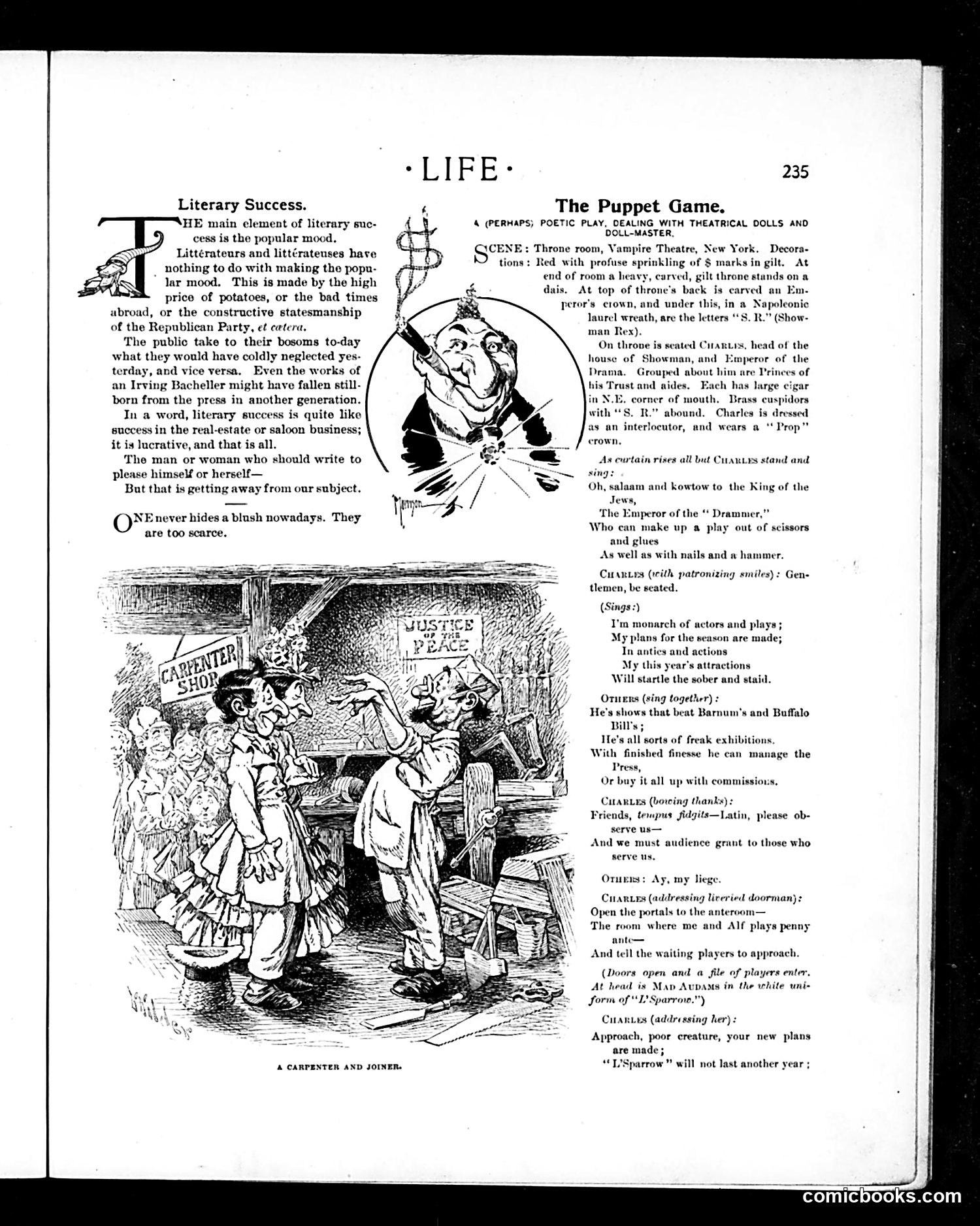
This is a theatrical satire mocking the autocratic control of Broadway producers over actors and playwrights. The "Emperor" character (labeled "S.R." for "Showman Rex") sits enthroned in a room decorated with dollar signs, depicting the producer as an absolute monarch who manipulates theatrical talent like puppets. The satire targets: 1. **Producer power**: The emperor controls "actors and plays" entirely, reducing creative work to mechanical assembly ("scissors and glues...nails and a hammer") 2. **Press manipulation**: References to buying newspaper coverage with "commissions" 3. **Disposability of performers**: The emperor dismisses an actress (appearing to be Mabel Adams in a "Sparrow" costume), telling her the show "will not last another year" 4. **Commercialism over art**: Everything reduces to financial transactions in a system where producers are kings and artists are expendable servants The accompanying "Literary Success" essay reinforces this: success depends on market conditions and timing, not merit—a cynical view shared across both entertainment and literature.
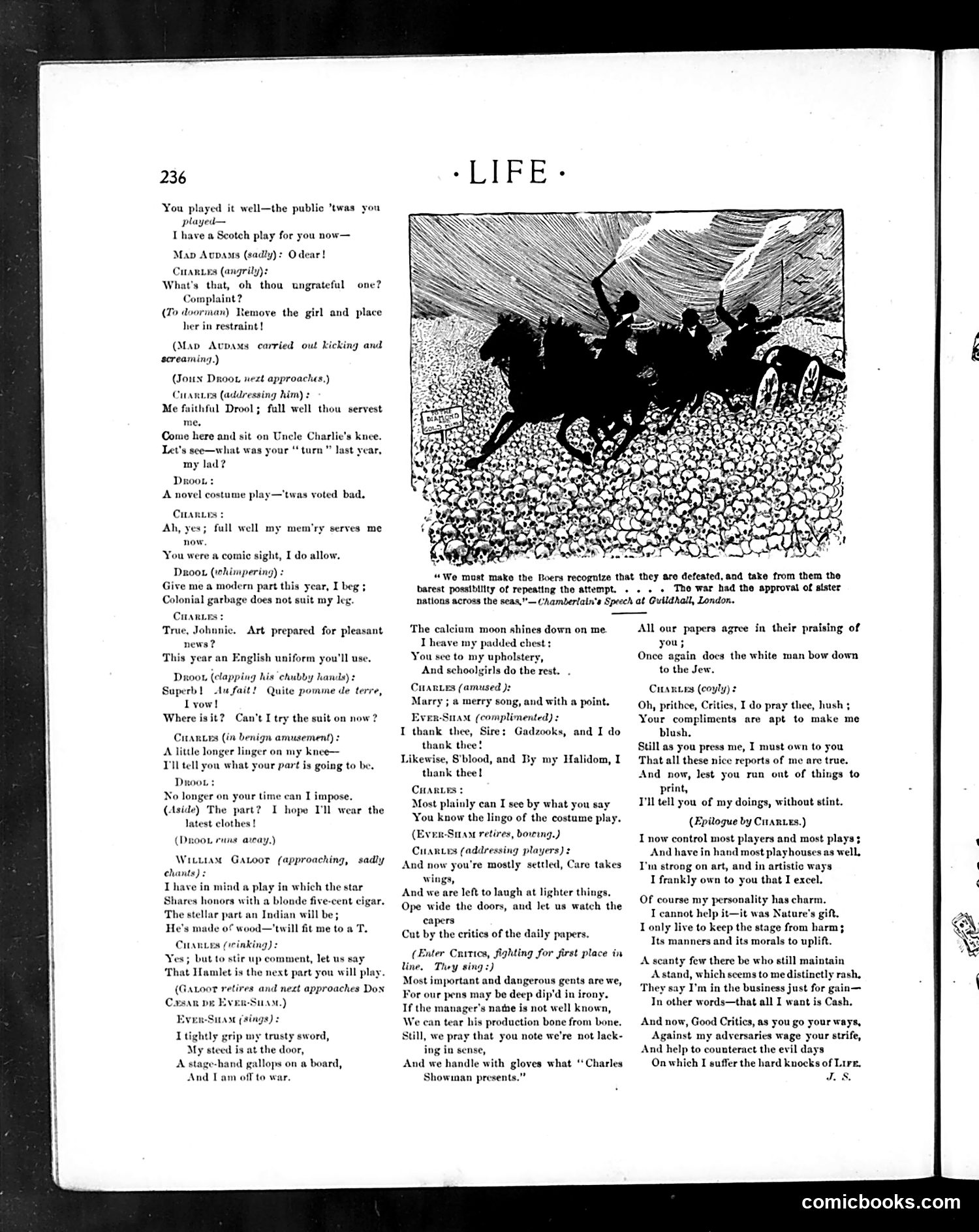
This page satirizes **Charles Frohman**, a dominant Broadway producer/impresario of the early 1900s, depicted as an autocratic ruler ("Charles") presiding over theatrical performers as subjects. The cartoon shows Frohman controlling various theatre personalities who parade before him seeking approval: - **Mad Adams** and other performers are literally subject to his whims (removal from theaters, costume dictates) - **John Drool**, **William Gattoor**, and **Ever-Sham** represent types of actors competing for his favor - **The Critics** (entering at bottom) sing about their power to "tear his production bone from bone"—yet also praise him fawningly The satire targets Frohman's near-monopoly over American theatre and the obsequiousness of both performers and critics toward him. A reference to **"the Boers"** and **"the white man bow down to the Jew"** reflects the page's antisemitic undercurrent typical of era-specific Life magazine content. The core joke: theatrical world operates as Frohman's absolute kingdom, where merit matters less than pleasing the all-powerful impresario.
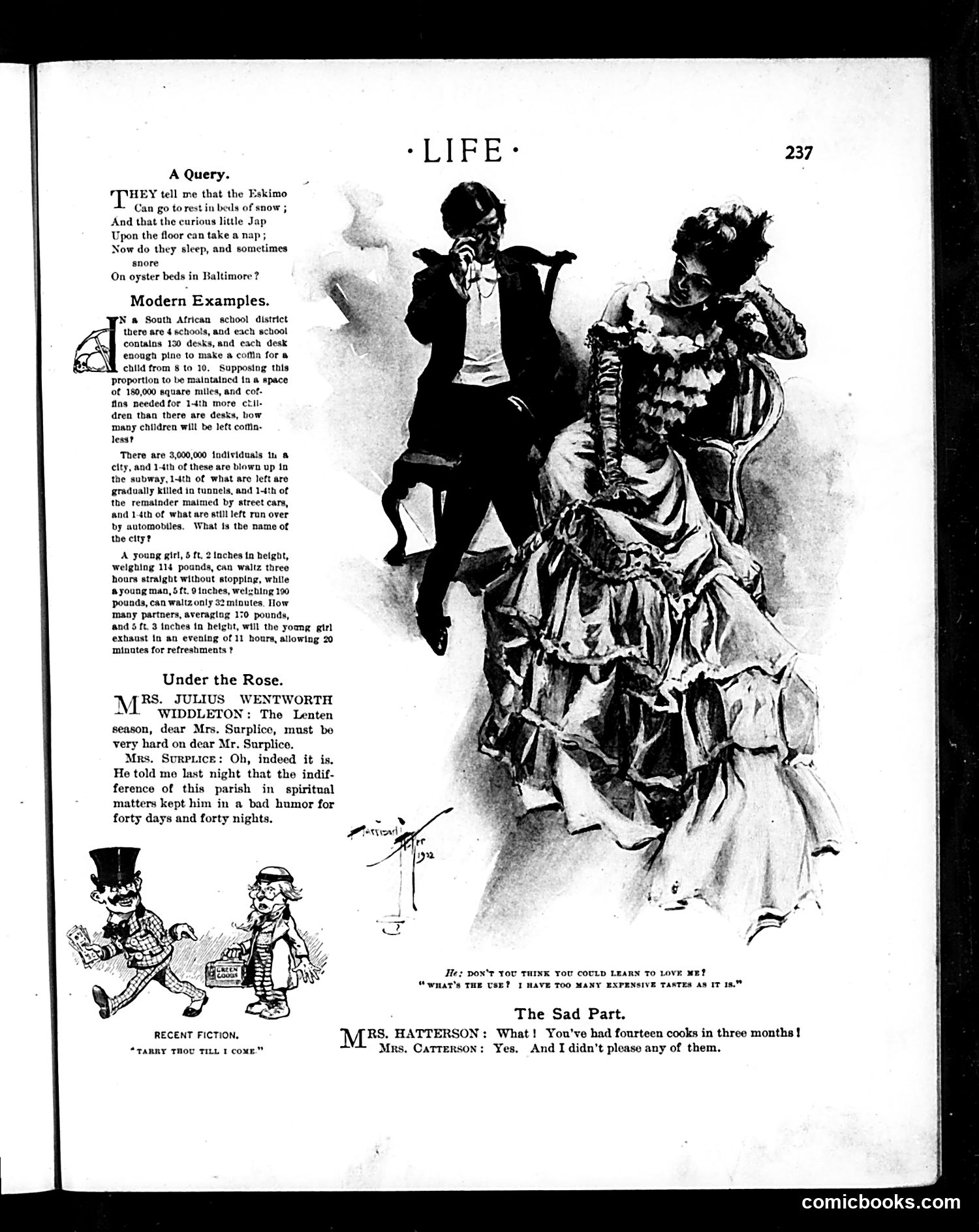
This page contains several unrelated satirical pieces typical of Life magazine's format. **"A Query"** opens with absurdist humor comparing sleeping customs of distant peoples (Eskimos, Japanese) to a ridiculous question about sleeping on oyster beds in Baltimore—likely mocking pseudo-scientific travel writing popular at the time. **"Modern Examples"** presents deliberately absurd math problems that use contemporary anxieties as setups: overcrowded schools in South Africa, subway dangers and traffic accidents in cities, and exhausting waltz partners. These mock both educational word problems and turn-of-the-century urban dangers into dark comedy. **"Under the Rose"** is a brief dialogue comedy about Mrs. Surplice complaining that her husband's bad mood during Lenten season stems from parishioners' spiritual indifference—gentle satire of religious hypocrisy. **"The Sad Part"** jokes about a woman who's had fourteen cooks in three months, none satisfying her—common servant-keeping humor among the wealthy. The illustrations show fashionable couples and comic character sketches typical of Life's visual style.
This page contains a satirical piece titled "Force of Habit" that mocks American boasting by exaggerating how Americans speak to Native Americans. The humor relies on contrast: a Comanche chief (Chuckabluff) makes elaborate, grandiose threats in broken English, then immediately flees in cowardice. An American general responds with equally absurd hyperbole, claiming his men can "chew up eleven redskins" and play poker simultaneously. The satire targets American braggadocio by suggesting Americans learned this trait from Native Americans themselves—a circular logic joke. By putting identical exaggerated boasting in both mouths, the piece ridicules American bombast as inherently absurd and performative. The piece reflects early-20th-century attitudes: Native Americans are portrayed as primitive and cowardly, while the satire's actual target is American overconfidence and empty rhetoric, not racism itself. The stereotypical dialect and characterizations would be considered offensive today.
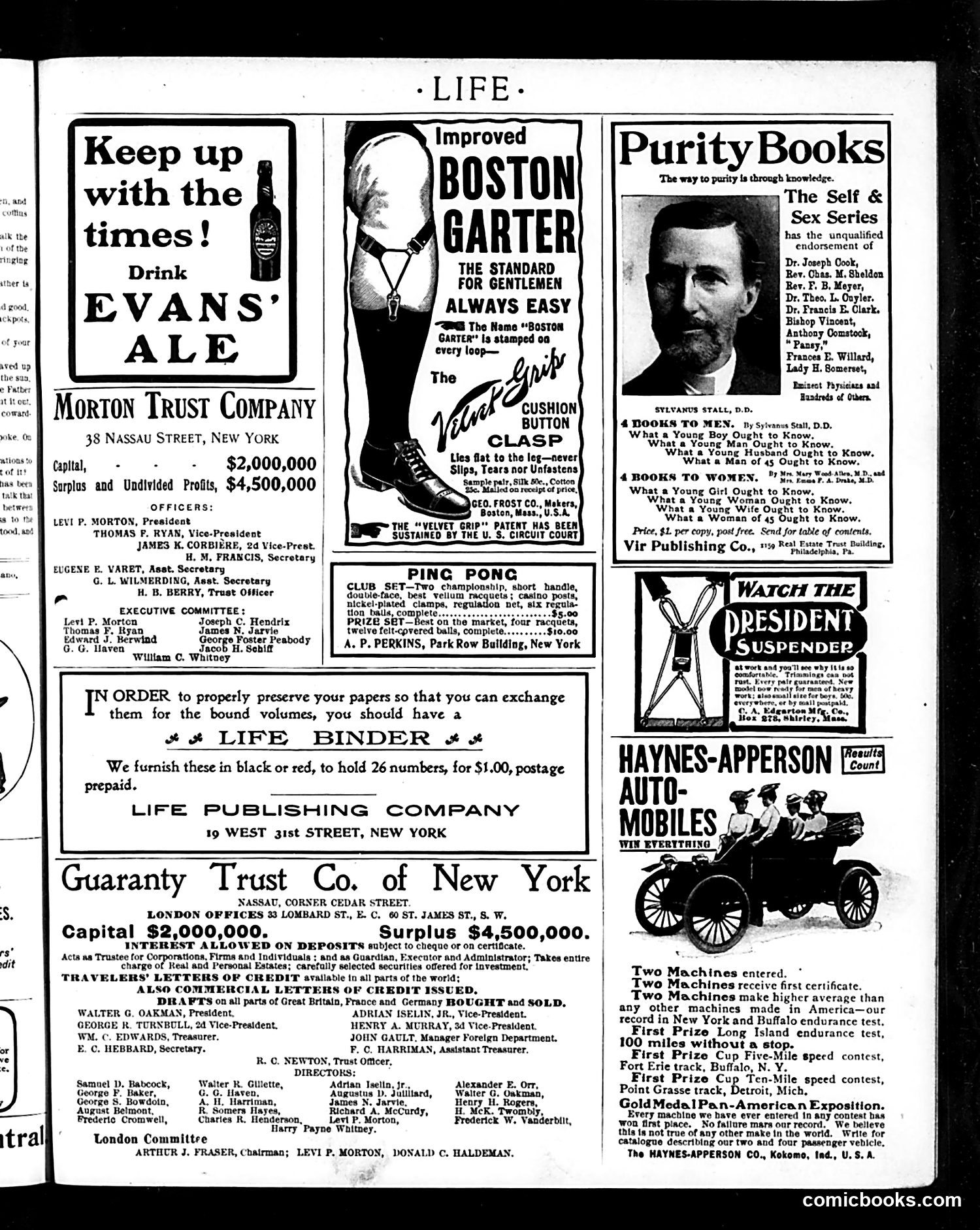
This page is predominantly **financial advertisements** and corporate announcements rather than editorial content or satire. The visible advertisements include: - Banking institutions (**Morton Trust Company**, **Guaranty Trust Co. of New York**) - Consumer products (**Evans' Ale**, **Boston Garter** suspenders, **Ping Pong** equipment) - **"Purity Books"** — a self-help series on sexual education endorsed by prominent moral figures (Anthony Comstock, Frances Willard), reflecting Progressive Era concern about sex education as moral instruction The only image that might be considered satirical is the portrait accompanying the **"Purity Books"** advertisement, but without clear context or caption, it's unclear whether it's meant as satire or earnest illustration. This appears to be a turn-of-the-century magazine page serving primarily commercial purposes rather than containing political or social satire.
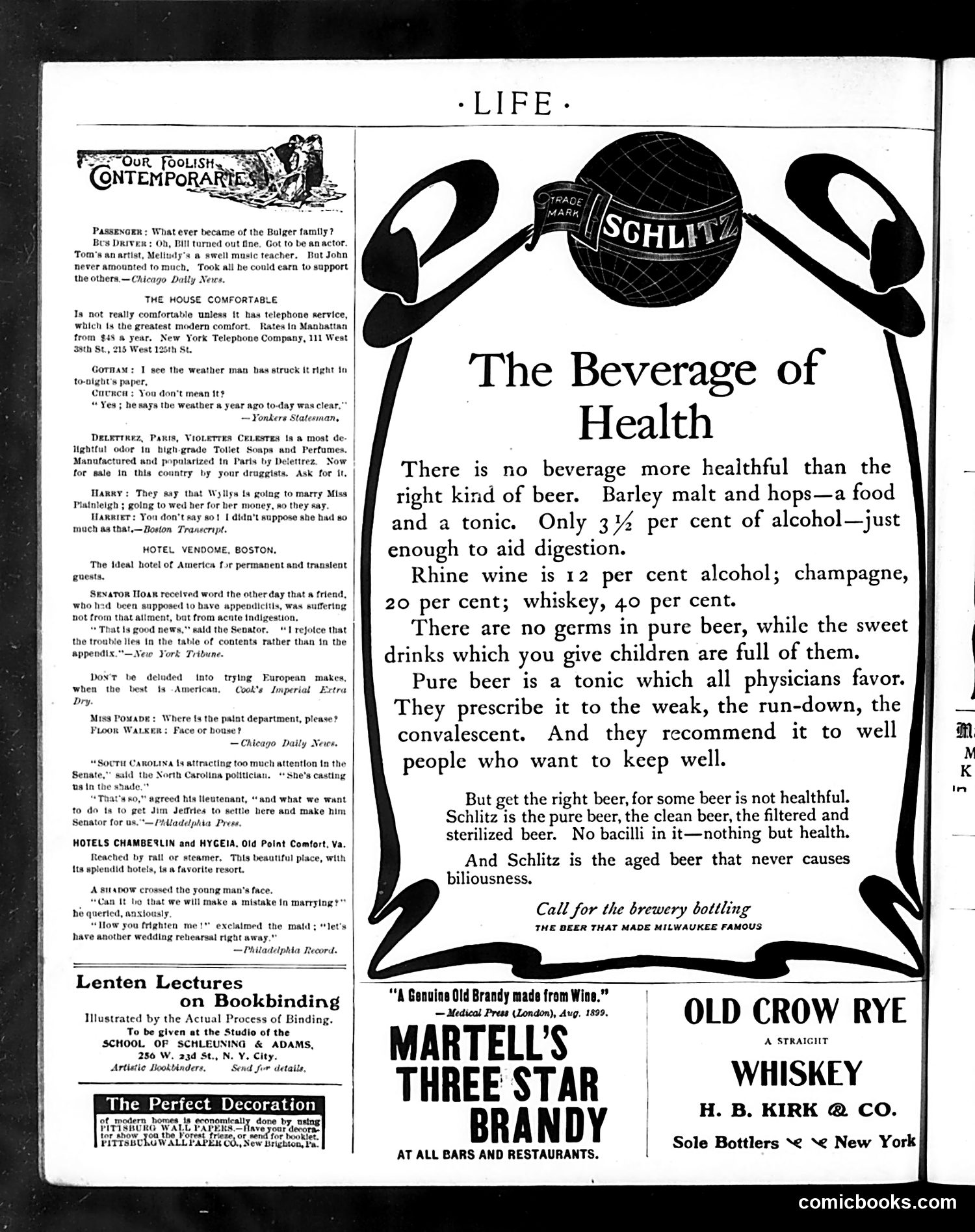
This page is primarily **advertising**, featuring humorous short jokes in the left column and three liquor advertisements. The ads use health claims common to the era—particularly notable is Schlitz beer's assertion that it contains "no germs" and is prescribed by physicians as a tonic for the weak and convalescent. The small jokes ("Our Foolish Contemporaries") mock everyday situations: families' economic struggles, misunderstandings about weather, and romantic complications. One satirizes Southern politicians' obsession with boxer Jim Jeffries as a potential senator—likely referencing early-1900s boxing celebrity. The advertisements reflect pre-Prohibition attitudes: beer marketed as medicinal, whiskey sold alongside brandy as legitimate products. The Schlitz ad specifically contrasts beer's low alcohol content (3.5%) with wine and whiskey, positioning beer as healthier—a marketing strategy targeting middle-class respectability before Prohibition (1920-1933) changed American attitudes toward alcohol entirely.
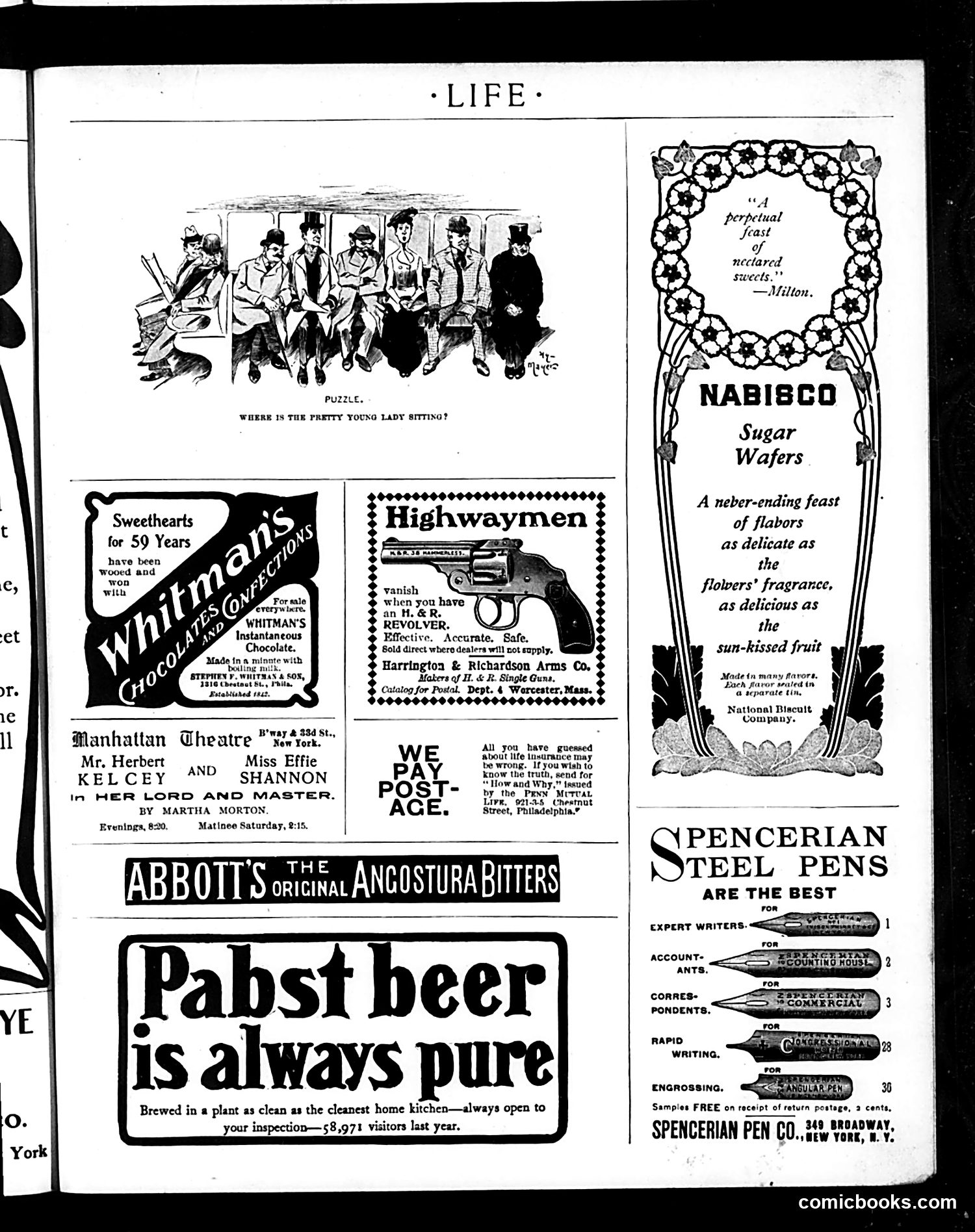
This is primarily an **advertising page** with one small cartoon at the top. The cartoon labeled "PUZZLE" shows seven people sitting together on what appears to be public transportation (likely a streetcar). The caption asks "WHERE IS THE PRETTY YOUNG LADY SITTING?" This is a visual puzzle—the joke likely depends on the reader spotting a woman among the figures, or perhaps the trick is that there *isn't* one, making it a "gotcha" moment typical of early 20th-century humor. The rest of the page contains period advertisements: Whitman's chocolate, firearms, a theater production, Pabst beer, Angostura bitters, Nabisco wafers, and Spencerian pens. These ads reflect consumer products and entertainment popular in this era. No significant political commentary is evident on this page—it's a standard issue of the satirical magazine dominated by commercial sponsorships rather than editorial content.
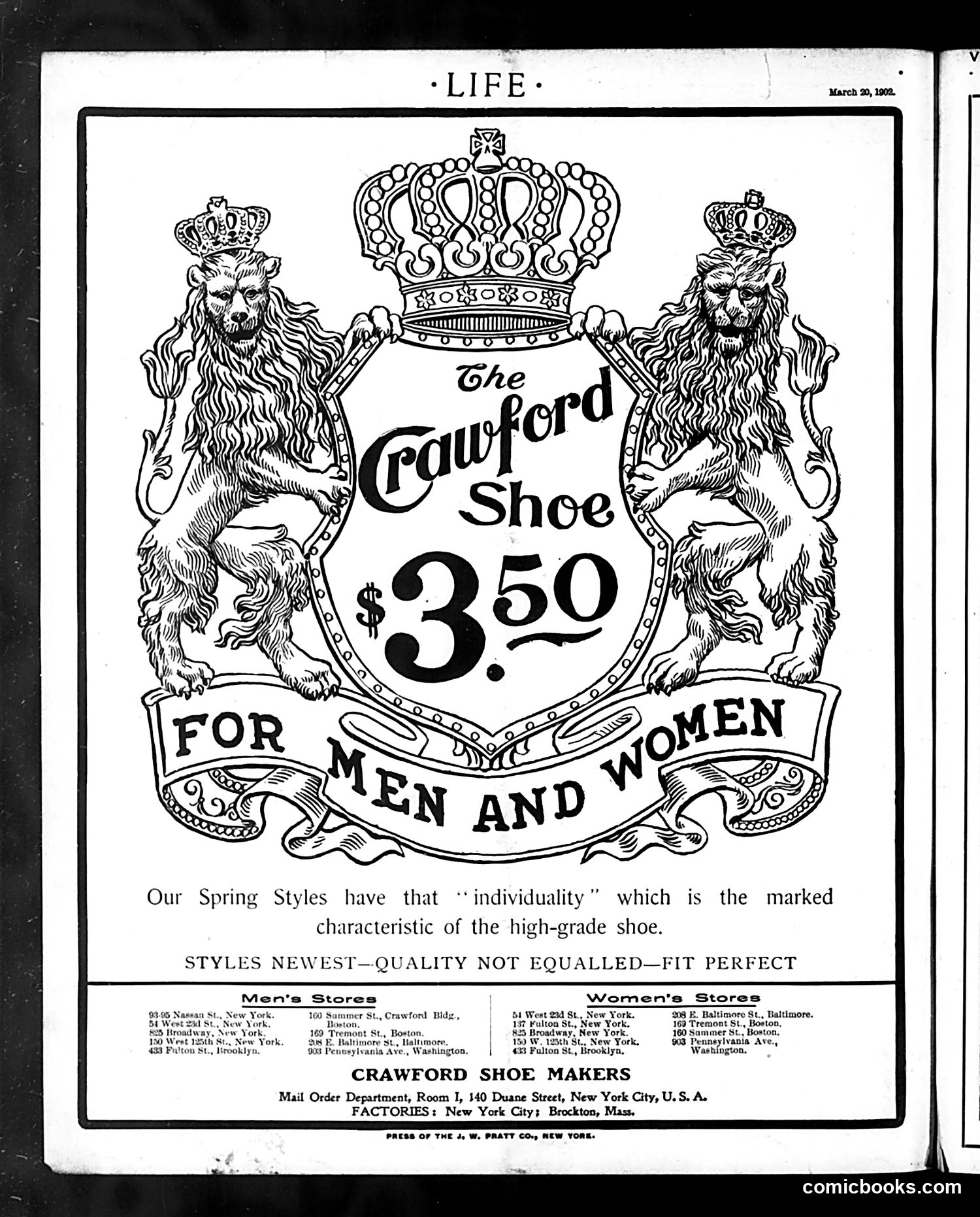
This is not a political cartoon but a **full-page advertisement** for Crawford Shoe Makers, dated March 20, 1909. The image features two crowned lions as heraldic supporters flanking a large crown and shield containing the product name and price ($3.50). The design mimics European royal coat-of-arms imagery, suggesting luxury and prestige. The advertisement claims their spring shoes possess "individuality" and "high-grade" quality with perfect fit. It lists retail locations in New York, Baltimore, and Washington, plus a mail-order department in New York City and factories in Brockton, Massachusetts. The heraldic lion imagery was common in period advertising to convey quality, tradition, and superiority—appealing to early-20th-century consumers' aspirations toward refined taste. This represents typical early-1900s magazine advertising practice rather than satire.