
Life, 1902-03-20 · page 4 of 20
Life — March 20, 1902 — page 4: what you’re looking at
What you’re looking at
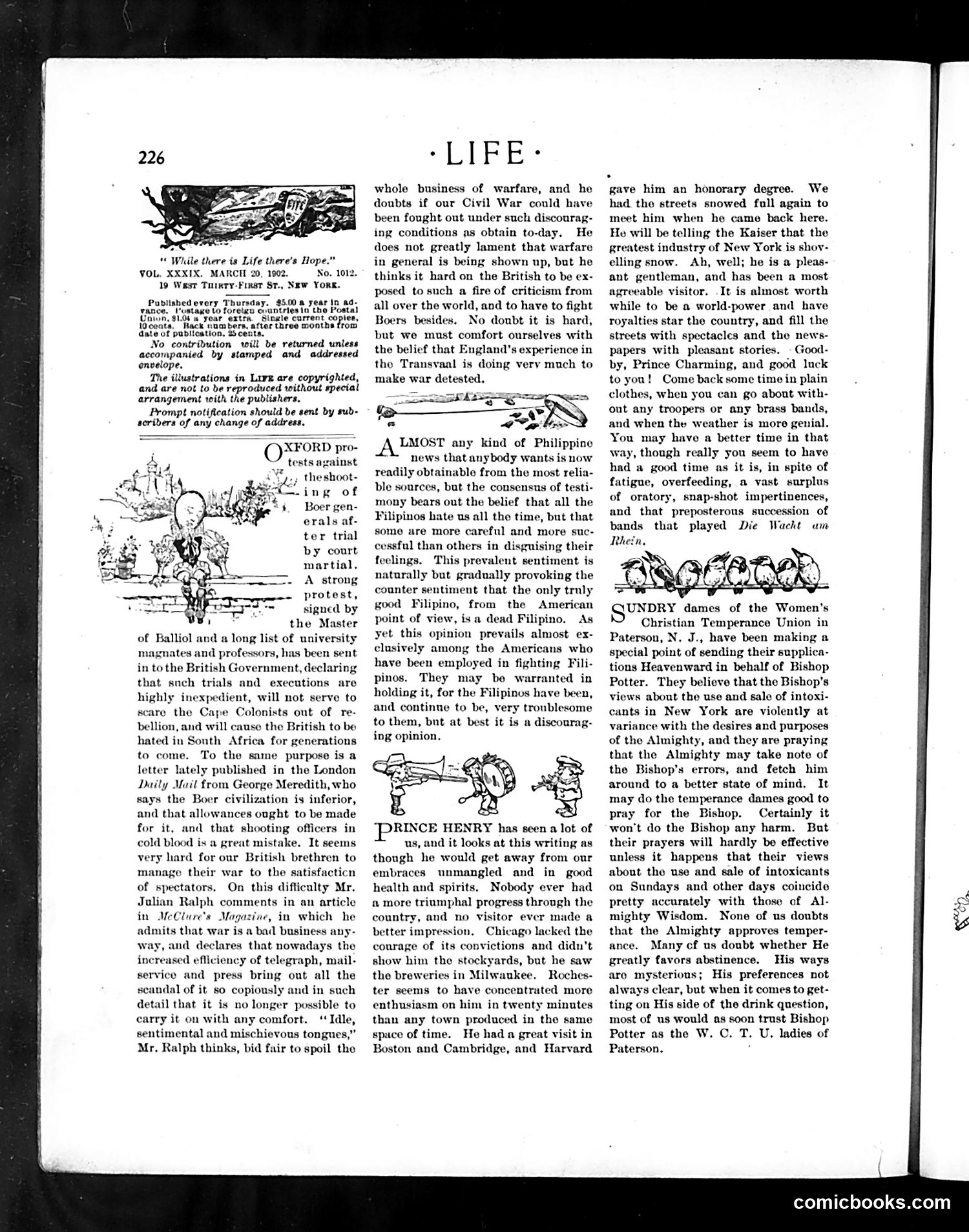
This page contains two main sections: editorial commentary and satirical illustrations about early 1900s British-Philippine relations. The text discusses the Philippines and British military conduct during the Boer War (referenced as "Transvaal"), arguing that England's experience there provides lessons for current conflicts. There's criticism of Filipino sentiment toward Americans and debate about war's necessity. The small cartoon illustrations appear to mock military figures and colonial administration, though specific identities are unclear from the image quality. One illustration seems to depict officers or officials in a satirical manner typical of Life's style. A final section addresses the Women's Christian Temperance Union's criticism of Bishop Potter regarding alcohol sales in New York, suggesting tension between temperance advocates and church leadership on moral regulation. The overall tone is skeptical toward military policy and institutional hypocrisy.
📄 Transcribed text from this page (OCR, searchable)
Machine-transcribed from the original scan — historical spelling and the odd misread are preserved.
While there is Life there's Hope.” VOL, XXXIX. MARCII 20, 1902. No. 1 19 Wast Taixty-Finst St., NEW YORE. Published every Thursday. $5.00 a year tn ad. Hostage to foreign countries to the Postal 1.04 a year extra. Single current copies, IQconts. “Rack numbers, after three months from date of publication, 25 ce: No contribution will be returned uniess accompanied by stamped and addressed envelope, ‘The iltustrations in Lure are copyrighted, and are not to be reproduced without special arrangement with the publishers, Prompt notification should be sent by sub- scribers of any change of address. XFORD pro- tests against of )., theshoot- ing of Boer gen- erals af- ter trial by court martial. A strong protest, signed by the Master of Balliol and a long list of university magnates and professors, has been sent in tothe British Government, declaring that snch trials and executions are highly inexpedient, will not serve to BC the Cape Colonists out of re- bellion, and will cause the British to be hated in South Africa for generations to come. To the same purpose is a letter lately published in the London Daily Mait from George Meredith, who says the Boer civilization is inferior, and that allowances ought to be made for it, and that shooting officers in cold blood is a great mistake. It seems very hard for our British brethren to manage their war to the satisfacticn of spectators. On this difficulty Mr. Julian Ralph comments in an article in MeClure’s Magazine, in which he admits that war is a bad business any- way, and declares that nowadays the increased efliciency of telegraph, mail- service and press bring out all the scandal of it so copiously and in such detail that it is no longer possible to carry it on with any comfort. ‘Idle, sentimental and mischievous tongues,” Mr. Ralph thinks, bid fair to spoil tho «LIFE - whole business of warfare, and he doubts if our Civil War could have been fought out under such discourag- ing conditions as obtain to-day. He does not greatly lament that warfare in general is being shown up, but he thinks it hard on the British to be ex- posed to such a fire of criticism from all over the world, and to have to fight Boers besides. No doubt it is hard, but we must comfort ourselves with the belief that England's experience in tho Transvaal is doing very much to make war detested. re ms 2, « A EMost any kind of Philippine news that anybody wants is now readily obtainable from the most relia- ble sources, but the consensus of testi- mony bears out the belief that all the Filipinos hate us all the time, but that some ure more careful and more suc- cessful than others in disguising their feelings. This prevalent sentiment is naturally but gradually provoking the counter sentiment that the only truly good Filipino, from the American point of view, isa dead Filipino. As yet this opinion prevails almost ex- clusively among the Americans who have been employed in fighting Fili- pinos. They may bo warranted in holding it, for the Filipinos have been, and continue to be, very troublesome to them, but at best it is a discourag- ing opinion. RINCE HENRY has seen a lot of us, and it looks at this writing as though he would get away from our embraces unmangled and in good health and spirits. Nobody ever had a more triumphal progress through the country, and no tor ever made a better impression. Chicago lacked the courage of its convictions and didn't show him tho stockyards, but he saw the breweries in Milwaukee. Roches- ter seems to have concentrated more enthusiasm on him in twenty minutes than any town produced in the same space of time. He had a great visit in Boston and Cambridge, and Harvard gave him an honorary degree. We had the streets snowed full again to meet him when he came back here. He will be telling the Kaiser that the greatest industry of New York is shov- elling snow. Ah, well; he is a pleas- ant gentleman, and has been a most agreeable visitor. .It is almost worth while to be a world-power and have royalties star the country, and fill the streets with spectacles and the ne papers with pleasant stories. -Good- by, Prince Charming, and good luck to you! Come back some time in plain clothes, when you can go about with- out any troopers or any brass bands, and when the weather is more genial. You may have a better time in that way, though really you seem to have had a good time as it is, in spite of fatigue, overfeeding, a vast surplus of oratory, snap-shot impertinences, and that preposterous succession of bands that played Die Wackt Rhein, am SUNDRY dames of the Women's Christian Temperance Union in Paterson, N. J., have been making a special point of sending their supplica- tions Heavenward in behalf of Bishop Potter. They believe that the Bishop's views about the use and sale of intoxi- cants in New York are violently at variance with the desires and purposes of the Almighty, and they are praying that the Almighty may take note of the Bishop’s errors, and fetch him around to a better state of mind. It may do the temperance dames good to pray for the Bishop. Certainly it won't do the Bishop any harm. But their prayers will hardly be effective unless it happens that their views about the use and sale of intoxicants on Sundays and other days coincide pretty accurately with those of Al- mighty Wisdom. None of us doubts that the Almighty approves temper- ance. Many cf us doubt whether He greatly favors abstinence. His ways aro mysterious; His preferences not always clear, but when it comes to get- ting on His side of the drink question, most of us would as soon trust Bishop Potter as the W. C. T. U. ladies of Paterson. . comicbooks.com