
Life, 1902-03-20 · page 12 of 20
Life — March 20, 1902 — page 12: what you’re looking at
What you’re looking at
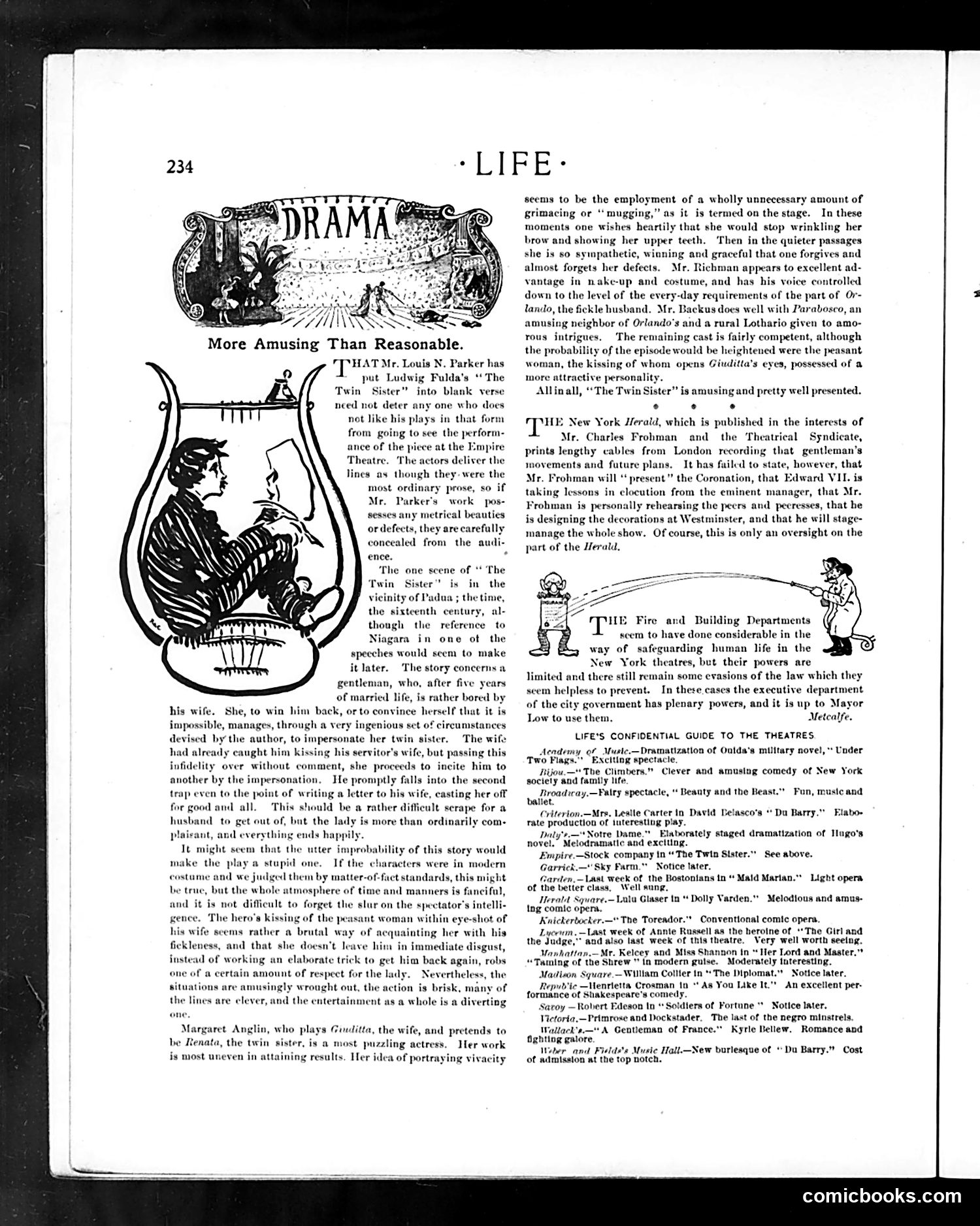
This drama critique reviews a theatrical production of "The Twin Sister," adapted by Louis N. Parker from Ludwig Fulda's play. The cartoon illustrates the central plot: a wife attempts to convince her husband she's actually his twin sister to win back his affections after infidelity. The lyre-framed illustration depicts a woman's profile in classical style, suggesting both theatrical grandeur and the deception at the play's heart. The critic finds the premise absurd but the execution charming, particularly praising actress Margaret Anglin's performance as "Giuditta." The satire targets theatrical conventions of the era—how improbable plots could succeed through skilled acting and spectacle rather than realistic storytelling.
📄 Transcribed text from this page (OCR, searchable)
Machine-transcribed from the original scan — historical spelling and the odd misread are preserved.
‘LIFE: Win Sie More Amusing Than Reasonable. THAT Me. Louis N. Parker has put Ludwig Fulda’s “The Twin Sister” into blank verse need not deter any one who does not like his plays in that form from going to see the perform- ance of the piece at the Empire Theatre. ‘The actors del lines as though the er the were the most ordinary prose, so if Mr. Parker's work pos- iy metrical beauties or defects, they are carefully concealed from the audi- ence. = The one scene of “ The Twin Sister” is in the vieinity of Padua ; the time, the sixteenth century, al- though the reference to Niagara in one ot the specches would seem to make it later. ‘The story concerns a gentleman, who, after five years of married life, is rather bored by his wife. She, to win him back, orto convince herself that it is impossible, manages, through a very ingenious set of circumstances devised by’ the author, to impersonate her twin sister, The wife caught him kissing his servitor's wife, but passing this y over without comment, she proceeds to incite him to another by the impersonation. He promptly falls into the second trap even to the point of writing a letter to his wife, casting her off for good and all. This should be a rather difficult serape for a husband to get out of, but the lady is more than ordinarily com- plaisant, and everything ends happily. It might scem that the utter improbability of this story would make the play a stupid one, If the characters were in modern costume and we judged them by matter-of-fact standards, this might 1 manners is fanciful, it is not difficult to forget the slur on the spectator’s intelli- gence. The hero's kissing of the peasant woman wit e-shot of his wife seems rather a brutal way of acquainting her with bis fickleness, and that she doesn’t leave hin in immediate disgust, instead of working an elaborate trick to get him back again, robs one of a certain amount of respect for the lady. Nevertheless, the situations are amusingly wrought out, the action is brisk, many of the lines are clever, and the entertainment asa whole is a di on sesses . but the whole atmosphere of time ai Margaret Anglin, who plays Guulitta, the wife, and pretends to be Renata, the vi ing actress. Her work is most uneven in attaining results. Her idea of portraying vivacity sister, is a most yz seems to be the employment of a wholly unnecessary amount of grimacing or “mugging,” as it is termed on the stage. In these moments one wishes heartily that she would stop wrinkling her brow and showing her upper teeth. ‘Then in the quieter passages she is so sympathetic, winning and graceful that one forgives and almost forgets her defects. Mr. Richman appears to excellent ad- vantage in nake-up and costume, and has his voice controlled down to the level of the every-day requirements of the part of Or- tando, the fickle husband. Mr. Backus does well with Parabosco, an amusing neighbor of Orlando's and a rural Lothario given to amo- rous intrigues. ‘The remaining cast is fairly competent, although the probability of the episode would be heightened were the peasant woman, the kissing of whom opens Giuditla’s eyes, possessed of a more attractive personality Allinall, “The Twin Sister” is amusing and pretty well presented. ° ° . Te New York Jerald, which is published in the interests of Mr. Charles Frohman and the Theatrical Syndicate, prints lengthy cables from London recording that’ gentleman's movements and future plans. It has fuiled to state, however, that Mr. Frohman will “ present" the Coronation, that Edward VIL. is taking lessons in elocution from the eminent manager, that Mr. Frohman is personally rehearsing the peers and pecresses, that he is designing the decorations at Westminster, and that he will stage- manage the whole show. Of course, this is only an oversight on the part of the Herald. HE Fire and Building Departments seem to have done considerable in the way of safeguarding human life in the New York theatres, but their powers are limited and there still remain some evasions of the law which th seem helpless to prevent. In these. cases the executive department of the city government has plenary powers, and it is up to Mayor Low to use them, Metcals LIFE’S CONFIDENTIAL GUIDE TO THE THEATRES Academy of Muste.—Dramatization of Ontda’s military novel, * Under Two Flags.” Exciting spectacle. Rijou.—" The Climbers.” Clever and amusing comedy of New York soctely and family life. a froadicay.—Palry spectacle, “ Deanty and the Heast."” Fun, muste and et. Criterion.—Mre. Leaite Carter In David Delasco’s * Da Barry.” rate production of tuteresting play. Daly's —*Notte Dame." Elaborately staged dramatization of Hugo's novel. Melodramatic and exciting. Empire.—Stock company in “The Twin Sister.” See Garrick.—" Sky Farm." Notice tater, Carden,—Last week of the Bostontans in “ Maid Marian." of the better class, Well aung, Herald Square.— Lulu Glaser tn “ Dolly Varden." Melodious and amus- tng comic opera. Knickertocker.—" The Toreador.” Conventional comtc opera. Lycenm.—Last week of Annte Russell as the heroine of “The Girl and the Judge,” and also last week of this theatre. Very well worth seeing. Vanhatian.—Mr. Kelcey and Miss Shannon tn “Her Lord and Master."* “Tatuing of the Shrew " in modern guise. Moderately tnteresting. Madivon Square.—William Colter in “The Diplomat." Notice later. Repudtic —Menrletta Crosman 1n ** As You Like It." An excetlent per- formance of Shakespeare's comedy. Saroy —Robert Edeson In “Soldiers of Fortune * Notice later. Victoria,—Primrose and Dockstader, The last of the negro minstrels Wallack's—" A Gentleman of France.” Kyrle Rellew. Romance and Aghting galore. Weber and Fistds's Music Hall.—New burlesque of © Du Barry.” Cost of admisslon at the top notch. Flabo- above. Light opera comicbooks.com